Results by title
234 books match the query 'Families' and 32 start with a
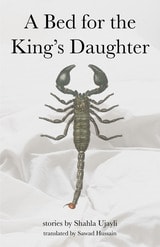
A Bed for the King's Daughter
Stories by Shahla Ujayli; translated by Sawad Hussain
University of Texas Press, 2020
A groundbreaking collection of experimental short fiction by award-winning Syrian author and Booker International Prize for Arabic Fiction nominee Shahla Ujayli, A Bed for the King’s Daughter uses surrealism and irony to examine such themes as women’s agency, the decline of collective life and imagination under modernity, and the effects of social and political corruption on daily life. In “The Memoir of Cinderella’s Shoes,” Cinderella uses her famous glass slipper as a weapon in order to take justice into her own hands. In “Tell Me About Surrealism,” an art history professor’s writing assignment reveals the slipperiness of storytelling, and in “Merry Christmas,” the realities of apartheid interfere with one family’s celebration. Through twenty-two short stories, Ujayli animates—with brevity and inventiveness—themes relevant to both the particularities of life in the Arab world and life outside it.
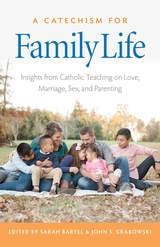
A Catechism for Family Life
Sarah Bartel
Catholic University of America Press, 2018
To address this need, we gathered pertinent questions facing men, women, and pastoral workers in marriage and family life. We then found passages relevant to these questions by researching Church documents on marriage and family from the past one hundred years. These include papal encyclicals, apostolic exhortations, and addresses, Vatican II documents, and the Catechism of the Catholic Church.
Mainstream media coverage of Church events and Church teaching leads many to misunderstand Catholic positions on marriage and family life. While the Catholic Church has developed a rich, detailed, and positive teaching on marriage, family, and sexuality, many Catholics do not have access to this teaching, buried as it is in lengthy Church documents which many find intimidating. Finding the relevant teaching to address specific questions is not always a simple task, either. This book’s main contribution is to present Church teaching relevant to marriage and family in one volume clearly organized by topic and question.
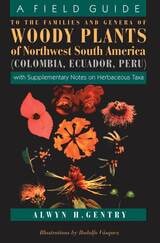
A Field Guide to the Families and Genera of Woody Plants of Northwest South America
With Supplementary Notes on Herbaceous TaxaAlwyn H. Gentry llustrated by Rodolfo Vasquez
University of Chicago Press, 1993
As a consummate field researcher, Gentry designed this guide to be not just comprehensive, but also easy to use in rigorous field conditions. Unlike many field guides, which rely for their identifications on flowers and fruits that are only present during certain seasons, Gentry's book focuses on characters such as bark, leaves, and odor that are present year-round. His guide is filled with clear illustrations, step-by-step keys to identification, and a wealth of previously unpublished data.
All biologists, wildlife managers, conservationists, and government officials concerned with the tropical rain forests will need and use this field guide.
Alwyn Gentry was one of the world's foremost experts on the biology of tropical plants. He was senior curator at the Missouri Botanical Garden, and was a member of Conservation International's interdisciplinary Rapid Assessment Program (RAP) team, which inventories the biodiversity of the most threatened tropical areas. From 1967 to 1993 he collected more than 80,000 plant specimens, many of them new to science.
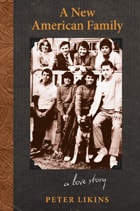
A New American Family
A Love StoryPeter Likins
University of Arizona Press, 2011
This poignant but ultimately empowering memoir tells the story of Peter Likins, his wife Patricia, and the six children they adopted in the 1960s, building a family beset by challenges that ultimately strengthened all bonds. With issues such as inter-racial adoption, mental illness, drug addiction, unwed pregnancy, and homosexuality entwined in their lives, the Likins’ tale isn’t just a family memoir—it’s a story of the American experience, a memoir with a message. With circumstances of race, age, and health making all of their children virtually unadoptable by 1960s standards, Pat and Pete never strayed from the belief that loyalty and love could build a strong family.
Both Pete and Pat have served as teachers. and Pete’s long academic career—holding positions as a professor, dean, provost, and then president—illuminates more than just his personal success. Pete’s professional attainments produce a context for his family story, wherein high achievements in educational, athletic, and financial terms coexist with the joys and sorrows of this exceptional family.
A frank, open account of the difficulties his family faced, this is a brave story, told with unflinching honesty and remarkable compassion. A New American Family is a wonderful narrative of the genesis of a family and a journey to the deepest parts of a father’s heart.
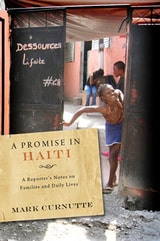
A Promise in Haiti
A Reporter's Notes on Families and Daily LivesMark Curnutte
Vanderbilt University Press, 2011
A Promise in Haiti is Curnutte's story of his time, spanning the last decade, living among several families in Gonaives, a city of 200,000 people a hundred kilometers north of Port-au-Prince. He began traveling to Haiti as a volunteer with the aid organization Hands Together, eventually building trust and credibility with many Haitians. Curnutte introduces the reader to the Cenecharles family, strained by entrenched unemployment and the need to continually travel for work. He is invited into the home of the Henrisma family, and is forced to reconcile journalistic detachment with basic compassion as he contributes financially to help them. The reader is confronted with a complicated, conflicted written and photographic record of a worldview that evolves right on the page. As a reporter, Curnutte found parallels between the lives he encountered in Gonaives and the world of the Great Depression recounted in James Agee and Walker Evans's Let Us Now Praise Famous Men. Agee and Evans loom large as a challenge and inspiration to Curnutte.
The result is equal parts homage to that historic chronicle, on-the-ground reporting, and introspective narrative on the lessons Gonaives taught Curnutte about his own life and family. In late February 2010, Curnutte went back to Haiti on assignment, but conditions made it impossible for him to return to Gonaives. The resulting frustration provoked a meditation on the monumental challenges that face Haiti -- and on the destructive cycle of international attention that constantly moves on to "The Next Big Story."

A Round of Golf with My Father
The New Psychology of Exploring Your Past to Make Peace with Your PresentDamon, William
Templeton Press, 2021
Viewing our past through the eyes of maturity can reveal insights that our younger selves could not see. Lessons that eluded us become apparent. Encounters that once felt like misfortunes now become understood as valued parts of who we are. We realize what we’ve learned and what we have to teach. And we’re encouraged to chart a future that is rich with purpose.
In A Round of Golf with My Father, William Damon introduces us to the “life review.” This is a process of looking with clarity and curiosity at the paths we’ve traveled, examining our pasts in a frank yet positive manner, and using what we’ve learned to write purposeful next chapters for our lives.
For Damon, that process began by uncovering the mysterious life of his father, whom he never met and never gave much thought to. What he discovered surprised him so greatly that he was moved to reassess the events of his own life, including the choices he made, the relationships he forged, and the career he pursued.
Early in his life, Damon was led to believe that his father had been killed in World War II. But the man survived and went on to live a second life abroad. He married a French ballerina, started a new family, and forged a significant Foreign Service career. He also was an excellent golfer, a bittersweet revelation for Damon, who wishes that his father had been around to teach him the game.
We follow Damon as he struggles to make sense of his father’s contradictions and how his father, even though living a world apart, influenced Damon’s own development in crucial ways. In his life review, Damon uses what he learned about his father to enhance his own newly emerging self-knowledge.
Readers of this book may come away inspired to conduct informal life reviews for themselves. By uncovering and assembling the often overlooked puzzle pieces of their pasts, readers can seek present-day contentment and look with growing optimism to the years ahead.
A Travel Guide To Basque America
Families, Feasts, and Festivals, 2nd EditionNancy Zubiri
University of Nevada Press, 2006
A Travel Guide to Basque America—the first-ever guide to America’s Basque-American communities, their history, culture, and festivals—has been a best-seller since it first appeared in 1998. This new edition lists dozens of new restaurants, Basque cultural clubs and cultural events, and hundreds of Basque-related Internet sites that have appeared since 1998. It also includes new information about recent events in the Basque Country, their impact on Basque-Americans, and new cultural and community efforts to preserve Basque culture in America. This is the essential guide for Basque-Americans seeking links to their ancient culture and its homeland and their counterparts in the U.S., as well as for any traveler interested in exploring one of this country’s most vibrant and fascinating ethnic minorities.
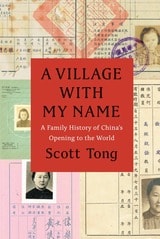
A Village with My Name
A Family History of China's Opening to the WorldScott Tong
University of Chicago Press, 2017
A Village with My Name offers a unique perspective on the transitions in China through the eyes of regular people who have witnessed such epochal events as the toppling of the Qing monarchy, Japan’s occupation during World War II, exile of political prisoners to forced labor camps, mass death and famine during the Great Leap Forward, market reforms under Deng Xiaoping, and the dawn of the One Child Policy. Tong’s story focuses on five members of his family, who each offer a specific window on a changing country: a rare American-educated girl born in the closing days of the Qing Dynasty, a pioneer exchange student, an abandoned toddler from World War II who later rides the wave of China’s global export boom, a young professional climbing the ladder at a multinational company, and an orphan (the author’s daughter) adopted in the middle of a baby-selling scandal fueled by foreign money. Through their stories, Tong shows us China anew, visiting former prison labor camps on the Tibetan plateau and rural outposts along the Yangtze, exploring the Shanghai of the 1930s, and touring factories across the mainland.
With curiosity and sensitivity, Tong explores the moments that have shaped China and its people, offering a compelling and deeply personal take on how China became what it is today.
Abandoned Families
Social Isolation in the Twenty-First CenturyKristin S. Seefeldt
Russell Sage Foundation, 2016
Vasquez-Tokos finds that their experiences in childhood, adolescence, and young adulthood shape their perceptions of race, which in turn influence their romantic expectations. Most Latinos marry other Latinos, but those who intermarry tend to marry whites. She finds that some Latina women who had domineering fathers assumed that most Latino men shared this trait and gravitated toward white men who differed from their fathers. Other Latina respondents who married white men fused ideas of race and class and perceived whites as higher status and considered themselves to be “marrying up.” Latinos who married non-Latino minorities—African Americans, Asian Americans, and Native Americans—often sought out non-white partners because they shared similar experiences of racial marginalization. Latinos who married Latinos of a different national origin expressed a desire for shared cultural commonalities with their partners, but—like those who married whites—often associated their own national-origin groups with oppressive gender roles.
Vasquez-Tokos also investigates how racial and cultural identities are maintained or altered for the respondents’ children. Within Latino-white marriages, biculturalism—in contrast with Latinos adopting a white “American” identity—is likely to emerge. For instance, white women who married Latino men often embraced aspects of Latino culture and passed it along to their children. Yet, for these children, upholding Latino cultural ties depended on their proximity to other Latinos, particularly extended family members. Both location and family relationships shape how parents and children from interracial families understand themselves culturally.
As interracial marriages become more common, Marriage Vows and Racial Choices shows how race, gender, and class influence our marital choices and personal lives.

Abolition Archives, Feminist Futures
Kathi Weeks
Duke University Press, 2026
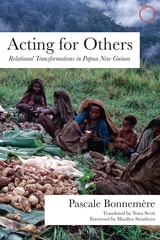
Acting for Others
Relational Transformations in Papua New GuineaPascale Bonnemère
HAU, 2018
At the heart of Pascale Bonnemère’s argument is the idea that it is possible for genders to act for and upon one another, and to do so almost paradoxically, by limiting action through the obeying of taboos and other restrictions. With this first English translation by acclaimed French translator Nora Scott, accompanied by a foreword from Marilyn Strathern, Acting for Others brings the Ankave ritual world to new theoretical life, challenging how we think about mutual action, mutual being, and mutual life.
Adoptive Families in a Diverse Society
Wegar, Katarina
Rutgers University Press, 2006
In recent years, different family types have begun demanding recognition to an unprecedented extent. Despite notable changes to our cultural and academic landscapes, however, adoptive families remain overlooked. According to census data, about two and a half percent of children in the United States are adopted. But mere numbers do not begin to indicate the profound impact that these families have on cultural definitions of kinship.
Adoptive Families in a Diverse Society brings together twenty-one prominent scholars to explore the experience, practice, and policy of adoption in North America. While much existing literature tends to stress the potential problems inherent in non-biological kinship, the essays in this volume consider adoptive family life in a broad and balanced context.
Essays explore our current fascination with genetics, showing how our intense belief that we are produced, shaped, and controlled by our genes has affected the authenticity and value that we credit to adoptive parent/child relations. Other essays look at identity development, community attitudes toward adoption, gay adoptive fathers’ experiences, the ways in which single mother adoptive families create kinship, and the ways in which cultural assumptions about race and class operate in the system.
Bringing new perspectives to the topics of kinship, identity, and belonging, this path-breaking book expands more than our understandings of adoptive family life; it urges us to rethink the limits and possibilities of diversity and assimilation in American society.
After Tears
Niq Mhlongo
Ohio University Press, 2011
Against Art
(The Notebooks)Tomas Espedal
Seagull Books, 2010
In contemporary Norwegian fiction Tomas Espedal’s work stands out as uniquely personal; it can be difficult to separate the fiction from Espedal’s own experiences. In that vein, his novel Against Art is not just the story of a boy growing up to be a writer, but it is also the story of writing. Specifically, it is about the profession of writing—the routines, responsibility, and obstacles. Yet, Against Art is also about being a father, a son, and a grandson; about a family and a family’s tales, and about how preceding generations mark their successors. It is at once about choices and changes, about motion and rest, about moving to a new place, and about living.
All Coyote's Children
Bette Lynch Husted
Oregon State University Press, 2018
Still fragile, a bereft Annie returns to the ranch, where she is befriended by Leona, a Umatilla-Cayuse neighbor. Leona, as it turns out, has a long connection to the family that even Jack never knew about. At the time of his disappearance, Jack had been grappling with his family’s legacy—with the conflicts and consequences of white settlement of native ground. Three generations before he was born, the family ranch was taken from the Umatilla reservation through the Allotment Act. Jack’s mother died when he was six, but his father’s stern presence still cast a shadow on the land.
“Survival is hard sometimes,” Leona says, but with her help, Annie is able to bring Riley home from rehab and begin the work of healing their small family, learning, season by season, how to go on living without Jack. Leona, Riley’s friends Alex and Mattie, and old neighbors Gus and Audrey become a larger family for Annie as they share the stories that connect them—long-silenced stories from both cultures that could solve the mystery of Jack’s disappearance.
In prose that is lyrical and clear-eyed, All Coyote’s Children weaves an unforgettable tale of cultures and families caught in the inescapable web of who they are and what they have inherited.
All That Rises
A NovelAlma García
University of Arizona Press, 2023
What follows is a story in which mysteries are unraveled, odd alliances are forged, and the boundaries between lives blur in destiny-changing ways—all in a place where the physical border between two countries is as palpable as it is porous, and the legacies of history are never far away. There are no easy solutions to the issues the characters face in this story, and their various realities—as undocumented workers, Border Patrol agents, the American supervisor of a Mexican factory employing an impoverished workforce—never play out against a black-and-white moral canvas. Instead, they are complex human beings with sometimes messy lives who struggle to create a place for themselves in a part of the world like no other, even as they are forced to confront the lives they have made.
All That Rises is about secrets, lies, border politics, and discovering where you belong—within a family, as well as in the world beyond. It is a novel for the times we live in, set in a place many people know only from the news.
All Together Now
American Holiday Symbolism Among Children and AdultsCindy Dell Clark
Rutgers University Press, 2019
The decorations, songs, special ways of dressing, and rituals carry deep significance that is viscerally felt by even young tots. Ritual has the capacity to condense a plethora of meaning into a unified metaphor such as a Christmas tree, a menorah, or the American flag. These symbols allow children and adults to co-opt the meaning of symbols in flexible and age-relevant ways, all while the symbols are still treasured and shared in common.
All in the Family
Childhood and Fictive Kinship in Roman SocietyGaia Gianni
University of Michigan Press, 2025
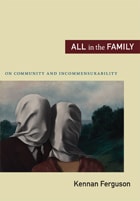
All in the Family
On Community and IncommensurabilityKennan Ferguson
Duke University Press, 2012
By closely observing the attachments that arise in families despite profound disagreements and incommensurabilities, Ferguson argues, we can imagine a political engagement that accommodates radical differences without sacrificing community. After examining how the concept of the family has been deployed and misused in political philosophy, Ferguson turns to the ways in which families actually operate: the macropolitical significance of family coping strategies such as silence and the impact that disability and caregiving have on conceptions of spatiality, sameness, and disparity. He also considers the emotional attachment between humans and their pets as an acknowledgment that compassion and community can exist even under conditions of profound difference.

All that We Ask of You Is to Always Be Happy
Bridget Bell
CavanKerry Press, 2025
Maternal mental illness is an ongoing health crisis and deserves awareness, not only in the medical world but in the poetry world, too. Bridget Bell’s All that We Ask of You Is to Always Be Happy offers support to current mothers, mothers-to-be, family members of people suffering from perinatal mental illnesses, OB-GYNs, nurses, and any other healthcare providers. Bell uses various poetic forms to shed light on the challenges that come with motherhood, including the physical and emotional challenges of childbirth while celebrating the beauty of women’s strength and resilience. Written with deep care and fearlessness, Bell’s debut collection is both an educational tool and a powerful component of recovery in that shares others’ similar stories.
America's Children
Resources from Family, Government, and the EconomyDonald J. Hernandez
Russell Sage Foundation, 1993
American Families Past and Present
Social Perspectives on TransformationsRoss, Susan
Rutgers University Press, 2006
American families today are noted for their wide variety of guises. Among the mix are single-parent families, childless-by-choice marriages, nuclear families, multigenerational families, and same-sex couples. Although this diversity has come under the scrutiny of everyone from politicians to the media, family diversity is not a recent development of contemporary culture. While nuclear families with a mother, a father, and children are the presumed historical norm, people have always resided in an assortment of family formations.
Bringing together essays by twenty-one distinguished scholars who have helped shape the field of family sociology in the last decade, this interdisciplinary anthology examines variation within family experience, especially as it has evolved across racial, ethnic, social, gender, and generational lines. The essays place historical and institutional frameworks at the center of the discussion.
The first part of the book focuses on the development of socially constructed dominant ideologies, demographic shifts in family composition, and historical perspectives on family rituals and mythmaking. Essays in the second part provide a historical perspective on the interdependence between the family as a social institution and other institutions. Selections highlight changes in women’s roles, the impact of economic, racial, and social inequalities on household labor and child care, the effects of war and military service, and the implications of the political climate for family welfare policy.
In-depth chapter introductions along with critical questions to spark class discussion make this an ideal text for courses focusing on family composition, trends, and controversies in the United States.
American Families and Households
James A. Sweet
Russell Sage Foundation, 1987
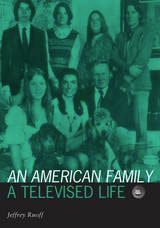
American Family
A Televised LifeJeffrey Ruoff
University of Minnesota Press, 2001
The first in-depth look at this pioneering "reality TV" documentary.
Before 1973, the Loud family of Santa Barbara, California, lived in the privacy of their own home. With the airing of the documentary An American Family, that "privacy" extended to every American home with a television-and there was no going back to the happy land of Beaver, Donna Reed, and Father Knows Best. This book is the first to offer a close, sustained look at An American Family-the documentary that blurred conventions, stirred passions among viewers and reviewers, revised impressions of family life and definitions of private and public, and began the breakdown of distinctions between reality and spectacle that culminated in cultural phenomena from The Oprah Winfrey Show to Survivor.
While placing Craig Gilbert’s innovative series in the context of 1970s nonfiction film and television, Jeffrey Ruoff tells the story behind An American Family from conception to broadcast, from reception to long-term impact. He reintroduces us to the Louds as intimate details of their daily lives, from one child’s dance recital to another’s gay lifestyle to the parents’ divorce proceedings, unfold first before the camera and then before American viewers, challenging audiences to think seriously about family, marital relations, sexuality, affluence, and the American dream. In the documentary’s immediate impact-on both producers and viewers of media-Ruoff uncovers the roots of new nonfiction forms including confessional talk shows like Oprah, first-person documentary films like Ross McElwee’s acclaimed Sherman’s March, and reality TV programs such as The Real World, Survivor, and Big Brother. A comprehensive production and reception study, Ruoff’s work restores An American Family to its rightful, pioneering place in the history of American television.Visible Evidence Series, volume 11
American Kinship
A Cultural AccountDavid M. Schneider
University of Chicago Press, 1980
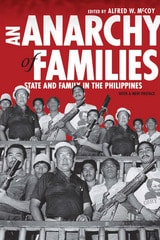
An Anarchy of Families
State and Family in the PhilippinesAlfred W. McCoy
University of Wisconsin Press, 2009
Edited by Alfred W. McCoy, An Anarchy of Families explores the pervasive influence of the modern dynasties that have led the Philippines during the past century. Exemplified by the Osmeñas and Lopezes, elite Filipino families have formed a powerful oligarchy—controlling capital, dominating national politics, and often owning the media. Beyond Manila, strong men such as Ramon Durano, Ali Dimaporo, and Justiniano Montano have used “guns, goons, and gold” to accumulate wealth and power in far-flung islands and provinces. In a new preface for this revised edition, the editor shows how this pattern of oligarchic control has continued into the twenty-first century, despite dramatic socio-economic change that has supplanted the classic “three g’s” of Philippine politics with the contemporary “four c’s”—continuity, Chinese, criminality, and celebrity.

And Justice for All
Families & the Criminal Justice System: Groves Monographs on Marriage and Family (Volume 4)Tessa le Roux
Michigan Publishing Services, 0
Groves Monographs on Marriage and Family is an edited book series based on the annual meetings of the Groves Conference on Marriage and Family, an interdisciplinary, interprofessional organization of limited invited membership founded in 1934. Groves Monographs publishes work on the leading edges of theory development and empirical research in the field of family studies. Individual volumes are edited by the chairs of the annual Groves Conferences and include peer-reviewed chapters by the conference presenters and invited authors. Topics are timely and provocative with diverse themes.
And They Lived Happily Ever After
Norms and Everyday Practices of Family and Parenthood in Russia and Eastern EuropeHelene Carlback
Central European University Press, 2012
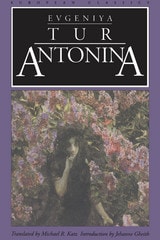
Antonina
Evgeniya Tur
Northwestern University Press, 1995

Arcadio
William Goyen
Northwestern University Press, 1994
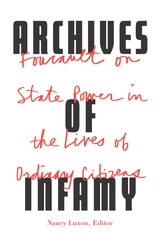
Archives of Infamy
Foucault on State Power in the Lives of Ordinary CitizensNancy Luxon
University of Minnesota Press, 2019
Expanding the insights of Arlette Farge and Michel Foucault’s Disorderly Families into policing, public order, (in)justice, and daily life
What might it mean for ordinary people to intervene in the circulation of power between police and the streets, sovereigns and their subjects? How did the police come to understand themselves as responsible for the circulation of people as much as things—and to separate law and justice from the maintenance of a newly emergent civil order? These are among the many questions addressed in the interpretive essays in Archives of Infamy.
Crisscrossing the Atlantic to bring together unpublished radio broadcasts, book reviews, and essays by historians, geographers, and political theorists, Archives of Infamy provides historical and archival contexts to the recent translation of Disorderly Families by Arlette Farge and Michel Foucault. This volume includes new translations of key texts, including a radio address Foucault gave in 1983 that explains the writing process for Disorderly Families; two essays by Foucault not readily available in English; and a previously untranslated essay by Farge that describes how historians have appropriated Foucault.
Archives of Infamy pushes past old debates between philosophers and historians to offer a new perspective on the crystallization of ideas—of the family, gender relations, and political power—into social relationships and the regimes of power they engender.
Contributors: Roger Chartier, Collège de France; Stuart Elden, U of Warwick; Arlette Farge, Centre national de recherche scientifique; Michel Foucault (1926–1984); Jean-Philippe Guinle, Catholic Institute of Paris; Michel Heurteaux; Pierre Nora, École des Hautes Études en Sciences Sociales; Michael Rey (1953–1993); Thomas Scott-Railton; Elizabeth Wingrove, U of Michigan.
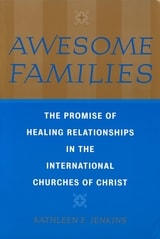
Awesome Families
The Promise of Healing Relationships in the International Churches of ChristKathleen Jenkins
Rutgers University Press, 2005
Denounced by some as a dangerous cult and lauded by others as a miraculous faith community, the International Churches of Christ was a conservative evangelical Christian movement that grew rapidly in the 1980s and 1990s.
Among its followers, promises to heal family relationships were central to the group's appeal. Members credit the church for helping them develop so-called "awesome families"-successful marriages and satisfying relationships with children, family of origin, and new church "brothers and sisters." The church engaged an elaborate array of services, including round-the-clock counseling, childcare, and Christian dating networks-all of which were said to lead to fulfilling relationships and exciting sex lives. Before the unified movement's demise in 2003-2004, the lure of blissful family-life led more than 100,000 individuals worldwide to be baptized into the church.
In Awesome Families, Kathleen Jenkins draws on four years of ethnographic research to explain how and why so many individuals-primarily from middle- to upper-middle-class backgrounds-were attracted to this religious group that was founded on principles of enforced community, explicit authoritative relationships, and therapeutic ideals. Weaving classical and contemporary social theory, she argues that members were commonly attracted to the structure and practice of family relationships advocated by the church, especially in the context of contemporary society where gender roles and family responsibilities are often ambiguous.
Tracing the rise and fall of this fast-growing religious movement, this timely study adds to our understanding of modern society and offers insight to the difficulties that revivalist movements have in sustaining growth.