Results by title
174 books match the query 'Indigenous peoples' and 17 start with a
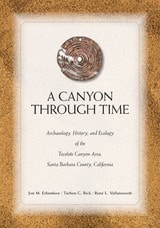
A Canyon through Time
Archaeology, History, and Ecology of the Tecolote Canyon Area, Santa Barbara County, CaliforniaJon M Erlandson
University of Utah Press, 2008
Known by the Chumash Indians as Hel’apunitse (guitar fish), the canyon was a major nexus of Chumash village life from about 2000 to 500 years ago. After the arrival of Europeans, the canyon passed from Chumash hands through successive Spanish, Mexican, and American administrations.
In A Canyon through Time, the authors summarize the deep history of this beautiful canyon, which serves as a fascinating history in microcosm of the California coastal region. Using data from archaeology, ecology, geology, geography, and history, they weave an interdisciplinary tale of the natural and human prehistory and history of the Tecolote Canyon area.
A Deeper Sense of Place
Stories and Journeys of Collaboration in Indigenous ResearchJay T. Johnson and Soren C. Larsen
Oregon State University Press, 2013
These first-person narratives offer insight into the challenges faced by Native and non-Native scholars to their academic and personal approaches during research with Indigenous communities. By addressing the ethical, political, intellectual, and practical meanings of collaboration with Indigenous peoples, A Deeper Sense of Place highlights the ways in which collaborative research can help Indigenous and settler communities find common ground through a shared commitment to land, people, and place.
A Deeper Sense of Place will inform students and academics engaged in research with Indigenous communities, as well as those interested in the challenges of employing critical, qualitative methodologies.

A Land Not Forgotten
Indigenous Food Security and Land-Based Practices in Northern OntarioMichael A. Robidoux
University of Manitoba Press, 2017
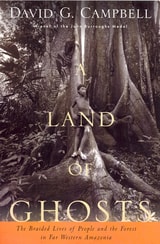
A Land of Ghosts
The Braided Lives of People and the Forest in Far Western AmazoniaCampbell, David G
Rutgers University Press, 2007
For thirty years David G. Campbell has explored the Amazon, an enchanting terrain of forest and river that is home to the greatest diversity of plants and animals to have ever existed, anywhere at any time, during the four-billion-year history of life on Earth.
With great artistic flair, Campbell describes a journey up the Rio Moa, a remote tributary of the Amazon River, 2,800 miles from its mouth. Here he joins three old friends: Arito, a caiman hunter turned paleontologist; Tarzan, a street urchin brought up in a bordello; and Pimentel, a master canoe pilot. They travel together deep into the rainforest and set up camp in order to survey every woody plant on a two-hectare plot of land with about as many tree species as in all of North America.
Campbell introduces us to two remarkable women, Dona Cabocla, a widow who raised six children on that lonely frontier, and Dona Ausira, a Nokini Native American who is the last speaker of her tribe's ages-old language. These pioneers live in a land whose original inhabitants were wiped out by centuries of disease, slavery, and genocide, taking their traditions and languages with them. He explores the intimate relationship between the extinction of native language and the extirpation of biological diversity. "It's hard for a people to love a place that is not defined in words and thus cannot be understood. And it's easy to give away something for which there are no words, something you never knew existed."
In elegant prose that enchants and entrances, Campbell has written an elegy for the Amazon forest and its peoples-for what has become a land of ghosts.
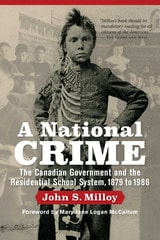
A National Crime
The Canadian Government and the Residential School System 2nd editionJohn S. Milloy
University of Manitoba Press, 2017

A World You Do Not Know
Settler Societies, Indigenous Peoples and the Attack on Cultural DiversityColin Samson
University of London Press, 2014

A World of Many Worlds
Marisol de la Cadena and Mario Blaser, editors
Duke University Press, 2018
Contributors. Mario Blaser, Alberto Corsín Jiménez, Déborah Danowski, Marisol de la Cadena, John Law, Marianne Lien, Isabelle Stengers, Marilyn Strathern, Helen Verran, Eduardo Viveiros de Castro
Abiayalan Pluriverses
Bridging Indigenous Studies and Hispanic StudiesGloria E. Chacon
Amherst College Press, 2024
Acoustic Colonialism
Acts of Mapuche InterferenceLuis E. Cárcamo-Huechante
Duke University Press, 2025
Animals and the Maya in Southeast Mexico
E. N. Anderson and Felix Medina Tzuc
University of Arizona Press, 2005
This book combines the insights of an anthropologist with the hands-on experience of a Maya campesino with the aim of improving the management of Quintana Roo’s wild lands and animal resources. E. N. Anderson and Felix Medina Tzuc pool their knowledge to document Yucatec Maya understanding and use of animals and to address practical matters related to wider conservation issues.
The book reflects a wealth of knowledge gathered from individuals regarded as experts on particular aspects of animal management, whether hunting, herding, or beekeeping. It also offers case studies of conservation successes and failures in various communities, pointing to the need for cooperation by the Mexican government and Maya people to save wildlife. Appendixes provide an extensive animal classification and a complete list of all birds identified in the area.
Even though sustainable forestry has finally come to the Yucatán, sustainable game use is practiced by only a few communities. Animals and the Maya in Southeast Mexico is a complete ethnozoology for the region, offered in the hope that it will encourage the recognition of Quintana Roo’s forests and wildlife as no less deserving of protection than ancient Maya cities.
Anthropologies of Guayana
Cultural Spaces in Northeastern AmazoniaEdited by Neil L. Whitehead and Stephanie Alemán
University of Arizona Press, 2009
This is an important collection that brings together the work of scholars from North America, South America, and Europe to reveal the anthropological significance of Guayana, the ancient realm of El Dorado and still the scene of gold and diamond mining. Beginning with the earliest civilizations of the region, the chapters focus on the historical ecology of the rain forest and the archaeological record up to the sixteenth century, as well as ethnography, ethnology, and perceptions of space. The book features extensive discussions of the history of a range of indigenous groups, such as the Waiwai, Trio, Wajãpi, and Palikur. Contributions analyze the emergence of a postcolonial national society, the contrasts between the coastlands and upland regions, and the significance of race and violence in contemporary politics.
A noteworthy study of the prehistory and history of the region, the book also provides a useful survey of the current issues facing northeastern Amazonia. The chapters extend the anthropological agenda beyond the conventional focus on the “indigenous” even as contributors describe how Guayanese languages, mythologies, and social structures have remained resilient in the face of intense outside pressures.
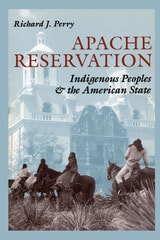
Apache Reservation
Indigenous Peoples and the American StateBy Richard J. Perry
University of Texas Press, 1993
"Indian reservations" were the United States' ultimate solution to the "problem" of what to do with native peoples who already occupied the western lands that Anglo settlers wanted. In this broadly inclusive study, Richard J. Perry considers the historical development of the reservation system and its contemporary relationship to the American state, with comparisons to similar phenomena in Canada, Australia, and South Africa.
The San Carlos Apache Reservation of Arizona provides the lens through which Perry views reservation issues. One of the oldest and largest reservations, its location in a minerals- and metals-rich area has often brought it into conflict with powerful private and governmental interests. Indeed, Perry argues that the reservation system is best understood in terms of competition for resources among interest groups through time within the hegemony of the state. He asserts that full control over their resources—and hence, over their lives—would address many of the Apache's contemporary economic problems.
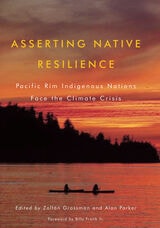
Asserting Native Resilience
Pacific Rim Indigenous Nations Face the Climate CrisisEdited by Zoltán Grossman and Alan Parker
Oregon State University Press, 2012
Native American tribes in the Pacific Northwest and Indigenous peoples around the Pacific Rim have already been deeply affected by droughts, flooding, reduced glaciers and snowmelts, seasonal shifts in winds and storms, and the northward movement of species on the land and in the ocean. Using tools of resilience, Native peoples are creating defenses to strengthen their communities, mitigate losses, and adapt where possible.
Asserting Native Resilience presents a rich variety of perspectives on Indigenous responses to the climate crisis, reflecting the voices of more than twenty contributors, including tribal leaders, scientists, scholars, and activists from the Pacific Northwest, British Columbia, Alaska, and Aotearoa / New Zealand, and beyond. Also included is a resource directory of Indigenous governments, NGOs, and communities and a community organizing booklet for use by Northwest tribes.
At the Risk of Being Heard
Identity, Indigenous Rights, and Postcolonial StatesBartholomew Dean and Jerome M. Levi, Editors
University of Michigan Press, 2003
Combining rich ethnographic descriptions with clear theoretical analyses, At the Risk of Being Heard considers the paradoxical challenges and opportunities confronting indigenous peoples at the dawn of the twenty-first century. In the face of state-sanctioned violence, indigenous peoples encounter considerable risks when asserting their rights, especially to self-determination. Yet, if they remain silent or absent from new arenas of power, hiding in marginalized homelands or cultural practices, they risk being invisible to those allies that would aid them in their struggles for survival.
At the Risk of Being Heard offers needed insights for individuals working on issues of governance, sustainable development, resource management, globalization, and indigenous affairs. It will undoubtedly appeal to undergraduate and graduate students in anthropology, sociology, history, political science, peace studies, and to those students in courses that explore relationships among postcolonial states, indigenous peoples, and human rights.
Bartholomew Dean is Assistant Professor of Anthropology, University of Kansas. Jerome M. Levi is Associate Professor of Anthropology, Carleton College.
Authorized Heritage
Place, Memory, and Historic Sites in Prairie CanadaRobert Coutts
University of Manitoba Press, 2021
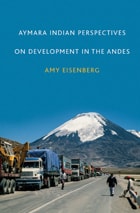
Aymara Indian Perspectives on Development in the Andes
Amy Eisenberg
University of Alabama Press, 2013
Aymara Indians are a geographically isolated, indigenous people living in the Andes Mountains near Chile’s Atacama Desert, one of the most arid regions of the world. As rapid economic growth in the area has begun to divert scarce water to hydroelectric and agricultural projects, the Aymara struggle to maintain their sustainable and traditional systems of water use, agriculture, and pastoralism.
In Aymara Indian Perspectives on Development in the Andes, Amy Eisenberg provides a detailed exploration of the ethnoecological dimensions of the tension between the Aymara, whose economic, spiritual, and social life are inextricably tied to land and water, and three major challenges: the paving of Chile Highway 11, the diversion of the Altiplano waters of the Río Lauca for irrigation and power-generation, and Chilean national park policies regarding Aymara communities, their natural resources, and cultural properties within Parque Nacional Lauca, the International Biosphere Reserve.
Pursuing collaborative research, Eisenberg performed ethnographic interviews with Aymara people in more than sixteen Andean villages, some at altitudes of 4,600 meters. Drawing upon botany, agriculture, natural history, physical and cultural geography, history, archaeology, and social and environmental impact assessment, she presents deep, multifaceted insights from the Aymara’s point of view.
Illustrated with maps and dramatic photographs by John Amato, Aymara Indian Perspectives on Development in the Andes provides an account of indigenous perspectives and concerns related to economic development that will be invaluable to scholars and policy-makers in the fields of natural and cultural resource preservation in and beyond Chile.
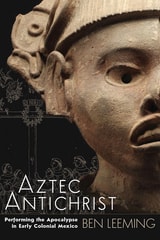
Aztec Antichrist
Performing the Apocalypse in Early Colonial MexicoBen Leeming
University Press of Colorado, 2022
Discovered in the archives of the Hispanic Society of America in New York inside a notebook of miscellaneous Nahuatl-Christian texts written almost entirely by an Indigenous writer named Fabían de Aquino, the plays are filled with references to human sacrifice, bloodletting, ritual divination, and other religious practices declared “idolatrous” at a time when ecclesiastical authorities actively sought to suppress writing about Indigenous religion. These are Indigenous plays for an Indigenous audience that reveal how Nahuas made sense of Christianity and helped form its colonial image—the title figure is a powerful Indigenous being, an “Aztec Antichrist,” who violently opposes the evangelizing efforts of the church and seeks to draw converted Nahuas back to the religious practices of their ancestors. These practices include devotion to Nahua deities such as Tlaloc, Quetzalcoatl, and Tezcatlipoca who, in one of the most striking moves made by Aquino, are cast as characters in the plays.
Along with the translations, Leeming provides context and analysis highlighting these rare and fascinating examples of early Indigenous American literature that offer a window into the complexity of Nahua interactions with Christianity in the early colonial period. The work is extremely valuable to all students and scholars of Latin American religion, colonialism, Indigenous history, and early modern history and theater.