Results by title
2194 books match the query 'Women's Studies' and 141 start with a
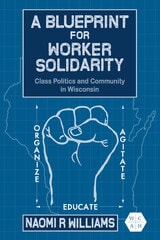
A Blueprint for Worker Solidarity
Class Politics and Community in WisconsinNaomi R Williams
University of Illinois Press, 2025
Naomi R Williams traces the journeys of two local activists to highlight how people can support democracy and economic freedom in the twenty-first century. In Racine, ideas of class and race shifted but remained strong. The broad-based class politics that emerged drew on racial analysis, vigilant organizing, and agile labor leadership that organized more people. Unionized workers in turn won political power while uniting to resist conservative and corporate attacks. Charting Racine’s transition, Williams breaks down how worker solidarity persevered and presents lessons that can provide valuable guidance for today’s generation of activists.
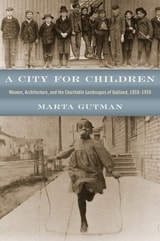
A City for Children
Women, Architecture, and the Charitable Landscapes of Oakland, 1850-1950Marta Gutman
University of Chicago Press, 2014
In A City for Children, Marta Gutman focuses on the use and adaptive reuse of everyday buildings in Oakland, California, to make the city a better place for children. She introduces us to the women who were determined to mitigate the burdens placed on working-class families by an indifferent industrial capitalist economy. Often without the financial means to build from scratch, women did not tend to conceive of urban land as a blank slate to be wiped clean for development. Instead, Gutman shows how, over and over, women turned private houses in Oakland into orphanages, kindergartens, settlement houses, and day care centers, and in the process built the charitable landscape—a network of places that was critical for the betterment of children, families, and public life. The industrial landscape of Oakland, riddled with the effects of social inequalities and racial prejudices, is not a neutral backdrop in Gutman’s story but an active player. Spanning one hundred years of history, A City for Children provides a compelling model for building urban institutions and demonstrates that children, women, charity, and incremental construction, renovations, alterations, additions, and repurposed structures are central to the understanding of modern cities.
A Colonial Lexicon
Of Birth Ritual, Medicalization, and Mobility in the CongoNancy Rose Hunt
Duke University Press, 1999
Relying on archival research in England and Belgium, as well as fieldwork in the Congo, Hunt reconstructs an ethnographic history of a remote British Baptist mission struggling to survive under the successive regimes of King Leopold II’s Congo Free State, the hyper-hygienic, pronatalist Belgian Congo, and Mobutu’s Zaire. After exploring the roots of social reproduction in rituals of manhood, she shows how the arrival of the fast and modern ushered in novel productions of gender, seen equally in the forced labor of road construction and the medicalization of childbirth. Hunt focuses on a specifically interwar modernity, where the speed of airplanes and bicycles correlated with a new, mobile medicine aimed at curbing epidemics and enumerating colonial subjects. Fascinating stories about imperial masculinities, Christmas rituals, evangelical humor, colonial terror, and European cannibalism demonstrate that everyday life in the mission, on plantations, and under a strongly Catholic colonial state was never quite what it seemed. In a world where everyone was living in translation, privileged access to new objects and technologies allowed a class of “colonial middle figures”—particularly teachers, nurses, and midwives—to mediate the evolving hybridity of Congolese society. Successfully blurring conventional distinctions between precolonial, colonial, and postcolonial situations, Hunt moves on to discuss the unexpected presence of colonial fragments in the vibrant world of today’s postcolonial Africa.
With its close attention to semiotics as well as sociology, A Colonial Lexicon will interest specialists in anthropology, African history, obstetrics and gynecology, medical history, religion, and women’s and cultural studies.
A Decade of Negative Thinking
Essays on Art, Politics, and Daily LifeMira Schor
Duke University Press, 2009
In essays such as “The ism that dare not speak its name,” “Generation 2.5,” “Like a Veneer,” “Modest Painting,” “Blurring Richter,” and “Trite Tropes, Clichés, or the Persistence of Styles,” Schor considers how artists relate to and represent the past and how the art market influences their choices: whether or not to disavow a social movement, to explicitly compare their work to that of a canonical artist, or to take up an exhausted style. She places her writings in the rich transitory space between the near past and the “nextmodern.” Witty, brave, rigorous, and heartfelt, Schor’s essays are impassioned reflections on art, politics, and criticism.
A Democratic Theory of Judgment
Linda M. G. Zerilli
University of Chicago Press, 2016
Zerilli deftly outlines the limitations of existing debates, both those that concern themselves with the impossibility of judging across cultures and those that try to find transcendental, rational values to anchor judgment. Looking at Kant through the lens of Arendt, Zerilli develops the notion of a public conception of truth, and from there she explores relativism, historicism, and universalism as they shape feminist approaches to judgment. Following Arendt even further, Zerilli arrives at a hopeful new pathway—seeing the collapse of philosophical criteria for judgment not as a problem but a way to practice judgment anew as a world-building activity of democratic citizens. The result is an astonishing theoretical argument that travels through—and goes beyond—some of the most important political thought of the modern period.

A Desire for Women
Relational Psychoanalysis, Writing, and Relationships between WomenJuhasz, Suzanne
Rutgers University Press, 2003
Uniquely weaving together psychoanalytic, feminist, queer, and literary theory as well as memoir to examine the value and meaning of relationships between women, Juhasz explores the writings of adult daughters, mothers, and lovers to consider how language both traces and shapes the contours of experience. She emphasizes the initial bond between mother and infant as the bedrock of identity formation, a process involving love, recognition, desire, and language, and shows how that relationship serves as source and model for all future loves.
Juhasz's lucid prose unravels the meaningful yet overlooked intricacies of the relationships that inflect much of women's writing in the twentieth century.
A Feminist Ethnomusicology
Writings on Music and GenderEllen Koskoff
University of Illinois Press, 2014
In this intellectual memoir, Koskoff describes her journey through the maze of social history and scholarship related to her work examining the intersection of music and gender. Koskoff collects new, revised, and hard-to-find published material from mid-1970s through 2010 to trace the evolution of ethnomusicological thinking about women, gender, and music, offering a perspective of how questions emerged and changed in those years, as well as Koskoff's reassessment of the early years and development of the field. Her goal: a personal map of the different paths to understanding she took over the decades, and how each inspired, informed, and clarified her scholarship. For example, Koskoff shows how a preference for face-to-face interactions with living people served her best in her research, and how her now-classic work within Brooklyn's Hasidic community inflamed her feminist consciousness while leading her into ethnomusicological studies.
An uncommon merging of retrospective and rumination, A Feminist Ethnomusicology: Writings on Music and Gender offers a witty and disarmingly frank tour through the formative decades of the field and will be of interest to ethnomusicologists, anthropologists, scholars of the history and development of feminist thought, and those engaged in fieldwork.
Includes a foreword by Suzanne Cusick framing Koskoff's career and an extensive bibliography provided by the author.
A Feminist Perspective in the Academy
The Difference It MakesEdited by Elizabeth Langland and Walter Gove
University of Chicago Press, 1983
In the essays collected here, nine distinguished scholars provide an overview of the differences the feminist perspective makes—and could make—in scholarship in the humanities and social sciences. Carefully documented and judiciously critical, these essays inform the reader about developments in feminist scholarship in literary criticism, the performing arts, religion, history, political science, economics, anthropology, psychology, and sociology. The authors point out achievements of lasting value and indicate how these might become an integral part of the various disciplines.
A Feminist Reading of Debt
Luci Cavallero
Pluto Press, 2021
***Winner of an English PEN Award 2021***
In this sharp intervention, authors Lucí Cavallero and Verónica Gago defiantly develop a feminist understanding of debt, showing its impact on women and members of the LGBTQ+ community and examining the relationship between debt and social reproduction.
Exploring the link between financial activity and the rise of conservative forces in Latin America, the book demonstrates that debt is intimately linked to gendered violence and patriarchal notions of the family. Yet, rather than seeing these forces as insurmountable, the authors also show ways in which debt can be resisted, drawing on concrete experiences and practices from Latin America and around the world.
Featuring interviews with women in Argentina and Brazil, the book reveals the real-life impact of debt and how it falls mainly on the shoulders of women, from the household to the wider effects of national debt and austerity. However, through discussions around experiences of work, prisons, domestic labour, agriculture, family, abortion and housing, a narrative of resistance emerges.
Translated by Liz Mason-Deese.

A Feminist Reading of Debt
Luci Cavallero
Pluto Press, 2021
***Winner of an English PEN Award 2021***
"Of great value to those interested in the financialisation of everyday life and social reproduction."—LSE Review of Books
In this sharp evaluation and call to action, authors Lucí Cavallero and Verónica Gago defiantly develop a feminist understanding of debt, showing its impact on women and members of the LGBTQ+ community and examining the relationship between debt and social reproduction.
Exploring the link between financial activity and the rise of conservative forces in Latin America, the book demonstrates that debt is intimately linked to gendered violence and patriarchal notions of the family. Yet, rather than seeing these forces as insurmountable, the authors also show ways in which debt can be resisted, drawing on concrete experiences and practices from Latin America and around the world. Chapters include:
*Debt and Social Reproduction
*Debt as a “Counter-revolution” of Everyday Life
*The writing on the Body of Women
*Neither Victims not Entrepreneurs
*Feminist Insubordination and Fascist Neoliberalism
*The Patriarchy Has My Missing Contributions
*Hunger and Gender Mandates
*Us Against Debt
The authors state in their Introduction, “Our investigations and activism show that there is an urgent need to develop a specifically feminist analysis of finance. Here we do so by bringing together methodological elements, political hypotheses, and narratives of practices elaborated by the feminist movement that are challenging finance.”
Featuring interviews with women in Argentina and Brazil, the book reveals the real-life impact of debt and how it falls mainly on the shoulders of women, from the household to the wider effects of national debt and austerity. However, through discussions around experiences of work, prisons, domestic labor, agriculture, family, abortion and housing, a narrative of resistance emerges.

A Great Big Girl Like Me
The Films of Marie DresslerVictoria Sturtevant
University of Illinois Press, 2008
This premier analysis of her body of work explores how Dressler refocused the generic frame of her films beyond the shallow problems of the rich and beautiful, instead dignifying the marginalized, the elderly, women, and the poor. Sturtevant inteprets the meanings of Dressler's body through different genres, venues, and historical periods by looking at her vaudeville career, her transgressive representation of an "unruly" yet sexual body in Emma and Christopher Bean, ideas of the body politic in the films Politics and Prosperity, and Dressler as a mythic body in Min and Bill and Tugboat Annie.
A Home in the West
Or, Emigration and Its ConsequencesRockwell, M. Emilia
University of Iowa Press, 2005
A House Is Not a Home
Polly Adler
University of Massachusetts Press, 2006
Polly Adler's “house”—the brothel that gave this best-selling 1953 autobiography its title—was a major site of New York City underworld activity from the 1920s through the 1940s. Adler's notorious Lexington Avenue house of prostitution functioned as a sort of social club for New York's gangsters and a variety of other celebrities, including Robert Benchley and his friend Dorothy Parker. According to one New York tabloid, it made Adler's name “synonymous with sin.”
This new edition of Adler's autobiography brings back into print a book that was a mass phenomenon, in both hardback and paperback, when it was first published. A self-consciously literary work, A House Is Not a Home provides an informal social history of immigrant mobility, prostitution, Jewish life in New York, police dishonesty, the “white slavery” scare of the early twentieth century, and political corruption.
Adler's story fills an important gap in the history of immigrant life, urban experience, and organized crime in New York City. While most other accounts of the New York underworld focus on the lives of men, from Herbert Asbury's Gangs of New York through more recent works on Jewish and Italian gangsters, this book brings women's lives and problems to the forefront.
A House Is Not a Home is compellingly readable and was popular enough to draw Hollywood's attention in the early 1960s—leading to a film starring Shelley Winters as Adler. The book has been largely forgotten in the ensuing decades, lost both to its initial audience of general readers and to scholars in women's studies, immigration history, and autobiography who are likely to find it a treasure trove. Now, with a new introduction by Rachel Rubin that contextualizes Adler's life and literary achievement, A House Is Not a Home is again available to the many readers who have come to understand such “marginal” life stories as a special refraction of the more typical American success narrative.
A Jewish Feminine Mystique?
Jewish Women in Postwar AmericaEdited by Hasia R. Diner, Shira Kohn, and Rachel Kranson
Rutgers University Press, 2010
As workers with or without pay, social justice activists, community builders, entertainers, and businesswomen, most Jewish women championed responsibilities outside their homes. Jewishness played a role in shaping their choices, shattering Friedan's assumptions about how middle-class women lived in the postwar years. Focusing on ordinary Jewish women as well as prominent figures such as Judy Holliday, Jennie Grossinger, and Herman Wouk's fictional Marjorie Morningstar, leading scholars explore the wide canvas upon which American Jewish women made their mark after the Second World War.
A Jewish Woman of Distinction
The Life and Diaries of Zinaida PoliakovaChaeRan Y. Freeze
Brandeis University Press, 2019
For more than seventy-five years, Poliakova kept detailed diaries of her world, giving us a rare look into the exclusive world of Jewish elites in Moscow and St. Petersburg. These rare documents reveal how Jews successfully integrated into Russian aristocratic society through their intimate friendships and patronage of the arts and philanthropy. And they did it all without converting—in fact, while staunchly demonstrating their Jewishness.
Poliakova’s life was marked by her dual identity as a Russian and a Jew. She cultivated aristocratic sensibilities and lived an extraordinarily lifestyle, and yet she was limited by the confessional laws of the empire and religious laws that governed her household. She brought her Russian tastes, habits, and sociability to France following her marriage to Reuben Gubbay (the grandson of Sir Albert Abdullah Sassoon). And she had to face the loss of almost all her family members and friends during the Holocaust.
Women’s voices are often lost in the sweep of history, and so A Jewish Women of Distinction is an exceptional, much-needed collection. These newly discovered primary sources will change the way we understand the full breadth of the Russian Jewish experience.

A Jumble of Needs
Women’s Activism and Neoliberalism in the Colonias of the SouthwestRebecca Dolhinow
University of Minnesota Press, 2010
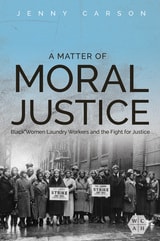
A Matter of Moral Justice
Black Women Laundry Workers and the Fight for JusticeJenny Carson
University of Illinois Press, 2021
Like thousands of African American women, Charlotte Adelmond and Dollie Robinson worked in New York’s power laundry industry in the 1930s. Jenny Carson tells the story of how substandard working conditions, racial and gender discrimination, and poor pay drove them to help unionize the city’s laundry workers. Laundry work opened a door for African American women to enter industry, and their numbers allowed women like Adelmond and Robinson to join the vanguard of a successful unionization effort. But an affiliation with the powerful Congress of Industrial Organizations (CIO) transformed the union from a radical, community-based institution into a bureaucratic organization led by men. It also launched a difficult battle to secure economic and social justice for the mostly women and people of color in the plants. As Carson shows, this local struggle highlighted how race and gender shaped worker conditions, labor organizing, and union politics across the country in the twentieth century.
Meticulous and engaging, A Matter of Moral Justice examines the role of African American and radical women activists and their collisions with labor organizing and union politics.
A Mother's Tale
Phillip Lopate
The Ohio State University Press, 2017
In 1984, Phillip Lopate sat down with his mother, Frances, to listen to her life story. A strong, resilient, indomitable woman who lived through the major events of the twentieth century, she was orphaned in childhood, ran away and married young, and then reinvented herself as a mother, war factory worker, candy store owner, community organizer, clerk, actress, and singer. But paired with exciting anecdotes are the criticisms of the husband who couldn’t satisfy her, the details of numerous affairs and sexual encounters, and, though she succeeded at many of her roles, accounts of how she always felt mistreated, taken advantage of. After the interviews, at a loss for what to do with the tapes, Lopate put them away. But thirty years later, after his mother had passed away, Lopate found himself drawn back to the recordings of this conversation. Thus begins a three-way conversation between a mother, his younger self, and the person he is today.
Trying to break open the family myths, rationalizations, and self-deceptions, A Mother’s Tale is about family members who love each other but who can’t seem to overcome their mutual mistrust. Though Phillip is sympathizing to a point, he cannot join her in her operatic displays of self-pity and how she blames his father for everything that went wrong. His detached, ironic character has been formed partly in response to her melodramatic one. The climax is an argument in which he tries to persuade her—using logic, of all things—that he really does love her, but is only partially successful, of course.
A Mother’s Tale is about something primal and universal: the relationship between a mother and her child, the parent disappointed with the payback, the child, now fully grown, judgmental. The humor is in the details.
A Narrative Compass
Stories that Guide Women's LivesEdited by Betsy Hearne and Roberta Seelinger Trites
University of Illinois Press, 2008
Each of us has a narrative compass, a story that has guided our lifework. In this extraordinary collection, women scholars from a variety of disciplines identify and examine the stories that have inspired them, haunted them, and shaped their research, from Little House on the Prairie to Little Women, from the fairy tales of Hans Christian Andersen and Alice's Adventures in Wonderland to Nancy Drew, Mary Jane, and even the Chinese memoir Jottings from the Transcendant's Abode at Mt. Youtai. Telling the "story of her story" leads each of the essayists to insights about her own approach to studying narratives and to a deeper, often surprising, understanding of the power of imagination.
Contributors are Deyonne Bryant, Minjie Chen, Cindy L. Christiansen, Beverly Lyon Clark, Karen Coats, Wendy Doniger, Bonnie Glass-Coffin, Betsy Hearne, Joanna Hearne, Ann Hendricks, Rania Huntington, Christine Jenkins, Kimberly Lau, Pamela Riney-Kehrberg, Maria Tatar, Ebony Elizabeth Thomas, Roberta Seelinger Trites, Claudia Quintero Ulloa, and Ofelia Zepeda.
A Nation of Family and Friends?
Sport and the Leisure Cultures of British Asian Girls and WomenAarti Ratna
Rutgers University Press, 2024
Ratna also examines two key cultural objects - the popular films "Bend it Like Beckham" and “Dhan Dhana Dhan Goal” - to examine in detail the gendered representation of South Asian soccer players’ engagement in amateur and elite levels of the sport. She critiques studies of women’s football fandom and sport that fail to acknowledge social differences relating to race, class, age, disability, and sexuality. By linking the social forces (across time and space) that differentially affect their sporting choices and leisure lifestyles, Ratna portrays the women of the South Asian diaspora as active agents in the shaping of their life courses and as skilled navigators of the complexities affecting their own identities. Ultimately Ratna examines the intersections of class, caste, age, generation, gender, and sexuality, to provide a rich and critical exploration of British Asian women's sport and leisure choices, pleasures, and lived realities.
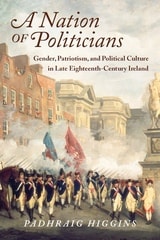
A Nation of Politicians
Gender, Patriotism, and Political Culture in Late Eighteenth-Century IrelandPadhraig Higgins
University of Wisconsin Press, 2009
In A Nation of Politicians, Padhraig Higgins argues that the development of Volunteer-initiated activities—associating, petitioning, subscribing, shopping, and attending celebrations—expanded the scope of political participation. Using a wide range of literary, archival, and visual sources, Higgins examines how ubiquitous forms of communication—sermons, songs and ballads, handbills, toasts, graffiti, theater, rumors, and gossip—encouraged ordinary Irish citizens to engage in the politics of a more inclusive society and consider the broader questions of civil liberties and the British Empire. A Nation of Politicians presents a fascinating tale of the beginnings of Ireland’s richly vocal political tradition at this important intersection of cultural, intellectual, social, and public history.
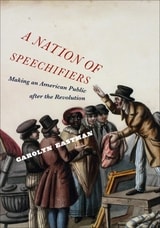
A Nation of Speechifiers
Making an American Public after the RevolutionCarolyn Eastman
University of Chicago Press, 2009
In the decades after the American Revolution, inhabitants of the United States began to shape a new national identity. Telling the story of this messy yet formative process, Carolyn Eastman argues that ordinary men and women gave meaning to American nationhood and national belonging by first learning to imagine themselves as members of a shared public.
She reveals that the creation of this American public—which only gradually developed nationalistic qualities—took place as men and women engaged with oratory and print media not only as readers and listeners but also as writers and speakers. Eastman paints vibrant portraits of the arenas where this engagement played out, from the schools that instructed children in elocution to the debating societies, newspapers, and presses through which different groups jostled to define themselves—sometimes against each other. Demonstrating the previously unrecognized extent to which nonelites participated in the formation of our ideas about politics, manners, and gender and race relations, A Nation of Speechifiers provides an unparalleled genealogy of early American identity.
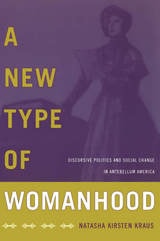
A New Type of Womanhood
Discursive Politics and Social Change in Antebellum AmericaNatasha Kirsten Kraus
Duke University Press, 2008
Enabling Kraus’s retelling of the 1850s woman’s rights movement is her theory of “structural aporias,” which takes the institutional structures of any particular society as fully imbricated with the force of language. Kraus reads the antebellum relations of womanhood, contract, property, the economy, and the nation as a fruitful site for analysis of the interconnected power of language, culture, and the law. She combines poststructural theory, particularly deconstructive approaches to discourse analysis; the political economic history of the antebellum era; and the interpretation of archival documents, including woman’s rights speeches, petitions, pamphlets, and convention proceedings, as well as state legislative debates, reports, and constitutional convention proceedings. Arguing that her method provides critical insight not only into social movements and cultural changes of the past but also of the present and future, Kraus concludes A New Type of Womanhood by considering the implications of her theory for contemporary feminist and queer politics.
A Plot of Her Own
The Female Protagonist in Russian LiteratureSona Stephan Hoisington
Northwestern University Press, 1995
A Poetics of Resistance
Women Writing in El Salvador, South Africa, and the United StatesMary DeShazer
University of Michigan Press, 1994
Engaging the works of critics such as Chandra Mohanty, Barbara Harlow, Claribel Alegria, Albie Sachs, and Audre Lorde, among others, Mary DeShazer reconceptualizes traditional notions of resistance and literature and the relationship between them. She argues that women’s voices have been underrepresented in previous analyses of Third World resistance poetry, and that when examined collectively, their work reveals overtly gendered concerns that distinguish it from that of their male counterparts.
DeShazer defines resistance as an active quest for justice and a means of collective empowerment. She looks at the diasporic consciousness of exiled and dislocated women, examines the tensions between claims of identity and claims of difference, and explores the ways in which gender and struggle connect women across nationalities and historical imperatives. Her analysis of Salvadoran and South African women’s poetry reveal the ways in which poetic conventions can be seen as “political declarations of privilege,” casting a new light on women’s resistance poetry in the United States.
A Primer for Teaching Women, Gender, and Sexuality in World History
Ten Design PrinciplesMerry E. Wiesner-Hanks and Urmi Engineer Willoughby
Duke University Press, 2018

A Private State
StoriesCharlotte Bacon
University of Massachusetts Press, 1998
Here is a finely crafted collection of stories about women who have arrived at awkward edges in their lives. Some are adolescents, some at the brink of old age, and some find themselves suddenly ill or pregnant. Others come to the abrupt discovery that their marriages are not as whole as they had believed, while a few tumble onto startling secrets. But despite their range in age and situation, they all try to use their new knowledge to stitch together a fresh pattern by which to live.
While most of the action unfolds along the East Coast—in Maryland, Maine, Boston, Philadelphia, New York—several of the women travel to Arizona, California, and Jamaica. Often the light is too bright in these glittery places and they wonder why they have come. Many seem to be searching for a sense of home, which one girl describes as a place that is “complete and full of longing all at once.”
Yet this desire for a personal territory, a point of constancy, is not necessarily rewarded: in this book, separations lead to divorce, sisters continue to misread each other, cancers kill. Still, the women refuse to turn their gaze away from what the world has thrown in their path. Often as not, they pick it up, wonder at it, test its relevance, and continue on, not happier perhaps, but certainly more knowing.
With humor and insight, Charlotte Bacon illuminates the unexpected ambiguities of women's lives. A Private State marks the arrival of an extremely talented writer.
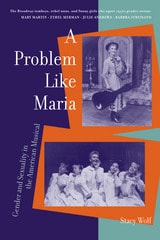
A Problem Like Maria
Gender and Sexuality in the American MusicalStacy Wolf
University of Michigan Press, 2002
Chapter by chapter, the book analyzes the stars' best-known and best-loved roles, including Martin as Nellie in South Pacific, Merman as Momma Rose in GypsyAndrews as Eliza in My Fair Lady and Guinevere in Camelot, and Streisand as Fanny Brice in Funny Girl. The final chapter scrutinizes the Broadway and film versions of The Sound of Music, illuminating its place in the hearts of lesbian spectators and the "delicious queerness" of Andrews's troublesome nun. As the first feminist and lesbian study of the American Broadway musical, A Problem Like Maria is a groundbreaking contribution to feminist studies, queer studies, and American studies and a delight for fans of musical theater.
Stacy Wolf is Associate Professor of Theatre and Dance, University of Texas, Austin.
A Queen Mother Defiant
Irene Drusilla Namaganda and the Remaking of Power and Gender in Colonial UgandaNakanyike B. Musisi
University of Wisconsin Press, 2026
In 1941, Irene Drusilla Namaganda, the reigning queen mother of British-occupied Buganda, shocked the kingdom when she revealed she was six months pregnant—only fifteen months after the king’s death. The father of her child, a schoolteacher nearly two decades her junior, quickly became the focal point for a scandal that engulfed the monarchy. The ensuing political crisis led to Namaganda’s removal from the office of queen mother (Nnamasole) and her companion’s exile, spurring her own departure.
Drawing from extensive archival research and in-depth oral interviews, this long-awaited biography analyzes Namaganda’s roles as wife, mother, widow, and prominent yet controversial cultural-political icon. Nakanyike Musisi moves beyond the scandal to explore how the monarch’s character and personal choices defied expectations of royal women and redefined motherhood, power, and tradition. She challenges dominant narratives in African political history and gender studies to show how African women navigated competing systems of authority and in doing so reshaped both the institution of monarchy and broader cultural and historical landscapes.
A Question of Sex
Feminism, Rhetoric, and Differences That MatterKristan Poirot
University of Massachusetts Press, 2014
Poirot focuses on five case studies—the circulation of Sojourner Truth's "Ain't I a Woman?" in early and contemporary feminist contexts; the visual rhetorics of the feminist self-help health movement; the public discourse of Elizabeth Cady Stanton and early nineteenth-century ideas about suffrage, sex, and race; the conflicts over lesbian sexuality in the 1960s and 1970s; and the discourse that surrounds twenty-first-century SlutWalks. In the process, Poirot rethinks the terms through which we understand U.S. feminist movements to explore the ways feminism has questioned sexed distinctions and practices over time. She emphasizes the importance of reading feminist engagements with sex as rhetorical endeavors—practices that are shaped by the instrumental demands of movements, the exigent situations that call for feminists to respond, and the enduring philosophical traditions that circulate in U.S. political contexts., reviewing a previous edition or volume

A Rule for Children and Other Writings
Jacqueline Pascal
University of Chicago Press, 2003
This book presents selections from the whole of Pascal's career as a writer, including her witty adolescent poetry and her pioneering treatise on the education of women, A Rule for Children, which drew on her experiences as schoolmistress at Port-Royal. Readers will also find Pascal's devotional treatise, which matched each moment in Christ's Passion with a corresponding virtue that his female disciples should cultivate; a transcript of her interrogation by church authorities, in which she defended the controversial theological doctrines taught at Port-Royal; a biographical sketch of her abbess, which presented Pascal's conception of the ideal nun; and a selection of letters offering spirited defenses of Pascal's right to practice her vocation, regardless of patriarchal objections.
A Small-Town Marriage
La Marchesa Colombi, translated from the Italian by Paula Spurlin Paige
Northwestern University Press, 2002
Denza Dellara is a clumsy Cinderella too big for her hand-me-downs, saddled with a family that frustrates her hopes, and in love with a gargantuan Prince Charming who woos and then betrays her. An engaging Frog Prince appears, and though he has an enormous wart on his forehead, he can end her daydreaming and save her from impending spinsterhood . . . if she lets him.
A Spectacular Leap
Black Women Athletes in Twentieth-Century AmericaJennifer H. Lansbury
University of Arkansas Press, 2014
A Stage of Their Own
Feminist Playwrights of the Suffrage EraSheila Stowell
University of Michigan Press, 1994
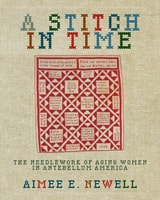
A Stitch in Time
The Needlework of Aging Women in Antebellum AmericaAimee E. Newell
Ohio University Press, 2014
Drawing from 167 examples of decorative needlework—primarily samplers and quilts from 114 collections across the United States—made by individual women aged forty years and over between 1820 and 1860, this exquisitely illustrated book explores how women experienced social and cultural change in antebellum America.
The book is filled with individual examples, stories, and over eighty fine color photographs that illuminate the role that samplers and needlework played in the culture of the time. For example, in October 1852, Amy Fiske (1785–1859) of Sturbridge, Massachusetts, stitched a sampler. But she was not a schoolgirl making a sampler to learn her letters. Instead, as she explained, “The above is what I have taken from my sampler that I wrought when I was nine years old. It was w[rough]t on fine cloth [and] it tattered to pieces. My age at this time is 66 years.”
Situated at the intersection of women’s history, material culture study, and the history of aging, this book brings together objects, diaries, letters, portraits, and prescriptive literature to consider how middle-class American women experienced the aging process. Chapters explore the physical and mental effects of “old age” on antebellum women and their needlework, technological developments related to needlework during the antebellum period and the tensions that arose from the increased mechanization of textile production, and how gift needlework functioned among friends and family members. Far from being solely decorative ornaments or functional household textiles, these samplers and quilts served their own ends. They offered aging women a means of coping, of sharing and of expressing themselves. These “threads of time” provide a valuable and revealing source for the lives of mature antebellum women.
Publication of this book was made possible in part through generous funding from the Coby Foundation, Ltd and from the Quilters Guild of Dallas, Helena Hibbs Endowment Fund.
A Story Larger than My Own
Women Writers Look Back on Their Lives and CareersEdited by Janet Burroway
University of Chicago Press, 2014
Kumin, who went on to win the Pulitzer Prize for poetry, was part of a groundbreaking generation of women writers who came of age during the midcentury feminist movement. By challenging the status quo and ultimately finding success for themselves, they paved the way for future generations of writers. In A Story Larger than My Own, Janet Burroway brings together Kumin, Julia Alvarez, Jane Smiley, Erica Jong, and fifteen other accomplished women of this generation to reflect on their writing lives.
The essays and poems featured in this collection illustrate that even writers who achieve critical and commercial success experience a familiar pattern of highs and lows over the course of their careers. Along with success comes the pressure to sustain it, as well as a constant search for subject matter, all too frequent crises of confidence, the challenges of a changing publishing scene, and the difficulty of combining writing with the ordinary stuff of life—family, marriage, jobs. The contributors, all now over the age of sixty, also confront the effects of aging, with its paradoxical duality of new limitations and newfound freedom.
Taken together, these stories offer advice from experience to writers at all stages of their careers and serve as a collective memoir of a truly remarkable generation of women.
A Stranger in My Own Land
Sofia Casanova, a Spanish Writer in the European Fin de SiecleKirsty Hooper
Vanderbilt University Press, 2008
This study addresses the scandalous disappearance of Casanova and her female contemporaries from accounts of the emergence of the modern Spanish nation. Arguing that women's perceived silence during this critical period in the formation of modern Iberian identities has significant repercussions even today, it takes her works as a case study for modeling a radical rethinking of the way we teach and research the crucial years around the turn of the twentieth century. The first study of Casanova's radical and compelling, but now forgotten, early narrative, it explores the Galician, Polish and Spanish context of her work, arguing that her transnational career demonstrates the inadequacies of existing models of national literary history. At the same time, recognizing Casanova's innovative and strategic use of literary genres and techniques traditionally denominated as "feminine" (and therefore excluded from discussions of "serious" national literature), it provides a model for re-evaluating the vast cultural store of popular and sentimental literature as a key part of the debates about the transition to modernity, in Spain and beyond.
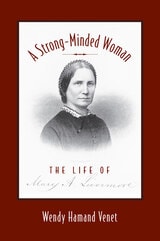
A Strong-Minded Woman
The Life of Mary LivermoreWendy Hamand Venet
University of Massachusetts Press, 2005
When Mary Livermore died in 1905 at age 84, a Boston newspaper praised her as “America's foremost woman.” A leading figure in the struggle for woman's rights as well as in the temperance movement, she was as widely recognized during her lifetime as Susan B. Anthony, and for a time the most popular and highly paid female orator in the country. Yet aside from Civil War historians familiar with her service as a wartime nurse, few today remember even her name.
In this book, Wendy Hamand Venet reconstructs Mary Livermore's remarkable story and explores how and why she became so renowned in her day. Born and raised in Boston, Livermore left home at age eighteen to become the private schoolteacher to a wealthy tobacco planter's children in Virginia, an experience that afforded her an intimate look at slave-based society in the 1840s. Returning to New England, she married and lived a conventional life as the wife of a minister and mother of three daughters. With the coming of the Civil War, however, Livermore's life changed dramatically when she became active with the United States Sanitary Commission, an organization that would propel her into the public limelight and cause her to challenge society's traditional view of the role of women.
After the war Livermore became deeply involved in the woman's rights movement, serving as editor of the newspaper Woman's Journal and later as president of three major suffrage organizations—the American, New England, and Massachusetts Woman Suffrage Associations. She was also founder and president of the Massachusetts Women's Christian Temperance Union, and became active in the Society of Christian Socialists in Boston. Her frequent speaking appearances on behalf of these causes eventually earned her the nickname “Queen of the Platform.” Although she may not have been as radical as some other early feminists, Livermore's ideas resonated with thousands of middle-class women whose experiences paralleled her own. For that reason alone, Venet shows, her life and legacy are worthy of our attention.
A Taste for Brown Sugar
Black Women in PornographyMireille Miller-Young
Duke University Press, 2014
A Time for Tea
Women, Labor, and Post/Colonial Politics on an Indian PlantationPiya Chatterjee
Duke University Press, 2001
Allowing personal, scholarly, and artistic voices to speak in turn and in tandem, Chatterjee discusses the fetishization of women who labor under colonial, postcolonial, and now neofeudal conditions. In telling the overarching story of commodity and empire, A Time for Tea demonstrates that at the heart of these narratives of travel, conquest, and settlement are compelling stories of women workers. While exploring the global and political dimensions of local practices of gendered labor, Chatterjee also reflects on the privileges and paradoxes of her own “decolonization” as a Third World feminist anthropologist. The book concludes with an extended reflection on the cultures of hierarchy, power, and difference in the plantation’s villages. It explores the overlapping processes by which gender, caste, and ethnicity constitute the interlocked patronage system of villages and their fields of labor. The tropes of coercion, consent, and resistance are threaded through the discussion.
A Time for Tea will appeal to anthropologists and historians, South Asianists, and those interested in colonialism, postcolonialism, labor studies, and comparative or international feminism.
Designated a John Hope Franklin Center book by the John Hope Franklin Seminar Group on Race, Religion, and Globalization.
A Touch of Innocence
A Memoir of ChildhoodKatherine Dunham
University of Chicago Press, 1994
In stark prose, she tells of growing up in both black and white households and of the divisions of race and class in Chicago that become the harsh realities of her young life. A riveting narrative of one girl's struggle to transcend the painful confusions of a family and culture in turmoil, Dunham's story is full of the clarity, candor, and intelligence that lifted her above her troubled beginnings.
"A Touch of Innocence is an absorbing family chronicle written with a gift for physical detail sometimes too real for comfort. In quietly graphic prose the growing girl, the slightly older brother, the ambitious father and the kind stepmother are pictured in such human terms that when their lives get tied into harder and harder knots beyond their undoing, one can only continue to read helplessly as doom closes in upon the household."—Langston Hughes, New York Herald Tribune
"A Touch of Innocence is one of the most extraordinary life stories I have ever read . . . . The content of this book is so heartbreaking that only the strongest artistic skills can keep it from leaking out into sobbing self-pity, but Katherine Dunham's art contains it, understands it and refuses to be overwhelmed by its terrors."—Elizabeth Janeway, New York Times
"The first eighteen years of the famous dancer and choreographer's life are brought vividly to the reader in this first volume of her autobiography. She writes of what it is like to be a special, gifted young woman growing up in a racially mixed family in the American Middle West. A beautiful, touching and sometimes discomforting book."—Publishers Weekly
"As writing it is honest, searing, graphic and touching, giving us a rather heartbreaking early view of the young American Negro who was later to make a name for herself as a dancer and choreographer."—Arthur Todd, Saturday Review
A Very Dangerous Woman
Martha Wright and Women's RightsSharon H. Penney
University of Massachusetts Press, 2004
In telling Wright's story, the authors make good use of her lively letters to her family, friends, and colleagues, including Susan B. Anthony and Elizabeth Cady Stanton. These letters reveal Wright's engaging wit and offer an insider's view of nineteenth-century reform and family life. Her correspondence with slaveholding relatives in the South grew increasingly contentious with the approach of the Civil War. One nephew became a hero of the Confederacy with his exploits at the Battle of Fredericksburg, and her son in the Union artillery was seriously wounded at Gettysburg while repelling Pickett's Charge.
Wright's life never lacked for drama. She survived a shipwreck, spent time at a frontier fort, experienced the trauma of the deaths of a fiancé, her first husband, and three of her seven children, and navigated intense conflicts within the women's rights and abolition movements. Throughout her tumultuous career, she drew on a reservoir of humor to promote her ideas and overcome the many challenges she faced. This accessible biography, written with the general reader in mind, does justice to her remarkable life.

A View from Life's Edge
Discovering What Really Matters with Older Women Across the GlobeCorinne G. Dempsey
Rutgers University Press, 2026
Speaking with nearly one hundred women over the age of eighty in four locations—northern Iceland, south India, a retirement community in California, and a convent in upstate New York—Corinne G. Dempsey finds that, as we near life’s end, we gain clarity about what really matters in life. Women’s stories and reflections, in which sorrow and loss are central to a life well lived, help to expand our sense of what it means to be human.
Drawing on the paradoxical wisdom of world religions and mystical traditions to frame late-life tendencies across cultures, Dempsey portrays these accounts as a corrective to mainstream values that defeat and diminish us. Dempsey encourages us to turn away from ageist fears rather than denying life’s inevitable end. Learning from older women’s perspectives, we might move their edge-of-life views closer to the center.
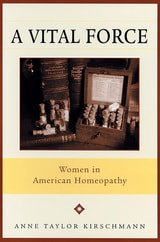
A Vital Force
Women in American HomeopathyKirschmann, Anne Taylor
Rutgers University Press, 2003
Homeopathy, as a medical system, presented a significant institutional and economic challenge to conventional medicine in the nineteenth century. Although contemporary critics portrayed homeopathic physicians as part of a sect whose treatment of disease was beyond the pale of acceptable medical practice, homeopathy was in many ways similar to established medicine. Anne Taylor Kirschmann explores the strategic choices and consequences for women practitioners. Not only were female homeopaths respected within their communities, they also enjoyed considerable professional advantages not available to women within regular medicine.
A Vital Force: Women in American Homeopathy offers a new interpretation of women’s roles in modern medicine. Kirschmann strengthens and clarifies the history of homeopathic women physicians and creates a framework of comparison to “regular,” or orthodox, physicians. Women medical practitioners chose homeopathy in dramatic numbers from the mid-nineteenth through the early twentieth centuries, although the reasons for this preference varied over time. Linked to social reform movements in the nineteenth century, anti-modernism in the late nineteenth and early twentieth, and countercultural ideals of the 1960s and 1970s, women's advocacy of homeopathy has been intertwined with broad social and cultural issues in American society.
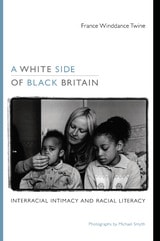
A White Side of Black Britain
Interracial Intimacy and Racial LiteracyFrance Winddance Twine
Duke University Press, 2010
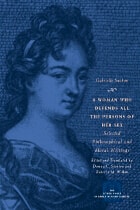
A Woman Who Defends All the Persons of Her Sex
Selected Philosophical and Moral WritingsGabrielle Suchon
University of Chicago Press, 2010
During the oppressive reign of Louis XIV, Gabrielle Suchon (1632–1703) was the most forceful female voice in France, advocating women’s freedom and self-determination, access to knowledge, and assertion of authority. This volume collects Suchon’s writing from two works—Treatise on Ethics and Politics (1693) and On the Celibate Life Freely Chosen; or, Life without Commitments (1700)—and demonstrates her to be an original philosophical and moral thinker and writer.
Suchon argues that both women and men have inherently similar intellectual, corporeal, and spiritual capacities, which entitle them equally to essentially human prerogatives, and she displays her breadth of knowledge as she harnesses evidence from biblical, classical, patristic, and contemporary secular sources to bolster her claim. Forgotten over the centuries, these writings have been gaining increasing attention from feminist historians, students of philosophy, and scholars of seventeenth-century French literature and culture. This translation, from Domna C. Stanton and Rebecca M. Wilkin, marks the first time these works will appear in English.
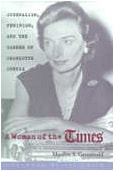
A Woman of the Times
Journalism, Feminism, and the Career of Charlotte CurtisMarilyn S. Greenwald
Ohio University Press, 1999
For twenty-five years, Charlotte Curtis was a society/women's reporter and editor and an op-ed editor at the New York Times. As the first woman section editor at the Times, Curtis was a pioneering journalist and one of the first nationwide to change the nature and content of the women's pages from fluffy wedding announcements and recipes to the more newsy, issue-oriented stories that characterize them today. In this riveting biography, Marilyn Greenwald describes how a woman reporter from Columbus, Ohio, broke into the ranks of the male-dominated upper echelon at the New York Times. It documents what she did to succeed and what she had to sacrifice.
Charlotte Curtis paved the way for the journalists who followed her. A Woman of the Times offers a chronicle of her hard-won journey as she invents her own brand of feminism during the 1960s and 1970s. In the telling of this remarkable woman’s life is the story, as well, of a critical era in the nation’s social history.
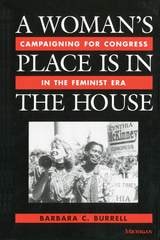
A Woman's Place Is in the House
Campaigning for Congress in the Feminist EraBarbara Burrell
University of Michigan Press, 1994
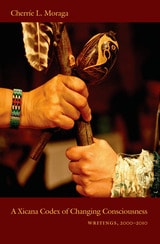
A Xicana Codex of Changing Consciousness
Writings, 2000-2010Cherríe L. Moraga
Duke University Press, 2011
Thirty years after the publication of Anzaldúa and Moraga’s collection This Bridge Called My Back, a landmark of women-of-color feminism, Moraga’s literary and political praxis remains motivated by and intertwined with indigenous spirituality and her identity as Chicana lesbian. Yet aspects of her thinking have changed over time. A Xicana Codex of Changing Consciousness reveals key transformations in Moraga’s thought; the breadth, rigor, and philosophical depth of her work; her views on contemporary debates about citizenship, immigration, and gay marriage; and her deepening involvement in transnational feminist and indigenous activism. It is a major statement from one of our most important public intellectuals.
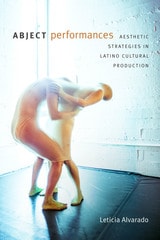
Abject Performances
Aesthetic Strategies in Latino Cultural ProductionLeticia Alvarado
Duke University Press, 2018