Results by title
441 books match the query 'Women and literature' and 36 start with a

A Desire for Women
Relational Psychoanalysis, Writing, and Relationships between WomenJuhasz, Suzanne
Rutgers University Press, 2003
Uniquely weaving together psychoanalytic, feminist, queer, and literary theory as well as memoir to examine the value and meaning of relationships between women, Juhasz explores the writings of adult daughters, mothers, and lovers to consider how language both traces and shapes the contours of experience. She emphasizes the initial bond between mother and infant as the bedrock of identity formation, a process involving love, recognition, desire, and language, and shows how that relationship serves as source and model for all future loves.
Juhasz's lucid prose unravels the meaningful yet overlooked intricacies of the relationships that inflect much of women's writing in the twentieth century.

A Dialogue of Voices
Feminist Literary Theory and BakhtinKaren Hohne and Helen Wussow, Editors
University of Minnesota Press, 1994
A Dialogue of Voices was first published in 1994. Minnesota Archive Editions uses digital technology to make long-unavailable books once again accessible, and are published unaltered from the original University of Minnesota Press editions.
The work of the Russian theorist Mikhail Bakhtin, particularly his notions of dialogics and genre, has had a substantial impact on contemporary critical practices. Until now, however, little attention has been paid to the possibilities and challenges Bakhtin presents to feminist theory, the task taken up in A Dialogue of Voices. The original essays in this book combine feminism and Bakhtin in unique ways and, by interpreting texts through these two lenses, arrive at new theoretical approaches. Together, these essays point to a new direction for feminist theory that originates in Bakhtin-one that would lead to a feminine être rather than a feminine écriture.
Focusing on feminist theorists such as Hélène Cixous, Teresa de Lauretis, Julia Kristeva, and Monique Wittig in conjunction with Bakhtin's concepts of dialogism, heteroglossia, and chronotope, the authors offer close readings of texts from a wide range of multicultural genres, including nature writing, sermon composition, nineteenth-century British women's fiction, the contemporary romance novel, Irish and French lyric poetry, and Latin American film. The result is a unique dialogue in which authors of both sexes, from several countries and different eras, speak against, for, and with one another in ways that reveal their works anew as well as the critical matrices surrounding them.Karen Hohne is an independent scholar and artist living in Moorhead, Minnesota. Helen Wussow is an assistant professor of English at Memphis State University.
A New Species
GENDER AND SCIENCE IN SCIENCE FICTIONRobin Roberts
University of Illinois Press, 1993
A Poet's Truth
Conversations with Latino/Latina PoetsBruce Allen Dick
University of Arizona Press, 2003
As Bruce Dick's insightful questions reveal, the key threads linking these writers are their connections to their families and communities and their concern for civil rights—believing like Chicana writer Pat Mora that "the work of the poet is for the people." The interviews also reveal diversity among and within the three communities, from Victor Hernández Cruz, who traces Latino collective identity to Africa and claims that all Latinos are "swimming in olive oil," to Cuban writer Gustavo Perez Firmat, who considers nationality more important than ethnicity and says that "the term Latino erases [his] nationality."
The dialogues also offer new insights on the place of Chicano/a writings in the U.S.-Mexico borderlands, on the Puerto Rican/Nuyorican establishment, and on the anti-Castro stand of Cuban-born poets. As these writers answer questions about their work, background, ethnic identity, and political ideology, they provide a wealth of biographical, intellectual, and literary material collected here for the first time. A Poet's Truth is a provocative and revealing book that not only conveys the fire of these writers' passions but also sheds important light on a whole literary movement.Interviews with:
Miguel Algarín
Martín Espada
Sandra María Esteves
Victor Hernández Cruz
Carolina Hospital and Carlos Medina
Demetria Martínez
Pat Mora
Judith Ortiz Cofer
Ricardo Pau-Llosa
Gustavo Pérez Firmat
Leroy Quintana
Aleida Rodríguez
Luis Rodríguez
Benjamin Alire Sáenz
Virgil Suárez
A Poetics of Resistance
Women Writing in El Salvador, South Africa, and the United StatesMary DeShazer
University of Michigan Press, 1994
Engaging the works of critics such as Chandra Mohanty, Barbara Harlow, Claribel Alegria, Albie Sachs, and Audre Lorde, among others, Mary DeShazer reconceptualizes traditional notions of resistance and literature and the relationship between them. She argues that women’s voices have been underrepresented in previous analyses of Third World resistance poetry, and that when examined collectively, their work reveals overtly gendered concerns that distinguish it from that of their male counterparts.
DeShazer defines resistance as an active quest for justice and a means of collective empowerment. She looks at the diasporic consciousness of exiled and dislocated women, examines the tensions between claims of identity and claims of difference, and explores the ways in which gender and struggle connect women across nationalities and historical imperatives. Her analysis of Salvadoran and South African women’s poetry reveal the ways in which poetic conventions can be seen as “political declarations of privilege,” casting a new light on women’s resistance poetry in the United States.
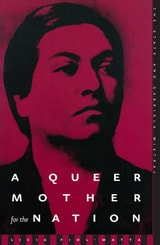
A Queer Mother For The Nation
The State And Gabriela MistralLicia Fiol-Matta
University of Minnesota Press, 2002
Chilean writer Gabriela Mistral (1889-1957), the first Latin American to win theNobel Prize for Literature, was a poetic idol for generations of Latin Americans who viewed her as Womanhood incarnate, the national schoolteacher-mother. How this distinctly masculine woman who never gave birth came to occupy this role, and what Mistral’s image, poetry, and life have to say about the relations-and realities-of race, gender, and sexual politics in her time, are the questions Licia Fiol-Matta pursues in this book, recreating the story of a woman whose misrepresentation is at least as intriguing, and as instructive, as her fame.
A Queer Mother for the Nation weaves a nuanced understanding of how Mistral cooperated with authority and fashioned herself as the figure of Motherhood in collaboration with the state. Drawing on Mistral’s little-known political and social essays, her correspondence and photographs, Fiol-Matta reconstructs Mistral’s relationship to state politics. Her work questions the notion of queer bodies as outlaws, and insists on the many ways in which queer subjects have participated in and sustained the normative discourses they seem to rebel against
A Stage of Their Own
Feminist Playwrights of the Suffrage EraSheila Stowell
University of Michigan Press, 1994
A Tawdry Place of Salvation
The Art of Jane BowlesEdited by Jennie Skerl
Southern Illinois University Press, 1997
Through these essays—which deal with Bowles’s published as well as her unpublished work—Skerl seeks to generate serious critical attention for an important but neglected female experimental writer of the mid-twentieth century and to celebrate her originality, power, and craft.
Based in disciplines and theoretical approaches that range from feminist criticism to Middle Eastern studies, from postmodernism to queer theory, and from Victorianism to the Beat Generation, the essayists naturally approach Bowles’s fiction and drama from a wide variety of critical perspectives. All of these essays are unpublished and written for this volume.
A Very Serious Thing
Women’s Humor and American CultureNancy A. Walker
University of Minnesota Press, 1988
A Very Serious Thing was first published in 1988. Minnesota Archive Editions uses digital technology to make long-unavailable books once again accessible, and are published unaltered from the original University of Minnesota Press editions.
"It is a very serious thing to be a funny woman." –Frances Miriam Berry Whitcher
A Very Serious Thing is the first book-length study of a part of American literature that has been consistently neglected by scholars and underrepresented in anthologies—American women's humorous writing. Nancy Walker proposes that the American humorous tradition to be redefined to include women's humor as well as men's, because, contrary to popular opinion, women do have a sense of humor.
Her book draws on history, sociology, anthropology, literature, and psychology to posit that the reasons for neglect of women's humorous expression are rooted in a male-dominated culture that has officially denied women the freedom and self-confidence essential to the humorist. Rather than a study of individual writers, the book is an exploration of relationships between cultural realities—including expectations of "true womanhood"—and women's humorous response to those realities.
Humorous expression, Walker maintains, is at odds with the culturally sanctioned ideal of the "lady," and much of women's humor seems to accept, while actually denying, this ideal. In fact, most of American women's humorous writing has been a feminist critique of American culture and its attitudes toward women, according to the author.
A Vocabulary of Thinking
Gertrude Stein and Contemporary North American Women's Innnovative WritingDeborah M. Mix
University of Iowa Press, 2007
Arguing that these authors have received relatively little attention because of the difficulty in categorizing them, Mix brings the writing of women of color, lesbians, and collaborative writers into the discussion of experimental writing. Thus, rather than exploring conventional lines of influence, she departs from earlier scholarship by using Stein and her work as a lens through which to read the ways these authors have renegotiated tradition, authority, and innovation.
Building on the tradition of experimental or avant-garde writing in the United States, Mix questions the politics of the canon and literary influence, offers close readings of previously neglected contemporary writers whose work doesn't fit within conventional categories, and by linking genres not typically associated with experimentalism-lyric, epic, and autobiography-challenges ongoing reevaluations of innovative writing.
Abandoned Women and Poetic Tradition
Lawrence Lipking
University of Chicago Press, 1988

Abortion, Choice, and Contemporary Fiction
The Armageddon of the Maternal InstinctJudith Wilt
University of Chicago Press, 1990
In the opening of the book, Wilt discusses real case histories of several women. After studying the ambiguities of their decisions, she turns to their counterpoints depicted in contemporary fiction. Working from a feminist perspective, Wilt traces the theme of maternal choice in works by Margaret Atwood, Margaret Drabble, Joan Didion, Mary Gordon, Alice Walker, Toni Morrison, Gloria Naylor, Marge Piercy, Thomas Keneally, Graham Swift, Ernest Hemingway, William Faulkner, John Barth, John Irving, and others.
Behind the political, medical, and moral debates on abortion, Wilt argues, is a profound psychocultural shock at the recognition that maternity is passing from the domain of instinct to that of conscious choice. Although never wholly instinctual, maternity's potential capture by consciousness raises complex questions. The novels Wilt discusses portray worlds in which principles are endangered by sexual inequality, male power and hidden male fear of abandonment, impotence, female submission, and covert rage, and, in the case of black maternity, the hideous aftermath of slavery.
Wilt provides a resonant new context for debates—whether political or personal—on the issue of abortion and maternal choice. Ultimately she enables us to rethink how we shape our own identities and lives.
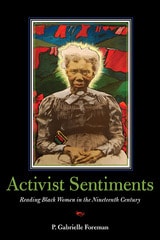
Activist Sentiments
Reading Black Women in the Nineteenth CenturyP. Gabrielle Foreman
University of Illinois Press, 2009
Activist Sentiments takes as its subject women who in fewer than fifty years moved from near literary invisibility to prolific productivity. Grounded in primary research and paying close attention to the historical archive, this book offers against-the-grain readings of the literary and activist work of Harriet Jacobs, Harriet Wilson, Frances E. W. Harper, Victoria Earle Matthews and Amelia E. Johnson.
Part literary criticism and part cultural history, Activist Sentiments examines nineteenth-century social, political, and representational literacies and reading practices. P. Gabrielle Foreman reveals how Black women's complex and confrontational commentary–often expressed directly in their journalistic prose and organizational involvement--emerges in their sentimental, and simultaneously political, literary production.
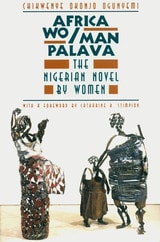
Africa Wo/Man Palava
The Nigerian Novel by WomenChikwenye Okonjo Ogunyemi
University of Chicago Press, 1995
Ogunyemi uses the novels to trace a Nigerian women's literary tradition that reflects an ideology centered on children and community. Of prime importance is the paradoxical Mammywata figure, the independent, childless mother, who serves as a basis for the new woman in these novels. Ogunyemi tracks this figure through many permutations, from matriarch to exile to woman writer, her multiple personalities reflecting competing loyalties—to self and other, children and nation. Such fragmented personalities characterize the postcolonial condition in their writing. Mapping geographies of pain and endurance, the work opens a space for addressing the palava between different groups of people. Valuable as the first sustained critical study of a substantial but little known body of literature, this book also counters the shortcomings of prevailing "masculinist" theories of black literature in a powerful narrative of the Nigerian world.
Afro-Future Females
Black Writers Chart Science Fiction's Newest New-Wave TrajectoryMarleen S. Barr
The Ohio State University Press, 2008
Alienated Women
A Study on Polish Women's Writing, 1845 -1918Grazyna Borkowska
Central European University Press, 2001
All Contraries Confounded
The Lyrical FictionKaren Kaivola
University of Iowa Press, 1991
Kaivola has worked out a strikingly original means of reading difference—and reading differently—in order to account for what has been inexplicable in different literary texts by women. All Contraries Confounded seeks to problematize feminist theory that celebrates resistance in fiction by women, for it questions the ability of dominant modes of feminist critical theory to recognize and address fully the forms of contradiction and ambivalence that riddle women's writings—and women's lives.
Allegories of Empire
The Figure of Woman in the Colonial TextJenny Sharpe
University of Minnesota Press, 1993
Ambiguity and Gender in the New Novel of Brazil and Spanish America
A Comparative AssessmentPayne, Judith A.
University of Iowa Press, 1993
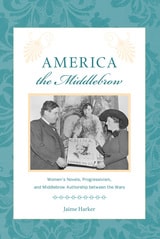
America the Middlebrow
Women's Novels, Progressivism, and Middlebrow Authorship between the WarsJaime Harker
University of Massachusetts Press, 2007
Between the two world wars, American publishing entered a “golden age” characterized by an explosion of new publishers, authors, audiences, distribution strategies, and marketing techniques. The period was distinguished by a diverse literary culture, ranging from modern cultural rebels to working-class laborers, political radicals, and progressive housewives. In America the Middlebrow, Jaime Harker focuses on one neglected mode of authorship in the interwar period—women's middlebrow authorship and its intersection with progressive politics.
With the rise of middlebrow institutions and readers came the need for the creation of the new category of authorship. Harker contends that these new writers appropriated and adapted a larger tradition of women's activism and literary activity to their own needs and practices. Like sentimental women writers and readers of the 1850s, these authors saw fiction as a means of reforming and transforming society. Like their Progressive Era forebears, they replaced religious icons with nationalistic images of progress and pragmatic ideology. In the interwar period, this mode of authorship was informed by Deweyan pragmatist aesthetics, which insisted that art provided vicarious experience that could help create humane, democratic societies.
Drawing on letters from publishers, editors, agents, and authors, America the Middlebrow traces four key moments in this distinctive culture of letters through the careers of Dorothy Canfield, Jessie Fauset, Pearl Buck, and Josephine Herbst. Both an exploration of a virtually invisible culture of letters and a challenge to monolithic paradigms of modernism, the book offers fresh insight into the ongoing tradition of political domestic fiction that flourished between the wars.
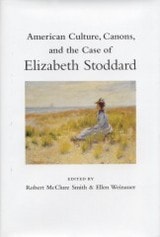
American Culture, Canons, and the Case of Elizabeth Stoddard
Robert McClure Smith
University of Alabama Press, 2003
Elizabeth Stoddard was a gifted writer of fiction, poetry, and journalism; successfully published within her own lifetime; esteemed by such writers as William Dean Howells and Nathaniel Hawthorne; and situated at the epicenter of New York’s literary world. Nonetheless, she has been almost excluded from literary memory and importance. This book seeks to understand why. By reconsidering Stoddard’s life and work and her current marginal status in the evolving canon of American literary studies, it raises important questions about women’s writing in the 19th century and canon formation in the 20th century.
Essays in this study locate Stoddard in the context of her contemporaries, such as Dickinson and Hawthorne, while others situate her work in the context of major 19th-century cultural forces and issues, among them the Civil War and Reconstruction, race and ethnicity, anorexia and female invalidism, nationalism and localism, and incest. One essay examines the development of Stoddard’s work in the light of her biography, and others probe her stylistic and philosophic originality, the journalistic roots of her voice, and the elliptical themes of her short fiction. Stoddard’s lifelong project to articulate the nature and dynamics of woman’s subjectivity, her challenging treatment of female appetite and will, and her depiction of the complex and often ambivalent relationships that white middle-class women had to their domestic spaces are also thoughtfully considered.
The editors argue that the neglect of Elizabeth Stoddard’s contribution to American literature is a compelling example of the contingency of critical values and the instability of literary history. This study asks the question, “Will Stoddard endure?” Will she continue to drift into oblivion or will a new generation of readers and critics secure her tenuous legacy?
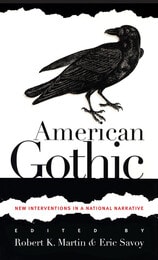
American Gothic
New Interventions in a National NarrativeRobert K. Martin
University of Iowa Press, 1998
In America as in Britain, the rise of the Gothic represented the other—the fearful shadows cast upon Enlightenment philosophies of common sense, democratic positivism, and optimistic futurity. Many critics have recognized the centrality of these shadows to American culture and self-identification. American Gothic, however, remaps the field by offering a series of revisionist essays associated with a common theme: the range and variety of Gothic manifestations in high and popular art from the roots of American culture to the present.
The thirteen essayists approach the persistence of the Gothic in American culture by providing a composite of interventions that focus on specific issues—the histories of gender and race, the cultures of cities and scandals and sensations—in order to advance distinct theoretical paradigms. Each essay sustains a connection between a particular theoretical field and a central problem in the Gothic tradition.
Drawing widely on contemporary theory—particularly revisionist views of Freud such as those offered by Lacan and Kristeva—this volume ranges from the well-known Gothic horrors of Edgar Allan Poe and Nathaniel Hawthorne to the popular fantasies of Stephen King and the postmodern visions of Kathy Acker. Special attention is paid to the issues of slavery and race in both black and white texts, including those by Ralph Ellison and William Faulkner. In the view of the editors and contributors, the Gothic is not so much a historical category as a mode of thought haunted by history, a part of suburban life and the lifeblood of films such as The Exorcist and Fatal Attraction.
American Hybrid Poetics
Gender, Mass Culture, and FormAmy Moorman Robbins
Rutgers University Press, 2014
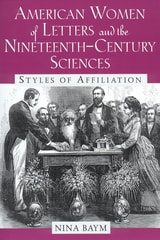
American Women of Letters and the Nineteenth-Century Sciences
Styles of AffiliationBaym, Nina
Rutgers University Press, 2001
Choice Outstanding Academic Title
During the nineteenth century, the content and institutional organization of the sciences evolved dramatically, altering the public's understanding of knowledge. As science grew in importance, many women of letters tried to incorporate it into a female worldview. Nina Baym explores the responses to science displayed in a range of writings by American women. Conceding that they could not become scientists, women insisted, however, that they were capable of understanding science and participating in its discourse. They used their access to publishing to advocate the study and transmission of scientific information to the general public.
Bayms book includes biographies and a full exploration of these women's works. Among those considered are:
• Almira Phelps, author of Familiar Lectures on Botany (it sold 350,000 copies)
• Sarah Hale, who filled Godey's Lady's Book with science articles
• Catharine Esther Beecher, who based her domestic advice on scientific information
• Elizabeth Cary Agassiz, the actual ghostwriter of her husband's popular science essays
• Emily Dickinson, whose poetry is replete with scientific images.
Baym also investigates science in women's novels, writing by and about women doctors, and the scientific claims advanced by women's spiritualist movements. This book truly breaks new ground, outlining a field of inquiry that few have noted exists.
Amy Levy
Critical EssaysLinda Hunt Beckman
Ohio University Press, 2000
Amy Lowell, American Modern
Bradshaw, Melissa
Rutgers University Press, 2004
For decades, the work of one of America’s most influential poets, 1925 Pulitzer Prize–winner Amy Lowell (1874–1925), has been largely overlooked. This vigorous, courageous poet gave voice to an erotic, thoroughly American sensibility. Cigar-smoker, Boston Brahmin, lesbian, impresario, entrepreneur, and prolific poet, Lowell heralded the rush of an American poetic flowering. A best-selling poet as well as a wildly popular lecturer (autograph-seeking fans were sometimes so boisterous that she required a police escort), she was a respected authority on modern poetry, forging the path that led to the works of Allen Ginsberg, May Sarton, Sylvia Plath, and beyond. Yet, since her death, her work has suffered critical neglect.
This volume presents an essential revaluation of Lowell, and builds a solid critical basis for evaluating her poetry, criticism, politics, and influence. Essays explore the varied contributions of Lowell as a woman poet, a modernist, and a significant force of the literary debates of early twentieth-century poetics. In addition to placing Lowell in her proper historical context, contributors demonstrate her centrality to current critical and theoretical discussions: feminist, gay and lesbian, and postcolonial, in as well as in disability, American, and cultural studies. The book includes a transatlantic group of literary critics and scholars.
Amy Lowell, American Modern offers the most sustained examination of Lowell to date. It returns her to conversation and to literary history where she belongs.

And Then There Were Nine. . .
More Women of MysteryUniversity of Wisconsin Press, 1985
Anglo-American Feminist Challenges to the Rhetorical Traditions
Virginia Woolf, Mary Daly, Adrienne RichKrista Ratcliffe
Southern Illinois University Press, 1996
Although women and men have different relationships to language and to each other, traditional theories of rhetoric do not foreground such gender differences. Krista Ratcliffe argues that because feminists generally have not conceptualized their language theories from the perspective of rhetoric and composition studies, rhetoric and composition scholars must construct feminist theories of rhetoric by employing a variety of interwoven strategies: recovering lost or marginalized texts; rereading traditional rhetoric texts; extrapolating rhetorical theories from such nonrhetoric texts as letters, diaries, essays, cookbooks, and other sources; and constructing their own theories of rhetoric.
Focusing on the third option, Ratcliffe explores ways in which the rhetorical theories of Virginia Woolf, Mary Daly, and Adrienne Rich may be extrapolated from their Anglo-American feminist texts through examination of the interrelationship between what these authors write and how they write. In other words, she extrapolates feminist theories of rhetoric from interwoven claims and textual strategies. By inviting Woolf, Daly, and Rich into the rhetorical traditions and by modeling the extrapolation strategy/methodology on their writings, Ratcliffe shows how feminist texts about women, language, and culture may be reread from the vantage point of rhetoric to construct feminist theories of rhetoric. She also outlines the pedagogical implications of these three feminist theories of rhetoric, thus contributing to ongoing discussions of feminist pedagogies.
Traditional rhetorical theories are gender-blind, ignoring the reality that women and men occupy different cultural spaces and that these spaces are further complicated by race and class, Ratcliffe explains. Arguing that issues such as who can talk, where one can talk, and how one can talk emerge in daily life but are often disregarded in rhetorical theories, Ratcliffe rereads Roland Barthes’ "The Old Rhetoric" to show the limitations of classical rhetorical theories for women and feminists. Discovering spaces for feminist theories of rhetoric in the rhetorical traditions, Ratcliffe invites readers not only to question how women have been located as a part of— and apart from—these traditions but also to explore the implications for rhetorical history, theory, and pedagogy.
Anne Sexton
Telling the TaleSteven E. Colburn, Editor
University of Michigan Press, 1988
Anne Tyler as Novelist
Dale Salwak
University of Iowa Press, 1994
Appropriate[Ing] Dress
Women's Rhetorical Style in Nineteenth-Century AmericaCarol Mattingly
Southern Illinois University Press, 2002
Carol Mattingly examines the importance of dress and appearance for nineteenth-century women speakers and explores how women appropriated gendered conceptions of dress and appearance to define the struggle for representation and power that is rhetoric. Although crucial to women’s effectiveness as speakers, Mattingly notes, appearance has been ignored because it was taken for granted by men.
Because women rarely spoke in public before the nineteenth century, no guidelines existed regarding appropriate dress when they began to speak to audiences. Dress evoked immediate images of gender, an essential consideration for women speakers because of its strong association with place, locating women in the domestic sphere and creating a primary image that women speakers would work with—and against—throughout the century. Opposition to conspicuous change for women often necessitated the subtle transfer of comforting images when women sought to inhabit traditionally masculine spaces. The most successful women speakers carefully negotiated expectations by highlighting some conventions even as they broke others.
Are Girls Necessary?
Lesbian Writing and Modern HistoriesJulie Abraham
University of Minnesota Press, 2008
Arguments with Silence
Writing the History of Roman WomenAmy Richlin
University of Michigan Press, 2014
Women in ancient Rome challenge the historian. Widely represented in literature and art, they rarely speak for themselves. Amy Richlin, among the foremost pioneers in ancient studies, gives voice to these women through scholarship that scours sources from high art to gutter invective.
In Arguments with Silence, Richlin presents a linked selection of her essays on Roman women’s history, originally published between 1981 and 2001 as the field of “women in antiquity” took shape, and here substantially rewritten and updated. The new introduction to the volume lays out the historical methodologies these essays developed, places this process in its own historical setting, and reviews work on Roman women since 2001, along with persistent silences. Individual chapter introductions locate each piece in the social context of Second Wave feminism in Classics and the academy, explaining why each mattered as an intervention then and still does now.
Inhabiting these pages are the women whose lives were shaped by great art, dirty jokes, slavery, and the definition of adultery as a wife’s crime; Julia, Augustus’ daughter, who died, as her daughter would, exiled to a desert island; women wearing makeup, safeguarding babies with amulets, practicing their religion at home and in public ceremonies; the satirist Sulpicia, flaunting her sexuality; and the praefica, leading the lament for the dead.
Amy Richlin is one of a small handful of modern thinkers in a position to consider these questions, and this guided journey with her brings surprise, delight, and entertainment, as well as a fresh look at important questions.
Arms and the Woman
Classical Tradition and Women Writers in the Venetian RenaissanceFrancesca D'Alessandro Behr
The Ohio State University Press, 2018
Arms and the Woman: Classical Tradition and Women Writers in the Venetian Renaissance by Francesca D’Alessandro Behr focuses on the classical reception in the works of female authors active in Venice during the Early Modern Age. Even in this relatively liberal city, women had restricted access to education and were subject to deep-seated cultural prejudices, but those who read and wrote were able, in part, to overcome those limitations.
In this study, Behr explores the work of Moderata Fonte and Lucrezia Marinella and demonstrates how they used knowledge of texts by Virgil, Ovid, and Aristotle to systematically reanalyze the biased patterns apparent both in the romance epic genre and contemporary society. Whereas these classical texts were normally used to bolster the belief in female inferiority and the status quo, Fonte and Marinella used them to envision societies structured according to new, egalitarian ethics. Reflecting on the humanist representation of virtue, Fonte and Marinella insisted on the importance of peace, mercy, and education for women. These authors took up the theme of the equality of genders and participated in the Renaissance querelle des femmes, promoting women’s capabilities and nature.
Asian American Women's Popular Literature
Feminizing Genres and Neoliberal BelongingPamela Thoma
Temple University Press, 2013
A volume in the American Literatures Initiative.
Assimilating Asians
Gendered Strategies of Authorship in Asian AmericaPatricia P. Chu
Duke University Press, 2000
Chu further demonstrates that Asian American male and female writers engage different strategies in the struggle to adapt, reflecting their particular, gender-based relationships to immigration, work, and cultural representation. While offering fresh perspectives on the well-known writings—both fiction and memoir—of Maxine Hong Kingston, Amy Tan, Bharati Mukherjee, Frank Chin, and David Mura, Assimilating Asians also provides new insight into the work of less recognized but nevertheless important writers like Carlos Bulosan, Edith Eaton, Younghill Kang, Milton Murayama, and John Okada. As she explores this expansive range of texts—published over the course of the last century by authors of Chinese, Japanese, Korean, Filipino, and Indian origin or descent—Chu is able to illuminate her argument by linking it to key historical and cultural events.
Assimilating Asians makes an important contribution to the fields of Asian American, American, and women’s studies. Scholars of Asian American literature and culture, as well as of ethnicity and assimilation, will find particular interest and value in this book.