Results by title
28164 books match the query 'History' and 2536 start with a
A Nation within a Nation
Voices of the Oneidas in WisconsinL. Gordon McLester III
Wisconsin Historical Society Press, 2010

A National Acoustics
Music and Mass Publicity in Weimar and Nazi GermanyBrian Currid
University of Minnesota Press, 2006
Offering a nuanced analysis of how publicity was constructed through radio programming, print media, popular song, and film, Currid examines how German citizens developed an emotional investment in the nation and other forms of collectivity that were tied to the sonic experience. Reading in detail popular genres of music—the Schlager (or “hit”), so-called gypsy music, and jazz—he offers a complex view of how they played a part in the creation of German culture.
A National Acoustics contributes to a new understanding of what constitutes the public sphere. In doing so, it illustrates the contradictions between Germany’s social and cultural histories and how the technologies of recording not only were vital to the emergence of a national imaginary but also exposed the fault lines in the contested terrain of mass communication.
Brian Currid is an independent scholar who lives in Berlin.
A National Crime
The Canadian Government and the Residential School System 2nd editionJohn S. Milloy
University of Manitoba Press, 2017
A Nation’s Undesirables
Mixed-Race Children and Whiteness in the Post-Nazi EraTracey Owens Patton
The Ohio State University Press, 2024
An innovative investigation of the entangled histories of race, transnational adoption, and post-Nazi Germany.
In a moving blend of family history and cutting-edge scholarship, Tracey Owens Patton’s A Nation’s Undesirables synthesizes work in rhetorical postmemory studies, critical adoption studies, Afrofuturism, and more to tell the story of her mother and aunt, Lore and Lilli. Two of thousands of children born to white German women and Black American men after World War II, the twins moved to the United States at age seven, where their mother renounced her parental rights and put them into the adoption system. They did not see her again for fifty-two years.Patton takes up the twins’ story and their reckoning with their mixed-race, Black German identity to disrupt standard narratives around World War II, Black experiences in Germany, and race and adoption. Combining family interviews, historical artifacts, and autoethnographic reflection, Patton composes a new narrative of women and Black German children in the postwar era. In examining the systemic racism of Germany’s efforts to move children like Lore and Lilli out of the country—and the suppression of German women’s bodily autonomy—Patton amplifies the once unacknowledged identities of these Black German children to broaden our understanding of citizenship, racism, and sexism after World War II.
A Natural History of Belize
Inside the Maya ForestBy Samuel Bridgewater
University of Texas Press, 2012
Belize's Chiquibul Forest is one of the largest remaining expanses of tropical moist forest in Central America. It forms part of what is popularly known as the Maya Forest. Battered by hurricanes over millions of years, occupied by the Maya for thousands of years, and logged for hundreds of years, this ecosystem has demonstrated its remarkable ecological resilience through its continued existence into the twenty-first century. Despite its history of disturbance, or maybe in part because of it, the Maya Forest is ranked as an important regional biodiversity hot spot and provides some of the last regional habitats for endangered species such as the jaguar, the scarlet macaw, Baird's tapir, and Morelet's crocodile.
A Natural History of Belize presents for the first time a detailed portrait of the habitats, biodiversity, and ecology of the Maya Forest, and Belize more broadly, in a format accessible to a popular audience. It is based in part on the research findings of scientists studying at Las Cuevas Research Station in the Chiquibul Forest. The book is unique in demystifying many of the big scientific debates related to rainforests. These include "Why are tropical forests so diverse?"; "How do flora and fauna evolve?"; and "How do species interact?" By focusing on the ecotourism paradise of Belize, this book illustrates how science has solved some of the riddles that once perplexed the likes of Charles Darwin, and also shows how it can assist us in managing our planet and forest resources wisely in the future.

A Natural History of Peace
Thomas A. Gregor
Vanderbilt University Press, 1996
We know a great deal about aggression, conflict, and war, but relatively little about peace, partially because it has been such a scarce phenomenon throughout history and in our own times. Peace is more than the absence of war. Peace requires special relationships, structures, and attitudes to promote and protect it.
A Natural History of Peace provides the first broadly interdisciplinary examination of peace as viewed from the perspectives of social anthropology, primatology, archaeology, psychology, political science, and economics. Among other notable features, this volume offers:
- a major theory concerning the evolution of peace and violence through human history;
- an in-depth comparative study of peaceful cultures with the goal of discovering what it is that makes them peaceful;
- one of the earliest reports of a new theory of the organization and collapse of ancient Maya civilization;
- a comparative examination of peace from the perspective of change, including the transition of one of the world's most violent societies to a relatively
- peaceful culture, and the decision-making process of terrorists who abandon violence;
- and a theory of political change that sees the conclusion of wars as uniquely creative periods in the evolution of peace among modern nations.
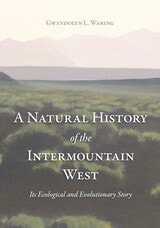
A Natural History of the Intermountain West
Its Ecological and Evolutionary StoryGwendolyn L Waring
University of Utah Press, 2010
A Natural History of the Intermountain West was written to inform people about the wild world around us, with the idea that we all crave a connection to the natural world to ground us and give us a sense of place. It is also a book about change. While species are described throughout the chapters, the text is focused more on the profound processes that have shaped western ecosystems, based on a belief that understanding those processes is more meaningful than a list of names. The ways and the rapidity with which enormous ecosystems replace one another and sometimes even return as climates change are a magnificent testament to the tenacity of life.
The first book of its kind for this region, A Natural History of the Intermountain West takes a fresh look at the natural history of the southern Rockies and the Intermountain Region based on cutting-edge research, interviews with numerous scientists, and the author’s personal experience. Drawing together many disparate fields, the book integrates the evolution of western ecosystems with the geological and climatic history of the region. It is a passionate, humanistic, and scientific treatment of this area’s ecosystems, how they function, and how they came to be through time; it is a wonderful guide for the general public and scientists alike.
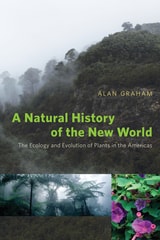
A Natural History of the New World
The Ecology and Evolution of Plants in the AmericasAlan Graham
University of Chicago Press, 2010
The paleoecological history of the Americas is as complex as the region is broad: stretching from the Arctic Circle to Tierra del Fuego, the New World features some of the most extraordinary vegetation on the planet. But until now it has lacked a complete natural history. Alan Graham remedies that with A Natural History of the New World. With plants as his scientific muse, Graham traces the evolution of ecosystems, beginning in the Late Cretaceous period (about 100 million years ago) and ending in the present, charting their responses to changes in geology and climate.
By highlighting plant communities’ roles in the environmental history of the Americas, Graham offers an overdue balance to natural histories that focus exclusively on animals. Plants are important in evolution’s splendid drama. Not only are they conspicuous and conveniently stationary components of the Earth’s ecosystems, but their extensive fossil record allows for a thorough reconstruction of the planet’s paleoenvironments. What’s more, plants provide oxygen, function as food and fuel, and provide habitat and shelter; in short, theirs is a history that can speak to many other areas of evolution.
A Natural History of the New World is an ambitious and unprecedented synthesis written by one of the world’s leading scholars of botany and geology.
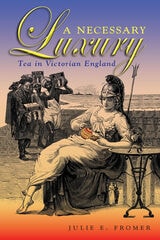
A Necessary Luxury
Tea in Victorian EnglandJulie E. Fromer
Ohio University Press, 2008
In A Necessary Luxury: Tea in Victorian England, Julie E. Fromer analyzes tea histories, advertisements, and nine Victorian novels, including Alice’s Adventures in Wonderland, Wuthering Heights, and Portrait of a Lady. Fromer demonstrates how tea functions within the literature as an arbiter of taste and middle-class respectability, aiding in the determination of class status and moral position. She reveals the way in which social identity and character are inextricably connected in Victorian ideology as seen through the ritual of tea.
Drawing from the fields of literary studies, cultural studies, history, and anthropology, A Necessary Luxury offers in-depth analysis of both visual and textual representations of the commodity and the ritual that was tea in nineteenth-century England.
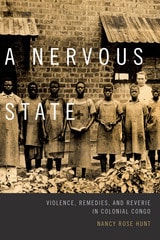
A Nervous State
Violence, Remedies, and Reverie in Colonial CongoNancy Rose Hunt
Duke University Press, 2016
A Network of Converso Families in Early Modern Toledo
Assimilating a MinorityLinda Martz
University of Michigan Press, 2003
Linda M. Martz focuses on families that were immersed in the worlds of business and finance. They formed the backbone of the trade industry and, during the economic expansion of the sixteenth century, enjoyed a high degree of affluence. The seventeenth century, however, brought harder times. How these families rose to positions of commercial eminence and then adapted to this economic downturn is one of the questions addressed in this insightful book.
A Network of Converso Families in Early Modern Toledo relies heavily on archival evidence--notarial, parish, and city records--that offers new insights into the families' histories. Business endeavors, marriage alliances, involvement in local politics, and the pursuit of improved social status are all subjected to Martz's keen analysis.
These families appear to have been well integrated into their contemporary society; aside from their business and financial activities, many were members of the city's governing council. But how well did they integrate with the lower classes? Assimilating minorities in the majority culture is a task that confronts most modern societies, so the experience of Spain and this particular minority may serve as an example of how earlier societies viewed and confronted this challenge.
This book will appeal to historians of medieval and Renaissance Spain and those interested in the Inquisition's effect on Renaissance Spain. It will also prove to be indispensable for those interested in the history of the Jewish race, as well as for those pursuing the question of marginalization.
Linda M. Martz is an independent historian as well as a freelance editor and writer.
A New Brand of Business
Charles Coolidge Parlin, Curtis Publishing Company, and the Origins of Market ResearchDouglas B. Ward
Temple University Press, 2009
Charles Coolidge Parlin was considered by many to be the founder of market research. Working for the dominant Curtis Publishing Company, he revolutionized the industry by providing added value to advertisers through information about the racial, ethnic, and regional biases of readers and consumers. By maintaining contact with both businesses and customers, Parlin and Curtis publications were able to turn consumer wants into corporate profits.
In A New Brand of Business, Douglas Ward provides an intriguing business history that explains how and why Curtis developed its market research division. He reveals the evolution and impact of Parlin’s work, which understood how readers and advertisers in the emerging consumer economy looked at magazines and advertisements. Ward also examines the cultural and social reasons for the development and use of market research—particularly in regard to Curtis' readership of upper-income elites. The result weaves the stories of Parlin and Curtis into the changes taking place in American business and advertising in the early twentieth century.
A New Civil Right
Telecommunications Equality for Deaf and Hard of Hearing AmericansKaren Peltz Strauss
Gallaudet University Press, 2006
When three deaf men in the 1960s invented and sold TTYs, the first teletypewriting devices that allowed deaf people to communicate by telephone, they started a telecommunications revolution for deaf people throughout America. A New Civil Right: Telecommunications Equality for Deaf and Hard of Hearing Americans chronicles the history of this movement, which lagged behind new technical developments decades after the advent of TTYs.
In this highly original work, Author Karen Peltz Strauss reveals how the paternalism of the hearing-oriented telecommunications industries slowed support for technology for deaf users. Throughout this comprehensive account, she emphasizes the grassroots efforts behind all of the eventual successes. A New Civil Right recounts each advance in turn, such as the pursuit of special customer premises equipment (SCPE) from telephone companies; the Telecommunications Act of 1982 and the Telecommunications Accessibility Enhancement Act of 1988 and the 1990 Americans with Disabilities Act, which required nationwide relay telephone services for deaf and hard of hearing users.
Strauss painstakingly details how all of these advances occurred incrementally, first on local and state levels, and later through federal law. It took exhaustive campaigning to establish 711 for nationwide relay dialing, while universal access to television captioning required diligent legal and legislative work to pass the Decoder Circuitry Act in 1990. The same persistence resulted in the enactment of the Telecommunications Act of 1996, which required all off-the-shelf communications equipment, including new wireless technology, to be readily accessible to deaf users.

A New Day in the Delta
Inventing School Desegregation As You GoDavid W. Beckwith
University of Alabama Press, 2009
Explores Mississippi’s school desegregation from the viewpoint of a white teacher
A New Day in the Delta is a fresh and appealing memoir of the experience of a young white college graduate in need of a job as the Vietnam War reached its zenith. David Beckwith applied and was accepted for a teaching position in the Mississippi Delta in the summer of 1969. Although it seemed to him a bit strange that he was accepted so quickly for this job while his other applications went nowhere, he was grateful for the opportunity. Beckwith reported for work to learn that he was to be assigned to an all-black school as the first step in Mississippi’s long-deferred school desegregation.
The nation and Mississippi alike were being transformed by war and evolving racial relations, and Beckwith found himself on the cutting edge of the transformation of American education and society in one of the most resistant (and poor) corners of the country. Beckwith’s revealing and often amusing story of the year of mutual incomprehension between an inexperienced white teacher and a classroom full of black children who had had minimal contact with any whites. This is history as it was experienced by those who were thrust into another sort of “front line.”
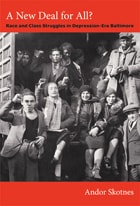
A New Deal for All?
Race and Class Struggles in Depression-Era BaltimoreAndor Skotnes
Duke University Press, 2012
A New Deal for Bronzeville
Housing, Employment, and Civil Rights in Black Chicago, 1935-1955Lionel Kimble Jr.
Southern Illinois University Press, 2015
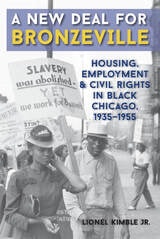
During the Great Migration of the 1920s and 1930s, southern African Americans flocked to the South Side Chicago community of Bronzeville, the cultural, political, social, and economic hub of African American life in the city, if not the Midwest. The area soon became the epicenter of community activism as working-class African Americans struggled for equality in housing and employment. In this study, Lionel Kimble Jr. demonstrates how these struggles led to much of the civil rights activism that occurred from 1935 to 1955 in Chicago and shows how this working-class activism and culture helped to ground the early civil rights movement. Despite the obstacles posed by the Depression, blue-collar African Americans worked with leftist organizations to counter job discrimination and made strong appeals to New Deal allies for access to public housing. Kimble details how growing federal intervention in local issues during World War II helped African Americans make significant inroads into Chicago’s war economy and how returning African American World War II veterans helped to continue the fight against discrimination in housing and employment after the war. The activism that appeared in Bronzeville was not simply motivated by the “class consciousness” rhetoric of the organized labor movement but instead grew out of everyday struggles for racial justice, citizenship rights, and improved economic and material conditions. With its focus on the role of working-class African Americans—as opposed to the middle-class leaders who have received the most attention from civil rights historians in the past—A New Deal for Bronzeville makes a significant contribution to the study of civil rights work in the Windy City and enriches our understanding of African American life in mid-twentieth-century Chicago.
This publication is partially funded by a grant from Furthermore: a program of the J.M. Kaplan fund.
A New Deal for Native Art
Indian Arts and Federal Policy, 1933-1943Jennifer McLerran
University of Arizona Press, 2009
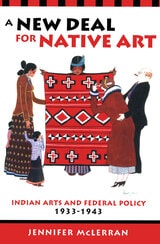
In A New Deal for Native Art, Jennifer McLerran reveals how positioning the native artist as a pre-modern Other served the goals of New Deal programs—and how this sometimes worked at cross-purposes with promoting native self-sufficiency. She describes federal policies of the 1930s and early 1940s that sought to generate an upscale market for Native American arts and crafts. And by unraveling the complex ways in which commodification was negotiated and the roles that producers, consumers, and New Deal administrators played in that process, she sheds new light on native art’s commodity status and the artist’s position as colonial subject.
In this first book to address the ways in which New Deal Indian policy specifically advanced commodification and colonization, McLerran reviews its multi-pronged effort to improve the market for Indian art through the Indian Arts and Crafts Board, arts and crafts cooperatives, murals, museum exhibits, and Civilian Conservation Corps projects. Presenting nationwide case studies that demonstrate transcultural dynamics of production and reception, she argues for viewing Indian art as a commodity, as part of the national economy, and as part of national political trends and reform efforts.
McLerran marks the contributions of key individuals, from John Collier and Rene d’Harnoncourt to Navajo artist Gerald Nailor, whose mural in the Navajo Nation Council House conveyed distinctly different messages to outsiders and tribal members. Featuring dozens of illustrations, A New Deal for Native Art offers a new look at the complexities of folk art “revivals” as it opens a new window on the Indian New Deal.
A New Deal for Navajo Weaving
Reform and Revival of Diné TextilesJennifer McLerran
University of Arizona Press, 2022
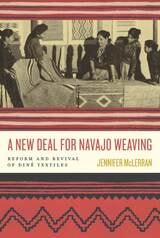
By the 1920s the durability and market value of Diné weavings had declined dramatically. Indian welfare advocates established projects aimed at improving the materials and techniques. Private efforts served as models for federal programs instituted by New Deal administrators. Historian Jennifer McLerran details how federal officials developed programs such as the Southwest Range and Sheep Breeding Laboratory at Fort Wingate in New Mexico and the Navajo Arts and Crafts Guild. Other federal efforts included the publication of Native natural dye recipes; the publication of portfolios of weaving designs to guide artisans; and the education of consumers through the exhibition of weavings, aiding them in their purchases and cultivating an upscale market. McLerran details how government officials sought to use these programs to bring the Diné into the national economy; instead, these federal tactics were ineffective because they marginalized Navajo women and ignored the important role weaving plays in the resilience and endurance of wider Diné culture.
A New Deal for Southeastern Archaeology
Edwin A. Lyon
University of Alabama Press, 1996
Recipient of the 1994 Anne B. and James B. McMillan Prize
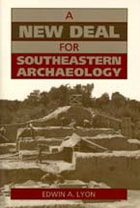
This comprehensive study provides a history of New Deal archaeology in the Southeast in the 1930s and early 1940s and focuses on the projects of the Federal Emergency Relief Administration, the Civil Works Administration, the Works Progress Administration, the Tennessee Valley Authority, the National Park Service, and the Smithsonian Institution.
Utilizing primary sources including correspondence and unpublished reports, Lyon demonstrates the great importance of the New Deal projects in the history of southeastern and North American archaeology. New Deal archaeology transformed the practice of archaeology in the Southeast and created the basis for the discipline that exists today. With the current emphasis on curation and repatriation, archaeologists and historians will find this volume invaluable in reconstructing the history of the projects that generated the many collections that now fill our museums.

A New Documentary History of Hong Kong, 1945–1997
Edited by Florence Mok and Fung Chi Keung Charles
Hong Kong University Press, 2025
Through analyzing newly released archival records from the National Archives in London and the Public Records Office in Hong Kong, A New Documentary History of Hong Kong, 1945–1997 provides an updated and improved understanding of basic aspects of the city such as governance, economy, society, and culture. It also aims to investigate topics that are under-explored in previous sourcebooks, such as race and diasporas, gender and familial relations, medicine and healthcare, and environment and natural disasters. Overall, this book offers an innovative and comprehensive long-term perspective of Hong Kong’s colonial history.
A New England Prison Diary
Slander, Religion, and Markets in Early AmericaMartin J. Hershock
University of Michigan Press, 2012
In 1812, New Hampshire shopkeeper Timothy M. Joy abandoned his young family, fleeing the creditors who threatened to imprison him. Within days, he found himself in a Massachusetts jailhouse, charged with defamation of a prominent politician. During the months of his incarceration, Joy kept a remarkable journal that recounts his personal, anguished path toward spiritual redemption. Martin J. Hershock situates Joy's account in the context of the pugnacious politics of the early republic, giving context to a common citizen's perspective on partisanship and the fate of an unfortunate shopkeeper swept along in the transition to market capitalism.
In addition to this close-up view of an ordinary person's experience of a transformative period, Hershock reflects on his own work as a historian. In the final chapter, he discusses the value of diaries as historical sources, the choices he made in telling Joy's story, alternative interpretations of the diary, and other contexts in which he might have placed Joy's experiences. The appendix reproduces Joy's original journal so that readers can develop their own skills using a primary source.

A New History of Black Pittsburgh
Advancing the Case for Reparatory JusticeJoe William Trotter, Jr., Esther Bush, Laurence Glasco, Benjamin Houston, Patricia Pugh Mitchell, Tony Norman, Rob Ruck, and Carla Young
University of Michigan Press, 2027
A rising chorus of voices have called for redress and compensation to level the playing field for African Americans across all walks of life. A New History of Black Pittsburgh brings together humanities scholars, social service and social justice activists, and community residents to document multigenerational patterns of class and racial inequality and forge a comprehensive case for reparatory justice.
Focusing on industry’s “first city,” the authors draw on oral histories, archival research, and scholarship to examine more than two centuries of Pittsburgh’s history. By featuring a city home to professional Negro League baseball teams, jazz artists, the Pittsburgh Courier, and acclaimed writers and playwrights, the authors show that recognizing ongoing creativity and community-building activities is just as vital for the case for reparations as documenting persistent forms of inequality. A New History of Black Pittsburgh offers insights and policy recommendations to inspire activists, educators, historians, and policymakers working to repair the damage of racial inequality around the globe.
A New Jersey Anthology
Lurie, Maxine N
Rutgers University Press, 2010
A New Language, A New World
Italian Immigrants in the United States, 1890-1945Nancy C. Carnevale
University of Illinois Press, 2012
A New Map of Wonders
A Journey in Search of Modern MarvelsCaspar Henderson
University of Chicago Press, 2017
Henderson’s brilliant exploration borrows from the form of one of the oldest and most widely known sources of wonder: maps. Large, detailed mappae mundi invited people in medieval Europe to vividly imagine places and possibilities they had never seen before: manticores with the head of a man, the body of a lion, and the stinging tail of a scorpion; tribes of one-eyed men who fought griffins for diamonds; and fearsome Scythian warriors who drank the blood of their enemies from their skulls. As outlandish as these maps and the stories that went with them sound to us today, Henderson argues that our views of the world today are sometimes no less incomplete or misleading. Scientists are only beginning to map the human brain, for example, revealing it as vastly more complex than any computer we can conceive. Our current understanding of physical reality is woefully incomplete. A New Map of Wonders explores these and other realms of the wonderful, in different times and cultures and in the present day, taking readers from Aboriginal Australian landscapes to sacred sites in Great Britain, all the while keeping sight questions such as the cognitive basis of wonder and the relationship between wonder and science.
Beautifully illustrated and written with wit and moral complexity, this sequel to The Book of Barely Imagined Beings is a fascinating account of the power of wonder and an unforgettable meditation on its importance to our future.

A New Orient
From German Scholarship to Middle Eastern Studies in IsraelAmit Levy
Brandeis University Press, 2024
This study examines the history of Zionist academic Orientalism—referred to throughout as Oriental studies, the term contemporary English speakers would have used—in light of its German-Jewish background, as a history of knowledge transfer stretching along an axis from Germany to Palestine. The transfer, which took place primarily during the 1920s and 1930s, involved questions about the re-establishment, far from Germany, of a field of knowledge with deep German roots. Like other German-Jewish scholars arriving in Palestine at the time, some of the Orientalist agents of transfer did so out of Zionist conviction as olim (immigrants making aliyah, or literally “ascending” to the homeland), while others joined them later as refugees from Nazi Germany; both groups were integrated into the institutional apparatus of the Hebrew University. Unlike other fields of knowledge or professions, however, the transfer of Orientalist knowledge was unique in that the axis involved an essential change in the nature of its encounter with the Orient: from a textual-scientific encounter at German universities, largely disconnected from contemporary issues to a living, substantive, and unmediated encounter with an essentially Arab region—and the escalating Jewish-Arab conflict in the background. Within the new context, German-Jewish Orientalist expertise was charged with political and cultural significance it had not previously faced, fundamentally influencing the course of the discipline’s development in Palestine and Israel.
A New Philosophy of History
Edited by Frank Ankersmit and Hans Kellner
University of Chicago Press, 1995
The range of approaches found in A New Philosophy of History ensures that this book will establish itself as required reading not only for historians, but for everyone interested in literary theory, philosophy, or cultural studies.
This volume presents essays by Hans Kellner, Nancy F. Partner, Richard T. Vann, Arthur C. Danto, Linda Orr, Philippe Carrard, Ann Rigney, Allan Megill, Robert Berkhofer, Stephen Bann, and Frank Ankersmit.
A New Sun Rises Over the Old Land
A Novel of Sihanouk’s CambodiaSuon Sorin
National University of Singapore Press, 2020
First published in 1961, eight years after Cambodia gained independence from French colonial rule, A New Sun Rises Over the Old Land is an iconic work of modern Khmer literature, a singularly illuminating document of the new nation. This is one of the first English translations of a modern Khmer novel, and the text is accompanied by an extended introduction that situates the author in his historical and artistic context and examines the novel’s literary value.
A New Type of Womanhood
Discursive Politics and Social Change in Antebellum AmericaNatasha Kirsten Kraus
Duke University Press, 2008
Enabling Kraus’s retelling of the 1850s woman’s rights movement is her theory of “structural aporias,” which takes the institutional structures of any particular society as fully imbricated with the force of language. Kraus reads the antebellum relations of womanhood, contract, property, the economy, and the nation as a fruitful site for analysis of the interconnected power of language, culture, and the law. She combines poststructural theory, particularly deconstructive approaches to discourse analysis; the political economic history of the antebellum era; and the interpretation of archival documents, including woman’s rights speeches, petitions, pamphlets, and convention proceedings, as well as state legislative debates, reports, and constitutional convention proceedings. Arguing that her method provides critical insight not only into social movements and cultural changes of the past but also of the present and future, Kraus concludes A New Type of Womanhood by considering the implications of her theory for contemporary feminist and queer politics.
A New Vision for Missions
William Cameron Townsend, The Wycliffe Bible Translators, and the Culture of Early Evangelical Faith Missions, 1917-1945William Lawrence Svelmoe
University of Alabama Press, 2008
A New Vision of Southern Jewish History
Studies in Institution Building, Leadership, Interaction, and MobilityMark K. Bauman, Foreword by Ronald H. Bayor
University of Alabama Press, 2019
Essays from a prolific career that challenge and overturn traditional narratives of southern Jewish history
Mark K. Bauman, one of the foremost scholars of southern Jewish history working today, has spent much of his career, as he puts it, “rewriting southern Jewish history” in ways that its earliest historians could not have envisioned or anticipated, and doing so by specifically targeting themes and trends that might not have been readily apparent to those scholars. A New Vision of Southern Jewish History: Studies in Institution Building, Leadership, Interaction, and Mobility features essays collected from over a forty-year career, including a never-before-published article.
The prevailing narrative in southern Jewish history tends to emphasize the role of immigrant Jews as merchants in small southern towns and their subsequent struggles and successes in making a place for themselves in the fabric of those communities. Bauman offers assessments that go far beyond these simplified frameworks and draws upon varieties of subject matter, time periods, locations, tools, and perspectives over three decades of writing and scholarship.
A New Vision of Southern Jewish History contains Bauman’s studies of Jewish urbanization, acculturation and migration, intra- and inter-group relations, economics and business, government, civic affairs, transnational diplomacy, social services, and gender—all complicating traditional notions of southern Jewish identity. Drawing on role theory as informed by sociology, psychology, demographics, and the nature and dynamics of leadership, Bauman traverses a broad swath—often urban—of the southern landscape, from Savannah, Charleston, and Baltimore through Atlanta, New Orleans, Galveston, and beyond the country to Europe and Israel.
Bauman’s retrospective volume gives readers the opportunity to review a lifetime of work in a single publication as well as peruse newly penned introductions to his essays. The book also features an “Additional Readings” section designed to update the historiography in the essays.
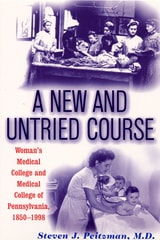
A New and Untried Course
Women's Medical College and Medical College of Pennysylvania, 1850-1998Peitzman, Steve J
Rutgers University Press, 2000

A Nice Derangement of Epistemes
Post-positivism in the Study of Science from Quine to LatourJohn H. Zammito
University of Chicago Press, 2004
Zammito shows how problems that Quine and Kuhn saw in the philosophy of the natural sciences inspired a turn to the philosophy of language for resolution. This linguistic turn led to claims that science needs to be situated in both historical and social contexts, but the claims of recent "science studies" only deepened the philosophical quandary. In essence, Zammito argues that none of the problems with positivism provides the slightest justification for denigrating empirical inquiry and scientific practice, delivering quite a blow to the "discipline" postmodern science studies.
Filling a gap in scholarship to date, A Nice Derangement of Epistemes will appeal to historians, philosophers, philosophers of science, and the broader scientific community.
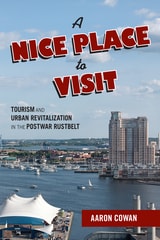
A Nice Place to Visit
Tourism and Urban Revitalization in the Postwar RustbeltAaron Cowan
Temple University Press, 2016
How did tourism gain a central role in the postwar American Rustbelt city? And how did tourism development reshape the meaning and function of these cities? These are the questions at the heart of Aaron Cowan’s groundbreaking book, A Nice Place to Visit.
Cowan provides an insightful, comparative look at the historical development of Cincinnati, St. Louis, Pittsburgh, and Baltimore in the post–World War II period to show how urban tourism provided a potential solution to the economic woes of deindustrialization. A Nice Place to Visit chronicles the visions of urban leaders who planned hotels, convention centers, stadiums, and festival marketplaces to remake these cities as tourist destinations. Cowan also addresses the ever-present tensions between tourist development and the needs and demands of residents in urban communities.
A Nice Place to Visit charts how these Rustbelt cities adapted to urban decline and struggled to meet the challenge of becoming an appealing place to visit, as well as good and just communities in which to live.
A Nickel and a Prayer
Jane Edna Hunter, Edited by Rhondda Robinson Thomas, with a foreword by Joycelyn Moody
West Virginia University Press, 2010
This new and annotated edition of A Nickel and a Prayer includes the final chapter, “Fireside Musings,” that Hunter added to the second, limited printing of her autobiography and an introduction that lauds her as a multifaceted social activist who not only engaged in racial uplift work, but impacted African American cultural production, increased higher education opportunities for women, and invigorated African American philanthropy. This important text restores Jane Edna Harris Hunter to her rightful place among prominent African American race leaders of the twentieth century.

A Nickel and a Prayer
Rhondda Robinson Thomas
University of Delaware Press, 0
Virtually unknown outside of her adopted hometown of Cleveland, Ohio, Jane Edna Hunter was one of the most influential African American social workers and progressive activists of the early to mid-twentieth century.
In her autobiography A Nickel and a Prayer, Hunter presents an enlightening two-part narrative that recollects her formative years in the post–Civil War South and her activist years in Cleveland. Published in 1940, Hunter’s autobiography recalls a childhood filled with the pleasures and pains of family life on the former plantation where her ancestors had toiled, adventures and achievements in schools for African American children, tests and trials during her brief marriage, and recognition and respect while completing nursing training and law school. When sharing the story of her life as an activist, Hunter describes the immense obstacles she overcame while developing an interracial coalition to support the establishment of the Working Girls Home Association (later, the Phillis Wheatley Association), a progressive institution intended to house and help unmarried African American women and girls, and nurture its growth from a rented home that provided accommodations for twenty-two women to a nine-story building that featured 135 rooms.
This new and annotated edition of A Nickel and a Prayer includes the final chapter, “Fireside Musings,” that Hunter added to the second, limited printing of her autobiography and an introduction that lauds her as a multifaceted social activist who not only engaged in racial uplift work, but impacted African American cultural production, increased higher education opportunities for women, and invigorated African American philanthropy. This important text restores Jane Edna Hunter to her rightful place among prominent African American leaders of the twentieth century.
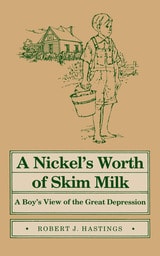
A Nickel's Worth of Skim Milk
A Boy's View of the Great DepressionRobert J. Hastings
Southern Illinois University Press, 1986
Told from the point of view of a young boy, this account shows how a family “faced the 1930s head on and lived to tell the story.” It is the story of growing up in southern Illinois, specifically the Marion, area during the Great Depression. But when it was first published in 1972 the book proved to be more than one writer’s memories of depression-era southern Illinois.
“People started writing me from all over the country,” Hastings notes. “And all said much the same: ‘You were writing about my family, as much as your own. That’s how I remember the 1930s, too.’”
As he proves time and again in this book, Hastings is a natural storyteller who can touch upon the detail that makes the tale both poignant and universal. He brings to life a period that marked every man, woman, and child who lived through it even as that national experience fades into the past.
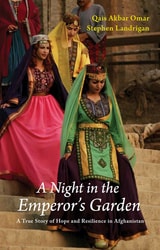
A Night in the Emperor's Garden
A True Story of Hope and Resilience in AfghanistanQais Akbar Omar and Stephen Landrigan
Haus Publishing, 2015
An actress visiting from Paris casually proposed to some Afghan actors in Kabul: Why not put on a play? The challenges were huge. It had been thirty years since men and women had appeared on stage together in Afghanistan. Was the country ready for it? Few Afghan actors had ever done theater. Did they even know how? They had performed only in films and television dramas.
Still, a company of actors gathered—among them a housewife, a policewoman, and a street kid turned film star. With no certainty of its outcome, they set out on a journey that would have life-changing consequences for all of them, and along the way lead to A Night in the Emperor’s Garden.

A Nimble Arc
James Van Der Zee and PhotographyEmilie Boone
Duke University Press, 2023
A Noble Fight
African American Freemasonry and the Struggle for Democracy in AmericaCorey D. B. Walker
University of Illinois Press, 2008
With great care and detail, Walker argues that African American freemasonry provides a critical theoretical lens for understanding the distinctive ways African Americans have constructed a radically democratic political imaginary through racial solidarity and political nationalism, forcing us to reconsider much more circumspectly the complex relationship between voluntary associations and democratic politics.
Mapping the discursive logics of the language of freemasonry as a metaphoric rendering of American democracy, this study interrogates the concrete forms of an associational culture, revealing how paradoxical aspects of freemasonry such as secrecy and public association inform the production of particular ideas and expressions of democracy in America.
A Noble and Independent Course
The Life of the Reverend Edward MitchellForrester A. Lee and James S. Pringle
Dartmouth College Press, 2018

A Page of Madness
Cinema and Modernity in 1920s JapanAaron Gerow
University of Michigan Press, 2008
A Paradise of Blood
The Creek War of 1813–14Howard T. Weir, III
Westholme Publishing, 2016
In 1811, a portion of the Creek Indians who inhabited a vast area across Georgia, Alabama, and parts of Florida and Mississippi, interpreted an earth tremor as a sign that they had to return to their traditional way of life. What was an internal Indian dispute soon became engulfed in the greater War of 1812 to become perhaps the most consequential campaign of that conflict. At immediate stake in what became known as the Creek War of 1813–14 was whether the Creeks and their inconstant British and Spanish allies or the young United States would control millions of acres of highly fertile Native American land. The conflict’s larger issue was whether the Indian nations of the lower American South—the Creek, Cherokee, Choctaw, and Chickasaw—would be able to remain in their ancestral homes.
Beginning with conquistador Ferdinand DeSoto’s fateful encounter with Indians of the southeast in the 1500s, A Paradise of Blood: The Creek War of 1813–14 by Howard T. Weir, III, narrates the complete story of the cultural clash and centuries-long struggle for this landscape of stunning beauty. Using contemporary letters, military reports, and other primary sources, the author places the Creek War in the context of Tecumseh’s fight for Native American independence and the ongoing war between the United States and European powers for control of North America. The Creek War was marked by savagery, such as the murder of hundreds of settlers at Fort Mims, Alabama—the largest massacre of its kind in United States history—and fierce battles, including Horseshoe Bend, where more Indian warriors were confirmed killed than in any other single engagement in the long wars against the Indians. Many notable personalities fought during the conflict, including Andrew Jackson, who gained national prominence for his service, Sam Houston, War Chief William Weatherford, and Davy Crockett. When the war was over, more than twenty million acres had been added to the United States, thousands of Indians were dead or homeless, and Jackson was on his way to the presidency. The war also eliminated the last effective Native American resistance to westward expansion east of the Mississippi, and by giving the United States land that was ideal for large-scale cotton planting, it laid the foundation for the Civil War a generation later. A Paradise of Blood is a comprehensive and masterful history of one of America’s most important and influential early wars.
A Partisan Church
Todd Scribner
Catholic University of America Press, 2015
A Party with Socialists in It
A History of the Labour LeftSimon Hannah
Pluto Press, 2018
A Party with Socialists in It addresses those questions and more, telling the story of the Labour Party from its origins to today, showing how at every turn it has struggled with the tension between the rights and demands of workers and a more centrist position. As Jeremy Corbyn’s leadership attempts to revitalize the party after the initial success of the Blair years turned into disappointment and disenchantment, this clear-eyed history could not be more timely.

A Party with Socialists in It
A History of the Labour LeftSimon
Pluto Press, 2022
A smart and succinct history of the Labour left
*A Guardian Book of the Day*
The defeat of socialist firebrand Jeremy Corbyn as Labour Leader in 2019 confirmed Tony Benn's famous retort 'the Labour party has never been a socialist party, although there have always been socialists in it.'
For over a hundred years, the British Labour Party has been a bastion for working-class organization and struggle. However, has it ever truly been on the side of the workers? Where do its interests really lie? And can we rely on it to provide a barrier against right-wing forces?
Simon Hannah's smart and succinct history of the Labour left guides us through the twists and turns of the party, from the Bevanite movement and the celebrated government of Clement Attlee, through the emergence of a New Left in the 1970s and the Blairism of the 1990s, to Corbyn's defeat and his replacement by Keir Starmer.
This new edition is updated throughout, with a new final chapter and conclusion bringing the story up to date.

A Passion for Consumption
The Gothic Novel in AmericaAnna Sonser
University of Wisconsin Press, 2001
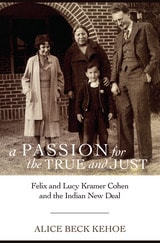
A Passion for the True and Just
Felix and Lucy Kramer Cohen and the Indian New DealAlice Beck Kehoe
University of Arizona Press, 2014
Kehoe argues that, due to anti-Semitism in 1930s America, Cohen could not speak for his legislation before Congress, and that Collier, an upper-class WASP, became the spokesman as well as the administrator. According to the author, historians of the Indian New Deal have not given due weight to Cohen’s work, nor have they recognized its foundation in his liberal secular Jewish culture. Both Felix and Lucy Cohen shared a belief in the moral duty of mitzvah, creating a commitment to the “true and the just” that was rooted in their Jewish intellectual and moral heritage, and their Social Democrat principles.
A Passion for the True and Just takes a fresh look at the Indian New Deal and the radical reversal of US Indian policies it caused, moving from ethnocide to retention of Indian homelands. Shifting attention to the Jewish tradition of moral obligation that served as a foundation for Felix and Lucy Kramer Cohen (and her professor Franz Boas), the book discusses Cohen’s landmark contributions to the principle of sovereignty that so significantly influenced American legal philosophy.

A Peaceful Conquest
Woodrow Wilson, Religion, and the New World OrderCara Lea Burnidge
University of Chicago Press, 2016
With A Peaceful Conquest, Cara Lea Burnidge presents the most detailed analysis yet of how Wilson’s religious beliefs affected his vision of American foreign policy, with repercussions that lasted into the Cold War and beyond. Framing Wilson’s intellectual development in relationship to the national religious landscape, and paying greater attention to the role of religion than in previous scholarship, Burnidge shows how Wilson’s blend of Southern evangelicalism and social Christianity became a central part of how America saw itself in the world, influencing seemingly secular policy decisions in subtle, lasting ways. Ultimately, Burnidge makes a case for Wilson’s religiosity as one of the key drivers of the emergence of the public conception of America’s unique, indispensable role in international relations.
As the presidential election cycle once again raises questions of America’s place in the world, A Peaceful Conquest offers a fascinating excavation of its little-known roots.
A Peculiar Imbalance
The Fall and Rise of Racial Equality in Minnesota, 1837–1869William D. Green
University of Minnesota Press, 2015
A Peculiar Imbalance is the little-known history of the black experience in Minnesota in the mid-1800s, a time of dramatic change in the region. William D. Green explains how, as white progressive politicians pushed for statehood, black men who had been integrated members of the community, owning businesses and maintaining good relationships with their neighbors, found themselves denied the right to vote or to run for office in those same communities.
As Minnesota was transformed from a wilderness territory to a state, the concepts of race and ethnicity and the distinctions among them made by Anglo-Americans grew more rigid and arbitrary. A black man might enjoy economic success and a middle-class lifestyle but was not considered a citizen under the law. In contrast, an Irish Catholic man was able to vote—as could a mixed-blood Indian—but might find himself struggling to build a business because of the ethnic and religious prejudices of the Anglo-American community. A Peculiar Imbalance examines these disparities, reflecting on the political, social, and legal experiences of black men from 1837 to 1869, the year of black suffrage.