Results by title
8113 books match the query 'Literary Criticism' and 619 start with a
Apparition of Splendor
Marianne Moore Performing Democracy through Celebrity, 1952–1970Elizabeth Gregory
University of Delaware Press, 2021
While the later work of the great Modernist poet Marianne Moore was hugely popular during her final two decades, since her death critics have condemned it as trivial. This book challenges that assessment: with fresh readings of many of the late poems and of the iconic, cross-dressing public persona Moore developed to deliver them, Apparition of Splendor demonstrates that Moore used her late-life celebrity in daring and innovative ways to activate egalitarian principles that had long animated her poetry. Dressed as George Washington in cape and tricorn and writing about accessible topics like sports, TV shows, holidays, love, activism, mortality and celebrity itself, she reached a wide cross-section of Americans, encouraging them to consider what democracy means in their daily lives, particularly around issues of gender, sexuality, racial integration, class, age, and immigration. Moore actively sought out publication in popular venues (like Vogue, The New Yorker, and the Saturday Evening Post, etc.) and wrote on material chosen to directly appeal to the audiences there, influencing younger contemporaries, including poets like Ashbery, O’Hara, and Bishop, and artists like Warhol, Yoko Ono, and Ray Johnson.
Published by the University of Delaware Press. Distributed worldwide by Rutgers University Press.
Appointed
An American NovelEric Gardner
University of Delaware Press, 0
As a coauthored novel of frustrated ambition, cross-racial friendship, and the tragedy of lynching, Appointed represents a unique contribution to African American literary history. This is the first scholarly edition of Appointed, and it includes a collection of writings from the Plaindealer, the authors’ short story “A Strange Freak of Fate,” and an introduction that locates Appointed and its authors within the journalistic and literary currents of the United States in the late nineteenth century.
Apprehending the Criminal
The Production of Deviance in Nineteenth Century DiscourseMarie-Christine Leps
Duke University Press, 1992
Leps focuses on three discursive practices: the emergence of criminology, the development of a mass-produced press, and the proliferation of crime fiction, in both England and France. Beginning where Foucault's work Discipline and Punish ends, Leps analyzes intertextual modes of knowledge production and shows how the elaboration of hegemonic truths about the criminal is related to the exercise of power.
The scope of her investigation includes scientific treatises such as Criminal Man by Cesare Lombroso and The English Convict by Charles Goring, reports on the Jack the Ripper murders in The Times and Le Petit Parisien, the Sherlock Holmes stories, Stevenson's Strange Case of Dr. Jekyll and Mr. Hyde, and novels by Zola and Bourget.
Approaches to Homer
Edited by Carl A. Rubino and Cynthia W. Shelmerdine
University of Texas Press, 1983
Modern Homeric scholarship is distinguished by a dazzling diversity of approaches. That diversity is brilliantly displayed in this volume, in which nine well-known classicists approach the Homeric poems from the various perspectives of archaeology, economic history, philosophy, literary criticism, linguistics, and Byzantine history.
Several essays are primarily concerned with what the Homeric poems teach us about the past. Richard Hope Simpson, for example, reviews the controversy sparked by his and John F. Lazenby's 1970 argument that the Catalogue of Ships in the Iliad accurately reflects the geography of Mycenean Greece. Using archaeology as just one of his starting points, Gregory Nagy reflects upon the death and funeral of Sarpedon as described in the Iliad. Our understanding of the word áté is enhanced by E. D. Francis, who closely examines its prehistory.
Norman Austin's elegant and original discussion of tone in the Odyssey's Cyclops tale is animated by both psychoanalytic theory and his work with two practitioners of optometric visual training. Writing of Odysseus, James M. Redfield dubs that hero "the economic man" and links certain tensions in the Odyssey to the actual economic concerns of Greece in the late eighth century BC. Both Ann L. T. Bergren and Mabel L. Lang concern themselves with problems of narrative in the Homeric epics.
Like Hope Simpson, C. J. Rowe updates a controversy—in this instance, the many objections raised to Arthur Adkins' influential 1960 study of moral values in Homer. Gareth Morgan provides a fascinating glimpse of the Homeric scholarship of another day by focusing on the work of the astonishing John Tzetzes in twelfth-century Byzantium.
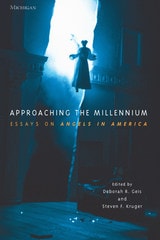
Approaching the Millennium
Essays on Angels in AmericaDeborah R. Geis and Steven F. Kruger, Editors
University of Michigan Press, 1997
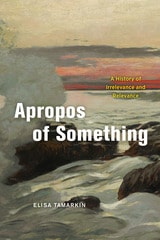
Apropos of Something
A History of Irrelevance and RelevanceElisa Tamarkin
University of Chicago Press, 2022
Before 1800 nothing was irrelevant. So argues Elisa Tamarkin’s sweeping meditation on a key shift in consciousness: the arrival of relevance as the means to grasp how something that was once disregarded, unvalued, or lost to us becomes interesting and important. When so much makes claims to our attention every day, how do we decide what is most valuable right now?
Relevance, Tamarkin shows, was an Anglo-American concept, derived from a word meaning “to raise or to lift up again,” and also “to give relief.” It engaged major intellectual figures, including Ralph Waldo Emerson and pragmatists and philosophers—William James, Alain Locke, John Dewey, and Alfred North Whitehead—as well as a range of critics, phenomenologists, linguists, and sociologists. Relevance is a struggle for recognition, especially in the worlds of literature, art, and criticism. Poems and paintings in the nineteenth century could now be seen as pragmatic works that make relevance and make interest—that reveal versions of events that feel apropos of our lives the moment we turn to them.
Vividly illustrated with paintings by Winslow Homer, Henry Ossawa Tanner, and others, Apropos of Something is a searching philosophical and poetic study of relevance—a concept calling for shifts in both attention and perceptions of importance with enormous social stakes. It remains an invitation for the humanities and for all of us who feel tasked every day with finding the point.
Arabs in the Mirror
Images and Self-Images from Pre-Islamic to Modern TimesBy Nissim Rejwan
University of Texas Press, 2008
What is an Arab? Though many in the West would answer that question with simplistic stereotypes, the reality is far more complex and interesting. Arabs themselves have been debating Arab identity since pre-Islamic times, coming to a variety of conclusions about the nature and extent of their “Arabness.” Likewise, Westerners and others have attempted to analyze Arab identity, reaching mostly negative conclusions about Arab culture and capacity for self-government.
To bring new perspectives to the question of Arab identity, Iraqi-born scholar Nissim Rejwan has assembled this fascinating collection of writings by Arab and Western intellectuals, who try to define what it means to be Arab. He begins with pre-Islamic times and continues to the last decades of the twentieth century, quoting thinkers ranging from Ibn Khaldun to modern writers such as al-Ansari, Haykal, Ahmad Amin, al-'Azm, and Said. Through their works, Rejwan shows how Arabs have grappled with such significant issues as the influence of Islam, the rise of nationalism, the quest for democracy, women's status, the younger generation, Egypt's place in the Arab world, Israel's role in Middle Eastern conflict, and the West's "cultural invasion."
By letting Arabs speak for themselves, Arabs in the Mirror refutes a prominent Western stereotype—that Arabs are incapable of self-reflection or self-government. On the contrary, it reveals a rich tradition of self-criticism and self-knowledge in the Arab world.
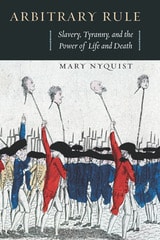
Arbitrary Rule
Slavery, Tyranny, and the Power of Life and DeathMary Nyquist
University of Chicago Press, 2013
Throughout, Nyquist demonstrates how principles relating to political slavery and tyranny are bound up with a Roman jurisprudential doctrine that sanctions the power of life and death held by the slaveholder over slaves and, by extension, the state, its representatives, or its laws over its citizenry.
Archaeologies of Modernity
Avant-Garde BildungRainer Rumold
Northwestern University Press, 2015
Archaeologies of Modernity explores the shift from the powerful tradition of literary forms of Bildung—the education of the individual as the self—to the visual forms of “Bildung” (from Bild) that characterize German modernism and the European avant-garde. Interrelated chapters examine the work of Franz Kafka, Jean/Hans Arp, Walter Benjamin, and Carl Einstein, and of artists such as Oskar Kokoschka or Kurt Schwitters, in the light of the surge of an autoformation (Bildung) of verbal and visual images at the core of expressionist and surrealist aesthetics and the art that followed. In this first scholarly focus on modernist avant-garde Bildung in its entwinement of conceptual modernity with forms of the archaic, Rumold resituates the significance of the poet and art theorist Einstein and his work on the language of primitivism and the visual imagination. Archaeologies of Modernity is a major reconsideration of the conception of the modernist project and will be of interest to scholars across the disciplines.
Archaeology and Its Avatars
Science and Culture in Latin AmericaJorge Coronado, Alexander Herrera Wassilowsky
Northwestern University Press, 2026
Illuminating the impact of archaeology on the culture and politics of Latin America
Since the mid-nineteenth century, archaeology has played a critical role in historicizing space and shaping cultural imaginaries. It has brought modern scientific practices into structured contact with ancient objects and landscapes, on the one hand, and modern Indigenous cultures in their material and historical complexity, on the other. Archaeology has thus served a variety of disciplines and practices, from history and anthropology to literary and social criticism and critical theory, and has actively animated practices quite distinct from itself, such as public policy, tourism, urban planning, art, literature, and nation-building.
This volume provides a unique analysis of a disciplinary formation crucial to the study of cultural history and theory in Latin America. The contributors represent archaeologists and scholars from a variety of disciplines within the humanities, each of whom approaches archaeology as theory and praxis. Collectively, they map the differences and similarities between archaeological interventions and the ways in which the materiality, practice, and discourse of archaeology have been taken up as analytic, metaphor, and discursive strategy.
Archaeopoetics
Word, Image, HistoryMandy Bloomfield
University of Alabama Press, 2016
Archaeopoetics explores “archaeological poetry,” ground-breaking and experimental writing by innovative poets whose work opens up broad new avenues by which contemporary readers may approach the past, illuminating the dense web of interconnections often lost in traditional historiography.
Critic Mandy Bloomfield traces the emergence of a significant historicist orientation in recent poetry, exemplified by the work of five writers: American poet Susan Howe, Korean-American artist Theresa Hak Kyung Cha, British poet Maggie O’Sullivan, and diasporic African Caribbean writers Kamau Brathwaite and M. NourbeSe Philip. Bloomfield sets the work of these five authors within a vigorous tradition, including earlier work by Ezra Pound and Walter Benjamin, and then shows how these five poets create poems that engender new encounters with pivotal episodes in history, such as the English regicide or Korea’s traumatized twentieth century.
Exploring our shared but imperfectly understood history as well as omissions and blind spots in historiography, Bloomfield outlines the tension between the irretrievability of effaced historical evidence and the hope that poetry may reconstitute such unrecoverable histories. She posits that this tension is fertile, engendering a form of aesthetically enacted epistemological enquiry.
Fascinating and seminal, Archaeopoetics pays special attention to the sensuous materiality of texts and most especially to the visual manifestations of poetry. The poems in this volume employ the visual imagery of the word itself or incorporate imagery into the poetry to propose persuasive alternatives to narrative or discursive frameworks of historical knowledge.
Archaic Greek Poetry
An AnthologySelected and translated by Barbara Hughes Fowler
University of Wisconsin Press, 1992
In addition to its breadth, Archaic Greek Poetry stands alone as the only volume of its kind translated by a contemporary published poet. Perhaps the most elegant translator of ancient Greek poetry into modern English, Barbara Hughes Fowler offers translations true to the original Greek while providing modern readers with superb examples of the beauty of lyric poetry. Students and scholars of classical and comparative literature, ancient history, and art history, as well as lovers of lyric poetry, will enthusiastically welcome this volume.
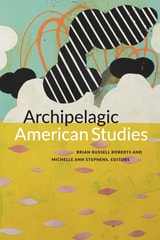
Archipelagic American Studies
Brian Russell Roberts and Michelle Ann Stephens, editors
Duke University Press, 2017
Birte Blascheck, J. Michael Dash, Paul Giles, Susan Gillman, Matthew Pratt Guterl, Hsinya Huang, Allan Punzalan Isaac, Joseph Keith, Yolanda Martínez-San Miguel, Brandy Nālani McDougall, Ifeoma Kiddoe Nwankwo, Craig Santos Perez, Brian Russell Roberts, John Carlos Rowe, Cherene Sherrard-Johnson, Ramón E. Soto-Crespo, Michelle Ann Stephens, Elaine Stratford, Etsuko Taketani, Alice Te Punga Somerville, Teresia Teaiwa, Lanny Thompson, Nicole A. Waligora-Davis
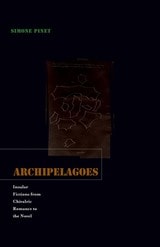
Archipelagoes
Insular Fictions from Chivalric Romance to the NovelSimone Pinet
University of Minnesota Press, 2010
Pinet looks closely at Amadís de Gaula and the Liber insularum archipelagi as the first examples of these genres. Both isolario and chivalric romance (libros de caballerías) make of the island a flexible yet cohesive framework that becomes intrinsic to the construction of their respective genres. The popularity of these forms throughout the seventeenth century in turn bears witness to the numerous possibilities the archipelagic structure offered, ultimately taken up by the grand genres of each discipline—the atlas and the novel.
Moving from verbal descriptions to engravings and tapestry weavings, and from the chivalric politics and ethics proposed in the Amadís de Gaula to the Insula Barataria episode in Don Quixote, Pinet’s analysis of insularity and the use of the island structure reveals diverging roles for fiction, illuminating both the emergence of the novel and contemporary philosophical discussion on fiction.
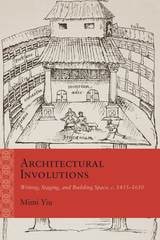
Architectural Involutions
Writing, Staging, and Building Space, c. 1435-1650Mimi Yiu
Northwestern University Press, 2014
Winner of the MLA Prize for Independent Scholars
Taking the reader on an inward journey from façades to closets, from physical to psychic space, Architectural Involutions offers an alternative genealogy of theater by revealing how innovations in architectural writing and practice transformed an early modern sense of interiority. The book launches from a matrix of related “platforms”—a term that in early modern usage denoted scaffolds, stages, and draftsmen’s sketches—to situate Alberti, Shakespeare, Jonson, and others within a landscape of spatial and visual change.
As the English house underwent a process of inward folding, replacing a logic of central assembly with one of dissemination, the subject who negotiated this new scenography became a flashpoint of conflict in both domestic and theatrical arenas. Combining theory with archival findings, Mimi Yiu reveals an emergent desire to perform subjectivity, to unfold an interior face to an admiring public. Highly praised for its lucid writing, comprehensive supplementary material, and engaging tone, Architectural Involutions was the winner of the 2016 MLA Prize for Independent Scholars.
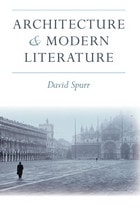
Architecture and Modern Literature
David Spurr
University of Michigan Press, 2012
Architecture and Modern Literature explores the representation and interpretation of architectural space in modern literature from the early nineteenth century to the present, with the aim of showing how literary production and architectural construction are related as cultural forms in the historical context of modernity. In addressing this subject, it also examines the larger questions of the relation between literature and architecture and the extent to which these two arts define one another in the social and philosophical contexts of modernity. Architecture and Modern Literature will serve as a foundational introduction to the emerging interdisciplinary study of architecture and literature. David Spurr addresses a broad range of material, including literary, critical, and philosophical works in English, French, and German, and proposes a new historical and theoretical overview of this area, in which modern forms of "meaning" in architecture and literature are related to the discourses of being, dwelling, and homelessness.
Architexts of Memory
Literature, Science, and AutobiographyEvelyne Ender
University of Michigan Press, 2005
"An important, cogently argued, subtle and rich study of a topic of great interest."
--Mieke Bal, University of Amsterdam
"A work of literary studies positioned at the intersection of tradition and innovation. Evelyne Ender's book brings fashionable cultural concerns to bear on traditional literary texts-her superb pedagogical skills lure and guide the reader through the most difficult psychoanalytical concepts."
--Nelly Furman, Cornell University
Evelyne Ender is Professor of French Studies, University of Washington. She is the author of Sexing the Mind: Nineteenth-Century Fictions of Hysteria.
Archival Afterlives
Cixous, Derrida, and the Matter of FriendshipLaura Hughes
Northwestern University Press, 2024
A capacious analysis of a legendary intellectual friendship and the material legacies it left behind
Over the course of their decades-long friendship, Hélène Cixous and Jacques Derrida assembled overlapping archives of written experiments and exchanges that document a shared interest in their literary afterlives. In this incisive account, Laura Hughes shows how pushing against the limits of writing and of life itself means not only imagining but manifesting a community of future readers.
Archival Afterlives: Cixous, Derrida, and the Matter of Friendship examines the embodied nature of literary creation, taking letters, fragments, notes, and other ephemera as objects of critical analysis and care. Combining close readings of key texts and previously unexamined archival materials, Hughes traces critical connections between Cixous and Derrida, between the theoretical and the autobiographical, and between life writing and its limits. In putting deconstruction into dialogue with new material analyses and archive studies, Archival Afterlives positions this historical and intellectual relationship as a lens through which to reexamine the legacy of critical theory itself.
Archival Fictions
Materiality, Form, and Media History in Contemporary LiteraturePaul Benzon
University of Massachusetts Press, 2021
Taking up works from Andy Warhol, Kevin Young, Don DeLillo, and Hari Kunzru, Archival Fictions considers how these writers have constructed a speculative history of media technology through formal experimentation. Although media technologies have determined the extent of what can be written, recorded, and remembered in the immediate aftermath of print's hegemony, Paul Benzon argues that literary form provides a vital means for critical engagement with the larger contours of media history. Drawing on approaches from media poetics, film studies, and the digital humanities, this interdisciplinary study demonstrates how authors who engage technology through form continue to imagine new roles for print literature across the late twentieth and early twenty-first centuries.
Archive Feelings
A Theory of Greek TragedyMario Telò
The Ohio State University Press, 2020
With bold readings of thirteen plays by Aeschylus, Sophocles, and Euripides, including the Oedipus cycle, the Oresteia,Medea, and Bacchae; an eclectic synthesis of Freud, Lacan, Derrida, Žižek, Deleuze, and other critical theorists; and an engagement with art, architecture, and film, Mario Telò’s Archive Feelings: A Theory of Greek Tragedy locates Greek tragedy’s aesthetic allure beyond catharsis in a vertiginous sense of giddy suspension, in a spiral of life and death that resists equilibrium, stabilization, and all forms of normativity. In so doing, Telò forges a new model of tragic aesthetics.
Archives of Labor
Working-Class Women and Literary Culture in the Antebellum United StatesLori Merish
Duke University Press, 2017
Arcticologies
Early Modern Actions for Our Warmer WorldLowell Duckert
University of Minnesota Press, 2025
Exploring the frozen past to rethink our warming future
Do we really know what cold is? In Arcticologies, Lowell Duckert delves into early modern European texts to trace how representations of frigidity from the sixteenth and seventeenth centuries have contributed to historical understandings of climate and contemporary debates on climate change. Arguing that human culture and science are, in fact, indebted to the cold, Duckert suggests that these early depictions offer critical terms for advancing the aims of climate-change activism and assisting in counterapocalyptic thinking.
An imaginative and intellectual journey, Arcticologies reveals the enduring role of cold in wide-ranging storytelling traditions. It draws on Shakespeare’s Hamlet and Othello and the works of Thomas Dekker, René Descartes, and Thomas Hobbes and is informed throughout by contemporary Indigenous writing, including that of Sheila Watt-Cloutier and Leanne Betasamosake Simpson. In reflecting on these assorted accounts, Duckert sees cold as not only an environmental hardship but a source of cultural creativity and resilience, highlighting moments of collaboration between humans and the icy world, from arctic exploration to urban fairs on frozen rivers.
Cold, Duckert makes clear, is more than the absence of warmth. Situating our contemporary obsession with impending planetary meltdown within the mazelike arcticologies of the past, Duckert shows how early modern cold brought about forms of curiosity, vocabulary, and interspecies relationality that can serve us today. In doing so, he asks us to identify what has been lost and who is at risk in today’s thinning cold—while also urging us to imagine alternative futures focused not on inevitable and total collapse but on adaptation and preserving what remains.

Are Girls Necessary?
Lesbian Writing and Modern HistoriesJulie Abraham
University of Minnesota Press, 2008
Are We There Yet?
Virtual Travel and Victorian RealismAlison Byerly
University of Michigan Press, 2012
Are We There Yet? Virtual Travel and Victorian Realismconnects the Victorian fascination with "virtual travel" with the rise of realism in nineteenth-century fiction and twenty-first-century experiments in virtual reality. Even as the expansion of river and railway networks in the nineteenth century made travel easier than ever before, staying at home and fantasizing about travel turned into a favorite pastime. New ways of representing place—360-degree panoramas, foldout river maps, exhaustive railway guides—offered themselves as substitutes for actual travel. Thinking of these representations as a form of "virtual travel" reveals a surprising continuity between the Victorian fascination with imaginative dislocation and twenty-first -century efforts to use digital technology to expand the physical boundaries of the self.
Argentina
Stories for a NationAmy K. Kaminsky
University of Minnesota Press, 2008
By the end of the twentieth century, Argentina’s complex identity-tango and chimichurri, Eva Perón and the Mothers of the Plaza de Mayo, the Falklands and the Dirty War, Jorge Luis Borges and Maradona, economic chaos and a memory of vast wealth-has become entrenched in the consciousness of the Western world.
In this wide-ranging and at times poetic new work, Amy K. Kaminsky explores Argentina’s unique national identity and the place it holds in the minds of those who live beyond its physical borders. To analyze the country’s meaning in the global imagination, Kaminsky probes Argentina’s presence in a broad range of literary texts from the United States, Poland, England, Western Europe, and Argentina itself, as well as internationally produced films, advertisements, and newspaper features.
Kaminsky’s examination reveals how Europe consumes an image of Argentina that acts as a pivot between the exotic and the familiar. Going beyond the idea of suffocating Eurocentrism as a theory of national identity, Kaminsky presents an original and vivid reading of national myths and realities that encapsulates the interplay among the many meanings of “Argentina” and its place in the world’s imagination.
Amy Kaminsky is professor of gender, women, and sexuality studies and global studies at the University of Minnesota and author of After Exile (Minnesota, 1999).
Arguing it Out
Discussion in Twelfth-Century ByzantiumAveril Cameron
Central European University Press, 2016
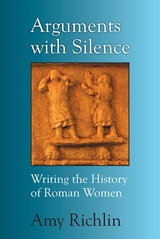
Arguments with Silence
Writing the History of Roman WomenAmy Richlin
University of Michigan Press, 2014
Women in ancient Rome challenge the historian. Widely represented in literature and art, they rarely speak for themselves. Amy Richlin, among the foremost pioneers in ancient studies, gives voice to these women through scholarship that scours sources from high art to gutter invective.
In Arguments with Silence, Richlin presents a linked selection of her essays on Roman women’s history, originally published between 1981 and 2001 as the field of “women in antiquity” took shape, and here substantially rewritten and updated. The new introduction to the volume lays out the historical methodologies these essays developed, places this process in its own historical setting, and reviews work on Roman women since 2001, along with persistent silences. Individual chapter introductions locate each piece in the social context of Second Wave feminism in Classics and the academy, explaining why each mattered as an intervention then and still does now.
Inhabiting these pages are the women whose lives were shaped by great art, dirty jokes, slavery, and the definition of adultery as a wife’s crime; Julia, Augustus’ daughter, who died, as her daughter would, exiled to a desert island; women wearing makeup, safeguarding babies with amulets, practicing their religion at home and in public ceremonies; the satirist Sulpicia, flaunting her sexuality; and the praefica, leading the lament for the dead.
Amy Richlin is one of a small handful of modern thinkers in a position to consider these questions, and this guided journey with her brings surprise, delight, and entertainment, as well as a fresh look at important questions.
Ariel
By José Enrique Rodó
University of Texas Press, 1988
"Irritating, insufferable, admirable, stimulating, disappointing Rodó: . . . you are part of our family quarrels, and must bear with your disrespectful, equally disappointed, intuitive, incomplete nephews, living in a world that you helped define for us, and offered unto our revolt." —from the Prologue by Carlos Fuentes
First published in 1900 Uruguay, Ariel is Latin America's most famous essay on esthetic and philosophical sensibility, as well as its most discussed treatise on hemispheric relations. Though Rodó protested the interpretation, his allegorical conflict between Ariel, the lover of beauty and truth, and Caliban, the evil spirit of materialism and positivism, has come to be regarded as a metaphor for the conflicts and cultural differences between Latin America and the United States. Generations of statesmen, intellectuals, and literary figures have been formed by this book, either in championing its teachings or in reacting against them. This edition of Ariel, prepared especially with teachers and students in mind, contains a reader's guide to names, places, and important movements, as well as notes and a comprehensive annotated English/Spanish bibliography.
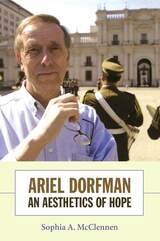
Ariel Dorfman
An Aesthetics of HopeSophia A. McClennen
Duke University Press, 2010
To illuminate Dorfman’s thematic concerns, McClennen chronicles the writer’s life, including his experiences working with Salvador Allende and his exile from Chile during the dictatorship of Augusto Pinochet, and she provides a careful account of his literary and cultural influences. Tracing his literary career chronologically, McClennen interprets Dorfman’s less-known texts alongside his most well-known works, which include How to Read Donald Duck, the pioneering critique of Western ideology and media culture co-authored with Armand Mattelart, and the award-winning play Death and the Maiden. In addition, McClennen provides two valuable appendices: a chronology documenting important dates and events in Dorfman’s life, and a full bibliography of his work in English and in Spanish.
Ariel and the Police
Frank Lentricchia
University of Wisconsin Press, 1989
In Ariel and the Police, Frank Lentricchia searches through the totalizing desires for power that have built and help to maintain tangible and intangible structures of confinement and purification within, and sometimes as, the house of modernism. And what he finds, in his lyrical effort to redeem the subject for history, is that someone lives there, slyly, sometimes even playfully defiant.
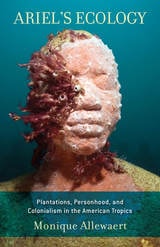
Ariel's Ecology
Plantations, Personhood, and Colonialism in the American TropicsMonique Allewaert
University of Minnesota Press, 2013
What happens if we abandon the assumption that a person is a discrete, world-making agent who acts on and creates place? This, Monique Allewaert contends, is precisely what occurred on eighteenth-century American plantations, where labor practices and ecological particularities threatened the literal and conceptual boundaries that separated persons from the natural world.
Integrating political philosophy and ecocriticism with literary analysis, Ariel’s Ecology explores the forms of personhood that developed out of New World plantations, from Georgia and Florida through Jamaica to Haiti and extending into colonial metropoles such as Philadelphia. Allewaert’s examination of the writings of naturalists, novelists, and poets; the oral stories of Africans in the diaspora; and Afro-American fetish artifacts shows that persons in American plantation spaces were pulled into a web of environmental stresses, ranging from humidity to the demand for sugar. This in turn gave rise to modes of personhood explicitly attuned to human beings’ interrelation with nonhuman forces in a process we might call ecological.
Certainly the possibility that colonial life revokes human agency haunts works from Shakespeare’s Tempest and Montesquieu’s Spirit of the Laws to Spivak’s theories of subalternity. In Allewaert’s interpretation, the transformation of colonial subjectivity into ecological personhood is not a nightmare; it is, rather, a mode of existence until now only glimmering in Che Guevara’s dictum that postcolonial resistance is synonymous with “perfect knowledge of the ground.”
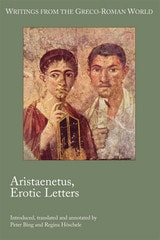
Aristaenetus, Erotic Letters
Peter Bing
SBL Press, 2014
The first complete English translation of Aristaenetus in nearly three centuries
Through allusion and adaption of earlier authors, Aristaenetus recounts tales that are the stuff of comedy, erotic poetry, and ancient novel. Here we read of lovers who use every trope of erotic literature to praise their beloveds in over-the-top speeches. Aristaenetus amazes us with tales of paramours hatching complicated schemes to achieve their desires, while wily go-betweens help smooth their way. He presents us with accounts of unfaithful spouses who barely avoid capture in the midst of hair-raising and amusing infidelities. This sixth century collection is perfect for anyone interested in classical and postclassical literature.
Features:
- English translation and Greek text on facing pages
- Introduction with history of the text
- Discussion of intertextual connections with Greco-Roman authors
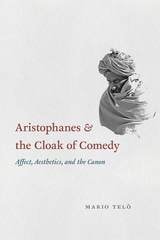
Aristophanes and the Cloak of Comedy
Affect, Aesthetics, and the CanonMario Telò
University of Chicago Press, 2016
Telò boldly traces Aristophanes’s rise, ironically, to the defeat of his play Clouds at the Great Dionysia of 423 BCE. Close readings of his revised Clouds and other works, such as Wasps, uncover references to the earlier Clouds, presented by Aristophanes as his failed attempt to heal the audience, who are reflected in the plays as a kind of dysfunctional father. In this proto-canonical narrative of failure, grounded in the distinctive feelings of different comic modes, Aristophanic comedy becomes cast as a prestigious object, a soft, protective cloak meant to shield viewers from the debilitating effects of competitors’ comedies and restore a sense of paternal responsibility and authority. Associations between afflicted fathers and healing sons, between audience and poet, are shown to be at the center of the discourse that has shaped Aristophanes’s canonical dominance ever since.
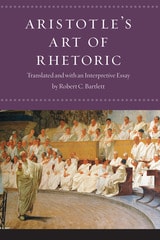
Aristotle's "Art of Rhetoric"
Aristotle
University of Chicago Press, 2019
Here Robert C. Bartlett offers a literal, yet easily readable, new translation of Aristotle’s “Art of Rhetoric,” one that takes into account important alternatives in the manuscript and is fully annotated to explain historical, literary, and other allusions. Bartlett’s translation is also accompanied by an outline of the argument of each book; copious indexes, including subjects, proper names, and literary citations; a glossary of key terms; and a substantial interpretive essay.
Aristotle's Poetics
Stephen Halliwell
University of Chicago Press, 1998
The core of the book is a fresh appraisal of Aristotle's view of tragic drama, in which Halliwell contends that at the heart of the Poetics lies a philosophical urge to instill a secularized understanding of Greek tragedy.
"Essential reading not only for all serious students of the Poetics . . . but also for those—the great majority—who have prudently fought shy of it altogether."—B. R. Rees, Classical Review
"A splendid work of scholarship and analysis . . . a brilliant interpretation."—Alexander Nehamas, Times Literary Supplement
Armed Ambiguity
Women Warriors in German Literature and Culture in the Age of GoetheJulie Koser
Northwestern University Press, 2016
Armed Ambiguity is a fascinating examination of the tropes of the woman warrior constructed by print culture—including press reports, novels, dramatic works, and lyrical texts—during the decades-long conflict in Europe around 1800.
In it, Julie Koser sheds new light on how women’s bodies became a battleground for competing social, cultural, and political agendas in one of the most pivotal periods of modern history. She traces the women warriors in this work as reflections of the social and political climate in German-speaking lands, and she reveals how literary texts and cultural artifacts that highlight women’s armed insurrection perpetuated the false dichotomy of "public" versus "private" spheres along a gendered fault line. Koser illuminates how reactionary visions of "ideal femininity" competed with subversive fantasies of new femininities in the ideological battle being waged over the restructuring of German society.
Arms and the Woman
Classical Tradition and Women Writers in the Venetian RenaissanceFrancesca D'Alessandro Behr
The Ohio State University Press, 2018
Arms and the Woman: Classical Tradition and Women Writers in the Venetian Renaissance by Francesca D’Alessandro Behr focuses on the classical reception in the works of female authors active in Venice during the Early Modern Age. Even in this relatively liberal city, women had restricted access to education and were subject to deep-seated cultural prejudices, but those who read and wrote were able, in part, to overcome those limitations.
In this study, Behr explores the work of Moderata Fonte and Lucrezia Marinella and demonstrates how they used knowledge of texts by Virgil, Ovid, and Aristotle to systematically reanalyze the biased patterns apparent both in the romance epic genre and contemporary society. Whereas these classical texts were normally used to bolster the belief in female inferiority and the status quo, Fonte and Marinella used them to envision societies structured according to new, egalitarian ethics. Reflecting on the humanist representation of virtue, Fonte and Marinella insisted on the importance of peace, mercy, and education for women. These authors took up the theme of the equality of genders and participated in the Renaissance querelle des femmes, promoting women’s capabilities and nature.
Around Quitting Time
Work and Middle-Class Fantasy in American FictionRobert Seguin
Duke University Press, 2001
Tracing connections between the reconstruction of the labor process and the aesthetic dilemmas of modernism, between the emergence of the modern state and the structure of narrative, Seguin analyzes the work of Nathanael West, Ernest Hemingway, Willa Cather, John Barth, and others. These fictional narratives serve to demonstrate for Seguin the pattern of social sites and cultural phenomenon that have emerged where work and leisure, production and consumption, and activity and passivity coincide. He reveals how, by creating pathways between these seemingly opposed domains, the middle-class imaginary at once captures and suspends the dynamics of social class and opens out onto a political and cultural terrain where class is both omnipresent and invisible.
Around Quitting Time will interest critics and historians of modern U.S. culture, literary scholars, and those who explore the interaction between economic and cultural forms.

Arranging Marriage
Conjugal Agency in the South Asian DiasporaMarian Aguiar
University of Minnesota Press, 2018
The first critical analysis of contemporary arranged marriage among South Asians in a global context
Arranged marriage is an institution of global fascination—an object of curiosity, revulsion, outrage, and even envy. Marian Aguiar provides the first sustained analysis of arranged marriage as a transnational cultural phenomenon, revealing how its meaning has been continuously reinvented within the South Asian diaspora of Britain, the United States, and Canada. Aguiar identifies and analyzes representations of arranged marriage in an interdisciplinary set of texts—from literary fiction and Bollywood films, to digital and print media, to contemporary law and policy on forced marriage.
Aguiar interprets depictions of South Asian arranged marriage to show we are in a moment of conjugal globalization, identifying how narratives about arranged marriage bear upon questions of consent, agency, state power, and national belonging. Aguiar argues that these discourses illuminate deep divisions in the processes of globalization constructed on a fault line between individualist and collectivist agency and in the process, critiques neoliberal celebrations of “culture as choice” that attempt to bridge that separation. Aguiar advocates situating arranged marriage discourses within their social and material contexts so as to see past reductive notions of culture and grasp the global forces mediating increasingly polarized visions of agency.
Arras Hanging
The Textile That Determined Early Modern Literature and DramaRebecca Olson
University of Delaware Press, 2014
Published by University of Delaware Press. Distributed worldwide by Rutgers University Press.
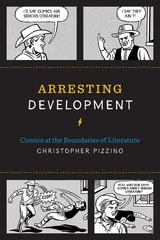
Arresting Development
Comics at the Boundaries of LiteratureBy Christopher Pizzino
University of Texas Press, 2016
Mainstream narratives of the graphic novel’s development describe the form’s “coming of age,” its maturation from pulp infancy to literary adulthood. In Arresting Development, Christopher Pizzino questions these established narratives, arguing that the medium’s history of censorship and marginalization endures in the minds of its present-day readers and, crucially, its authors. Comics and their writers remain burdened by the stigma of literary illegitimacy and the struggles for status that marked their earlier history.
Many graphic novelists are intensely aware of both the medium’s troubled past and their own tenuous status in contemporary culture. Arresting Development presents case studies of four key works—Frank Miller’s Batman: The Dark Knight Returns, Alison Bechdel’s Fun Home, Charles Burns’s Black Hole, and Gilbert Hernandez’s Love and Rockets—exploring how their authors engage the problem of comics’ cultural standing. Pizzino illuminates the separation of high and low culture, art and pulp, and sophisticated appreciation and vulgar consumption as continual influences that determine the limits of literature, the status of readers, and the value of the very act of reading.
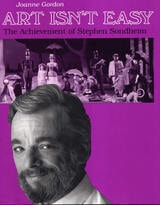
Art Isn't Easy
The Achievement of Stephen SondheimJoanne Gordon
Southern Illinois University Press, 1990
The new musical theatre of Stephen Sondheim shuns the traditional story of love triumphant, probing instead the more disturbing issues of contemporary life.
Confident that the musical is America’s greatest original contribution to theatre, Joanne Gordon explicates the works of Sondheim to repudiate the common perception of the genre as mere escapist entertainment.
Gordon notes that Sondheim tackles real themes, that he has no fear of introducing pain, trauma, and complex ideas onto the Broadway stage. Tracing Sondheim’s career from his initial success as lyricist for West Side Story and Gypsy to the opening of Into the Woods, Gordon demonstrates that the value of Sondheim’s work obviously lies in its seriousness of theme coupled with its disturbing content; less obvious, but equally important, is Sondheim’s innovative use of form.
From A Funny Thing Happened on the Way to the Forum through Anyone Can Whistle, Company, Follies, A Little Night Music, Pacific Overtures, Sweeney Todd, Merrily We Roll Along, Sunday in the Park with George, and Into the Woods, Sondheim’s music and lyrics prove to be inextricably woven into the fabric of the entire work. Both music and lyrics, Gordon stresses, "grow out of the dramatic idea inherent in the show’s concept and themselves become part of the drama that previous theatre songs would only reflect."
Sondheim, Gordon notes, asks much of an audience that may not want to be challenged. In short, to enjoy a Sondheim play, the audience must participate intellectually. The audience willing to expend the effort will not be cheated, Gordon insists, because Sondheim, throughout his career, has demonstrated that "musical theatre can be serious, poignant, and still exhilarating."
Art after Philosophy
Boris Pasternak's Early ProseElena Glazov-Corrigan
The Ohio State University Press, 2013
Art and Answerability
Early Philosophical EssaysBy M. M. Bakhtin
University of Texas Press, 1990
Art and Answerability contains three of Mikhail Bakhtin's early essays from the years following the Russian Revolution, when Bakhtin and other intellectuals eagerly participated in the debates, lectures, demonstrations, and manifesto writing of the period. Because they predate works that have already been translated, these essays—"Art and Answerability," "Author and Hero in Aesthetic Activity," and "The Problem of Content, Material, and Form in Verbal Art"—are essential to a comprehensive understanding of Bakhtin's later works. A superb introduction by Michael Holquist sets out the major themes and concerns of the three essays and identifies their place in the canon of Bakhtin's work and in intellectual history. The introduction, together with Vadim Liapunov's scholarly gloss, makes these essays accessible to students as well as scholars.
Art and Artifact in Austen
Anna Battigelli
University of Delaware Press, 2020
Published by University of Delaware Press. Distributed worldwide by Rutgers University Press.
Art in Doubt
Tolstoy, Nabokov, and the Problem of Other MindsTatyana Gershkovich
Northwestern University Press, 2021
Leo Tolstoy’s and Vladimir Nabokov’s radically opposed aesthetic worldviews emanate from a shared intuition—that approaching a text skeptically is easy, but trusting it is hard
Two figures central to the Russian literary tradition—Tolstoy, the moralist, and Nabokov, the aesthete—seem to have sharply conflicting ideas about the purpose of literature. Tatyana Gershkovich undermines this familiar opposition by identifying a shared fear at the root of their seemingly antithetical aesthetics: that one’s experience of the world might be entirely one’s own, private and impossible to share through art.
Art in Doubt: Tolstoy, Nabokov, and the Problem of Other Minds reconceives the pair’s celebrated fiction and contentious theorizing as coherent, lifelong efforts to reckon with the problem of other people’s minds. Gershkovich demonstrates how the authors’ shared yearning for an impossibly intimate knowledge of others formed and deformed their fiction and brought them through parallel logic to their rival late styles: Tolstoy’s rustic simplicity and Nabokov’s baroque complexity. Unlike those authors for whom the skeptical predicament ends in absurdity or despair, Tolstoy and Nabokov both hold out hope that skepticism can be overcome, not by force of will but with the right kind of text, one designed to withstand our impulse to doubt it. Through close readings of key canonical works—Anna Karenina, The Kreutzer Sonata, Hadji Murat, The Gift, Pale Fire—this book brings the twin titans of Russian fiction to bear on contemporary debates about how we read now, and how we ought to.
Art of Darkness
A Poetics of GothicAnne Williams
University of Chicago Press, 1995
Building on the psychoanalytic and feminist theory of Julia Kristeva, Williams argues that Gothic conventions such as the haunted castle and the family curse signify the fall of the patriarchal family; Gothic is therefore "poetic" in Kristeva's sense because it reveals those "others" most often identified with the female. Williams identifies distinct Male and Female Gothic traditions: In the Male plot, the protagonist faces a cruel, violent, and supernatural world, without hope of salvation. The Female plot, by contrast, asserts the power of the mind to comprehend a world which, though mysterious, is ultimately sensible. By showing how Coleridge and Keats used both Male and Female Gothic, Williams challenges accepted notions about gender and authorship among the Romantics. Lucidly and gracefully written, Art of Darkness alters our understanding of the Gothic tradition, of Romanticism, and of the relations between gender and genre in literary history.
Art, Music, and Literature, 1897-1902
Theodore Dreiser. Edited by Yoshinobu Hakutani
University of Illinois Press, 2007
In this volume, liberally seasoned with period illustrations, Yoshinobu Hakutani has collected and annotated a rich selection of Theodore Dreiser's pre-fame writings on the cultural milieu of his day.
In these brief essays, Dreiser sallies into the vibrant world of creative work in turn-of-the-century America. He inspects the eccentric and revealing paraphernalia of artists' studios, probes the work habits of writers, and goes behind the scenes in the popular song-writing business, where this week's celebrity is next week's has-been. He profiles famous figures and introduces numerous women artists, novelists, and musicians, including the prolific and tireless Amelia Barr (mother of fourteen children and author of thirty-two novels), the illustrator Alice B. Stephens, and the opera singer Lillian Nordica. Hakutani's notes provide biographical detail on dozens of now-obscure individuals mentioned by Dreiser.
Art, Theory, Revolution
The Turn to Generality in Contemporary LiteratureMitchum Huehls
The Ohio State University Press, 2022
Artaud and His Doubles
Kimberly Jannarone
University of Michigan Press, 2012
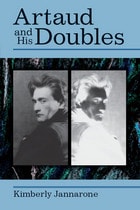
Artaud and His Doublesis a radical re-thinking of one of the most influential theater figures of the twentieth century. Placing Artaud's writing within the specific context of European political, theatrical, and intellectual history, the book reveals Artaud's affinities with a disturbing array of anti-intellectual and reactionary writers and artists whose ranks swelled catastrophically between the wars in Western Europe.
Kimberly Jannarone shows that Artaud's work reveals two sets of doubles: one, a body of peculiarly persistent received interpretations from the American experimental theater and French post-structuralist readings of the 1960s; and, two, a darker set of doubles—those of Artaud's contemporaries who, in the tumultuous, alienated, and pessimistic atmosphere enveloping much of Europe after World War I, denounced the degradation of civilization, yearned for cosmic purification, and called for an ecstatic loss of the self. Artaud and His Doubleswill generate provocative new discussions about Artaud and fundamentally challenge the way we look at his work and ideas.