Results by title
28164 books match the query 'History' and 2536 start with a
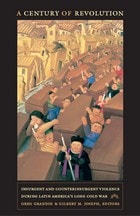
A Century of Revolution
Insurgent and Counterinsurgent Violence during Latin America's Long Cold WarGreg Grandin and Gilbert M. Joseph, eds.
Duke University Press, 2010
Contributors. Michelle Chase, Jeffrey L. Gould, Greg Grandin, Lillian Guerra, Forrest Hylton, Gilbert M. Joseph, Friedrich Katz, Thomas Miller Klubock, Neil Larsen, Arno J. Mayer, Carlota McAllister, Jocelyn Olcott, Gerardo Rénique, Corey Robin, Peter Winn
A Century of Transnationalism
Immigrants and Their Homeland ConnectionsEdited by Nancy L. Green and Roger Waldinger
University of Illinois Press, 2016
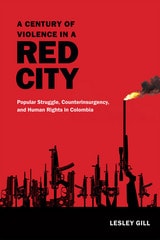
A Century of Violence in a Red City
Popular Struggle, Counterinsurgency, and Human Rights in ColombiaLesley Gill
Duke University Press, 2016
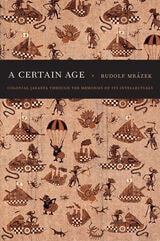
A Certain Age
Colonial Jakarta through the Memories of Its IntellectualsRudolf Mrázek
Duke University Press, 2010
When Mrázek began his interviews, he expected to discuss phenomena such as the transition from colonialism to postcolonialism. His interviewees, however, wanted to share more personal recollections. Mrázek illuminates their stories of the past with evocative depictions of their late-twentieth-century surroundings. He brings to bear insights from thinkers including Walter Benjamin, Bertold Brecht, Le Corbusier, and Marcel Proust, and from his youth in Prague, another metropolis with its own experience of passages and revolution. Architectural and spatial tropes organize the book. Thresholds, windowsills, and sidewalks come to seem more apt as descriptors of historical transitions than colonial and postcolonial, or modern and postmodern. Asphalt roads, homes, classrooms, fences, and windows organize movement, perceptions, and selves in relation to others. A Certain Age is a portal into questions about how the past informs the present and how historical accounts are inevitably partial and incomplete.
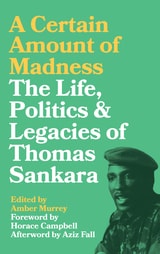
A Certain Amount of Madness
The Life Politics and Legacies of Thomas SankaraAmber Murrey
Pluto Press, 2018
This book looks at Sankara's political philosophies and legacies and their relevance today. Analyses of his synthesis of Pan-Africanism and humanist Marxist politics, as well as his approach to gender, development, ecology and decolonisation offer new insights to Sankarist political philosophies. Critical evaluations of the limitations of the revolution examine his relationship with labour unions and other aspects of his leadership style. His legacy is revealed by looking at contemporary activists, artists and politicians who draw inspiration from Sankarist thought in social movement struggles today, from South Africa to Burkina Faso.
In the 30th anniversary of his assassination, this book illustrates how Sankara's political praxis continues to provide lessons and hope for decolonisation struggles today.

A Cezanne in the Hedge and Other Memories of Charleston and Bloomsbury
Edited by Hugh Lee
University of Chicago Press, 1992
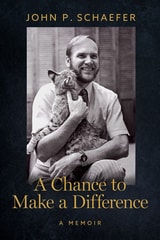
A Chance to Make a Difference
A MemoirJohn P. Schaefer
University of Arizona Press, 2025
Southwest Books of the Year Top Pick
John P. Schaefer was only thirty-six years old when he assumed the role of fifteenth president of the University of Arizona in 1971. The son of hardworking German immigrants, Schaefer grew up in Queens, New York, where childhood centered on sports, academics, and the great outdoors.
Earning a PhD in chemistry in 1958, Dr. Schaefer’s career skyrocketed through the ranks of academia, moving him from junior faculty to university president in a mere decade. As president, he led the University of Arizona through a transformational period of growth and is credited with securing the university’s status as a top-tier research institution.
A Chance to Make a Difference recounts poignant, eye-opening, and often humorous stories from childhood to presidency, revealing the characteristics of an inspiring university leader.
A Change Is Gonna Come
Music, Race & the Soul of AmericaCraig Werner
University of Michigan Press, 2006
—Notes
"No one has written this way about music in a long, long time. Lucid, insightful, with real spiritual, political, intellectual, and emotional grasp of the whole picture. A book about why music matters, and how, and to whom."
—Dave Marsh, author of Louie, Louie and Born to Run: The Bruce Springsteen Story
"This book is urgently needed: a comprehensive look at the various forms of black popular music, both as music and as seen in a larger social context. No one can do this better than Craig Werner."
—Henry Louis Gates, Jr., W.E.B. Du Bois Professor of the Humanities, Harvard University
"[Werner has] mastered the extremely difficult art of writing about music as both an aesthetic and social force that conveys, implies, symbolizes, and represents ideas as well as emotion, but without reducing its complexities and ambiguities to merely didactic categories."
—African American Review
A Change Is Gonna Come is the story of more than four decades of enormously influential black music, from the hopeful, angry refrains of the Freedom movement, to the slick pop of Motown; from the disco inferno to the Million Man March; from Woodstock's "Summer of Love" to the war in Vietnam and the race riots that inspired Marvin Gaye to write "What's Going On."
Originally published in 1998, A Change Is Gonna Come drew the attention of scholars and general readers alike. This new edition, featuring four new and updated chapters, will reintroduce Werner's seminal study of black music to a new generation of readers.
Craig Werner is Professor of Afro-American Studies at the University of Wisconsin, and author of many books, including Playing the Changes: From Afro-Modernism to the Jazz Impulse and Up Around the Bend: An Oral History of Creedence Clearwater Revival. His most recent book is Higher Ground: Stevie Wonder, Aretha Franklin, Curtis Mayfield, and the Rise and Fall of American Soul.
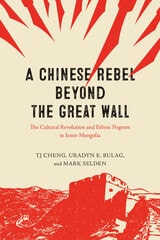
A Chinese Rebel beyond the Great Wall
The Cultural Revolution and Ethnic Pogrom in Inner MongoliaTJ Cheng, Uradyn E. Bulag, and Mark Selden
University of Chicago Press, 2023
During the Great Leap Forward, as hundreds of thousands of Chinese famine refugees headed to Inner Mongolia, Cheng Tiejun arrived in 1959 as a middle school student. In 1966, when the PRC plunged into the Cultural Revolution, he joined the Red Guards just as Inner Mongolia’s longtime leader, Ulanhu, was purged. With the military in control, and with deepening conflict with the Soviet Union and its ally Mongolia on the border, Mongols were accused of being nationalists and traitors. A pogrom followed, taking more than 16,000 Mongol lives, the heaviest toll anywhere in China.
At the heart of this book are Cheng’s first-person recollections of his experiences as a rebel. These are complemented by a close examination of the documentary record of the era from the three coauthors. The final chapter offers a theoretical framework for Inner Mongolia’s repression. The repression’s goal, the authors show, was not to destroy the Mongols as a people or as a culture—it was not a genocide. It was, however, a “politicide,” an attempt to break the will of a nationality to exercise leadership of their autonomous region. This unusual narrative provides urgently needed primary source material to understand the events of the Cultural Revolution, while also offering a novel explanation of contemporary Chinese minority politics involving the Uyghurs, Tibetans, and Mongols.
A Christian Samurai
William J. Farge
Catholic University of America Press, 2016
A Cinema Without Walls
Movies and Culture after VietnamCorrigan, Timothy
Rutgers University Press, 1991
How have modern advertising techniques, the widespread use of VCRs, conglomerate takeovers of studios and film archives, cable TV, and media coverage of the Vietnam war changed the ways we watch movies? And how, in turn, have those different habits and patterns of viewing changed the ways in which films address their viewers? Drawing on a wide variety of American and European films and on many theoretical models, Timothy Corrigan investigates what he calls "a cinema without walls," taking a close look at particular films in order to see how we watch them differently in the post-Vietnam era. He examines cult audiences, narrative structure, genre films (road movies, in particular), and contemporary politics as they engage new models of film making and viewing. He thus provides a rare, serious attempt to deal with contemporary movies. Corrigan discusses filmmakers from a variety of backgrounds and cultures, including Martin Scorsese, Raoul Ruiz, Michael Cimino, Alexander Kluge, Francis Ford Coppola, Stephen Frears, and Wim Wenders. He offers detailed analyses of films such as Platoon; Full Metal Jacket; 9-1/2 Weeks; The Singing Detective; Choose Me; After Hours; Badlands; The King of Comedy; Paris, Texas; and My Beautiful Laundrette. Orchestrating this diversity, Corrigan provides a critical basis for making sense of contemporary film culture and its major achievements.
A Circle of Trust
Remembering SNCCGreenberg, Cheryl L
Rutgers University Press, 1998
"The reminiscences and reflections voiced at the SNCC reunion remind us of the remarkable vision and courageous dedication of the civil rights movement of the 1960s. Framed by Cheryl Greenberg's eloquent and probing introduction, the SNCC veterans' comments about the triumphs and limitations of their movement represent a major contribution to the historical literature on race and power in modern America." --Raymond Arsenault, University of South Florida
On the occasion of the SNCC's 25th anniversary, more than 500 people gathered at Trinity College in Connecticut to both celebrate and critique its accomplishments. More than 40 SNCC members tell their stories and reflect on the contributions, limits and legacies of the movement in A Circle of Trust. Engaging in spirited debate with each other, with historians of the movement, and with contemporary political culture more broadly, these former and perpetual activists speak of their vision of a just society and what still remains to be done. With increasing racial tension and the continued debate over integration and separatism in America in the 1990s, the content of this conference is more relevant than ever.
Cheryl Lynn Greenberg begins with an overview of SNCC and introduces each of the chapters of oral history. Participants explore the origins of SNCC, its early adoption of nonviolent protest, its ultimate renunciation of liberal integration and embrace of militant black radicalism, its refusal to repudiate far-left organizations, and controversies over the roles of women in SNCC and society at large. The result is a thoughtful, moving, sometimes acrimonious, sometimes celebratory account of one of the most significant civil rights organizations and its successes and failures.
A City At War
Milwaukee Labor During World War IIRichard L. Pifer
Wisconsin Historical Society Press, 2003
A City Called Heaven
Chicago and the Birth of Gospel MusicRobert Marovich
University of Illinois Press, 2015
A City Called Heaven celebrates a sound too mighty and too joyous for even church walls to hold.
A City Divided
The Racial Landscape of Kansas City, 1900-1960Sherry Lamb Schirmer
University of Missouri Press, 2002
As the African American population grew in size and assertiveness, whites increasingly identified blacks with those factors that most deprived a given space of its middle-class character. Consequently, African Americans came to represent the antithesis of middle-class values, and the white middle class established its identity by excluding blacks from the urban spaces it occupied.
By 1930, racial discrimination rested firmly on gender and family values as well as class. Inequitable law enforcement in the ghetto increased criminal activity, both real and perceived, within the African American community. White Kansas Citians maintained this system of racial exclusion and denigration in part by “misdirection,” either by denying that exclusion existed or by claiming that segregation was necessary to prevent racial violence. Consequently, African American organizations sought to counter misdirection tactics. The most effective of these efforts followed World War II, when local black activists devised demonstration strategies that targeted misdirection specifically.
At the same time, a new perception emerged among white liberals about the role of race in shaping society. Whites in the local civil rights movement acted upon the belief that integration would produce a better society by transforming human character. Successful in laying the foundation for desegregating public accommodations in Kansas City, black and white activists nonetheless failed to dismantle the systems of spatial exclusion and inequitable law enforcement or to eradicate the racial ideologies that underlay those systems.
These racial perceptions continue to shape race relations in Kansas City and elsewhere. This study demystifies these perceptions by exploring their historical context. While there have been many studies of the emergence of ghettos in northern and border cities, and others of race, gender, segregation, and the origins of white ideologies, A City Divided is the first to address these topics in the context of a dynamic, urban society in the Midwest.
A City for Children
Women, Architecture, and the Charitable Landscapes of Oakland, 1850-1950Marta Gutman
University of Chicago Press, 2014
In A City for Children, Marta Gutman focuses on the use and adaptive reuse of everyday buildings in Oakland, California, to make the city a better place for children. She introduces us to the women who were determined to mitigate the burdens placed on working-class families by an indifferent industrial capitalist economy. Often without the financial means to build from scratch, women did not tend to conceive of urban land as a blank slate to be wiped clean for development. Instead, Gutman shows how, over and over, women turned private houses in Oakland into orphanages, kindergartens, settlement houses, and day care centers, and in the process built the charitable landscape—a network of places that was critical for the betterment of children, families, and public life. The industrial landscape of Oakland, riddled with the effects of social inequalities and racial prejudices, is not a neutral backdrop in Gutman’s story but an active player. Spanning one hundred years of history, A City for Children provides a compelling model for building urban institutions and demonstrates that children, women, charity, and incremental construction, renovations, alterations, additions, and repurposed structures are central to the understanding of modern cities.
A City on a Lake
Urban Political Ecology and the Growth of Mexico CityMatthew Vitz
Duke University Press, 2018
A City within a City
The Black Freedom Struggle in Grand Rapids, MichiganTodd E Robinson
Temple University Press, 2012
A City within a City cogently argues that the post-war political reform championed by local Republicans transformed the city's racial geography, creating a racialized "city within a city," featuring a system of "managerial racism" designed to keep blacks in declining inner-city areas. As Robinson indicates, this bold, provocative framework for understanding race relations in Grand Rapids has broader implications for illuminating the twentieth-century African American urban experience in secondary cities.
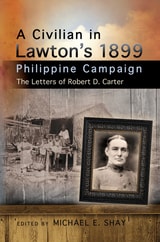
A Civilian in Lawton's 1899 Philippine Campaign
The Letters of Robert D. CarterEdited by Michael E. Shay
University of Missouri Press, 2013
In the midst of the Philippine-American War, twenty-two-year-old Robert Dexter Carter served in Manila as a civilian quartermaster clerk. Through his letters to his family, he provided a vivid picture of army life in Manila—the sights, the smells, and his responses to the native culture. In addition to his letters, his diary and several related articles present a firsthand account of the historic voyage of the United States Army Transport Grant through the Suez Canal to Manila in early 1899. Carter’s writings not only tell of his sometimes harrowing experiences, but also reveal the aspirations and fears of a young man not quite sure of his next steps on life’s journey.
Carter’s father, Robert Goldthwaite Carter, was a war hero and a longtime friend of Maj. Gen. Henry W. Lawton. Carter obtained his position through Lawton’s influence, and his respect for Lawton is clear throughout his writings. A frequent guest in the Lawton home, the young clerk was introduced to many notable figures both military and civilian. Carter’s letters, particularly to his father, are full of news and gossip related to his commander. In other letters, he reveals the kindness and generosity of Mrs. Lawton, who took time to look out for Carter while he was in the hospital and often loaned him books.
This well-researched and expertly edited work casts light on the role of support troops in war, a subject too often minimized or ignored. Shay begins each chapter with an introduction that establishes the setting, the context of events, and the disposition of Carter and his compatriots and provides notes and commentary to place the letters in context. By choosing not to edit the offensive expletives of a sometimes arrogant and racist young man, Shay presents a fully nuanced portrait of a young American exploring the larger world in a time of turmoil.
Enhanced by photographs from collections at the Library of Congress and the Military History Institute, as well as many of Carter’s own whimsical drawings, the book will appeal to armchair historians and scholars alike.
A Clubbable Man
Essays on Eighteenth-Century Literature and Culture in Honor of Greg ClinghamAnthony W. Lee
Bucknell University Press, 2022
A Coalition of Lineages
The Fernandeño Tataviam Band of Mission IndiansDuane Champagne and Carole Goldberg
University of Arizona Press, 2021
The history of Southern California’s Indigenous communities is mapped through the story of family and their descendants, or lineages. The authors explain how politically and culturally independent lineages merged and strengthened via marriage, creating complex and enduring coalitions among Indigenous communities. The Indigenous people of Southern California faced waves of colonizers—the Spanish, then the Mexicans, followed by Americans—and their coalitions allowed them to endure to today.
Champagne and Goldberg are leading experts in Native sovereignty policies and histories. They worked in collaboration with members of the Fernandeño Tataviam Band of Mission Indians to illustrate how the community formed and persisted. A Coalition of Lineages is not only the story of a Native Southern California community, it is also a model for multicultural tribal development for recognized and nonrecognized Indian nations in the United States and elsewhere.
A Cold War State of Mind
Brainwashing and Postwar American SocietyMatthew W. Dunne
University of Massachusetts Press, 2013
First popularized during the 1950s, the concept of “brainwashing” is often viewed as an example of Cold War paranoia, an amusing relic of a bygone era. Yet as Matthew W. Dunne shows in this study, over time brainwashing came to connote much more than a sinister form of Communist mind control, taking on broader cultural and political meanings.
Moving beyond well-known debates over Korean War POWs and iconic cultural texts like The Manchurian Candidate, Dunne explores the impact of the idea of brainwashing on popular concerns about freedom, individualism, loyalty, and trust in authority. By the late 1950s the concept had been appropriated into critiques of various aspects of American life such as an insistence on conformity, the alleged “softening” of American men, and rampant consumerism fueled by corporate advertising that used “hidden” or “subliminal” forms of persuasion. Because of these associations and growing anxieties about the potential misuse of psychology, concerns about brainwashing contributed to a new emphasis on individuality and skepticism toward authority in the 1960s. The notion even played an unusual role in the 1968 presidential race, when Republican frontrunner George Romney's claim that he had been “brainwashed” about the Vietnam War by the Johnson administration effectively destroyed his campaign.
In addition to analyzing the evolving meaning of brainwashing over an extended period of time, A Cold War State of Mind explores the class and gender implications of the idea, such as the assumption that working-class POWs were more susceptible to mind control and that women were more easily taken in by the manipulations of advertisers.

A Collection of Ranter Writings
Spiritual Liberty and Sexual Freedom in the English RevolutionNigel Smith
Pluto Press, 2014
The Ranters - like the Levellers and the Diggers - were a group of religious libertarians who flourished during the English Civil War (1642–1651), a period of social and religious turmoil which saw, in the words of the historian Christopher Hill, 'the world turned upside down'.
A Collection of Ranter Writings is the most notable attempt to anthologise the key Ranter writings, bringing together some of the most remarkable, visionary and unforgettable texts. The subjects range from the limits to pleasure and divine right, to social justice and collective action.
The Ranters have intrigued and captivated generations of scholars and philosophers. This carefully curated collection will be of great interest to historians, philosophers and all those trying to understand past radical traditions.
A Collective Pursuit
Teachers' Unions and Education ReformLesley Lavery
Temple University Press, 2020
Teachers’ unions are the organizations responsible for safeguarding the conditions of teachers’ employment. Union supporters claim strong synergies between teachers’ interests and students’ interests, but critics of unions insist that the stance of teachers in collective bargaining may disadvantage students as unions reduce the power of administrators to manage, remove, reward or retain excellent teachers.
In A Collective Pursuit, Lesley Laveryunpacks how teachers’ unions today are fighting for contracts that allow them to earn a decent living and build “schools all students deserve.” She explains the form and function of the nation’s largest teachers’ unions. Lavery then explores unionization campaigns in the Twin Cities charter schools. A Collective Pursuit also examines teacher strikes and contract negotiations, school finance and finance reform, and district and union attempts to address racial achievement gaps, to provide a context for understanding the economic, political, and demographic forces that inspire teachers to improve conditions for students.
A Collective Pursuit emphasizes that while teachers’ unions serve a traditional, economic role, they also provide a vast array of valuable services to students, educators, parents, and community members.
A Colonel in the Armored Divisions
A Memoir, 1941-1945William S. Triplet, Edited by Robert H. Ferrell
University of Missouri Press, 2001
In this fascinating memoir William S. Triplet continues the saga begun in his earlier book, A Youth in the Meuse-Argonne: A Memoir, 1917-1918. After serving in World War I, Triplet chose to become a career military man and entered West Point. Upon graduation in 1924, his assignments were routine—to regiments in the Southwest and in Panama or as an officer in charge of Reserve Officers' Training Corps units or of men sent to a tank school. All this changed, however, when a new war opened in Europe.
From 1940 to1942, Triplet was assigned to the Infantry Board at Fort Benning, Georgia, where he engaged in testing new weapons and machines for the expanding army. He became a full colonel in December 1942. After leaving Benning he received posts with four armored forces: the Thirteenth Armored Division forming in the United States, an amphibious tank and troop carrier group training at Fort Ord, California, and the Second and Seventh Armored Divisions in Europe. His extraordinary abilities as a tank commander became evident in the Seventh Armored, where he took over a four-thousand-man unit known as Combat Command A. He was soon moving from triumph to triumph as he led his unit into Germany. Here was much room for professional judgment and decision, and the colonel was in his element. In the war's last days Triplet and his men fought their way to the Baltic, preventing many German troops from joining in the defense of Berlin against the advancing Soviet army.
Although Triplet was recommended for brigadier general, Dwight D. Eisenhower believed the U.S. Army had enough generals to finish the war; thus, the indomitable Triplet served out the few remaining years of his career as a colonel. After retiring in 1954, Triplet moved to Leesburg, Virginia, where he soon began to mull over his military experiences. Fascinated by the history he had witnessed, engaged by the attraction of writing about it, he recorded his memories with a combination of verve, thoughtfulness, and harsh judgments concerning ranking officers he considered incompetent— generals not excluded.
Through his annotations, Robert H. Ferrell provides the historical context for Triplet's experiences. Well written and completely absorbing, A Colonel in the Armored Divisions provides readers the rare opportunity to see firsthand what a real professional in the U.S. Army thought about America's preparation for and participation in the war against Germany and Japan.
A Colonial Lexicon
Of Birth Ritual, Medicalization, and Mobility in the CongoNancy Rose Hunt
Duke University Press, 1999
Relying on archival research in England and Belgium, as well as fieldwork in the Congo, Hunt reconstructs an ethnographic history of a remote British Baptist mission struggling to survive under the successive regimes of King Leopold II’s Congo Free State, the hyper-hygienic, pronatalist Belgian Congo, and Mobutu’s Zaire. After exploring the roots of social reproduction in rituals of manhood, she shows how the arrival of the fast and modern ushered in novel productions of gender, seen equally in the forced labor of road construction and the medicalization of childbirth. Hunt focuses on a specifically interwar modernity, where the speed of airplanes and bicycles correlated with a new, mobile medicine aimed at curbing epidemics and enumerating colonial subjects. Fascinating stories about imperial masculinities, Christmas rituals, evangelical humor, colonial terror, and European cannibalism demonstrate that everyday life in the mission, on plantations, and under a strongly Catholic colonial state was never quite what it seemed. In a world where everyone was living in translation, privileged access to new objects and technologies allowed a class of “colonial middle figures”—particularly teachers, nurses, and midwives—to mediate the evolving hybridity of Congolese society. Successfully blurring conventional distinctions between precolonial, colonial, and postcolonial situations, Hunt moves on to discuss the unexpected presence of colonial fragments in the vibrant world of today’s postcolonial Africa.
With its close attention to semiotics as well as sociology, A Colonial Lexicon will interest specialists in anthropology, African history, obstetrics and gynecology, medical history, religion, and women’s and cultural studies.
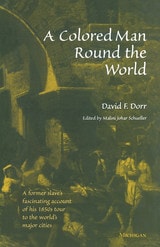
A Colored Man Round the World
David F. Dorr
University of Michigan Press, 1999
Malini Johar Schueller has edited and annotated the 1858 text and added a critical introduction that provides a useful context for understanding and appreciating this important but heretofore neglected document. Her edition of A Colored Man Round the World provides a fascinating account of Dorr's negotiation of the conflicting roles of slave versus man, taking into account all of the racial complexities that existed at the time. As a traveler abroad, Dorr claimed an American selfhood that allowed him mobility in Europe, and he benefited from the privileges accorded American "Orientalists" venturing in the near East. However, any empowerment that Dorr experienced while a tourist vanished upon his return to America.
The book will be welcomed for the rare perspective it provides of the mid-nineteenth century, through the eyes of an African-American slave and for the light it casts on world and U.S. history as well as on questions of racial and national identity.
Malini Johar Schueller is Professor of English, University of Florida.
A Comedy Called Susenbrotus
Connie McQuillen
University of Michigan Press, 1998
Susenbrotus is in many ways representative of later university comedy. It is a rowdy, bawdy farce with roots in the Roman comedies of Plautus and Terence. The wit and much of the humor in these plays is in the reworking of traditional themes with characters and situations adapted to contemporary types and topical satire. Almost every playwright for the professional stage (with the notable exception of Shakespeare) either wrote or acted in university plays. Moreover, they were popular forms of entertainment and were attended not only by members of the academic community but also by visiting dignitaries, courtiers, foreign ambassadors, and on occasion, the English monarchs.
Susenbrotus is special among later university plays because it was specifically written for King James I. It was meant to flatter the king, who prided himself on his humanist education, with a display of wit and erudition. It was also meant to entertain: the play itself is quite funny. It involves the antics of several contemporary types (the pedant, a poet, a Spanish dandy, and a braggart soldier) vying for the affection of a cross-dressed boy. Much of the wit in Susenbrotus is verbal: scholarly puns, sexual metaphors, classical allusions, and quotations that are explained in annotations. The sustained transvestitism of the character Fortunia distinguishes it from its classical sources as well as from other plays of its type. Unlike Latin texts that were submitted to publishing houses and therefore corrected or stylized by printers, Susenbrotus is an example of Latin as it was written in the seventeenth century.
Connie McQuillen is Associate Professor of Humanities, Southwest State University, Minnesota.
A Commentary on Aristophanes' Knights
Carl Arne Anderson and T. Keith Dix
University of Michigan Press, 2020
In addition to the complete Greek text and commentary, this volume includes a substantial introduction to the playwright’s career and to the historical and political background of the play. It includes advice for students on grammar and syntax, meter, festivals and staging, as well as topical and literary references and allusions that will help guide students to a mature appreciation of the comedy’s humor, seriousness, and artistic quality. Priced and sized for classroom use, this is the first full commentary on Knights since 1901 and will be widely welcomed.
A Commentary on Cicero, De Divinatione I
Celia E. Schultz
University of Michigan Press, 2014
A Commentary on Cicero, De Divinatione II
Andrew R. Dyck
University of Michigan Press, 2020
Celia Schultz’s earlier volume in this series presented the text and commentary for De Divinatione I. With Andrew Dyck’s companion volume on the second book of De Divinatione, students and teachers are well served with crucial texts from one of Rome’s most famous philosophers, as he considers important Roman practices and beliefs.
A Commentary on Cicero, De Legibus
Andrew R. Dyck
University of Michigan Press, 2004
Surprisingly, de Legibus has been one of Cicero's most neglected works. Andrew R. Dyck's commentary is the first to appear on the complete work in well over one hundred years. Dyck provides a detailed interpretation and sets the essay into the context of the politics and philosophical thought of its time. While previous commentaries focused primarily on grammar and textual criticism, this one also seeks to relate Cicero's text to the political, philosophical, and religious trends of his day. The author identifies the influences on Cicero's thinking and analyzes the relation of this theoretical treatise to his other works. This commentary is based on a new text, worked out in consultations between the author and Jonathan Powell of Royal Holloway, London.
Andrew Dyck is Professor of Classics, University of California at Los Angeles.
A Commentary on Cicero, De Natura Deorum II
Andrew R. Dyck
University of Michigan Press, 2025
A Commentary on Cicero, De Officiis
Andrew R. Dyck
University of Michigan Press, 1997
Composed in haste shortly before Cicero's death, de Officiis has exercised enormous influence over the centuries. It is all the more surprising that Andrew R. Dyck's volume is the first detailed English commentary on the work written in this century. It deals with the problems of the Latin text (taking account of Michael Winterbottom's new edition), it delineates the work's structure and sometimes elusive train of thought, clarifies the underlying Greek and Latin concepts, and provides starting points for approaching the philosophical and historical problems that de Officiis raises.
A work of major importance for classicists, philosophers, and ancient historians, this Commentary will be an invaluable companion to all readers of Cicero's last philosophical work.
Andrew R. Dyck is Professor of Classics, University of California, Los Angeles.
Publication of this volume is supported by a grant from the National Endowment for the Humanities.
A Commentary on Plautus' Curculio
T. H. M. Gellar-Goad
University of Michigan Press, 2024
This up-to-date, authoritative commentary on the play will prove useful to directors and actors and will readily introduce students to the joys of Roman comedy.

A Common Law for Europe
Barbara Pasa
Central European University Press, 2005
A Communist Odyssey
The life of József Pogány/John PepperThomas Sakmyster
Central European University Press, 2012
A Community Built on Words
The Constitution in History and PoliticsH. Jefferson Powell
University of Chicago Press, 2002
Combining history and theory, Powell analyzes a series of constitutional controversies from 1790 to 1944 to demonstrate that constitutional law from its very beginning has involved politically charged and ideologically divisive arguments. Nowhere in our past can one find the golden age of apolitical constitutional thinking that a great deal of contemporary scholarship seeks or presupposes. Viewed over time, American constitutional law is a history of political dispute couched in constitutional terms.
Powell then takes his conclusions one step further, claiming that it is precisely this historical tradition of argument that has given American constitutional law a remarkable coherence and integrity over time. No matter what the particular political disputes of the day might be, constitutional argument has provided a shared language through which our political community has been able to fight out its battles without ultimately fracturing.
A Community Built on Words will be must reading for any student of constitutional history, theory, or law.
A Community of Writers
Paul Engle and the Iowa Writers' WorkshopDana, Robert
University of Iowa Press, 1999
With these words, written long before his Iowa Writers' Workshop became world famous, much imitated, and academically rich, Paul Engle captured the spirit behind his beloved workshop. Now, in this collection of essays by and about those writers who shared the energetic early years, Robert Dana presents a dynamic, informative tribute to Engle and his world.
The book's three sections mingle myth and history with style and grace and no small amount of humor. The beginning essays are given over to memories of Paul Engle in his heyday. The second group focuses particularly on those teachers—Robert Lowell, John Berryman, Kurt Vonnegut, for example—who made the workshop hum on a day-to-day basis. Finally, the third section is devoted to storytelling: tall tales, vignettes, surprises, sober and not-so-sober moments. Engle's own essay, "The Writer and the Place," describes his "simple, and yet how reckless" conviction that "the creative imagination in all of the arts is as important, as congenial, and as necessary, as the historical study of all the arts."
Today, of course, there are hundreds of writers' workshops, many of them founded and directed by graduates of the original Iowa workshop. But when Paul Engle arrived in Iowa there were exactly two. His indomitable nature and great persuasive powers, combined with his distinguished reputation as a poet, loomed large behind the enhancement of the Iowa Writers' Workshop. This volume of fine and witty essays reveals the enthusiasm and drive and sheer pleasure that went into Iowa's renowned workshop.
A Companion to Apollonius of Rhodes
Ruth Scodel
University of Michigan Press, 2025
A Companion to Apollonius of Rhodes aims to help contemporary readers appreciate what is most characteristic of Apollonius’ epic—its fascination with ritual and myth, gods who act without the direction of Zeus, frequent distanced narration, the portrayal of characters in situations where there are no good choices. It includes thorough analyses of the poem’s relationship to contemporary art with illustrations and treats familiar topics, such as Jason’s leadership, with nuance. Contributors include Benjamin Acosta-Hughes, Annemarie Ambühl, Anja Bettenworth, Keyne Cheshire, Christopher Chinn, James Clauss, Adele Teresa Cozzoli, Kristopher Fletcher, Alexander Hollmann, Regina Höschele, Niklas Holzberg, Alison Keith, Adolf Köhnken†, Anatole Mori, William H. Race, Norman Sandridge, Selina Stewart, Stefanie Stürner, and Graham Zanker.
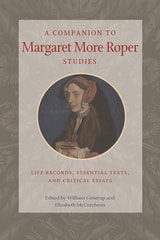
A Companion to Margaret More Roper Studies
Life Records, Essential Texts, and Critical EssaysElizabeth McCutcheon
Catholic University of America Press, 2022
Margaret More Roper is the learned daughter of St. Thomas More, the Catholic martyr; their lives are closely linked to each other and to early sixteenth-century changes in politics and religion and the social upheaval and crises of conscience that they brought. Specifically, Roper's major works - her translation of Erasmus's commentary on the Lord's Prayer and the long dialogue letter between More and Roper on conscience - highlight two major preoccupations of the period: Erasmian humanism and More's last years, which led to his death and martyrdom.
Roper was one of the most learned women of her time and a prototype of the woman writer in England, and this edited volume is a tribute to her life, writings, and place among early women authors. It combines comprehensive and convenient joining of biographical, textual, historical, and critical components within a single volume for the modern reader. There is no comparable study in print, and it fills a significant gap in studies of early modern women writers.
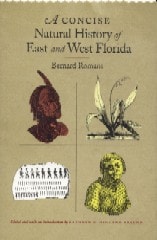
A Concise Natural History of East and West Florida
Bernard Romans, edited and with an introduction by Kathryn E. Holland Braund
University of Alabama Press, 2013
Braund presents the only annotated edition of Bernard Romans's rare and valuable 18th-century account of his observations in the southeastern United States.
Bernard Romans's A Concise Natural History of East and West Florida, William Bartram's Travels, and James Adair's History of the American Indian are the three most significant accounts of the southeastern United States published during the late 18th century. This new edition of Romans's Concise Natural History, edited by historian Kathryn Braund, provides the first fully annotated edition of this early and rare description of both the European settled areas and the adjoining Indian lands in what are now the states of Florida, Georgia, Alabama, Mississippi, and Louisiana.
Romans's purpose in producing his Concise Natural History was twofold: to aid navigators and shippers by detailing the sailing passages of the region and to promote trade and settlement in the region. To those ends, he provided detailed scientific observations on the natural history of the area, a summary of the region's political history, and an assessment of the potential for economic growth in the Floridas based on the area's natural resources.
A trained surveyor and cartographer and a self-taught naturalist, Romans supplied detailed descriptions of the region's topography and environment, including information about the climate and weather patterns, plants, animals, and diseases. He provided information about the state of scientific inquiry in the South and touched on many of the most important intellectual arguments of the day, such as the origin of the races, the practice of slavery, and the benefits and drawbacks of monopoly on trade.
In addition, Concise Natural History can be placed firmly in the genre of colonial promotional literature. Romans's book was an enthusiastic guide aimed at those seeking to establish modest holdings in the region:
"What a field is open here! . . . No country ever had such inexhaustible resources; no empire had ever half so many advantages combining in its behalf!" Romans explained how settlers should travel to the area, what they would need in terms of provisions and tools, and what it would cost to have their land surveyed. In addition to providing an abundance of practical advice, Romans also offered information about the history of earlier settlements, including the earliest and most complete account of New Smyrna near St. Augustine.
Romans also presented unique information about the various Indian tribes he encountered. In fact, historians agree that among the most useful portions of the book are Romans's descriptions of the largest Indian tribes in the 18th-century Southeast: the Creeks, Choctaws, and Chickasaws. Romans's account of the diet of the Creeks and Choctaws is one of the most complete available. And his description of the location of Choctaw village sites is one of the best sources for this information.
A Conditional Embrace
Black Queer Feminism in PerformanceKristyl D. Tift
The Ohio State University Press, 2026
In A Conditional Embrace, Kristyl D. Tift seeks to understand how Black queer women theater and film artists depict their own survival in heterosexist temporalities and spaces. Using the framework of lovin’ on—a theory inspired by Black feminist thought, performance theory, and queer theory—Tift closely reads the works of a selection of artists to investigate the “conditional embrace” of Black queer art in society. Her intersectional and intertextual methodology considers the text and body as part and parcel of performance work, allowing her to examine the multiple and complex intersections of identity at play in works meant to be read and performed. Tift puts the work of more visible artists such as Dee Rees, Sharon Bridgforth, and Staceyann Chin in direct conversation with lesser-known contributors to Black queer feminist performance such as Shirlene Holmes and Donnetta Lavinia Grays, analyzing not only their plays, installations, and poetry but also interviews, personal essays, performances, and more. Centering the works of artists situated, by birth or migration, in the Southern US and the Caribbean, A Conditional Embrace explores how artists at the margins of art and society represent Black queer women’s survival through processes of self-making, community-building, and homemaking.
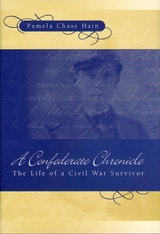
A Confederate Chronicle
The Life of a Civil War SurvivorPamela Chase Hain
University of Missouri Press, 2005
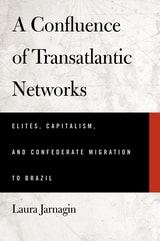
A Confluence of Transatlantic Networks
Elites, Capitalism, and Confederate Migration to BrazilLaura Jarnagin
University of Alabama Press, 2013
A Confluence of Transatlantic Network demonstrates how portions of interconnected trust-based kinship, business, and ideational transatlantic networks evolved over roughly a century and a half and eventually converged to engender, promote, and facilitate the migration of southern elites to Brazil in the post–Civil War era. Placing that migration in the context of the Atlantic world sharpens our understanding of the transborder dynamic of such mainstream nineteenth-century historical currents as international commerce, liberalism, Protestantism, and Freemasonry. The manifestation of these transatlantic forces as found in Brazil at midcentury provided disaffected Confederates with a propitious environment in which to try to re-create a cherished lifestyle.
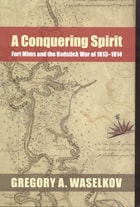
A Conquering Spirit
Fort Mims and the Redstick War of 1813–1814Gregory A. Waselkov
University of Alabama Press, 2009
WINNER, ADULT NONFICTION BOOK OF THE YEAR AWARD BY THE ALABAMA LIBRARY ASSOCIATION
WINNER, CLINTON JACKSON COLEY AWARD FROM THE ALABAMA HISTORICAL ASSOCIATION
Uncovering the Forgotten Battle That Changed a Nation.
The Fort Mims massacre changed the course of American history in many ways, not the least of which was the ensuing rise of one Andrew Jackson to the national stage. The unprecedented Indian victory over the encroaching Americans who were bent on taking their lands and destroying their culture horrified many and injured the young nation's pride. Tragedies such as this one have always rallied Americans to a common cause: a single-minded determination to destroy the enemy and avenge the fallen. The August 30, 1813 massacre at Fort Mims, involving hundreds of dead men, women, and children, was just such a spark.
Gregory Waselkov tells compellingly the story of this fierce battle at the fortified plantation home of Samuel Mims in the Tensaw District of the Mississippi Territory. With valuable maps, tables, and artifact illustrations, Waselkov looks closely at the battle to cut through the legends and misinformation that have grown around the event almost from the moment the last flames died at the smoldering ruins. At least as important as the details of the battle, though, is his elucidation of how social forces remarkably converged to spark the conflict and how reverberations of the battle echo still today, nearly two hundred years later.
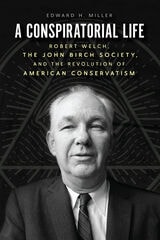
A Conspiratorial Life
Robert Welch, the John Birch Society, and the Revolution of American ConservatismEdward H. Miller
University of Chicago Press, 2021
Though you may not know his name, Robert Welch (1899-1985)—founder of the John Birch Society—is easily one of the most significant architects of our current political moment. In A Conspiratorial Life, the first full-scale biography of Welch, Edward H. Miller delves deep into the life of an overlooked figure whose ideas nevertheless reshaped the American right.
A child prodigy who entered college at age 12, Welch became an unlikely candy magnate, founding the company that created Sugar Daddies, Junior Mints, and other famed confections. In 1958, he funneled his wealth into establishing the organization that would define his legacy and change the face of American politics: the John Birch Society. Though the group’s paranoiac right-wing nativism was dismissed by conservative thinkers like William F. Buckley, its ideas gradually moved from the far-right fringe into the mainstream. By exploring the development of Welch’s political worldview, A Conspiratorial Life shows how the John Birch Society’s rabid libertarianism—and its highly effective grassroots networking—became a profound, yet often ignored or derided influence on the modern Republican Party. Miller convincingly connects the accusatory conservatism of the midcentury John Birch Society to the inflammatory rhetoric of the Tea Party, the Trump administration, Q, and more. As this book makes clear, whether or not you know his name or what he accomplished, it’s hard to deny that we’re living in Robert Welch’s America.

A Conspiratorial Life
Robert Welch, the John Birch Society, and the Revolution of American ConservatismEdward H. Miller
University of Chicago Press, 2021
This is an auto-narrated audiobook edition of this book.
The first full-scale biography of Robert Welch, who founded the John Birch Society and planted some of modern conservatism’s most insidious seeds.
Though you may not know his name, Robert Welch (1899-1985)—founder of the John Birch Society—is easily one of the most significant architects of our current political moment. In A Conspiratorial Life, the first full-scale biography of Welch, Edward H. Miller delves deep into the life of an overlooked figure whose ideas nevertheless reshaped the American right.
A child prodigy who entered college at age 12, Welch became an unlikely candy magnate, founding the company that created Sugar Daddies, Junior Mints, and other famed confections. In 1958, he funneled his wealth into establishing the organization that would define his legacy and change the face of American politics: the John Birch Society. Though the group’s paranoiac right-wing nativism was dismissed by conservative thinkers like William F. Buckley, its ideas gradually moved from the far-right fringe into the mainstream. By exploring the development of Welch’s political worldview, A Conspiratorial Life shows how the John Birch Society’s rabid libertarianism—and its highly effective grassroots networking—became a profound, yet often ignored or derided influence on the modern Republican Party. Miller convincingly connects the accusatory conservatism of the midcentury John Birch Society to the inflammatory rhetoric of the Tea Party, the Trump administration, Q, and more. As this book makes clear, whether or not you know his name or what he accomplished, it’s hard to deny that we’re living in Robert Welch’s America.
A Constant Struggle
Deaf Education in New South Wales Since World War IINaomi Malone
Gallaudet University Press, 2019
A Constitutional History of the U.S. Supreme Court
Richard Regan
Catholic University of America Press, 2015