Results by title
18284 books match the query 'United States' and 1653 start with a

America's Gothic Fiction
The Legacy of Magnalia Christi AmericanaDorothy Z. Baker
The Ohio State University Press, 2007
America's Inequality Trap
Nathan J. Kelly
University of Chicago Press, 2019
Nathan J. Kelly argues that a key reason for this is that rising concentrations of wealth create a politics that makes reducing economic inequality more difficult. Kelly convincingly shows that, when a small fraction of the people control most of the economic resources, they also hold a disproportionate amount of political power, hurtling us toward a self-perpetuating plutocracy, or an “inequality trap.” Among other things, the rich support a broad political campaign that convinces voters that policies to reduce inequality are unwise and not in the average voter’s interest, regardless of the real economic impact. They also take advantage of interest groups they generously support to influence Congress and the president, as well as state governments, in ways that stop or slow down reform. One of the key implications of this book is that social policies designed to combat inequality should work hand-in-hand with political reforms that enhance democratic governance and efforts to fight racism, and a coordinated effort on all of these fronts will be needed to reverse the decades-long trend.
America's Japan and Japan's Performing Arts
Cultural Mobility and Exchange in New York, 1952-2011Barbara E. Thornbury
University of Michigan Press, 2013
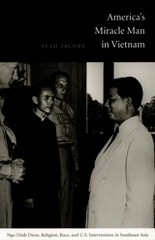
America's Miracle Man in Vietnam
Ngo Dinh Diem, Religion, Race, and U.S. Intervention in Southeast AsiaSeth Jacobs
Duke University Press, 2004
A diplomatic and cultural history, America’s Miracle Man in Vietnam draws on government archives, presidential libraries, private papers, novels, newspapers, magazines, movies, and television and radio broadcasts. Jacobs shows in detail how, in the 1950s, U.S. policymakers conceived of Cold War anticommunism as a crusade in which Americans needed to combine with fellow Judeo-Christians against an adversary dangerous as much for its atheism as for its military might. He describes how racist assumptions that Asians were culturally unready for democratic self-government predisposed Americans to excuse Diem’s dictatorship as necessary in “the Orient.” By focusing attention on the role of American religious and racial ideologies, Jacobs makes a crucial contribution to our understanding of the disastrous commitment of the United States to “sink or swim with Ngo Dinh Diem.”
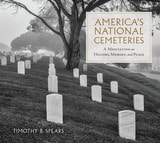
America's National Cemeteries
A Meditation on History, Memory, and PlaceTimothy B. Spears, Foreword by Roderick Gainer
University of Alabama Press, 2025
A poignant photographic tour of honor, sacrifice, and memory within America's national cemeteries
In America’s National Cemeteries, Timothy B. Spears takes the reader on a grand tour of these singular places of commemoration, the final resting place for more than four million American military personnel who died either in wartime, during their time of service, or after their honorable discharge. His absorbing account—part historical narrative and part travelogue—is enhanced by 180 of his remarkable photographs, which capture the spirit, beauty, and solemn remembrance to be found in each of the 156 national cemeteries across America.
Spears details the history of the cemeteries since their establishment during the American Civil War and explores their ongoing evolution and importance to American society and the commitment America has made to honoring its military dead. With headstones neatly arrayed in rows and each soldier typically buried in an identical fashion, the cemeteries symbolize an enduring connection between human mortality and national identity. They also reflect the nation’s persistent challenges with inequalities and injustice, violence and racism, lingering questions about “good” versus “bad” wars, and the vexed legacies of America’s military forays.
In this unique meditation on American history, memory, and place, Spears embraces the impact of the past on the present, offering an original perspective on the meaning of military service, mortality, and remembrance and how these national cemeteries have evolved into truly iconic and emblematic American spaces. The book also features a foreword by Roderick Gainer, Chief Curator of Arlington National Cemetery since 2013.
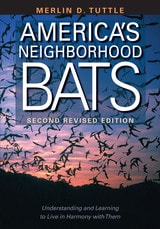
America's Neighborhood Bats
Understanding and Learning to Live in Harmony with ThemBy Merlin D. Tuttle
University of Texas Press, 2005
Since its first publication in 1988, America's Neighborhood Bats has changed the way we look at bats by underscoring their harmless and beneficial nature. In this second revised edition, Merlin Tuttle offers bat aficionados the most up-to-date bat facts, including a wealth of new information on bat house design and current threats to bat survival.
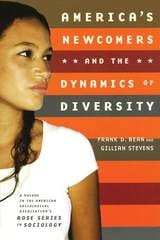
America's Newcomers and the Dynamics of Diversity
Frank D. Bean
Russell Sage Foundation, 2003
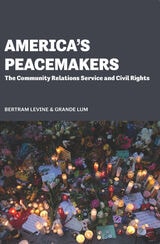
America's Peacemakers
The Community Relations Service and Civil RightsBertram Levine
University of Missouri Press, 2020
Covered in this expanded edition are the post–9/11 efforts of the CRS to prevent violence and hate crimes against those perceived as Middle Eastern. Also discussed are the cross-border Elián González custody dispute and the notable tragedies of Trayvon Martin and Michael Brown, both of which brought police interaction with communities of color back into the spotlight.
The 2009 Matthew Shepard and James Byrd, Jr., Hate Crimes Prevention Act substantially altered CRS’s jurisdiction, which began to focus on gender, gender identity, religion, sexual orientation, and disability in addition to race, color, and national origin. Lum’s documentation of this expanded jurisdiction provides insight into the progression of civil rights. The ongoing story of the Community Relations Service is a crucial component of the national narrative on civil rights and conflict resolution. This new edition will be highly informative to all readers and useful to professionals and academics in the civil rights, dispute resolution, domestic and international peacemaking, and law enforcement-community relations fields.

America's Philosopher
John Locke in American Intellectual LifeClaire Rydell Arcenas
University of Chicago Press, 2022
The influence of polymath philosopher John Locke (1632–1704) can still be found in a dizzying range of fields, as his writings touch on issues of identity, republicanism, and the nature of knowledge itself. Claire Rydell Arcenas’s new book tells the story of Americans’ longstanding yet ever-mutable obsession with this English thinker’s ideas, a saga whose most recent manifestations have found the so-called Father of Liberalism held up as a right-wing icon.
The first book to detail Locke’s trans-Atlantic influence from the eighteenth century until today, America’s Philosopher shows how and why interpretations of his ideas have captivated Americans in ways few other philosophers—from any nation—ever have. As Arcenas makes clear, each generation has essentially remade Locke in its own image, taking inspiration and transmuting his ideas to suit the needs of the particular historical moment. Drawing from a host of vernacular sources to illuminate Locke’s often contradictory impact on American daily and intellectual life from before the Revolutionary War to the present, Arcenas delivers a pathbreaking work in the history of ideas.

America's Philosopher
John Locke in American Intellectual LifeClaire Rydell Arcenas
University of Chicago Press, 2022
This is an auto-narrated audiobook edition of this book.
America’s Philosopher examines how John Locke has been interpreted, reinterpreted, and misinterpreted over three centuries of American history.
The influence of polymath philosopher John Locke (1632–1704) can still be found in a dizzying range of fields, as his writings touch on issues of identity, republicanism, and the nature of knowledge itself. Claire Rydell Arcenas’s new book tells the story of Americans’ longstanding yet ever-mutable obsession with this English thinker’s ideas, a saga whose most recent manifestations have found the so-called Father of Liberalism held up as a right-wing icon.
The first book to detail Locke’s trans-Atlantic influence from the eighteenth century until today, America’s Philosopher shows how and why interpretations of his ideas have captivated Americans in ways few other philosophers—from any nation—ever have. As Arcenas makes clear, each generation has essentially remade Locke in its own image, taking inspiration and transmuting his ideas to suit the needs of the particular historical moment. Drawing from a host of vernacular sources to illuminate Locke’s often contradictory impact on American daily and intellectual life from before the Revolutionary War to the present, Arcenas delivers a pathbreaking work in the history of ideas.
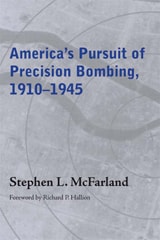
America's Pursuit of Precision Bombing, 1910-1945
Stephen L. McFarland
University of Alabama Press, 2008
Carl Norden, its brilliant and eccentric inventor, was a Dutch national who never became an American citizen. He took little interest in the day-to-day operations of the firm that bore his name, doing the bulk of his design work at his mother's home in Switzerland, even in 1939-40. His designs were sent back to the United States via sealed diplomatic pouch. Complications arose in World War II when the U.S. Navy retained three-quarters of the instruments despite having little need for them. Also, as production shifted from hand-crafting to mass production, the accuracy of the bombsights fell.
McFarland's exhaustive account remains a definitive and authoritative history of this fascinating piece of technology.
America's Religions
From Their Origins to the Twenty-first CenturyPeter W. Williams
University of Illinois Press, 2015
America's Religious Crossroads
Faith and Community in the Emerging MidwestStephen T. Kissel
University of Illinois Press, 2021
Perceptive and broad in scope, America’s Religious Crossroads illuminates the integral relationship between communal and spiritual growth in early Midwestern history.
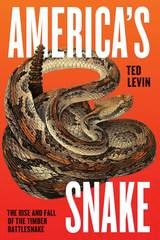
America's Snake
The Rise and Fall of the Timber RattlesnakeTed Levin
University of Chicago Press, 2016
Yet most of us have never seen a timber rattler. Though they’re found in thirty-one states, and near many major cities, in contemporary America timber rattlesnakes are creatures mostly of imagination and innate fear.
Ted Levin aims to change that with America’s Snake, a portrait of the timber rattlesnake, its place in America’s pantheon of creatures and in our own frontier history—and of the heroic efforts to protect it against habitat loss, climate change, and the human tendency to kill what we fear. Taking us from labs where the secrets of the snake’s evolutionary history are being unlocked to far-flung habitats whose locations are fiercely protected by biologists and dedicated amateur herpetologists alike, Levin paints a picture of a fascinating creature: peaceable, social, long-lived, and, despite our phobias, not inclined to bite. The timber rattler emerges here as emblematic of America and also, unfortunately, of the complicated, painful struggles involved in protecting and preserving the natural world.
A wonderful mix of natural history, travel writing, and exemplary journalism, America’s Snake is loaded with remarkable characters—none more so than the snake at its heart: frightening, perhaps; endangered, certainly; and unquestionably unforgettable.
America's Spiritual Capital
Nicholas N. Capaldi
St. Augustine's Press, 2012
America's Switzerland
Estes Park and Rocky Mountain National Park, the Growth YearsJames H. Pickering
University Press of Colorado, 2005
America's Teilhard
Susan Kassman Sack
Catholic University of America Press, 2019
America's Vietnam
The Longue Durée of U.S. Literature and EmpireMarguerite Nguyen
Temple University Press, 2018
America’s Vietnam challenges the prevailing genealogy of Vietnam’s emergence in the American imagination—one that presupposes the Vietnam War as the starting point of meaningful Vietnamese-U.S. political and cultural involvements. Examining literature from as early as the 1820s, Marguerite Nguyen takes a comparative, long historical approach to interpreting constructions of Vietnam in American literature. She analyzes works in various genres published in English and Vietnamese by Monique Truong and Michael Herr as well as lesser-known writers such as John White, Harry Hervey, and Võ Phiến. The book’s cross-cultural prism spans Paris, Saigon, New York, and multiple oceans, and its departure from Cold War frames reveals rich cross-period connections.
America’s Vietnam recounts a mostly unexamined story of Southeast Asia’s lasting and varied influence on U.S. aesthetic and political concerns. Tracking Vietnam’s transition from an emergent nation in the nineteenth century to a French colony to a Vietnamese-American war zone, Nguyen demonstrates that how authors represent Vietnam is deeply entwined with the United States’ shifting role in the world. As America’s longstanding presence in Vietnam evolves, the literature it generates significantly revises our perceptions of war, race, and empire over time.

America's War
Talking about the Civil War and Emancipation on Their 150th AnniversariesAmerican Library Association, 2012
America's Working Man
Work, Home, and Politics Among Blue Collar Property OwnersDavid Halle
University of Chicago Press, 1984
America, Compromised
Lawrence Lessig
University of Chicago Press, 2018
So begins Lawrence Lessig's sweeping indictment of contemporary American institutions and the corruption that besets them. We can all see it—from the selling of Congress to special interests to the corporate capture of the academy. Something is wrong. It’s getting worse.
And it’s our fault. What Lessig shows, brilliantly and persuasively, is that we can’t blame the problems of contemporary American life on bad people, as our discourse all too often tends to do. Rather, he explains, “We have allowed core institutions of America’s economic, social, and political life to become corrupted. Not by evil souls, but by good souls. Not through crime, but through compromise.” Every one of us, every day, making the modest compromises that seem necessary to keep moving along, is contributing to the rot at the core of American civic life. Through case studies of Congress, finance, the academy, the media, and the law, Lessig shows how institutions are drawn away from higher purposes and toward money, power, quick rewards—the first steps to corruption.
Lessig knows that a charge so broad should not be levied lightly, and that our instinct will be to resist it. So he brings copious, damning detail gleaned from years of research, building a case that is all but incontrovertible: America is on the wrong path. If we don’t acknowledge our own part in that, and act now to change it, we will hand our children a less perfect union than we were given. It will be a long struggle. This book represents the first steps.
America, New Mexico
Robert Leonard Reid
University of Arizona Press, 1998
America
Exploration and TravelSteven E. Kagel
University of Wisconsin Press, 1979
Travel gets us from one place to another—often with wonderful attendant enjoyment–but exploration makes us understand our travel, the places we travel to—and ourselves. The essays in this collection constitute a major step toward this understanding. They open up new areas for concern and draw many valuable insights and conclusions.
American Academic Cultures
A History of Higher EducationPaul H. Mattingly
University of Chicago Press, 2017
Mattingly sketches out seven broad generational cultures: evangelical, Jeffersonian, republican/nondenominational, industrially driven, progressively pragmatic, internationally minded, and the current corporate model. What we see through his close analysis of each of these cultures in their historical moments is that the politics of higher education, both inside and outside institutions, are ultimately driven by the dominant culture of the time. By looking at the history of higher education in this new way, Mattingly opens our eyes to our own moment, and the part its culture plays in generating its politics and promise.
American Agriculture, Water Resources, and Climate Change
Edited by Gary D. Libecap and Ariel Dinar
University of Chicago Press, 2024
A collection of the most advanced and authoritative agricultural-economic research in the face of increasing water scarcity.
Agriculture has been critical in the development of the American economy. Except in parts of the western United States, water access has not been a critical constraint on agricultural productivity, but with climate change, this may no longer be the case. This volume highlights new research on the interconnections between American agriculture, water resources, and climate change. It examines climatic and geologic factors that affect the agricultural sector and highlights historical and contemporary farmer responses to varying conditions and water availability. It identifies the potential effects of climate change on water supplies, access, agricultural practices, and profitability, and analyzes technological, agronomic, management, and institutional adjustments. Adaptations such as new crops, production practices, irrigation technologies, water conveyance infrastructure, fertilizer application, and increased use of groundwater can generate both social benefits and social costs, which may be internalized with various institutional innovations. Drawing on both historical and present experiences, this volume provides valuable insights into the economics of water supply in American agriculture as climate change unfolds.
American Anatomies
Theorizing Race and GenderRobyn Wiegman
Duke University Press, 1995
American Anatomies takes the long view: What epistemological frameworks allowed the West, from the Renaissance forward, to schematize racial and gender differences and to create social hierarchies based on these differences? How have those epistemological regimes changed—and not changed—over time? Where are we now? With painstaking care, political passion, and intellectual daring, Wiegman analyzes the biological and cultural bases of racial and gender bias in order to reinvigorate the discussion of identity politics. She concludes that, for very different reasons, identity proves to be dangerous to minority and majority alike.
American Anti-Pastoral
Brookside, New Jersey and the Garden State of Philip RothThomas Gustafson
Rutgers University Press, 2024
American Anti-Pastoral reads the events in Roth’s novel in relation to the history of Brookside and its region. While Roth’s protagonist Seymour “Swede” Levov initially views Old Rimrock as an idyllic paradise within the Garden State, its real-world counterpart has a more complex past in its origins as a small industrial village, as well as a site for the politics of exclusionary zoning and a 1960s anti-war protest at its celebrated 4th of July parade. Literary historian and Brookside native Thomas Gustafson casts Roth’s canonical novel in a fresh light as he studies both Old Rimrock in comparison to Brookside and the novel in relationship to NJ literature, making a case for it as the Great New Jersey novel. For Roth fans and history buffs alike, American Anti-Pastoral peels back the myths about the bucolic Garden State countryside to reveal deep fissures along the fault-lines of race and religion in American democracy.
American Appetites
A Documentary ReaderJennifer Jensen Wallach
University of Arkansas Press, 2014
American Architects and Their Books, 1840-1915
Kenneth Hafertepe
University of Massachusetts Press, 2007
In this well-illustrated volume, a chronological sequel to American Architects and Their Books to 1848, twelve distinguished historians of architecture discuss from various points of view the books that inspired architects both famous and not-so-famous, and the books the architects themselves produced. They examine the multifaceted relationship of nineteenth- and early twentieth-century architects to print culture—the literary works that architects collected, used, argued over, wrote, illustrated, designed, printed, were inspired by, cribbed from, educated clients with, advertised their services through, designed libraries for, or just plain enjoyed. The result is a volume that presents the intersection of the history of architecture, the history of ideas, and the history of the book. Changes in print culture during this period had a significant impact on the architectural profession, as revealed in these well-informed scholarly essays.
In addition to the editors, contributors include Jhennifer A. Amundson, Edward R. Bosley, Ted Cavanagh, Elspeth Cowell, Elaine Harrington, Michael J. Lewis, Anne E. Mallek, Daniel D. Reiff, Earle G. Shettleworth, Jr., and Chris Szczesny-Adams. Among the architects discussed are A. J. Downing, Charles Sumner Greene, James Sims, Samuel Sloan, John Calvin Stevens, Thomas U. Walter, and Frank Lloyd Wright.
American Architects and the Mechanics of Fame
By Roxanne Kuter Williamson
University of Texas Press, 1991
Why does one talented individual win lasting recognition in a particular field, while another equally talented person does not? While there are many possible reasons, one obvious answer is that something more than talent is requisite to produce fame. The "something more" in the field of architecture, asserts Roxanne Williamson, is the association with a "famous" architect at the moment he or she first receives major publicity or designs the building for which he or she will eventually be celebrated.
In this study of more than six hundred American architects who have achieved a place in architectural histories, Williamson finds that only a small minority do not fit the "right person–right time" pattern. She traces the apprenticeship connection in case studies of Louis Sullivan, Frank Lloyd Wright, Henry Hobson Richardson, the firm of McKim, Mead & White, Latrobe and his descendants, the Bulfinch and Renwick Lines, the European immigrant masters, and Louis Kahn.
Although she acknowledges and discusses the importance of family connections, the right schools, self-promotion, scholarships, design competition awards, and promotion by important journals, Williamson maintains that the apprenticeship connection is the single most important predictor of architectural fame. She offers the intriguing hypothesis that what is transferred in the relationship is not a particular style or approach but rather the courage and self-confidence to be true to one's own vision. Perhaps, she says, this is the case in all the arts.
American Architects and the Mechanics of Fame is sure to provoke thought and comment in architecture and other creative fields.
American Arms Supermarket
By Michael T. Klare
University of Texas Press, 1985
U.S. arms sales to Third World countries rapidly escalated from $250 million per year in the 1950s and 1960s to $10 billion and above in the 1970s and 1980s. But were these military sales, so critical in their impact on Third World nations and on America’s perception of its global role, achieving the ends and benefits attributed to them by U.S. policymakers? In American Arms Supermarket, Michael T. Klare responds to this troubling, still-timely question with a resounding no, showing how a steady growth in arms sales places global security and stability in jeopardy.
Tracing U.S. policies, practices, and experiences in military sales to the Third World from the 1950s to the 1980s, Klare explains how the formation of U.S. foreign policy did not keep pace with its escalating arms sales—how, instead, U.S. arms exports proved to be an unreliable instrument of policy, often producing results that diminished rather than enhanced fundamental American interests. Klare carefully considers the whole spectrum of contemporary American arms policy, focusing on the political economy of military sales, the evolution of U.S. arms export policy from John F. Kennedy to Ronald Reagan, and the institutional framework for arms export decision making. Actual case studies of U.S. arms sales to Latin America, Iran, and the Middle East provide useful data in assessing the effectiveness of arms transfer programs in meeting U.S. foreign policy objectives.
The author also rigorously examines trouble spots in arms policy: the transfer of arms-making technology to Third World arms producers, the relationship between arms transfers and human rights, and the enforcement of arms embargoes on South Africa, Chile, and other “pariah” regimes. Klare also compares the U.S. record on arms transfers to the experiences of other major arms suppliers: the Soviet Union and the “big four” European nations—France, Britain, the former West Germany, and Italy. Concluding with a reasoned, carefully drawn proposal for an alternative arms export policy, Klare vividly demonstrates the need for cautious, restrained, and sensitive policy.
American Artifacts
Essays in Material CultureJules David Prown
Michigan State University Press, 2000
When defining culture, one must indeed take into account even the minutest of details. What of a lighter, for example, or a telephone? The essays in this new collection examine just that. The contributors pose not only a historical, pragmatic use for the items, but also delve into more imaginative aspects of what defines us as Americans. Both the lighter and the telephone are investigated, as well as how the lava lamp represents sixties counterculture and containment. The late nineteenth-century corset is discussed as an embodiment of womanhood, and an Amish quilt is used as an illustration of cultural continuity. These are just a few of the artifacts discussed. Scholars will be intrigued by the historical interpretations that contributors proposed concerning a teapot, card table, and locket; students will not only find merit in the expositions, but also by learning from the models how such interpretation can be carried out. This collection helps us understand that very thing that makes us who we are. Viewing these objects from both our past and our present, we can begin to define what it is to be American.

American Astronomy
Community, Careers, and Power, 1859-1940John Lankford
University of Chicago Press, 1997
research, teaching, or practice in the United States between 1859 and 1940, John Lankford
paints a meticulously documented portrait of this community. He tallies the number with and
without doctorates, the number that taught in colleges or universities versus those involved in
industrial or government work, the number of women versus men, and so on. He also
addresses the crucial question of power within the community—what it meant, which
astronomers had it, and what they did with it.
Drawing on more than a decade of archival research, Lankford attends to the numbers in
concise tables and figures, and takes care to focus through biographical sketches on the
human beings his data represent. This dual approach convincingly illustrates how the changing
structure of a scientific community can alter both the career trajectories of its members and the
nature of the scientific research they choose to pursue.
American Atrocity
The Types of Violence in LynchingGuy Lancaster
University of Arkansas Press, 2021
Lynching is often viewed as a narrow form of violence: either the spontaneous act of an angry mob against accused individuals, or a demonstration of white supremacy against an entire population considered subhuman. However, in this new treatise, historian Guy Lancaster exposes the multiple forms of violence hidden beneath the singular label of lynching.
Lancaster, who has written extensively on racial violence, details several lynchings of Blacks by white posses in post-Reconstruction Arkansas. Drawing from the fields of history, philosophy, cognitive science, sociology, and literary theory, and quoting chilling contemporary accounts, he argues that the act of lynching encompasses five distinct but overlapping types of violence. This new framework reveals lynching to be even more of an atrocity than previously understood: that mobs did not disregard the humanity of their victims but rather reveled in it; that they were not simply enacting personal vengeance but manifesting an elite project of subjugation. Lancaster thus clarifies and connects the motives and goals of seemingly isolated lynch mobs, embedding the practice in the ongoing enforcement of white supremacy. By interrogating the substance of lynching, American Atrocity shines new light on both past anti-Black violence and the historical underpinnings of our present moment.
American Beginnings
The Prehistory and Palaeoecology of BeringiaEdited by Frederick Hadleigh West
University of Chicago Press, 1996
"An invaluable resource. . . . It will no doubt remain the key reference book for Beringia for many years to come."—Steven Mithen, Journal of Human Evolution
"Extraordinary. The fifty-six contributors . . . represent the most prominent American and Russian researchers in the region."—Choice
"Publication of this well-illustrated compendium is a great service to early American and especially Siberian Upper Paleolithic archaeology."—Nicholas Saunders, New Scientist
"This is a great book . . . perhaps the greatest contribution to the archaeology of Beringia that has yet been published. . . . This is the kind of book to which archaeology should aspire."—Herbert D.G. Maschner, Antiquity

American Birkebeiner
The Nation's Greatest Ski MarathonJerome P. Poling
Wisconsin Historical Society Press, 2025
An exhilarating behind-the-scenes journey into the history of America’s largest cross-country ski race
Each February, cross-country skiers from across the nation and around the world descend upon the sleepy northern Wisconsin town of Hayward to compete in the American Birkebeiner—the largest cross-country ski race in North America. In American Birkebeiner: The Nation’s Greatest Ski Marathon, author and skier Jerome P. Poling traces the remarkable history of the famed “Birkie,” from its modest origins in the early 1970s to its modern incarnation as an international Nordic-themed festival and multi-day racing event drawing more than 30,000 skiers and spectators.
American Birkebeiner offers an up-close, behind-the-scenes tour of all things Birkie—from pre-race preparations and skier profiles to race-day highlights and history-making finishes. It also tells the story of visionary race founder Tony Wise and his efforts to popularize the sport of cross-country skiing in the Upper Midwest. The book delves into the origin and evolution of the world-class Birkebeiner Trail and the communities that support it, as well as the ways the American Birkebeiner Ski Foundation is adapting to climate change to help ensure the event thrives for years to come.
American Birkebeiner sparks with lively, narrative-driven prose and is based on extensive archival research, reporting, and personal interviews. The lavishly illustrated book also features 150 photographs, including intimate portraits of athletes pushed to the limits of their endurance, sweeping aerial shots of skiers and cheering crowds, and awe-inspiring winter vistas. An exquisitely crafted ode to an extraordinary race, American Birkebeiner will inspire winter sports fans and outdoor enthusiasts alike.
American Blockbuster
Movies, Technology, and WonderCharles R. Acland
Duke University Press, 2020
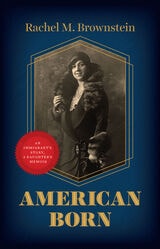
American Born
An Immigrant's Story, a Daughter's MemoirRachel M. Brownstein
University of Chicago Press, 2023
When she arrived alone in New York in 1924, eighteen-year-old Reisel Thaler resembled the other Yiddish-speaking immigrants from Eastern Europe who accompanied her. Yet she already had an American passport tucked in her scant luggage. Reisel had drawn her first breath on the Lower East Side of Manhattan in 1905, then was taken back to Galicia (in what is now Poland) by her father before she turned two. She was, as she would boast to the end of her days, “American born.”
The distinguished biographer and critic Rachel M. Brownstein began writing about her mother Reisel during the Trump years, dwelling on the tales she told about her life and the questions they raised about nationalism, immigration, and storytelling. For most of the twentieth century, Brownstein’s mother gracefully balanced her identities as an American and a Jew. Her values, her language, and her sense of timing inform the imagination of the daughter who recalls her in her own old age. The memorializing daughter interrupts, interprets, and glosses, sifting through alternate versions of the same stories using scenes, songs, and books from their time together.
But the central character of this book is Reisel, who eventually becomes Grandma Rose—always watching and judging, singing, baking, and bustling. Living life as the heroine of her own story, she reminds us how to laugh despite tragedy, find our courage, and be our most unapologetically authentic selves.
American Boundaries
The Nation, the States, the Rectangular SurveyBill Hubbard Jr.
University of Chicago Press, 2009
American Business and Political Power
Public Opinion, Elections, and DemocracyMark A. Smith
University of Chicago Press, 2000
Rather than succumbing to corporate America, Smith argues, representatives paradoxically become more responsive to their constituents when facing a united corporate front. Corporations gain the most influence over legislation when they work with organizations such as think tanks to shape Americans' beliefs about what government should and should not do.
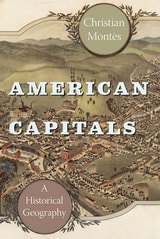
American Capitals
A Historical GeographyChristian Montès
University of Chicago Press, 2014
American Catastrophe
Fundamentalism, Climate Change, Gun Rights, and the Rhetoric of Donald J. TrumpLuke Winslow
The Ohio State University Press, 2020
Luke Winslow introduces the rhetorical homology as a critical tool useful for understanding how catastrophic appeals unite Americans across disparate religious, ecological, cultural, and political spheres. More specifically, the four case study chapters examining Christian fundamentalism, anti-environmentalism, gun rights messaging, and the administration of Donald Trump reveal a consistent formal pattern oriented toward catastrophe. In teasing out this orientation toward catastrophe, Winslow offers a fresh, provocative, and insightful contribution to our most pressing social challenges.
American Catholic Hospitals
A Century of Changing Markets and MissionsWall, Barbra Mann
Rutgers University Press, 2016
In American Catholic Hospitals, Barbra Mann Wall chronicles changes in Catholic hospitals during the twentieth century, many of which are emblematic of trends in the American healthcare system.
Wall explores the Church's struggle to safeguard its religious values. As hospital leaders reacted to increased political, economic, and societal secularization, they extended their religious principles in the areas of universal health care and adherence to the Ethical and Religious Values in Catholic Hospitals, leading to tensions between the Church, government, and society. The book also examines the power of women--as administrators, Catholic sisters wielded significant authority--as well as the gender disparity in these institutions which came to be run, for the most part, by men. Wall also situates these critical transformations within the context of the changing Church policy during the 1960s. She undertakes unprecedented analyses of the gendered politics of post-Second Vatican Council Catholic hospitals, as well as the effect of social movements on the practice of medicine.
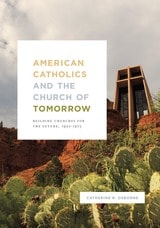
American Catholics and the Church of Tomorrow
Building Churches for the Future, 1925–1975Catherine R. Osborne
University of Chicago Press, 2018
Catherine R. Osborne’s innovative new book finds the answer: the alignment between postwar advancements in technology and design and evolutionary thought within the burgeoning American Catholic community. A new, visibly contemporary approach to design, church leaders thought, could lead to the rebirth of the church community of the future. As Osborne explains, the engineering breakthroughs that made modernist churches feasible themselves raised questions that were, for many Catholics, fundamentally theological. Couldn’t technological improvements engender worship spaces that better reflected God's presence in the contemporary world? Detailing the social, architectural, and theological movements that made modern churches possible, American Catholics and the Churches of Tomorrow breaks important new ground in the history of American Catholicism, and also presents new lines of thought for scholars attracted to modern architectural and urban history.
American Childhood
Risks and RealitiesSchneider, Dona
Rutgers University Press, 1995
To show how the statistics can both disguise and highlight problems, Schneider alternates a discussion of the numbers with vivid encounters with individual children and adults: the middle-class black high school student's offhand explanation about how to get a gun; a vital statistics bureau worker's astonishment at his own classification as Hispanic; a young woman's pleasure in holding down a job after teachers dismissed her as learning disabled; and a latchkey child's nightmare of coming home from school to an empty house when she was sick.
This book guides us through the morass of numbers bandied about to describe the state of America's children—what the numbers tell us and what they don't—and it offers a call for action. Comprehensive in its treatment of all groups of children and accessible in style, this book is essential for anyone concerned about children in American society.
American Christianity
The Continuing RevolutionBy Stephen Cox
University of Texas Press, 2014
Christianity takes an astonishing variety of forms in America, from churches that cherish traditional modes of worship to evangelical churches and fellowships, Pentecostal churches, social-action churches, megachurches, and apocalyptic churches—congregations ministering to believers of diverse ethnicities, social classes, and sexual orientations. Nor is this diversity a recent phenomenon, despite many Americans’ nostalgia for an undeviating “faith of our fathers” in the days of yore. Rather, as Stephen Cox argues in this thought-provoking book, American Christianity is a revolution that is always happening, and always needs to happen. The old-time religion always has to be made new, and that is what Americans have been doing throughout their history.
American Christianity is an engaging book, wide ranging and well informed, in touch with the living reality of America’s diverse traditions and with the surprising ways in which they have developed. Radical and unpredictable change, Cox argues, is one of the few dependable features of Christianity in America. He explores how both the Catholic Church and the mainline Protestant churches have evolved in ways that would make them seem alien to their adherents in past centuries. He traces the rise of uniquely American movements, from the Mormons to the Seventh-day Adventists and Jehovah’s Witnesses, and brings to life the vivid personalities—Aimee Semple McPherson, Billy Sunday, and many others—who have taken the gospel to the masses. He sheds new light on such issues as American Christians’ intense but constantly changing political involvements, their controversial revisions in the style and substance of worship, and their chronic expectation that God is about to intervene conclusively in human life. Asserting that “a church that doesn’t promise new beginnings can never prosper in America,“ Cox demonstrates that American Christianity must be seen not as a sociological phenomenon but as the ever-changing story of individual people seeking their own connections with God, constantly reinventing their religion, making it more volatile, more colorful, and more fascinating.
American Cinema 1890-1909
Themes and VariationsGaudreault, Andre
Rutgers University Press, 2009
The essays in American Cinema 1890-1909 explore and define how the making of motion pictures flowered into an industry that would finally become the central entertainment institution of the world. Beginning with all the early types of pictures that moved, this volume tells the story of the invention and consolidation of the various processes that gave rise to what we now call "cinema." By examining the battles over patents, production, exhibition, and the reception of film, readers learn how going to the movies became a social tradition in American society.
In the course of these two decades, cinema succeeded both in establishing itself among other entertainment and instructional media and in updating various forms of spectacle.
American Cinema of the 1910s
Themes and VariationsKeil, Charlie
Rutgers University Press, 2009
The essays in American Cinema of the 1910s explore the rapid developments of the decade that began with D. W. Griffith's unrivaled one-reelers. By mid-decade, multi-reel feature films were profoundly reshaping the industry and deluxe theaters were built to attract the broadest possible audience. Stars like Mary Pickford, Charlie Chaplin, and Douglas Fairbanks became vitally important and companies began writing high-profile contracts to secure them. With the outbreak of World War I, the political, economic, and industrial groundwork was laid for American cinema's global dominance. By the end of the decade, filmmaking had become a true industry, complete with vertical integration, efficient specialization and standardization of practices, and self-regulatory agencies.
American Cinema of the 1920s
Themes and VariationsFischer, Lucy
Rutgers University Press, 2009
In ten original essays, American Cinema of the 1920s examines the film industry's continued growth and prosperity while focusing on important themes of the era.
American Cinema of the 1930s
Themes and VariationsHark, Ina Rae
Rutgers University Press, 2007
The ten original essays in American Cinema of the 1930s focus on sixty diverse films of the decade, including Dracula, The Public Enemy, Trouble in Paradise, 42nd Street, King Kong, Imitation of Life, The Adventures of Robin Hood, Swing Time, Angels with Dirty Faces, Nothing Sacred, Jezebel, Mr. Smith Goes toWashington, and Stagecoach .