Results by title
18284 books match the query 'United States' and 1653 start with a
American Infanticide
Sexism, Science, and the Politics of SympathyClara S. Lewis
Rutgers University Press, 2025
Emboldened by fear, the sorority sisters investigated. In the driveway next to the kitchen door, they found Emile’s newborn baby girl dead inside a garbage bag. Emile’s crime seemed senseless and left her family and friends with an aching question: what happened?
American Infanticide situates Emile's tragic act in a long intellectual, social, and legal history, uncovering disturbing missing chapters in our national history that undercut myths that have shaped public reactions to so-called monster moms and dumpster babies since the colonial era. Ultimately, the book uncovers how bias and inconsistency dictate how women accused of infant homicide are perceived and punished and sheds new light on how and why our legal responses to infanticide are so deeply misguided.
American Intelligence
Small-Town News and Political Culture in Federalist New HampshireBen P. Lafferty
University of Massachusetts Press, 2020
Taking up the New Hampshire newspaper industry as its case study, American Intelligence unpacks the ways in which an unprecedented quantity of printed material was gathered, distributed, marketed, and consumed, as well as the strong influence that it had on the shaping of the American political imagination. Ben P. Lafferty also considers the lives of the printers themselves and asks why so many men chose to pursue such a fraught and turbulent profession. This snapshot resonates with the contemporary media-saturated and politically chaotic age.
American Jewish Filmmakers
David Desser and Lester D. Friedman
University of Illinois Press, 2003
The effects of the Holocaust linger, both in gripping dramatic form (Mazursky's Enemies, a Love Story) and in black comedy (Brooks's The Producers). In his trilogy consisting of Serpico, Prince of the City, and Q&A, Lumet focuses on the failure of society's institutions to deliver social justice. Woody Allen portrays urban life and family relationships (Manhattan and Hannah and Her Sisters), sometimes with a nostalgic twist (Radio Days).
This edition concludes with a newly written discussion of the careers of other prominent Jewish filmmakers such as Steven Spielberg, Barry Levinson, Brian Singer, and Darren Aronofsky.

American Jewish History
A Primary Source ReaderEdited by Gary Phillip Zola and Marc Dollinger
Brandeis University Press, 2014
American Jewish Identity Politics
Deborah Dash Moore, editor
University of Michigan Press, 2009
"Displays the full range of informed, thoughtful opinion on the place of Jews in the American politics of identity."
---David A. Hollinger, Preston Hotchkis Professor of American History, University of California, Berkeley
"A fascinating anthology whose essays crystallize the most salient features of American Jewish life in the second half of the twentieth century."
---Beth S. Wenger, Katz Family Associate Professor of American Jewish History and Director of the Jewish Studies Program, University of Pennsylvania
"A wonderful collection of important essays, indispensable for understanding the searing conflicts over faith, familial, and political commitments marking American Jewry's journey through the paradoxes of the post-Holocaust era."
---Michael E. Staub, Professor of English, Baruch College, CUNY, and author of Torn at the Roots: The Crisis of Jewish Liberalism in Postwar America
"This provocative anthology offers fascinating essays on Jewish culture, politics, religion, feminism, and much more. It is a must-read for all those interested in the intersection of Jewish life and identity politics in the modern period."
---Joyce Antler, Samuel Lane Professor of American Jewish History and Culture, Brandeis University
"This collection of essays invites the reader to engage with some of the best writing and thinking about American Jewish life by some of the finest scholars in the field. Deborah Moore's introduction offers an important framework to understand not only the essays, but the academic and political contexts in which they are rooted."
---Riv-Ellen Prell, Professor and Chair, American Studies, University of Minnesota, and editor of Women Remaking American Judaism
American Judaism
Nathan Glazer
University of Chicago Press, 1988
Glazer's new introduction describes the drift away from the popular equation of American Judaism with liberalism during the last two decades and considers the threat of divisiveness within American Judaism. Glazer also discusses tensions between American Judaism and Israel as a result of a revivified Orthodoxy and the disillusionment with liberalism.
"American Judaism has been arguably the best known and most used introduction to the study of the Jewish religion in the United States. . . . It is an inordinately clear-sighted work that can be read with much profit to this day."—American Jewish History (1987)
American Judaism
Nathan Glazer
University of Chicago Press, 1988
First published in 1957, Nathan Glazer's classic, historical study of Judaism in America has been described by the New York Times Book Review as "a remarkable story . . . told briefly and clearly by an objective historical mind, yet with a fine combination of sociological insight and religious sensitivity."
Glazer's new introduction describes the drift away from the popular equation of American Judaism with liberalism during the last two decades and considers the threat of divisiveness within American Judaism. Glazer also discusses tensions between American Judaism and Israel as a result of a revivified Orthodoxy and the disillusionment with liberalism.
"American Judaism has been arguably the best known and most used introduction to the study of the Jewish religion in the United States. . . . It is an inordinately clear-sighted work that can be read with much profit to this day."—American Jewish History (1987)
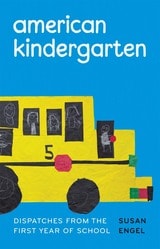
American Kindergarten
Dispatches from the First Year of SchoolSusan Engel
University of Chicago Press, 2026
When we think of kindergarten, many might imagine joyous free play, and a tangle of trucks, dress-up clothes, and blocks, as five-year-olds explore their vivid imaginations and budding social skills. Others might envision a quiet group sitting cross-legged in a circle during story time. Neither of these scenes would be an inaccurate representation of the pivotal year of entry into traditional education in this country. However, neither offers a complete picture of what children do every day in those seemingly transparent, yet actually mysterious, classrooms. What can or should we expect during the first year of school? How are children learning and growing during those hours spent away from their homes?
Susan Engel embarked on finding these answers in American Kindergarten: Dispatches from the First Year of School. Engel toured twenty-nine classrooms across fourteen states, observing each closely, with a special eye toward the ways each classroom’s goals reflect its community. As she made her way across the country, Engel found that on the surface, kindergarten students are similar: good-natured, eager to learn, and deeply affectionate. Their classrooms, too, feature many of the same expectations, routines, and activities. But the differences between the classrooms were striking and often surprising. Over the two years of her classroom visits, Engel identified five promises that teachers and their classrooms make to their students: reading, order, thinking, identity, and love. Engel found that schools differ in how they prioritize and keep the promises they make; some make all five promises, while others emphasize only one or two. The five promises capture a set of values, aspirations, and goals that drive everything that happens in a classroom.
Engaging and incisive, American Kindergarten is the story of the promises our country’s schools make to five-year-old children, and how those promises are kept and sometimes broken.
American Kinship
A Cultural AccountDavid M. Schneider
University of Chicago Press, 1980
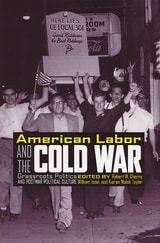
American Labor and the Cold War
Grassroots Politics and Postwar Political CultureCherny, Robert
Rutgers University Press, 2004
The American labor movement seemed poised on the threshold of unparalleled success at the beginning of the post-World War II era. Fourteen million strong in 1946, unions represented thirty five percent of non-agricultural workers. Why then did the gains made between the 1930s and the end of the war produce so few results by the 1960s?
This collection addresses the history of labor in the postwar years by exploring the impact of the global contest between the United States and the Soviet Union on American workers and labor unions. The essays focus on the actual behavior of Americans in their diverse workplaces and communities during the Cold War. Where previous scholarship on labor and the Cold War has overemphasized the importance of the Communist Party, the automobile industry, and Hollywood, this book focuses on politically moderate, conservative workers and union leaders, the medium-sized cities that housed the majority of the population, and the Roman Catholic Church. These are all original essays that draw upon extensive archival research and some upon oral history sources.
American Labor in the Southwest
The First One Hundred YearsEdited by James C. Foster
University of Arizona Press, 1982
The Western Federation of Miners
James C. Foster, D. H. Dinwoodie
The Industrial Workers of the World
Earl Bruce White, James Byrkit
The Rise of Unionized Farm Workers
H. L. Mitchell, Edward D. Beechert, Art Carstens
Mexican Labor, North and South of the Border
John M. Hart, Rodney Anderson, David Maciel
Labor and Politics
Paul Mandel, George N. Green, Charles O. Rice

American Legal English, 2nd Edition
Using Language in Legal ContextsDebra S. Lee, J.D., Charles Hall, and Susan M. Barone
University of Michigan Press, 2012
Law is a profession that requires the ability to read critically, write well, synthesize sources from research, and speak concisely and clearly. American Legal English was developed to help non-native speakers improve their ability to understand and communicate in English with their legal counterparts around the world. The text is an introduction to basic legal information and the U.S. legal system that addresses the major areas of law and provides actual cases and statutes so that students can become familiar with legal syntax and legal vocabulary.
Each chapter addresses a particular area of the law and has three parts:
- Discovering Connections is a warm-up activity that focuses on non-legal concepts that lead into a discussion of the law.
- Legal Listening and Legally Speaking offer the opportunity to practice new vocabulary terms before they are used in context later in the chapter.
- Legal Thumbnail provides a simplified summary of the law with actual statutory and case materials.
In the second edition, the language development activities have been moved to the back of the book and are organized in the categories of writing, reading, oral communication, grammar, and culture.
Supplemental listening activities (21 tracks) are available via an audio CD (978-0-472-00325-9) or MP3 download (978-0-472-00360-0) is available for use in conjunction with this textbook. Running time: 000:40:02.
American Literary Minimalism
Robert C. Clark
University of Alabama Press, 2015
Tracing the evolution of minimalist style from Hemingway to the twenty‑first century.
Although a handful of books and articles have been written about American literary Minimalism during the last forty years, the mode remains misunderstood. When in a 2011 interview in The Paris Review author Ann Beattie was asked how she felt about being “classed as a minimalist,” she began her answer: “none of us have ever known what that means.” Her response brings into focus the lack of agreement or clarity about the sources and definitions of literary Minimalism. Robert C. Clark’s American Literary Minimalism fills this significant gap.
Clark demonstrates that, despite assertions by many scholars to the contrary, the movement originated in the aesthetic programs of the Imagists and literary Impressionists active at the turn of the twentieth century. The genre reflects the philosophy that “form is thought,” and that style alone dictates whether a poem, story, or novel falls within the parameters of the tradition. The characteristics of Minimalist fiction are efficiency, frequent use of allusion, and implication through omission.
Organizing his analysis both chronologically and according to lines of influence, Clark offers a definition of the mode, describes its early stages, and then explores six works that reflect its core characteristics: Ernest Hemingway’s In Our Time; Raymond Carver’s Cathedral; Jay McInerney’s Bright Lights, Big City; Susan Minot’s Monkeys; Sandra Cisneros’s Caramelo; and Cormac McCarthy’s The Road. In his conclusion, Clark discusses the ongoing evolution of the category.

American Literature and the Destruction of Knowledge
Innovative Writing in the Age of EpistemologyRonald E. Martin
Duke University Press, 1991
The works of Melville, Emerson, Whitman, and Dickinson, followed by Crane, Frost, Pound, Stein, Hemingway, Dos Passos, Aiken, Stevens, and Williams, are examined as part of a cultural current that casts doubt on the possibility of knowledge itself. The destruction of concepts, of literary and linguistic forms, was for these writers a precondition for liberating the imagination to gain more access to the self and the real world. As part of the exploration of this cultural context, literary and philosophical realisms are examined together, allowing a comparison of their somewhat different objectives, as well as their common epistemological predicament.
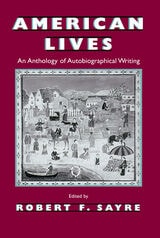
American Lives
An Anthology of Autobiographical WritingRobert F. Sayre
University of Wisconsin Press, 1994
American Lives is a groundbreaking book, the first historically organized anthology of American autobiographical writing, bringing us fifty-five voices from throughout the nation's history, from Abigail Adams, Abraham Lincoln, Jonathan Edwards, and Richard Wright to Quaker preacher Elizabeth Ashbridge, con man Stephen Burroughs, and circus impresario P.T. Barnum. Representing canonical and non-canonical writers, slaves and slave-owners, generals and conscientious objectors, scientists, immigrants, and Native Americans, the pieces in this collection make up a rich gathering of American “songs of ourselves.”
Robert F. Sayre frames the selections with an overview of theory and criticism of autobiography and with commentary on the relation between history and many kinds of autobiographical texts—travel narratives, stories of captivity, diaries of sexual liberation, religious conversions, accounts of political disillusionment, and discoveries of ethnic identity. With each selection Sayre also includes an extensive headnote providing valuable critical and biographical information.
A scholarly and popular landmark, American Lives is a book for general readers and for teachers, students, and every American scholar.
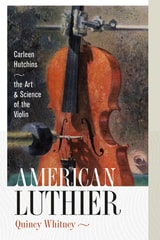
American Luthier
Carleen Hutchins—the Art and Science of the ViolinQuincy Whitney
University Press of New England, 2016
American Magnitude
Hemispheric Vision and Public Feeling in the United StatesChrista J. Olson
The Ohio State University Press, 2021
Winner, 2023 Rhetoric Society of America Book Award
Winner, 2022 Marie Hochmuth Nichols Award from the National Communication Association
At a moment in US politics when racially motivated nationalism, shifting relations with Latin America, and anxiety over national futures intertwine, understanding the long history of American preoccupation with magnitude and how it underpins national identity is vitally important. In American Magnitude, Christa J. Olson tracks the visual history of US appeals to grandeur, import, and consequence (megethos), focusing on images that use the wider Americas to establish US character. Her sources—including lithographs from the US-Mexican War, pre–Civil War paintings of the Andes, photo essays of Machu Picchu, and WWII-era films promoting hemispheric unity—span from 1845 to 1950 but resonate into the present.
Olson demonstrates how those crafting the appeals that feed the US national imaginary—artists, scientists, journalists, diplomats, and others—have invited US audiences to view Latin America as a foil for the greatness of their own nation and encouraged white US publics in particular to see themselves as especially American among Americans. She reveals how each instance of visual rhetoric relies upon the eyes of others to instantiate its magnitude—and falters as some viewers look askance instead. The result is the possibility of a post-magnitude United States: neither great nor failed, but modest, partial, and imperfect.
American Mainline Religion
Its Changing Shape and FutureWade Clark Roof and William McKinney
Rutgers University Press, 1987
"American Mainline Religion" provides a new "mapping" of the families of American religion and the underlying social, cultural, and demographic forces that will reshape American religion in the century to come. Going beyond the headlines in daily newspapers, Roof and McKinney document the decline of the Protestant establishment, the rise of a more assimilated and public-minded Roman Catholicism, the place of black Protestantism and Judaism, and the resurgence of conservative Protestantism as a religious and cultural force.
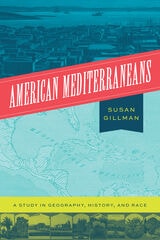
American Mediterraneans
A Study in Geography, History, and RaceSusan Gillman
University of Chicago Press, 2022
The naturalist Alexander von Humboldt, visiting the Gulf-Caribbean in the early nineteenth century, called it America’s Mediterranean. Almost a century later, Southern California was hailed as “Our Mediterranean, Our Italy!” Although “American Mediterranean” is not a household phrase in the United States today, it once circulated widely in French, Spanish, and English as a term of art and folk idiom. In this book, Susan Gillman asks what cultural work is done by this kind of unsystematic, open-ended comparative thinking.
American Mediterraneans tracks two centuries of this geohistorical concept, from Humboldt in the early 1800s, to writers of the 1890s reflecting on the Pacific world of the California coast, to writers of the 1930s and 40s speculating on the political past and future of the Caribbean. Following the term through its travels across disciplines and borders, American Mediterraneans reveals a little-known racialized history, one that paradoxically appealed to a range of race-neutral ideas and ideals.
American Melancholy
Constructions of Depression in the Twentieth CenturyHirshbein, Laura D
Rutgers University Press, 2009
American Melancholy traces the growth of depression as an object of medical study and as a consumer commodity and illustrates how and why depression came to be such a huge medical, social, and cultural phenomenon. It is the first book to address gender issues in the construction of depression, explores key questions of how its diagnosis was developed, how it has been used, and how we should question its application in American society.
American Memories
Atrocities and the LawJoachim J. Savelsberg
Russell Sage Foundation, 2012
American Multiculturalism and the Anti-Discrimination Regime
The Challenge to Liberal PluralismThomas F. Powers
St. Augustine's Press, 2023
American Muslim Women, Religious Authority, and Activism
More Than a PrayerBy Juliane Hammer
University of Texas Press, 2012
Following the events of September 11, 2001, American Muslims found themselves under unprecedented scrutiny. Muslim communities in the United States suffered from negative representations of their religion, but they also experienced increased interest in aspects of their faith and cultures. They seized the opportunity to shape the intellectual contribution of American Muslims to contemporary Muslim thought as never before. Muslim women in particular—often assumed to be silenced, oppressed members of their own communities—challenged stereotypes through their writing, seeking to express what it means to be a Muslim woman in America and carrying out intra-Muslim debates about gender roles and women’s participation in society. Hammer looks at the work of significant female American Muslim writers, scholars, and activists, using their writings as a lens for a larger discussion of Muslim intellectual production in America and beyond.
Centered on the controversial women-led Friday prayer in March 2005, Hammer uses this event and its aftermath to address themes of faith, community, and public opinion. Tracing the writings of American Muslim women since 1990, the author covers an extensive list of authors, including Amina Wadud, Leila Ahmed, Asma Barlas, Riffat Hassan, Mohja Kahf, Azizah al-Hibri, Asra Normani, and Asma Gull Hasan. Hammer deftly examines each author’s writings, demonstrating that the debates that concern American Muslim women are at the heart of modern Muslim debates worldwide. While gender is the catalyst for Hammer’s study, her examination of these women’s intellectual output touches on themes central to contemporary Islam: authority, tradition, Islamic law, justice, and authenticity.
American Neighborhoods and Residential Differentiation
Michael J. White
Russell Sage Foundation, 1987
American Nietzsche
A History of an Icon and His IdeasJennifer Ratner-Rosenhagen
University of Chicago Press, 2011
If you were looking for a philosopher likely to appeal to Americans, Friedrich Nietzsche would be far from your first choice. After all, in his blazing career, Nietzsche took aim at nearly all the foundations of modern American life: Christian morality, the Enlightenment faith in reason, and the idea of human equality. Despite that, for more than a century Nietzsche has been a hugely popular—and surprisingly influential—figure in American thought and culture.
In American Nietzsche, Jennifer Ratner-Rosenhagen delves deeply into Nietzsche's philosophy, and America’s reception of it, to tell the story of his curious appeal. Beginning her account with Ralph Waldo Emerson, whom the seventeen-year-old Nietzsche read fervently, she shows how Nietzsche’s ideas first burst on American shores at the turn of the twentieth century, and how they continued alternately to invigorate and to shock Americans for the century to come. She also delineates the broader intellectual and cultural contexts within which a wide array of commentators—academic and armchair philosophers, theologians and atheists, romantic poets and hard-nosed empiricists, and political ideologues and apostates from the Left and the Right—drew insight and inspiration from Nietzsche’s claims for the death of God, his challenge to universal truth, and his insistence on the interpretive nature of all human thought and beliefs. At the same time, she explores how his image as an iconoclastic immoralist was put to work in American popular culture, making Nietzsche an unlikely posthumous celebrity capable of inspiring both teenagers and scholars alike.
A penetrating examination of a powerful but little-explored undercurrent of twentieth-century American thought and culture, American Nietzsche dramatically recasts our understanding of American intellectual life—and puts Nietzsche squarely at its heart.

American Nightmares
The Haunted House Formula in American Popular FictionDale Bailey
University of Wisconsin Press, 1999
American Oligarchy
The Permanent Political ClassRon Formisano
University of Illinois Press, 2017
American Opera
Elise K. Kirk
University of Illinois Press, 2001
Tired of Tannhäuser? Bored with Bohème? Open your imagination to boundless creativity and wide-ranging repertory of American opera. Elise K. Kirk provides a treasure trove of information that fills in the long-neglected history of opera in the United States. Looking at more than 100 works, Kirk sketches the musical traits, provides plot summaries, describes sets and stagings, and offers in-depth profiles of performers, composers, and librettists.
Beginning with the English-influenced harle-quinade of the revolutionary period, Kirk follows the development of comic opera, the rise of melodramatic romanticism, the emergence of American grand opera and verismo, and the explosion of eclectic forms that characterized American opera in the twentieth century. Devoting particular attention to women and African American composers and librettists, Kirk explores how American operas incorporated indigenous elements such as jazz, popular song, folk music, Native American motifs, and Hollywood's cinematic techniques. She also discusses radio and television's impact, the advent of opera workshops in universities, the integration of multimedia effects into productions, and the ways innovations such as co-commissioning and joint staging have helped sustain the genre in the face of declining federal support.
American Orchestras in the Nineteenth Century
Edited by John Spitzer
University of Chicago Press, 2012
Studies of concert life in nineteenth-century America have generally been limited to large orchestras and the programs we are familiar with today. But as this book reveals, audiences of that era enjoyed far more diverse musical experiences than this focus would suggest. To hear an orchestra, people were more likely to head to a beer garden, restaurant, or summer resort than to a concert hall. And what they heard weren’t just symphonic works—programs also included opera excerpts and arrangements, instrumental showpieces, comic numbers, and medleys of patriotic tunes.

American Orient
Imagining the East from the Colonial Era through the Twentieth CenturyDavid Weir
University of Massachusetts Press, 2011
Surveying the American fascination with the Far East since the mid-eighteenth century, this book explains why the Orient had a fundamentally different meaning in the United States than in Europe or Great Britain. David Weir argues that unlike their European counterparts, Americans did not treat the East simply as a site of imperialist adventure; on the contrary, colonial subjugation was an experience that early Americans shared with the peoples of China and India.
In eighteenth-century America, the East was, paradoxically, a means of reinforcing the enlightenment values of the West: Franklin, Jefferson, and other American writers found in Confucius a complement to their own political and philosophical beliefs. In the nineteenth century, with the shift from an agrarian to an industrial economy, the Hindu Orient emerged as a mystical alternative to American reality. During this period, Emerson, Thoreau, and other Transcendentalists viewed the “Oriental” not as an exotic other but as an image of what Americans could be, if stripped of all the commercialism and materialism that set them apart from their ideal. A similar sense of Oriental otherness informed the aesthetic discoveries of the early twentieth century, as Pound, Eliot, and other poets found in Chinese and Japanese literature an artistic purity and intensity absent from Western tradition. For all of these figures the Orient became a complex fantasy that allowed them to overcome something objectionable, either in themselves or in the culture of which they were a part, in order to attain some freer, more genuine form of philosophical, religious, or artistic expression.
American Pantheon
Sculptural and Artistic Decoration of the United States CapitolDonald R. Kennon
Ohio University Press, 2002
Like the ancient Roman Pantheon, the U.S. Capitol was designed by its political and aesthetic arbiters to memorialize the virtues, events, and persons most representative of the nation's ideals—an attempt to raise a particular version of the nation's founding to the level of myth.
American Pantheon examines the influences upon not only those virtues and persons selected for inclusion in the American pantheon, but also those excluded. Two chapters address the exclusion of slavery and African Americans from the art in the Capitol, a silence made all the more deafening by the major contributions of slaves and free black workers to the construction of the building. Two other authors consider the subject of women emerging as artists, subjects, patrons, and proponents of art in the Capitol, a development that began to emerge only in the second half of the nineteenth century.
The Rotunda, the Capitol's principal ceremonial space, was designed in part as an art museum of American history—at least the authorized version of it. It is explored in several of the essays, including discussions of the influence of the early-nineteenth-century Italian sculptors who provided the first sculptural reliefs for the room and the contributions of the mid-nineteenth-century Italian American artist Constantino Brumidi, to the mix of allegory, mythology, and history that permeates the space and indeed the Capitol itself.
American Paper Mills, 1690–1832
A Directory of the Paper Trade with Notes on Products, Watermarks, Distribution Methods, and Manufacturing TechniquesJohn Bidwell
Dartmouth College Press, 2013
American Paper Son
A Chinese Immigrant in the MidwestWayne Hung Wong
University of Illinois Press, 2005
In the early and mid-twentieth century, Chinese migrants evaded draconian anti-immigrant laws by entering the US under false papers that identified them as the sons of people who had returned to China to marry. Wayne Hung Wong tells the story of his life after emigrating to Wichita, Kansas, as a thirteen-year-old paper son. After working in his father’s restaurant as a teen, Wong served in an all-Chinese Air Force unit stationed in China during World War II. His account traces the impact of race and segregation on his service experience and follows his postwar life from finding a wife in Taishan through his involvement in the government’s amnesty program for Chinese immigrants and career in real estate. Throughout, Wong describes the realities of life as part of a small Chinese American community in a midwestern town.
Vivid and rich with poignant insights, American Paper Son explores twentieth-century Asian American history through one person’s experiences.
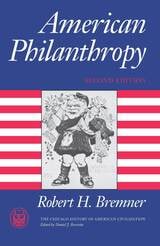
American Philanthropy
Robert H. Bremner
University of Chicago Press, 1988
"[This] book, as Bremner points out, is not encyclopedic. It is what he intended it to be, a pleasant narrative, seasoned with humorous comments, briefly but interestingly treating its principal persons and subjects. It should serve teacher and student as a springboard for further study of individuals, institutions and movements."—Karl De Schweinitz, American Historical Review
"[American Philanthropy] is the starting point for both casual readers and academic scholars. . . . a readable book, important beyond its diminutive size."—Richard Magat, Foundation News
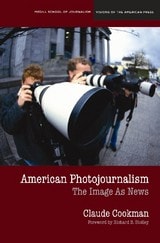
American Photojournalism
Motivations and MeaningsClaude Cookman
Northwestern University Press, 2009
Photojournalism has long been the medium of urgency and social change. It has profoundly affected American public opinion, going back at least to Mathew Brady's images from the Civil War. In American Photojournalism: Motivations and Meanings, Claude Cookman explores the history and future of the medium through the work of such exemplary photojournalists as Jacob Riis, Dorothea Lange, Weegee, Margaret Bourke-White, W. Eugene Smith, Gordon Parks, Rich Clarkson, and Carol Guzy, among others. The traditional approach to studying American photojournalism explains the what and who of photojournalism--what events and developments occurred, what notable images were taken, and who took them. Without neglecting these concerns, American Photojournalism emphasizes the why. Cookman argues convincingly that contemporary photojournalism is grounded in the desire to witness and record history, and the embrace of a universal humanism. Unafraid to engage questions of truth and intentionality, American Photojournalism will only become more relevant as the medium evolves.
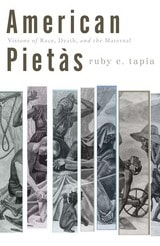
American Pietàs
Visions of Race, Death, and the MaternalRuby C. Tapia
University of Minnesota Press, 2010
Tapia explores the implications of this argument for racialized productions of death and the maternal in the context of specific cultural moments: the commemoration of Princess Diana in U.S. magazines; the intertext of Toni Morrison’s and Hollywood’s Beloved; the social and cultural death in teen pregnancy, imaged and regulated in California’s Partnership for Responsible Parenting campaigns; and popular constructions of the “Widows of 9/11” in print and televisual journalism.
Taken together, these various visual media texts function in American Pietàs as cultural artifacts and as visual nodes in a larger network of racialized productions of maternal bodies in contexts of national death and remembering. To engage this network is to ask how and toward what end the racial project of the nation imbues some maternal bodies with resurrecting power and leaves others for dead. In the spaces between these different maternities, says Tapia, U.S. citizen-subjects are born—and reborn.
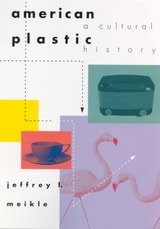
American Plastic
A Cultural HistoryMeikle, Jeffrey L
Rutgers University Press, 1995
Winner of the 1996 Dexter Prize from the Society for the History of Technology and a 1996 Choice Outstanding Academic Book
“A splendid history of plastic. The book is authoritative, thorough, interdisciplinary, and intriguing. . . [Meikle] traces the course of plastics from 19th–century celluloid and the fist wholly synthetic bakelite, in 1907, through the proliferation of compounds (vinyls, acrylics, polystyrene, nylon, etc.) and recent ecological concerns. . . .Interested readers of whatever predisposition will likely enjoy this comprehensive and thoughtful treatise.”—Publishers Weekly
“A landmark account. . . . He combines a first–rate technological history with a most impressive cultural analysis of how plastics evolved from a material surrounded by utopian expectations to a material epitomizing inferiority and eventually to a part of everyday life. . . . One of the most significant works ever written in the history of American technology and culture.”
—Nature
“[A] truly outstanding work . . . here is a work of intellectual strength written with great literary style. . . . This significant work is likely to be widely cited in academic circles, defining the field for a generation of readers. Don’t let it pass you by! An extraordinary contribution, for all levels of readers.”—Choice
“This is real interdisciplinary work, roaming in focus, adaptive in method.”—Journal of American History
“This scholarly and comprehensive work . . . is nontechnical and emphasizes the social and cultural impact of plastics. . . . Highly recommended for anyone with an interest in understanding contemporary society.”—Library Journal
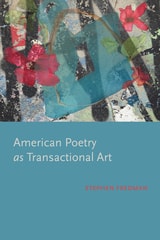
American Poetry as Transactional Art
Stephen Fredman
University of Alabama Press, 2020
Explores the ways American poetry engages with visual art, music, fiction, spirituality, and performance art
Many people think of poetry as a hermetic art, as though poets wrote only about themselves or as if the subject of poetry were finally only poetry—its forms and traditions. Indeed much of what constitutes poetry in the lyric tradition depends on a stringently controlled point of view and aims for a timeless, intransitive utterance. Stephen Fredman’s study proposes a different perspective.
American Poetry as Transactional Art explores a salient quality of much avant-garde American poetry that has so far lacked sustained treatment: namely, its role as a transactional art. Specifically Fredman describes this role as the ways it consistently engages in conversation, talk, correspondence, going beyond the scope of its own subjects and forms—its existential interactions with the outside world. Poetry operating in this vein draws together images, ideas, practices, rituals, and verbal techniques from around the globe, and across time—not to equate them, but to establish dialogue, to invite as many guests as possible to the World Party, which Robert Duncan has called the “symposium of the whole.”
Fredman invites new readers into contemporary poetry by providing lucid and nuanced analyses of specific poems and specific interchanges between poets and their surroundings. He explores such topics as poetry’s transactions with spiritual traditions and practices over the course of the twentieth century; the impact of World War II on the poetry of Charles Olson and George Oppen; exchanges between poetry and other art forms including sculpture, performance art, and ambient music; the battle between poetry and prose in the early work of Paul Auster and in Lyn Hejinian’s My Life. The epilogue looks briefly at another crucial transactional occasion: teaching American poetry in the classroom in a way that demonstrates that it is at the center of the arts and at the heart of American culture.
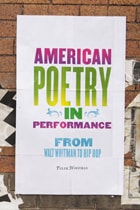
American Poetry in Performance
From Walt Whitman to Hip HopTyler Hoffman
University of Michigan Press, 2013
"Tyler Hoffman brings a fresh perspective to the subject of performance poetry, and this comes at an excellent time, when there is such a vast interest across the country and around the world in the performance of poetry. He makes important connections, explaining things in a manner that remains provocative, interesting, and accessible."
---Jay Parini, Middlebury College
American Poetry in Performance: From Walt Whitman to Hip Hop is the first book to trace a comprehensive history of performance poetry in America, covering 150 years of literary history from Walt Whitman through the rap-meets-poetry scene. It reveals how the performance of poetry is bound up with the performance of identity and nationality in the modern period and carries its own shifting cultural politics. This book stands at the crossroads of the humanities and the social sciences; it is a book of literary and cultural criticism that deals squarely with issues of "performance," a concept that has attained great importance in the disciplines of anthropology and sociology and has generated its own distinct field of performance studies. American Poetry in Performance will be a meaningful contribution both to the field of American poetry studies and to the fields of cultural and performance studies, as it focuses on poetry that refuses the status of fixed aesthetic object and, in its variability, performs versions of race, class, gender, and sexuality both on and off the page.
Relating the performance of poetry to shifting political and cultural ideologies in the United States, Hoffman argues that the vocal aspect of public poetry possesses (or has been imagined to possess) the ability to help construct both national and subaltern communities. American Poetry in Performance explores public poets' confrontations with emergent sound recording and communications technologies as those confrontations shape their mythologies of the spoken word and their corresponding notions about America and Americanness.
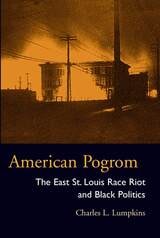
American Pogrom
The East St. Louis Race Riot and Black PoliticsCharles L. Lumpkins
Ohio University Press, 2008
Charles Lumpkins shows that black residents of East St. Louis had engaged in formal politics since the 1870s, exerting influence through the ballot and through patronage in a city dominated by powerful real estate interests even as many African Americans elsewhere experienced setbacks in exercising their political and economic rights.
While Lumpkins asserts that the race riots were a pogrom—an organized massacre of a particular ethnic group—orchestrated by certain businessmen intent on preventing black residents from attaining political power and on turning the city into a “sundown” town permanently cleared of African Americans, he also demonstrates how the African American community survived. He situates the activities of the black citizens of East St. Louis in the context of the larger story of the African American quest for freedom, citizenship, and equality.
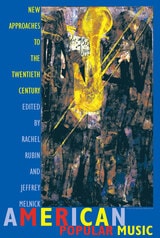
American Popular Music
New Approaches to the Twentieth CenturyRachel Rubin
University of Massachusetts Press, 2001
Designed as a broad introductory survey, and written by experts in the field, this book examines the rise of American music over the past hundred years — the period in which that music came into its own and achieved unprecedented popularity. Beginning with a look at music as a business, eleven essays explore a variety of popular musical genres, including Tin Pan Alley, blues, jazz, country, gospel, rhythm and blues, rock and roll, folk, rap, and Mexican American corridos. Reading these essays, we come to see that the forms created by one group often appeal to, and are in turn influenced by, other groups—across lines of race, ethnicity, class, gender, region, and age. The chapters speak to one another, arguing for the primacy of such concepts as minstrelsy, urbanization, hybridity, and crossover as the most powerful tools for understanding American popular music. Moving beyond outdated music-industry categories and misleading genre labels, while acknowledging the complexities of the market, the book recovers and reinforces the essential blackness of much popular music—even a presumably white form like country and western. In addition to Rachel Rubin and Jeffrey Melnick, contributors include Reebee Garofalo, Geoffrey Jacques, Kip Lornell, Mark Anthony Neal, Millie Rahn, David Sanjek, James Smethurst, Elijah Wald, and Gail Hilson Woldu.
American Popular Music
Readings From the Popular Press Volume 2: The Age of RockTimothy E. Scheurer
University of Wisconsin Press, 1989

American Popular Music
Readings From the Popular Press Volume I: The Nineteenth-Century Tin Pan AlleyTimothy E. Scheurer
University of Wisconsin Press, 1989
American Power and International Theory at the Council on Foreign Relations, 1953-54
David M. McCourt, Editor
University of Michigan Press, 2020
Between December 1953 and June 1954, the elite think-tank the Council on Foreign Relations (CFR) joined prominent figures in International Relations, including Pennsylvania’s Robert Strausz-Hupé, Yale’s Arnold Wolfers, the Rockefeller Foundation’s William Thompson, government adviser Dorothy Fosdick, and nuclear strategist William Kaufmann. They spent seven meetings assessing approaches to world politics—from the “realist” theory of Hans Morgenthau to theories of imperialism of Karl Marx and V.I. Lenin—to discern basic elements of a theory of international relations.
The study group’s materials are an indispensable window to the development of IR theory, illuminating the seeds of the theory-practice nexus in Cold War U.S. foreign policy. Historians of International Relations recently revised the standard narrative of the field’s origins, showing that IR witnessed a sharp turn to theoretical consideration of international politics beginning around 1950, and remained preoccupied with theory. Taking place in 1953–54, the CFR study group represents a vital snapshot of this shift.
This book situates the CFR study group in its historical and historiographical contexts, and offers a biographical analysis of the participants. It includes seven preparatory papers on diverse theoretical approaches, penned by former Berkeley political scientist George A. Lipsky, followed by the digest of discussions from the study group meetings. American Power and International Theory at the Council on Foreign Relations, 1953–54 offers new insights into the early development of IR as well as the thinking of prominent elites in the early years of the Cold War.
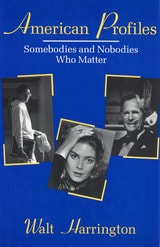
American Profiles
Somebodies and Nobodies Who MatterWalt Harrington
University of Missouri Press, 1992
Author Walt Harrington, award-winning writer for the Washington Post Magazine, lifts the masks of celebrity and obscurity to reveal the lives of some singular men and women--from actress Kelly McGillis to nocturnal satanist Anton LaVey.
American Progressive History
An Experiment in ModernizationErnst Breisach
University of Chicago Press, 1993
Focusing his account on the work of the movement's most important representatives—including Charles Beard, James Harvey Robinson, and Carl Becker—Ernst Breisach demonstrates that Progressive history is distinguished by its unique combination of beliefs in the objective reality of historical facts and its faith in the inevitability of the progress of the human race. And though he discusses at length Frederick Jackson Turner's contributions to the creation of a modern American historiography, Breisach sets him apart from the scholars who shaped Progressive history.
While Progressive history is usually treated in isolation from simultanieous movements in European historiography, Breisach shows how it was formulated in the face of the same cultural pressures confronting European historians. Indeed, it becomes clear that until the 1930s the Progressive historians' confidence in the validity of historical investigation and the progress of civilization shielded American historians from the skepticism and cultural pessimism which characterized many of their European contempories.
Breisach's exceptionally broad and subtle analysis reveals American Progressive history to be an important and innovative experiment in the international quest for a New History, as well as a coherent school of thought in its own right.
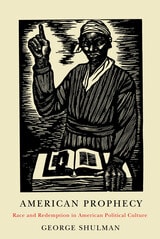
American Prophecy
Race and Redemption in American Political CultureGeorge Shulman
University of Minnesota Press, 2008
The political meaning of prophetic language in America
Prophecy is the fundamental idiom of American politics—a biblical rhetoric about redeeming the crimes, suffering, and promise of a special people. Yet American prophecy and its great practitioners—from Frederick Douglass and Henry Thoreau to Martin Luther King, James Baldwin, and Toni Morrison—are rarely addressed, let alone analyzed, by political theorists. This paradox is at the heart of American Prophecy, a work in which George Shulman unpacks and critiques the political meaning of American prophetic rhetoric.
In the face of religious fundamentalisms that associate prophecy and redemption with dogmatism and domination, American Prophecy finds connections between prophetic language and democratic politics, particularly racial politics. Exploring how American critics of white supremacy have repeatedly reworked biblical prophecy, Shulman demonstrates how these writers and thinkers have transformed prophecy into a political language and given redemption a political meaning. To examine how antiracism is linked to prophecy as a vernacular idiom is to rethink political theology, recast democratic theory, and reassess the bearing of religion on American political culture. Still, prophetic language is not always liberatory, and American Prophecy maintains a critical dispassion about a rhetoric that is both prevalent and problematic.
American Prophet
The Life and Work of Carey McWilliamsPeter Richardson
University of Michigan Press, 2005
Peter Richardson's absorbing and elegantly paced book reveals a figure thoroughly engaged with the issues of his time. Deftly interweaving correspondence, diary notes, published writings, and McWilliams's own and others' observations on a colorful and influential cast of characters from Hollywood, New York, Washington, DC, and the American West, Richardson maps the evolution of McWilliams's personal and professional life. Among those making an appearance are H. L. Mencken (McWilliams's mentor and role model), Louis Adamic, John Fante, Robert Towne, Richard Nixon, Studs Terkel, J. Edgar Hoover, Arthur Schlesinger, Jr., and Joseph McCarthy.
American Prophet illustrates the arc of McWilliams's life and career from his early literary journalism through his legal and political activism, his stint in state government, and his two decades as editor of the Nation. This book makes the case for McWilliams's place in the Olympian realm of our most influential and prescient political writers.
Peter Richardson is the editorial director at PoliPointPress in Sausalito, California. He is the author or editor of numerous works on language, literature, and California public policy. He holds a Ph.D. in English from the University of California Berkeley.
American Public Administration
Past, Present, FutureFrederick C. Mosher
University of Alabama Press, 1975
The essays raise such issues as the education of civil servants, the changes necessitated by crises, the growth of social sciences in governmental concerns, and primarily, the role of public administrators in America. Each author is a distinguished expert in his own right, and each essay can stand alone as a remarkable insight into the changing world of public administration within American society. Frederick Mosher’s expertise and supervision shapes this work into a remarkable and holistic perspective on public administration over time.
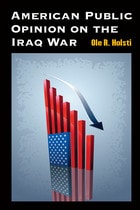
American Public Opinion on the Iraq War
Ole R. Holsti
University of Michigan Press, 2011
"A substantial contribution to understanding the role of public opinion and the news media during the Iraq War. Equally impressive, it effectively puts the domestic context of U.S. policy in historical perspective, making the book useful to historians as well as to political scientists."
---Ralph B. Levering, Davidson College
"American Public Opinion on the Iraq War sets out to chart against a detailed account of the war a nuanced assessment of how public opinion on the conflict evolved, the partisan differences that emerged, how the issue affected other areas of foreign policy opinion, and the limits of public opinion on policy. It succeeds at all of this, and it does so in a manner that is at once informative, inherently interesting, and exceptionally easy to read."
---Randolph M. Siverson, University of California, Davis
Ole R. Holsti explores the extent to which changes in public opinion reflected the vigorous public relations efforts of the Bush administration to gain support for the war and the partisanship marking debates over policies toward Iraq. Holsti investigates the ways in which the Iraq experience has led substantial numbers of Americans to reconsider their nation's proper international role, and he assesses the impact that public opinion has had on policymakers. Significantly, Holsti places his findings in a broader context to address the role of public opinion and of the media in democratic governance.