Results by title
5448 books match the query 'History and criticism' and 404 start with a
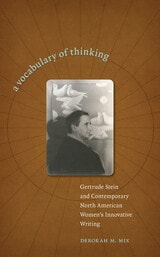
A Vocabulary of Thinking
Gertrude Stein and Contemporary North American Women's Innnovative WritingDeborah M. Mix
University of Iowa Press, 2007
Arguing that these authors have received relatively little attention because of the difficulty in categorizing them, Mix brings the writing of women of color, lesbians, and collaborative writers into the discussion of experimental writing. Thus, rather than exploring conventional lines of influence, she departs from earlier scholarship by using Stein and her work as a lens through which to read the ways these authors have renegotiated tradition, authority, and innovation.
Building on the tradition of experimental or avant-garde writing in the United States, Mix questions the politics of the canon and literary influence, offers close readings of previously neglected contemporary writers whose work doesn't fit within conventional categories, and by linking genres not typically associated with experimentalism-lyric, epic, and autobiography-challenges ongoing reevaluations of innovative writing.
A Voltaire for Russia
A. P. Sumarokov's Journey from Poet-Critic to Russian PhilosopheAmanda Ewington
Northwestern University Press, 2010
In A Voltaire for Russia, Amanda Ewington examines the tumultuous literary career of Alexander Petrovich Sumarokov in relation to that of his slightly older French contemporary, Voltaire. Although largely unknown in the English-speaking world, Sumarokov was one of the founding fathers of modern Russian literature, renowned in his own time as a great playwright and prolific
poet.
A Voltaire for Russia polemicizes with long-accepted readings of Sumarokov as an imitator of French neoclassical poets, ultimately questioning the very notion of a Russian “classicism.” Ewington uncovers Sumarokov’s poignantly personal devotion to Voltaire as a new framework for understanding not only his works but also his literary allegiances and agenda, as he sets out to establish a Russian literature and cultivate a reading public.
A World That Will Hold All the People
Suzanne Gardinier
University of Michigan Press, 1996
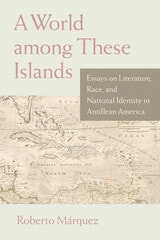
A World among These Islands
Essays on Literature, Race, and National Identity in Antillean AmericaRoberto Marquez
University of Massachusetts Press, 2010
Caribbean literature and culture have all too often been viewed in fragmented terms, without attention to the broader commonalities of the region. In this collection of essays written over many years, Roberto Márquez offers a more encompassing vision, one that respects the individual traditions of particular locales, languages, and cultures but also sees the larger themes that bind the area's literary heritage and history. Márquez begins by making the case for a genuinely Caribbean literary criticism, one that moves beyond the colonial history of fragmentation and isolation and the critical insularity of more conventional approaches. His pan-Caribbean perspective provides a point of departure for the scrutiny of the evolving dramas of race, nationality, nation-building, and cultural articulation in the region. Márquez then focuses specifically on Puerto Rico—its literary and socio—historical experience, the particularities of its “New Creole” incarnations, and the effects of waves of migration to the United States. In the final section of the book, he discusses writers and cultural figures from the other Spanish, Anglophone, and Francophone territories and the ways in which they engage or reflect the defining themes of literature, race, and national identity in Antillean America.
A World of Fiction
Digital Collections and the Future of Literary HistoryKatherine Bode
University of Michigan Press, 2018
A World of Words
Language and Displacement in the Fiction of Edgar Allan PoeMichael J. S. Williams
Duke University Press, 1988
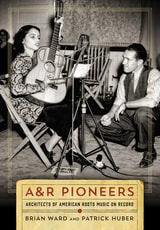
A&R Pioneers
Architects of American Roots Music on RecordBrian Ward
Vanderbilt University Press, 2018
A&R Pioneers offers the first comprehensive account of the diverse group of men and women who pioneered artists-and-repertoire (A&R) work in the early US recording industry. In the process, they helped create much of what we now think of as American roots music. Resourceful, innovative, and, at times, shockingly unscrupulous, they scouted and signed many of the singers and musicians who came to define American roots music between the two world wars. They also shaped the repertoires and musical styles of their discoveries, supervised recording sessions, and then devised marketing campaigns to sell the resulting records. By World War II, they had helped redefine the canons of American popular music and established the basic structure and practices of the modern recording industry. Moreover, though their musical interests, talents, and sensibilities varied enormously, these A&R pioneers created the template for the job that would subsequently become known as "record producer."
Without Ralph Peer, Art Satherley, Frank Walker, Polk C. Brockman, Eli Oberstein, Don Law, Lester Melrose, J. Mayo Williams, John Hammond, Helen Oakley Dance, and a whole army of lesser known but often hugely influential A&R representatives, the music of Bessie Smith and Bob Wills, of the Carter Family and Count Basie, of Robert Johnson and Jimmie Rodgers may never have found its way onto commercial records and into the heart of America's musical heritage. This is their story.
A/MORAL ECONOMICS
CLASSICAL POLITICAL ECONOMY AND CULTURAL AUTHORITY IN NINETEENTH-CENTURY ENGLANDClaudia C. Klaver
The Ohio State University Press, 2003
A/Moral Economics is an interdisciplinary historical study that examines the ways which social “science” of economics emerged through the discourse of the literary, namely the dominant moral and fictional narrative genres of early and mid-Victorian England. In particular, this book argues that the classical economic theory of early-nineteenth-century England gained its broad cultural authority not directly, through the well- known texts of such canonical economic theorists as David Ricardo, but indirectly through the narratives constructed by Ricardo’s popularizers John Ramsey McCulloch and Harriet Martineau.
By reexamining the rhetorical and institutional contexts of classical political economy in the nineteenth century, A/Moral Economics repositions the popular writings of both supporters and detractors of political economy as central to early political economists’ bids for a cultural voice. The now marginalized economic writings of McCulloch, Martineau, Henry Mayhew, and John Ruskin, as well as the texts of Charles Dickens and J. S. Mill, must be read as constituting in part the entities they have been read as merely criticizing. It is this repressed moral logic that resurfaces in a range of textual contradictions—not only in the writings of Ricardo’s supporters, but, ironically, in those of his critics as well.
Abandoned Women and Poetic Tradition
Lawrence Lipking
University of Chicago Press, 1988
Abandoning the Black Hero
Sympathy and Privacy in the Postwar African American White-Life NovelCharles, John C
Rutgers University Press, 2012
Abandoning the Black Hero is the first book to examine the postwar African American white-life novel—novels with white protagonists written by African Americans. These fascinating works have been understudied despite having been written by such defining figures in the tradition as Richard Wright, Zora Neale Hurston, James Baldwin, Ann Petry, and Chester Himes, as well as lesser known but formerly best-selling authors Willard Motley and Frank Yerby.
John C. Charles argues that these fictions have been overlooked because they deviate from two critical suppositions: that black literature is always about black life and that when it represents whiteness, it must attack white supremacy. The authors are, however, quite sympathetic in the treatment of their white protagonists, which Charles contends should be read not as a failure of racial pride but instead as a strategy for claiming creative freedom, expansive moral authority, and critical agency.
In an era when “Negro writers” were expected to protest, their sympathetic treatment of white suffering grants these authors a degree of racial privacy previously unavailable to them. White writers, after all, have the privilege of racial privacy because they are never pressured to write only about white life. Charles reveals that the freedom to abandon the “Negro problem” encouraged these authors to explore a range of new genres and themes, generating a strikingly diverse body of novels that significantly revise our understanding of mid-twentieth-century black writing.
Aberrations In Black
Toward a Queer of Color CritiqueRoderick A. Ferguson
University of Minnesota Press, 2003
A hard-hitting look at the regulation of sexual difference and its role in circumscribing African American culture
The sociology of race relations in America typically describes an intersection of poverty, race, and economic discrimination. But what is missing from the picture—sexual difference—can be as instructive as what is present. In this ambitious work, Roderick A. Ferguson reveals how the discourses of sexuality are used to articulate theories of racial difference in the field of sociology. He shows how canonical sociology—Gunnar Myrdal, Ernest Burgess, Robert Park, Daniel Patrick Moynihan, and William Julius Wilson—has measured African Americans’s unsuitability for a liberal capitalist order in terms of their adherence to the norms of a heterosexual and patriarchal nuclear family model. In short, to the extent that African Americans’s culture and behavior deviated from those norms, they would not achieve economic and racial equality.
Aberrations in Black tells the story of canonical sociology’s regulation of sexual difference as part of its general regulation of African American culture. Ferguson places this story within other stories—the narrative of capital’s emergence and development, the histories of Marxism and revolutionary nationalism, and the novels that depict the gendered and sexual idiosyncrasies of African American culture—works by Richard Wright, Ralph Ellison, James Baldwin, Audre Lorde, and Toni Morrison. In turn, this book tries to present another story—one in which people who presumably manifest the dysfunctions of capitalism are reconsidered as indictments of the norms of state, capital, and social science. Ferguson includes the first-ever discussion of a new archival discovery—a never-published chapter of Invisible Man that deals with a gay character in a way that complicates and illuminates Ellison’s project.
Unique in the way it situates critiques of race, gender, and sexuality within analyses of cultural, economic, and epistemological formations, Ferguson’s work introduces a new mode of discourse—which Ferguson calls queer of color analysis—that helps to lay bare the mutual distortions of racial, economic, and sexual portrayals within sociology.
Aberrations of Mourning
Laurence A. Rickels
University of Minnesota Press, 2011
Rickels studies mourning and melancholia within and around psychoanalysis, analyzing the writings of such thinkers as Freud, Nietzsche, Lessing, Heinse, Artaud, Keller, Stifter, Kafka, and Kraus. Rickels maintains that we must shift the way we read literature, philosophy, and psychoanalysis to go beyond traditional Oedipal structures.
Aberrations of Mourning argues that the idea of the crypt has had a surprisingly potent influence on psychoanalysis, and Rickels shows how society’s disturbed relationship with death and dying, our inability to let go of loved ones, has resulted in technology to form more and more crypts for the dead by preserving them—both physically and psychologically—in new ways.
Abolition Time
Grammars of Law, Poetics of JusticeJess A. Goldberg
University of Minnesota Press, 2024
How Black Atlantic literature can challenge conventions and redefine literary scholarship
Abolition Time is an invitation to reenvision abolitionist justice through literary studies. Placing critical race theory, queer theory, critical prison studies, and antiprison activism in conversation with an archive of Black Atlantic literatures of slavery, Jess A. Goldberg reveals how literary studies can help undo carceral epistemologies embedded in language and poetics.
Goldberg examines poetry, drama, and novels from the nineteenth century through the twenty-first—such as William Wells Brown’s The Escape, Angelina Weld Grimké’s Rachel, Toni Morrison’s A Mercy, and Claudia Rankine’s Citizen—to consider literature and literary scholarship’s roles in shaping societal paradigms. Focusing on how Black Atlantic literature disrupts the grammar of law and order, they show how these texts propose nonlinear theories of time that imagine a queer relationality characterized by care rather than inheritance, property, or biology.
Abolition Time offers a framework for thinking critically about what is meant by the term justice in the broadest and deepest sense, using close reading to inform the question of abolishing prisons or the police and to think seriously about the most fundamental questions at the heart of the abolitionist movement.
Abolition’s Public Sphere
Robert Fanuzzi
University of Minnesota Press, 2003
An innovative analysis of the Enlightenment’s effects on the anti-slavery movement
Echoes of Thomas Paine and Enlightenment thought resonate throughout the abolitionist movement and in the efforts of its leaders to create an antislavery reading public. In Abolition’s Public Sphere Robert Fanuzzi critically examines the writings of William Lloyd Garrison, Frederick Douglass, Henry David Thoreau, and Sarah and Angelina Grimke, and their massive abolition publicity campaign—pamphlets, newspapers, petitions, and public gatherings—geared to an audience of white male citizens, free black noncitizens, women, and the enslaved. Including provocative readings of Thoreau’s Walden and of the symbolic space of Boston’s Faneuil Hall, Abolition’s Public Sphere demonstrates how abolitionist public discourse sought to reenact eighteenth-century scenarios of revolution and democracy in the antebellum era.
Fanuzzi illustrates how the dissemination of abolitionist tracts served to create an “imaginary public” that promoted and provoked the discussion of slavery. However, by embracing Enlightenment abstractions of liberty, reason, and progress, Fanuzzi argues, abolitionist strategy introduced aesthetic concerns that challenged political institutions of the public sphere and prevailing notions of citizenship. Insightful and thought-provoking, Abolition’s Public Sphere questions standard versions of abolitionist history and, in the process, our understanding of democracy itself.
Abortion in the American Imagination
Before Life and Choice, 1880-1940Weingarten, Karen
Rutgers University Press, 2014
Abortion in the American Imagination returns to the moment when American writers first dared to broach the controversial subject of abortion. What was once a topic avoided by polite society, only discussed in vague euphemisms behind closed doors, suddenly became open to vigorous public debate as it was represented everywhere from sensationalistic melodramas to treatises on social reform. Literary scholar and cultural historian Karen Weingarten shows how these discussions were remarkably fluid and far-ranging, touching upon issues of eugenics, economics, race, and gender roles.
Weingarten traces the discourses on abortion across a wide array of media, putting fiction by canonical writers like William Faulkner, Edith Wharton, and Langston Hughes into conversation with the era’s films, newspaper articles, and activist rhetoric. By doing so, she exposes not only the ways that public perceptions of abortion changed over the course of the twentieth century, but also the ways in which these abortion debates shaped our very sense of what it means to be an American.

Abortion, Choice, and Contemporary Fiction
The Armageddon of the Maternal InstinctJudith Wilt
University of Chicago Press, 1990
In the opening of the book, Wilt discusses real case histories of several women. After studying the ambiguities of their decisions, she turns to their counterpoints depicted in contemporary fiction. Working from a feminist perspective, Wilt traces the theme of maternal choice in works by Margaret Atwood, Margaret Drabble, Joan Didion, Mary Gordon, Alice Walker, Toni Morrison, Gloria Naylor, Marge Piercy, Thomas Keneally, Graham Swift, Ernest Hemingway, William Faulkner, John Barth, John Irving, and others.
Behind the political, medical, and moral debates on abortion, Wilt argues, is a profound psychocultural shock at the recognition that maternity is passing from the domain of instinct to that of conscious choice. Although never wholly instinctual, maternity's potential capture by consciousness raises complex questions. The novels Wilt discusses portray worlds in which principles are endangered by sexual inequality, male power and hidden male fear of abandonment, impotence, female submission, and covert rage, and, in the case of black maternity, the hideous aftermath of slavery.
Wilt provides a resonant new context for debates—whether political or personal—on the issue of abortion and maternal choice. Ultimately she enables us to rethink how we shape our own identities and lives.
About Bach
Edited by Gregory Butler, George Stauffer, and Mary Dalton Greer
University of Illinois Press, 2007
Contributors are Gregory G. Butler, Jen-Yen Chen, Alexander J. Fisher, Mary Dalton Greer, Robert Hill, Ton Koopman, Daniel R. Melamed, Michael Ochs, Mark Risinger, William H. Scheide, Hans-Joachim Schulze, Douglass Seaton, George B. Stauffer, Andrew Talle, and Kathryn Welter.
Above Time
Emerson's and Thoreau's Temporal RevolutionsJames R. Guthrie
University of Missouri Press, 2001
In Above Time, James R. Guthrie explores the origins of the two preeminent transcendentalists' revolutionary approaches to time, as well as to the related concepts of history, memory, and change. Most critical discussions of this period neglect the important truth that the entire American transcendentalist project involved a transcendence of temporality as well as of materiality. Correspondingly, both writers call in their major works for temporal reform, to be achieved primarily by rejecting the past and future in order to live in an amplified present moment.
Emerson and Thoreau were compelled to see time in a new light by concurrent developments in the sciences and the professions. Geologists were just then hotly debating the age of the earth, while zoologists were beginning to unravel the mysteries of speciation, and archaeologists were deciphering the Egyptian hieroglyphs. These discoveries worked collectively to enlarge the scope of time, thereby helping pave the way for the appearance of Darwin's Origin of Species in 1859.
Well aware of these wider cultural developments, Emerson and Thoreau both tried (although with varying degrees of success) to integrate contemporary scientific thought with their preexisting late-romantic idealism. As transcendentalists, they already believed in the existence of "correspondences"—affinities between man and nature, formalized as symbols. These symbols could then be decoded to discover the animating presence in the world of eternal laws as pervasive as the laws of science. Yet unlike scientists, Emerson and Thoreau hoped to go beyond merely understanding nature to achieving a kind of passionate identity with it, and they believed that such a union might be achieved only if time was first recognized as being a purely human construct with little or no validity in the rest of the natural world. Consequently, both authors employ a series of philosophical, rhetorical, and psychological strategies designed to jolt their readers out of time, often by attacking received cultural notions about temporality.
Above the American Renaissance
David S. Reynolds and the Spiritual Imagination in American Literary StudiesHarold K. Bush
University of Massachusetts Press, 2018
In addition to the editors and David S. Reynolds, contributors include Jeffrey Bilbro, Dawn Coleman, Jonathan A. Cook, Tracy Fessenden, Zachary Hutchins, Richard Kopley, Mason I. Lowance Jr., John Matteson, Christopher N. Phillips, Vivian Pollak, Michael Robertson, Gail K. Smith, Claudia Stokes, and Timothy Sweet.
Abraham Lincoln, Statesman Historian
Jesse Derber
University of Illinois Press, 2024
Abraham Lincoln drew upon history in his political career and particularly when crafting the rhetorical masterpieces that still resonate in the present day. Jesse Derber explores how Lincoln’s views of the limits of human understanding drove a belief in--and untiring pursuit of--historical truth.
Lincoln embraced the traditional ideas that good history made good statesmanship and that an understanding of the past informed decision-making in the present. Seeing history as a source of wisdom, Lincoln strove for accuracy through a combination of research, reasoning ability, emotional maturity, and a willingness to admit his mistakes and challenge his biases. His philosophy flowed from an idea that authentic history could enlighten people about human nature. Though he revered precedents, Lincoln understood the past could be imperfect, and that progress through change was an ineffable part of building a better nation.
Perceptive and revealing, Abraham Lincoln, Statesman Historian looks at how the Lincoln practiced history and applied its lessons to politics and leadership.

Accessible Citizenships
Disability, Nation, and the Cultural Politics of Greater MexicoJulie Avril Minich
Temple University Press, 2013
A volume in the American Literatures Initiative
Acoustic Colonialism
Acts of Mapuche InterferenceLuis E. Cárcamo-Huechante
Duke University Press, 2025

Acoustic Properties
Radio, Narrative, and the New Neighborhood of the AmericasTom McEnaney
Northwestern University Press, 2017
Based on original archival research in Buenos Aires, Havana, Paris, and the United States, the book develops a literary media theory that understands sound as a transmedial phenomenon and radio as a transnational medium. Analyzing the construction of new social and political relations in the wake of the United States’ 1930s Good Neighbor Policy, Acoustic Properties challenges standard narratives of hemispheric influence through new readings of Richard Wright’s cinematic work in Argentina, Severo Sarduy’s radio plays in France, and novels by John Dos Passos, Manuel Puig, Raymond Chandler, and Carson McCullers. Alongside these writers, the book also explores Che Guevara and Fidel Castro’s Radio Rebelde, FDR’s fireside chats, Félix Caignet’s invention of the radionovela in Cuba, Evita Perón’s populist melodramas in Argentina, Orson Welles’s experimental New Deal radio, Cuban and U.S. “radio wars,” and the 1960s African American activist Robert F. Williams’s proto–black power Radio Free Dixie.
From the doldrums of the Great Depression to the tumult of the Cuban Revolution, Acoustic Properties illuminates how novelists in the radio age converted writing into a practice of listening, transforming realism as they struggled to channel and shape popular power.
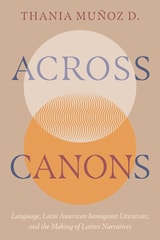
Across Canons
Language, Latin American Immigrant Literature, and the Making of Latinx NarrativesThania Muñoz D.
University of Arizona Press, 2026
Author Thania Muñoz D. looks at immigrant experiences impacted by a prism of social and political factors, including free trade agreements, drug trafficking, political violence, massive foreign debt, and economic dependency. The author examines why these writers refuse to identify as immigrants and reject stereotypical portrayals. Throughout, Muñoz D. makes the case for a new field within Latinx literature: Latin American immigrant writing in Spanish. She explains why this type of literary work is critical across Latin American, Latinx, and U.S. literature.
This book highlights the benefits of comparative, interdisciplinary interpretations that allow readers and scholars to grapple with the realities of a multilingual Latin American–origin literary present and future of the United States.
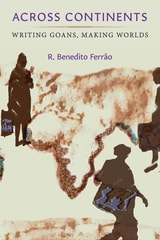
Across Continents
Writing Goans, Making WorldsR. Benedito Ferrão
University of Michigan Press, 2026
Across Continents employs Goan literary subjectivity as epistemology to critique a specific limitation of postcolonial thought, one that does not account for the situations or afterlife of Portuguese colonialism. Employing various novels, R. Benedito Ferrão considers the relationship between Portuguese and British colonialisms through the displacement of Goan characters betwixt Asia, Africa, Europe, and North America. The experiences of these figures in dealing with the processes of nation, statecraft, and political intrigue at various historical junctures offer a comparative understanding of the tumultuous conditions of postcoloniality in the making of marginalized subjectivity across continents.
In examining the mobility and diversity of Goan experiences as represented in works by Salman Rushdie, M. G. Vassanji, Roger King, and Margaret Mascarenhas, this book calls into question limits of citizenship, nationality, and notions of belonging. Ferrão centers seemingly minor figures to exemplify the effects of colonial and postcolonial changes that connect diverse geopolities.
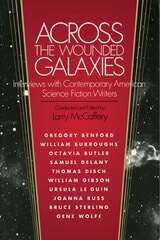
Across the Wounded Galaxies
Interviews with Contemporary American Science Fiction WritersConducted and edited by Larry McCaffery
University of Illinois Press, 1990
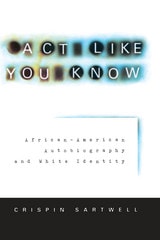
Act Like You Know
African-American Autobiography and White IdentityCrispin Sartwell
University of Chicago Press, 1998
There is, Sartwell contends, a fundamental elusiveness to that identity. Whiteness defines itself as normative, as a neutral form of the human condition, marking all other forms of identity as "racial" or "ethnic" deviations. Invisible to itself, white identity seeks to define its essence over and against those other identities, in effect defining itself through opposition and oppression. By maintaining fictions of black licentiousness, violence, and corruption, white identity is able to cast itself as humane, benevolent, and pure; the stereotype fabricates not only the oppressed but the oppressor as well. Sartwell argues that African-American autobiography perceives white identity from a particular and unique vantage point; one that is knowledgeable and intimate, yet fundamentally removed from the white world and thus unencumbered by its obfuscating claims to normativity.
Throughout this provocative work, Sartwell steadfastly recognizes the many ways in which he too is implicated in the formulation and perpetuation of racial attitudes and discourse. In Act Like You Know, he challenges both himself and others to take a long, hard look in the mirror of African-American autobiography, and to find there, in the light of those narratives, the visible features of white identity.
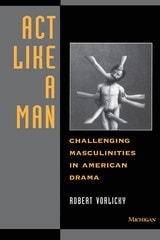
Act Like a Man
Challenging Masculinities in American DramaRobert Vorlicky
University of Michigan Press, 1995
In the first comprehensive study of plays written for male characters only, Robert Vorlicky offers a new theory that links cultural codes governing gender and the conventions determining dramatic form. Act Like a Manlooks at a range of plays, including those by O'Neill, Albee, Mamet, Baraka, and Rabe as well as new works by Philip Kan Gotanda, Alonzo Lamont, and Robin Swados, to examine how dialogue within these works reflects the social codes of male behavior and inhibits individualization among men.
Plays in which women are absent are often characterized by the location of a male "other"—a female presence who distances himself from the dominant, impersonal masculine ethos and thereby becomes a facilitator of personal communication. The potential authority of this figure is so powerful that its presence becomes the primary determinant of the quality of men's interaction and of the range of male subjectivities possible. This formulation becomes the basis of an alternative theory of American dramatic construction, one that challenges traditional dramaturgical notions of realism.
The book will appeal to scholars and students interested in drama, gender, race, sexuality, and American culture, as well as playwrights, teachers of playwrights, and artistic directors. It includes an extensive bibliography of more than four hundred male-cast plays and monodramas, the first such compilation and one that points to further research into a previously unexplored area.
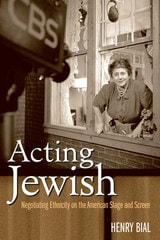
Acting Jewish
Negotiating Ethnicity on the American Stage and ScreenHenry Bial
University of Michigan Press, 2005
Acting Jewish documents this history, looking at the work of Jewish writers, directors, and actors in the American entertainment industry with particular attention to the ways in which these artists offer behavioral models for Jewish-American audiences. The book spans the period from 1947 to the present and takes a close look at some of America's favorite plays (Death of a Salesman, Fiddler on the Roof, Angels in America), films (Gentleman's Agreement, AnnieHall), and television shows (The Goldbergs, Seinfeld), identifying a double-coding by which performers enact, and spectators read, Jewishness in contemporary performance-and, by extension, enact and read other minority identities. The book thus explores and illuminates the ever-changing relationship between Jews and mainstream American culture.
"Fascinating and original . . . Bial's command of sources is impressive, and his concept of 'double-coding' is convincing . . . the book should have no trouble finding a large audience."
-Barbara Grossman, author of Funny Woman: The Life and Times of Fanny Brice
Acting Like Men
Gender, Drama, and Nostalgia in Ancient GreeceKaren Bassi
University of Michigan Press, 1999
Action without Hope
Victorian Literature after Climate CollapseNathan K. Hensley
University of Chicago Press, 2025
What does it feel like to live helplessly in a world that is coming undone? Nathan Hensley turns to Victorian literature to uncover a prehistory of this deeply contemporary sense of powerlessness. For many in nineteenth-century Britain, their world seemed so scarred by human rapacity that restoring it seemed beyond the powers of any one individual. Like George Eliot’s characters in Middlemarch or the doomed lovers of Wuthering Heights, observers of the gathering carbon economy felt themselves ensnared by interlocked and broken systems. In the face of damage so vast and apparently irreversible, what could possibly be done?
To answer this question, Hensley shows that nineteenth-century writers and artists devised new ways to understand action—and hope. They rescaled action away from the grandly heroic and toward minor adjustments and collaborative interventions. They turned away from logical proofs and direct argumentation and instead called on aesthetic technologies like sonnets and fractured lyrics, watercolor sketches, and vast, multiplot novels, finding scope for action not at the level of the theme or the thesis but in gestures and details. Ranging from J. M. W. Turner’s painterly technique to Emily Brontë’s dreamlike fragments (and reading along the way works by Alfred, Lord Tennyson, H. G. Wells, Lewis Carroll, Gerard Manley Hopkins, William Berryman, Charlotte Brontë, George Eliot, and Christina Rossetti), Hensley’s study makes an important contribution to Victorian studies and the environmental humanities.
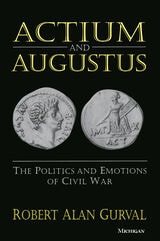
Actium and Augustus
The Politics and Emotions of Civil WarRobert Alan Gurval
University of Michigan Press, 1998
Actium and Augustus marks a turning point as well. Robert Alan Gurval's unusual approach is to examine contemporary views of the battle and its immediate political and social consequences. He starts with a consideration of the official celebration and public commemoration of the Actian victory and then moves on to other questions. What were the "Actian" monuments that Octavian erected on the battle site and later in Rome? What role did the Actian victory play in the political formation of the Principate and its public ideology? What was the response of contemporary poetry? Throughout, this volume concentrates on contemporary views of Actium and its results.
Written to include the general reader, Actium and Augustus presents a thoughtful examination of a complex period. All Greek and Latin quotations are translated, and extensive illustrations present graphic evidence about the issues Romans faced.
Robert Alan Gurval is Associate Professor of Classics, University of California, Los Angeles, and has been a recipient of the Rome Prize awarded by the American Academy in Rome.
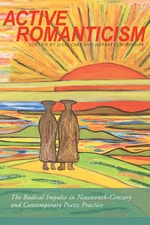
Active Romanticism
The Radical Impulse in Nineteenth-Century and Contemporary Poetic PracticeEdited by Julie Carr and Jeffrey C. Robinson
University of Alabama Press, 2015
A collection of essays highlighting the pervasive, yet often unacknowledged, role of Romantic poetry and poetics on modern and contemporary innovative poetry.
Literary history generally locates the primary movement toward poetic innovation in twentieth-century modernism, an impulse carried out against a supposedly enervated “late-Romantic” poetry of the nineteenth century. The original essays in Active Romanticism challenge this interpretation by tracing the fundamental continuities between Romanticism’s poetic and political radicalism and the experimental movements in poetry from the late nineteenth century to the present day.
According to editors July Carr and Jeffrey C. Robinson, “active romanticism” is a poetic response, direct or indirect, to pressing social issues and an attempt to redress forms of ideological repression; at its core, “active romanticism” champions democratic pluralism and confronts ideologies that suppress the evidence of pluralism. “Poetry fetter’d, fetters the human race,” declared poet William Blake at the beginning of the nineteenth century. No other statement from the era of the French Revolution marks with such terseness the challenge for poetry to participate in the liberation of human society from forms of inequality and invisibility. No other statement insists so vividly that a poetic event pushing for social progress demands the unfettering of traditional, customary poetic form and language.
Bringing together work by well-known writers and critics, ranging from scholarly studies to poets’ testimonials, Active Romanticism shows Romantic poetry not to be the sclerotic corpse against which the avant-garde reacted but rather the wellspring from which it flowed.
Offering a fundamental rethinking of the history of modern poetry, Carr and Robinson have grouped together in this collection a variety of essays that confirm the existence of Romanticism as an ongoing mode of poetic production that is innovative and dynamic, a continuation of the nineteenth-century Romantic tradition, and a form that reacts and renews itself at any given moment of perceived social crisis.
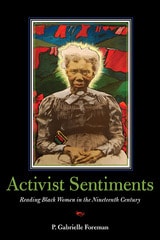
Activist Sentiments
Reading Black Women in the Nineteenth CenturyP. Gabrielle Foreman
University of Illinois Press, 2009
Activist Sentiments takes as its subject women who in fewer than fifty years moved from near literary invisibility to prolific productivity. Grounded in primary research and paying close attention to the historical archive, this book offers against-the-grain readings of the literary and activist work of Harriet Jacobs, Harriet Wilson, Frances E. W. Harper, Victoria Earle Matthews and Amelia E. Johnson.
Part literary criticism and part cultural history, Activist Sentiments examines nineteenth-century social, political, and representational literacies and reading practices. P. Gabrielle Foreman reveals how Black women's complex and confrontational commentary–often expressed directly in their journalistic prose and organizational involvement--emerges in their sentimental, and simultaneously political, literary production.

Acts of Dramaturgy
The Shakespeare TrilogyMichael Pinchbeck
Intellect Books, 2020
Acts of Dramaturgy is a critical frame for Michael Pinchbeck’s The Shakespeare Trilogy, a recent touring project comprising three performances—The Beginning, The Middle, and The End—that explored the role of the dramaturg. This book sets the playtexts in dialogue with reflexive essays and provocations on contemporary dramaturgy from a range of contributors.
Weaving together different modes of writing, the volume reflects on the politics of dramaturgy, authorship, adaptation, performance, and the use of Shakespeare as a stimulus for making contemporary theater. The resulting work is as much a reflection on the entanglements of processes, lineages, and relations that have shaped the work and its reception as it is an exploration of ways of reflecting and being with practice now. A valuable new contribution to the study of contemporary dramaturgy, the book will be of interest to makers and scholars of theater and performance and anyone interested in practice research and creative critical writing.
Acts of Faith and Imagination
Theological Patterns in Catholic FictionBrent Little
Catholic University of America Press, 2023
Acts of Mind
Conversations with Contemporary PoetsRichard Jackson
University of Alabama Press, 1984
Acts of Mind grew out of interviews conducted by the author for Poetry Miscellany. The aim of which was to help develop a method for talking about the work of contemporary poets.
The poets whose views appear in this volume represent a fair cross-section of the more important tendencies and impulses to be found in contemporary poetry and poetics.
Acts of Poetry
American Poets' Theater and the Politics of PerformanceHeidi R. Bean
University of Michigan Press, 2019
American poets’ theater emerged in the postwar period alongside the rich, performance-oriented poetry and theater scenes that proliferated on the makeshift stages of urban coffee houses, shared apartments, and underground theaters, yet its significance has been largely overlooked by critics. Acts of Poetry shines a spotlight on poets’ theater’s key groups, practitioners, influencers, and inheritors, such as the Poets’ Theatre, the Living Theatre, Gertrude Stein, Bunny Lang, Frank O’Hara, Amiri Baraka, Carla Harryman, and Suzan-Lori Parks. Heidi R. Bean demonstrates the importance of poets’ theater in the development of twentieth-century theater and performance poetry, and especially evolving notions of the audience’s role in performance, and in narratives of the relationship between performance and everyday life. Drawing on an extensive archive of scripts, production materials, personal correspondence, theater records, interviews, manifestoes, editorials, and reviews, the book captures critical assessments and behind-the-scenes discussions that enrich our understanding of the intertwined histories of American theater and American poetry in the twentieth century.
Adam and Eve in the Armenian Tradition, Fifth through Seventeenth Centuries
Michael E. Stone
SBL Press, 2013
Adapting Performance Between Stage and Screen
Victoria Lowe
Intellect Books, 2020
Provides a new foundation for discussions about theater, film, and translations between the two mediums.
Adapting Performance Between Stage and Screen provides an introduction to adaptations between theater and film, establishing a framework for considering these as distinct from literary adaptation. The book places emphasis on performance and event, opening new avenues of exploration to include non-literary issues such as the treatment of space and place, mis en scène, acting styles, and star personas. The recent growth of digital theater is examined to foreground the “events” of theater and cinema—largely ignored in adaptation studies—with phenomena such as National Theatre Live analyzed for the different ways that “liveness” is adapted.
Drawing from case studies that explore distinct periods in British film and theater history, the volume looks at issues surrounding theatrical naturalism and cinematic realism and illustrates the principle that adaptations can't be divorced from the historical and cultural moment in which they are produced. Adapting Performance Between Stage and Screen explores how cultural values can be articulated in the act of translating between media, providing a new framework for the discussion of theater and film as dramatic works.
Addressing Postmodernity
Kenneth Burke, Rhetoric, and a Theory of Social ChangeBarbara Biesecker
University of Alabama Press, 2000
In Addressing Postmodernity, Barbara Biesecker examines the relationship between rhetoric and social change and the ways human beings transform social relations through the purposeful use of symbols. In discerning the conditions of possibility for social transformation and the role of human beings and rhetoric in it, Biesecker turns to the seminal work of Kenneth Burke.
Through a close reading of Burke's major works, A Grammar of Motives, A Rhetoric of Motives, and The Rhetoric of Religion: Studies in Logology, the author addresses the critical topic of the
fragmentation of the contemporary lifeworld revealing postmodernity will have a major impact on Burkeian scholarship and on the rhetorical critique of social relations in general.
Directly confronting the challenges posed by postmodernity to social theorists and critics alike and juxtaposing the work of Burke and Jurgen Habermas, Biesecker argues that a radicalized rereading of Burke's theory of the negative opens the way toward a resolutely rhetorical theory of social change and human agency.

Adoption Memoirs
Inside StoriesMarianne Novy
Temple University Press, 2024
Novy considers 45 memoirs, mostly from the twenty-first century, by birthmothers, adoptees, and adoptive parents, about same-race and transracial adoption. These adoptees, she recounts, wanted to learn about their ancestry and appreciated adoptive parents who helped. Birthmother Amy Seek shows why open adoption is not simple, and many other memoirs tell stories that continue past reunion.
Adoption Memoirs will enlighten readers who lack experience with adoption and help those looking for a shared experience to also understand adoption from a different standpoint.
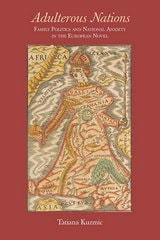
Adulterous Nations
Family Politics and National Anxiety in the European NovelTatiana Kuzmic
Northwestern University Press, 2016
In Adulterous Nations, Tatiana Kuzmic enlarges our perspective on the nineteenth-century novel of adultery, showing how it often served as a metaphor for relationships between the imperialistic and the colonized. In the context of the long-standing practice of gendering nations as female, the novels under discussion here—George Eliot’s Middlemarch, Theodor Fontane’s Effi Briest, and Leo Tolstoy’s Anna Karenina, along with August Šenoa’s The Goldsmith’s Gold and Henryk Sienkiewicz’s Quo Vadis—can be understood as depicting international crises on the scale of the nuclear family. In each example, an outsider figure is responsible for the disruption experienced by the family. Kuzmic deftly argues that the hopes, anxieties, and interests of European nations during this period can be discerned in the destabilizing force of adultery. Reading the work of Šenoa and Sienkiewicz, from Croatia and Poland, respectively, Kuzmic illuminates the relationship between the literature of dominant nations and that of the semicolonized territories that posed a threat to them. Ultimately, Kuzmic’s study enhances our understanding of not only these five novels but nineteenth-century European literature more generally.

Adventure, Mystery, and Romance
Formula Stories as Art and Popular CultureJohn G. Cawelti
University of Chicago Press, 1976
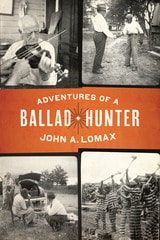
Adventures of a Ballad Hunter
By John A. Lomax, foreword by John Lomax III, John Nova Lomax, and Anna Lomax Wood
University of Texas Press, 2017
Growing up beside the Chisholm Trail, captivated by the songs of passing cowboys and his bosom friend, an African American farmhand, John A. Lomax developed a passion for American folk songs that ultimately made him one of the foremost authorities on this fundamental aspect of Americana. Across many decades and throughout the country, Lomax and his informants created over five thousand recordings of America’s musical heritage, including ballads, blues, children’s songs, fiddle tunes, field hollers, lullabies, play-party songs, religious dramas, spirituals, and work songs. He acted as honorary curator of the Archive of American Folk Song at the Library of Congress, directed the Slave Narrative Project of the WPA, and cofounded the Texas Folklore Society. Lomax’s books include Cowboy Songs and Other Frontier Ballads, American Ballads and Folk Songs, Negro Folk Songs as Sung by Leadbelly, and Our Singing Country, the last three coauthored with his son Alan Lomax.
Adventures of a Ballad Hunter is a memoir of Lomax’s eventful life. It recalls his early years and the fruitful decades he spent on the road collecting folk songs, on his own and later with son Alan and second wife Ruby Terrill Lomax. Vibrant, amusing, often haunting stories of the people he met and recorded are the gems of this book, which also gives lyrics for dozens of songs. Adventures of a Ballad Hunter illuminates vital traditions in American popular culture and the labor that has gone into their preservation.
Advertising the Self in Renaissance France
Lemaire, Marot, and RabelaisScott Francis
University of Delaware Press, 2019
Published by University of Delaware Press. Distributed worldwide by Rutgers University Press.
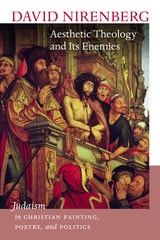
Aesthetic Theology and Its Enemies
Judaism in Christian Painting, Poetry, and PoliticsDavid Nirenberg
Brandeis University Press, 2015
Aesthetics and Revolution
Nicaraguan Poetry 1979-1990Greg Dawes
University of Minnesota Press, 1993
In Aesthetics and Revolution, Dawes demonstrates that there is an objective grounding for cultural studies found in the aesthetic means of production. By analyzing the relations and forces of production in this realm we inevitably cross over into the economic means of production as well as the struggle for political representation. Ultimately, aesthetics is at the intersection of class and gender interests and their struggle for hegemony.
In Aesthetics and Revolution, Dawes has chosen a group of writers of different theoretical sympathies, class, gender, and social positions to reveal the conflictual interests of the social classes and genders as a whole. Through close readings of their work, Dawes examines the thematic nodes that are expressed in positions as diverse as Ernesto Cardenal’s liberation theology, Pablo Antonio Cuadra’s populism, the campesino’s oral tradition, and Gioconda Belli’s erotic verses in relation to the changes taking place in revolutionary Nicaragua.
Aesthetics of Alienation
Reassessment of Early Soviet Cultural TheoriesEvgeny Dobrenko
Northwestern University Press, 2005
In chapters on Proletkult, RAPP, LEF, and Pereval, Dobrenko reexamines the theories generated by these major Marxist literary groupings of the early Soviet Union. He shows how each approached the problems of literature's response to the presumed social mandate of the young communist society, and how Socialist Realism emerged as a conglomerate of these earlier, revolutionary theories. With extensive and detailed reference to supporting testimony and documents, Dobrenko clearly demonstrates how Socialist Realism was created from within the revolutionary culture, and how this culture and its disciples fully participated in this creative process. His work represents a major breakthrough in our current understanding of the complex sources that contributed to early Soviet culture.
Affirmation of Poetry
Judith Balso
University of Minnesota Press, 2014
Since the times of Plato and Aristotle, the relation of poetry to philosophy has been controversial. For certain scholars, poetry should in no way be confused with philosophy. For others, poetry is at the heart of the possibility of thinking itself. In Affirmation of Poetry, Judith Balso defends the significance of poetry as a necessary practice for thinking. For Balso, if reading poetry properly has become an obscure task, poetry itself still carries with it a power of thinking: the efforts of the poets must continue. In analyzing the affirmation of thought found within the work of such poets as Osip Mandelstam, Wallace Stevens, Alberto Caeiro, and Giacomo Leopardi, Balso reestablishes poetry’s place as a site of thought.