Results by title
8818 books match the query 'Political Science' and 626 start with a
A Nation at Work
The Heldrich Guide to the American WorkforceVan Horn, Carl E
Rutgers University Press, 2003
A Nation at Work addresses the fundamental economic, demographic, policy, and business facts about how the workforce and workplace are changing in the early twenty-first century. Illustrated with over thirty-five graphs, Part I covers essential topics about the American workforce and workers. Part II gathers essays and speeches from the nation's outstanding journalists and workplace analysts. The book incorporates facts and data, including invaluable tables and listings for useful Internet sites, books, and organizations.
Comprehensive in scope, A Nation at Work will help readers reach a better understanding about their own work and the world of work around them.
A Nation of Immigrants Reconsidered
US Society in an Age of Restriction, 1924-1965Maddalena Marinari, Madeline Hsu, Maria Garcia
University of Illinois Press, 2019
Contributors: Eiichiro Azuma, David Cook-Martín, David FitzGerald, Monique Laney, Heather Lee, Kathleen López, Laura Madokoro, Ronald L. Mize, Arissa H. Oh, Ana Elizabeth Rosas, Lorrin Thomas, Ruth Ellen Wasem, and Elliott Young
A Nation of Politicians
Gender, Patriotism, and Political Culture in Late Eighteenth-Century IrelandPadhraig Higgins
University of Wisconsin Press, 2009
In A Nation of Politicians, Padhraig Higgins argues that the development of Volunteer-initiated activities—associating, petitioning, subscribing, shopping, and attending celebrations—expanded the scope of political participation. Using a wide range of literary, archival, and visual sources, Higgins examines how ubiquitous forms of communication—sermons, songs and ballads, handbills, toasts, graffiti, theater, rumors, and gossip—encouraged ordinary Irish citizens to engage in the politics of a more inclusive society and consider the broader questions of civil liberties and the British Empire. A Nation of Politicians presents a fascinating tale of the beginnings of Ireland’s richly vocal political tradition at this important intersection of cultural, intellectual, social, and public history.

A Nation of Takers
America’s Entitlement EpidemicNicholas Eberstadt
Templeton Press, 2012

A Natural History of Peace
Thomas A. Gregor
Vanderbilt University Press, 1996
We know a great deal about aggression, conflict, and war, but relatively little about peace, partially because it has been such a scarce phenomenon throughout history and in our own times. Peace is more than the absence of war. Peace requires special relationships, structures, and attitudes to promote and protect it.
A Natural History of Peace provides the first broadly interdisciplinary examination of peace as viewed from the perspectives of social anthropology, primatology, archaeology, psychology, political science, and economics. Among other notable features, this volume offers:
- a major theory concerning the evolution of peace and violence through human history;
- an in-depth comparative study of peaceful cultures with the goal of discovering what it is that makes them peaceful;
- one of the earliest reports of a new theory of the organization and collapse of ancient Maya civilization;
- a comparative examination of peace from the perspective of change, including the transition of one of the world's most violent societies to a relatively
- peaceful culture, and the decision-making process of terrorists who abandon violence;
- and a theory of political change that sees the conclusion of wars as uniquely creative periods in the evolution of peace among modern nations.
A New Constitutionalism
Designing Political Institutions for a Good SocietyEdited by Stephen L. Elkin and Karol Edward Soltan
University of Chicago Press, 1993
Believing that constitutionalism needs to go beyond the classical goal of limiting the arbitrary exercise of political power, the contributors argue that it should—and can—be designed to achieve economic efficiency, informed democratic control, and other valued political ends. More broadly, they believe that political and social theory needs to turn away from the negativism of critical theory to consider how a good society should be "constituted" and to direct the work of designing institutions that can constitute a "good polity," in both the economic and civic senses.
Stephen L. Elkin and Karol Edward Soltan begin with an overview of constitutionalist theory and a discussion of the new constitutionalism within the broader intellectual and historical context of political and social thought. Charles Anderson, James Ceaser, and the editors then offer different interpretations of the central issues regarding institutional design in a constitutionalist social science, consider various ways of performing the task, and discuss the inadequacy of recent political science to the job it ought to be doing. The book concludes with essays by Ted Lowi, Cass Sunstein and Edwin Haefele which apply these themes to the American regime.
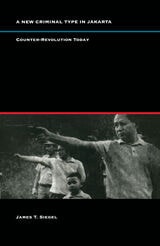
A New Criminal Type in Jakarta
Counter-Revolution TodayJames T. Siegel
Duke University Press, 1998
Examining the links between the concept of criminality and scandal, rumor, fear, and the state, Siegel analyzes daily life in Jakarta through the seemingly disparate but strongly connected elements of family life, gossip, and sensationalist journalism. He offers close analysis of the preoccupation with crime in Pos Kota (a newspaper directed toward the lower classes) and the middle-class magazine Tempo. Because criminal activity has been a sensationalized preoccupation in Jakarta’s news venues and among its people, criminality, according to Siegel, has pervaded the identities of its ordinary citizens. Siegel examines how and why the government, fearing revolution and in an attempt to assert power, has made criminality itself a disturbing rationalization for the spectacular massacre of the people it calls criminals—many of whom were never accused of particular crimes. A New Criminal Type in Jakarta reveals that Indonesians—once united by Sukarno’s revolutionary proclamations in the name of “the people”—are now, lacking any other unifying element, united through their identification with the criminal and through a “nationalization of death” that has emerged with Suharto’s strong counter-revolutionary measures.
A provocative introduction to contemporary Indonesia, this book will engage those interested in Southeast Asian studies, anthropology, history, political science, postcolonial studies, public culture, and cultural studies generally.
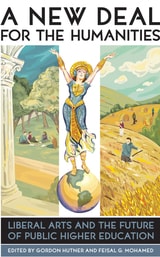
A New Deal for the Humanities
Liberal Arts and the Future of Public Higher EducationHutner, Gordon
Rutgers University Press, 2015
The contributors offer spirited and thought-provoking debates on a diverse range of topics. For instance, they deplore the push by administrations to narrow learning into quantifiable outcomes as well as the demands of state governments for more practical, usable training. Indeed, for those who suggest that a college education should be “practical”—that it should lean toward the sciences and engineering, where the high-paying jobs are—this book points out that while a few nations produce as many technicians as the United States does, America is still renowned worldwide for its innovation and creativity, skills taught most effectively in the humanities. Most importantly, the essays in this collection examine ways to make the humanities even more effective, such as offering a broader array of options than the traditional major/minor scheme, options that combine a student’s professional and intellectual interests, like the new medical humanities programs.
A democracy can only be as energetic as the minds of its citizens, and the questions fundamental to the humanities are also fundamental to a thoughtful life. A New Deal for the Humanities takes an intrepid step in making the humanities—and our citizens—even stronger in the future.

A New Generation Draws the Line
'Humanitarian' Intervention and the Standards of the WestNoam Chomsky
Pluto Press, 2012
A New Green Order?
The World Bank and the Politics of the Global Environment FacilityZoe Young
Pluto Press, 2002
Investigating the workings of this little known aid fund, Zoe Young takes a critical look at the conflicts involved, focusing on how the GEF's agenda relates to questions of globalisation, knowledge and accountability in the United States and the World Bank.
As our landscapes, fertility, cultures and ecosystems are being destroyed every day, Zoe Young gives a disturbing account of the complex issues that must be addressed before the world's environment can be managed more democratically - and effectively.
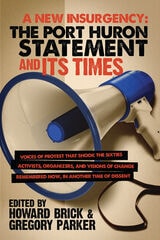
A New Insurgency
The Port Huron Statement and Its TimesHoward Brick and Gregory Parker, eds.
Michigan Publishing Services, 2018
This volume features three never-before-published “manifesto drafts” written by Tom Hayden in early 1962 that generated the discussion leading to the Port Huron meeting. Other highlights include recollections from leading women in the Port Huron deliberations who, three years later, protested the subordination of women within the radical movements, thus setting the stage for the rise of women’s liberation. A New Insurgency is based on the University of Michigan’s conference commemorating the fiftieth anniversary of the Port Huron Statement in 2012.
“The fiftieth anniversary of the Port Huron Statement has drawn a great number of reflections and commemorations, but this carefully conceived volume offers an account of unrivaled ambition, exceptional breadth, and surprising insight. It both excavates the event itself—vividly, perceptively, exhaustively—and gives it the largest and most illuminating of contexts. A New Insurgency is as close to definitive as any volume of this kind can become.”
—Geoff Eley, Karl Pohrt Distinguished University Professor of Contemporary History, University of Michigan
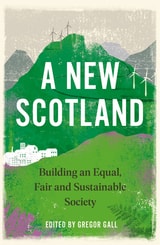
A New Scotland
Building an Equal, Fair and Sustainable SocietyGregor Gall
Pluto Press, 2022
In A New Scotland, leading activists and academics lay out the blueprints for radical reform, showing how society can be transformed by embedding values of democracy, social justice and environmental sustainability into a coherent set of policy ideas.
Structured in two parts, the book takes to task the challenges to affect radical change, before exploring new approaches to key questions such as healthcare, education, public ownership, race, gender and human rights.
A Noble Fight
African American Freemasonry and the Struggle for Democracy in AmericaCorey D. B. Walker
University of Illinois Press, 2008
With great care and detail, Walker argues that African American freemasonry provides a critical theoretical lens for understanding the distinctive ways African Americans have constructed a radically democratic political imaginary through racial solidarity and political nationalism, forcing us to reconsider much more circumspectly the complex relationship between voluntary associations and democratic politics.
Mapping the discursive logics of the language of freemasonry as a metaphoric rendering of American democracy, this study interrogates the concrete forms of an associational culture, revealing how paradoxical aspects of freemasonry such as secrecy and public association inform the production of particular ideas and expressions of democracy in America.
A Not So Foreign Affair
Fascism, Sexuality, and the Cultural Rhetoric of American DemocracyAndrea Slane
Duke University Press, 2001
World War II marked a turning point in the cultural rhetoric of democracy, Slane claims, because it intensified a preoccupation with the political role of private life and pushed sexuality to the center of democratic discourse. Having created tremendous anxiety—and fascination—in American culture, Nazism became associated with promiscuity, sexual perversionand the destruction of the family. Slane reveals how this particular imprint of fascism is used in progressive as well as conservative imagery and language to further their domestic agendas and shows how our cultural engagement with Nazism reflects the inherent tension in democracy between the value of diversity, individual freedoms national identity, and notions of the common good. Finally, she applies her analysis of wartime narratives to contemporary texts, examining anti-abortion, anti-gay, and anti-federal rhetoric, as well as the psychic life of skinheads, censorship debates, and the contemporary fascination with incest.
An invaluable resource for understanding the language we use—both visual and narrative—to describe and debate democracy in the United States today, A Not So Foreign Affair will appeal to those interested in cultural studies, film and video studies, American studies, twentieth century history, German studies, rhetoric, and sexuality studies.
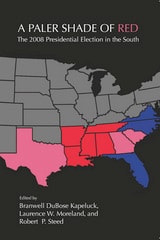
A Paler Shade of Red
The 2008 Presidential Election in the SouthBranwell DuBose Kapeluck
University of Arkansas Press, 2009
A Passion for Cooperation
Adventures of a Wide-Ranging ScientistRobert Axelrod
University of Michigan Press, 2023
Yet Axelrod’s autobiography is not just an account of his wide-ranging passion for cooperation. It reveals his struggles to overcome failures and experience the joys of gaining new insights into how to achieve cooperation. A Passion for Cooperation recounts Robert Axelrod’s adventures talking with the leader of the organization Hamas, the Prime Minister of Israel, and the Foreign Minister of Syria. Axelrod also shares stories of being hosted in Kazakhstan by senior Soviet retired generals and visiting China with well-connected policy advisors on issues of military aspects of cyber conflict. Through stories of the difficulties and rewards of interdisciplinary collaborations, readers will discover how Axelrod’s academic and practical work have enriched each other and demonstrated that opportunities for cooperation are much greater than generally thought.
A Peaceful Conquest
Woodrow Wilson, Religion, and the New World OrderCara Lea Burnidge
University of Chicago Press, 2016
With A Peaceful Conquest, Cara Lea Burnidge presents the most detailed analysis yet of how Wilson’s religious beliefs affected his vision of American foreign policy, with repercussions that lasted into the Cold War and beyond. Framing Wilson’s intellectual development in relationship to the national religious landscape, and paying greater attention to the role of religion than in previous scholarship, Burnidge shows how Wilson’s blend of Southern evangelicalism and social Christianity became a central part of how America saw itself in the world, influencing seemingly secular policy decisions in subtle, lasting ways. Ultimately, Burnidge makes a case for Wilson’s religiosity as one of the key drivers of the emergence of the public conception of America’s unique, indispensable role in international relations.
As the presidential election cycle once again raises questions of America’s place in the world, A Peaceful Conquest offers a fascinating excavation of its little-known roots.
A People's History of the European Court of Human Rights
A People's History of the European Court of Human Rights, First Paperback EditionGoldhaber, Michael
Rutgers University Press, 2007
The exceptionality of America’s Supreme Court has long been conventional wisdom. But the United States Supreme Court is no longer the only one changing the landscape of public rights and values. Over the past thirty years, the European Court of Human Rights has developed an ambitious, American-style body of law. Unheralded by the mass press, this obscure tribunal in Strasbourg, France has become, in many ways, the Supreme Court of Europe.
Michael Goldhaber introduces American audiences to the judicial arm of the Council of Europe—a group distinct from the European Union, and much larger—whose mission is centered on interpreting the European Convention on Human Rights. The Council routinely confronts nations over their most culturally-sensitive, hot-button issues. It has stared down France on the issue of Muslim immigration; Ireland on abortion; Greece on Greek Orthodoxy; Turkey on Kurdish separatism; Austria on Nazism; and Britain on gay rights and corporal punishment. And what is most extraordinary is that nations commonly comply.
In the battle for the world’s conscience, Goldhaber shows how the court in Strasbourg may be pulling ahead.
A People's History of the Russian Revolution
Neil Faulkner
Pluto Press, 2017
Faulkner rejects caricatures of Lenin and the Bolsheviks as authoritarian conspirators or the progenitors of Stalinist dictatorship, and forcefully argues that the Russian Revolution was an explosion of democracy and creativity—and that it was crushed by bloody counter-revolution and replaced with a form of bureaucratic state-capitalism.
Grounded by powerful first-hand testimony, this history marks the centenary of the Revolution by restoring the democratic essence of the revolution, offering a perfect primer for the modern reader.

A Perfect Pint's Beer Guide to the Heartland
Michael Agnew
University of Illinois Press, 2014
- Agnew's exclusive choices on which beers to try at each location
- Entries on every brewery's history and philosophy
- Information on tours, tasting rooms and attached pubs, and dining options and other amenities
- A survey of each brewery's brands, including its flagship beer plus seasonal brews and special releases
- Brewery equipment and capacity
- Nearby attractions
In addition, Agnew sets the stage with a history of Midwestern beer spanning the origins of the immigrant brewers who arrived in the 1800s to the homebrewers-made-good who have built a new kind of brewing culture founded on creativity, dedication to quality, and attention to customer feedback.
Informed and unique, A Perfect Pint's Beer Guide to the Heartland is the essential companion for beer aficionados and curious others determined to drink the best the Midwest has to offer.
Includes more than 150 full color images, including the region's most distinctive beer labels, trademarks, and company logos.

A Phenomenology of Trumpism
America Talks with the Origins of the WestMichael Arvanitopoulos
Intellect Books, 2026
This book traces our escalating geopolitical chaos to the utter failure of Western education. The purging of the Greeks from our schools with the masquerade that was modernity, combined with the prevalence of Teutonic neo-barbarism in Europe and a constitutional anti-intellectualism in America, has bred compiling generations of citizens bereft of a kind of thought that is essentially human. In the absence of human thought, market ideologies from Karl Marx to Adam Smith have enjoyed a long leash to establish as incontestable the idea that any existential proposition other than their own is nothing but an arrogant desire to redesign life itself. Thus Western “democracies” alternatively keep voting in Satan to fend off Beelzebub, having to choose between either a preanthropic Hobbesian, or a metanthropic Sartrean future, with not much in between. From what universal constancy, and from what kind of “education,” can an anthropic measure show beyond doubt that there is an alternative path? This is the riddle of the Age of Trumpism, the book argues; and forces the Statue of Liberty into a syzetetic discussion with the Greek statue, through a critical phenomenological return to the things themselves that bridges Heidegger’s thought with the metaphysics of Greek tragic art.
A Place for Dialogue
Language, Land Use, and Politics in Southern ArizonaSharon McKenzie Stevens
University of Iowa Press, 2007
In A Place for Dialogue, Sharon McKenzie Stevens views the contradictions and collaborations involved in the management of public land in southern Arizona—and by extension the entire arid West—through the lens of political rhetoric. Revealing the socioecological relationships among cattlemen and environmentalists as well as developers and recreationists, she analyzes the ways that language shapes landscape by shaping decisions about land use.
Stevens focuses on the collaborative Sonoran Desert Conservation Plan initiated by Pima County, Arizona, the ubiquitous use of scientific argument to defend contradictory practices, and the construction and negotiation of rancher/environmentalist identities to illuminate both literally and metaphorically the dynamics of land use politics. Drawing specifically upon extensive interviews with a diverse array of agents on all sides of the debate—ranchers, environmentalists, scientists, land managers, government officials—on historical narratives, and on her own conflicting experiences as someone who grew up with those who work the western lands, she demonstrates that it is possible to use differences to solve, rather than to aggravate, the entrenched problems that bridge land and language.
By integrating her richly textured case study of a fragile region with rhetorical approaches to narrative, science-based argument, and collective identities, Stevens makes a significant contribution to the fields of rhetoric, land management, and cultural studies.

A Police State
Politics and Public Safety in Minneapolis, 1945–2020Michael J. Lansing
University of Chicago Press, 2027
How the police in Minneapolis used electoral politics to accrue power and avoid accountability.
The 2020 murder of George Floyd made Minneapolis synonymous with unjust policing and the pain and outrage left in its wake. The city became ground zero for police reform in the United States—even though liberal politicians in Minnesota had promised, and delivered, police reforms for decades. Centered on professionalization, these changes inadvertently exacerbated injustice. Better training and higher standards broadened the influence of the police, who then claimed expertise in public safety. They deployed it to bargain for governmental support, even when they treated residents unfairly. Though Black, Indigenous, and gay residents resisted, the political power amassed by the police rendered real change almost impossible.
In A Police State, historian and fourth-generation Minneapolis resident Michael J. Lansing chronicles how the police became a political force in one of the nation’s most liberal cities. Lansing shows how, in the years after World War II, public safety policies that appealed to voters in the overwhelmingly white city protected and expanded police discretion. As union members, administrators, and citizens, officers shaped these policies to shield themselves and their violent actions from scrutiny. They campaigned for better wages, secured legal safeguards, resisted race-neutral policing, and elected one of their own to the mayor’s office. Ultimately, they used democratic institutions to cultivate and sustain a police state that protected white people and harmed people of color. Lansing uncovers this dysfunctional relationship between a city and its cops while illuminating a larger American story about reform, resistance, and democracy.
A significant exploration of policing politics, this book helps us understand the history that led to George Floyd’s murder—and insists that the future of community safety depends on reenvisioning the role of police in our society.
A Political Economy of Justice
Edited by Danielle Allen, Yochai Benkler, Leah Downey, Rebecca Henderson, and Josh Simons
University of Chicago Press, 2022
If we can agree that our current social-political moment is tenuous and unsustainable—and indeed, that may be the only thing we can agree on right now—then how do markets, governments, and people interact in this next era of the world? A Political Economy of Justice considers the strained state of our political economy in terms of where it can go from here. The contributors to this timely and essential volume look squarely at how normative and positive questions about political economy interact with each other—and from that beginning, how to chart a way forward to a just economy.
A Political Economy of Justice collects fourteen essays from prominent scholars across the social sciences, each writing in one of three lanes: the measures of a just political economy; the role of firms; and the roles of institutions and governments. The result is a wholly original and urgent new benchmark for the next stage of our democracy.

A Political Theology of Negative Sovereignty
Claudio Lomnitz
Duke University Press, 2027
A Politics of Virtue
Hinduism, Sexuality, and Countercolonial Discourse in FijiJohn D. Kelly
University of Chicago Press, 1991
changing conditions of political possibility by examining the
connection between politics and sexual morality in the British
colony of Fiji from 1929 to 1932.
A Postcapitalist Politics
J. K. Gibson-Graham
University of Minnesota Press, 2006
A Postcapitalist Politics reveals a prolific landscape of economic diversity—one that is not exclusively or predominantly capitalist—and examines the challenges and successes of alternative economic interventions. Gibson-Graham bring together political economy, feminist poststructuralism, and economic activism to foreground the ethical decisions, as opposed to structural imperatives, that construct economic “development” pathways. Marshalling empirical evidence from local economic projects and action research in the United States, Australia, and Asia, they produce a distinctive political imaginary with three intersecting moments: a politics of language, of the subject, and of collective action. In the face of an almost universal sense of surrender to capitalist globalization, this book demonstrates that postcapitalist subjects, economies, and communities can be fostered. The authors describe a politics of possibility that can build different economies in place and over space. They urge us to confront the forces that stand in the way of economic experimentation and to explore different ways of moving from theory to action.
J. K. Gibson-Graham is the pen name of Katherine Gibson and Julie Graham, feminist economic geographers who work, respectively, at the Australian National University in Canberra and the University of Massachusetts Amherst.
A Pragmatic Alliance
Jewish-Lithuanian political cooperation at the beginning of the 20th centuryVladas Sirutavicius
Central European University Press, 2011

A Pragmatism of Beginnings
Governing Crises in the AnthropocenePol Bargués
University of Michigan Press, 2027
As climate change, pandemics, disasters, migrations, and conflicts increasingly overlap, crises are becoming more complex and difficult to address. The Anthropocene is an era characterized by uncertainty and contestation, in which traditional approaches to crisis management are no longer working. This book examines the ideas that have emerged to help societies move forward, including resilience, navigation, adaptation, precaution, and slow peacebuilding. While these approaches promise hope and progress, A Pragmatism of Beginnings critically highlights their limitations, showing how they often focus on coping with crises in ways that merely preserve and reproduce a decaying status quo.
Drawing on philosophical pragmatism, the book places these imaginaries that drive crisis management today in dialogue with the work of the classical pragmatists William James, John Dewey, and Jane Addams, as well as contemporary philosophers Bruno Latour, Graham Harman, and Elizabeth Grosz, to assess both their promises and their limitations. Across a series of case studies covering disaster response, peacebuilding, global health, climate governance, migration management, and the Women, Peace and Security agenda, the book shows how contemporary crisis governance often seeks to preserve the status quo by managing risks and avoiding breakdown rather than pursue transformative change. A Pragmatism of Beginnings argues that responding to today’s crises requires more; it also demands the courage and imagination to seize new beginnings.
A Preface to Democratic Theory
Robert A. Dahl
University of Chicago Press, 1963
"A Preface to Democratic Theory is well worth the devoted attention of anyone who cares about democracy. For it will have an important influence on both theory about democracy and on actual practice in democracies round the world."—Bernard Barber, Political Science Quarterly
"The book is a must for democratic theorists."—J. Roland Pennock, Journal of Politics
A Preface to Democratic Theory, Expanded Edition
Robert A. Dahl
University of Chicago Press, 2006
For this fiftieth-anniversary edition, Dahl has written an extensive new afterword that reevaluates Madisonian theory in light of recent research. And in a new foreword, he reflects back on his influential volume and the ways his views have evolved since he wrote it. For any student or scholar of political science, this new material is an essential update on a gold standard in the evolving field of democratic theory.
“A Preface to Democratic Theory is well worth the devoted attention of anyone who cares about democracy.”—Political Science Quarterly

A Prelude to the Welfare State
The Origins of Workers' CompensationPrice V. Fishback and Shawn Everett Kantor
University of Chicago Press, 2000
In this highly original and persuasive work, Price V. Fishback and Shawn Everett Kantor challenge widespread historical perceptions, arguing that, rather than being an early progressive victory, workers' compensation succeeded because all relevant parties—labor and management, insurance companies, lawyers, and legislators—benefited from the legislation. Thorough, rigorous, and convincing, A Prelude to the Welfare State: The Origins of Workers' Compensation is a major reappraisal of the causes and consequences of a movement that ultimately transformed the nature of social insurance and the American workplace.
A Presidential Civil Service
FDR's Liaison Office for Personnel ManagementMordecai Lee
University of Alabama Press, 2016
Revealing the overlooked agency that transformed presidential personnel management and modern federal governance.
A Presidential Civil Service offers a comprehensive and definitive study of President Franklin Delano Roosevelt’s Liaison Office for Personnel Management (LOPM). Established in 1939 following the release of Roosevelt’s Brownlow Committee report, LOPM became a key milestone in the evolution of the contemporary executive-focused civil service.
The Progressive Movement of the nineteenth and early twentieth centuries comprised groups across the political spectrum with quite different. All, however, agreed on the need for a politically autonomous and independent federal Civil Service Commission (CSC) to eliminate patronage and political favoritism. In A Presidential Civil Service, public administration scholar Mordecai Lee explores two models open to later reformers: continuing a merit-based system isolated from politics or a management-based system subordinated to the executive and grounded in the growing field of managerial science.
Roosevelt’s 1937 Brownlow Committee, formally known as the President’s Committee on Administrative Management, has been widely studied including its recommendation to disband the CSC and replace it with a presidential personnel director. What has never been documented in detail was Roosevelt’s effort to implement that recommendation over the objections of Congress by establishing the LOPM as a nonstatutory agency.
The role and existence of LOPM from 1939 to 1945 has been largely dismissed in the history of public administration. Lee’s meticulously researched A Presidential Civil Service, however, persuasively shows that LOPM played a critical role in overseeing personnel policy. It was involved in every major HR initiative before and during World War II. Though small, the agency’s deft leadership almost always succeeded at impelling the CSC to follow its lead.
Roosevelt’s actions were in fact an artful and creative victory, a move finally vindicated when, in 1978, Congress abolished the CSC and replaced it with an Office of Personnel Management headed by a presidential appointee. A Presidential Civil Service offers a fascinating account and vital reassessment of the enduring legacy of Roosevelt’s LOPM.

A Prison in the Woods
Environment and Incarceration in New York's North CountryClarence Jefferson Hall
University of Massachusetts Press, 2020
Clarence Jefferson Hall Jr. reveals that the introduction of correctional facilities—especially in the last three decades of the twentieth century—unearthed long-standing conflicts over the proper uses of Adirondack nature, particularly since these sites have contributed to deforestation, pollution, and habitat decline, even as they've provided jobs and spurred economic growth. Additionally, prison plans have challenged individuals' commitment to environmental protection, tested the strength of environmental regulations, endangered environmental and public health, and exposed tensions around race, class, place, and belonging in the isolated prison towns of America's largest state park.

A Program for Land Use in Northern Minnesota
A Type Study in Land UtilizationOscar Jesness
University of Minnesota Press, 1935
A Prosperous Way Down
Principles and PoliciesHoward T. Odum
University Press of Colorado, 2008
A Prosperous Way Down considers ways in which a future with less fossil fuel could be peaceful and prosperous. Although history records the collapse of countless civilizations, some societies and ecosystems have managed to descend in orderly stages, reducing demands and selecting and saving what is most important.
The authors make recommendations for a more equitable and cooperative world society, with specific suggestions based on their evaluations of trends in global population, wealth distribution, energy sources, conservation, urban development, capitalism and international trade, information technology, and education.
Available for the first time in paperback, this thoughtful, provocative book forces us to confront assumptions about our world 's future and provides both a steadying hand and a call to action with its pragmatic analysis of a global transition.
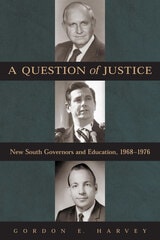
A Question of Justice
New South Governors and Education, 1968-1976Gordon E. Harvey
University of Alabama Press, 2005
The governors who used education to transform the modern South.
In southern politics, 1970 marked a watershed. A group of southern governors entered office that year and changed both the way the nation looked at the South and the way the constituents of those states viewed themselves. Reubin Askew in Florida, John West in South Carolina, Jimmy Carter in Georgia, and Albert Brewer in Alabama all represented a new breed of progressive moderate politician that helped demolish Jim Crow segregation and the dual economies, societies, and educational systems notorious to the Sunbelt South. Historian Gordon Harvey explores the political lives and legacies of three of these governors, examining the conditions that led to such a radical change in political leadership, the effects their legislative agendas had on the identity of their states, and the aftermath of their terms in elected office.
A common thread in each governor's agenda was educational reform. Albert Brewer's short term as Alabama governor resulted in a sweeping education package that still stands as the most progressive the state has seen. Reubin Askew, far more outspoken than Brewer, won the Florida gubernatorial election through a campaign that openly promoted desegregation, busing, and tax reform as a means of equal school funding. John West's commitment to a policy of inclusion helped allay fears of both black and white parents and made South Carolina's one of the smoothest transitions to integrated schools.
As members of the first generation of New South governors, Brewer, Askew, and West played the role of trailblazers. Their successful assaults on economic and racial injustice in their states were certainly aided by such landmark events as Brown v. Board of Education, the civil rights movement, and the expansion of voting rights-all of which sounded the death knell for the traditional one-party segregated South. But in this critical detailing of their work for justice, we learn how these reform-minded men made education central to their gubernatorial terms and, in doing so, helped redefine the very character of the place they called home.
A Question of Voice
Philosophy and the Search for LegitimacyRon Scapp
University of Michigan Press, 2020
A Radical Convergence
Latter-day Saints and Their Utopian Socialist OriginsErik J. Freeman
University of Illinois Press, 2026
Erik J. Freeman uses the lives of radical converts to explore the international socialist politics that permeated the early Church. These energetic newcomers fueled LDS expansion even as they laid the foundation for a global religion. At the same time, utopian socialists within the Church helped lay the groundwork for later political and social movements and progressive ideas. The Church in the United States pivoted toward capitalism after the turn of the century, but socialist thought remained—and remain—an important thread throughout LDS communities around the world.
Provocative and sweeping, A Radical Convergence tells the surprising story of utopian socialism's place in Church history.
A Radical History of the World
Neil Faulkner
Pluto Press, 2018
“Staggeringly ambitious.”―New Internationalist
“One of the finest historians on the left.”—John Newsinger, author, The Blood Never Dried
Rejecting the top-down approach of conventional history, Neil Faulkner contends that it is the mass action of ordinary people that drives the transformative events of our many histories. This is a history of power, abuse, and greed, but also one of liberation, progress, and solidarity.
From the hunter-gatherers two million years ago to the ancient empires of Persia and China, and from the Russian Revolution to modern imperialism, humans have always struggled to create a better society than what came before. All over the world at numerous points in the past, a different way of life has become an absolute necessity, over and over again. This is a history of the humans in these struggles—the hominid and the hunter, the emperor and the slave, the dictator and the revolutionary.
Reading against the grain of mainstream histories, Neil Faulkner reveals that what happened in the past has never been predetermined. From antiquity to feudalism, and from fascism to our precarious political present, choices have always been numerous and complex, and the possible outcomes have ranged broadly between liberation and barbarism. His chapters include:
*Hunters and Farmers
*The First Class Societies
*Ancient Empires
*The Medieval World
*European Feudalism
*The First Wave of Bourgeois Revolutions
*Absolutist Europe and Capitalist Globalization
*The Rise of Industrial Capitalism
*The Revolutionary Wave
*The Great Depression and the Rise of Fascism
*World War and Cold War
*The New World Disorder
*Capitalism’s Greatest Crisis? The Early Twenty-First Century
In our fraught political present—as we face the loss of civil liberties and environmental protections, the rise of ethnonationalism, and the looming threat of nuclear war—we need the perspective of these histories now more than ever. The lesson of A Radical History of the World is that, if we created our past, we can also create a better future.
A Radical Spirit
The History and Potential of the Latter Day Saint TraditionEdited by Andrew Bolton, Taunalyn Ford, and Patrick Q. Mason
University of Illinois Press, 2027
Early followers of Joseph Smith believed their new faith could organize society from the ground up and create a religious community shaped by justice, equality, and spiritual transformation. The essayists look at the movement’s diverse influences—religious, philosophical, and cultural—alongside the economic, gender, and racial issues that informed its radicalism. They also trace the competing pressures inside and outside the movement that helped determine which radical ideas survived and which faded or were later enhanced.
Eye-opening and expansive, A Radical Spirit rediscovers implications of the original heart of the Restoration tradition that thrived among the marginalized poor in the USA, Canada and in Europe—a radical Spirit of Jesus that offers possibilities for our times.
Contributors: Andrew Bolton, Gerard Charmley, Rebekah Clark, Taunalyn Ford, Russell Arben Fox, Erik J. Freeman, David J. Howlett, Brad A. Martell, Lori Martell, Patrick Q. Mason, Michael Ratcliffe, Jennifer Reeder, Joseph M. Spencer, Jordan T. Watkins, Walker Wright
A Rebellious People
Basques, Protests, And PoliticsCyrus Ernesto Zirakzadeh
University of Nevada Press, 1991
In this scholarly work, Zirakzadeh argues that there is a calculated reasoning behind ETA's political violence that is often overlooked by researchers. His book is a comprehensive account of the Basque region's grassroots politics.
A Received Grace
Slavery, Heirlooms, and the Feminine Labor of ForgettingMacushla Robinson
Duke University Press, 2027
A Reckoning
Philippine Trials of Japanese War CriminalsSharon W. Chamberlain
University of Wisconsin Press, 2019
Chamberlain highlights the differing views of Filipinos and Japanese about the trials. The Philippine government aimed to show its commitment to impartial proceedings with just outcomes. In Japan, it appeared that defendants were selected arbitrarily, judges and prosecutors were biased, and lower-ranking soldiers were punished for crimes ordered by their superior officers. She analyzes the broader implications of this divergence as bilateral relations between the two nations evolved and contends that these competing narratives were reimagined in a way that, paradoxically, aided a path toward postwar reconciliation.
A Red Family
Junius, Gladys, and Barbara ScalesMickey Friedman. Afterword by Barbara Scales. Historical Essay by Gail O'Brien.
University of Illinois Press, 2008
Through the distinct perspectives of Junius, his wife Gladys, and his daughter Barbara, this book deepens and personalizes the story of American radicalism. Conversational, intimate, and exceptionally accessible, A Red Family offers a unique look at the American communist experience from the inside out.
A Renegade Union
Interracial Organizing and Labor RadicalismLisa Phillips
University of Illinois Press, 2013
A Return to Servitude
Maya Migration and the Tourist Trade in CancúnM. Bianet Castellanos
University of Minnesota Press, 2010
A Return to Servitude is an ethnography of Maya migration within Mexico that analyzes the foundational role indigenous peoples play in the development of the modern nation-state. Focusing on tourism in the Yucatán Peninsula, M. Bianet Castellanos examines how Cancún came to be equated with modernity, how this city has shaped the political economy of the peninsula, and how indigenous communities engage with this vision of contemporary life. More broadly, she demonstrates how indigenous communities experience, resist, and accommodate themselves to transnational capitalism.
Tourism and the social stratification that results from migration have created conflict among the Maya. At the same time, this work asserts, it is through engagement with modernity and its resources that they are able to maintain their sense of indigeneity and community.
A Rhetorical Crime
Genocide in the Geopolitical Discourse of the Cold WarWeiss-Wendt, Anton
Rutgers University Press, 2018
A Rhetorical Crime shows how genocide morphed from a legal concept into a political discourse used in propaganda battles between the United States and the Soviet Union. Over the course of the Cold War era, nearly eighty countries were accused of genocide, and yet there were few real-time interventions to stop the atrocities committed by genocidal regimes like the Cambodian Khmer Rouge.
Renowned genocide scholar Anton Weiss-Wendt employs a unique comparative approach, analyzing the statements of Soviet and American politicians, historians, and legal scholars in order to deduce why their moral posturing far exceeded their humanitarian action.
A Rich and Tantalizing Brew
A History of How Coffee Connected the WorldJeanette M. Fregulia
University of Arkansas Press, 2019
The history of coffee is much more than the tale of one luxury good—it is a lens through which to consider various strands of world history, from food and foodways to religion and economics and sociocultural dynamics.
A Rich and Tantalizing Brew traces the history of coffee from its cultivation and brewing first as a private pleasure in the highlands of Ethiopia and Yemen through its emergence as a sought-after public commodity served in coffeehouses first in the Muslim world, and then traveling across the Mediterranean to Italy, to other parts of Europe, and finally to India and the Americas. At each of these stops the brew gathered ardent aficionados and vocal critics, all the while reshaping patterns of socialization.
Taking its conversational tone from the chats often held over a steaming cup, A Rich and Tantalizing Brew offers a critical and entertaining look at how this bitter beverage, with a little help from the tastes that traveled with it—chocolate, tea, and sugar—has connected people to each other both within and outside of their typical circles, inspiring a new context for sharing news, conducting business affairs, and even plotting revolution.
A Rift in the Clouds
Race and the Southern Federal Judiciary, 1900-1910Brent J. Aucoin
University of Arkansas Press, 2007