Results by title
5448 books match the query 'History and criticism' and 252 start with b
BASTARDS AND FOUNDLINGS
ILLEGITIMACY IN EIGHTEENTH-CENTURY ENGLANDLisa Zunshine
The Ohio State University Press, 2005
BLACK BRITISH LITERATURE
NOVELS OF TRANSFORMATIONMark Stein
The Ohio State University Press, 2004
BLUEGRASS
A HistoryNeil V. Rosenberg
University of Illinois Press, 2005
Baby, Let Me Follow You Down
The Illustrated Story of the Cambridge Folk YearsEric von Schmidt
University of Massachusetts Press, 1979
Compiled by two musicians who were active participants in the Cambridge folk scene, the volume documents a special time in United States culture when the honesty and vitality of traditional folk music were combined with the raw power of urban blues and the high energy of electric rock and roll to create a new American popular music.
Bacchanalian Sentiments
Musical Experiences and Political Counterpoints in TrinidadKevin K. Birth
Duke University Press, 2008
Birth draws on fieldwork he conducted in one of Trinidad’s ethnically diverse rural villages to explore the relationship between music and social and political consciousness on the island. He describes how Trinidadians use the affective power of music and the physiological experience of performance to express and work through issues related to identity, ethnicity, and politics. He looks at how the performers and audience members relate to different musical traditions. Turning explicitly to politics, Birth recounts how Trinidadians used music as a means of making sense of the attempted coup d’état in 1990 and the 1995 parliamentary election, which resulted in a tie between the two major political parties. Bacchanalian Sentiments is an innovative ethnographic analysis of the significance of music, and particular musical forms, in the everyday lives of rural Trinidadians.

Bach Perspectives, Volume 12
Bach and the Counterpoint of ReligionEdited by Robin A. Leaver
University of Illinois Press, 2018
Bach Perspectives, Volume 13
Bach ReworkedEdited by Laura Buch
University of Illinois Press, 2020
An insightful look at how composers build on each other's work, Bach Reworked reveals how nuanced understandings of parody procedures can fuel both musical innovation and historically informed performance.
Contributors: Stephen A. Crist, Ellen Exner, Moira Leanne Hill, Erinn E. Knyt, and Markus Zepf
Bach Perspectives, Volume 14
Bach and Mozart: Connections, Patterns, and PathwaysEdited by Paul Corneilson
University of Illinois Press, 2022
An official publication of the American Bach Society, Bach Perspectives, Volume 14 draws on a variety of approaches and a broad range of subject matter in presenting a new wave of innovative classical musical scholarship.
Contributors: Eleanor Selfridge-Field, Yoel Greenberg, Noelle M. Heber, Michael Maul, Stephen Roe, and David Schulenberg
Bach Perspectives, Volume 5
Bach in AmericaEdited by Stephen A. Crist
University of Illinois Press, 2002
More than a century passed after Johann Sebastian Bach's death in 1750 before his music found an audience in the United States. Volume Five in the Bach Perspectives series tracks the composer's reputation in America from obscure artist to a cultural mainstay whose music has spread to all parts of the country.
Barbara Owen surveys Bach's early reception in America. Matthew Dirst focuses on John Sullivan Dwight's role in advocating Bach's work. Michael Broyles considers Bach's early impact in Boston while Mary J. Greer offers a counterpoint in her study of Bach's reception in New York. Hans-Joachim Schulze's essay links the American descendants of August Reinhold Bach to the composer. Christoph Wolff also focuses on Bach's descendants in America, particularly Friederica Sophia Bach, the daughter of Bach's eldest son. Peter Wollny evaluates manuscripts not included in Gerhard Herz's study of Bach Sources in America. The volume concludes with Carol K. Baron's comparison of Bach with Charles Ives while Stephen A. Crist measures Bach's influence on the jazz icon Dave Brubeck.

Bach Perspectives, Volume 9
J.S. Bach and His Contemporaries in GermanyEdited by Andrew Talle
University of Illinois Press, 2013
In this volume, Wolfgang Hirschmann proposes an ethnographic approach that contextualizes Bach's works, addressing the aesthetic paths he took as well as those he did not pursue. Steven Zohn's essay considers Telemann's contribution to the orchestral Ouverture genre, observering how Telemann's approach to integrating the national styles of his time was quite different from, but no less rich than, Bach's. Andrew Talle compares settings and strategies of Vergnügte Ruh, beliebte Seelenlust by Bach and Graupner. Alison Dunlop presents valuable primary research on Muffat, the most commonly cited keyboard music composer in Vienna during Bach's lifetime. Finally, Michael Maul sheds new light on the Scheibe-Birnbaum controversy, contextualizing the most famous critique of J. S. Bach's compositional style by discussing the other composers that Scheibe critiqued.

Bachata
A Social History of a Dominican Popular MusicDeborah Pacini
Temple University Press, 1995
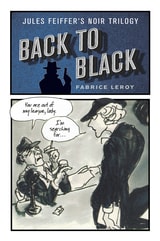
Back to Black
Jules Feiffer’s Noir TrilogyFabrice Leroy
Rutgers University Press, 2025
Named the Best Academic Work of 2025 by The Comics Journal
The legendary American cartoonist and author Jules Feiffer has enjoyed a long and varied career, working on everything from illustrating The Phantom Tollbooth to writing the screenplay for the film Popeye. But some of his most innovative work came very late in his career, with a trio of graphic novels he composed in his eighties: Kill My Mother (2014), Cousin Joseph (2016), and The Ghost Script (2018).
Back to Black provides the first full-length critical analysis of this trilogy, exploring how it pays homage to the iconography and themes of film noir through constant graphic experimentation and a striking reinvention of Feiffer’s distinctive style. Fabrice Leroy shows how Feiffer deftly alternates between dramatic and satirical tones as he plays with the conventions of noir to provide a caustic yet moving commentary on mid-twentieth-century American life. Through close readings of each novel in the trilogy, he examines Feiffer’s singular depiction of the central political issues in the United States from the Great Depression to the 1950s, which still resonate today: unionization struggles, cinematic propaganda, McCarthyism, the American Dream, immigration, antisemitism, civil rights, and gender discrimination. Placing the noir trilogy into the context of Feiffer’s long career, Back to Black demonstrates how he offers a loving pastiche of the genre without losing his unique voice or critical edge.
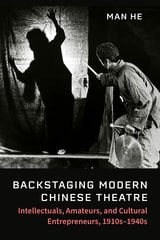
Backstaging Modern Chinese Theatre
Intellectuals, Amateurs, and Cultural Entrepreneurs, 1910s–1940sMan He
University of Michigan Press, 2025
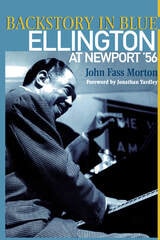
Backstory in Blue
Ellington at Newport '56John Fass Morton
Rutgers University Press, 2008
Certificate of Merit for the 2009 Association for Recorded Sound Collections Award for Excellence in Historical Recorded Sound Research
It may be that the song most baby boomers identify from July 1956 is a simple twelve-bar blues, hyped on national television by a twenty-one-year-old Elvis Presley and his handlers. But it is a very different song, with its elongated fourteen-bar choruses of rhythm and dissonance, played on the night of July 7, 1956, by a fifty-seven-year-old Duke Ellington and his big band that got everybody on their feet and moving as one. More than fifty years later, “Diminuendo and Crescendo in Blue,” recorded at the 1956 Newport Jazz Festival, still makes a profound statement about postwar America—how we got there and where it all went.
Backstory in Blue is a behind-the-scenes look at this epic moment in American cultural history. It is the story of who and what made Ellington’s composition so compelling and how one piece of music reflected the feelings and shaped the sensibilities of the postwar generation. As John Fass Morton explains, it was music expressed as much by those who performed offstage as by those who performed on.
Written from the point of view of the audience, this unique account draws on interviews with fans and music professionals of all kinds who were there and whose lives were touched, and in some cases changed, by the experience. Included are profiles of George Avakian, who recorded and produced Ellington at Newport 1956; Paul Gonsalves, the tenor sax player responsible for the legendary twenty-seven choruses that enabled the rebirth of Ellington’s career; and the “Bedford Blonde,” Elaine Anderson, whose dance ignited both the band and the crowd.
Duke Ellington once remarked, “I was born at Newport.” Here we learn that Newport was much more than the turning point for Ellington’s career. It was the tipping point for a generation and a musical genre.
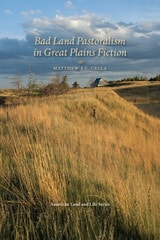
Bad Land Pastoralism in Great Plains Fiction
Matthew J. C. Cella
University of Iowa Press, 2010
At the core of this nuanced book is the question that ecocritics have been debating for decades: what is the relationship between aesthetics and activism, between art and community? By using a pastoral lens to examine ten fictional narratives that chronicle the dialogue between human culture and nonhuman nature on the Great Plains, Matthew Cella explores literary treatments of a succession of abrupt cultural transitions from the Euroamerican conquest of the “Indian wilderness” in the nineteenth century to the Buffalo Commons phenomenon in the twentieth. By charting the shifting meaning of land use and biocultural change in the region, he posits this bad land—the arid West—as a crucible for the development of the human imagination.
Each chapter deals closely with two novels that chronicle the same crisis within the Plains community. Cella highlights, for example, how Willa Cather reconciles her persistent romanticism with a growing disillusionment about the future of rural Nebraska, how Tillie Olsen and Frederick Manfred approach the tragedy of the Dust Bowl with strikingly similar visions, and how Annie Proulx and Thomas King use the return of the buffalo as the centerpiece of a revised mythology of the Plains as a palimpsest defined by layers of change and response. By illuminating these fictional quests for wholeness on the Great Plains, Cella leads us to understand the intricate interdependency of people and the places they inhabit.
Cella uses the term “pastoralism” in its broadest sense to mean a mode of thinking that probes the relationship between nature and culture: a discourse concerned with human engagement—material and nonmaterial—with the nonhuman community. In all ten novels discussed in this book, pastoral experience—the encounter with the Beautiful—leads to a renewed understanding of the integral connection between human and nonhuman communities. Propelling this tradition of bad land pastoralism are an underlying faith in the beauty of wholeness that comes from inhabiting a continuously changing biocultural landscape and a recognition of the inevitability of change. The power of story and language to shape the direction of that change gives literary pastoralism the potential to support an alternative series of ideals based not on escape but on stewardship: community, continuity, and commitment.
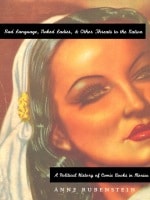
Bad Language, Naked Ladies, and Other Threats to the Nation
A Political History of Comic Books in MexicoAnne Rubenstein
Duke University Press, 1998
Since their first appearance in 1934, comic books enjoyed wide readership, often serving as a practical guide to life in booming new cities. Conservative protest against the so-called immorality of these publications, of mass media generally, and of Mexican modernity itself, however, led the Mexican government to establish a censorship office that, while having little impact on the content of comic books, succeeded in directing conservative ire away from government policies and toward the Mexican media. Bad Language, Naked Ladies, and Other Threats to the Nation examines the complex dynamics of the politics of censorship occasioned by Mexican comic books, including the conservative political campaigns against them, government and industrial responses to such campaigns, and the publishers’ championing of Mexican nationalism and their efforts to preserve their publishing empires through informal influence over government policies. Rubenstein’s analysis suggests a new Mexican history after the revolution, one in which negotiation over cultural questions replaced open conflict and mass-media narrative helped ensure political stability.
This book will engage readers with an interest in Mexican history, Latin American studies, cultural studies, and popular culture.

Bad Modernisms
Douglas Mao and Rebecca L. Walkowitz, eds.
Duke University Press, 2006
Bad Modernisms thus builds on and extends the “new modernist studies,” recent work marked by the application of diverse methods and attention to texts and artists not usually labeled as modernist. In this collection, these developments are exemplified by essays ranging from a reading of dandyism in 1920s Harlem as a performance of a “bad” black modernist imaginary to a consideration of Filipino American modernism in the context of anticolonialism. The contributors reconsider familiar figures—such as Virginia Woolf, D. H. Lawrence, Josef von Sternberg, Ludwig Wittgenstein, W. H. Auden, and Wyndham Lewis—and bring to light the work of lesser-known artists, including the writer Carlos Bulosan and the experimental filmmaker Len Lye. Examining cultural artifacts ranging from novels to manifestos, from philosophical treatises to movie musicals, and from anthropological essays to advertising campaigns, these essays signal the capaciousness and energy galvanizing the new modernist studies.
Contributors. Lisa Fluet, Laura Frost, Michael LeMahieu, Heather K. Love, Douglas Mao, Jesse Matz, Joshua L. Miller, Monica L. Miller, Sianne Ngai, Martin Puchner, Rebecca L. Walkowitz

Bad Objects
Essays Popular and UnpopularNaomi Schor
Duke University Press, 1995
Written in a distinctive personal and self-reflective mode, this collection offers new unpublished work and brings together for the first time some of Schor’s best-known and most influential essays. These engagements with Anglo-American feminist theory, Freud and psychoanalytic theory, French poststructuralists such as Barthes, Foucault, and Irigaray, and French fiction by or about women—especially of the nineteenth century—also address such issues as bilingual identity, professional controversies, female fetishism, and literature and gender. Schor then concludes with a provocative meditation on the future of feminism.
As they read Bad Objects, Anglo-American theoreticians who have been mainly preoccupied with French feminism will find themselves drawn into French literary and cultural history, while French literary critics and historians will be placed in contact with feminist debate.
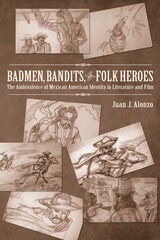
Badmen, Bandits, and Folk Heroes
The Ambivalence of Mexican American Identity in Literature and FilmJuan J. Alonzo
University of Arizona Press, 2009
Alonzo opens his provocative study with a fresh look at the adventure stories of Stephen Crane and the silent Western movies of D. W. Griffith. He also investigates the conflation of the greaser, the bandit, and the Mexican revolutionary into one villainous figure in early Western movies and, more broadly, traces the development of the badman in Westerns. He newly interrogates the writings of Américo Paredes regarding the makeup of Mexican masculinity, and productively trains his analytic eye on the recent films of Jim Mendiola and the contemporary poetry of Evangelina Vigil.
Throughout Badmen, Bandits, and Folk Heroes, Alonzo convincingly demonstrates how fiction and films that formerly appeared one-dimensional in their treatment of Mexicans and Mexican Americans actually offer surprisingly multifarious and ambivalent representations. At the same time, his valuation of indeterminacy, contingency, and hybridity in contemporary cultural production creates new possibilities for understanding identity formation.
Bakhtin and the Classics
R. Bracht Branham
Northwestern University Press, 2001
The authors, eminent classicists and distinguished critics of Bakhtin, put Bakhtin into dialogue with the classics--and classicists into dialogue with Bakhtin. Each essay offers a critical account of an important aspect of Bakhtin's thought and examines the value of his approach in the context of literary or cultural history. Beginning with an overview of Bakhtin's notion of carnival laughter, perhaps his central critical concept, the volume explores Bakhtin's thought and writing in relation to Homer's epic verse. Catullus's lyric poetry, ancient Roman novels, and Greek philosophy from Aristotle's theory of narrative to the work of Antiphon the Sophist. The results are of interest and importance to Bakhtinians, theorists, and classicists.

Ballad Hunting with Max Hunter
Stories of an Ozark Folksong CollectorSarah Jane Nelson; Foreword by Robert Cochran
University of Illinois Press, 2023
Sarah Jane Nelson chronicles Hunter’s song collecting adventures alongside portraits of the singers and mentors he met along the way. The guitar-strumming Hunter picked up the recording habit to expand his repertoire but almost immediately embraced the role of song preservationist. Being a local allowed Hunter to merge his native Ozark earthiness with sharp observational skills to connect--often more than once--with his singers. Hunter’s own ability to be present added to that sense of connection. Despite his painstaking approach, ballad collecting was also a source of pleasure for Hunter. Ultimately, his dedication to capturing Ozarks song culture in its natural state brought Hunter into contact with people like Vance Randolph, Mary Parler, and non-academic folklorists who shared his values.
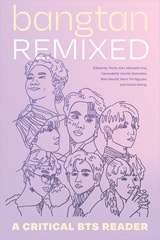
Bangtan Remixed
A Critical BTS ReaderPatty Ahn, Michelle Cho, Vernadette Vicuña Gonzalez, Rani Neutill, Mimi Thi Nguyen, and Yutian Wong, editors
Duke University Press, 2024
Contributors. Andrea Acosta, Patty Ahn, Carolina Alves, Inez Amihan Anderson, Allison Anne Gray Atis, Kaina “Kai” Bernal, Mutlu Binark, Jheanelle Brown, Sophia Cai, Michelle Cho, Mariam Elba, Ameena Fareeda, Vernadette Vicuña Gonzalez, Rosanna Hall, Dal Yong Jin, JIN Youngsun, Despina Kakoudaki, Yuni Kartika, Alptekin Keskin, Rachel Kuo, Marci Kwon, Courtney Lazore, Regina Yung Lee, S. Heijin Lee, Wonseok Lee, Amanda Lovely, Melody Lynch-Kimery, Maria Mison, Noel Sajid I. Murad, Sara Murphy, UyenThi Tran Myhre, Rani Neutill, Johnny Huy Nguyễn, Mimi Thi Nguyen, Karlina Octaviany, Nykeah Parham, Stefania Piccialli, Raymond San Diego, Hannah Ruth L. Sison, Prerna Subramanian, Havannah Tran, Andrew Ty, Gracelynne West, Yutian Wong, Jaclyn Zhou
Banjo Roots and Branches
Edited by Robert B. Winans
University of Illinois Press, 2018
Wide-ranging and illustrated with twenty color images, Banjo Roots and Branches offers a wealth of new information to scholars of African American and folk musics as well as the worldwide community of banjo aficionados.
Contributors: Greg C. Adams, Nick Bamber, Jim Dalton, George R. Gibson, Chuck Levy, Shlomo Pestcoe, Pete Ross, Tony Thomas, Saskia Willaert, and Robert B. Winans.

Barbarous Play
Race on the English Renaissance StageLara Bovilsky
University of Minnesota Press, 2008
Like our own, early modern beliefs about race depended on metaphorical, selective, and contradictory understandings of how membership in groups is determined. Although race took distinctive forms in the past, the fallacies that underlie early modern racial experience generally are precisely-and surprisingly-the same as those in contemporary culture.
Exploring the similar underpinnings of early modern and contemporary ideas of difference, Barbarous Play examines English Renaissance understandings of race as depicted in drama. Reading plays by Shakespeare, Marlowe, Webster, and Middleton, Bovilsky offers case studies of how racial meanings are generated by narratives of boundary crossing-especially miscegenation, religious conversion, class transgression, and moral and physical degeneracy. In the process, she reveals deep parallels between the period’s conceptions of race and gender.
Barbarous Play contests the widely held view that race and racism depend on modern science for their existence and argues that understanding just what is false and figurative in past depictions of race, such as those found in Othello, The Merchant of Venice, The White Devil, and The Changeling, can clarify the illogic of present-day racism.
Lara Bovilsky is assistant professor of English at Washington University in St. Louis.
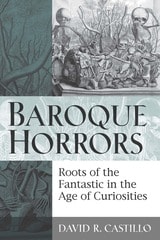
Baroque Horrors
Roots of the Fantastic in the Age of CuriositiesDavid R. Castillo
University of Michigan Press, 2011
"David Castillo takes us on a tour of some horrific materials that have rarely been considered together. He sheds a fantastical new light on the baroque."
---Anthony J. Cascardi, University of California Berkeley
"Baroque Horrors is a textual archeologist's dream, scavenged from obscure chronicles, manuals, minor histories, and lesser-known works of major artists. Castillo finds tales of mutilation, mutation, monstrosity, murder, and mayhem, and delivers them to us with an inimitable flair for the sensational that nonetheless rejects sensationalism because it remains so grounded in historical fact."
---William Egginton, Johns Hopkins University
"Baroque Horrors is a major contribution to baroque ideology, as well as an exploration of the grotesque, the horrible, the fantastic. Castillo organizes his monograph around the motif of curiosity, refuting the belief that Spain is a country incapable of organized scientific inquiry."
---David Foster, Arizona State University
Baroque Horrors turns the current cultural and political conversation from the familiar narrative patterns and self-justifying allegories of abjection to a dialogue on the history of our modern fears and their monstrous offspring. When life and death are severed from nature and history, "reality" and "authenticity" may be experienced as spectator sports and staged attractions, as in the "real lives" captured by reality TV and the "authentic cadavers" displayed around the world in the Body Worlds exhibitions. Rather than thinking of virtual reality and staged authenticity as recent developments of the postmodern age, Castillo looks back to the Spanish baroque period in search for the roots of the commodification of nature and the horror vacui that accompanies it. Aimed at specialists, students, and readers of early modern literature and culture in the Spanish and Anglophone traditions as well as anyone interested in horror fantasy, Baroque Horrors offers new ways to rethink broad questions of intellectual and political history and relate them to the modern age.
David Castillo is Associate Professor and Director of Graduate Studies in the Department of Romance Languages and Literatures at the University at Buffalo, SUNY.
Jacket art: Frederick Ruysch's anatomical diorama. Engraving reproduction "drawn from life" by Cornelius Huyberts. Image from the Zymoglyphic Museum.
Barrelhouse Words
A Blues Dialect DictionaryStephen Calt
University of Illinois Press, 2009

Barrier of a Common Language
An American Looks at Contemporary British PoetryDana Gioia
University of Michigan Press, 2003
Barrio Rhythm
Mexican American Music in Los AngelesSteven Loza
University of Illinois Press, 1993
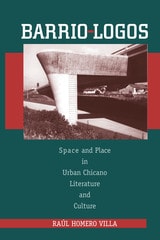
Barrio-Logos
Space and Place in Urban Chicano Literature and CultureBy Raúl Homero Villa
University of Texas Press, 2000
Struggles over space and resistance to geographic displacement gave birth to much of Chicano history and culture. In this pathfinding book, Raúl Villa explores how California Chicano/a activists, journalists, writers, artists, and musicians have used expressive culture to oppose the community-destroying forces of urban renewal programs and massive freeway development and to create and defend a sense of Chicano place-identity.
Villa opens with a historical overview that shows how Chicano communities and culture have grown in response to conflicts over space ever since the United States' annexation of Mexican territory in the 1840s. Then, turning to the work of contemporary members of the Chicano intelligentsia such as Helena Maria Viramontes, Ron Arias, and Lorna Dee Cervantes, Villa demonstrates how their expressive practices re-imagine and re-create the dominant urban space as a community enabling place. In doing so, he illuminates the endless interplay in which cultural texts and practices are shaped by and act upon their social and political contexts.

Baseball and Country Music
Don Cusic
University of Wisconsin Press, 2003
Basic K'ichee' Grammar
38 Lessons, Revised EditionJames L. Mondloch
University Press of Colorado, 2016
A pedagogical rather than a reference grammar, the book is a thorough presentation of the basics of the K’ichee’ Maya language organized around graded grammatical lessons accompanied by drills and exercises. Author James L. Mondloch spent ten years in K’ichee’-speaking communities and provides a complete analysis of the K’ichee’ verb system based on the everyday speech of the people and using a wealth of examples and detailed commentaries on actual usage.
A guide for learning the K’ichee’ language, Basic K'ichee' Grammar is a valuable resource for anyone seeking a speaking and reading knowledge of modern K’ichee’, including linguists, anthropologists, and art historians, as well as nonacademics working in K’ichee’ communities, such as physicians, dentists, community development workers, and educators.
Basques of the American West
New and Collected Essays on History and EthnicityRichard W. Etulain
University of Nevada Press, 2026
This collection offers readers a thoughtful and engaging look at the enduring presence and influence of Basques across the cultural and historical landscape of the American West.
Bawaajimo
A Dialect of Dreams in Anishinaabe Language and LiteratureMargaret Noodin
Michigan State University Press, 2014
Bean Blossom
The Brown County Jamboree and Bill Monroe's Bluegrass FestivalsThomas A. Adler
University of Illinois Press, 2011
Bearing False Witness
Debunking Centuries of Anti-Catholic HistoryRodney Stark
Templeton Press, 2016
As we all know and as many of our well-established textbooks have argued for decades, the Inquisition was one of the most frightening and bloody chapters in Western history; Pope Pius XII was anti-Semitic and rightfully called “Hitler’s Pope,” the Dark Ages were stunting the progress of knowledge to be redeemed only by the secular spirit of the Enlightenment. The religious Crusades were an early example of the rapacious Western thirst for riches and power. But what if these long held beliefs were all wrong?
In this stunning, powerful, and ultimately persuasive book, Rodney Stark, one of the most highly regarded sociologists of religion and bestselling author of The Rise of Christianity (HarperSanFrancisco 1997), argues that some of our most firmly held ideas about history, ideas that paint the Catholic Church in the least favorable light are, in fact, fiction. Why have we held these wrongheaded ideas so firmly and for so long? And if our beliefs are wrong, what is the truth?
In each chapter, Stark takes on a well-established anti-Catholic myth, gives a fascinating history of how each myth became conventional wisdom and presents a startling picture of the real truth. For example, instead of the Spanish Inquisition being an anomaly of torture and murder of innocent people persecuted for “imaginary” crimes such as witchcraft and blasphemy, Stark argues that not only did the Spanish Inquisition spill very little blood, but it was a major force in support of moderation and justice.
Stark dispels the myth of Pope Pius XII being apathetic or even helpful to the Nazi movement, such as to merit the title “Hitler’s Pope,” and instead shows that the campaign to link Pope Pius XII to Hitler was initiated by the Soviet Union, presumably in hopes of neutralizing the Vatican in post-World War II affairs. Many praised Pope Pius XIIs vigorous and devoted efforts to saving Jewish lives during the war.
Instead of understanding the Dark Ages as a millennium of ignorance and backwardness inspired by the Catholic Church’s power, Stark argues that the whole notion of the “Dark Ages” was an act of pride perpetuated by anti-religious intellectuals who were determined to claim that theirs was the era of “Enlightenment.”
In the end, readers of Bearing False Witness will have a more accurate history of the Catholic Church and will also understand why it became unfairly maligned for so long. Bearing False Witness is a compelling and sobering account of how egotism and ideology often work together to give us a false truth.

Bearing the Bad News
Contemporary American Literature and CultureSanford Pinsker
University of Iowa Press, 1990
Beasts at Bedtime
Revealing the Environmental Wisdom in Children’s LiteratureLiam Heneghan
University of Chicago Press, 2018
In Beasts at Bedtime, scientist (and father) Liam Heneghan examines the environmental underpinnings of children’s stories. From Beatrix Potter to Harry Potter, Heneghan unearths the universal insights into our inextricable relationship with nature that underlie so many classic children’s stories. Some of the largest environmental challenges in coming years—from climate instability, the extinction crisis, freshwater depletion, and deforestation—are likely to become even more severe as this generation of children grows up. Though today’s young readers will bear the brunt of these environmental calamities, they will also be able to contribute to environmental solutions if prepared properly. And all it takes is an attentive eye: Heneghan shows how the nature curriculum is already embedded in bedtime stories, from the earliest board books like The Rainbow Fish to contemporary young adult classics like The Hunger Games.
Beasts at Bedtime is an awakening to the vital environmental education children’s stories can provide—from the misadventures of The Runaway Bunny to more overt tales like The Lorax. Heneghan serves as our guide, drawing richly upon his own adolescent and parental experiences, as well as his travels in landscapes both experienced and imagined. Organized into thematic sections, the work winds its way through literary forests, colorful characters, and global environments.
This book enthralls as it engages. Heneghan as a guide is as charming as he is insightful, showing how kids (and adults) can start to experience the natural world in incredible ways from the comfort of their own rooms. Beasts at Bedtime will help parents, teachers, and guardians extend those cozy times curled up together with a good book into a lifetime of caring for our planet.
Beautiful Bottom, Beautiful Shame
Where "Black" Meets "Queer"Kathryn Bond Stockton
Duke University Press, 2006
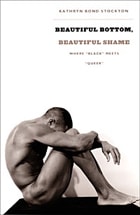
Stockton engages the domains of African American studies, queer theory, psychoanalysis, film theory, photography, semiotics, and gender studies. She brings together thinkers rarely, if ever, read together in a single study—James Baldwin, Radclyffe Hall, Jean Genet, Toni Morrison, Robert Mapplethorpe, Eldridge Cleaver, Todd Haynes, Norman Mailer, Leslie Feinberg, David Fincher, and Quentin Tarantino—and reads them with and against major theorists, including Georges Bataille, Sigmund Freud, Eve Kosofsky Sedgwick, Jacques Lacan, Roland Barthes, and Leo Bersani. Stockton asserts that there is no clear, mirrored relation between the terms “black” and “queer”; rather, seemingly definitive associations attached to each are often taken up or crossed through by the other. Stockton explores dramatic switchpoints between these terms: the stigmatized “skin” of some queers’ clothes, the description of blacks as an “economic bottom,” the visual force of interracial homosexual rape, the complicated logic of so-called same-sex miscegenation, and the ways in which a famous depiction of slavery (namely, Morrison’s Beloved) seems bound up with depictions of AIDS. All of the thinkers Stockton considers scrutinize the social nature of shame as they examine the structures that make debasements possible, bearable, pleasurable, and creative, even in their darkness.

Beautiful Fighting Girl
Saito Tamaki
University of Minnesota Press, 2010
In Beautiful Fighting Girl, Saito Tamaki offers a far more sophisticated and convincing interpretation of this alluring and capable figure. For Saito, the beautiful fighting girl is a complex sexual fantasy that paradoxically lends reality to the fictional spaces she inhabits. As an object of desire for male otaku (obsessive fans of anime and manga), she saturates these worlds with meaning even as her fictional status demands her ceaseless proliferation and reproduction. Rejecting simplistic moralizing, Saito understands the otaku’s ability to eroticize and even fall in love with the beautiful fighting girl not as a sign of immaturity or maladaptation but as a result of a heightened sensitivity to the multiple layers of mediation and fictional context that constitute life in our hypermediated world—a logical outcome of the media they consume.
Featuring extensive interviews with Japanese and American otaku, a comprehensive genealogy of the beautiful fighting girl, and an analysis of the American outsider artist Henry Darger, whose baroque imagination Saito sees as an important antecedent of otaku culture, Beautiful Fighting Girl was hugely influential when first published in Japan, and it remains a key text in the study of manga, anime, and otaku culture. Now available in English for the first time, this book will spark new debates about the role played by desire in the production and consumption of popular culture.
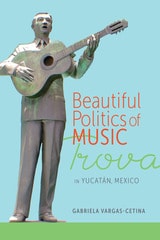
Beautiful Politics of Music
Trova in Yucatán, MexicoGabriela Vargas-Cetina
University of Alabama Press, 2017
An exploration into the history and practice of trova, a genre of music that is the soul of Yucatán.
Yucatecan trova is a music genre comprising a type of romantic song that is considered “the soul of Yucatán and Yucatecans.” This first book on Yucatecan trova offers an insider’s view of the history and practice of a treasured cultural heritage. A central theme of Gabriela Vargas-Cetina’s ethnography is what she refers to as the “beautiful politics of music” practiced by Yucatecan trova patrons and organizations, which is a way of asserting the importance of groups and issues through nonconfrontational means.
Trova emerged on the peninsula at the end of the nineteenth century and continues to be part of the general urban soundscape in the states of Yucatán and Campeche. Until the 1920s, this music was little known outside Yucatán and became absorbed into the larger Latin American Bolero genre, making it difficult to perceive its uniqueness and relation to life in Yucatán.
Vargas-Cetina, a native Yucatecan and trova musician, offers ethnographic insight into the local music scene. With family connections, she embedded herself as a trovadora, and her fieldwork—singing, playing the guitar in a trova group, and extensively researching the genre and talking with fellow enthusiasts and experts—ensued. Trova, like other types of artistic endeavors, is the result of collaboration and social milieu. She describes the dedicated trova clubs, cultural institutions, the Yucatecan economy of agricultural exports, and identity politics that helped the music come about and have maintained it today.
Positioned in the larger context of the music of Mexico and Latin America and engaging with theories of modernity and cosmopolitanism, experimental ethnography, and the anthropology of organizations, Beautiful Politics of Music consists of rigorous scholarship. It is also a warm tribute to performers and songs that have inspired many people around the world for more than two centuries.
Beauvoir and Her Sisters
The Politics of Women's Bodies in FranceSandra Reineke
University of Illinois Press, 2011
Becoming French
Mapping the Geographies of French Identity, 1871-1914Dana Kristofor Lindaman
Northwestern University Press, 2016
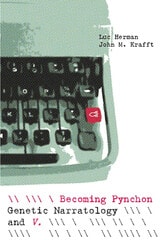
Becoming Pynchon
Genetic Narratology and V.Luc Herman and John M. Krafft
The Ohio State University Press, 2023
The 1963 publication of Thomas Pynchon’s V. changed the landscape of American fiction. Becoming Pynchon: Genetic Narratology and V. offers a detailed examination of the dramatic transformations that took place as Pynchon’s foundational novel went from typescript to published work. Luc Herman and John M. Krafft develop and deploy a rich theory of genetic narratology to examine the performance of genre in the novel. Pushing back against the current dominance of cognitive narratology, they discuss focalization, character construction, and evocation of consciousness as clues to Pynchon’s developing narratology of historical fiction. Their theoretical interventions offer an important and timely corrective to the field of narratology with a method that brings the author back into the analytical frame.
Herman and Krafft use as their guide the typescript of V. that surfaced in 2001, when it was acquired by the Harry Ransom Humanities Research Center, as well as Pynchon’s editorial correspondence with Corlies Smith, his first editor at J. B. Lippincott. Becoming Pynchon assembles a comprehensive and unequaled picture of Pynchon’s writing process that will appeal both to Pynchonians and to postmodernism scholars more broadly.
Becoming Ray Bradbury
Jonathan R. Eller
University of Illinois Press, 2013
Beginning with his childhood in Waukegan, Illinois, and Los Angeles, this biography follows Bradbury's development from avid reader to maturing author, making a living writing for the genre pulps and mainstream magazines. Eller illuminates the sources of Bradbury's growing interest in the human mind, the human condition, and the ambiguities of life and death--themes that became increasingly apparent in his early fiction. Bradbury's correspondence documents his frustrating encounters with the major trade publishing houses and his earliest unpublished reflections on the nature of authorship. Eller traces the sources of Bradbury's very conscious decisions, following the sudden success of The Martian Chronicles and The Illustrated Man, to voice controversial political statements in his fiction. Eller also elucidates the complex creative motivations that yielded Fahrenheit 451.
Becoming Ray Bradbury reveals Bradbury's emotional world as it matured through his explorations of cinema and art, his interactions with agents and editors, his reading discoveries, and the invaluable reading suggestions of older writers. These largely unexplored elements of his life pave the way to a deeper understanding of his more public achievements, providing a biography of the mind, the story of Bradbury's self-education and the emerging sense of authorship at the heart of his boundless creativity.
Becoming Reinaldo Arenas
Family, Sexuality, and The Cuban RevolutionJorge Olivares
Duke University Press, 2013
Through insightful close readings of a selection of Arenas's works, including unpublished manuscripts and correspondence, Olivares examines the writer's personal, political, and artistic trajectory, focusing on his portrayals of family, sexuality, exile, and nostalgia. He documents Arenas's critical engagement with cultural and political developments in revolutionary Cuba and investigates the ways in which Arenas challenged literary and national norms. Olivares's analysis shows how Arenas drew on his life experiences to offer revealing perspectives on the Cuban Revolution, the struggles of Cuban exiles, and the politics of sexuality.
Becoming a New Self
Practices of Belief in Early Modern CatholicismMoshe Sluhovsky
University of Chicago Press, 2017
Practices such as the examination of conscience, general confession, and spiritual exercises, which until the 1400s had been restricted to monastic elites, breached the walls of monasteries in the period that followed. Thanks in large part to Franciscans and Jesuits, lay urban elites—both men and women—gained access to spiritual practices whose goal was to enhance belief and create new selves. Using Michel Foucault’s writing on the hermeneutics of the self, and the French philosopher’s intuition that the early modern period was a moment of transition in the configurations of the self, Sluhovsky offers a broad panorama of spiritual and devotional techniques of self-formation and subjectivation.
Bede and Aethelthryth
An Introduction to Christian Latin PoeticsStephen J. Harris
West Virginia University Press, 2016
Bede and Aethelthryth asks why Christians in Britain around the year 700 enjoyed Latin poetry. What did they see in it? What did they get from it? This book attempts to reconstruct the horizon of expectation of a highly learned, Latin-speaking nun as she encounters a fifty-line poem by the Venerable Bede, the Hymn to Aethelthryth.
The reconstruction is hypothetical and derived from grammatical manuals, learned commentaries from the early medieval period (especially Servius’s commentary on Virgil), and a wide variety of aesthetic observations by classical and medieval readers. The first four chapters describe basic expectations of a reader of Christian Latin poetry. The fifth chapter places the Hymn in its context within Bede’s Ecclesiastical History. A few pages after Bede records his hymn, Caedmon will recite his own hymn under the watchful eye of Whitby’s Abbess Hild, who was a friend of Aethelthryth.
Both hymns are attempts to reform the lyric traditions of pagan Rome and pagan Anglo-Saxon England in the light of Christian teaching. The last three chapters contain a line-by-line commentary on Bede’s alphabetic, epanaleptic elegy.
Beethoven's French Piano
A Tale of Ambition and FrustrationTom Beghin
University of Chicago Press, 2022
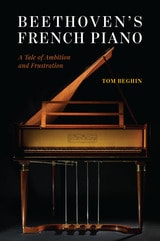
In 1803 Beethoven acquired a French piano from the Erard Frères workshop in Paris. The composer was “so enchanted with it,” one visitor reported, “that he regards all the pianos made here as rubbish by comparison.” While Beethoven loved its sound, the touch of the French keyboard was much heavier than that of the Viennese pianos he had been used to. Hoping to overcome this drawback, he commissioned a local technician to undertake a series of revisions, with ultimately disappointing results. Beethoven set aside the Erard piano for good in 1810.
Beethoven’s French Piano returns the reader to this period of Beethoven’s enthusiasm for all things French. What traces of the Erard’s presence can be found in piano sonatas like his “Waldstein” and “Appassionata”? To answer this question, Tom Beghin worked with a team of historians and musicians to commission the making of an accurate replica of the Erard piano. As both a scholar and a recording artist, Beghin is uniquely positioned to guide us through this key period of Beethoven’s work. Whether buried in archives, investigating the output of the French pianists who so fascinated Beethoven, or seated at the keyboard of his Erard, Beghin thinks and feels his way into the mind of the composer, bringing startling new insights into some of the best-known piano compositions of all time.
Before Cultures
The Ethnographic Imagination in American Literature, 1865-1920Brad Evans
University of Chicago Press, 2005
In this work, Brad Evans weaves together the histories of American literature and anthropology. His study brings alive not only the regionalist and ethnographic fiction of the time but also revives a range of neglected materials, including the Zuni sketchbooks of anthropologist Frank Hamilton Cushing; popular magazines such as Century Illustrated Monthly, which published Cushing's articles alongside Henry James's; the debate between Joel Chandler Harris, author/collector of the Uncle Remus folktales, and John Wesley Powell, perhaps the most important American anthropologist of the time; and Du Bois's polemics against the culture concept as it was being developed in the early twentieth century.
Written with clarity and grace, Before Cultures will be of value to students of American literature, history, and anthropology alike.
Before Intimacy
Asocial Sexuality in Early Modern EnglandDaniel Juan Gil
University of Minnesota Press, 2006
Engaging the poems of Wyatt, Sidney’s Astrophil and Stella, Spenser’s Amoretti and The Faerie Queene, and Shakespeare’s Troilus and Cressida and the Sonnets, Gil demonstrates how sexuality was conceived as a relationship system inhabited by men and women interchangeably—set apart from the “norm” and not institutionalized in a private or domestic realm. Going beyond the sodomy-as-transgression analytic, he asserts the existence of socially inconsequential sexual bonds while recognizing the pleasurable effects of violating the supposed traditional modes of bonding and ideals of universal humanity and social hierarchy.
Celebrating the ability of corporeal emotions to interpret connections between people who share nothing in terms of societal structure, Before Intimacy shows how these works of early modern literature provide a discourse of sexuality that strives to understand status differences in erotic contexts and thereby question key assumptions of modernity.
Daniel Juan Gil is assistant professor of English at TCU.