Results by title
752 books match the query 'Illinois' and 51 start with b
Back of the Yards
The Making of a Local DemocracyRobert A. Slayton
University of Chicago Press, 1986
Ballists, Dead Beats, and Muffins
Inside Early Baseball in IllinoisRobert D. Sampson
University of Illinois Press, 2023
Baseball’s spread across Illinois paralleled the sport’s explosive growth in other parts of the country.Robert D. Sampson taps a wealth of archival research to transport readers to an era when an epidemic of “base ball on the brain” raged from Alton to Woodstock. Focusing on the years 1865 to 1869, Sampson offers a vivid portrait of a game where local teams and civic ambition went hand in hand and teams of paid professionals displaced gentlemen’s clubs devoted to sporting fair play. This preoccupation with competition sparked rules disputes and controversies over imported players while the game itself mirrored society by excluding Black Americans and women. The new era nonetheless brought out paying crowds to watch the Rock Island Lively Turtles, Fairfield Snails, and other teams take the field up and down the state.
A first-ever history of early baseball in Illinois, Ballists, Dead Beats, and Muffins adds the Prairie State game’s unique shadings and colorful stories to the history of the national pastime.
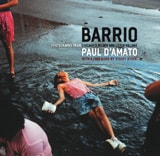
Barrio
Photographs from Chicago's Pilsen and Little VillagePaul D'Amato
University of Chicago Press, 2006
Barrio collects ninety of these striking color images along with D’Amato’s fascinating account of his time photographing Mexican Chicago and his acceptance—often grudging, after threatened violence—into the heart of the city’s Mexican community. Some of the photos here are beautifully composed and startling—visual narratives that are surreal and dreamlike, haunting and mythic. Others, like those D’Amato took while shadowing graffiti artists in the subway, are far more immediate and improvisational. With a foreword by author Stuart Dybek that places D’Amato’s work in the context of the Pilsen and Little Village that Dybek has elsewhere captured so memorably, this book offers a penetrating, evocative, and overall streetwise portrait of two iconic and enduring Hispanic neighborhoods.
Battleground 1948
Truman, Stevenson, Douglas, and the Most Surprising Election in Illinois HistoryRobert E. Hartley
Southern Illinois University Press, 2013
The election year of 1948 remains to this day one of the most astonishing in U.S. political history. During this first general election after World War II, Americans looked to their governments for change. As the battle for the nation’s highest office came to a head in Illinois, the state was embroiled in its own partisan showdowns—elections that would prove critical in the course of state and national history.
In Battleground 1948, Robert E. Hartley offers the first comprehensive chronicle of this historic election year and its consequences, which still resonate today. Focusing on the races that ushered Adlai Stevenson, Paul Douglas, and Harry Truman into office—the last by the slimmest of margins—Battleground 1948 details the pivotal events that played out in the state of Illinois, from the newspaper wars in Chicago to tragedy in the mine at Centralia.
In addition to in-depth revelations on the saga of the American election machine in 1948, Hartley probes the dark underbelly of Illinois politics in the 1930s and 1940s to set the stage, spotlight key party players, and expose the behind-the-scenes influences of media, money, corruption, and crime. In doing so, he draws powerful parallels between the politics of the past and those of the present. Above all, Battleground 1948 tells the story of grassroots change writ large on the American political landscape—change that helped a nation move past an era of conflict and depression, and forever transformed Illinois and the U.S. government.
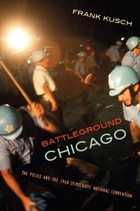
Battleground Chicago
The Police and the 1968 Democratic National ConventionFrank Kusch
University of Chicago Press, 2008
Working from interviews with eighty former Chicago police officers who were on the scene, Frank Kusch uncovers the other side of the story of ’68, deepening our understanding of a turbulent decade.
“Frank Kusch’s compelling account of the clash between Mayor Richard Daley’s men in blue and anti-war rebels reveals why the 1960s was such a painful era for many Americans. . . . to his great credit, [Kusch] allows ‘the pigs’ to speak up for themselves.”—Michael Kazin
“Kusch’s history of white Chicago policemen and the 1968 Democratic National Convention is a solid addition to a growing literature on the cultural sensibility and political perspective of the conservative white working class in the last third of the twentieth century.”—David Farber, Journal of American History
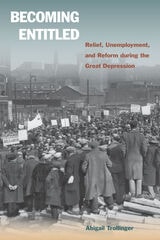
Becoming Entitled
Relief, Unemployment, and Reform during the Great DepressionAbigail Trollinger
Temple University Press, 2020
In the 1930s, the unemployed were organizing. Jobless workers felt they were “entitled" to a new kind of government protection—the protection from undeserved unemployment and the financial straits that such unemployment created. They wanted dignified forms of relief (including work relief) during the Depression, and unemployment insurance after.
Becoming Entitled artfully chronicles the emergence of this worker entitlement and the people who cultivated it. Abigail Trollinger focuses largely on Chicago after the Progressive Era, where the settlement house and labor movements both flourished. She shows how reformers joined workers and relief officials to redeem the unemployed and secure government-funded social insurance for them. Becoming Entitled also offers a critical reappraisal of New Deal social and economic changes, suggesting that the transformations of the 1930s came from reformers in the “middle,” who helped establish a limited form of entitlement for workers.
Ultimately, Trollinger highlights the achievements made by reformers working on city- and nation-wide issues. She captures the moment when some people shed the stigma that came with unemployment and demanded that the government do the same.
Becoming the Second City
Chicago's Mass News Media, 1833-1898Richard Junger
University of Illinois Press, 2010
Behind the Guns
The History of Battery I, 2nd Regiment, Illinois Light ArtilleryThaddeus C. S. Brown, Samuel J. Murphy, and William G. Putney. Edited with a Foreword by Clyde C. Walton
Southern Illinois University Press, 2000
Much has been written of the infantry and the cavalry during the Civil War, but little attention has been paid the artillery. Through the battles of Chickamauga and Missionary Ridge in 1863 and the Atlanta Campaign of 1864 and with General Sherman’s forces on the famous March to the Sea, the acts of a courageous fighting group are vividly recounted in Behind the Guns: The History of Battery I, 2nd Regiment, Illinois Light Artillery. Originally published in 1965 in a limited edition, this regimental history of a light artillery unit was written by three of its soldiers, including the bugler.
Battery I was formed in 1861 by Charles W. Keith of Joliet and Henry B. Plant of Peoria. More than a hundred men were mustered into service in December near Springfield and left for Cairo in February 1862. The battery trained at Camp Paine across the Ohio River in Kentucky until March, when the men were dispatched to the South. During the war, the Battery was attached to three different armies: the Army of the Mississippi, the Army of the Ohio, and the Army of the Cumberland.
Clyde C. Walton’s foreword and the narrative discuss the variety of weapons used by the unit, including James, Parrott, and Rodman guns and the bronze, muzzle-loading Napoleons that fired twelve-pound projectiles. The book also includes an account of the prisoner-of-war experience of Battery I lieutenant Charles McDonald, biographical sketches of the battery soldiers, and eighteen maps and five line drawings.
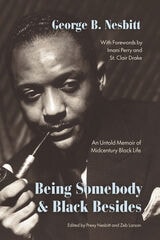
Being Somebody and Black Besides
An Untold Memoir of Midcentury Black LifeGeorge B. Nesbitt
University of Chicago Press, 2021
The late Chicagoan George Nesbitt could perhaps best be described as an ordinary man with an extraordinary gift for storytelling. In his newly uncovered memoir—written fifty years ago, yet never published—he chronicles in vivid and captivating detail the story of how his upwardly mobile Midwestern Black family lived through the tumultuous twentieth century.
Spanning three generations, Nesbitt’s tale starts in 1906 with the Great Migration and ends with the Freedom Struggle in the 1960s. He describes his parents’ journey out of the South, his struggle against racist military authorities in World War II, the promise and peril of Cold War America, the educational and professional accomplishments he strove for and achieved, the lost faith in integration, and, despite every hardship, the unwavering commitment by three generations of Black Americans to fight for a better world. Through all of it—with his sharp insights, nuance, and often humor—we see a family striving to lift themselves up in a country that is working to hold them down.
Nesbitt’s memoir includes two insightful forewords: one by John Gibbs St. Clair Drake (1911–90), a pioneer in the study of African American life, the other a contemporary rumination by noted Black studies scholar Imani Perry. A rare first-person, long-form narrative about Black life in the twentieth century, Being Somebody and Black Besides is a remarkable literary-historical time capsule that will delight modern readers.

Beyond Conformity or Rebellion
Youth and Authority in AmericaGary Schwartz
University of Chicago Press, 1987
Beyond the Usual Beating
The Jon Burge Police Torture Scandal and Social Movements for Police Accountability in ChicagoAndrew S. Baer
University of Chicago Press, 2020
A story of institutionalized police brutality and how Chicago's public outcry led to long-lasting criminal justice reforms.
The malign and long-lasting influence of Chicago police commander Jon Burge cannot be overestimated, particularly as fresh examples of local and national criminal-justice abuse continue to surface with dismaying frequency. Burge’s decades-long tenure on the Chicago police force was marked by racist and barbaric interrogation methods, including psychological torture, burnings, and mock executions—techniques that went far “beyond the usual beating.” After being exposed in 1989, he became a symbol of police brutality and the unequal treatment of nonwhite people, and the persistent outcry against him led to reforms such as the abolition of the death penalty in Illinois.
But Burge hardly developed or operated in a vacuum, as Andrew S. Baer explores to stark effect here. He identifies the darkness of the Burge era as a product of local social forces, arising from a specific milieu beyond the nationwide racialized reactionary fever of the 1960s and 1970s. Similarly, the popular resistance movements that rallied in his wake actually predated Burge’s exposure but cohered with unexpected power due to the galvanizing focus on his crimes and abuses. For more than thirty years, a shifting coalition including torture survivors, their families, civil rights attorneys, and journalists helped to corroborate allegations of violence, free the wrongfully convicted, have Burge fired and incarcerated, and win passage of a municipal reparations package, among other victories. Beyond the Usual Beating reveals that though the Burge scandal underscores the relationship between personal bigotry and structural racism in the criminal justice system, it also shows how ordinary people held perpetrators accountable in the face of intransigent local power.

Big Bill Thompson, Chicago, and the Politics of Image
Douglas Bukowski
University of Illinois Press, 1998
A brilliant chameleon of a politician, Thompson could move from pro- to anti-prohibition, from opposing the Chicago Teachers Federation to opposing a superintendent hostile to it, from being anti-Catholic to winning, in huge numbers, the Catholic vote. Shape-shifter extraordinaire, Thompson stayed in power by repeatedly altering his political image. In Big Bill Thompson, Chicago, and the Politics of Image, Douglas Bukowski captures the essence of this wily urban politico as no other biographer or historian has. Using materials accessible only thanks to the Freedom of Information Act, Bukowski has fashioned an unforgettable story of a volatile Chicago leader and his era. And he does it with such grace and in such an irresistible style that readers will yearn to visit the local speakeasy and lift a glass to colorful politicians gone by.
Big Bill of Chicago
Lloyd Wendt and Herman Kogan
Northwestern University Press, 2005
To some he was a humanitarian and builder. Others scorned him as a fake and friend of gangsters with "the carcass of a rhinoceros and the brain of a baboon." This rollicking history traces the rise of William Hale "Big Bill" Thompson, Chicago's famous reform mayor, from his upper class roots to his years as a teenaged cowboy, from his fame as a star athlete to the years as a master politician in a world where the ward boss ruled and whiskey for the voters cost a quarter a shot. Big Bill of Chicago profiles the whole brawling arena of city politics from the turn of the century to the Prohibition Era. It is a primer in the way American politics worked-and works-and a map along the countless winding ways even the dirtiest deal can lead to something great.
Bigger, Brighter, Louder
150 Years of Chicago Theater as Seen by "Chicago Tribune" CriticsChris Jones
University of Chicago Press, 2013
The Chicago of today, on the other hand, is regarded as one of the world’s premier cities for theater, and no one has had a more consistent front-row seat to its ascendance than the Chicago Tribune theater critics. Bigger, Brighter, Louder weaves together more than 150 years of Tribune reviews into a compelling narrative, pairing full reviews with commentary and history. With a sharp eye for telling details and a keen sense of historical context, Jones, longtime chief Tribune theater critic, takes readers through decades of highs and lows, successes and failures.
The book showcases fascinating early reviews of actors and shows that would go on to achieve phenomenal success, including a tryout of A Raisin in the Sun with newcomer Sidney Poitier and the first major review of The Producers. It also delves into the rare and the unusual, such as a previously unpublished Tennessee Williams interview and a long conversation with Edward Albee’s mother. With reviews from Claudia Cassidy, Peregine Pickle, William Leonard, and more, many never collected before, Bigger, Brighter, Louder offers a unique lasting record of an ephemeral art and a riveting look at the history behind Chicago’s rise to theatrical greatness.
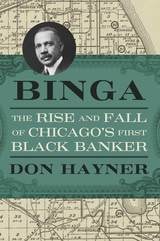
Binga
The Rise and Fall of Chicago's First Black BankerDon Hayner
Northwestern University Press, 2020
Binga is the definitive full-length biography of Jesse Binga, the first black banker in Chicago. Born into a large family in Detroit, Binga arrived in Chicago in 1892 in his late twenties with virtually nothing. Through his wits and resourcefulness, he rose to wealth and influence as a real estate broker, and in 1908 he founded the Binga Bank, the first black-owned bank in the city. But his achievements were followed by an equally notable downfall. Binga recounts this gripping story about race, history, politics, and finance.
The Black Belt, where Binga’s bank was located, was a segregated neighborhood on Chicago’s South Side—a burgeoning city within a city—and its growth can be traced through the arc of Binga’s career. He preached and embodied an American gospel of self-help and accrued wealth while expanding housing options and business opportunities for blacks. Devout Roman Catholics, he and his wife Eudora supported church activities and various cultural and artistic organizations; their annual Christmas party was the Black Belt’s social event of the year. But Binga’s success came at the price of a vicious backlash. After he moved his family into a white neighborhood in 1917, their house was bombed multiple times, his offices were attacked twice, and he became a lightning rod for the worst race riots in Chicago history, which took place in 1919. Binga persevered, but, starting with the stock market crash of October 1929, a string of reversals cost him his bank, his property, and his fortune.
A quintessentially Chicago story, Binga tells the history of racial change in one of the most segregated cities in America and how an extraordinary man stood as a symbol of hope in a community isolated by racial animosity.
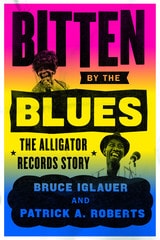
Bitten by the Blues
The Alligator Records StoryBruce Iglauer and Patrick A. Roberts
University of Chicago Press, 2018
Bitten by the Blues is Iglauer’s memoir of a life immersed in the blues—and the business of the blues. No one person was present at the creation of more great contemporary blues music than Iglauer: he produced albums by Koko Taylor, Albert Collins, Professor Longhair, Johnny Winter, Lonnie Mack, Son Seals, Roy Buchanan, Shemekia Copeland, and many other major figures. In this book, Iglauer takes us behind the scenes, offering unforgettable stories of those charismatic musicians and classic sessions, delivering an intimate and unvarnished look at what it’s like to work with the greats of the blues. It’s a vivid portrait of some of the extraordinary musicians and larger-than-life personalities who brought America’s music to life in the clubs of Chicago’s South and West Sides. Bitten by the Blues is also an expansive history of half a century of blues in Chicago and around the world, tracing the blues recording business through massive transitions, as a genre of music originally created by and for black southerners adapted to an influx of white fans and musicians and found a worldwide audience.
Most of the smoky bars and packed clubs that fostered the Chicago blues scene have long since disappeared. But their soul lives on, and so does their sound. As real and audacious as the music that shaped it, Bitten by the Blues is a raucous journey through the world of Genuine Houserockin’ Music.
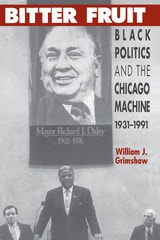
Bitter Fruit
Black Politics and the Chicago Machine, 1931-1991William J. Grimshaw
University of Chicago Press, 1992
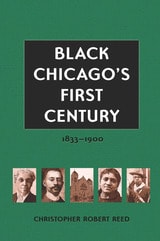
Black Chicago's First Century
1833-1900Christopher Robert Reed
University of Missouri Press, 2005
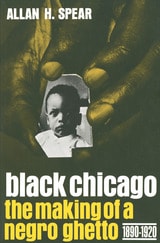
Black Chicago
The Making of a Negro Ghetto, 1890-1920Allan H. Spear
University of Chicago Press, 1969
Black Corporate Executives
Sharon Collins
Temple University Press, 1996
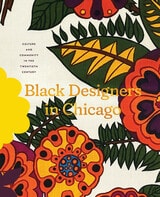
Black Designers in Chicago
Culture and Community in the Twentieth CenturyEdited by Chris Dingwall, David Hartt, and Daniel Schulman
University of Chicago Press, 2026
In twentieth-century Chicago, generations of Black artisans, craftspeople, art educators, clothing makers, commercial illustrators, sign painters, furniture makers, beauticians, graphic designers, art directors, and screen printers made and remade the city into an energetic center for modern design. Ambitious, enterprising, and resolutely modern, these Black designers were workers and intellectuals, activists and entrepreneurs. They created works for commercial and everyday use and helped to build community institutions such as the South Side Community Art Center and businesses like the Johnson Publishing Company. Their works ranged from branding and housewares for major corporations to pamphlets and posters made in the name of civil rights and Black Power. Together, they made Black Chicago into a dynamic design scene, working against racism in their professions while embracing the possibilities of design as a medium of social change.
This book is the first to chronicle their collective history while also celebrating their influence on design as well as African American culture more broadly. Based on extensive archival research and building on a major 2018 exhibition, Black Designers in Chicago presents essays by experts in African American history and design. The book features illustrations of a stunning variety of works—from graphic design to screenprints to textiles and household wares—placing African Americans at the center of modern design history, while highlighting the role of design in the cultural history of Black Chicago.
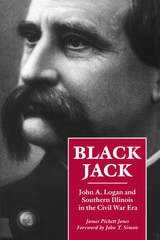
Black Jack
John A. Logan and Southern Illinois in the Civil War EraJames Pickett Jones. Foreword by John Y. Simon
Southern Illinois University Press, 1995
John A. Logan, called "Black Jack" by the men he led in Civil War battles from the Henry-Donelson campaign to Vicksburg, Chattanooga, and on to Atlanta, was one of the Union Army’s most colorful generals.
James Pickett Jones places Logan in his southern Illinois surroundings as he examines the role of the political soldier in the Civil War. When Logan altered his stance on national issues, so did the southern part of the state. Although secession, civil strife, Copperheadism, and the new attitudes created by the war contributed to this change of position in southern Illinois, Logan’s role as political and military leader was important in the region’s swing to strong support of the war against the Confederacy, to the policies of Lincoln, and eventually, to the Republican party.
Black Metropolis
A Study of Negro Life in a Northern CitySt. Clair Drake and Horace R. Cayton
University of Chicago Press, 1993
"Black Metropolis is a rare combination of research and synthesis, a book to be deeply pondered. . . . No one who reads it intelligently can ever believe again that our racial dilemma can be solved by pushing buttons, or by gradual processes which may reach four or five hundred years into the future."—Bucklin Moon, The Nation
"This volume makes a great contribution to the building of the future American and the free world."—Louis Wirth, New York Times
"By virtue of its range, its labor and its insight, the book seems certain to become a landmark not only in race studies but in the broader field of social anthropology."—Thomas Sancton, New Republic
Black Metropolis
A Study of Negro Life in a Northern CitySt. Clair Drake and Horace R. Cayton
University of Chicago Press, 2015
Black Metropolis has been a foundational work for the study of race and urban life since its publication in 1945, and it remains indispensable today. Few studies since have been able to match its scope and magnitude, offering one of the most comprehensive looks at black life in America. Based on research conducted by Works Progress Administration field workers, it is a sweeping historical and sociological account of the people of Chicago's South Side from the 1840s through the 1930s. Its findings offer a comprehensive analysis of black migration, settlement, community structure, and black-white race relations in the first half of the twentieth century. It offers a dizzying and dynamic world filled with captivating people and startling revelations.
A new foreword from sociologist Mary Pattillo places the study in modern context, updating the story with the current state of black communities in Chicago and the larger United States and exploring what this means for the future. As the country continues to struggle with race and our treatment of black lives, Black Metropolis continues to be a powerful contribution to the conversation.
Black Picket Fences, Second Edition
Privilege and Peril among the Black Middle ClassMary Pattillo
University of Chicago Press, 2013
Stark, moving, and still timely, the book is updated for this edition with a new epilogue by the author that details how the neighborhood and its residents fared in the recession of 2008, as well as new interviews with many of the same neighborhood residents featured in the original. Also included is a new foreword by acclaimed University of Pennsylvania sociologist Annette Lareau.
Black Picket Fences
Privilege and Peril among the Black Middle ClassMary Pattillo-McCoy
University of Chicago Press, 1999
"An insightful look at the socio-economic experiences of the black middle class. . . . Through the prism of a South Side Chicago neighborhood, the author shows the distinctly different reality middle-class blacks face as opposed to middle-class whites." —Ebony
"A detailed and well-written account of one neighborhood's struggle to remain a haven of stability and prosperity in the midst of the cyclone that is the American economy." —Emerge
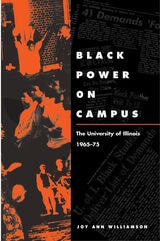
Black Power on Campus
The University of Illinois, 1965-75Joy Ann Williamson
University of Illinois Press, 2003
Drawing on student publications of the late 1960s and early 1970s, as well as interviews with student activists, former administrators, and faculty, Williamson discusses the emergence of Black Power ideology, what constituted "blackness," and notions of self-advancement versus racial solidarity. Promoting an understanding of the role of black youth in protest movements, Black Power on Campus is an important contribution to the literature on African American liberation movements and the reform of American higher education.
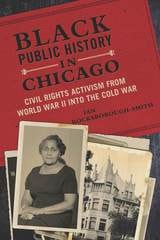
Black Public History in Chicago
Civil Rights Activism from World War II into the Cold WarIan Rocksborough-Smith
University of Illinois Press, 2018
Ian Rocksborough-Smith’s meticulous research and adept storytelling provide the first in-depth look at how these committed individuals leveraged Chicago’s black public history. Their goal: to engage with the struggle for racial equality. Rocksborough-Smith shows teachers working to advance curriculum reform in public schools, while well-known activists Margaret and Charles Burroughs pushed for greater recognition of black history by founding the DuSable Museum of African American History. Organizations like the Afro-American Heritage Association, meanwhile, used black public history work to connect radical politics and nationalism. Together, these people and their projects advanced important ideas about race, citizenship, education, and intellectual labor that paralleled the shifting terrain of mid-twentieth-century civil rights.
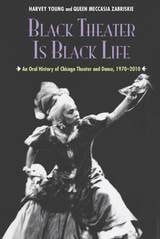
Black Theater Is Black Life
An Oral History of Chicago Theater and Dance, 1970-2010Harvey Young and Queen Meccasia Zabriskie
Northwestern University Press, 2013
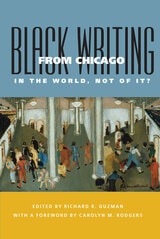
Black Writing from Chicago
In the World, Not of It?Edited by Richard R. Guzman. Foreword by Carolyn M. Rodgers
Southern Illinois University Press, 2006
Black Writing from Chicago: In the World, Not of It? takes readers on a cultural trip through Chicago’s literary history. Editor Richard R. Guzman compiles the first comprehensive collection of the works of Chicago’s black writers from 1861 to the present day. The anthology, which includes works from newspaper writing, poetry, fiction, drama, essays, and historical and social commentary, seeks not only to represent a broad range of writings but also to focus tightly on such themes as hope and despair, racism and equality, spirituality and religion. More than sixty writers, from the anonymous “J. W. M. (Colored)” to Ken Green, unfold a story that reflects the literary periods in black American history. Each author’s selection is preceded by a biographical and a bibliographical introduction. Readers interested in Chicago, race relations, and literature, as well as scholars of history, sociology, urban studies, and cultural studies, will find the collection invaluable.
Black on the Block
The Politics of Race and Class in the CityMary Pattillo
University of Chicago Press, 2007
“To see how diversity creates strange and sometimes awkward bedfellows . . . turn to Mary Pattillo's Black on the Block.”—Boston Globe
Block by Block
Neighborhoods and Public Policy on Chicago's West SideAmanda I. Seligman
University of Chicago Press, 2005
Seligman's study reveals that the responses of white West Siders to racial changes occurring in their neighborhoods were both multifaceted and extensive. She shows that, despite rehabilitation efforts, deterioration in these areas began long before the color of their inhabitants changed from white to black. And ultimately, the riots that erupted on Chicago's West Side and across the country in the mid-1960s stemmed not only from the tribulations specific to blacks in urban centers but also from the legacy of accumulated neglect after decades of white occupancy. Seligman's careful and evenhanded account will be essential to understanding that the "flight" of whites to the suburbs was the eventual result of a series of responses to transformations in Chicago's physical and social landscape, occurring one block at a time.
Blood Runs Green
The Murder That Transfixed Gilded Age ChicagoGillian O'Brien
University of Chicago Press, 2015
It was the biggest funeral Chicago had seen since Lincoln’s. On May 26, 1889, four thousand mourners proceeded down Michigan Avenue, followed by a crowd forty thousand strong, in a howl of protest at what commentators called one of the ghastliest and most curious crimes in civilized history. The dead man, Dr. P. H. Cronin, was a respected Irish physician, but his brutal murder uncovered a web of intrigue, secrecy, and corruption that stretched across the United States and far beyond.
Blood Runs Green tells the story of Cronin’s murder from the police investigation to the trial. It is a story of hotheaded journalists in pursuit of sensational crimes, of a bungling police force riddled with informers and spies, and of a secret revolutionary society determined to free Ireland but succeeding only in tearing itself apart. It is also the story of a booming immigrant population clamoring for power at a time of unprecedented change.
From backrooms to courtrooms, historian Gillian O’Brien deftly navigates the complexities of Irish Chicago, bringing to life a rich cast of characters and tracing the spectacular rise and fall of the secret Irish American society Clan na Gael. She draws on real-life accounts and sources from the United States, Ireland, and Britain to cast new light on Clan na Gael and reveal how Irish republicanism swept across the United States. Destined to be a true crime classic, Blood Runs Green is an enthralling tale of a murder that captivated the world and reverberated through society long after the coffin closed.
Bloody Williamson
A Chapter in American LawlessnessPaul M. Angle; Introduction by John Y. Simon
University of Illinois Press, 1952
"In Williamson County some men took to violence almost as a way of life. A shocking story, well told."--New Yorker
Williamson County in southern Illinois has been the scene of almost unparalleled violence, from the Bloody Vendetta between two families in the 1870s through the Herrin Massacre of 1922, Ku Klux Klan activities that ended in fatalities, and the gang war of the 1920s between the Charlie Birger and Shelton brothers gangs. Paul Angle was fascinated by this more-than-fifty-year history, and his account of this violence has become a classic.
Blue Chicago
The Search for Authenticity in Urban Blues ClubsDavid Grazian
University of Chicago Press, 2003
For any music lover, that image captures the essence of an authentic experience of the blues. In Blue Chicago, David Grazian takes us inside the world of contemporary urban blues clubs to uncover how such images are manufactured and sold to music fans and audiences. Drawing on countless nights in dozens of blues clubs throughout Chicago, Grazian shows how this quest for authenticity has transformed the very shape of the blues experience. He explores the ways in which professional and amateur musicians, club owners, and city boosters define authenticity and dish it out to tourists and bar regulars. He also tracks the changing relations between race and the blues over the past several decades, including the increased frustrations of black musicians forced to slog through the same set of overplayed blues standards for mainly white audiences night after night. In the end, Grazian finds that authenticity lies in the eye of the beholder: a nocturnal fantasy to some, an essential way of life to others, and a frustrating burden to the rest.
From B.L.U.E.S. and the Checkerboard Lounge to the Chicago Blues Festival itself, Grazian's gritty and often sobering tour in Blue Chicago shows us not what the blues is all about, but why we care so much about that question.
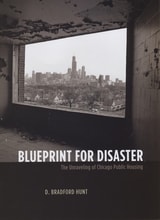
Blueprint for Disaster
The Unraveling of Chicago Public HousingD. Bradford Hunt
University of Chicago Press, 2009
Now considered a dysfunctional mess, Chicago’s public housing projects once had long waiting lists of would-be residents hoping to leave the slums behind. So what went wrong? To answer this complicated question, D. Bradford Hunt traces public housing’s history in Chicago from its New Deal roots through current mayor Richard M. Daley’s Plan for Transformation. In the process, he chronicles the Chicago Housing Authority’s own transformation from the city’s most progressive government agency to its largest slumlord.
Challenging explanations that attribute the projects’ decline primarily to racial discrimination and real estate interests, Hunt argues that well-intentioned but misguided policy decisions—ranging from design choices to maintenance contracts—also paved the road to failure. Moreover, administrators who fully understood the potential drawbacks did not try to halt such deeply flawed projects as Cabrini-Green and the Robert Taylor Homes. These massive high-rise complexes housed unprecedented numbers of children but relatively few adults, engendering disorder that pushed out the working class and, consequently, the rents needed to maintain the buildings. The resulting combination of fiscal crisis, managerial incompetence, and social unrest plunged the CHA into a quagmire from which it is still struggling to emerge.
Blueprint for Disaster, then,is an urgent reminder of the havoc poorly conceived policy can wreak on our most vulnerable citizens.
Blues Before Sunrise 2
Interviews from the Chicago SceneSteve Cushing
University of Illinois Press, 2019
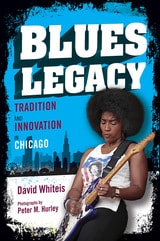
Blues Legacy
Tradition and Innovation in ChicagoDavid Whiteis
University of Illinois Press, 2019
David Whiteis delves into how the current and upcoming Chicago blues generations carry on this legacy. Drawing on in-person interviews, Whiteis places the artists within the ongoing social and cultural reality their work reflects and helps create. Beginning with James Cotton, Eddie Shaw, and other bequeathers, he moves through an all-star council of elders like Otis Rush and Buddy Guy and on to inheritors and today's heirs apparent like Ronnie Baker Brooks, Shemekia Copeland, and Nellie "Tiger" Travis.
Insightful and wide-ranging, Blues Legacy reveals a constantly adapting art form that, whatever the challenges, maintains its links to a rich musical past.
BluesSpeak
Best of the Original Chicago Blues AnnualLincoln T. Beauchamp, Jr.
University of Illinois Press, 2010
This incomparable anthology collects articles, interviews, fiction, and poetry from the Original Chicago Blues Annual, one of music history's most significant periodical blues publications. Founded and operated from 1989 to 1995 by African American musician and entrepreneur Lincoln T. Beauchamp Jr., OCBA gave voice to the blues community and often frankly addressed contentious issues within the blues such as race, identity, prejudice, wealth, gender, and inequity.
OCBA often expressed an explicitly black perspective, but its contributors were a mix of black and white, American and international. Likewise, although OCBA's roots and main focus were in Chicago, Beauchamp's vision for the publication (and his own activities as a blues performer and promoter) embraced an international dimension, reflecting a broad diversity of blues audiences and activities in locations as farflung as Iceland, Poland, France, Italy, and South Africa.
This volume includes key selections from OCBA's seven issues and features candid interviews with blues luminaries such as Koko Taylor, Eddie Boyd, Famoudou Don Moye, Big Daddy Kinsey, Lester Bowie, Junior Wells, Billy Boy Arnold, Herb Kent, Barry Dolins, and many more. Also featured are heartfelt memorials to bygone blues artists, insightful observations on the state of the blues in Chicago and beyond, and dozens of photographs of performers, promoters, and other participants in the worldwide blues scene.
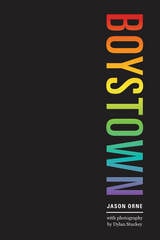
Boystown
Sex and Community in ChicagoJason Orne
University of Chicago Press, 2017
In Boystown, Orne takes readers on a detailed, lively journey through Chicago’s Boystown, which serves as a model for gayborhoods around the country. The neighborhood, he argues, has become an entertainment district—a gay Disneyland—where people get lost in the magic of the night and where straight white women can “go on safari.” In their original form, though, gayborhoods like this one don’t celebrate differences; they create them. By fostering a space outside the mainstream, gay spaces allow people to develop an alternative culture—a queer culture that celebrates sex.
Orne spent three years doing fieldwork in Boystown, searching for ways to ask new questions about the connective power of sex and about what it means to be not just gay, but queer. The result is the striking Boystown, illustrated throughout with street photography by Dylan Stuckey. In the dark backrooms of raunchy clubs where bachelorettes wouldn’t dare tread, people are hooking up and forging “naked intimacy.” Orne is your tour guide to the real Boystown, then, where sex functions as a vital center and an antidote to assimilation.
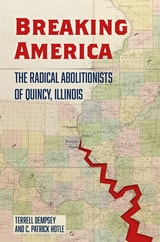
Breaking America
The Radical Abolitionists of Quincy, IllinoisTerrell Dempsey
University of Missouri Press, 2026
In this engaging new work, Terrell Dempsey and Patrick Hotle draw from newly discovered and underutilized primary sources to craft a detailed narrative history of the rise of a group of radical abolitionists in Quincy, Illinois, and the outsized, if mostly overlooked, influence they had on the dissolution of the Union.
The story begins with the 1830 arrival in Marion County, Missouri, of Dr. David Nelson, a Presbyterian minister and supporter of the American Colonization Society. After hearing a speech by Theodore B. Weld, Nelson was converted to the abolitionist cause and went on to recruit Elijah Lovejoy into the region’s nascent anti-slavery movement. Nelson’s activities resulted in the creation of an active anti-abolitionist organization in Northeast Missouri that ended up running him out of the state and across the river to Quincy, Illinois, at the same time Lovejoy sought shelter in Alton, Illinois.
In Quincy, Nelson and a group of like-minded moderate anti-slavery activists opened a manual labor school called the Mission Institute. Following the murder of Lovejoy by a pro-slavery mob, a small band of abolitionists at the Mission Institute became radicalized and decided to aid enslaved people in their quest for freedom. After three of these abolitionists were captured in Missouri and sentenced to twelve years in prison, others at the Mission Institute published a call for the Illinois Anti-Slavery Society to organize an underground railroad in Illinois. The Society officially committed to assisting enslaved people to escape slavery in May of 1842, which triggered a hostile reaction from enslavers in Missouri who went on to organize patrols, seek stricter state laws, and attempt to sabotage the underground railroad in neighboring Illinois.
In Breaking America, Dempsey and Hotle demonstrate the impact of the Quincy abolitionists on the later Dred Scott cases. The authors trace a sequence of revivals, public meetings, daring escapes, over-reactions, judicial decisions, and violence, providing a roadmap for how Missouri judicial opinion changed from “once free, always free” to “once a slave, always a slave” under Missouri Law. Breaking America is an important new addition to the history of abolitionism, the Dred Scott decision, and the eventual dissolution of the Union.
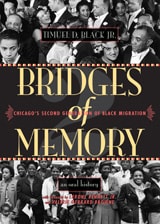
Bridges of Memory Volume 2
Chicago's Second Generation of Black MigrationTimuel Black
Northwestern University Press, 2008
In the second volume of Bridges of Memory, historian Timuel D. Black Jr. continues his conversations with African-Americans who migrated to Chicago from the South in search of economic, social, and cultural opportunities. With his trademark gift for interviewing, Black-himself the son of first-generation migrants to Chicago-guides these individual discussions with ease, resulting in first-person narratives that are informative and entertaining.
Picking up where the first book left off, volume 2 introduces the reader to more members of the first wave of migration and also members of the second generation, the children of those who came in the first wave. In telling their stories, the interviewees paint a vivid picture of the thriving and tight-knit Chicago community formerly known as the Black Belt—today's historic Bronzeville neighborhood. They bring to life the role of family, religion, business, music, and, most of all, the hopes, dreams, and perseverance that enabled a group of people to establish a successful community within a larger society that seemed determined to keep them from success. The experiences of these diverse and vivid personalities often illustrate the role that racial prejudice has played in shaping the specific arcs of their lives. But personal histories such as these are not just chronicles of frustration and despair; more important these narratives reveal an unwavering dedication to breaking the color line and a tireless pursuit of their right to the promise of America.
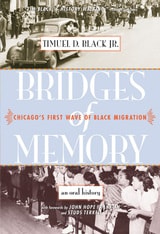
Bridges of Memory
Chicago's First Wave of Black MigrationTimuel D. Black Jr.
Northwestern University Press, 2005
Co-published with the DuSable Museum of African American History
Recipient of 2007 The Hyde Park Historical Society Paul Cornell Award
A collection of interviews with African Americans who came to Chicago from the South. In their first great migration to Chicago that began during World War I, African Americans came from the South seeking a better life--and fleeing a Jim Crow system of racial prejudice, discrimination, and segregation. What they found was much less than what they'd hoped for, but it was much better than what they'd come from--and in the process they set in motion vast changes not only in Chicago but also in the whole fabric of American society. This book, the first of three volumes, revisits this momentous chapter in American history with those who lived it.
Oral history of the first order, Bridges of Memory lets us hear the voices of those who left social, political, and economic oppression for political freedom and opportunity such as they'd never known--and for new forms of prejudice and segregation. These children and grandchildren of ex-slaves found work in the stockyards and steel mills of Chicago, settled and started small businesses in the "Black Belt" on the South Side, and brought forth the jazz, blues, and gospel music that the city is now known for. Historian Timuel D. Black, Jr., himself the son of first-generation migrants to Chicago, interviews a wide cross-section of African Americans whose remarks and reflections touch on issues ranging from fascism to Jim Crow segregation to the origin of the blues. Their recollections comprise a vivid record of a neighborhood, a city, a society, and a people undergoing dramatic and unprecedented changes.
Bridging Divides
The Origins of the Beckman Institute at IllinoisTheodore L. Brown. Forewords by Stanley O. Ikenberry and Richard H. Herman.
University of Illinois Press, 2009
Brown in the Windy City
Mexicans and Puerto Ricans in Postwar ChicagoLilia Fernández
University of Chicago Press, 2012
Brown in the Windy City is the first history to examine the migration and settlement of Mexicans and Puerto Ricans in postwar Chicago. Lilia Fernández reveals how the two populations arrived in Chicago in the midst of tremendous social and economic change and, in spite of declining industrial employment and massive urban renewal projects, managed to carve out a geographic and racial place in one of America’s great cities. Through their experiences in the city’s central neighborhoods over the course of these three decades, Fernández demonstrates how Mexicans and Puerto Ricans collectively articulated a distinct racial position in Chicago, one that was flexible and fluid, neither black nor white.
Building Ideas
An Architectural Guide to the University of ChicagoJay Pridmore
University of Chicago Press, 2013
Building Ideas: An Architectural Guide to the University of Chicago explores the environment that has supported more than a century of exceptional thinkers. This photographic guide traces the evolution of campus architecture from the university’s founding in 1890 to its plans for the twenty-first century.
When William Rainey Harper, the university’s first president, and the trustees decided to build a set of Gothic quadrangles, they created a visual link to European precursors and made a bold statement about the future of higher education in the United States. Since then the university has regularly commissioned forward-thinking architects to design buildings that expand—or explode—traditional ideals while redefining the contemporary campus.
Full of panoramic photographs and exquisite details, Building Ideas features the work of architects such as Frank Lloyd Wright, Henry Ives Cobb, Holabird & Roche, Eero Saarinen, Ludwig Mies van der Rohe, Walter Netsch, Ricardo Legorreta, Rafael Viñoly, César Pelli, Helmut Jahn, and Tod Williams Billie Tsien Architects. The guide also includes guest commentaries by prominent architects and other notable public figures. It is the perfect collection for Chicago alumni and students, Hyde Park residents and visitors, and anyone inspired by the institutional ideas and aspirations of architecture.
Building the Black Metropolis
African American Entrepreneurship in ChicagoRobert Weems Jr., Jason Chambers
University of Illinois Press, 2017
Contributors: Jason P. Chambers, Marcia Chatelain, Will Cooley, Robert Howard, Christopher Robert Reed, Myiti Sengstacke Rice, Clovis E. Semmes, Juliet E. K. Walker, and Robert E. Weems Jr.
Building the South Side
Urban Space and Civic Culture in Chicago, 1890-1919Robin F. Bachin
University of Chicago Press, 2004
Bulls Markets
Chicago's Basketball Business and the New InequalitySean Dinces
University of Chicago Press, 2018
The 1990s were a glorious time for the Chicago Bulls, an age of historic championships and all-time basketball greats like Scottie Pippen and Michael Jordan. It seemed only fitting that city, county, and state officials would assist the team owners in constructing a sparkling new venue to house this incredible team that was identified worldwide with Chicago. That arena, the United Center, is the focus of Bulls Markets, an unvarnished look at the economic and political choices that forever reshaped one of America’s largest cities—arguably for the worse.
Sean Dinces shows how the construction of the United Center reveals the fundamental problems with neoliberal urban development. The pitch for building the arena was fueled by promises of private funding and equitable revitalization in a long-blighted neighborhood. However, the effort was funded in large part by municipal tax breaks that few ordinary Chicagoans knew about, and that wound up exacerbating the rising problems of gentrification and wealth stratification. In this portrait of the construction of the United Center and the urban life that developed around it, Dinces starkly depicts a pattern of inequity that has become emblematic of contemporary American cities: governments and sports franchises collude to provide amenities for the wealthy at the expense of poorer citizens, diminishing their experiences as fans and—far worse—creating an urban environment that is regulated and surveilled for the comfort and protection of that same moneyed elite.
Burnham of Chicago
Architect and Planner, Second EditionThomas S. Hines
University of Chicago Press, 2008
“In every sense this is the definitive biography.”—Harry Weese, Chicago Tribune