Results by title
18284 books match the query 'United States' and 902 start with b

Building a Market
The Rise of the Home Improvement Industry, 1914-1960Richard Harris
University of Chicago Press, 2012
Building a New Educational State
Foundations, Schools, and the American SouthJoan Malczewski
University of Chicago Press, 2016
Malczewski presents foundation leaders as self-conscious state builders and policy entrepreneurs who aimed to promote national ideals through a public system of education—efforts they believed were especially critical in the South. Black education was an important component of this national agenda. Through extensive efforts to create a more centralized and standard system of public education aimed at bringing isolated and rural black schools into the public system, schools became important places for expanding the capacity of state and local governance. Schooling provided opportunities to reorganize local communities and augment black agency in the process. When foundations realized they could not unilaterally impose their educational vision on the South, particularly in black communities, they began to collaborate with locals, thereby opening political opportunity in rural areas. Unfortunately, while foundations were effective at developing the institutional configurations necessary for education reform, they were less successful at implementing local programs consistently due to each state’s distinctive political and institutional context.
Building a Resilient Twenty-First-Century Economy for Rural America
Don E. Albrecht
Utah State University Press, 2020
Trump’s promises to restore rural industrial jobs simply cannot be fulfilled because his policies do not address the base cause for this job loss—technological change, the most significant factor being the machine replacement of human labor in the production process. Bringing a personal understanding of the effects on rural communities and residents, Albrecht focuses each chapter on a community that has traditionally been economically dependent on a single industry—manufacturing, coal mining, agriculture, logging, oil and gas production, and tourism—and the consequences of losing that industry. He also lays out a plan for rebuilding America’s rural areas and creating an economically vibrant country with a more sustainable future.
The rural economy cannot return to the past as it was structured and instead must look to a new future. Building a Resilient Twenty-First-Century Economy for Rural America describes the source of economic concerns in rural America and offers real ways to address them. It will be vital to students, scholars, practitioners, community leaders, politicians, and policy makers concerned with rural community development.
Building a Revolutionary State
The Legal Transformation of New York, 1776-1783Howard Pashman
University of Chicago Press, 2018
Building a Revolutionary State looks closely at one state, New York, to understand the broader question of how legal structures emerged from an insurgency. By examining law as New Yorkers experienced it in daily life during the war, Pashman reconstructs a world of revolutionary law that prevailed during America’s transition to independence. In doing so, Pashman explores a central paradox of the revolutionary era: aggressive enforcement of partisan property rules actually had stabilizing effects that allowed insurgents to build legal institutions that enjoyed popular support. Tracing the transformation from revolutionary disorder to legal order, Building a New Revolutionary State gives us a radically fresh way to understand the emergence of new states.
Building for the Arts
The Strategic Design of Cultural FacilitiesPeter Frumkin and Ana Kolendo
University of Chicago Press, 2014
With Building for the Arts, Peter Frumkin and Ana Kolendo explore how artistic vision, funding partnerships, and institutional culture work together—or fail to—throughout the process of major cultural construction projects. Drawing on detailed case studies and in-depth interviews at museums and other cultural institutions varying in size and funding arrangements, including the Art Institute of Chicago, Atlanta Opera, and AT&T Performing Arts Center in Dallas, Frumkin and Kolendo analyze the decision-making considerations and challenges and identify four factors whose alignment characterizes the most successful and sustainable of the projects discussed: institutional requirements, capacity of the institution to manage the project while maintaining ongoing operations, community interest and support, and sufficient sources of funding. How and whether these factors are strategically aligned in the design and execution of a building initiative, the authors argue, can lead an organization to either thrive or fail. The book closes with an analysis of specific tactics that can enhance the chances of a project’s success.
A practical guide grounded in the latest scholarship on nonprofit strategy and governance, Building for the Arts will be an invaluable resource for professional arts staff and management, trustees of arts organizations, development professionals, and donors, as well as those who study and seek to understand them.
Building on a Borrowed Past
Place and Identity in Pipestone, MinnesotaSally J. Southwick
Ohio University Press, 2005
Why is there a national monument near a small town on the Minnesota prairie? Why do the town’s residents dress as Indians each summer and perform a historical pageant based on a Victorian-era poem? To answer such questions, Building on a Borrowed Past: Place and Identity in Pipestone, Minnesota shows what happens when one culture absorbs the heritage of another for civic advantage.
Founded in 1874, Pipestone was named for the quarries where regional tribes excavated soft stone for making pipes. George Catlin and Henry Wadsworth Longfellow described the place and its tribal history. Promotion by white residents of the quarries as central to America’s Indian heritage helped Pipestone obtain a federal Indian boarding school in the 1890s and a national monument in the 1930s. The annual “Song of Hiawatha” pageant attracted tourists after World War II. Sally J. Southwick’s prizewinning study demonstrates how average, small–town citizens contributed to the generic image of “the Indian” in American culture.
Examining oral histories, memoirs, newspapers, federal documents, civic group records, and promotional literature, Southwick focuses on the role of middle–class individuals in establishing a historical, place–based identity. Building on a Borrowed Past reveals how identities are formed through adaptation of cultural, spiritual, racial, and historical symbols.
Building the American Republic, Volume 1
A Narrative History to 1877Harry L. Watson
University of Chicago Press, 2018
Volume 1 starts at sea and ends on the battlefield. Beginning with the earliest Americans and the arrival of strangers on the eastern shore, it then moves through colonial society to the fight for independence and the construction of a federalist republic. From there, it explains the renegotiations and refinements that took place as a new nation found its footing, and it traces the actions that eventually rippled into the Civil War.
This volume goes beyond famous names and battles to incorporate politics, economics, science, arts, and culture. And it shows that issues that resonate today—immigration, race, labor, gender roles, and the power of technology—have been part of the American fabric since the very beginning.
Building the American Republic, Volume 2
A Narrative History from 1877Jane Dailey
University of Chicago Press, 2018
The American nation came apart in a violent civil war less than a century after ratification of the Constitution. When it was reborn five years later, both the republic and its Constitution were transformed. Volume 2 opens as America struggles to regain its footing, reeling from a presidential assassination and facing massive economic growth, rapid demographic change, and combustive politics.
The next century and a half saw the United States enter and then dominate the world stage, even as the country struggled to live up to its own principles of liberty, justice, and equality. Volume 2 of Building the American Republic takes the reader from the Gilded Age to the present, as the nation becomes an imperial power, rethinks the Constitution, witnesses the rise of powerful new technologies, and navigates an always-shifting cultural landscape shaped by an increasingly diverse population. Ending with the 2016 election, this volume provides a needed reminder that the future of the American republic depends on a citizenry that understands—and can learn from—its history.
Building the Black Arts Movement
Hoyt Fuller and the Cultural Politics of the 1960sJonathan Fenderson
University of Illinois Press, 2019
Building the Black Metropolis
African American Entrepreneurship in ChicagoRobert Weems Jr., Jason Chambers
University of Illinois Press, 2017
Contributors: Jason P. Chambers, Marcia Chatelain, Will Cooley, Robert Howard, Christopher Robert Reed, Myiti Sengstacke Rice, Clovis E. Semmes, Juliet E. K. Walker, and Robert E. Weems Jr.
Building the Cold War Consensus
The Political Economy of U.S. National Security Policy, 1949-51Benjamin O. Fordham
University of Michigan Press, 1998
Building the Devil's Empire
French Colonial New OrleansShannon Lee Dawdy
University of Chicago Press, 2008
Building the Devil’s Empire is the first comprehensive history of New Orleans’s early years, tracing the town’s development from its origins in 1718 to its revolt against Spanish rule in 1768. Shannon Lee Dawdy’s picaresque account of New Orleans’s wild youth features a cast of strong-willed captives, thin-skinned nobles, sharp-tongued women, and carousing travelers. But she also widens her lens to reveal the port city’s global significance, examining its role in the French Empire and the Caribbean, and she concludes that by exemplifying a kind of rogue colonialism—where governments, outlaws, and capitalism become entwined—New Orleans should prompt us to reconsider our notions of how colonialism works.
"[A] penetrating study of the colony's founding."—Nation
“A brilliant and spirited reinterpretation of the emergence of French New Orleans. Dawdy leads us deep into the daily life of the city, and along the many paths that connected it to France, the North American interior, and the Greater Caribbean. A major contribution to our understanding of the history of the Americas and of the French Atlantic, the work is also a model of interdisciplinary research and analysis, skillfully bringing together archival research, archaeology, and literary analysis.”—Laurent Dubois, Duke University
Building the Metropolis
Architecture, Construction, and Labor in New York City, 1880–1935Alexander Wood
University of Chicago Press, 2025
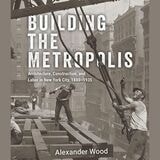
Between the 1880s and the 1930s, New York City experienced explosive growth as nearly a million buildings, dozens of bridges and tunnels, hundreds of miles of subway lines, and thousands of miles of streets were erected to meet the needs of an ever-swelling population. This landscape—jagged with skyscrapers, rattling with the sound of mass transit, alive with people—made the city world-famous.
Building the Metropolis offers a revelatory look at this era of urban development by asking, “Who built New York, and how?” Focusing on the work of architects, builders, and construction workers, Alexander Wood chronicles the physical process of the city’s rapid expansion. New York’s towering buildings and busy thoroughfares aren’t just stylish or structural marvels, Wood shows, but the direct result of the many colorful personalities who worked in one of the city’s largest industries. This development boom drew on the resources of the whole community and required money, political will, creative vision, entrepreneurial drive, skilled workmanship, and hard physical labor. Wood shows this to be an even larger story as well. As cities became nodes in a regional, national, and global economy, the business of construction became an important motor of economic, political, and social development. While they held drastically different views on the course of urban growth, machine politicians, reformers, and radicals alike were all committed to city building on an epic scale.
Drawing on resources that include city archives and the records of architecture firms, construction companies, and labor unions, Building the Metropolis tells the story of New York in a way that’s epic, lively, and utterly original.
Building the Metropolis
Architecture, Construction, and Labor in New York City, 1880–1935Alexander Wood
University of Chicago Press, 2025
A sweeping history of New York that chronicles the construction of one of the world’s great cities.
Between the 1880s and the 1930s, New York City experienced explosive growth as nearly a million buildings, dozens of bridges and tunnels, hundreds of miles of subway lines, and thousands of miles of streets were erected to meet the needs of an ever-swelling population. This landscape—jagged with skyscrapers, rattling with the sound of mass transit, alive with people—made the city world-famous.
Building the Metropolis offers a revelatory look at this era of urban development by asking, “Who built New York, and how?” Focusing on the work of architects, builders, and construction workers, Alexander Wood chronicles the physical process of the city’s rapid expansion. New York’s towering buildings and busy thoroughfares aren’t just stylish or structural marvels, Wood shows, but the direct result of the many colorful personalities who worked in one of the city’s largest industries. This development boom drew on the resources of the whole community and required money, political will, creative vision, entrepreneurial drive, skilled workmanship, and hard physical labor. Wood shows this to be an even larger story as well. As cities became nodes in a regional, national, and global economy, the business of construction became an important motor of economic, political, and social development. While they held drastically different views on the course of urban growth, machine politicians, reformers, and radicals alike were all committed to city building on an epic scale.
Drawing on resources that include city archives and the records of architecture firms, construction companies, and labor unions, Building the Metropolis tells the story of New York in a way that’s epic, lively, and utterly original.
Building the Prison State
Race and the Politics of Mass IncarcerationHeather Schoenfeld
University of Chicago Press, 2018
Reframing the story of mass incarceration, Heather Schoenfeld illustrates how the unfinished task of full equality for African Americans led to a series of policy choices that expanded the government’s power to punish, even as they were designed to protect individuals from arbitrary state violence. Examining civil rights protests, prison condition lawsuits, sentencing reforms, the War on Drugs, and the rise of conservative Tea Party politics, Schoenfeld explains why politicians veered from skepticism of prisons to an embrace of incarceration as the appropriate response to crime. To reduce the number of people behind bars, Schoenfeld argues that we must transform the political incentives for imprisonment and develop a new ideological basis for punishment.
Building the South Side
Urban Space and Civic Culture in Chicago, 1890-1919Robin F. Bachin
University of Chicago Press, 2004
Building the Urban Environment
Visions of the Organic City in the United States, Europe, and Latin AmericaHarold L Platt
Temple University Press, 2015
Building the Urban Environment is a comparative study of the contestation among planners, policymakers, and the grassroots over the production and meaning of urban space. Award-winning historian Harold Platt presents case studies of seven cities, including Rotterdam, Chicago, and Sao Paulo, to show how, over time, urban life created hybrid spaces that transformed people, culture, and their environments.
As Platt explains, during the post-1945 race to technological modernization, policymakers gave urban planners of the International Style extraordinary influence to build their utopian vision of a self-sustaining “organic city.” However, in the 1960s, they faced a revolt of the grassroots. Building the Urban Environment traces the rise and fall of the Modernist planners during an era of Cold War, urban crisis, unnatural disasters, and global restructuring in the wake of the oil-energy embargo of the ’70s.
Ultimately, Platt provides a way to measure different visions of the postwar city against actual results in terms of the built environment, contrasting how each city created a unique urban space.

Built To Win
The Female Athlete As Cultural IconLeslie Heywood
University of Minnesota Press, 2003
A timely look at the rise of women in sports
The sculpted speed of Marion Jones. The grit and agility of Mia Hamm. The slam-dunk style of Lisa Leslie. The skill and finesse of these sports figures are widely admired, no longer causing the puzzlement and discomfort directed toward earlier generations of athletic women. Built to Win explores this relatively recent phenomenon—the confident, empowered female athletes found everywhere in American popular culture.
Leslie Heywood and Shari L. Dworkin examine the role of female athletes through interviews with elementary- and high school-age girls and boys; careful readings of ad campaigns by Nike, Reebok, and others; discussions of movies like Fight Club and Girlfight; and explorations of their own sports experiences. They ask: what, if any, dissonance is there between popular images and the actual experiences of these athletes? Do these images really “redefine femininity” and contribute to a greater inclusion of all women in sport? Are sexualized images of these women damaging their quest to be taken seriously? Do they inspire young boys to respect and admire female athletes, and will this ultimately make a difference in the ways gender and power are constructed and perceived?Proposing a paradigm shift from second- to third-wave feminism, Heywood and Dworkin argue that, in the years since the passage of Title IX, gender stereotypes have been destabilized in profound ways, and they assert that female athletes and their imagery are doing important cultural work to that end. Important, refreshing, and engrossing, Built to Win examines sport in all its complexity.
Bullets and Bacilli
The Spanish-American War and Military MedicineCirillo, Vincent J.
Rutgers University Press, 2003
Bullets and Fire
Lynching and Authority in Arkansas, 1840-1950Guy Lancaster
University of Arkansas Press, 2017
Among the topics discussed are the lynching of slaves, the Arkansas Council of the Association of Southern Women for the Prevention of Lynching, the 1927 lynching of John Carter in Little Rock, and the state’s long opposition to a federal anti-lynching law.
Throughout, the work reveals how the phenomenon of lynching—as the means by which a system of white supremacy reified itself, with its perpetrators rarely punished and its defenders never condemned—served to construct authority in Arkansas. Bullets and Fire will add depth to the growing body of literature on American lynching and integrate a deeper understanding of this violence into Arkansas history.
Bullets, Ballots, and Rhetoric
Confederate States Policy for the United States Presidential ContestLarry E. Nelson
University of Alabama Press, 1980
The Confederacy's hopes for independence were founded less on the belief that the South could defeat the North than on a strategy of staving off defeat long enough for the North to weary of the fight. The South’s single biggest opportunity to effect political change in the North was the presidential contest of 1864. If Lincoln’s support foundered and the North elected a president with a more flexible vision of peace on the continent, the South might realize its dream of independence.
Praised as an important contribution to understanding the Davis administration, in Bullets, Ballots, and Rhetoric, Larry Nelson vividly brings to life the complex state of Northern and Southern internal politics during the election year of 1863. He recounts fluctuations in the value of the dollar, draft resistance and riots, protests against emancipation, political defeats suffered by the Republicans in the elections of 1862, and growing discontent in the border states and Midwest. This gripping account explores a mission Davis sent to Canada in 1864 seeking to influence the election of a new US president, a strategy Nelson's persuasive analysis shows to have been intelligent and reasonable. Nevertheless, Davis's haphazard leadership contributed to its failure. Nelson hypothesizes that had Davis drawn the North into negotiations before the Democratic convention for the upcoming elections, a temporary armistice might well have proved permanent.
Nelson offers an insider’s look at the administration of Jefferson Davis as it searched for cracks in Northern unity and electoral opportunities to exploit—and yet also as it overlooked war-weariness in the South itself. Bullets, Ballots, and Rhetoric is an engrossing account of a little-known but critical aspect of Civil War statecraft and politics.

Bulls Markets
Chicago's Basketball Business and the New InequalitySean Dinces
University of Chicago Press, 2018
The 1990s were a glorious time for the Chicago Bulls, an age of historic championships and all-time basketball greats like Scottie Pippen and Michael Jordan. It seemed only fitting that city, county, and state officials would assist the team owners in constructing a sparkling new venue to house this incredible team that was identified worldwide with Chicago. That arena, the United Center, is the focus of Bulls Markets, an unvarnished look at the economic and political choices that forever reshaped one of America’s largest cities—arguably for the worse.
Sean Dinces shows how the construction of the United Center reveals the fundamental problems with neoliberal urban development. The pitch for building the arena was fueled by promises of private funding and equitable revitalization in a long-blighted neighborhood. However, the effort was funded in large part by municipal tax breaks that few ordinary Chicagoans knew about, and that wound up exacerbating the rising problems of gentrification and wealth stratification. In this portrait of the construction of the United Center and the urban life that developed around it, Dinces starkly depicts a pattern of inequity that has become emblematic of contemporary American cities: governments and sports franchises collude to provide amenities for the wealthy at the expense of poorer citizens, diminishing their experiences as fans and—far worse—creating an urban environment that is regulated and surveilled for the comfort and protection of that same moneyed elite.
Bureaucracy in America
The Administrative State's Challenge to Constitutional GovernmentJoseph Postell
University of Missouri Press, 2023
Bureaucracy vs. Environment
The Environmental Costs of Bureaucratic GovernanceJohn Baden and Richard L. Stroup, Editors
University of Michigan Press, 1981

Bureaucratizing the Muse
Public Funds and the Cultural WorkerSteven C. Dubin
University of Chicago Press, 1987
Bureaucratizing the Muse is a study of the Chicago AIR program. By its very nature art is a nonrational process, even at times antirational, and the idea of organizing artists in this kind of work environment was an unusual one. Steven C. Dubin's account is a fascinating story of the tensions between struggling artists who need a paycheck but fear the compromise of their art and bureaucrats who need to produce measurable results.
Bureaucrats, Clients, and Geography
The Bailly Nuclear Power Plant Battle in Northern IndianaNancy J. Obermeyer
University of Chicago Press, 1989
Buried Indians
Digging Up the Past in a Midwestern TownLaurie Hovell McMillin
University of Wisconsin Press, 2006
In Buried Indians, Laurie Hovell McMillin presents the struggle of her hometown, Trempealeau, Wisconsin, to determine whether platform mounds atop Trempealeau Mountain constitute authentic Indian mounds. This dispute, as McMillin subtly demonstrates, reveals much about the attitude and interaction-past and present-between the white and Indian inhabitants of this Midwestern town.
McMillin's account, rich in detail and sensitive to current political issues of American Indian interactions with the dominant European American culture, locates two opposing views: one that denies a Native American presence outright and one that asserts its long history and ruthless destruction. The highly reflective oral histories McMillin includes turn Buried Indians into an accessible, readable portrait of a uniquely American culture clash and a dramatic narrative grounded in people's genuine perceptions of what the platform mounds mean.
Burn Scars
A Documentary History of Fire Suppression, from Colonial Origins to the Resurgence of Cultural BurningChar Miller
Oregon State University Press, 2024
In Burn Scars, historian Char Miller assembles a collection of primary sources focused on debates over “light burning” (as prescribed or controlled burning was called). These historic documents show that not only was fire suppression controversial, but that it was also driven by explicitly racist and colonial beliefs. Yet the suppression paradigm contained within it the seeds of its destruction: Indigenous people continued to use fire as did non-Indigenous land managers. By the 1920s, scientific evidence was beginning to reveal that fire was essential for regenerating grasslands and forests; by the 1930s even the Forest Service was testing fire’s ecological benefits.
Burn Scars focuses on the burning debates of the early twentieth century, but Miller also provides evidence of a powerful counternarrative emerging from southern non-Indigenous foresters who used fire to revive longleaf pine ecosystems. The volume begins and ends with contributions from Indigenous practitioners discussing the long history and resurgent practice of cultural burning as part of traditional land management.
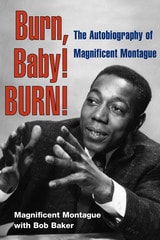
Burn, Baby! BURN!
The Autobiography of Magnificent MontagueMagnificent Montague with Bob Baker
University of Illinois Press, 2009
Like many black disc jockeys of his day, Montague played a role in his community beyond simply spreading the music of James Brown, Otis Redding, Aretha Franklin, and other prominent artists. Montague served as an unofficial spokesman for his black listeners, reflecting their beliefs and acting as a sounding board for their concerns.
Montague was based in Los Angeles in 1965 when the Watts rioters seized on his incendiary slogan, turning the shout of musical appreciation into a rallying cry for racial violence. In Burn, Baby! BURN! Montague recalls these tumultuous times, including the personal struggle he faced over whether to remain true to his listeners or bend to political pressure and stop shouting his suddenly controversial slogan.
Since the mid-1950s Montague had also expressed his passion for African American culture by becoming a zealous collector of artifacts of black history. He has built a monumental collection, taking time out from his collecting to become only the second African American to build his own radio station literally from the ground up.
A compelling account of a rich and varied life, Burn, Baby! BURN! gives an insider's view of half a century of black history, told with on-the-air zest by the DJ/historian who was there to see it unfold.

Burning Country
Syrians in Revolution and WarRobin Yassin-Kassab and Leila Al-Shami
Pluto Press, 2018
Burning Country explores the complicated reality of life in present-day Syria with unprecedented detail and sophistication, drawing on new firsthand testimonies from opposition fighters, exiles lost in an archipelago of refugee camps, and courageous human rights activists. Robin Yassin-Kassab and Leila Al-Shami expertly interweave these stories with an incisive analysis of the militarization of the uprising, the rise of the Islamists and sectarian warfare, and the role of Syria’s government in exacerbating the brutalization of the conflict. Through these accounts and a broad range of secondary source material, the authors persuasively argue that the international community has failed in its stated commitments to support the Syrian opposition movements.
This new edition brings the story up to the present, with a new chapter that covers the internationalization of the conflict, including interventions by the United States, Russia, and Iran; the rollback of ISIS; the fall of Daraya and Aleppo; the crushing of local democracy; sectarian cleansing; and the forced exile of millions of Syrians.
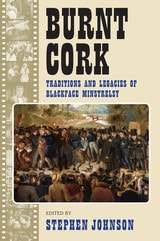
Burnt Cork
Traditions and Legacies of Blackface MinstrelsyStephen Johnson
University of Massachusetts Press, 2012
Beginning in the 1830s and continuing for more than a century, blackface minstrelsy—stage performances that claimed to represent the culture of black Americans—remained arguably the most popular entertainment in North America. A renewed scholarly interest in this contentious form of entertainment has produced studies treating a range of issues: its contradictory depictions of class, race, and gender; its role in the development of racial stereotyping; and its legacy in humor, dance, and music, and in live performance, film, and television. The style and substance of minstrelsy persist in popular music, tap and hip-hop dance, the language of the standup comic, and everyday rituals of contemporary culture. The blackface makeup all but disappeared for a time, though its influence never diminished—and recently, even the makeup has been making a comeback.
This collection of original essays brings together a group of prominent scholars of blackface performance to reflect on this complex and troublesome tradition. Essays consider the early relationship of the blackface performer with American politics and the antislavery movement; the relationship of minstrels to the commonplace compromises of the touring “show” business and to the mechanization of the industrial revolution; the exploration and exploitation of blackface in the mass media, by D. W. Griffith and Spike Lee, in early sound animation, and in reality television; and the recent reappropriation of the form at home and abroad.
In addition to the editor, contributors include Dale Cockrell, Catherine Cole, Louis Chude-Sokei, W. T. Lhamon, Alice Maurice, Nicholas Sammond, and Linda Williams.
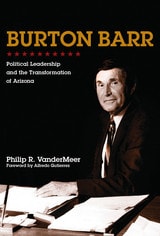
Burton Barr
Political Leadership and the Transformation of ArizonaPhilip R. VanderMeer, Foreword by Alfredo Gutierrez
University of Arizona Press, 2014
Considered perhaps the most influential person in Arizona’s political development, Burton Barr represented north central Phoenix in the Arizona House of Representatives for the twenty-two years from 1964 to 1986. As the Republican House Majority Leader for twenty of those years, he left his fingerprints on every major piece of legislation during those decades, covering such issues as air pollution, health care for indigents, school aid, the tax code, prison reform, child care, groundwater management, and freeway funding.
Burton Barr’s political life unfolded during the very time his state and region shifted from being outliers to trendsetters. His choices in policy making and his leadership style were both an outcome and a creator of his sociopolitical environment. Arizona politics in the 1960s and ’70s was a rich brew of key elements, a time when the economy was being transformed, the nature and distribution of populations shifted, partisan politics were in flux, and the very lifeblood of the West—water—was being contested under increasing pressures of usage and depletion.
How Barr successfully responded to those challenges is the story of Arizona’s development during those years. At the heart of it, Barr’s political life and personality are inextricably bound up with the life of the West.
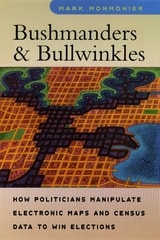
Bushmanders and Bullwinkles
How Politicians Manipulate Electronic Maps and Census Data to Win ElectionsMark Monmonier
University of Chicago Press, 2001
Written from the perspective of a cartographer rather than a political scientist, Bushmanders and Bullwinkles examines the political tales maps tell when votes and power are at stake. Monmonier shows how redistricting committees carve out favorable election districts for themselves and their allies; how disgruntled politicians use shape to challenge alleged racial gerrymanders; and how geographic information systems can make reapportionment a controversial process with outrageous products. He also explores controversies over the proper roles of natural boundaries, media maps, census enumeration, and ethnic identity. Raising important questions about Supreme Court decisions in regulating redistricting, Monmonier asks if the focus on form rather than function may be little more than a distraction from larger issues like election reform.
Characterized by the same wit and clarity as Monmonier's previous books, Bushmanders and Bullwinkles is essential background for understanding what might prove the most contentious political debate of the new decade.

Business Confronts Terrorism
Risks and ResponsesDean C. Alexander
University of Wisconsin Press, 2004
These scenarios could be part of a future Hollywood movie. Sadly, they are representative of previous terror attacks against industry and government interests worldwide. Moreover, they are harbingers of global terror threats.
Industry constitutes a prime target of contemporary terrorism. This timely book analyzes the threats companies face due to terrorism, industry responses to these dangers, and terrorism’s effects on conducting business in the post-9/11 environment. Dean C. Alexander details the conventional and unconventional terror capabilities facing industry. He describes the activities of terrorists in the economic system and the ways they finance their operations.
Alexander discusses how companies can reduce terrorist threats and that corporate security can minimize political violence. He outlines the dynamics of the public-private partnership against terrorism: government aiding industry, business supporting government, and tensions between the two. He also delineates terrorism’s effects—financial, physical, and emotional—on workers and employers. He highlights the negative financial and economic consequences of terrorism. He discusses the impact of terrorism on traditional business practices and concludes with an assessment of future trends.
Business Cycles, Indicators, and Forecasting
Edited by James H. Stock and Mark W. Watson
University of Chicago Press, 1993
Business Of Jews In Louisiana, 1840–1875
Elliot Ashkenazi
University of Alabama Press, 1988
Goes beyond institutional history to concentrate on commercial and social matters
The author’s findings imply that Jewish immigrants to the South in the first half of the 19th century came from particular locales with similar social, economic, and religious backgrounds, and they chose to live in the South because of those traditions. The experience of Jews with commercial capitalism, rather than landowning, in agricultural societies, gave the Jews of Louisiana a comparable niche in America, and they participated in the commercial aspects of a regional economy based on agricultural production. Commercial and family connections with other Jewish groups facilitated their development into a settled community. In growth and decline, Jewish communities in Louisiana and elsewhere became permanent features of the landscape and influenced, and were influenced, by the areas in which they lived.

Business Of Practicing Law
Carroll Seron
Temple University Press, 1996
Business as Usual
How Sponsored Media Sold American Capitalism in the Twentieth CenturyCaroline Jack
University of Chicago Press, 2024
Business as Usual reveals how American capitalism has been promoted in the most ephemeral of materials: public service announcements, pamphlets, educational films, and games—what Caroline Jack calls “sponsored economic education media.” These items, which were funded by corporations and trade groups who aimed to “sell America to Americans,” found their way into communities, classrooms, and workplaces, and onto the airwaves, where they promoted ideals of “free enterprise” under the cloaks of public service and civic education. They offered an idealized vision of US industrial development as a source of patriotic optimism, framed business management imperatives as economic principles, and conflated the privileges granted to corporations by the law with foundational political rights held by individuals. This rhetoric remains dominant—a harbinger of the power of disinformation that so besets us today. Jack reveals the funding, production, and distribution that together entrenched a particular vision of corporate responsibility—and, in the process, shut out other hierarchies of value and common care.
Butcher's Work
True Crime Tales of American Murder and MadnessHarold Schechter
University of Iowa Press, 2022
Buxton
A Black Utopia in the Heartland, An Expanded EditionDorothy Schwieder
University of Iowa Press, 2003
Buy Black
How Black Women Transformed US Pop CultureAria S. Halliday
University of Illinois Press, 2022
Far-ranging and bold, Buy Black reveals what attitudes inform a contemporary Black sensibility based in representation and consumerism. It also traces the parameters of Black symbolic power, mapping the sites where intraracial ideals of blackness, womanhood, beauty, play, and sexuality meet and mix in consumer and popular culture.
Buying In or Selling Out?
The Commercialization of the American Research UniversityStein, Donald G.
Rutgers University Press, 2004
Universities were once ivory towers where scholarship and teaching reigned supreme, or so we tell ourselves. Whether they were ever as pure as we think, it is certainly the case that they are pure no longer. Administrators look to patents as they seek money by commercializing faculty discoveries; they pour money into sports with the expectation that these spectacles will somehow bring in revenue; they sign contracts with soda and fast-food companies, legitimizing the dominance of a single brand on campus; and they charge for distance learning courses that they market widely. In this volume, edited by Donald G. Stein, university presidents and others in higher education leadership positions comment on the many connections between business and scholarship when intellectual property and learning is treated as a marketable commodity. Some contributors write about the benefits of these connections in providing much needed resources. Others emphasize that the thirst for profits may bias the type of research that is carried out and the quality of that research. They fear for the future of basic research if faculty are in search of immediate payoffs.
The majority of the contributors acknowledge that commercialization is the current reality and has progressed too far to return to the “good old days.” They propose guidelines for students and professors to govern commercial activities. Such guidelines can increase the likelihood that quality, openness, and collegiality will remain core academic values.
Buying Power
A History of Consumer Activism in AmericaLawrence B. Glickman
University of Chicago Press, 2009
A definitive history of consumer activism, Buying Power traces the lineage of this political tradition back to our nation’s founding, revealing that Americans used purchasing power to support causes and punish enemies long before the word boycott even entered our lexicon. Taking the Boston Tea Party as his starting point, Lawrence Glickman argues that the rejection of British imports by revolutionary patriots inaugurated a continuous series of consumer boycotts, campaigns for safe and ethical consumption, and efforts to make goods more broadly accessible. He explores abolitionist-led efforts to eschew slave-made goods, African American consumer campaigns against Jim Crow, a 1930s refusal of silk from fascist Japan, and emerging contemporary movements like slow food. Uncovering previously unknown episodes and analyzing famous events from a fresh perspective, Glickman illuminates moments when consumer activism intersected with political and civil rights movements. He also sheds new light on activists’ relationship with the consumer movement, which gave rise to lobbies like the National Consumers League and Consumers Union as well as ill-fated legislation to create a federal Consumer Protection Agency.
Buying into the Regime
Grapes and Consumption in Cold War Chile and the United StatesHeidi Tinsman
Duke University Press, 2014

Buying the Farm
Peace and War on a Sixties CommuneTom Fels
University of Massachusetts Press, 2012
With deft individual portraits, Fels reveals the social dynamics of the group and explores the ongoing difficulties faced by a commune that was founded in idealism and sought to operate on the model of a leaderless democracy. He draws on a large body of farm-family and 1960s-related writing and the notes of community members to present a variety of points of view. The result is an absorbing narrative that chronicles the positive aspects of Montague Farm while documenting the many challenges and disruptions that marked its history.
Buying the Night Flight
The Autobiography of a Woman Foreign CorrespondentGeorgie Anne Geyer
University of Chicago Press, 2001
Buying the Wind
Regional Folklore in the United StatesRichard M. Dorson
University of Chicago Press, 1964
Their tales, songs, riddles, proverbs, games, superstitions, and customs provide a wealth of living folklore presented here as it was recorded in the field. And this unvarnished folklore fact—retains the spicy flavor of authentic narrative, told in the vernacular of the skillful folk storyteller.
By The Ore Docks
A Working People’s History Of DuluthRichard Hudelson
University of Minnesota Press, 2006
In By the Ore Docks, Richard Hudelson and Carl Ross trace seventy years in the lives of Duluth’s multi-ethnic working class—Scandinavians, Finns, Italians, Poles, Irish, Jews, and African Americans—and chronicle, along with the events of the times, the city’s vibrant neighborhoods, religious traditions, and communities. But they also tell the dramatic story of how a populist worker’s coalition challenged the “legitimate American” business interests of the city, including the major corporation U.S. Steel.
From the Knights of Labor in the 1880s to the Industrial Workers of the World, the AFL and CIO, and the Democratic Farmer-Labor party, radical organizations and their immigrant visionaries put Duluth on the national map as a center in the fight for worker’s rights—a struggle inflamed by major strikes in the copper and iron mines.
By the Ore Docks is at once an important history of Duluth and a story of its working people, common laborers as well as union activists like Ernie Pearson, journalist Irene Paull, and Communist party gubernatorial candidate Sam Davis. Hudelson and Ross reveal tension between Duluth’s ethnic groups, while also highlighting the ability of the people to overcome those differences and shape the legacy of the city’s unsettled and remarkable past.
Richard Hudelson is professor of philosophy at the University of Wisconsin, Superior. He is the author of, among other works, Marxism and Philosophy in the Twentieth Century and The Rise and Fall of Communism.
Carl Ross (1913–2004) was a labor activist and the author of The Finn Factor in American Labor, Culture, and Society. He was director of the Twentieth-Century Radicalism in Minnesota Project of the Minnesota Historical Society.

By Wind and Iron
Naval Campaigns in the Champlain Valley, 1665–1815Michael Laramie
Westholme Publishing, 2027
For more than 150 years, the natural invasion route along the waterways of the Champlain and Richelieu valleys into northeastern North America was among the most fiercely contested in the history of the continent. Whether the French and their Indian allies attacking British forts and settlements during the Seven Years’ War, the American Continentals striking north into Canada during the American Revolution, or the British battling French and later American forces in these wars and the War of 1812, it was clear to policy makers in Quebec, London, Paris, Philadelphia, and Washington that whoever controlled this corridor and its lakes and rivers, controlled the heart of the continent. In By Wind and Iron: Naval Campaigns in the Champlain Valley, 1665–1815, Michael G. Laramie details the maritime history of this region from the first French fortifications along the Richelieu River in the late seventeenth century through the tremendous American victory over the British at the Battle of Plattsburgh on Lake Champlain in 1814. Using period letters, journals, and other primary source materials, the author examines the northeastern waterways and their tributaries within the framework of the soldiers and sailors who faced the perils of the campaigns, while at the same time clarifying the key role played by this region in the greater struggle for North America and American independence.
In support of the narrative, the book also contains appendices that include after action reports from various fleet commanders, tables of fleet strengths, additional battle maps, a glossary, and a dictionary of lake warships with notes on vessel types, typical armament, construction, deployment, and fates.

By the Beautiful Sea
The Rise and High Times of That Great American Resort, Atlantic CityFunnell, Charles
Rutgers University Press, 1983