Results by title
22279 books match the query 'Social Science' and 1147 start with b
Born This Way
Science, Citizenship, and Inequality in the American LGBTQ+ MovementJoanna Wuest
University of Chicago Press, 2023
The story of how a biologically driven understanding of gender and sexuality became central to US LGBTQ+ political and legal advocacy.
Across protests and courtrooms, LGBTQ+ advocates argue that sexual and gender identities are innate. Oppositely, conservatives incite panic over “groomers” and a contagious “gender ideology” that corrupts susceptible children. Yet, as this debate rages on, the history of what first compelled the hunt for homosexuality’s biological origin story may hold answers for the queer rights movement’s future.
Born This Way tells the story of how a biologically based understanding of gender and sexuality became central to LGBTQ+ advocacy. Starting in the 1950s, activists sought out mental health experts to combat the pathologizing of homosexuality. As Joanna Wuest shows, these relationships were forged in subsequent decades alongside two broader, concurrent developments: the rise of an interest-group model of rights advocacy and an explosion of biogenetic and bio-based psychological research. The result is essential reading to fully understand LGBTQ+ activism today and how clashes over science remain crucial to equal rights struggles.
Born This Way
Science, Citizenship, and Inequality in the American LGBTQ+ MovementJoanna Wuest
University of Chicago Press, 2023
This is an auto-narrated audiobook version of this book.
The story of how a biologically driven understanding of gender and sexuality became central to US LGBTQ+ political and legal advocacy.
Across protests and courtrooms, LGBTQ+ advocates argue that sexual and gender identities are innate. Oppositely, conservatives incite panic over “groomers” and a contagious “gender ideology” that corrupts susceptible children. Yet, as this debate rages on, the history of what first compelled the hunt for homosexuality’s biological origin story may hold answers for the queer rights movement’s future.
Born This Way tells the story of how a biologically based understanding of gender and sexuality became central to LGBTQ+ advocacy. Starting in the 1950s, activists sought out mental health experts to combat the pathologizing of homosexuality. As Joanna Wuest shows, these relationships were forged in subsequent decades alongside two broader, concurrent developments: the rise of an interest-group model of rights advocacy and an explosion of biogenetic and bio-based psychological research. The result is essential reading to fully understand LGBTQ+ activism today and how clashes over science remain crucial to equal rights struggles.
Born in the U.S.A.
Birth, Commemoration, and American Public MemorySeth C. Bruggeman
University of Massachusetts Press, 2012
Beyond asking why it is that Americans care about birthplaces and how they choose which ones to commemorate, Born in the U.S.A. offers insights from historians, curators, interpretive specialists, and others whose experience speaks directly to the challenges of managing historical sites. Each essay points to new ways of telling old stories at these mainstays of American memory. The case of the modern house museum receives special attention in a provocative concluding essay by Patricia West.
In addition to West and the editor, contributors include Christine Arato, Dan Currie, Keith A. Erekson, David Glassberg, Anna Thompson Hajdik, Zachary J. Lechner, Paul Lewis, Hilary Iris Lowe, Cynthia Miller, Laura Lawfer Orr, Robert Paynter, Angela Phelps, and Paul Reber.
Born of War in Colombia
Reproductive Violence and Memories of AbsenceTatiana Sanchez Parra
Rutgers University Press, 2024
Born to Belonging
Writings on Spirit and JusticeMab Segrest
Rutgers University Press, 2002
Borrowed Power
Essays on Cultural AppropriationEdited by Bruce Ziff
Rutgers University Press, 1997
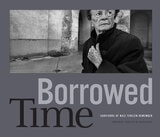
Borrowed Time
Survivors of Nazi Terezín RememberDennis Carlyle Darling
University of Texas Press, 2024
Honorable Mention — The International Photography Awards 2024 Book Category
Documentation, through photographs and interviews, of those who survived the unique Nazi ghetto/camp located at Terezín, Czech Republic.
Dennis Carlyle Darling has photographed and interviewed hundreds of Holocaust survivors who spent time at the German transit camp and ghetto at Terezín, a former eighteenth-century military garrison located north of Prague. Many of the prisoners were kept there until they could be transported to Auschwitz or other camps, but unlike German captives elsewhere, they were allowed to participate in creative activities that the Nazis used for propaganda purposes to show the world how well they were treating Jews. Although it was not classified as a “death camp,” more than 33,000 prisoners died at Terezín from hunger, disease, and mistreatment.
In Borrowed Time, Darling reveals Terezín as a place of painful contradictions, through striking and intimate portraits that retrace time and place with his subjects, the last remnants of those who survived the experience. Returning to sites of painful memories with his interview subjects to photograph them, Darling respectfully depicts these survivors and tells their stories.
Borrowed Voices
Writing and Racial Ventriloquism in the Jewish American ImaginationGlaser, Jennifer
Rutgers University Press, 2016
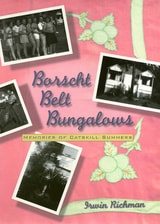
Borscht Belt Bungalows
Memoirs Of Catskill SummersIrwin Richman
Temple University Press, 2003
These were not glamorous places, and middle-class Jews today remember the colonies with either aversion or fondness. Irwin Richman's narrative, anecdotes, and photos recapture everything from the traffic jams leaving the city to the strategies for sneaking into the casinos of the big hotels. He brings to life the attitudes of the renters and the owners, the differences between the social activities and swimming pools advertised and what people actually received. He reminisces about the changing fashion of the guests and owners—everything that made summers memorable.
The author remembers his boyhood: what it was like to spend summers outside the city, swimming in the Neversink, "noodling around," and helping with the bungalow operation, while Grandpa charged the tenants and acted as president of Congregation B'nai Israel of Woodbourne, N.Y. He also traces the changes in the Catskills, including the influx of Hasidic families. Richman talks about what it's like to go back and to see the ghosts of resorts along the roads he once traveled.
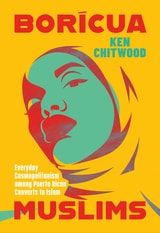
Borícua Muslims
Everyday Cosmopolitanism among Puerto Rican Converts to IslamKen Chitwood
University of Texas Press, 2025
The stories and struggles of Puerto Rican Muslims in modern day America.
Among Puerto Rican converts to Islam, marginalization is a fact of daily life. Their “authenticity” is questioned by other Muslims and by fellow Borícua on the island and in the United States. At the same time, they exist under the shadow of US colonization and as Muslims in the context of American empire. To be a Puerto Rican Muslim, then, is to negotiate identity at numerous intersections of diversity and difference.
Drawing on years of ethnographic research and more than a hundred interviews conducted in Puerto Rico, New York, Florida, Texas, New Jersey, and online, Ken Chitwood tells the story of Puerto Rican Muslims as they construct a shared sense of peoplehood through everyday practices. Borícua Muslims thus provides a study of cosmopolitanism not as a political ideal but as a mundane social reality—a reality that complicates scholarly and public conversations about race, ethnicity, and religion in the Americas. Expanding the geography of global Islam and recasting the relationship between religion and Puerto Rican culture, Borícua Muslims is an insightful reckoning with the manifold entanglements of identity amid late-modern globalization.
Bosnia the Good
Tolerance and TraditionRusmir Mahmutcehajic
Central European University Press, 2000
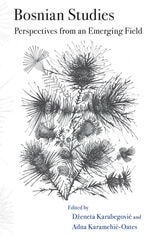
Bosnian Studies
Perspectives from an Emerging FieldDzeneta Karabegovic
University of Missouri Press, 2023
Diaspora communities have formed in North America (especially in St. Louis), Europe, and Australia because of war and displacement, and have themselves become a considerable topic of study spanning the disciplines of anthropology, migration studies, political science, memory studies, conflict and security studies, psychology, and geography.
This volume seeks to illuminate how Bosnian migrant and diaspora scholars are contributing to the development of Bosnian Studies. The authors included in this volume are either writing from their (new) home bases in Australia, Austria, Canada, Switzerland, the United Kingdom, and the United States, among others, or they have returned to Bosnia after a period of migration. Their chapters have distinct entry points of inquiry, demonstrating how scholars have integrated Bosnia as a theme across the range of disciplines in which they are situated. The selections included in the volume range from literary analysis to personal memoirs of the conflict, from studies of heritage and identity to political science analysis of diaspora voting, to genocide studies and questions of (or lack of) ethics in the growing field of Bosnian Studies.

Boss-Busters and Sin Hounds
Kansas City and Its StarHarry Haskell
University of Missouri Press, 2007
At the turn of the twentieth century, the Kansas City Star was a trust-busting newspaper acclaimed for its crusading progressive spirit; fifty years later it was a busted trust, targeted in the most important antitrust action ever brought against an American daily. Now Harry Haskell tells the tale of the Star’s rise and decline against the richly textured backdrop of Kansas City—the story of how a newspaper and a city grew together and ultimately grew apart.
Boss-Busters and Sin Hounds takes readers into the city room and executive offices of one of the most respected American newspapers, whose influence extended beyond its own community to international affairs. Re-creating life at the Star from the inside, the book traces the shifting fortunes of a great newspaper and the compelling “power of purpose” it exerted from the birth of the progressive movement in the 1880s to the 1950s.
This fascinating tale—with underlying themes of sin and redemption, high-minded ideals and gutter politics—is populated by a cast of larger-than-life characters, ranging from power brokers to presidents and including such Kansas City notables as Tom Pendergast, J. C. Nichols, and Frank Walsh. But at heart this is the story of three men with contrasting personalities and agendas who shaped the newspaper over more than three-quarters of a century: William Rockhill Nelson, among the last of the great “personal” editors from journalism’s golden age; the scholarly Henry J. Haskell, who led the Star to its peak of influence in the 1930s and ’40s; and Roy A. Roberts, who went on to combine the roles of newspaper publisher and political kingmaker.
Along the way, Haskell recounts such milestones as the Star’s role in the City Beautiful movement that helped transform America’s urban centers; the nation’s entry into two global wars; a bold but ill-starred experiment in employee ownership; and the paper’s on-again, off-again battle with Boss Pendergast’s legendary political machine. And he brings into focus issues that remain timely today, from social and political reform to the very role of newspapers in a democracy, while also drawing parallels with recent American history—disillusionment with liberalism, the hijacking of the GOP by the far right, America’s go-it-alone attitude—that are as alarming as they are instructive.
As Haskell shows, the evolution of American journalism from crusading newspapers to pawns of corporate culture was already under way in the early 1900s and was substantially complete by midcentury. Boss-Busters and Sin Hounds chronicles the glory days of an illustrious newspaper as it opens new windows on a city’s history.
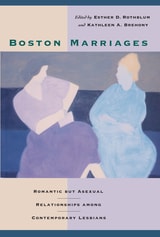
Boston Marriages
Romantic but Asexual Relationships among Contemporary LesbiansEdited by Esther D. Rothblum and Kathleen A. Brehony
University of Massachusetts Press, 1993
For decades the term “Boston marriage” was used to describe single women who lived together and shared their lives. The presumption then was that these partnerships were nonsexual. In recent years, however, the opposite assumption has prevailed, causing some women involved in such relationships to hide the asexual nature of their attachments in the lesbian community.
Convinced that Boston marriages are both legitimate and important, Esther D. Rothblum and Kathleen A. Brehony argue that in a society that defines intimacy by the occurrence of sexual activity, we have no word for—and thus no understanding of—the intensely romantic but asexual relationships that some lesbians form. By bringing these relationships “out of the closet” and discussing them openly, the editors and other contributors to this volume challenge our views about lesbianism and address larger questions concerning the construction of sexuality and sexual identity. How, for example, do we define a lesbian relationship? What constitutes a romantic involvement? If a couple does not engage in sex, are they still considered lovers?
This book includes ten personal accounts by women involved in Boston marriages as well as theoretical essays by Lillian Faderman, Marnie Hall, JoAnn Loulan, Suzanna Rose, Debra Zand, Marie Cini, and Laura Brown.
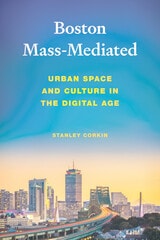
Boston Mass-Mediated
Urban Space and Culture in the Digital AgeStanley Corkin
University of Massachusetts Press, 2024
In the mid-nineteenth century, Boston fashioned itself as a global hub. By the early 1970s, it was barely a dot on the national picture. It had gained a reputation as a decaying city rife with crime and dysfunctional politics, as well as decidedly retrograde race relations, prominently exemplified by white resistance to school integration. Despite this historical ebb in its national and international presence, it still possessed the infrastructure—superb educational institutions such as Harvard and MIT, world-class sports teams like the Celtics and Red Sox, powerful media outlets like The Boston Globe, and extensive shipping capacity—required to eventually thrive in an age of global trade and mass communication.
In Boston Mass-Mediated, Stanley Corkin explores the power of mass media to define a place. He examines the tensions between the emergent and prosperous city of the late twentieth and early twenty-first centuries and its representation in a range of media genres such as news journalism, professional sports broadcasting, and popular films like Mystic River and The Departed. This mass media, with its ever-increasing digital reach, has emphasized a city restricted by tropes suggestive of an earlier Boston—racism, white ethnic crime, Catholicism, and a pre-modern insularity—even as it becomes increasingly international and multicultural. These tropes mediate our understanding and experience of the city. Using Boston as a case study, Corkin contends that our contemporary sense of place occurs through a media saturated world, a world created by the explosion of digital technology that is steeped in preconceptions.
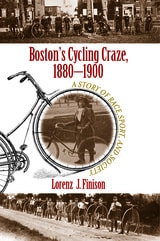
Boston's Cycling Craze, 1880-1900
A Story of Race, Sport, and SocietyLorenz J. Finison
University of Massachusetts Press, 2014
Lorenz J. Finison explores the remarkable rise of Boston cycling through the lives of several participants, including Kittie Knox, a biracial twenty-year-old seamstress who challenged the color line; Mary Sargent Hopkins, a self-proclaimed expert on women's cycling and publisher of The Wheelwoman; and Abbot Bassett, a longtime secretary of the League of American Wheelman and a vocal cycling advocate for forty years. Finison shows how these riders and others interacted on the road and in their cycling clubhouses, often constrained by issues of race, class, religion, and gender. He reveals the challenges facing these riders, whether cycling for recreation or racing, in a time of segregation, increased immigration, and debates about the rights of women.
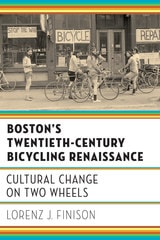
Boston's Twentieth-Century Bicycling Renaissance
Cultural Change on Two WheelsLorenz J. Finison
University of Massachusetts Press, 2019
Finison traces the city's cycling history, chronicling the activities of environmental and social justice activists, stories of women breaking into male-dominated professions by becoming bike messengers and mechanics, and challenges faced by African American cyclists. Making use of newspaper archives, newly discovered records of local biking organizations, and interviews with Boston-area bicyclists and bike builders, Boston's Twentieth-Century Bicycling Renaissance brings these voices and battles back to life.
Both Hands Tied
Welfare Reform and the Race to the Bottom in the Low-Wage Labor MarketJane L. Collins and Victoria Mayer
University of Chicago Press, 2010
Both Hands Tied studies the working poor in the United States, focusing in particular on the relation between welfare and low-wage earnings among working mothers. Grounded in the experience of thirty-three women living in Milwaukee and Racine, Wisconsin, it tells the story of their struggle to balance child care and wage-earning in poorly paying and often state-funded jobs with inflexible schedules—and the moments when these jobs failed them and they turned to the state for additional aid.
Jane L. Collins and Victoria Mayer here examine the situations of these women in light of the 1996 national Personal Responsibility and Work Opportunity Reconciliation Act and other like-minded reforms—laws that ended the entitlement to welfare for those in need and provided an incentive for them to return to work. Arguing that this reform came at a time of gendered change in the labor force and profound shifts in the responsibilities of family, firms, and the state, Both Hands Tied provides a stark but poignant portrait of how welfare reform afflicted poor, single-parent families, ultimately eroding the participants’ economic rights and affecting their ability to care for themselves and their children.
Bottle Creek
A Pensacola Culture Site in South AlabamaEdited by Ian W. Brown, with a foreword by David S. Brose
University of Alabama Press, 2002
The first comprehensive study and analysis of the most important Mississippian mound site on the north-central Gulf coast
Consisting of 18 earthen mounds and numerous additional habitation areas dating to A.D. 1250-1550, the Bottle Creek site was first professionally investigated in 1932 when David L. DeJarnette of the Alabama Museum of Natural History began work there to determine if the site had a cultural relationship with Moundville, connected to the north by a river system. Although partially mapped in the 1880s, Bottle Creek's location in the vast Mobile-Tensaw Delta of Baldwin County completely surrounded by swamp made it inaccessible and protected it from most of the plunder experienced by similar sites in the Southeast.
This volume builds on earlier investigations to present extensive recent data from major excavations conducted from 1991 to 1994 and supported in part by an NEH grant. Ten anthropologists examine various aspects of the site, including mound architecture, prehistoric diet, pottery classification, vessel forms, textiles used to make pottery impressions, a microlithic stone tool industry, water travel, the persistence of mound use into historic times, and the position of Bottle Creek in the protohistoric world.
The site is concluded to be the best remaining example of Pensacola culture, an archaeological variant of the widespread Mississippian tradition identified by a shell-tempered pottery complex and by its geographic association with the north-central coast of the Gulf of Mexico. Occupied for three centuries by a thriving native culture, Bottle Creek is an important remnant of North American peoples and as such is designated a National Historic Landmark. This published compilation of the research data should establish a base for future scholarly investigation and interpretation.
A Dan Josselyn Memorial Publication
Bottleneck
Moving, Building, and Belonging in an African CityCaroline Melly
University of Chicago Press, 2017
Melly opens with an account of the generation of urban men who came of age on the heels of the era of structural adjustment, a diverse cohort with great dreams of building, moving, and belonging, but frustratingly few opportunities to do so. From there, she moves to a close study of taxi drivers and state workers, and shows how bottlenecks—physical and institutional—affect both. The third section of the book covers a seemingly stalled state effort to solve housing problems by building large numbers of concrete houses, while the fourth takes up the thousands of migrants who attempt, sometimes with tragic results, to cross the Mediterranean on rickety boats in search of new opportunities. The resulting book offers a remarkable portrait of contemporary Senegal and a means of theorizing mobility and its impossibilities far beyond the African continent.
Bounce
Rap Music and Local Identity in New OrleansMatt Miller
University of Massachusetts Press, 2012
Over the course of the twentieth century, African Americans in New Orleans helped define the genres of jazz, rhythm and blues, soul, and funk. In recent decades, younger generations of New Orleanians have created a rich and dynamic local rap scene, which has revolved around a dance-oriented style called “bounce.”
Hip-hop has been the latest conduit for a “New Orleans sound” that lies at the heart of many of the city's best-known contributions to earlier popular music genres. Bounce, while globally connected and constantly evolving, reflects an enduring cultural continuity that reaches back and builds on the city's rich musical and cultural traditions.
In this book, the popular music scholar and filmmaker Matt Miller explores the ways in which participants in New Orleans's hip-hop scene have collectively established, contested, and revised a distinctive style of rap that exists at the intersection of deeply rooted vernacular music traditions and the modern, globalized economy of commercial popular music. Like other forms of grassroots expressive culture in the city, New Orleans rap is a site of intense aesthetic and economic competition that reflects the creativity and resilience of the city's poor and working-class African Americans.
Bound For the Promised Land
African American Religion and the Great MigrationMilton C. Sernett
Duke University Press, 1997
Drawing on a range of sources—interviews, government documents, church periodicals, books, pamphlets, and articles—Sernett shows how the mass migration created an institutional crisis for black religious leaders. He describes the creative tensions that resulted when the southern migrants who saw their exodus as the Second Emancipation brought their religious beliefs and practices into northern cities such as Chicago, and traces the resulting emergence of the belief that black churches ought to be more than places for "praying and preaching." Explaining how this social gospel perspective came to dominate many of the classic studies of African American religion, Bound for the Promised Land sheds new light on various components of the development of black religion, including philanthropic endeavors to "modernize" the southern black rural church. In providing a balanced and holistic understanding of black religion in post–World War I America, Bound for the Promised Land serves to reveal the challenges presently confronting this vital component of America’s religious mosaic.

Bound and Gagged
Pornography and the Politics of Fantasy in AmericaLaura Kipnis
Duke University Press, 1998
Using this textbook example of social hysteria as a springboard, Kipnis argues that criminalizing fantasy—even perverse and unacceptable fantasy—has dire social consequences. Exploring the entire spectrum of pornography, she declares that porn isn’t just about gender and that fantasy doesn’t necessarily constitute intent. She reveals Larry Flynt’s Hustler to be one of the most politically outspoken and class-antagonistic magazine in the country and shows how fetishes such as fat admiration challenge our aesthetic prejudices and socially sanctioned disgust. Kipnis demonstrates that the porn industry—whose multibillion-dollar annual revenues rival those of the three major television networks combined—know precisely how to tap into our culture’s deepest anxieties and desires, and that this knowledge, more than all the naked bodies, is what guarantees its vast popularity.
Bound and Gagged challenges our most basic assumptions about America’s relationship with pornography and questions what the calls to eliminate it are really attempting to protect.
Bound by Creativity
How Contemporary Art Is Created and JudgedHannah Wohl
University of Chicago Press, 2021
Bound by Creativity reveals how artists develop conceptions of their distinctive creative visions through experimentation and social interactions. Ultimately, we come to appreciate how judgment is integral to the creative process, both resulting in the creation of original works while also limiting an artist’s ability to break new ground. Exploring creativity through the lens of judgment sheds new light on the production of cultural objects, markets, and prestige.
Bound to Respect
Antebellum Narratives of Black Imprisonment, Servitude, and Bondage, 1816–1861Keith Michael Green
University of Alabama Press, 2015
WINNER OF THE ELIZABETH AGEE PRIZE IN AMERICAN LITERATURE
Challenges the commonplace narrative that the African American experience of captivity in the United States is reducible to the legal institution of slavery, a status remedied through emancipation
In Bound to Respect: Antebellum Narratives of Black Imprisonment, Servitude, and Bondage, 1816–1861, Keith Michael Green examines key texts that illuminate forms of black bondage and captivity that existed within and alongside slavery. In doing so, he restores to antebellum African American autobiographical writing the fascinating heterogeneity lost if the historical experiences of African Americans are attributed to slavery alone.
The book’s title is taken from the assertion by US Supreme Court chief justice Roger B. Taney in his 1857 Dred Scott decision that blacks had no rights that whites were “bound to respect.” This allusion highlights Green’s critical assertion that the dehumanizing absurdities to which defenders of slavery resorted to justify slavery only brought into more stark relief the humanity of African Americans.
A gifted storyteller, Green examines four forms of captivity: incarceration, enslavement to Native Americans, child indentured servitude, and maritime capture. By illuminating this dense penumbra of captivity beyond the strict definitions of slavery, he presents a fluid and holistic network of images, vocabulary, narratives, and history. By demonstrating how these additional forms of confinement flourished in the era of slavery, Green shows how they persisted beyond emancipation, in such a way that freed slaves did not in fact partake of “freedom” as white Americans understood it. This gap in understanding continues to bedevil contemporary American society, and Green deftly draws persuasive connections between past and present.
A vital and convincing offering to readers of literary criticism, African American studies, and American history, Green’s Bound to Respect brings fresh and nuanced insights to this fundamental chapter in the American story.
Boundaries That Divide
How Journalists in Turkey Surrendered Their Power over PoliticsDefne Över
Rutgers University Press, 2026
Turkey presents a striking example of the most recent wave of global authoritarian turns. The two-decade-long transition in the country’s political system also transformed its media environment. As mainstream journalists gradually yielded their places to sycophants, much more willing to praise the government in their news, the mainstream media that once oversaw—however imperfectly—political decisions started devoting its full service to cheerleading the government. Simultaneously, a new sphere of critical journalism began to emerge, with mainstream media journalists joining their fellows in the peripheries of the media. Considering the transformation of Turkey’s news media as the decay of a democratic institution, this book asks, How does the media break down under the rule of an elected government?
Drawing on fieldwork and in-depth interviews, the book traces the ruling AKP’s manipulation of social divides to consolidate power and journalists’ navigation of the resulting climate of fear, hope, doubt, and anger. The book shows how Turkey’s news media surrendered its power over politics as some journalists embraced disinformation as a path to heightened status, others turned to self-censorship for protection, and still others resisted capture through continuous but fragmented efforts.
The book portrays journalists as central actors in media decay, while also revealing that resilience to decay emerges where rising demand for “news” meets the contentious mobilization of journalists. Although focused on Turkey, the book’s insights extend far beyond, offering urgent lessons about the future of journalism in an age of populism, polarization, and institutional erosion.
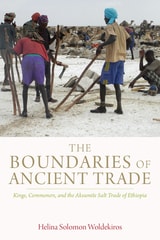
Boundaries of Ancient Trade
Kings, Commoners, and the Aksumite Salt Trade of EthiopiaHelina Solomon Woldekiros
University Press of Colorado, 2023
trade routes in the world.
For thousands of years, farmers in the Tigray, Amhara, and Afar regions of Ethiopia and Eritrea have run caravans of nearly 250,000 people and pack animals annually along an eighty-mile route through both cold, high-altitude farmlands and some of the hottest volcanic desert terrain on earth. In her fieldwork, archaeologist Helina Solomon Woldekiros followed the route with her own donkey and camel caravan, observing and interviewing over 150 Arho (caravaners), salt miners, salt cutters, warehouse owners, brokers, shop owners, and salt village residents to model the political economy of the ancient Aksumite state. The first integrated ethnoarchaeological and archaeological research on this legendary route, this volume provides evidence that informal economies and local participation have played a critical role in regional trade and, ultimately, in maintaining the considerable power of the Aksumite state. Woldekiros also contributes new insights into the logistics of pack animal–based trade and variability in the central and regional organization of global ancient trade.
Using a culturally informed framework for understanding the organization of the ancient salt route and its role in linking the Aksumite state to rural highland agricultural and lowland mobile pastoralist populations, The Boundaries of Ancient Trade makes a key contribution to theoretical discussions of hierarchy and more diffuse power structures in ancient states. This work generates new interest in the region as an area of global relevance in archaeological and anthropological debates on landscape, social interaction, and practice theories.

Boundaries of Repair
Memory, Emotion, and Mobility across Timor-Leste and IndonesiaVictoria Sakti
National University of Singapore Press, 2026
A study of Timorese communities that offers a human perspective on post-conflict reconciliation.
Violent conflict may end in a kind of peace. But reconciliation processes do not always work, let alone bring healing. How are families and communities to rebuild their lives when old divisions, pain, and memories still linger? Centering on social repair, this beautifully crafted study explores how families and communities in Timor-Leste and exile communities in Indonesia live with the enduring consequences of political violence, forced separation, and displacement after twenty-four years of Indonesian occupation.
Following relationships across borders and between generations, Boundaries of Repair shows how ruptures in kinship and community life reverberate across time and space, and even between the living and the dead. Rather than treating repair as a state-driven undertaking, the book reveals social repair as an uneven, fragile, and ongoing process, sustained through everyday care practices, memory work, emotional labor, and creative acts of negotiation in contexts marked by impunity and unresolved loss.
By foregrounding what it means to live with damage that cannot be fully repaired, the book challenges dominant assumptions about justice, healing, and closure. It offers a powerful account of how people renegotiate relationships, boundaries, and belonging amid traces of violence, contributing new insights to debates on post-conflict recovery, memory, displacement, and the limits of reconciliation.

Boundaries of Touch
Parenting and Adult-Child IntimacyJean O'Malley Halley
University of Illinois Press, 2006
Discussing issues of parent-child contact ranging from breastfeeding to sexual abuse, Jean O'Malley Halley traces the evolution of mainstream ideas about touching between adults and children over the course of the twentieth century in the United States. Debates over when a child should be weaned and whether to allow a child to sleep in the parent's bed reveal deep differences in conceptions of appropriate adult-child contact.
Boundaries of Touch shows how arguments about adult-child touch have been politicized, simplified, and bifurcated into "naturalist" and "behaviorist" viewpoints, thereby sharpening certain binary constructions such as mind/body and male/female. Halley discusses the gendering of ideas about touch that were advanced by influential social scientists and parenting experts including Benjamin Spock, Alfred C. Kinsey, and Luther Emmett Holt. She also explores how touch ideology fared within and against the post-World War II feminist movements, especially with respect to issues of breastfeeding and sleeping with a child versus using a crib.
In addition to contemporary periodicals and self-help books on child rearing, Halley uses information gathered from interviews she conducted with mothers ranging in age from twenty-eight to seventy-three. Throughout, she reveals how the parent-child relationship, far from being a private or benign subject, continues as a highly contested, politicized affair of keen public interest.
Boundaries of the State in US History
Edited by James T. Sparrow, William J. Novak, and Stephen W. Sawyer
University of Chicago Press, 2015
Here, James T. Sparrow, William J. Novak, and Stephen W. Sawyer assemble definitional essays that search for explanations to account for the extraordinary growth of US power without resorting to exceptionalist narratives. Turning away from abstract, metaphysical questions about what the state is, or schematic models of how it must work, these essays focus instead on the more pragmatic, historical question of what it does. By historicizing the construction of the boundaries dividing America and the world, civil society and the state, they are able to explain the dynamism and flexibility of a government whose powers appear so natural as to be given, invisible, inevitable, and exceptional.
Boundaries of the Text
Epic Performances in South and Southeast AsiaJoyce Burkhalter Flueckiger and Laurie Sears, Editors
University of Michigan Press, 1991
Boundary Conditions
Macrobotanical Remains and the Oliver Phase of Central Indiana, A.D. 1200-1450Leslie L. Bush
University of Alabama Press, 2004
Prehistoric plant use in the Late Woodland Period of central Indiana
This book explores the extent to which foodways, an important marker of group identity, can be recognized in charred macrobotanical remains from archaeological sites. From analysis of mere bits of burned plants we can discern what ancient people chose to eat, and how they cooked it, stored it, and preserved it.
Leslie Bush compares archaeobotanical remains from 13 Oliver Phase sites in Indiana to other late prehistoric sites through correspondence analysis. The Oliver area is adjacent to the territories of three of the largest and best-known archaeological cultures of the region—Mississippian, Fort Ancient, and Oneota—so findings about Oliver foodways have implications for studies of migration, ethnogenesis, social risk, and culture contact. Historical records of three Native American tribes (Shawnee, Miami, and Huron) are also examined for potential insights into Oliver foodways.
The study determines that people who inhabited central Indiana during late prehistoric times had a distinctive signature of plant use that separates them from other archaeological groups, not just in space and time but also in ideas about appropriate uses of plants. The uniqueness of the Oliver botanical pattern is found to lie in the choice of particular crops, the intensity of growing versus gathering, and the use of a large number of wild resources.
Boundary Images
Giselle Beiguelman
University of Minnesota Press, 2024
How are images made, and how should we understand their limits, capacities, and forces in digital media?
While functioning as representations or mediations of the political, images also act through the technologies and social processes that they claim only to represent. In both capacities, images can be innovative, but they can also reproduce harmful phenomena such as racism, misogyny, and conspiracy. Boundary Images investigates the political, material, and visual work that images do to cross and blur the boundaries between the technological and biological and between humans, machines, and nature. Exploring the limits of the visual and beyond what can be seen, Boundary Images posits these boundaries as starting points for the production of new and radically different ways of knowing about the world.
Bounded Lives, Bounded Places
Free Black Society in Colonial New Orleans, 1769–1803Kimberly S. Hanger
Duke University Press, 1997
Drawing on rare archives in Louisiana and Spain, Hanger reconstructs the world of late-eighteenth-century New Orleans from the perspective of its free black residents, and documents the common experiences and enterprises that helped solidify libres’ sense of group identity. Over the course of three and a half decades of Spanish rule, free people of African descent in New Orleans made their greatest advances in terms of legal rights and privileges, demographic expansion, vocational responsibilities, and social standing. Although not all blacks in Spanish New Orleans yearned for expanded opportunity, Hanger shows that those who did were more likely to succeed under Spain’s dominion than under the governance of France, Great Britain, or the United States.
The advent of U.S. rule brought restrictions to both manumission and free black activities in New Orleans. Nonetheless, the colonial libre population became the foundation for the city’s prosperous and much acclaimed Creoles of Color during the antebellum era.
Bountiful Deserts
Sustaining Indigenous Worlds in Northern New SpainCynthia Radding
University of Arizona Press, 2022
Common understandings drawn from biblical references, literature, and art portray deserts as barren places that are far from God and spiritual sustenance. In our own time, attention focuses on the rigors of climate change in arid lands and the perils of the desert in the northern Mexican borderlands for migrants seeking shelter and a new life.
Bountiful Deserts foregrounds the knowledge of Indigenous peoples in the arid lands of northwestern Mexico, for whom the desert was anything but barren or empty. Instead, they nurtured and harvested the desert as a bountiful and sacred space. Drawing together historical texts and oral testimonies, archaeology, and natural history, author Cynthia Radding develops the relationships between people and plants and the ways that Indigenous people sustained their worlds before European contact through the changes set in motion by Spanish encounters, highlighting the long process of colonial conflicts and adaptations over more than two centuries. This work reveals the spiritual power of deserts by weaving together the cultural practices of historical peoples and contemporary living communities, centered especially on the Yaqui/Yoeme and Mayo/Yoreme.
Radding uses the tools of history, anthropology, geography, and ecology to paint an expansive picture of Indigenous worlds before and during colonial encounters. She re-creates the Indigenous worlds in both their spiritual and material realms, bringing together the analytical dimension of scientific research and the wisdom of oral traditions in its exploration of different kinds of knowledge about the natural world.
Published in cooperation with the William P. Clements Center for Southwest Studies, Southern Methodist University
Bourdieu and Historical Analysis
Philip S. Gorski, ed.
Duke University Press, 2012
The contributors to Bourdieu and Historical Analysis explore this expanded understanding of Bourdieu's thought and its potential contributions to analyses of large-scale social change and historical crisis. Their essays offer a primer on his concepts and methods and relate them to alternative approaches, including rational choice, Lacanian psychoanalysis, pragmatism, Latour's actor-network theory, and the "new" sociology of ideas. Several contributors examine Bourdieu's work on literature and sports. Others extend his thinking in new directions, applying it to nationalism and social policy. Taken together, the essays initiate an important conversation about Bourdieu's approach to sociohistorical change.
Contributors. Craig Calhoun, Charles Camic, Christophe Charle, Jacques Defrance, Mustafa Emirbayer, Ivan Ermakoff, Gil Eyal, Chad Alan Goldberg, Philip S. Gorski, Robert A. Nye, Erik Schneiderhan, Gisele Shapiro, George Steinmetz, David Swartz
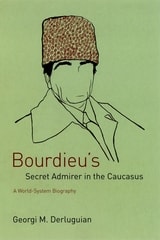
Bourdieu's Secret Admirer in the Caucasus
A World-System BiographyGeorgi M. Derluguian
University of Chicago Press, 2005
Exploring globalization, democratization, ethnic identity, and international terrorism, Derluguian contextualizes Shanib's personal trajectory from de-Stalinization through the nationalist rebellions of the 1990s, to the recent rise in Islamic militancy. He masterfully reveals not only how external economic and political forces affect the former Soviet republics but how those forces are in turn shaped by the individuals, institutions, ethnicities, and social networks that make up those societies. Drawing on the work of Charles Tilly, Immanuel Wallerstein, and, of course, Bourdieu, Derluguian's explanation of the recent ethnic wars and terrorist acts in Russia succeeds in illuminating the role of human agency in shaping history.
Bourdieu
Critical PerspectivesEdited by Craig Calhoun, Edward LiPuma, and Moishe Postone
University of Chicago Press, 1993
American reception of his works, however, has lacked a full understanding of their place within the broad context of French human science. His individual works separated by distinct boundaries between social science fields in American academia, Bourdieu's cohesive thought has come to this country in fragments.
Bourdieu: Critical Perspectives provides a unified and balanced appraisal of Bourdieu's varied works by both proponents and skeptics. The essays are written from the varied viewpoints of cultural anthropology, ethnomethodology and other varieties of sociology, existential and Wittgensteinian philosophies, linguistics, media studies, and feminism. They work around three main themes: Bourdieu's effort to transcend gaps between practical knowledge and universal structures, his central concept of "reflexivity," and the relations between social structure, systems of classification, and language.
Ultimately, the contributors raise a variety of crucial theoretical questions and address problems that are important not only to understanding Bourdieu but to advancing empirical work of the kind he has pioneered. In an essay written especially for this volume, Bourdieu describes his own "mode of intellectual production" and the reasons he sees for its common misunderstanding.
The contributors are Hubert Dreyfus, Paul Rabinow, Charles Taylor, Aaron Cicourel, James Collins, William Hanks, Beate Krais, Nicholas Garnham, Scott Lash, Roger Brubaker, and Loic Wacquant, and the editors.
Bourgeois Equality
How Ideas, Not Capital or Institutions, Enriched the WorldDeirdre Nansen McCloskey
University of Chicago Press, 2016
Why? Most economists—from Adam Smith and Karl Marx to Thomas Piketty—say the Great Enrichment since 1800 came from accumulated capital. McCloskey disagrees, fiercely. “Our riches,” she argues, “were made not by piling brick on brick, bank balance on bank balance, but by piling idea on idea.” Capital was necessary, but so was the presence of oxygen. It was ideas, not matter, that drove “trade-tested betterment.” Nor were institutions the drivers. The World Bank orthodoxy of “add institutions and stir” doesn’t work, and didn’t. McCloskey builds a powerful case for the initiating role of ideas—ideas for electric motors and free elections, of course, but more deeply the bizarre and liberal ideas of equal liberty and dignity for ordinary folk. Liberalism arose from theological and political revolutions in northwest Europe, yielding a unique respect for betterment and its practitioners, and upending ancient hierarchies. Commoners were encouraged to have a go, and the bourgeoisie took up the Bourgeois Deal, and we were all enriched.
Few economists or historians write like McCloskey—her ability to invest the facts of economic history with the urgency of a novel, or of a leading case at law, is unmatched. She summarizes modern economics and modern economic history with verve and lucidity, yet sees through to the really big scientific conclusion. Not matter, but ideas. Big books don’t come any more ambitious, or captivating, than Bourgeois Equality.
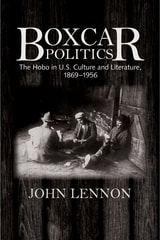
Boxcar Politics
The Hobo in U.S. Culture and Literature, 1869-1956John Lennon
University of Massachusetts Press, 2014
John Lennon maps the rise and demise of the political hobo from the nineteenth-century introduction of the transcontinental railroad to the Federal Aid Highway Act of 1956. Intertwining literary, historical, and theoretical representations of the hobo, he explores how riders and writers imagined alternative ways that working-class people could use mobility to create powerful dissenting voices outside of fixed hierarchal political organizations. Placing portrayals of hobos in the works of Jack London, Jim Tully, John Dos Passos, and Jack Kerouac alongside the lived reality of people hopping trains (including hobos of the IWW, the Scottsboro Boys, and those found in numerous long-forgotten memoirs), Lennon investigates how these marginalized individuals exerted collective political voices through subcultural practices.
Boxed In
The Culture of TVMark Crispin Miller
Northwestern University Press, 1988
Boxing the Kangaroo
A Reporter's MemoirRobert J. Donovan
University of Missouri Press, 2000
"The host had brought out a pair of boxing gloves and asked the president if any of his friends would like to indulge in the Australian sport of boxing kangaroos. Once the president of the United States had selected me, there was almost no way out, unless I ran home to tell my mother."
In Boxing the Kangaroo: A Reporter's Memoir, Robert J. Donovan shares many exciting events that highlighted his stellar journalistic career. As an investigative reporter during five presidential administrations, Donovan has had many "insider" experiences. His memoir delightfully humanizes each of the five presidents he reported on: Truman, Eisenhower, Kennedy, Johnson, and Nixon.
Donovan began his career working as a night copyboy for the Buffalo Courier-Express, earning seven dollars a week. In 1937, he got a job as a reporter for the New York Herald Tribune, where he worked for many years. By 1942 the Herald Tribune had assigned Donovan to cover City Hall and the lively activities of Fiorello La Guardia. After his service in World War II he returned to the Herald Tribune to cover the man from Missouri who followed FDR. Ultimately, Donovan served as chief of the New York Herald Tribune Washington bureau and the Los Angeles Times Washington bureau.
Donovan traveled across the country with Harry S. Truman during his "Give 'Em Hell, Harry" campaign. He covered Dwight D. Eisenhower's election, about which he says there was never a doubt--Ike, the war hero, mesmerized the country. He was a personal friend of John F. Kennedy, having written about the President's PT-109 heroics in World War II, and was on the scene the day Kennedy was assassinated: "The drama in the second press bus, in which I rode in the presidential motorcade in Dallas, is unforgettable. `Why has the motorcade stopped?' a reporter asked as we drew near the Texas School Book Depository. . . . `I heard a shot,' another said. A voice in the rear contradicted him. `That was a motorcycle backfiring.'" Donovan would find out shortly before the rest of the world that, in fact, it was not a motorcycle backfiring, but the firing of an assassin's bullet that killed the nation's thirty-fifth president.
Boxing the Kangaroo is one of the best "I was there" accounts of American history. This fascinating book will appeal to journalists, American history buffs, and the general reader alike.
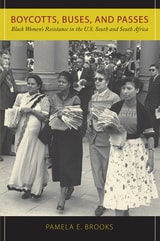
Boycotts, Buses, and Passes
Black Women's Resistance in the U.S. South and South AfricaPamela E. Brooks
University of Massachusetts Press, 2008
In the mid-1950s, as many developing nations sought independence from colonial rule, black women in the American South and in South Africa launched parallel campaigns to end racial injustice within their respective communities. Just as the dignified obstinacy of Mrs. Rosa Parks sparked the Montgomery bus boycott in 1955, the 20,000 South African women who marched in Pretoria a year later to protest the pass laws signaled a new wave of resistance to the system of apartheid. In both places women who had previously been consigned to subordinate roles brought fresh leadership to the struggle for political freedom and social equality.
In this book, Pamela E. Brooks tells their story, documenting the extraordinary achievements of otherwise ordinary women. In comparing the experiences of black women activists in two different parts of the African diaspora, Brooks draws heavily on oral histories that provide clear, and often painful, insight into their backgrounds, their motives, their hopes, and their fears. We learn how black women from all walks of life—domestic and factory workers, householders, teachers, union organizers, churchwomen, clubwomen, rural and urban dwellers alike—had to overcome their class differences and work through the often difficult gender relations within their families and communities. Yet eventually they came together to forge their own political organizations, such as the Women's Political Council and the Federation of South African Women, or joined orga-nizations of women and men, such as the Montgomery Improvement Association and the African National Congress, to advance the common agenda of black liberation.By tracing the dual rise of political consciousness and activism among the black women of the U.S. South and South Africa, Brooks not only illuminates patterns that have long been overlooked but places that shared history within the context of a larger global struggle to bring an end to the vestiges of European colonialism.
Boys Abducted
The Homoerotics of Empire and Race in Early ModernityAbdulhamit Arvas
Duke University Press, 2025
Boys From Grover Avenue
Ed Mcbain's 87th Precinct NovelsGeorge N. Dove
University of Wisconsin Press, 1985
Boystown
Sex and Community in ChicagoJason Orne
University of Chicago Press, 2017
In Boystown, Orne takes readers on a detailed, lively journey through Chicago’s Boystown, which serves as a model for gayborhoods around the country. The neighborhood, he argues, has become an entertainment district—a gay Disneyland—where people get lost in the magic of the night and where straight white women can “go on safari.” In their original form, though, gayborhoods like this one don’t celebrate differences; they create them. By fostering a space outside the mainstream, gay spaces allow people to develop an alternative culture—a queer culture that celebrates sex.
Orne spent three years doing fieldwork in Boystown, searching for ways to ask new questions about the connective power of sex and about what it means to be not just gay, but queer. The result is the striking Boystown, illustrated throughout with street photography by Dylan Stuckey. In the dark backrooms of raunchy clubs where bachelorettes wouldn’t dare tread, people are hooking up and forging “naked intimacy.” Orne is your tour guide to the real Boystown, then, where sex functions as a vital center and an antidote to assimilation.
Braided Worlds
Alma Gottlieb and Philip Graham
University of Chicago Press, 2012
Brain Culture
Neuroscience and Popular MediaDavi Johnson Thornton
Rutgers University Press, 2011
Brain Culture investigates the American obsession with the health of the brain. The brain has become more than a bodily organ, acquiring a near-mystical status. The message that this organ is the key to everything is everywhere--in self-help books that tell us to work on our brains to achieve happiness and enlightenment, in drug advertisements that promise a few tweaks to our brain chemistry will cure us of our discontents, and in politicians' speeches that tell us that our brains are national resources essential to our economic prosperity.
Davi Johnson Thornton looks at these familiar messages, tracing the ways that brain science and colorful brain images produced by novel scientific technologies are taken up and distributed in popular media. She tracks the impact of the message that, "you are your brain" across multiple contemporary contexts, analyzing its influence on child development, family life, education, and public policy. Brain Culture shows that our fixation on the brain is not simply a reaction to scientific progress, but a cultural phenomenon deeply tied to social and political values of individualism and limitless achievement.
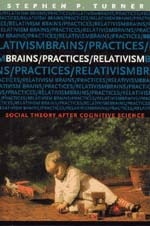
Brains/Practices/Relativism
Social Theory after Cognitive ScienceStephen Turner
University of Chicago Press, 2002
In a series of tightly argued essays, Turner traces out the implications that discarding the notion of shared frameworks has for relativism, social constructionism, normativity, and a number of other concepts. He suggests ways in which these ideas might be reformulated more productively, in part through extended critiques of the work of scholars such as Ian Hacking, Andrew Pickering, Pierre Bourdieu, Quentin Skinner, Robert Brandom, Clifford Geertz, and Edward Shils.
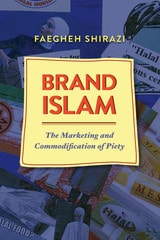
Brand Islam
The Marketing and Commodification of PietyBy Faegheh Shirazi
University of Texas Press, 2016
From food products to fashions and cosmetics to children’s toys, a wide range of commodities today are being marketed as “halal” (permitted, lawful) or “Islamic” to Muslim consumers both in the West and in Muslim-majority nations. However, many of these products are not authentically Islamic or halal, and their producers have not necessarily created them to honor religious practice or sentiment. Instead, most “halal” commodities are profit-driven, and they exploit the rise of a new Islamic economic paradigm, “Brand Islam,” as a clever marketing tool.
Brand Islam investigates the rise of this highly lucrative marketing strategy and the resulting growth in consumer loyalty to goods and services identified as Islamic. Faegheh Shirazi explores the reasons why consumers buy Islam-branded products, including conspicuous piety or a longing to identify with a larger Muslim community, especially for those Muslims who live in Western countries, and how this phenomenon is affecting the religious, cultural, and economic lives of Muslim consumers. She demonstrates that Brand Islam has actually enabled a new type of global networking, joining product and service sectors together in a huge conglomerate that some are referring to as the Interland. A timely and original contribution to Muslim cultural studies, Brand Islam reveals how and why the growth of consumerism, global communications, and the Westernization of many Islamic countries are all driving the commercialization of Islam.