Results by title
2728 books match the query 'Education' and 92 start with b

Black Street Speech
Its History, Structure, and SurvivalBy John Baugh
University of Texas Press, 1983
In the minds of many, black street speech—the urban dialect of black Americans—bespeaks illiteracy, poverty, and ignorance. John Baugh challenges those prejudices in this brilliant new inquiry into the history, linguistic structure, and survival within white society of black street speech. In doing so, he successfully integrates a scholarly respect for black English with a humanistic approach to language differences that weds rigor of research with a keen sense of social responsibility.
Baugh's is the first book on black English that is based on a long-term study of adult speakers. Beginning in 1972, black men and women in Los Angeles, Philadelphia, Chicago, Austin, and Houston were repeatedly interviewed, in varied social settings, in order to determine the nature of their linguistic styles and the social circumstances where subtle changes in their speech appear. Baugh's work uncovered a far wider breadth of speaking styles among black Americans than among standard English speakers. Having detailed his findings, he explores their serious implications for the employability and education of black Americans.
Black Street Speech is a work of enduring importance for educators, linguists, sociologists, scholars of black and urban studies, and all concerned with black English and its social consequences.
Black Students in the Ivory Tower
African American Student Activism at the University of Pennsylvania, 1967-1990Wayne C. Glasker
University of Massachusetts Press, 2002
Glasker begins his study in the late 1960s, when the university's expansion into a predominantly black Philadelphia neighborhood precipitated a massive sit-in and protest. In response, Penn accelerated the process of admitting more black students, doubling the number of black matriculants by September 1969. Many came from inner city public high schools with backgrounds, ideas, and interests far different from those of the affluent middle- and upper-class white students who constituted the majority of the undergraduate population. As a result, the next decade was marked by recurrent tension and conflict, as black students at Penn rejected assimilation and agitated successfully for the creation of a variety of institutions that recognized their needs. These included an Afro-American studies program, a residence for students interested in black culture, and a Black Student League. Following a 1978 sit-in, they won a demand for an Inter-cultural Center and formed the United Minorities Council, and in 1986 they joined with white activists to press the university to divest its holdings from companies doing business in South Africa.
Throughout the book Glasker interweaves two parallel stories: that of an Ivy League university wrestling with questions of diversity, compensatory education, and the meaning of merit and qualification; and that of black students grappling with issues of assimilation, separatism, and cultural pluralism. In the end, he argues, the students sought to preserve their own distinctive ethnic culture, identity, and heritage while pursuing economic upward mobility. Rather than separatism, they aspired to a form of biculturalism that involved economic empowerment without cultural assimilation.
Black Studies, Rap, and the Academy
Houston A. Baker Jr.
University of Chicago Press, 1993
Black Tech Ecosystems
How Black Adult Learners Use Computer Code Bootcamps for LiberationAntonio Byrd
University Press of Colorado, 2025
Black Tech Ecosystems reports on a year-long ethnographic study of low-income Black adult learners attending Clearwater Academy, a nonprofit computer code bootcamp that teaches coding literacy to help end racism and poverty. While Clearwater Academy offers pathways into a lucrative career that promotes Black social mobility and a diverse tech industry, Antonio Byrd describes a more complicated story. The core challenges of weak social-support networks, embedded cultures in tech, financial strains, and racism persistently present roadblocks to Clearwater Academy’s Black adult learners’ success. However, through this experience, Black adult learners develop new knowledge and frameworks that change their relationship with coding literacy and labor. Instead of solely focusing on learning computer programming for work, Black Tech Ecosystems describes a liberatory and transformative use of computer programming that centers Black lives instead of the tech industry.
Black and Smart
How Black High-Achieving Women Experience CollegeAdrianne Musu Davis
Rutgers University Press, 2023

Blacked Out
Dilemmas of Race, Identity, and Success at Capital HighSignithia Fordham
University of Chicago Press, 1996
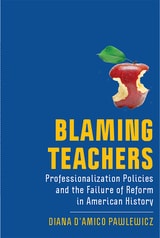
Blaming Teachers
Professionalization Policies and the Failure of Reform in American HistoryDiana D'Amico Pawlewicz
Rutgers University Press, 2020
Historically, Americans of all stripes have concurred that teachers were essential to the success of the public schools and nation. However, they have also concurred that public school teachers were to blame for the failures of the schools and identified professionalization as a panacea.
In Blaming Teachers, Diana D'Amico Pawlewicz reveals that historical professionalization reforms subverted public school teachers’ professional legitimacy. Superficially, professionalism connotes authority, expertise, and status. Professionalization for teachers never unfolded this way; rather, it was a policy process fueled by blame where others identified teachers’ shortcomings. Policymakers, school leaders, and others understood professionalization measures for teachers as efficient ways to bolster the growing bureaucratic order of the public schools through regulation and standardization. Beginning in the mid-nineteenth century with the rise of municipal public school systems and reaching into the 1980s, Blaming Teachers traces the history of professionalization policies and the discourses of blame that sustained them.
Blockchain Foundations
For the Internet of ValueMary C. Lacity
Epic Books, 2020
Blow Up the Humanities
Toby Miller
Temple University Press, 2012
A short, sharp, and provocative book, Blow Up the Humanities has esteemed scholar Toby Miller declaring that there are two humanities in the United States. One is the venerable, powerful humanities of private universities; the other is the humanities of state schools, which focus mainly on job prospects. There is a class division between the two—both in terms of faculty research and student background—and it must end.
Miller critically lays waste to the system. He examines scholarly publishing as well as media and cultural studies to show how to restructure the humanities by studying popular cultural phenomena, like video games. Miller ultimately insists that these two humanities must merge in order to survive and succeed in producing an aware and concerned citizenry.
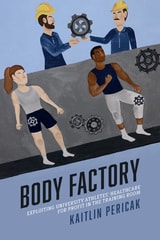
Body Factory
Exploiting University Athletes' Healthcare for Profit in the Training RoomKaitlin Pericak
Temple University Press, 2025
Body Factory enters an NCAA Division I athletic training room to examine the disconnect between what the NCAA states as its goal of athlete healthcare and what is actually happening. Kaitlin Pericak conducts observations in this space and interviews injured athletes and sports medicine staff members to show how institutional control over “best interests” often ends up exploiting the individual athlete. The influences at work are part of a neoliberal paradigm that explains why interest in an athlete’s care is greatly diminished once they are injured and can no longer play.
Body Factory considers how race, gender, and health before and after injury are deciding factors in these university training centers. The bureaucratic organization has a goal of maintaining power to generate profit, and Pericak shows this is almost always at the expense of the athlete.
Boo-Tickle Tales
Not-So-Scary Stories for Ages 4-9Lynette Ford & Sherry Norfolk
Parkhurst Brothers, Inc., 2016
The attraction of scary stories begins very early in childhood, but the fortitude to be truly scared comes later. So where are the scary stories for young children? Educators and storytellers, Ford and Norfolk deliver a silly and gently spooky collection of jumps, laughs, interactive moments, and mostly happy endings to satisfy the curious-for-creepy Pre-K through Grade 4 set. Their weirdly funny and gently scary collection of adapted folktales, original stories, and verses will delight those who enjoy being surprised more than being scared.
This book is for:
Parents, grandparents, and other mentors who work with children developmentally aged 4 to 9
Educators, librarians and others serving young listeners, who like silly and creepy stories, but may not like very scary material
Audiences ages 4-9, who like creepy but not-too-scary stories.
Twelve pen-and-ink drawings based on folktale motifs complement the fanciful tone of the book.
Boys and Girls
Superheroes in the Doll CornerVivian Gussin Paley
University of Chicago Press, 1984
"I will admit my biases up front: having a three-year old daughter of my own made it impossible for this book to be anything but fun to read. I dare anyone who enjoys children not to enjoy this story about stories, this narrative about narratives."—Jerry Powell, Winterthur Portfolio
Boys and Girls
Superheroes in the Doll CornerVivian Gussin Paley
University of Chicago Press, 2014
For more than forty years, Boys and Girls has a classic account of the little-known world that young children create together when they play. Vivian Gussin Paley takes readers inside a kindergarten classroom to show them in detail how boys and girls play—and how, by playing and fantasizing in different ways, they work through complicated notions of gender roles and identity. The children’s own conversations, stories, playacting, and scuffles are interwoven with Paley’s observations and accounts of her vain attempts to alter their stereotyped play. In the decades since the book's original publication, play in kindergarten and early years of school has lost ground to structured teaching and even testing, which makes Paley's book, updated for a new era, more important than ever. To teach kids successfully, we must make space for play.
Brave New Words
How Literature Will Save the PlanetAmmons, Elizabeth
University of Iowa Press, 2010
The activist tradition in American literature has long testified to the power of words to change people and the power of people to change the world, yet in recent years many professional humanists have chosen to distract themselves with a postmodern fundamentalism of indeterminacy and instability rather than engage with social and political issues. Throughout her bold and provocative call to action, Elizabeth Ammons argues that the responsibility now facing humanists is urgent: inside and outside academic settings, they need to revive the liberal arts as a progressive cultural force that offers workable ideas and inspiration in the real-world struggle to achieve social and environmental justice.
Brave New Words challenges present and future literary scholars and teachers to look beyond mere literary critique toward the concrete issue of social change and how to achieve it. Calling for a profound realignment of thought and spirit in the service of positive social change, Ammons argues for the continued importance of multiculturalism in the twenty-first century despite attacks on the concept from both right and left. Concentrating on activist U.S. writers—from ecocritics to feminists to those dedicated to exposing race and class biases, from Jim Wallis and Cornel West to Winona LaDuke and Paula Moya and many others—she calls for all humanists to link their work to the progressive literature of the last half century, to insist on activism in the service of positive change as part of their mission, and to teach the power of hope and action to their students.
As Ammons clearly demonstrates, much of American literature was written to expose injustice and motivate readers to work for social transformation. She challenges today’s academic humanists to address the issues of hope and purpose by creating a practical activist pedagogy that gives students the knowledge to connect their theoretical learning to the outside world. By relying on the transformative power of literature and replacing nihilism and powerlessness with conviction and faith, the liberal arts can offer practical, useful inspiration to everyone seeking to create a better world.
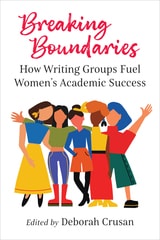
Breaking Boundaries
How Writing Groups Fuel Women's Academic SuccessEdited by Deborah Crusan
University of Michigan Press, 2026
Writing groups often fly under the radar in academia, but they can make a big difference. Faculty are under constant pressure to publish while juggling teaching, research, and service. Add packed schedules and limited time, and writing can easily get sidelined—especially for women balancing work and family. Breaking Boundaries: How Writing Groups Fuel Women’s Academic Success explores how writing groups offer support, structure, and community to help navigate these challenges.
Whether you’re a grad student trying to finish a dissertation, a stuck faculty member, or someone newly tenured wondering what’s next—you’re in the right place. This book shares honest stories, insights, and encouragement from women who have found strength in writing together. Each chapter highlights real experiences with writing groups—what helped, what didn’t, and how these groups shaped the authors’ scholarly identities. They discuss topics such as overcoming imposter syndrome, access to writing resources, navigating the stress of tenure, making academic contributions outside traditional paths, and creating sustainable writing habits. The contributors come from diverse disciplines and deliver practical advice for making writing fit into a hectic academic life. Their message is clear: when scholars support each other in writing, they not only grow their own careers, but also become mentors, leaders, and role models in the academic world.
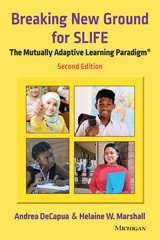
Breaking New Ground for SLIFE
The Mutually Adaptive Learning ParadigmAndrea DeCapua and Helaine W. Marshall
University of Michigan Press, 2023
In its second edition, Breaking New Ground for SLIFE builds on its model for supporting students who are new to English and may have experienced a disruption in their schooling. The practices presented in this book emerge from the belief that education for students with limited or interrupted formal education, also known as SLIFE, should not be remedial but should build on the students’ prior learning experiences and existing areas of knowledge. This second edition has been significantly updated, informed by recent research in the field, feedback from teachers, and new scholarly treatments of the topic. Breaking New Ground for SLIFE, second edition, explores the MALP approach, highlights how technology can be incorporated into classroom activities, and includes actual MALP projects implemented by MALP-trained teachers of both young and adolescent learners. In addition, the authors provide a newly revised MALP Teacher Planning Checklist.
By reading Breaking New Ground for SLIFE, educators will:
- Learn about the Mutually Adaptive Learning Paradigm (MALP) and how to integrate it into their classrooms
- Discover and learn about the MALP instructional approach and how to use it to develop a project-based curriculum using examples from teachers in the field

Breast Cancer in the Academy
Solidarity in the Fight for Our LivesWendy K.Z. Anderson
Rutgers University Press, 2027
This edited collection is an interdisciplinary dialogue about how breast cancer diagnosis, treatment, and healing is experienced by academic women. The contributors fostered dialogue rooted in critical, qualitative, and autoethnographic traditions about how breast cancer diagnosis, treatment, and healing was experienced by a group with academic privileges, such as the ability to research and advocate for themselves. The book takes on a global perspective, incorporating pieces from medical doctors who became patients, BIPOC women, as well as scholars who identify as LBGTQIA, as they faced decisions about issues such as flat closures, fertility treatments, and being one-sided. These seventeen academic women navigated and resisted healthcare systems to develop a theory of coalitional survivorship.
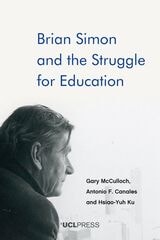
Brian Simon and the Struggle for Education
Gary McCulloch, Antonio Canales, and Hsiao-Yuh Ku
University College London, 2023
Using documentary sources that have only recently become publicly available, this book reveals the remarkably broad range of Brian Simon’s life as a student, soldier, schoolteacher, Communist Party activist, educational academic, campaigner, and reformer. In a sympathetic biography that retains critical distance, the authors analyze Simon’s contribution to Marxism and the Communist Party, explore the influence of both on his work as a historian of education, and trace the significance of his Marxist beliefs, political associations, and historical approaches to the cause of educational reform.
In so doing, they consider the full nature and limitations of Simon’s achievements in his struggle for education. Unlike many Marxist scholars, he remained loyal to the Communist Party in the 1950s, which damaged his reputation as a public intellectual. Nevertheless, his support for comprehensive education helped to promote egalitarian educational reforms in Britain, although he was later unable to provide sufficient resistance to the 1988 Education Reform Act and to a decline in the position of comprehensive schools.
In all this, the significance of Simon’s family, and especially his relationship with his wife Joan, is brought to the fore. Joan and Brian forged a formidable sixty-year partnership in politics and the Communist Party as well as in life, a partnership that lasted until Brian’s death in January 2002.
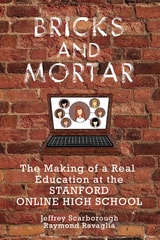
Bricks and Mortar
The Making of a Real Education at the Stanford Online High SchoolJeffrey Scarborough and Raymond Ravaglia
CSLI, 2014
This volume shows how a group of online-learning believers built the best high school in the world without laying a single brick: the Stanford Online High School (SOHS). By chronicling SOHS’s distinctive approach to curriculum, gifted education, and school community over SOHS’s first seven years, Bricks and Mortar makes the case that the dynamic use of technology and the best traditional methodologies in education are not, in fact, mutually exclusive. Indeed, while SOHS has redefined what is possible online, a great education is ultimately the product of an interactive community of teachers and students.

Bridges to Knowledge
Foreign Students in Comparative PerspectiveElinor G. Barber, Philip G. Altbach, and Robert G. Myers
University of Chicago Press, 1984
Bridging Benjamin
A Philosophy of Technology, Place, and EducationDominic Smith
University of Minnesota Press, 2026
Walter Benjamin reimagined through the forgotten power of radio
Philosopher and cultural critic Walter Benjamin (1892–1940) has long been recognized for his influence on the fields of literature, film, media studies, critical legal theory, and philosophy. Bringing fresh attention to an often-overlooked aspect of his oeuvre, Bridging Benjamin examines the dozens of radio broadcasts he produced, primarily for children, between 1927 and 1933. Delivered after the academic rejection of his notoriously complex Trauerspiel, these shows became a testing ground for Benjamin’s developing ideas and experimental pedagogy. Though they were cast off as inconsequential by both Benjamin and his contemporaries, Dominic Smith reveals the broadcasts to be a fruitful site for a novel, “derailed” interpretation of Benjamin’s larger body of work.
Reading Benjamin’s radio production as a dynamic site of philosophical experimentation, Smith uses it as a channel and amplifier for three integral but underappreciated aspects of Benjamin’s work: his philosophies of technology, place, and education. Showing how he used broadcast media to explore the increasing “virtualization” of place in networked society, Bridging Benjamin encourages an embrace of Benjamin in contrast to his divisive historical counterparts in the philosophy of technology, such as Martin Heidegger and Carl Schmitt.
Interpreting Benjamin’s broadcasts as a form of peripatetic thinking—deeply embedded in place, yet mobile and mediated—Bridging Benjamin offers a compelling model for reassessing attachments to the technologies and practices shaping our contemporary worlds.
Retail e-book files for this title are screen-reader friendly.
Bridging Liberalism and Multiculturalism in American Education
Rob Reich
University of Chicago Press, 2002
Linking political theory with educational history and policy, Rob Reich offers provocative new answers to these questions. He develops a liberal theory of multicultural education in which the leading goal is the cultivation of individual autonomy in children. Reich draws out the policy implications of his theory through one of the first sustained considerations of homeschooling in American education. He also evaluates three of the most prominent trends in contemporary school reform—vouchers, charter schools, and the small school movement—and provides pedagogical recommendations that sharply challenge the reigning wisdom of many multicultural educators.
Written in clear and accessible language, this book will be of interest to political theorists, philosophers, educators, educational policymakers, and teachers.
Bridging Scholarship and Activism
Reflections from the Frontlines of Collaborative ResearchBernd Reiter
Michigan State University Press, 2015
CONTENTS:
Introduction, Ulrich Oslender and Bernd Reiter
Part One. The Promises and Pitfalls of Collaborative Research
- Of Academic Embeddedness: Communities of Choice and How to Make Sense of Activism and Research Abroad, Bernd Reiter
- New Shapes of Revolution, Gustavo Esteva
- The Accidental Activist Scholar: A Memoir on Reactive Boundary and Identity Work for Social Change within the Academy, Rob Benford
- Leaving the Field: How to Write about Disappointment and Frustration in Collaborative Research, Ulrich Oslender
- Invisible Heroes, Eshe Lewis
- El Muntuen America, Manuel Zapata Olivella
- Activism as History Making: The Collective and the Personal in Collaborative Research with the Process of Black Communities in Colombia, Arturo Escobar
- Out of Bounds: Negotiating Researcher Positionality in Brazil, Elizabeth Hordge-Freeman
- Between Soapboxes and Shadows: Activism, Theory, and the Politics of Life and Death in Salvador, Bahia, Brazil, Christen A. Smith
- State Violence and the Ethnographic Encounter: Feminist Research and Racial Embodiment, Keisha-Khan Y. Perry
- The Challenges Resulting from Combining Scientific Production and Social-Political Activism in the Brazilian Academy, Fernando Conceição
- The Challenge of Doing Applied/Activist Anti-Racist Anthropology in Revolutionary Cuba, Gayle L. McGarrity
- Conclusion, Ulrich Oslender and Bernd Reiter
- About the Authors
Bridging the Gap
Perspectives on Nationally Competitive ScholarshipsSuzanne McCray
University of Arkansas Press, 2019
Bridging the Gaps
College Pathways to Career SuccessJames E. Rosenbaum
Russell Sage Foundation, 2017
The authors find that sub-baccalaureate credentials—associate degrees and college certificates—can improve employment outcomes. Young adults who complete these credentials have higher employment rates, earnings, autonomy, career opportunities, and job satisfaction than those who enroll but do not complete credentials. Sub-BA credentials can be completed at community college in less time than bachelor’s degrees, making them an affordable option for many low-income students.
Bridging the Gaps shows that when community colleges overemphasize bachelor’s degrees, they tend to funnel resources into remedial programs, and try to get low-performing students on track for a BA. Yet, remedial programs have inconsistent success rates and can create unrealistic expectations, leading struggling students to drop out before completing any degree. The authors show that colleges can devise procedures that reduce remedial placements and help students discover unseen abilities, attain valued credentials, get good jobs, and progress on degree ladders to higher credentials.
To turn college-for-all into a reality, community college students must be aware of their multiple credential and career options. Bridging the Gaps shows how colleges can create new pathways for non-traditional students to achieve success in their schooling and careers.
Bright College Years
Inside the American College TodayAnne Matthews
University of Chicago Press, 1998
"Matthews writes with sympathy and substantial understanding of the dilemmas colleges face these days."—Tara Fitzpatrick, Chicago Tribune
"A wide-ranging, well-written and lively account of contemporary academia."—Christian Wiman, Dallas Morning News
"Notable Book of the Year." New York Times
"An eye-opening, startling exposé;. . . . Matthews' energetic and well-written report provides a dismal yet concise insider portrait of college life."—Booklist
Bringing Montessori to America
S. S. McClure, Maria Montessori, and the Campaign to Publicize Montessori EducationGerald L. Gutek and Patricia A. Gutek
University of Alabama Press, 2016
2016 CHOICE OUTSTANDING ACADEMIC TITLE
The remarkable story of how Montessori education crossed the Atlantic and transformed American educational thought.
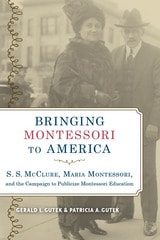
Born on the Adriatic, Montessori first entered the world stage in 1906 as the innovator of a revolutionary teaching method that creates an environment where children learn at their own pace and initiate skills like reading and writing in a spontaneous way. As her school in Rome swiftly attracted attention, curiosity, and followers, Montessori recruited disciples whom she immersed in a rigorous and detailed teacher-training regimen of her own creation.
McClure was an Irish-born media baron of America’s Gilded Age, best known as the founder and publisher of McClure’s Magazine. Against the backdrop of Theodore Roosevelt’s Bull Moose insurgency, the brilliant and mercurial McClure used his flagship publication as a vehicle to advance Progressive Party causes. After meeting in 1910, McClure and Montessori embarked on a five-year collaboration to introduce Montessori’s innovative teaching style in the United States.
Gerald and Patricia Gutek trace the dramatic arc of the partnership between the Italian teacher and American publisher united by a vision of educational change in the United States. After her triumphal lecture tour in 1913, Montessori, secure in her trust of her American partner, gave McClure her power of attorney and returned to Italy. The surge in popularity of Montessori education in America, however, deeply concerned Montessori, who had heretofore exerted total control over her method, apparatus, schools, and teacher training. The American entrepreneurial spirit, along with a desire to disseminate the Montessori method quickly, led to major conflicts between the Italian educator and American businesspeople, particularly McClure. Feeling betrayed, Montessori ended her relationship with her erstwhile collaborator.
Gutek and Gutek describe the fascinating story of this first wave of Montessori education in the United States, which did not sustain itself during Montessori’s lifetime. It would not be until the 1950s that Montessori education was revived with the successful establishment of Montessori academies throughout the United States.

Bringing Powerful Knowledge into Classrooms
Subject teachers as agents of recontextualisationEdited by Mark Hardman, Marie Nilsberth, and Mikko Puustinen
University College London, 2026
An empirically grounded, yet theoretically sound, study of how teachers bring powerful knowledge into classrooms and develop effective thinking among their students.
Powerful knowledge equips students with the capacity to engage with systematic, disciplinary thinking, to imagine futures that are not yet conceived, and to think what is yet to be thought. Bringing Powerful Knowledge into Classrooms explores how teachers develop such knowledge in classrooms by transforming disciplinary understandings through subject teaching that responds to the educational needs of society.
Drawing on sociologist Basil Bernstein’s concept of recontextualization and theories of teacher agency, this book examines how teachers navigate the boundaries between academic disciplines, school subjects, and everyday knowledge. Through empirical case studies from the UK, Finland, and Sweden, it illustrates how teachers’ decisions are shaped by national expectations, institutional frameworks, and classroom dynamics. Combining Anglophone and Nordic traditions in subject teaching with curriculum theory and classroom research, the book offers a theoretically grounded yet practical account of how teachers recontextualize knowledge. It develops new insights into teacher agency and recontextualization that are highly relevant to teacher education, curriculum design, and educational policy. By focusing on real-life teaching across a range of subjects, the book deepens our understanding of how powerful knowledge is brought into classrooms and how teachers can be supported in this vital work.
Broke
The Racial Consequences of Underfunding Public UniversitiesLaura T. Hamilton and Kelly Nielsen
University of Chicago Press, 2021
In Broke, Laura T. Hamilton and Kelly Nielsen examine virtually all aspects of campus life to show how the new economic order in public universities, particularly at two campuses in the renowned University of California system, affects students. For most of the twentieth century, they show, less affluent families of color paid with their taxes for wealthy white students to attend universities where their own offspring were not welcome. That changed as a subset of public research universities, some quite old, opted for a “new” approach, making racially and economically marginalized youth the lifeblood of the university. These new universities, however, have been particularly hard hit by austerity. To survive, they’ve had to adapt, finding new ways to secure funding and trim costs—but ultimately it’s their students who pay the price, in decreased services and inadequate infrastructure.
The rise of new universities is a reminder that a world-class education for all is possible. Broke shows us how far we are from that ideal and sets out a path for how we could get there.
Brotherhood University
Black Men's Friendships and the Transition to AdulthoodBrandon A. Jackson
Rutgers University Press, 2024
Brothers in Grief
The Hidden Toll of Gun Violence on Black Boys and Their SchoolsNora Gross
University of Chicago Press, 2024
JahSun, a dependable, much-loved senior at Boys’ Prep was just hitting his stride in the fall of 2017. He had finally earned a starting position on the varsity football team and was already weighing two college acceptances. Then, over Thanksgiving, tragedy struck. An altercation at his older sister’s home escalated into violence, killing the unarmed teenager in a hail of bullets. JahSun’s untimely death overwhelmed his entire community, sending his family, friends, and school into seemingly insurmountable grief. Worse yet, that spring two additional Boys’ Prep students would be shot to death in their neighborhood. JahSun and his peers are not alone in suffering the toll of gun violence, as every year in the United States teenagers die by gunfire in epidemic numbers, with Black boys most deeply affected.
Brothers in Grief closely attends to the neglected victims of youth gun violence: the suffering friends and classmates who must cope, mostly out of public view, with lasting grief and hidden anguish. Set at an ambitious urban high school for boys during the heartbreaking year following the death of JahSun, the book chronicles the consequences of untimely death on Black teen boys and on a school community struggling to recover. Sociologist Nora Gross tells the story of students attempting to grapple with unthinkable loss, inviting readers in to observe how they move through their days at school and on social media in the aftermath of their friends’ and classmates’ deaths. Gross highlights the discrepancy between their school’s educational mission and teachers’ and administrators’ fraught attempts to care for students’ emotional wellbeing. In the end, the school did not provide adequate space for grief, making it more difficult for students to heal, reengage with school, and imagine hopeful futures. Even so, supportive relationships deepened among students and formed across generations, offering promising examples of productive efforts to channel student grief into positive community change.
A searing testimony of our collective failure to understand the inner lives of our children in crisis, Brothers in Grief invites us all to wrestle with the hidden costs of gun violence on racial and educational inequity.

Building Bridges, Crossing Borders
One Young Deaf Woman’s EducationAnn Darby Getty
Gallaudet University Press, 2014
As soon as they realized that their daughter was deaf, Kyler’s parents, who were hearing, immediately began to learn sign language. They also engaged Darby, a parent/infant educator employed by the state school for the deaf, to work with Kyler. From the age of 13 months until Kyler’s college graduation 22 years later, Darby was involved in her education and development.
Despite living in a rural area, Kyler enjoyed an array of services, including parent/infant education, sign language interaction/modeling, speech and language therapy, and also a cochlear implant. At the same time that she developed her speech skills, sign language continued to be a critically important facet of her communication. In grade school, she learned with other deaf students, while in high school, she worked successfully in mainstream classrooms with interpreters and notetakers. As a college graduate, gifted artist, and veterinarian’s assistant today, Kyler exemplifies how a balanced approach to deaf education, using all resources at hand, can achieve remarkable results. Her story serves as a model for parents of other deaf children and the professionals who work with them.
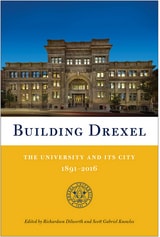
Building Drexel
The University and Its City 1891-2016Richardson Dilworth
Temple University Press, 2016
Published in conjunction with Drexel University’s 125th anniversary, Building Drexel chronicles the founding of the university by Anthony J. Drexel through to the present day. The editors and contributors create a prismatic discussion of the university and its evolution.
Richly illustrated chapters cover the architectural history of notable Drexel buildings; the role of Drexel in Philadelphia’s modern history; its Greek life; sports—particularly Drexel’s history in the Big 5; and each of the university’s schools and colleges. There is a history of the medical college and law school, plus the creation of new schools such as those of biomedical engineering, science and health systems.
Building Drexel also documents the civil rights history of Drexel and its urban planning history in relation to the racially diverse Powelton Village and Mantua neighborhoods it borders. This commemorative volume shows the development of the university both in the city and in the world.
Contributors include: Lloyd Ackert, Cordelia Frances Biddle, Paula Marantz Cohen, Donna Marie De Carolis, Roger Dennis, Gloria Donnelly, Kevin D. Egan, Alissa Falcone, David Fenske, John A. Fry, Stephen F. Gambescia, Marla J. Gold, Charles Haas, Kathy Harvatt, Daniel Johnson, Jeannine Keefer, Larry Keiser, Michael Kelley, Jason Ludwig, Jonson Miller, Julie Mostov, Danuta A. Nitecki, Anthony M. Noce, Steven J. Peitzman, David Raizman, Tiago Saraiva, Amy E. Slaton, Nathaniel Stanton, Virginia Theerman, Laura Valenti, James Wolfinger, Eric A. Zillmer, and the editors.
Building Internationalized Spaces
Second Language Perspectives on Developing Language and Cultural Exchange Programs in Higher EducationEdited by Matthew Allen, Estela Ene, and Kyle McIntosh
University of Michigan Press, 2022
This volume contributes to emerging interdisciplinary conversations in higher education about how to refine internationalization in terms of praxis and how to coordinate curricular and pedagogical efforts to achieve meaningful learning outcomes for all students. The chapters provide suggestions for how L2 specialists can reframe their work in their individual programs to help internationalize the entire university in ways that lead to improved learning outcomes for students at different points in their degree programs, including:
- Orientation programs (early arrival on campus, before classes start)
- Language Center contexts (support during studies)
- Volunteer programs for International Teaching Assistants (ITA) and undergraduate students
- Graduate-level writing support structures
- Instructional design (virtual learning spaces)
- Virtual Partner programs (co-curricular)
- Intercultural composition (placement, interdisciplinary collaborations)
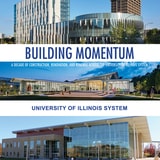
Building Momentum
A Decade of Construction, Renovation, and Renewal across the University of Illinois SystemUniversity of Illinois. Foreword by Timothy L. Killeen
University of Illinois Press, 2023
The University of Illinois System’s universities have undergone a dramatic transformation. This lavishly illustrated volume showcases the major capital projects and renovations dedicated to keeping facilities on the cutting edge while at the same time preserving history at the universities in Urbana-Champaign, Chicago, and Springfield. Fueled by an ambitious capital initiative launched in 2018, these essential and forward-looking changes include more than 500 projects valued at $4 billion over 10 years. The initiative harnesses a mix of innovative funding programs like public-private partnerships, thoughtful use of capital reserves and bonding authority, and generous state funding.
Covering completed and ongoing projects, Building Momentum offers a one- or two-page feature on each undertaking that covers its history and purpose while providing specific details about its unit, campus, architect, square footage or renovation size, budget, and LEED or other certifications. More than 100 architectural drawings and commissioned and historical photographs round out the descriptions.
Building Womanist Coalitions
Writing and Teaching in the Spirit of LoveEdited by Gary L. Lemons
University of Illinois Press, 2019

Building a Curriculum for General Education
A Description of the General College ProgramIvol Spafford
University of Minnesota Press, 1943
Building a Curriculum for General Education was first published in 1943. Minnesota Archive Editions uses digital technology to make long-unavailable books once again accessible, and are published unaltered from the original University of Minnesota Press editions.
Building a New Educational State
Foundations, Schools, and the American SouthJoan Malczewski
University of Chicago Press, 2016
Malczewski presents foundation leaders as self-conscious state builders and policy entrepreneurs who aimed to promote national ideals through a public system of education—efforts they believed were especially critical in the South. Black education was an important component of this national agenda. Through extensive efforts to create a more centralized and standard system of public education aimed at bringing isolated and rural black schools into the public system, schools became important places for expanding the capacity of state and local governance. Schooling provided opportunities to reorganize local communities and augment black agency in the process. When foundations realized they could not unilaterally impose their educational vision on the South, particularly in black communities, they began to collaborate with locals, thereby opening political opportunity in rural areas. Unfortunately, while foundations were effective at developing the institutional configurations necessary for education reform, they were less successful at implementing local programs consistently due to each state’s distinctive political and institutional context.
Bullying
The Social Destruction of SelfLaura Martocci
Temple University Press, 2015
Moving beyond the identification of aggressive behaviors to an analysis of how and why we have arrived at a culture that thrives on humiliation, she critiques the social forces that gave rise to, and help maintain, bullying. Martocci’s analysis of gossip, laughter, stereotyping, and competition—dynamics that foment bullying and prompt responses of shame, violence, and depression—is positioned within a larger social narrative: the means by which we negotiate damaged social bonds and the role that bystanders play in the possibility of atonement, forgiveness, and redemption.
Martocci’s fresh perspective on bullying positions shame as pivotal. She urges us to acknowledge the pain and confusion caused by social disgrace; to understand its social, psychological, and neurological nature; and to address it through narratives of loss, grief, and redemption—cultural supports that are already in place.
Burnin' Daylight
Building a Principle-Driven Writing ProgramRyan J. Dippre
Utah State University Press, 2024
WPAs face a range of challenges on a regular basis: organizing class schedules, leading professional learning events, conducting program assessments, responding to student needs, meeting with deans and provosts, and more. Additionally, WPAs need to learn about and direct their programs strategically when considering the kind of program they currently have, the sort of program they envision, and how they can transition from one to another. Burnin’ Daylight acts as a roadmap for IRB-approved research and provides WPAs—specifically, new and returning WPAs—with a detailed yet flexible plan for understanding the inner workings of a writing program and how to develop a future trajectory for it.
Burnin’ Daylight is for writing program administrators of all experience levels and other administrators interested in taking a “principled practices” approach to their work.
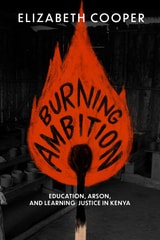
Burning Ambition
Education, Arson, and Learning Justice in KenyaElizabeth Cooper
University of Wisconsin Press, 2022
Drawing from years of research and a rich array of sources, Cooper accounts for how school fires stoke a national conversation about the limited means for ordinary Kenyans, and especially youth, to peacefully influence the governance of their own lives. Further, Cooper argues that Kenyan students’ actions challenge the existing complacency with the globalized agenda of “education for all,” demonstrating that submissive despondency is not the only possible response to the failed promises of education to transform material and social inequalities.

Buying In or Selling Out?
The Commercialization of the American Research UniversityStein, Donald G.
Rutgers University Press, 2004
Universities were once ivory towers where scholarship and teaching reigned supreme, or so we tell ourselves. Whether they were ever as pure as we think, it is certainly the case that they are pure no longer. Administrators look to patents as they seek money by commercializing faculty discoveries; they pour money into sports with the expectation that these spectacles will somehow bring in revenue; they sign contracts with soda and fast-food companies, legitimizing the dominance of a single brand on campus; and they charge for distance learning courses that they market widely. In this volume, edited by Donald G. Stein, university presidents and others in higher education leadership positions comment on the many connections between business and scholarship when intellectual property and learning is treated as a marketable commodity. Some contributors write about the benefits of these connections in providing much needed resources. Others emphasize that the thirst for profits may bias the type of research that is carried out and the quality of that research. They fear for the future of basic research if faculty are in search of immediate payoffs.
The majority of the contributors acknowledge that commercialization is the current reality and has progressed too far to return to the “good old days.” They propose guidelines for students and professors to govern commercial activities. Such guidelines can increase the likelihood that quality, openness, and collegiality will remain core academic values.