Results by title
1201 books match the query 'Race relations' and 96 start with b
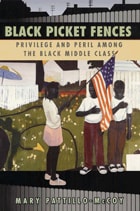
Black Picket Fences
Privilege and Peril among the Black Middle ClassMary Pattillo-McCoy
University of Chicago Press, 1999
"An insightful look at the socio-economic experiences of the black middle class. . . . Through the prism of a South Side Chicago neighborhood, the author shows the distinctly different reality middle-class blacks face as opposed to middle-class whites." —Ebony
"A detailed and well-written account of one neighborhood's struggle to remain a haven of stability and prosperity in the midst of the cyclone that is the American economy." —Emerge
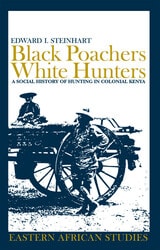
Black Poachers, White Hunters
A Social History of Hunting in Colonial KenyaEdward I. Steinhart
Ohio University Press, 2006
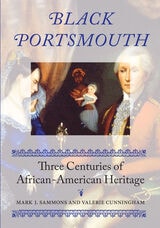
Black Portsmouth
Three Centuries of African-American HeritageMark J. Sammons
University of New Hampshire Press, 2004
Few people think of a rich Black heritage when they think of New England. In the pioneering book Black Portsmouth, Mark J. Sammons and Valerie Cunningham celebrate it, guiding the reader through more than three centuries of New England and Portsmouth social, political, economic, and cultural history as well as scores of personal and site-specific stories.
Here, we meet such Africans as the likely negro boys and girls from Gambia, who debarked at Portsmouth from a slave ship in 1758, and Prince Whipple, who fought in the American Revolution. We learn about their descendants, including the performer Richard Potter and John Tate of the People's Baptist Church, who overcame the tragedies and challenges of their ancestors' enslavement and subsequent marginalization to build communities and families, found institutions, and contribute to their city, region, state, and nation in many capacities. Individual entries speak to broader issues—the anti-slavery movement, American religion, and foodways, for example. We also learn about the extant historical sites important to Black Portsmouth—including the surprise revelation of an African burial ground in October 2003—as well as the extraordinary efforts being made to preserve remnants of the city's early Black heritage.
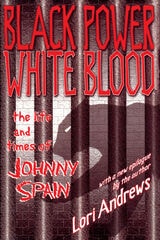
Black Power White Blood
Lori Andrews
Temple University Press, 1999
At six years old, already the target of name-calling children and threatening adults, he could not attend school with his older brother. Only decades later would he be told why the Armstrongs sent him to live with a black family in Los Angeles. As Johnny came of age, he thought of himself as having been rejected by his white family as well as by his black peers. His erratic, destructive behavior put him on a collision course with the penal system; he was only seventeen when convicted of murder and sent to Soledad.
Drawn into the black power movement and the Black Panther Party by fellow inmate, the charismatic George Jackson, Spain became a dynamic force for uniting prisoners once divided by racial hatred. He committed himself to the cause of prisoners' rights, impressing inmates, prison officials, and politicians with his intelligence and passion. Nevertheless, among the San Quentin Six, only he was convicted of conspiracy after Jackson's failed escape attempt.
Lori Andrews, a professor of law, vividly portrays the dehumanizing conditions in the prisons, the pervasive abuses in the criminal justice system, and the case for overturning Spain's conspiracy conviction. Spain's personal transformation is the heart of the book, but Andrews frames it within an indictment of intolerance and injustice that gives this individual's story broad significance.
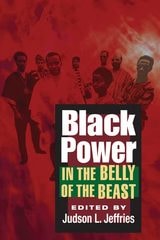
Black Power in the Belly of the Beast
Edited by Judson L. Jeffries
University of Illinois Press, 2006
The volume’s twelve contributors include well-known scholars such as James A. Geschwender and Douglas Glasgow as well as prominent community activists Akbar Muhammad Ahmad, Floyd W. Hayes III, and Komozi Woodard. Each of their chapters explores a single Black Power organization including Us, the Black Panther Party, and the Deacons for Defense and Justice. Important but lesser-known Black Power organizations such as the Republic of New Afrika and Sons of Watts are paid equal attention, as contributors address issues including self-defense, Black identity, and the politics of class and gender. Throughout, authors emphasize the primary role that Black institutions and charismatic leaders played in the rise, development, and eventual decline of the overall movement.
Black Power, Jewish Politics
Reinventing the Alliance in the 1960sMarc Dollinger
Brandeis University Press, 2018
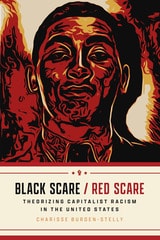
Black Scare / Red Scare
Theorizing Capitalist Racism in the United StatesCharisse Burden-Stelly
University of Chicago Press, 2023
In the early twentieth century, two panics emerged in the United States. The Black Scare was rooted in white Americans’ fear of Black Nationalism and dread at what social, economic, and political equality of Black people might entail. The Red Scare, sparked by communist uprisings abroad and subversion at home, established anticapitalism as a force capable of infiltrating and disrupting the American order. In Black Scare / Red Scare, Charisse Burden-Stelly meticulously outlines the conjoined nature of these state-sanctioned panics, revealing how they unfolded together as the United States pursued capitalist domination. Antiradical repression, she shows, is inseparable from anti-Black oppression, and vice versa.
Beginning her account in 1917—the year of the Bolshevik Revolution, the East St. Louis Race Riot, and the Espionage Act—Burden-Stelly traces the long duration of these intertwined and mutually reinforcing phenomena. She theorizes two bases of the Black Scare / Red Scare: US Capitalist Racist Society, a racially hierarchical political economy built on exploitative labor relationships, and Wall Street Imperialism, the violent processes by which businesses and the US government structured domestic and foreign policies to consolidate capital and racial domination. In opposition, Radical Blackness embodied the government’s fear of both Black insurrection and Red instigation. The state’s actions and rhetoric therefore characterized Black anticapitalists as foreign, alien, and undesirable. This reactionary response led to an ideology that Burden-Stelly calls True Americanism, the belief that the best things about America were absolutely not Red and not Black, which were interchangeable threats.
Black Scare / Red Scare illuminates the anticommunist nature of the US and its governance, but also shines a light on a misunderstood tradition of struggle for Black liberation. Burden-Stelly highlights the Black anticapitalist organizers working within and alongside the international communist movement and analyzes the ways the Black Scare/Red Scare reverberates through ongoing suppression of Black radical activism today. Drawing on a range of administrative, legal, and archival sources, Burden-Stelly incorporates emancipatory ideas from several disciplines to uncover novel insights into Black political minorities and their legacy.
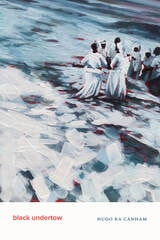
Black Undertow
Hugo ka Canham
Duke University Press, 2026
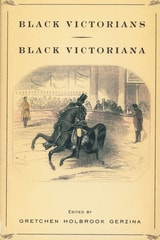
Black Victorians / Black Victoriana
Edited by Gretchen Holbrook Gerzina
Rutgers University Press, 2003
The essays taken as a whole also highlight prevailing Victorian attitudes toward race by focusing on the ways in which empire building spawned a "subculture of blackness" consisting of caricature, exhibition, representation, and scientific racism absorbed by society at large. This misrepresentation made it difficult to be both black and British while at the same time it helped to construct British identity as a whole. Covering many topics that detail the life of blacks during this period, Black Victorians/Black Victoriana will be a landmark contribution to the emergent field of black history in England.
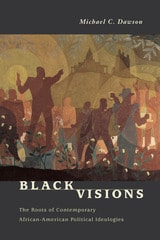
Black Visions
The Roots of Contemporary African-American Political IdeologiesMichael C. Dawson
University of Chicago Press, 2001

Black and Green
The Fight For Civil Rights in Northern Ireland & Black AmericaBrian Dooley
Pluto Press, 1998
'Focusing on the period from the 1960s onward, Brian Dooley suggests that the black rights struggle in the US had a formative influence on Northern Ireland's civil rights movement which adopted similar tactics of protest marches and sit-ins ... A well researched book, written from an unusual angle that illuminates this understudied international influence on the Ulster conflict' Political Studies
Ties between political activists in Black America and Ireland span several centuries, from the days of the slave trade to the close links between Frederick Douglass and Daniel O’Connell, and between Marcus Garvey and Eamon de Valera. This timely book traces those historic links and examines how the struggle for black civil rights in America in the 1960s helped shape the campaign against discrimination in Northern Ireland. The author includes interviews with key figures such as Angela Davis, Bernadette McAliskey and Eamonn McCann.

Black and Indigenous
Garifuna Activism and Consumer Culture in HondurasMark Anderson
University of Minnesota Press, 2009
Garifuna live in Central America, primarily Honduras, and the United States. Identified as Black by others and by themselves, they also claim indigenous status and rights in Latin America. Examining this set of paradoxes, Mark Anderson shows how, on the one hand, Garifuna embrace discourses of tradition, roots, and a paradigm of ethnic political struggle. On the other hand, Garifuna often affirm blackness through assertions of African roots and affiliations with Blacks elsewhere, drawing particularly on popular images of U.S. blackness embodied by hip-hop music and culture.
Black and Indigenous explores the politics of race and culture among Garifuna in Honduras as a window into the active relations among multiculturalism, consumption, and neoliberalism in the Americas. Based on ethnographic work, Anderson questions perspectives that view indigeneity and blackness, nativist attachments and diasporic affiliations, as mutually exclusive paradigms of representation, being, and belonging.
As Anderson reveals, within contemporary struggles of race, ethnicity, and culture, indigeneity serves as a normative model for collective rights, while blackness confers a status of subaltern cosmopolitanism. Indigeneity and blackness, he concludes, operate as unstable, often ambivalent, and sometimes overlapping modes through which people both represent themselves and negotiate oppression.
Black and White Styles in Conflict
Thomas Kochman
University of Chicago Press, 1981
Black into White
Race and Nationality in Brazilian ThoughtThomas E. Skidmore
Duke University Press, 1993
Black on the Block
The Politics of Race and Class in the CityMary Pattillo
University of Chicago Press, 2007
“To see how diversity creates strange and sometimes awkward bedfellows . . . turn to Mary Pattillo's Black on the Block.”—Boston Globe
Black or Right
Anti/Racist Campus RhetoricsLouis M. Maraj
Utah State University Press, 2020
Offering four Black rhetorics as antiracist means for rhetorical reclamation—autoethnography, hashtagging, inter(con)textual reading, and reconceptualized disruption—the book uses Black feminist relationality via an African indigenous approach. Maraj examines fluid, quotidian ways Black folk engage anti/racism at historically white institutions in the United States in response to violent campus spaces, educational structures, protest movements, and policy practice. Black or Right’s experimental, creative style strives to undiscipline knowledge from academic confinement. Exercising different vantage points in each chapter—autoethnographer, digital media scholar/pedagogue, cultural rhetorician, and critical discourse analyst—Maraj challenges readers to ecologically understand shifting, multiple meanings of Blackness in knowledge-making. Black or Right’s expressive form, organization, narratives, and poetics intimately interweave with its argument that Black folk must continuously invent “otherwise” in reiterative escape from oppressive white spaces.
In centering Black experiences, Black theory, and diasporic Blackness, Black or Right mobilizes generative approaches to destabilizing institutional whiteness, as opposed to reparative attempts to “fix racism,” which often paradoxically center whiteness. It will be of interest to both academic and general readers and significant for specialists in cultural rhetorics, Black studies, and critical theory.
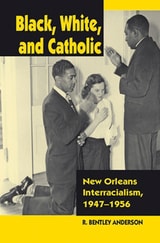
Black, White, and Catholic
New Orleans Interracialism, 1947-1956R. Bentley Anderson
Vanderbilt University Press, 2005
Anderson leads readers through the tumultuous years just after World War II when the Roman Catholic Church in the American South struggled to reconcile its commitment to social justice with the legal and social heritage of Jim Crow society. Though these early efforts at reform, by and large, failed, they did serve to galvanize Catholic supporters and opponents of the Civil Rights Movement and provided a model for more successful efforts at desegregation in the '60s.
As a Jesuit himself, Anderson has access to archives that remain off-limits to other scholars. His deep knowledge of the history of the Catholic Church also allows him to draw connections between this historical period and the present. In the resistance to desegregation, Anderson finds expression of a distinctly American form of Catholicism, in which lay people expect Church authorities to ratify their ideas and beliefs in an almost democratic fashion. The conflict he describes is as much between popular and hierarchical models of the Church as between segregation and integration.
This book has been made possible through a grant from the Louisiana Endowment for the Humanities, a state affiliate of the National Endowment for the Humanities.
Blackhood Against the Police Power
Punishment and Disavowal in the "Post-Racial" EraTryon P. Woods
Michigan State University Press, 2019
Blacks and Blackness in Central America
Between Race and PlaceLowell Gudmundson and Justin Wolfe, eds.
Duke University Press, 2010
Contributors. Rina Cáceres Gómez, Lowell Gudmundson, Ronald Harpelle, Juliet Hooker, Catherine Komisaruk, Russell Lohse, Paul Lokken, Mauricio Meléndez Obando, Karl H. Offen, Lara Putnam, Justin Wolfe
Blacks and Whites in Sao Paulo, Brazil, 1888-1988
George Reid Andrews
University of Wisconsin Press, 1991
For much of the twentieth century Brazil enjoyed an international reputation as a “racial democracy,” but that image has been largely undermined in recent decades by research suggesting the existence of widespread racial inequality. George Reid Andrews provides the first thoroughly documented history of Brazilian racial inequality from the abolition of slavery in 1888 up to the late 1980s, showing how economic, social, and political changes in Brazil during the last one hundred years have shaped race relations.
No laws of segregation or apartheid exist in Brazil, but by looking carefully at government policies, data on employment, mainstream and Afro-Brazilian newspapers, and a variety of other sources, Andrews traces pervasive discrimination against Afro-Brazilians over time. He draws his evidence from the country’s largest and most economically important state, São Paulo, showing how race relations were affected by its transformation from a plantation-based economy to South America’s most urban, industrialized society.
The book focuses first on Afro-Brazilians' entry into the agricultural and urban working class after the abolition of slavery. This transition, Andrews argues, was seriously hampered by state policies giving the many European immigrants of the period preference over black workers. As immigration declined and these policies were overturned in the late 1920s, black laborers began to be employed in agriculture and industry on nearly equal terms with whites. Andrews then surveys efforts of blacks to move into the middle class during the 1900s. He finds that informal racial solidarity among middle-class whites has tended to exclude Afro-Brazilians from the professions and other white-collar jobs.
Andrews traces how discrimination throughout the century led Afro-Brazilians to mobilize, first through the antislavery movement of the 1880s, then through such social and political organizations of the 1920s and 1930s as the Brazilian Black Front, and finally through the anti-racism movements of the 1970s and 1980s. These recent movements have provoked much debate among Brazilians over their national image as a racial democracy. It remains to be seen, Andrews concludes, whether that debate will result in increased opportunities for black Brazilians.
Winner of the 1993 Arthur P. Whitaker Prize
Blacks in Colonial Veracruz
Race, Ethnicity, and Regional DevelopmentBy Patrick J. Carroll
University of Texas Press, 1991
Beginning with the Spanish conquest, Mexico has become a racially complex society intermixing Indian, Spanish, and African populations. Questions of race and ethnicity have fueled much political and scholarly debate, sometimes obscuring the experiences of particular groups, especially blacks. Blacks in Colonial Veracruz seeks to remedy this omission by studying the black experience in central Veracruz during virtually the entire colonial period.
The book probes the conditions that shaped the lives of inhabitants in Veracruz from the first European contact through the early formative period, colonial years, independence era, and the postindependence decade. While the primary focus is on blacks, Carroll relates their experience to that of Indians, Spaniards, and castas (racially hybrid people) to present a full picture of the interplay between local populations, the physical setting, and technological advances in the development of this important but little-studied region.
Blacks on the Border
The Black Refugees in British North America, 1815–1860Harvey Whitfield
University Press of New England, 2006

Blacks, Coloureds and National Identity in Nineteenth-century Latin America
Edited by Nancy Priscilla Naro
University of London Press, 2003
Blacks, Reds, and Russians
Sojourners in Search of the Soviet PromiseJoy Gleason Carew
Rutgers University Press, 2010
In Blacks, Reds, and Russians, Joy Gleason Carew offers insight into the political strategies that often underlie relationships between different peoples and countries. She draws on the autobiographies of key sojourners, including Harry Haywood and Robert Robinson, in addition to the writings of Claude McKay, W.E.B. Du Bois, and Langston Hughes. Interviews with the descendents of figures such as Paul Robeson and Oliver Golden offer rare personal insights into the story of a group of emigrants who, confronted by the daunting challenges of making a life for themselves in a racist United States, found unprecedented opportunities in communist Russia.
Blaming the Poor
The Long Shadow of the Moynihan Report on Cruel Images about PovertyGreenbaum, Susan D
Rutgers University Press, 2015
Block by Block
Neighborhoods and Public Policy on Chicago's West SideAmanda I. Seligman
University of Chicago Press, 2005
Seligman's study reveals that the responses of white West Siders to racial changes occurring in their neighborhoods were both multifaceted and extensive. She shows that, despite rehabilitation efforts, deterioration in these areas began long before the color of their inhabitants changed from white to black. And ultimately, the riots that erupted on Chicago's West Side and across the country in the mid-1960s stemmed not only from the tribulations specific to blacks in urban centers but also from the legacy of accumulated neglect after decades of white occupancy. Seligman's careful and evenhanded account will be essential to understanding that the "flight" of whites to the suburbs was the eventual result of a series of responses to transformations in Chicago's physical and social landscape, occurring one block at a time.
Blood in Their Eyes
The Elaine Massacre of 1919Grif Stockley
University of Arkansas Press, 2020
The first edition of Grif Stockley’s Blood in Their Eyes, published in 2001, brought renewed attention to the Elaine Massacre and sparked valuable new studies on racial violence and exploitation in Arkansas and beyond. With contributions from fellow historians Brian K. Mitchell and Guy Lancaster, this revised edition draws from recently uncovered source material and explores in greater detail the actions of the mob, the lives of those who survived the massacre, and the regime of fear and terror that prevailed under Jim Crow.
Blue Jenkins
Working for WorkersJulia Pferdehirt
Wisconsin Historical Society Press, 2011

Blues in the Blood
Julien Delmaire
Seagull Books, 2023
Blues in the Blood is an ode to the spring of 1932 in the Mississippi delta, when stifling heat crushed the countryside and threatened the harvest, pervasive injustice ruled the day, and ghostly riders of the Ku Klux Klan spread terror. A panoramic historical and musical portrait, Blues in the Blood follows a poor young Black couple who believe their love for each other will save them from this devastation. Julien Delmaire introduces us to a gallery of figures: Blacks, Whites, Native Americans, mulattos, landowners, itinerant bluesmen, preachers, witches, corrupt politicians, prisoners, bootleggers, and Legba, the voodoo god, “master of crossroads,” who, like an otherworldly detective, watches over people’s destinies. As the story unfolds, a world is reborn: the delta, the birthplace of the blues, in which oppressed women and men rediscover the voices and rhythms of their humanity.
Bones on the Ground
Elizabeth O'Maley
Indiana Historical Society Press, 2014
Borderland on the Isthmus
Race, Culture, and the Struggle for the Canal ZoneMichael E. Donoghue
Duke University Press, 2014
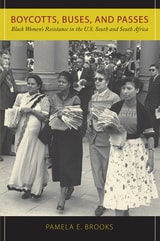
Boycotts, Buses, and Passes
Black Women's Resistance in the U.S. South and South AfricaPamela E. Brooks
University of Massachusetts Press, 2008
In the mid-1950s, as many developing nations sought independence from colonial rule, black women in the American South and in South Africa launched parallel campaigns to end racial injustice within their respective communities. Just as the dignified obstinacy of Mrs. Rosa Parks sparked the Montgomery bus boycott in 1955, the 20,000 South African women who marched in Pretoria a year later to protest the pass laws signaled a new wave of resistance to the system of apartheid. In both places women who had previously been consigned to subordinate roles brought fresh leadership to the struggle for political freedom and social equality.
In this book, Pamela E. Brooks tells their story, documenting the extraordinary achievements of otherwise ordinary women. In comparing the experiences of black women activists in two different parts of the African diaspora, Brooks draws heavily on oral histories that provide clear, and often painful, insight into their backgrounds, their motives, their hopes, and their fears. We learn how black women from all walks of life—domestic and factory workers, householders, teachers, union organizers, churchwomen, clubwomen, rural and urban dwellers alike—had to overcome their class differences and work through the often difficult gender relations within their families and communities. Yet eventually they came together to forge their own political organizations, such as the Women's Political Council and the Federation of South African Women, or joined orga-nizations of women and men, such as the Montgomery Improvement Association and the African National Congress, to advance the common agenda of black liberation.By tracing the dual rise of political consciousness and activism among the black women of the U.S. South and South Africa, Brooks not only illuminates patterns that have long been overlooked but places that shared history within the context of a larger global struggle to bring an end to the vestiges of European colonialism.
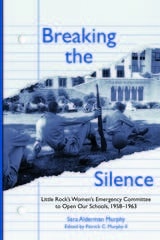
Breaking the Silence
The Little Rock Women's Emergency Committee to Open Our Schools, 1958–1963Sara Murphy
University of Arkansas Press, 1997
The Little Rock Central High School integration crisis did not end in1957 when President Eisenhower sent a portion of the first Airborne Division to protect nine black students. The turmoil was entering its second year in 1958 when Arkansas governor Orval Faubus invoked a hastily passed state law to close the high schools rather than obey the federal court orders that would integrate them.
A group of respectable, middle-class white women, faced with the prospect of no schools as well as the further loss of their city’s good name, turned militant. Led by Adolphine Fletcher Terry, a prominent, “old family” civic leader in her seventies, the women quickly put together the Women’s Emergency Committee to Open Our Schools (WEC), a highly effective organization that bombarded the city with ads, fliers, and statements challenging Faubus’s action. At peak membership, the WEC mustered two thousand to their cause. Largely inexperienced in politics when they joined the WEC, these women became articulate, confident promoters of public schools and helped others to understand that those schools must be fully integrated.
Forty years later, Sara Murphy, a key member of the WEC, recounts the rarely told sto1y of these courageous women who formed a resistance movement. With passion and sensitivity, she reconstructs the challenges and triumphs of that battle, which issued from the mutual link Southern white women shared with disfranchised African Americans in their common goal for full citizenship.
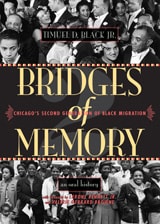
Bridges of Memory Volume 2
Chicago's Second Generation of Black MigrationTimuel Black
Northwestern University Press, 2008
In the second volume of Bridges of Memory, historian Timuel D. Black Jr. continues his conversations with African-Americans who migrated to Chicago from the South in search of economic, social, and cultural opportunities. With his trademark gift for interviewing, Black-himself the son of first-generation migrants to Chicago-guides these individual discussions with ease, resulting in first-person narratives that are informative and entertaining.
Picking up where the first book left off, volume 2 introduces the reader to more members of the first wave of migration and also members of the second generation, the children of those who came in the first wave. In telling their stories, the interviewees paint a vivid picture of the thriving and tight-knit Chicago community formerly known as the Black Belt—today's historic Bronzeville neighborhood. They bring to life the role of family, religion, business, music, and, most of all, the hopes, dreams, and perseverance that enabled a group of people to establish a successful community within a larger society that seemed determined to keep them from success. The experiences of these diverse and vivid personalities often illustrate the role that racial prejudice has played in shaping the specific arcs of their lives. But personal histories such as these are not just chronicles of frustration and despair; more important these narratives reveal an unwavering dedication to breaking the color line and a tireless pursuit of their right to the promise of America.
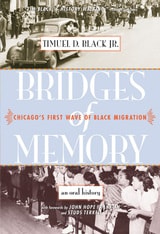
Bridges of Memory
Chicago's First Wave of Black MigrationTimuel D. Black Jr.
Northwestern University Press, 2005
Co-published with the DuSable Museum of African American History
Recipient of 2007 The Hyde Park Historical Society Paul Cornell Award
A collection of interviews with African Americans who came to Chicago from the South. In their first great migration to Chicago that began during World War I, African Americans came from the South seeking a better life--and fleeing a Jim Crow system of racial prejudice, discrimination, and segregation. What they found was much less than what they'd hoped for, but it was much better than what they'd come from--and in the process they set in motion vast changes not only in Chicago but also in the whole fabric of American society. This book, the first of three volumes, revisits this momentous chapter in American history with those who lived it.
Oral history of the first order, Bridges of Memory lets us hear the voices of those who left social, political, and economic oppression for political freedom and opportunity such as they'd never known--and for new forms of prejudice and segregation. These children and grandchildren of ex-slaves found work in the stockyards and steel mills of Chicago, settled and started small businesses in the "Black Belt" on the South Side, and brought forth the jazz, blues, and gospel music that the city is now known for. Historian Timuel D. Black, Jr., himself the son of first-generation migrants to Chicago, interviews a wide cross-section of African Americans whose remarks and reflections touch on issues ranging from fascism to Jim Crow segregation to the origin of the blues. Their recollections comprise a vivid record of a neighborhood, a city, a society, and a people undergoing dramatic and unprecedented changes.
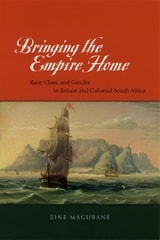
Bringing the Empire Home
Race, Class, and Gender in Britain and Colonial South AfricaZine Magubane
University of Chicago Press, 2003
Bringing the Empire Home tracks colonial images of blackness from South Africa to England and back again to answer questions such as these. Before the mid-1800s, black Africans were considered savage to the extent that their plight mirrored England's internal Others—women, the poor, and the Irish. By the 1900s, England's minority groups were being defined in relation to stereotypes of black South Africans. These stereotypes, in turn, were used to justify both new capitalist class and gender hierarchies in England and the subhuman treatment of blacks in South Africa. Bearing this in mind, Zine Magubane considers how marginalized groups in both countries responded to these racialized representations.
Revealing the often overlooked links among ideologies of race, class, and gender, Bringing the Empire Home demonstrates how much black Africans taught the English about what it meant to be white, poor, or female.
Broken Brotherhood
The Rise and Fall of the National Afro-American CouncilBenjamin R. Justesen
Southern Illinois University Press, 2008
Broken Brotherhood: The Rise and Fall of the National Afro-American Council gives a comprehensive account of the National Afro-American Council, the first truly nationwide U.S. civil rights organization, which existed from 1898 to 1908. Based on exhaustive research, the volume chronicles the Council’s achievements and its annual meetings and provides portraits of its key leaders.
Led by four of the most notable African American leaders of the time—journalist T. Thomas Fortune, Bishop Alexander Walters, educator Booker T. Washington, and Congressman George Henry White—the Council persevered for a decade despite structural flaws and external pressures that eventually led to its demise in 1908.
Author Benjamin R. Justesen provides historical context for the Council’s development during an era of unprecedented growth in African American organizations. Justesen establishes the National Afro-American Council as the earliest national arena for discussions of critical social and political issues affecting African Americans and the single most important united voice lobbying for protection of the nation’s largest minority. In a period marked by racial segregation, widespread disfranchisement, and lynching violence, the nonpartisan council helped establish two more enduring successor organizations, providing core leadership for both the National Association for the Advancement of Colored People and the National Urban League.
Broken Brotherhood traces the history of the Council and the complicated relationships among key leaders from its creation in Rochester in 1898 to its last gathering in Baltimore in 1907, drawing on both private correspondence and contemporary journalism to create a balanced historical portrait. Enhanced by thirteen illustrations, the volume also provides intriguing details about the ten national gatherings, describes the Council’s unsuccessful attempt to challenge disfranchisement before the U.S. Supreme Court, and sheds light on the gradual breakdown of Republican solidarity among African American leaders in the first decade of the twentieth century.
Brother Bill
President Clinton and the Politics of Race and ClassDaryl A Carter
University of Arkansas Press, 2016
“This book is a fascinating analysis of race and class in the age of President Bill Clinton. It provides much-needed clarity in regards to the myth of the ‘First Black President.’ It contributes much to our understanding of the history that informs our present moment!”
—Cornel West
As President Barack Obama was sworn into office on January 20, 2009, the United States was abuzz with talk of the first African American president. At this historic moment, one man standing on the inaugural platform, seemingly a relic of the past, had actually been called by the moniker the “first black president” for years.
President William Jefferson Clinton had long enjoyed the support of African Americans during his political career, but the man from Hope also had a complex and tenuous relationship with this faction of his political base. Clinton stood at the nexus of intense political battles between conservatives’ demands for a return to the past and African Americans’ demands for change and fuller equality. He also struggled with the class dynamics dividing the American electorate, especially African Americans. Those with financial means seized newfound opportunities to go to college, enter the professions, pursue entrepreneurial ambitions, and engage in mainstream politics, while those without financial means were essentially left behind. The former became key to Clinton’s political success as he skillfully negotiated the African American class structure while at the same time maintaining the support of white Americans. The results were tremendously positive for some African Americans. For others, the Clinton presidency was devastating.
Brother Bill examines President Clinton’s political relationship with African Americans and illuminates the nuances of race and class at the end of the twentieth century, an era of technological, political, and social upheaval.
Brothers
A Memoir of Love, Loss, and RaceNico Slate
Temple University Press, 2023
Brothers is Nico Slate’s poignant memoir about Peter Slate, aka XL, a Black rapper and screenwriter whose life was tragically cut short. Nico and Peter shared the same White American mother but had different fathers. Nico’s was White; Peter’s was Black. Growing up in California in the 1980s and 1990s, Nico often forgot about their racial differences until one night in March 1994 when Peter was attacked by a White man in a nightclub in Los Angeles.
Nico began writing Brothers with the hope that investigating the attack would bring him closer to Peter. He could not understand that night, however, without grappling with the many ways race had long separated him from his brother.
This is a memoir of loss—the loss of a life and the loss at the heart of our racial divide—but it is also a memoir of love. The love between Nico and Peter permeates every page of Brothers. This achingly beautiful memoir presents one family’s resilience on the fault lines of race in contemporary America.
Brown Skin, White Masks
Hamid Dabashi
Pluto Press, 2011
In this unprecedented study, Hamid Dabashi provides a critical examination of the role that immigrant "comprador intellectuals" play in facilitating the global domination of American imperialism.
In his pioneering book about the relationship between race and colonialism, Black Skin, White Masks, Frantz Fanon explored the traumatic consequences of the sense of inferiority that colonized people felt, and how this often led them to identify with the ideology of the colonial agency. Brown Skin, White Masks picks up where Frantz Fanon left off. Dabashi extends Fanon’s insights as they apply to today's world.
Dabashi shows how intellectuals who migrate to the West are often used by the imperial powers to misrepresent their home countries. Just as many Iraqi exiles were used to justify the invasion of Iraq, Dabashi demonstrates that this is a common phenomenon, and examines why and how so many immigrant intellectuals help to sustain imperialism.
The book radically alters Edward Said’s notion of the “intellectual exile,” in order to show the negative impact of intellectual migration. Dabashi examines the ideology of cultural superiority, and provides a passionate account of how these immigrant intellectuals—rootless compradors, and guns for hire–continue to betray any notion of home or country in order to manufacture consent for imperial projects.
Brown Tide Rising
Metaphors of Latinos in Contemporary American Public DiscourseBy Otto Santa Ana
University of Texas Press, 2002
2002 – Best Book on Ethnic and Racial Political Ideology and/or Political Theory – Organized Section on Race, Ethnicity, and Politics of the American Political Science Association
"...awash under a brown tide...the relentless flow of immigrants..like waves on a beach, these human flows are remaking the face of America...." Since 1993, metaphorical language such as this has permeated mainstream media reporting on the United States' growing Latino population. In this groundbreaking book, Otto Santa Ana argues that far from being mere figures of speech, such metaphors produce and sustain negative public perceptions of the Latino community and its place in American society, precluding the view that Latinos are vested with the same rights and privileges as other citizens.
Applying the insights of cognitive metaphor theory to an extensive natural language data set drawn from hundreds of articles in the Los Angeles Times and other media, Santa Ana reveals how metaphorical language portrays Latinos as invaders, outsiders, burdens, parasites, diseases, animals, and weeds. He convincingly demonstrates that three anti-Latino referenda passed in California because of such imagery, particularly the infamous anti-immigrant measure, Proposition 187. Santa Ana illustrates how Proposition 209 organizers broadcast compelling new metaphors about racism to persuade an electorate that had previously supported affirmative action to ban it. He also shows how Proposition 227 supporters used antiquated metaphors for learning, school, and language to blame Latino children's speech—rather than gross structural inequity—for their schools' failure to educate them. Santa Ana concludes by calling for the creation of insurgent metaphors to contest oppressive U.S. public discourse about minority communities.
Brownsville, Brooklyn
Blacks, Jews, and the Changing Face of the GhettoWendell E. Pritchett
University of Chicago Press, 2001
The story of these two different, but in many ways similar, Brownsvilles is compellingly told in this probing new work. Focusing on the interaction of Brownsville residents with New York's political and institutional elites, Wendell Pritchett shows how the profound economic and social changes of post-World War II America affected the area. He covers a number of pivotal episodes in Brownsville's history as well: the rise and fall of interracial organizations, the struggles to deal with deteriorating housing, and the battles over local schools that culminated in the famous 1968 Teachers Strike. Far from just a cautionary tale of failed policies and institutional neglect, the story of Brownsville's transformation, he finds, is one of mutual struggle and frustrated cooperation among whites, blacks, and Latinos.
Ultimately, Brownsville, Brooklyn reminds us how working-class neighborhoods have played, and continue to play, a central role in American history. It is a story that needs to be read by all those concerned with the many challenges facing America's cities today.
Building the South Side
Urban Space and Civic Culture in Chicago, 1890-1919Robin F. Bachin
University of Chicago Press, 2004
Bull Connor
William A. Nunnelley
University of Alabama Press, 1990
Nunnelley’s biography covers Connor’s early life as a sportscaster, his years as a nearly pathological police chief, and his reign as president of a corrupt public service commission.While providing the first published biographical study of Connor, Bull also traces the evolution of the civil rights movement in Birmingham. The book amplifies traditional one-dimensional accounts through the use of such primary sources a s Connor FBI files gained from a Freedom of Information request, Connor papers discovered in an old fire station about to be demolished, files from a law firm which represented Connor, interviews, and newspaper files. Connor’s racist image remains intact, but a more complete portrait of the controversial commissioner emerges.
Eugene “Bull” Connor gained infamy during the spring of 1963 as the heavy-handed Birmingham police commissioner who turned power hoses and police dogs on the black demonstrators led by Martin Luther King, Jr. Bull Connor and Birmingham symbolized hard-line Southern racism. Connor’s actions received national and international media coverage, which dramatized the plight of black people in segregated areas, giving the civil rights movement much-needed attention. After viewing television reports of the fire-hose and police-dogs episode, President John Kennedy said, “The civil rights movement should thank God for Bull Connor. He helped is as much as Abraham Lincoln.”
Bull Connor was an unlikely catalyst for the civil rights movement. Rather than forestalling integration, his response to the 1963 demonstrations hastened the demise of the dual society of which he became a symbol. Within weeks of King’s much-publicized Birmingham campaign, Congress took the first steps toward enacting the most sweeping civil rights legislation in American history. Birmingham was a turning point in the civil rights struggle, and Connor was the movement’s perfect adversary.
Burnt Cork
Traditions and Legacies of Blackface MinstrelsyStephen Johnson
University of Massachusetts Press, 2012
Beginning in the 1830s and continuing for more than a century, blackface minstrelsy—stage performances that claimed to represent the culture of black Americans—remained arguably the most popular entertainment in North America. A renewed scholarly interest in this contentious form of entertainment has produced studies treating a range of issues: its contradictory depictions of class, race, and gender; its role in the development of racial stereotyping; and its legacy in humor, dance, and music, and in live performance, film, and television. The style and substance of minstrelsy persist in popular music, tap and hip-hop dance, the language of the standup comic, and everyday rituals of contemporary culture. The blackface makeup all but disappeared for a time, though its influence never diminished—and recently, even the makeup has been making a comeback.
This collection of original essays brings together a group of prominent scholars of blackface performance to reflect on this complex and troublesome tradition. Essays consider the early relationship of the blackface performer with American politics and the antislavery movement; the relationship of minstrels to the commonplace compromises of the touring “show” business and to the mechanization of the industrial revolution; the exploration and exploitation of blackface in the mass media, by D. W. Griffith and Spike Lee, in early sound animation, and in reality television; and the recent reappropriation of the form at home and abroad.
In addition to the editor, contributors include Dale Cockrell, Catherine Cole, Louis Chude-Sokei, W. T. Lhamon, Alice Maurice, Nicholas Sammond, and Linda Williams.
Buxton
A Black Utopia in the Heartland, An Expanded EditionDorothy Schwieder
University of Iowa Press, 2003