Results by title
8113 books match the query 'Literary Criticism' and 307 start with b
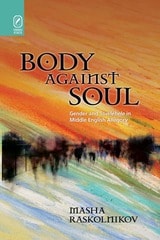
Body Against Soul
Gender and Sowlehele in Middle English AllegoryMasha Raskolnikov
The Ohio State University Press, 2009
The topic of this book is one that runs through all of Western history and remains of primary interest to modern theorists—how “my” body relates to “me.” In the allegorical tradition traced by this study, a male person could imagine himself as a being populated by female personifications, because Latin and Romance languages tended to gender abstract nouns as female. However, since Middle English had ceased to inflect abstract nouns as male or female, writers were free to gender abstractions like “Will” or “Reason” any way they liked. This permitted some psychological allegories to avoid the representational tension caused by placing a female soul inside a male body, instead creating surprisingly queer same-sex inner worlds. The didactic intent driving sowlehele is, it turns out, complicated by the erotics of the struggle to establish a hierarchy of the self’s inner powers.
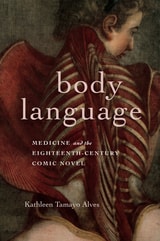
Body Language
Medicine and the Eighteenth-Century Comic NovelKathleen Tamayo Alves
Bucknell University Press, 2026
Body Language examines the complex intersections of British eighteenth-century comic fiction and medical discourse. By engaging medical writings of renowned and widely-read physicians of the Enlightenment such as John Freind, Thomas Sydenham, Albrecht von Haller, John Whytt, and William Cullen, with novels of humor by Henry Fielding, Tobias Smollett, Laurence Sterne, and Charlotte Lennox, Alves explains how medicine shaped comic language by dramatizing female-specific phenomena like menstruation, hysteria, nervous disorders, and pregnancy. In these novels, the medical belief that women are incapable of bodily self-regulation becomes an imperative for policing women’s bodies and highlights the enduring shortcomings of patriarchal systems. Ultimately, these comic representations offer a counternarrative of women’s bodies, agency, and selfhood, exposing masculine anxieties about the effectiveness of marriage to regulate women’s sexuality.
Published by Bucknell University Press. Distributed worldwide by Rutgers University Press.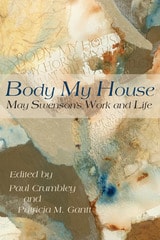
Body My House
May Swenson's Work and Lifeedited by Paul Crumbley and Patricia M. Gantt
Utah State University Press, 2000
The first collection of critical essays on May Swenson and her literary universe, Body My House initiates an academic conversation about an unquestionably major poet of the middle and late twentienth century. Includes many previously unpublished Swenson poems.
Essays here address the breadth of Swenson's literary corpus and offer varied scholarly approaches to it. They reference Swenson manuscripts---poems, letters, diaries, and other prose---some of which have not been widely available before. Chapters focus on Swenson's work as a nature writer; the literary and social contexts of her writing; her national and international acclaim; her work as a translator; associations with other poets and writers (Bishop, Moore, and others); her creative process; and her profound explorations of gender and sexuality. The first full volume of scholarship on May Swenson, Body My House suggests an ambitious agenda for further work.
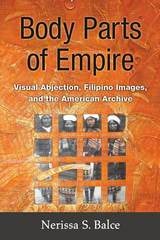
Body Parts of Empire
Visual Abjection, Filipino Images, and the American ArchiveNerissa S. Balce
University of Michigan Press, 2016
Rather than focusing on canonical American authors who wrote at the time of U.S. imperialism, this book examines abject texts—images of naked savages, corpses, clothed native elites, and uniformed American soldiers—as well as bodies of writing that document the goodwill and violence of American expansion in the Philippine colony. Contributing to the fields of American studies, Asian American studies, and gender studies, the book analyzes the actual archive of the Philippine-American War and how the racialization and sexualization of the Filipino colonial native have always been part of the cultures of America and U.S. imperialism. By focusing on the Filipino native as an abject body of the American imperial imaginary, this study offers a historical materialist optic for reading the cultures of Filipino America.
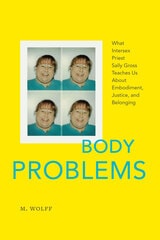
Body Problems
What Intersex Priest Sally Gross Teaches Us About Embodiment, Justice, and BelongingM. Wolff
Duke University Press, 2025
Body and Soul
Essays on PoetryMark Jarman
University of Michigan Press, 2002
The essays "Where Poems Take Place" and "A Shared Humanity" consider the relation between setting or situation and representation. The psychological roots of narrative are considered in "The Primal Storyteller." But the main interest of these essays is how and why narrative is used as a form. The influence of Robinson Jeffers's style of narrative is argued in "Slip, Shift, and Speed Up: The Influence of Robinson Jeffers's Narrative Syntax." In "The Trace of a Story Line" an argument is made that the poets Philip Levine and Charles Wright employ narration or storytelling in their poetry as a mode of meaning. Other essays consider Donald Davie, Philip Larkin, Herbert Lomas, Louis Simpson, Lyn Hejinian, Tess Gallagher, and Ellen Bryant Voigt.
Mark Jarman's poetry has appeared in many publications, including the American Poetry Review and the New Yorker. He has won the Lenore Marshall/Nation Prize of the Academy of American Poets, a Guggenheim fellowship, and multiple grants from the National Endowment for the Arts. He is Professor of English, Vanderbilt University.
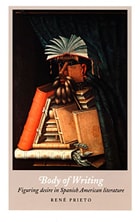
Body of Writing
Figuring Desire in Spanish American LiteratureRené Prieto
Duke University Press, 2000
Healthy, invalid, lustful, and confined bodies—as portrayed by Julio Cortázar, Guillermo Cabrera Infante, Gabriel García Márquez, Severo Sarduy, Rosario Castellanos, and Tununa Mercado—become evidence for Roland Barthes’s contention that works of fiction are “anagrams of the body.” Claiming that an author’s intentions can be uncovered by analyzing “the topography of a text,” Prieto pays particular attention not to the actions or plots of these writers’ fiction but rather to their settings and characterizations. In the belief that bodily traces left on the page reveal the motivating force behind a writer’s creative act, he explores such fictional themes as camouflage, deterioration, defilement, entrapment, and subordination. Along the way, Prieto reaches unexpected conclusions regarding topics that include the relationship of the female body to power, male and female transgressive impulses, and the connection between aggression, the idealization of women, and anal eroticism in men.
This study of how authors’ longings and fears become embodied in literature will interest students and scholars of literary and psychoanalytic criticism, gender studies, and twentieth-century and Latin American literature.
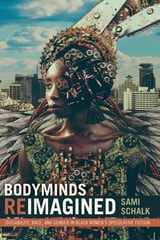
Bodyminds Reimagined
(Dis)ability, Race, and Gender in Black Women's Speculative FictionSami Schalk
Duke University Press, 2018
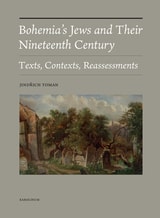
Bohemia's Jews and Their Nineteenth Century
Texts, Contexts, ReassessmentsJindrich Toman
Karolinum Press, 2023
This book on Jewish culture and literature focuses on the “quiet” decades of the nineteenth century, a scarcely written-about period of time in Bohemian Jewish history. Using a myriad of sources, including travelers’ accounts, poems, essays, short stories, guides, and newspaper articles, the volume explores Jewish expression, Jewish-Czech relations, and the changing attitudes toward Jews between the 1820s and 1880s. It offers close readings of writers like Karel Havlíćek Borovský, Ján Kollár, Siegfried Kapper, and Jan Neruda, as well as lesser-known authors and sources. Combining skillful sustained analysis, judicious argumentation, and elegant writing, the book is a truly enriching reading experience.
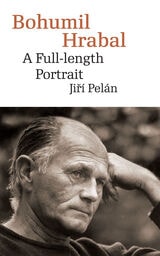
Bohumil Hrabal
A Full-Length PortraitJirí Pelán
Karolinum Press, 2019
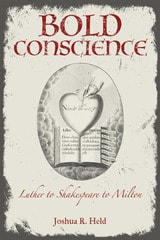
Bold Conscience
Luther to Shakespeare to MiltonJoshua R. Held
University of Alabama Press, 2023
Traces how conscience—inner moral conviction—came to shape public life, fueling martyrdom, free speech, and political revolts
Bold Conscience: Luther to Shakespeare to Milton is a sweeping, original study of how conscience became one of the most powerful ideas in early modern England. Tracing the emergence of what Joshua R. Held calls the “bold conscience,” the book shows how inner moral conviction moved from the realm of private guilt to public action, fueling debates about authority, obedience, free speech, and resistance. By placing conscience at the center of literary, religious, and political conflict, Bold Conscience reveals a vital intellectual throughline linking the Reformation to the birth of modern ideas of liberty and toleration.
The book unfolds chronologically, beginning with Martin Luther and Henry VIII and moving through Shakespeare’s Hamlet and Henry VIII, John Donne’s court sermons, and John Milton’s polemical and poetic works, including Areopagitica and Paradise Lost. Each chapter combines close literary reading with historical and theological analysis, showing how conscience operates across genres—drama, sermon, pamphlet, and epic poetry. Joshua R. Held is a distinguished scholar of early modern literature whose work bridges literary criticism, intellectual history, and religious studies, bringing clarity and narrative energy to complex debates.
Bold Conscience will appeal to scholars and students of early modern literature, Shakespeare, Milton, and Reformation history, as well as readers interested in the origins of religious freedom and political dissent. It will also engage anyone concerned with how moral conviction shapes public life then and now.
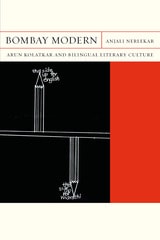
Bombay Modern
Arun Kolatkar and Bilingual Literary CultureAnjali Nerlekar
Northwestern University Press, 2016
Bombay Modern uncovers an alternative and provincial modernism through poetry, a genre that is marginal to postcolonial studies, and through bilingual scholarship across English and Marathi texts, a methodology that is currently peripheral at best to both modernist studies and postcolonial literary criticism in India. Eschewing any attempt to define an overarching or universal modernism, Bombay Modern delimits its sphere of study to "Bombay" and to the "post-1960" (the sathottari period) in an attempt to examine at close range the specific way in which this poetry redeployed the regional, the national, and the international to create a very tangible yet transient local.
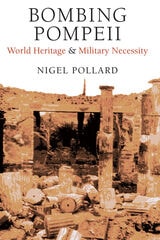
Bombing Pompeii
World Heritage and Military NecessityNigel Pollard
University of Michigan Press, 2020

Bonds of Affection
Thoreau on Dogs and CatsWesley T. Mott
University of Massachusetts Press, 2005
Henry David Thoreau is celebrated as one of America's greatest nature writers, yet few readers are aware of the tender, perceptive, and often humorous attention he gave to the animals closest to human domestic life. Bonds of Affection: Thoreau on Dogs and Cats gathers the finest of Thoreau's own writings in which he turns his unflinching powers of observation and his characteristic philosophical wit toward our oldest animal companions.
In these pages, Thoreau emerges not merely as a solitary sojourner in the wild, but as a keen and affectionate chronicler of the relationships between people and the animals who share their lives. Whether tracking the behavior of a neighborhood dog, or meditating on the inscrutable self-possession of a cat, Thoreau reveals the depth of feeling and moral seriousness he believed we owe to all living creatures. His observations are sometimes wry, sometimes lyrical, and always charged with his conviction that an attentive life demands that we see the world through eyes other than our own.
Beautifully complemented by original engravings from celebrated artist Barry Moser and framed by a foreword from bestselling animal author Elizabeth Marshall Thomas, this elegantly produced volume is both a delight for lovers of Thoreau and an essential companion for anyone who has ever shared their home—and their heart—with a dog or a cat.
Published in cooperation with the Thoreau Society, Bonds of Affection introduces readers to a Thoreau who is at once familiar and surprising: playful and profound, grounded in the everyday, and alive to the wonder of the natural and domestic world alike.
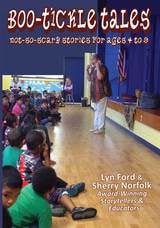
Boo-Tickle Tales
Not-So-Scary Stories for Ages 4-9Lynette Ford & Sherry Norfolk
Parkhurst Brothers, Inc., 2016
The attraction of scary stories begins very early in childhood, but the fortitude to be truly scared comes later. So where are the scary stories for young children? Educators and storytellers, Ford and Norfolk deliver a silly and gently spooky collection of jumps, laughs, interactive moments, and mostly happy endings to satisfy the curious-for-creepy Pre-K through Grade 4 set. Their weirdly funny and gently scary collection of adapted folktales, original stories, and verses will delight those who enjoy being surprised more than being scared.
This book is for:
Parents, grandparents, and other mentors who work with children developmentally aged 4 to 9
Educators, librarians and others serving young listeners, who like silly and creepy stories, but may not like very scary material
Audiences ages 4-9, who like creepy but not-too-scary stories.
Twelve pen-and-ink drawings based on folktale motifs complement the fanciful tone of the book.
Book Anatomy
Body Politics and the Materiality of Indigenous Book HistoryAmy Gore
University of Massachusetts Press, 2023
Winner of the Beatrice Medicine Award for Scholarship in American Indian Studies
From the marginalia of their readers to the social and cultural means of their production, books bear the imprint of our humanity. Embodying the marks, traces, and scars of colonial survival, Indigenous books are contested spaces. A constellation of nontextual components surrounded Native American–authored publications of the long nineteenth century, shaping how these books were read and understood—including illustrations, typefaces, explanatory prefaces, appendices, copyright statements, author portraits, and more.
Centering Indigenous writers, Book Anatomy explores works from John Rollin Ridge, Sarah Winnemucca Hopkins, Pretty Shield, and D’Arcy McNickle published between 1854 and 1936. In examining critical moments of junction between Indigenous books and a mainstream literary marketplace, Amy Gore argues that the reprints, editions, and paratextual elements of Indigenous books matter: they embody a frontline of colonization in which Native authors battle the public perception and reception of Indigenous books, negotiate representations of Indigenous bodies, and fight for authority and ownership over their literary work.
Book Clubs
Women and the Uses of Reading in Everyday LifeElizabeth Long
University of Chicago Press, 2003
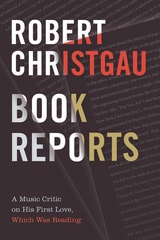
Book Reports
A Music Critic on His First Love, Which Was ReadingRobert Christgau
Duke University Press, 2019
Book Was There
Reading in Electronic TimesAndrew Piper
University of Chicago Press, 2012
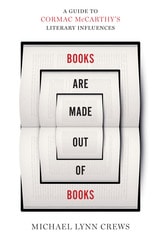
Books Are Made Out of Books
A Guide to Cormac McCarthy's Literary InfluencesBy Michael Lynn Crews
University of Texas Press, 2017
Cormac McCarthy told an interviewer for the New York Times Magazine that “books are made out of books,” but he has been famously unwilling to discuss how his own writing draws on the works of other writers. Yet his novels and plays masterfully appropriate and allude to an extensive range of literary works, demonstrating that McCarthy is well aware of literary tradition, respectful of the canon, and deliberately situating himself in a knowing relationship to precursors.
The Wittliff Collection at Texas State University acquired McCarthy’s literary archive in 2007. In Books Are Made Out of Books, Michael Lynn Crews thoroughly mines the archive to identify nearly 150 writers and thinkers that McCarthy himself references in early drafts, marginalia, notes, and correspondence. Crews organizes the references into chapters devoted to McCarthy’s published works, the unpublished screenplay Whales and Men, and McCarthy’s correspondence. For each work, Crews identifies the authors, artists, or other cultural figures that McCarthy references; gives the source of the reference in McCarthy’s papers; provides context for the reference as it appears in the archives; and explains the significance of the reference to the novel or play that McCarthy was working on. This groundbreaking exploration of McCarthy’s literary influences—impossible to undertake before the opening of the archive—vastly expands our understanding of how one of America’s foremost authors has engaged with the ideas, images, metaphors, and language of other thinkers and made them his own.
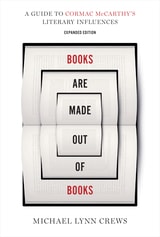
Books Are Made Out of Books
A Guide to Cormac McCarthy's Literary InfluencesMichael Lynn Crews
University of Texas Press, 2024
Cormac McCarthy told an interviewer for the New York Times Magazine that “books are made out of books,” but he was famously unwilling to discuss how his own writing draws on the works of other writers. Yet his novels and plays masterfully appropriate and allude to an extensive range of literary works, demonstrating that McCarthy was well aware of literary tradition and deliberately situating himself in a knowing relationship to precursors.
In Books Are Made Out of Books, Michael Lynn Crews thoroughly mines McCarthy’s literary archive to identify over 150 writers and thinkers that McCarthy referenced in early drafts, marginalia, notes, and correspondence. Crews organizes the references into chapters devoted to McCarthy’s published works, the unpublished screenplay Whales and Men, and McCarthy’s correspondence. This updated edition now examines McCarthy’s final publications: the novel The Passenger and its play-like coda Stella Maris.
For each work, Crews identifies authors, artists, or other cultural figures that McCarthy referenced; gives the source of the reference in McCarthy’s papers; provides context for the reference as it appears in the archives; and explains the significance of the reference to the novel or play that McCarthy was working on. This groundbreaking exploration of McCarthy’s literary influences vastly expands our understanding of how one of America’s foremost authors engaged with the ideas, images, metaphors, and language of other thinkers and made them his own.

Books and My Food
Literary Quotations and Recipes for Every YearElisabeth L. Cary
University of Iowa Press, 1997
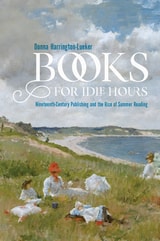
Books for Idle Hours
Nineteenth-Century Publishing and the Rise of Summer ReadingDonna Harrington-Lueker
University of Massachusetts Press, 2019
Drawing on publishing records, book reviews, readers' diaries, and popular novels of the period, Donna Harrington-Lueker explores the beginning of summer reading and the backlash against it. Countering fears about the dangers of leisurely reading—especially for young women—publishers framed summer reading not as a disreputable habit but as a respectable pastime and welcome respite. Books for Idle Hours sheds new light on an ongoing seasonal publishing tradition.
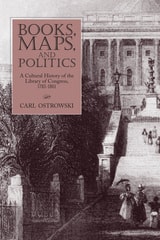
Books, Maps, and Politics
A Cultural History of the Library of Congress, 1783-1861Carl Ostrowski
University of Massachusetts Press, 2004
The author explores the relationship between the Library and the period's expanding print culture. He identifies the books that legislators required to be placed in the Library and establishes how these volumes were used. His analysis of the earliest printed catalogs of the Library reveals that law, politics, economics, geography, and history were the subjects most assiduously collected. These books provided government officials with practical guidance in domestic legislation and foreign affairs, including disputes with European powers over territorial boundaries.
Ostrowski also discusses a number of secondary functions of the Library, one of which was to provide reading material for the entertainment and instruction of government officials and their families. As a result, the richness of America's burgeoning literary culture from the 1830s to the 1860s was amply represented on the Library's shelves. For those with access to its Capitol rooms, the Library served an important social function, providing a space for interaction and the display and appreciation of American works of art.
Ostrowski skillfully demonstrates that the history of the Library of Congress offers a lens through which we can view changing American attitudes toward books, literature, and the relationship between the federal government and the world of arts and letters.

Books, Readers and Libraries in Fiction
Edited by Karen Attar and Andrew Nash
University of London Press, 2024
Books and libraries appear in fiction from the earliest times onwards, in works for all age groups, in canonical literature, and in books that form part of popular culture. Fiction enables writers to teach readers how to read, but it can also portray subversive acts of reading that engage with contemporary cultural anxieties or moral debates. The reading material of fictional personae is part of their characterization; we are often reading readers.
Drawing on approaches from literary studies, book history, library history, and theories and histories of reading, Books, Readers and Libraries in Fiction examines what fictional representations of reading tell us about changing cultural attitudes to different reading practices, and the use (and abuse) of books beyond actual reading, both in the context of specific works and about the reception of books more widely. Through detailed case studies from primarily British fiction that address common themes such as gender, genre, and the relation between reading and writing itself, this collection catalogs the ways in which authors of fiction mediate and interpret books, libraries, and the act of reading to their own readers.
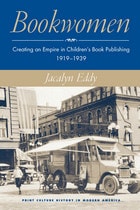
Bookwomen
Creating an Empire in Children’s Book Publishing, 1919–1939Jacalyn Eddy
University of Wisconsin Press, 2006
The most comprehensive account of the women who, as librarians, editors, and founders of the Horn Book, shaped the modern children's book industry between 1919 and 1939. The lives of Anne Carroll Moore, Alice Jordan, Louise Seaman Bechtel, May Massee, Bertha Mahony Miller, and Elinor Whitney Field open up for readers the world of female professionalization. What emerges is a vivid illustration of some of the cultural debates of the time, including concerns about "good reading" for children and about women's negotiations between domesticity and participation in the paid labor force and the costs and payoffs of professional life.
Published in collaboration among the University of Wisconsin Press, the Center for the History of Print Culture in Modern America (a joint program of the University of Wisconsin–Madison and the Wisconsin Historical Society), and the University of Wisconsin–Madison General Library System Office of Scholarly Communication.
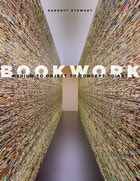
Bookwork
Medium to Object to Concept to ArtGarrett Stewart
University of Chicago Press, 2011
“There they rest, inert, impertinent, in gallery space—those book forms either imitated or mutilated, replicas of reading matter or its vestiges. Strange, after its long and robust career, for the book to take early retirement in a museum, not as rare manuscript but as functionless sculpture. Readymade or constructed, such book shapes are canceled as text when deposited as gallery objects, shut off from their normal reading when not, in some yet more drastic way, dismembered or reassembled.” So begins Bookwork, which follows our passion for books to its logical extreme in artists who employ found or simulated books as a sculptural medium. Investigating the conceptual labor behind this proliferating international art practice, Garrett Stewart looks at hundreds of book-like objects, alone or as part of gallery installations, in this original account of works that force attention upon a book’s material identity and cultural resonance.
Less an inquiry into the artist’s book than an exploration of the book form’s contemporary objecthood, Stewart’s interdisciplinary approach traces the lineage of these aggressive artifacts from the 1919 Unhappy Readymade of Marcel Duchamp down to the current crisis of paper-based media in the digital era. Bookwork surveys and illustrates a stunning variety of appropriated and fabricated books alike, ranging from hacksawed discards to the giant lead folios of Anselm Kiefer. The unreadable books Stewart engages with in this timely study are found, again and again, to generate graphic metaphors for the textual experience they preclude, becoming in this sense legible after all.

Border Biomes
Ecological Imaginaries of Mexico's EdgesEmily Celeste Vázquez Enríquez
Vanderbilt University Press, 2025
This book is freely available in an open-access edition thanks to the generous support by the University of California Davis Library.
What effect do heavily fortified national borders have on the natural environments that surround them? In Border Biomes, Emily Celeste Vázquez Enríquez explores this question by analyzing contemporary Mexican, Latinx, and Indigenous literature that has tried to highlight the human and ecological toll of Mexico’s borders with the United States and Guatemala. By challenging the very premise of borders as permanent, immovable boundaries, she shows how novelists and poets in Mexico and the United States have tried to represent and understand the vast social, political, and ecological harm caused by these constructions. She argues that the environmental destruction that borders create is inseparable from state‑sanctioned, anti‑immigrant racial violence. To do this, she structures the book around three main biomes: rivers, deserts, and forests. Within each chapter, Vázquez Enríquez considers how authors such as Dolores Dorantes, Natalie Diaz, and Ofelia Zepeda have drawn upon alternative Indigenous epistemologies and forms of representation to register the sweeping damage of bordering regimes on the Colorado River, the Southwest Desert, and the Selva El Petén, and other biomes. By critically analyzing the work of these US and Mexican writers, she contests traditional interpretations of Mexican literature as nationally bounded and instead proposes an expansive view of “Mexican literature.” More fundamentally, Border Biomes suggests literature's potential to create new ecological realities and challenge the naturalization of borders and the ecological violence that they provoke.
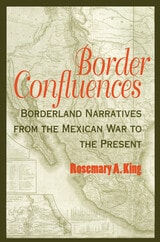
Border Confluences
Borderland Narratives from the Mexican War to the PresentRosemary A. King
University of Arizona Press, 2004

Border Crossings
An Introduction to East German ProseThomas C. Fox
University of Michigan Press, 1993
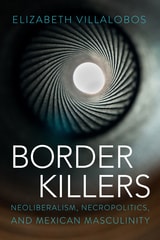
Border Killers
Neoliberalism, Necropolitics, and Mexican MasculinityElizabeth Villalobos
University of Arizona Press, 2024
Villalobos focuses on representations of “border killers” in literature, film, and theater. The author develops a metaphor of “maquilization” to describe the mass-production of masculine violence as a result of neoliberalism. The author demonstrates that the killer is an interchangeable cog in a societal factory of violence whose work is to produce dead bodies. By turning to cultural narratives, Villalobos seeks to counter the sensationalistic and stereotyped media depictions of border residents as criminals. The cultural works she examines instead indict the Mexican state and the global economic system for producing agents of violence.
Focusing on both Mexico’s northern and southern borders, Border Killers uses Achille Mbembe’s concept of necropolitics and various theories of masculinity to argue that contemporary Mexico is home to a form of necropolitical masculinity that has flourished in the neoliberal era and made the exercise of death both profitable and necessary for the functioning of Mexico’s state-cartel-corporate governance matrix.
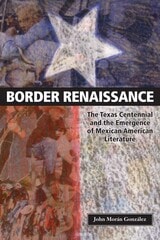
Border Renaissance
The Texas Centennial and the Emergence of Mexican American LiteratureBy John Morán González
University of Texas Press, 2009
The Texas Centennial of 1936, commemorated by statewide celebrations of independence from Mexico, proved to be a powerful catalyst for the formation of a distinctly Mexican American identity. Confronted by a media frenzy that vilified "Meskins" as the antithesis of Texan liberty, Mexican Americans created literary responses that critiqued these racialized representations while forging a new bilingual, bicultural community within the United States. The development of a modern Tejana identity, controversies surrounding bicultural nationalism, and other conflictual aspects of the transformation from mexicano to Mexican American are explored in this study. Capturing this fascinating aesthetic and political rebirth, Border Renaissance presents innovative readings of important novels by María Elena Zamora O'Shea, Américo Paredes, and Jovita González. In addition, the previously overlooked literary texts by members of the League of United Latin American Citizens (LULAC) are given their first detailed consideration in this compelling work of intellectual and literary history.
Drawing on extensive archival research in the English and Spanish languages, John Morán González revisits the 1930s as a crucial decade for the vibrant Mexican American reclamation of Texas history. Border Renaissance pays tribute to this vital turning point in the Mexican American struggle for civil rights.
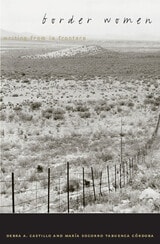
Border Women
Writing From La FronteraDebra A. Castillo
University of Minnesota Press, 2002
The first study to foreground writing by women who live at the U.S.-Mexico Border.
It is a peculiar fact that U.S.-Mexico border theory is dominated by those who write about, not from, the border. By looking at the work of women writers from both sides of the border, Debra A. Castillo and María-Socorro Tabuenca Córdoba open border studies to a truly transnational analysis while bringing questions of gender to the fore.
Border Women rethinks border theory by emphasizing women writers whose work—in Spanish, English, or a mixture of the two languages—calls into question accepted notions of border identities. These writers include those who are already well recognized internationally (Helena María Viramontes, Sheila and Sandra Ortiz Taylor, and María Novaro); those who have become part of the Chicano canon (Norma Cantú, Alicia Gaspar de Alba, and Demetria Martínez); along with some of the lesser-known, yet most exciting, women’s voices from the Mexican border (Rosario Sanmiguel, Rosina Conde, and Regina Swain).
Border Writing
The Multidimensional TextD. Emily HicksForeword by Neil Larsen
University of Minnesota Press, 1991
Border Writing was first published in 1991. Minnesota Archive Editions uses digital technology to make long-unavailable books once again accessible, and are published unaltered from the original University of Minnesota Press editions.
Until recently, literary theory has been grounded in the histories of English, French, German, and Spanish literature. The terms and models for the production of literature and its function in culture and society were decided in Western Europe, and any deviations were immediately marginalized. This Eurocentric view has been widely attached by postmodern, feminist, and postcolonial political practices.
Drawing on a variety of critical and theoretical sources, D. Emily Hicks employs the concept of border writing to consider the complexities of contemporary Latin American writing. With its emphasis on the multiplicity of languages and the problems of translation, border writing connotes a perspective that is no longer determined by neat distinctions. Hicks combines Deleuze and Guattari's notion of "deterritorialization" (the geographic, linguistic, or cultural displacement from one's own country, language, or native culture) with a holographic metaphor in provocative readings of Latin America writers, including Gabriel Garcia Marquez, Luisa Valenzuela, and Julio Cortazar. The result is a volume that forces the reader to consider the development of literature in terms of strategies and tactics that contribute to the production of meaning in culturally complex and politically repressive societies.
D. Emily Hicks is associate professor of English and comparative literature and a member of the Latin American studies faculty at San Diego State University. Neil Larsen is associate professor of Spanish and Latin American literature at Northeastern University and the author of Modernism and Hegemony: A Materialist Critique of Aesthetic Agencies (Minnesota, 1990).
Borderlands Saints
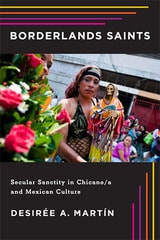
Secular Sanctity in Chicano/a and Mexican CultureMartín, Desirée A
Rutgers University Press, 2013
Winner of the 2014 Latina/o Studies Section - LASA Outstanding Book Award
In Borderlands Saints, Desirée A. Martín examines the rise and fall of popular saints and saint-like figures in the borderlands of the United States and Mexico. Focusing specifically on Teresa Urrea (La Santa de Cabora), Pancho Villa, César Chávez, Subcomandante Marcos, and Santa Muerte, she traces the intersections of these figures, their devotees, artistic representations, and dominant institutions with an eye for the ways in which such unofficial saints mirror traditional spiritual practices and serve specific cultural needs.
Popular spirituality of this kind engages the use and exchange of relics, faith healing, pilgrimages, and spirit possession, exemplifying the contradictions between high and popular culture, human and divine, and secular and sacred. Martín focuses upon a wide range of Mexican and Chicano/a cultural works drawn from the nineteenth century to the present, covering such diverse genres as the novel, the communiqué, drama, the essay or crónica, film, and contemporary digital media. She argues that spiritual practice is often represented as narrative, while narrative—whether literary, historical, visual, or oral—may modify or even function as devotional practice.
Borderpunk
Non-Respectable Narratives of the Post-SixtiesSophia Martínez Abbud
University of Arizona Press, 2027
The U.S.-Mexico border has long been a home to artists, poets, emos, and punks. In the clandestine undergrounds of borderlands cultural production, there lies an impulse to live below and beyond border surveillance technologies. This book is about the utopic stories that narrate this impulse and the punk literary scenes that facilitate these fabulations.
Using an innovative methodology of “scene-work”—a blend of literary analysis, queer theory, critical regionalism, and auto-ethnography—Borderpunk identifies, aggregates, and outlines the emergent genre of borderpunk cultural productions. Beginning with the post-1960s through the present, author Sophia Martínez Abbud examines how music, playlists, literature, art, and performance borderpunk narratives teach us to elide, undermine, and work against the border’s presumed authority. Through these narratives, readers become attuned to the anarchic sense of abjection that permeates the border regions and the kinds of punk subjectivities emerging from these sites of re-mediation.
Borderpunk offers scenes that refuse notions of respectability at different time periods, geographies, and scales. Following the mechanics of other narrative punk genres, such as cyberpunk or solarpunk, it sketches out the uses of “punk” as a way of being in border spaces—where abjection, relajo, and illegibility become useful tools that encourage us to divest from the norm, participate in horizontal community building, and imagine borders in radical new ways.
Borderwaters
Amid the Archipelagic States of AmericaBrian Russell Roberts
Duke University Press, 2021
Boredom
The Literary History of a State of MindPatricia Meyer Spacks
University of Chicago Press, 1994
Borges and Europe Revisited
Edited by Evelyn Fishburn
University of London Press, 1998
Borges and His Fiction
A Guide to His Mind and ArtBy Gene H. Bell-Villada
University of Texas Press, 2000
From reviews of the first edition:
"A compulsively readable account of the life and works of our greatest...writer of fantasy. With a keen appreciation of Borges himself and a pleasant disregard for the critical clichés, Bell-Villada tells us all we really want to know about the modern master-from pronouncing his name to understanding the stories." —New York Daily News
"Of the scores of Borges studies by now published in English, Bell-Villada's excellent book stands out as one of the freshest and most generally helpful.... Lay readers and specialists alike will find his book a valuable and highly readable companion to Ficciones and El Aleph." —Choice
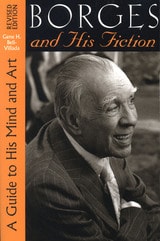
Since its first publication in 1981, Borges and His Fiction has introduced the life and works of this Argentinian master-writer to an entire generation of students, high school and college teachers, and general readers. Responding to a steady demand for an updated edition, Gene H. Bell-Villada has significantly revised and expanded the book to incorporate new information that has become available since Borges' death in 1986. In particular, he offers a more complete look at Borges and Peronism and Borges' personal experiences of love and mysticism, as well as revised interpretations of some of Borges' stories. As before, the book is divided into three sections that examine Borges' life, his stories in Ficciones and El Aleph, and his place in world literature.
Borges and Kafka, Bolaño and Bloom
Latin American Authors and the Western CanonJuan E. De Castro
Vanderbilt University Press, 2022
Borges and Kafka, Bolaño and Bloom is a parsing not simply of these authors' reactions to a canon, but of the notion of canon writ large and the inequities and erasures therein. It concludes with a look at the testimonial and autobiographical writings of Rigoberta Menchú and Lurgio Gavilán, who arguably represent the trajectory of Indigenous testimonial and autobiographical writing during the last forty years, noting how their texts represent alternative ways of relating to national and, on occasion, Western cultures. This study is a new attempt to map writers' diverse ways of thinking about locality and universality from within and without what is known as the canon.
Borges
An IntroductionJulio Premat
Vanderbilt University Press, 2021
Originally published in French by an Argentine ex-pat living in Paris, Borges includes the Argentine specificities of Borges’s work—specificities that are often unrecognized or glossed over in Anglophone readings.
This book is a boon for university students of philosophy and literature, teachers and researchers in these fields who are looking to better understand this complex author, and anyone interested in the advanced study of literature. Somewhere between a guidebook and an exhaustive work of advanced research, Borges is the ultimate stepping-stone into the deeper Borgesian world.
Borrowed Voices
Writing and Racial Ventriloquism in the Jewish American ImaginationGlaser, Jennifer
Rutgers University Press, 2016
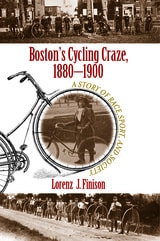
Boston's Cycling Craze, 1880-1900
A Story of Race, Sport, and SocietyLorenz J. Finison
University of Massachusetts Press, 2014
Lorenz J. Finison explores the remarkable rise of Boston cycling through the lives of several participants, including Kittie Knox, a biracial twenty-year-old seamstress who challenged the color line; Mary Sargent Hopkins, a self-proclaimed expert on women's cycling and publisher of The Wheelwoman; and Abbot Bassett, a longtime secretary of the League of American Wheelman and a vocal cycling advocate for forty years. Finison shows how these riders and others interacted on the road and in their cycling clubhouses, often constrained by issues of race, class, religion, and gender. He reveals the challenges facing these riders, whether cycling for recreation or racing, in a time of segregation, increased immigration, and debates about the rights of women.
Boston
Voices and VisionsShaun O'Connell
University of Massachusetts Press, 2010
“New England was founded consciously, and in no fit of absence of mind,” observed historian Samuel Eliot Morison on the establishment of the Bay Colony in 1630 on the narrow, mountainous Shawmut peninsula of what became Massachusetts. That self-conscious presence of mind has endured for four centuries. Boston has been shaped and sustained by observation, imagination, and interpretation. As a result, the evolving vision of Boston has yielded a compelling literary record.
In this wide-ranging anthology, Shaun O'Connell includes a generous sampling of those who have recorded, revised, and redefined the vision of Boston. Anne Bradstreet, Nathaniel Hawthorne, Henry James, W. E. B. Du Bois, Mary Antin, Edwin O'Connor, John Updike, and many others eloquently evoke and explain Boston in these pages.
From John Winthrop's “city upon a hill” sermon, delivered aboard the Arbella before his followers landed in 1630 in the place they would call Boston, to Robert Lowell's “For the Union Dead,” a poem delivered in Boston's Public Garden in 1960, writers have continued to invoke the high purposes for which the city was founded, sometimes in praise of the city, but often in what Robert Frost named a “lover's quarrel,” in works that called attention to the city's failures to fulfill its promises. In the twenty-first century some writers continue to celebrate or to castigate the city, while others look back to Boston's origins to reassess its founders and renew its covenant of high purpose.
This is an interpretive anthology—one that includes commentary as well as writings. Section introductions provide historical and biographical context, offer analysis that stresses the thematic relevance of each selection, and explore the pattern of their relations. Rather than present a random array of writers who happen to have been Greater Bostonians, O'Connell focuses on those authors who possessed a commitment to the sense of place, those who addressed Boston not only as a geographical, social, and political entity but as an image, idea, and site of symbolic values.
Boswell and the Press
Essays on the Ephemeral Writing of James BoswellDonald J. Newman
Bucknell University Press, 2021
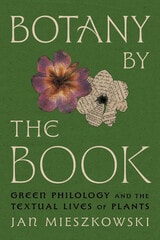
Botany by the Book
Green Philology and the Textual Lives of PlantsJan Mieszkowski
University of Chicago Press, 0
Drawing on philosophers and poets with a passion for botany, this book shows that the study of plants has always been a study of language as much as of living things.
At a moment when environmental thought is struggling to move beyond inherited assumptions about nature and humanity’s place within it, Botany by the Book offers a new perspective on the history of ecological thinking. Bringing together a diverse range of writers, it uncovers a long and largely forgotten tradition of “green philology” in which empirical inquiry and literary reflection developed side by side. Figures such as Locke, Rousseau, Goethe, Mill, Dickinson, Akhmatova, Luxemburg, Celan, and Heidegger were avid botanizers, collecting specimens and in some cases meticulously curating herbaria. Spanning centuries, this hidden conversation links poets, philosophers, and naturalists whose intellectual kinship was often stronger than they themselves realized.
Tracing a line from Carl Linnaeus’s love of metaphor to Emily Dickinson’s adolescent herbarium to the contemporary politics of floral aesthetics, Jan Mieszkowski reveals how efforts to conceptualize plant life raise fundamental questions about power and knowledge. He also takes up contemporary writers, such as Hanif Abdurraqib and Ross Gay, whose flower poems refuse to play by the rules. Ultimately, Mieszkowski shows that botany has inspired a green philology, its distinctive reflections on language and epistemology offering fertile soil for ecocriticism today. Going beyond traditional distinctions between the sciences and the humanities, Botany by the Book argues that reckoning honestly with how we represent nature is inseparable from imagining more livable ecological futures.
Bounce
Rap Music and Local Identity in New OrleansMatt Miller
University of Massachusetts Press, 2012
Over the course of the twentieth century, African Americans in New Orleans helped define the genres of jazz, rhythm and blues, soul, and funk. In recent decades, younger generations of New Orleanians have created a rich and dynamic local rap scene, which has revolved around a dance-oriented style called “bounce.”
Hip-hop has been the latest conduit for a “New Orleans sound” that lies at the heart of many of the city's best-known contributions to earlier popular music genres. Bounce, while globally connected and constantly evolving, reflects an enduring cultural continuity that reaches back and builds on the city's rich musical and cultural traditions.
In this book, the popular music scholar and filmmaker Matt Miller explores the ways in which participants in New Orleans's hip-hop scene have collectively established, contested, and revised a distinctive style of rap that exists at the intersection of deeply rooted vernacular music traditions and the modern, globalized economy of commercial popular music. Like other forms of grassroots expressive culture in the city, New Orleans rap is a site of intense aesthetic and economic competition that reflects the creativity and resilience of the city's poor and working-class African Americans.
Bound and Determined
Captivity, Culture-Crossing, and White Womanhood from Mary Rowlandson to Patty HearstChristopher Castiglia
University of Chicago Press, 1996
Examining more than sixty accounts by women captives, as well as novels ranging from Susanna Rowson's eighteenth-century classic Rueben and Rachel to today's mass-market romances, Castiglia investigates paradoxes central to the genre. In captivity, women often find freedom from stereotypical roles as helpless, dependent, sexually vulnerable, and xenophobic. In their condemnations of their non-white captors, they defy assumptions about race that undergird their own societies. Castiglia questions critical conceptions of captivity stories as primarily an appeal to racism and misogyny, and instead finds in them an appeal of a much different nature: as all-too-rare stories of imaginative challenges to rigid gender roles and racial ideologies.
Whether the women of these stories resist or escape captivity, endure until they are released, or eventually choose to live among their captors, they end up with the power to be critical of both cultures. Castiglia shows that these compelling narratives, with their boundary crossings and persistent explorations of cultural divisions and differences, have significant implications for current critical investigations into the construction of gender, race, and nation.
Bound to Respect
Antebellum Narratives of Black Imprisonment, Servitude, and Bondage, 1816–1861Keith Michael Green
University of Alabama Press, 2015
WINNER OF THE ELIZABETH AGEE PRIZE IN AMERICAN LITERATURE
Challenges the commonplace narrative that the African American experience of captivity in the United States is reducible to the legal institution of slavery, a status remedied through emancipation
In Bound to Respect: Antebellum Narratives of Black Imprisonment, Servitude, and Bondage, 1816–1861, Keith Michael Green examines key texts that illuminate forms of black bondage and captivity that existed within and alongside slavery. In doing so, he restores to antebellum African American autobiographical writing the fascinating heterogeneity lost if the historical experiences of African Americans are attributed to slavery alone.
The book’s title is taken from the assertion by US Supreme Court chief justice Roger B. Taney in his 1857 Dred Scott decision that blacks had no rights that whites were “bound to respect.” This allusion highlights Green’s critical assertion that the dehumanizing absurdities to which defenders of slavery resorted to justify slavery only brought into more stark relief the humanity of African Americans.
A gifted storyteller, Green examines four forms of captivity: incarceration, enslavement to Native Americans, child indentured servitude, and maritime capture. By illuminating this dense penumbra of captivity beyond the strict definitions of slavery, he presents a fluid and holistic network of images, vocabulary, narratives, and history. By demonstrating how these additional forms of confinement flourished in the era of slavery, Green shows how they persisted beyond emancipation, in such a way that freed slaves did not in fact partake of “freedom” as white Americans understood it. This gap in understanding continues to bedevil contemporary American society, and Green deftly draws persuasive connections between past and present.
A vital and convincing offering to readers of literary criticism, African American studies, and American history, Green’s Bound to Respect brings fresh and nuanced insights to this fundamental chapter in the American story.