Results by title
784 books match the query 'American Government' and 58 start with c
CHALLENGING PARTIES, CHANGING PARLIAMENT
Women and Elected Office in Contemporary Western EuropeMiki Caul Kittilson
The Ohio State University Press, 2006
CHEAP SEATS
The Democratic Party’s Advantage in U.S. House ElectionsJames E. Campbell
The Ohio State University Press, 1996
The longest continuous majority in the history of the U.S. House of Representatives came to a dramatic close with the 1994 midterm elections. The Democratic Party had controlled the House for forty years—two and a half times as long as any previous majority. In Cheap Seats, James E. Campbell considers the reasons why the Democrats dominated House elections for four decades and why they ultimately lost that control.
Examining the structural advantages that helped congressional Democrats, Campbell finds that their unprecedented success in the House was due in no small measure to a favorable election system, an advantage in the way in which votes are translated into House seats. His straightforward analysis indicates that Democrats consistently win most of the very-low-turnout districts, or “cheap seats.” In fact, because of the party's continued hold on such districts, the new Democratic minority is considerably larger than it would otherwise have been.
Cheap Seats is a thorough and innovative investigation into the electoral system's impact on partisan politics and representation in Congress. Campbell presents an impressive array of evidence, including both quantitative analysis of election returns from 1936 to 1994 and in-depth studies of several cheap-seat districts. He also explores the important theoretical issues of representation that cheap seats raise and offers several proposals to reform the system. This well-written and provocative volume is accessible to anyone interested in American politics, in addition to scholars especially interested in the areas of Congress, elections, electoral systems, and political parties.
Campaign Finance and American Democracy
What the Public Really Thinks and Why It MattersDavid M. Primo and Jeffrey D. Milyo
University of Chicago Press, 2020
Primo and Milyo probe original survey data to determine Americans’ sentiments on the role of money in politics, what drives these sentiments, and why they matter. What Primo and Milyo find is that while many individuals support the idea of reform, they are also skeptical that reform would successfully limit corruption, which Americans believe stains almost every fiber of the political system. Moreover, support for campaign finance restrictions is deeply divided along party lines, reflecting the polarization of our times. Ultimately, Primo and Milyo contend, American attitudes toward money in politics reflect larger fears about the health of American democracy, fears that will not be allayed by campaign finance reform.
Campaign Reform
Insights and EvidenceLarry M. Bartels and Lynn Vavreck, Editors
University of Michigan Press, 2000
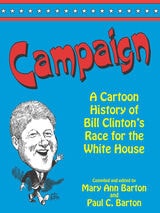
Campaign
A Cartoon History of Bill Clinton's Race for the White HouseMary Ann Barton
University of Arkansas Press, 1993
For many people, in the United States and abroad, the dramas of the campaign created the character of Clinton. From the Gennifer Flowers debacle to Clinton’s
resurrection at the Democratic National Convention and the triumph of the election win, the incisive cartoons in this collection capture Clinton’s emerging image in a way that no written word can. The forty-five contributing artists use these cartoons to depict the breathtaking and colorful events that only a presidential campaign can produce and offer hours of entertainment for any reader.
Capital, State, Empire
The New American Way of Digital WarfareScott Timcke
University of Westminster Press, 2017
The United States presents the greatest source of global geo-political violence and instability. Guided by the radical political economy tradition, this book offers an analysis of the USA’s historical impulse to weaponize communication technologies.
Scott Timcke explores the foundations of this impulse and how the militarization of digital society creates structural injustices and social inequalities. He analyses how new digital communication technologies support American paramountcy and conditions for worldwide capital accumulation. Identifying selected features of contemporary American society, Capital, State, Empire undertakes a materialist critique of this digital society and of the New American Way of War. At the same time it demonstrates how the American security state represses activists—such as Black Lives Matter—who resist this emerging security leviathan. The book also critiques the digital positivism behind the algorithmic regulation used to control labour and further diminish prospects for human flourishing for the ‘99%’.
Capital, State, Empire contributes to a broader understanding of the dynamics of global capitalism and political power in the early 21st century.
Capitol Investments
The Marketability of Political SkillsGlenn R. Parker
University of Michigan Press, 2011
What would you do if, the very day you were hired, you knew you could be unemployed in as little as two years? You'd seek opportunities in your current job to develop a portfolio of skills and contacts in order to make yourself more attractive to future employers. Representatives and senators think about their jobs in Congress in this way, according to Glenn R. Parker.
While in office, members of Congress plan not merely for the next election but for the next stage of their careers. By networking, serving on committees, and championing particular legislation, they deliberately accumulate human capital---expertise, networks, and reputation---which later will give them bargaining power in the job market. Parker's study of the postelective careers of more than 200 former members of Congress, both U.S. representatives and senators, who have left office during the last half century shows that such strategic planning generally succeeds. In most cases, the human capital these politicians amassed while in office increased their occupational mobility and earning power.
Capitol Investments offers a sophisticated yet accessible analysis of the acquisition and marketability of political skills. It suggests that an awareness of the trade in human capital shapes an officeholder's actions as much as the desire to win another election.
Glenn R. Parker is Distinguished Professor in the Department of Political Science at Purdue University.
Changing Their Minds?
Donald Trump and Presidential LeadershipGeorge C. Edwards III
University of Chicago Press, 2021
Donald Trump has been a distinctive president, and his arrival in the Oval Office brought new questions. Could someone with his decades of experience as a self-promoter connect with the public and win its support? Could a president who is an experienced negotiator obtain the support in Congress needed to pass his legislative programs? Would we need to adjust the theory of presidential leadership to accommodate a president with unique persuasive skills?
Building on decades of research and employing extensive new data, George C. Edwards III addresses these questions. He finds that President Trump has been no different than other presidents in being constrained by his environment. He moved neither the public nor Congress. Even for an experienced salesman and dealmaker, presidential power is still not the power to persuade. Equally important was the fact that, as Edwards shows, Trump was not able to exploit the opportunities he had. In fact, we learn here that the patterns of the president’s rhetoric and communications and his approach to dealing with Congress ultimately lessened his chances of success. President Trump, it turns out, was often his own agenda’s undoing.

Chicago Latina Trailblazers
Testimonios of Political ActivismEdited by Rita D. Hernández, Leticia Villarreal Sosa, Elena R. Gutiérrez
University of Illinois Press, 2024
Mexican American and Puerto Rican women have long taken up the challenge to improve the lives of Chicagoans in the city’s Latino/a/x communities. Rita D. Hernández, Leticia Villarreal Sosa, and Elena R. Gutiérrez present testimonies by Latina leaders who blazed new trails and shaped Latina Chicago history from the 1960s through today.
Taking a do-it-all attitude, these women advanced agendas, built institutions, forged alliances, and created essential resources that Latino/a/x communities lacked. Time and again, they found themselves the first Latina to hold their post or part of the first Latino/a/x institution of its kind. Just as often, early grassroots efforts to address issues affecting themselves, their families, and their neighborhoods grew into larger endeavors. Their experiences ranged from public schools to healthcare to politics to broadcast media, and each woman’s story shows how her work changed countless lives and still reverberates across the entire city.
An eyewitness view of an unknown history, Chicago Latina Trailblazers reveals the vision and passion that fueled a group of women in the vanguard of reform.
Contributors: Ana Castillo, Maria B. Cerda, Carmen Chico, Aracelis Flecha Figueroa, Aida Luz Maisonet Giachello, Mary Gonzales, Ada Nivia López, Emma Lozano, Virginia Martinez, Carmen Mendoza, Elena Mulcahy, Guadalupe Reyes, Luz Maria B. Solis, and Carmen Velasquez

Chicago's Block Clubs
How Neighbors Shape the CityAmanda I. Seligman
University of Chicago Press, 2016
In Chicago’s Block Clubs, Amanda I. Seligman uncovers the history of the block club in Chicago—from its origins in the Urban League in the early 1900s through to the Chicago Police Department’s twenty-first-century community policing program. Recognizing that many neighborhood problems are too big for one resident to handle—but too small for the city to keep up with—city residents have for more than a century created clubs to establish and maintain their neighborhood’s particular social dynamics, quality of life, and appearance. Omnipresent yet evanescent, block clubs are sometimes the major outlets for community organizing in the city—especially in neighborhoods otherwise lacking in political strength and clout. Drawing on the stories of hundreds of these groups from across the city, Seligman vividly illustrates what neighbors can—and cannot—accomplish when they work together.
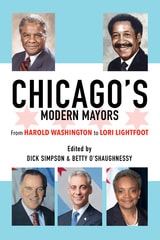
Chicago’s Modern Mayors
From Harold Washington to Lori LightfootEdited by Dick Simpson and Betty O'Shaughnessy
University of Illinois Press, 2024
Chicago’s transformation into a global city began at City Hall. Dick Simpson and Betty O’Shaughnessy edit in-depth analyses of the five mayors that guided the city through this transition beginning with Harold Washington’s 1983 election: Washington, Eugene Sawyer, Richard M. Daley, Rahm Emmanuel, and Lori Lightfoot. Though the respected political science, sociologist, and journalist contributors approach their subjects from distinct perspectives, each essay addresses three essential issues: how and why each mayor won the office; whether the City Council of their time acted as a rubber stamp or independent body; and the ways the unique qualities of each mayor’s administration and accomplishments influenced their legacy.
Filled with expert analysis and valuable insights, Chicago’s Modern Mayors illuminates a time of transition and change and considers the politicians who--for better and worse--shaped the Chicago of today.
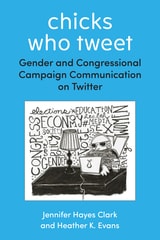
Chicks Who Tweet
Gender and Congressional Campaign Communication on TwitterJennifer Hayes Clark and Heather K. Evans
University of Michigan Press, 2027
Does gender shape campaign communication? Drawing on an original dataset of candidate tweets across six election cycles, Chicks Who Tweet demonstrates that gender systematically shapes congressional campaign messaging. Not only does gender predict the issues candidates emphasize, but also the tone of their communication and their strategic decisions to engage in negative campaigning. Even after controlling for partisanship, incumbency status, district competitiveness, and overall tweeting volume, gender remains a robust and statistically significant predictor of issue emphasis.
Working to reclaim the label “chicks,” the authors show that women candidates are acutely aware of the gendered stereotypes that shape voter expectations and media coverage. Women candidates tweet more frequently than men and are more likely to criticize their opponents. However, they often face backlash to negative campaigning that men do not. Interviews with campaign communication directors and staff further illuminate how strategic messaging decisions are filtered through gendered expectations about credibility, likability, and leadership. The authors also look at how race and ethnicity interact with gender to shape issue framing and agenda-setting strategies. Although social media platforms offer women candidates new avenues to articulate representational claims and mobilize supporters, Chicks Who Tweet shows that gendered double standards still constrain strategic choices and contribute to ongoing disparities in congressional representation.
Choosing State Supreme Court Justices
Merit Selection and the Consequences of Institutional ReformGreg Goelzhauser
Temple University Press, 2016
Since 1940, more than half of all states have switched at least in part from popular election or elite appointment to experiment with merit selection in choosing some or all of their state supreme court justices. Under merit selection, a commission—often comprising some combination of judges, attorneys, and the general public—is tasked with considering applications from candidates vying to fill a judicial vacancy. Ostensibly, the commission forwards the best candidates to the governor, who ultimately appoints them. Presently, numerous states are debating whether to adopt or abolish merit selection.
In his short, sharp book, Choosing State Supreme Court Justices, Greg Goelzhauser utilizes new data on more than 1,500 state supreme court justices seated from 1960 through 2014 to answer the question, Does merit selection produce better types of judges? He traces the rise of merit selection and explores whether certain judicial selection institutions favor candidates who have better qualifications, are more diverse, and have different types of professional experience.
Goelzhauser’s results ultimately contribute to the broader debate concerning comparative institutional performance with respect to state judicial selection.
Choosing to Lead
Understanding Congressional Foreign Policy EntrepreneursRalph G. Carter and James M. Scott
Duke University Press, 2009
Carter and Scott combine extensive quantitative analysis, interviews with members of Congress and their staff, and case studies of key foreign policy entrepreneurs, including Frank Church, William Fulbright, Jesse Helms, Edward Kennedy, Pat McCarran, and Curt Weldon. Drawing on their empirical data, the authors identify the key variables in foreign policy entrepreneurship, including membership in the Senate or House, seniority and committee assignments, majority or minority party status, choice of foreign policy issues, and the means used to influence policy. By illuminating the roles and impact of individual members of Congress, Carter and Scott contribute to a more nuanced understanding of the broader U.S. foreign policy-making process.
Citizen Brown
Race, Democracy, and Inequality in the St. Louis SuburbsColin Gordon
University of Chicago Press, 2019
Citizen Brown uncovers half a century of private practices and public policies that resulted in bitter inequality and sustained segregation in Ferguson and beyond. Gordon shows how municipal and school district boundaries were pointedly drawn to contain or exclude African Americans and how local policies and services—especially policing, education, and urban renewal—were weaponized to maintain civic separation. He also makes it clear that the outcry that arose in Ferguson was no impulsive outburst but rather an explosion of pent-up rage against long-standing systems of segregation and inequality—of which a police force that viewed citizens not as subjects to serve and protect but as sources of revenue was only the most immediate example. Worse, Citizen Brown illustrates the fact that though the greater St. Louis area provides some extraordinarily clear examples of fraught racial dynamics, in this it is hardly alone among American cities and regions.
Interactive maps and other companion resources to Citizen Brown are available at the book website.
Citizen Lobbyists
Local Efforts to Influence Public PolicyBrian Adams
Temple University Press, 2006
Citizenship in the American Republic
Brian L. Fife
University of Michigan Press, 2021
The Constitution has governed the United States since 1789, but many Americans are not aware of the structural rules that govern the oldest democracy in the world. Important public policy challenges require a knowledgeable, interested citizenry able to address the issues that represent the rich pageantry of American society. Issues such as climate change, national debt, poverty, pandemics, income inequality, and more can be addressed sufficiently if citizens play an active role in their own republic. Collectively, citizens are vulnerable to exploitation and manipulation if we place limits on our individual political knowledge. A more informed, engaged citizenry can best rise to the great policy challenges of contemporary society and beyond.
Brian L. Fife provides readers with essential information on all aspects of American politics, showing them how to use political knowledge to shape the future of the republic. Activist citizens are the key to making the United States a more vibrant democracy. Fife equips citizens and would-be citizens with the tools and understanding they need to engage fully in the political process. At the end of each chapter, he analyzes why citizenship matters and how citizens can use that chapter’s material in their own lives. Fife also provides readers with a citizen homework section that presents web links to further explore issues raised in each chapter.

City Limits
Paul E. Peterson
University of Chicago Press, 1981
"City Limits radically reinterprets urban politics by deriving its dominant forces from the logic of the American federal structure. It is thereby able to explain some pervasive tendencies of urban political outcomes that are puzzling or scarcely noticed at all when cities are viewed as autonomous units, outside the federal framework. Professor Peterson's analysis is imaginativelyfor conceived and skillfully carried through. His beautifully finished volume will lastingly alter our understanding of urban affairs in America."—from the citation by the selection committee for the Woodrow Wilson Foundation Award

City Trenches
Urban Politics and the Patterning of Class in the United StatesIra Katznelson
University of Chicago Press, 1982
City and Regime in the American Republic
Stephen L. Elkin
University of Chicago Press, 1987
The present workings of American urban political institutions are, Elkin maintains, characterized by a close relationship between politicians and businessmen, a relationship that promotes neither political equality nor effective social problem-solving. Elkin pays particular attention to the issue of land-use in his analysis of these failures of popular control in traditional city politics. Urban political institutions, however, are not just instruments for the dispensing of valued outcomes or devices for social problem-solving—they help to form the citizenry. Our present institutions largely define citizens as interest group adversaries and do little to encourage them to focus on the commercial public interest of the city. Elkin concludes by proposing new institutional arrangements that would be better able to harness the self-interested behavior of individuals for the common good of a commercial republic.
City of Newsmen
Public Lies and Professional Secrets in Cold War WashingtonKathryn J. McGarr
University of Chicago Press, 2022
Americans’ current trust in journalists is at a dismayingly low ebb, particularly on the subject of national and international politics. For some, it might be tempting to look back to the mid-twentieth century, when the nation’s press corps was a seemingly venerable and monolithic institution that conveyed the official line from Washington with nary a glint of anti-patriotic cynicism. As Kathryn McGarr’s City of Newsmen shows, however, the real story of what Cold War–era journalists did and how they did it wasn’t exactly the one you’d find in the morning papers.
City of Newsmen explores foreign policy journalism in Washington during and after World War II—a time supposedly defined by the press’s blind patriotism and groupthink. McGarr reveals, though, that DC reporters then were deeply cynical about government sources and their motives, but kept their doubts to themselves for professional, social, and ideological reasons. The alliance and rivalries among these reporters constituted a world of debts and loyalties: shared memories of harrowing wartime experiences, shared frustrations with government censorship and information programs, shared antagonisms, and shared mentors. McGarr ventures into the back hallways and private clubs of the 1940s and 1950s to show how white male reporters suppressed their skepticism to build one of the most powerful and enduring constructed realities in recent US history—the Washington Cold War consensus. Though by the 1960s, this set of reporters was seen as unduly complicit with the government—failing to openly critique the decisions and worldviews that led to disasters like the Vietnam War—McGarr shows how self-aware these reporters were as they negotiated for access, prominence, and, yes, the truth—even as they denied those things to their readers.
Civil Wars, Civil Beings, and Civil Rights in Alabama's Black Belt
A History of Perry CountyBertis D. English, Foreword by Wayne Flynt
University of Alabama Press, 2020
Reconstruction politics and race relations between freed blacks and the white establishment in Perry County, Alabama
In his fascinating, in-depth study, Bertis D. English analyzes why Perry County, situated in the heart of a violence-prone subregion of Alabama, enjoyed more peaceful race relations and less bloodshed than several neighboring counties. Choosing an atypical locality as central to his study, English raises questions about factors affecting ethnic disturbances in the Black Belt and elsewhere in Alabama. He also uses Perry County, which he deems an anomalous county, to caution against the tendency of some scholars to make sweeping generalizations about entire regions and subregions.
English contends Perry County was a relatively tranquil place with a set of extremely influential African American businessmen, clergy, politicians, and other leaders during Reconstruction. Together with egalitarian or opportunistic white citizens, they headed a successful campaign for black agency and biracial cooperation that few counties in Alabama matched. English also illustrates how a significant number of educational institutions, a high density of African American residents, and an unusually organized and informed African American population were essential factors in forming Perry County’s character. He likewise traces the development of religion in Perry, the nineteenth-century Baptist capital of Alabama, and the emergence of civil rights in Perry, an underemphasized center of activism during the twentieth century.
This well-researched and comprehensive volume illuminates Perry County’s history from the various perspectives of its black, interracial, and white inhabitants, amplifying their own voices in a novel way. The narrative includes rich personal details about ordinary and affluent people, both free and unfree, creating a distinctive resource that will be useful to scholars as well as a reference that will serve the needs of students and general readers.
Claytie and the Lady
Ann Richards, Gender, and Politics in TexasBy Sue Tolleson-Rinehart and Jeanie R. Stanley
University of Texas Press, 1994
It was like a remake of The Cowboy and the Lady, except that this time they weren't friends. The 1990 Texas governor's race pitted Republican Clayton Williams, a politically conservative rancher and oil millionaire, against Democrat Ann Richards, an experienced progressive politician noted for her toughness and quick wit. Their differences offered voters a choice not only of policies and programs but also of stereotypes and myths of men's and women's proper roles.
Claytie and the Lady is the first in-depth look at how gender affected the 1990 governor's race. The authors' analysis reveals that Ann Richards' victory was a result of a unique combination of characteristics. She was simultaneously tough enough to convince voters that she could lead and feminine enough to put them at ease. At the same time, she remained committed to the progressive and women's issues that had won her the early support of feminists and progressives. The authors also show how Clayton Williams' appeal to the Texas cowboy myth backfired when he broke the cowboy code of chivalry to women.
The authors set their discussion within the historical context of twentieth-century Texas politics and the theoretical context of gender politics in order to pose a number of thought-provoking questions about the effects of women's participation in political life. Interviews with key players in the 1990 election, including Governor Ann Richards, add a lively and insightful counterpoint to the text.

Clear It with Sid!
Sidney R. Yates and Fifty Years of Presidents, Pragmatism, and Public ServiceMichael C. Dorf and George Van Dusen
University of Illinois Press, 2022
Michael C. Dorf and George Van Dusen draw on scores of interviews and unprecedented access to private papers to illuminate the life of an Illinois political icon. Wise, energetic, charismatic, petty, stubborn--Sid Yates presented a complicated character to constituents and colleagues alike. Yet his get-it-done approach to legislation allowed him to bridge partisan divides in the often-polarized House of Representatives. Following Yates from the campaign trail to the negotiating table to the House floor, Dorf and Van Dusen offer a rich portrait of a dealmaker extraordinaire and tireless patriot on a fifty-year journey through postwar American politics.
Coalition Politics and Cabinet Decision Making
A Comparative Analysis of Foreign Policy ChoicesJuliet Kaarbo
University of Michigan Press, 2013
Every day, coalition cabinets make policy decisions critical to international politics. Juliet Kaarbo examines the dynamics of these multiparty cabinets in parliamentary democracies in order to assess both the quality of coalition decision making and the degree to which coalitions tend to favor peaceful or military solutions. Are coalition cabinets so riddled by conflict that they cannot make foreign policy effectively, or do the multiple voices represented in the cabinet create more legitimate and imaginative responses to the international system? Do political and institutional constraints inherent to coalition cabinets lead to nonaggressive policies? Or do institutional and political forces precipitate more belligerent behavior?
Employing theory from security studies and political psychology as well as a combination of quantitative cross-national analyses and twelve qualitative comparative case studies of foreign policy made by coalition cabinets in Japan, the Netherlands, and Turkey, Kaarbo identifies the factors that generate highly aggressive policies, inconsistency, and other policy outcomes. Her findings have implications not merely for foreign policy but for all types of decision making and policy-making by coalition governments.
Combative Politics
The Media and Public Perceptions of LawmakingMary Layton Atkinson
University of Chicago Press, 2017
By the time a bill is pushed through Congress or ultimately defeated, we’ve often been exposed to weeks, months—even years—of media coverage that underscores the unpopular process of policymaking, and Mary Layton Atkinson argues that this leads us to reject the bill itself. Contrary to many Americans’ understandings of the policymaking process, the best answer to a complex problem is rarely self-evident, and politicians must weigh many potential options, each with merits and drawbacks. As the public awaits a resolution, the news media tend to focus not on the substance of the debate but on descriptions of partisan combat. This coverage leads the public to believe everyone in Washington has lost sight of the problem altogether and is merely pursuing policies designed for individual political gain. Politicians in turn exacerbate the problem when they focus their objections to proposed policies on the lawmaking process, claiming, for example, that a bill is being pushed through Congress with maneuvers designed to limit minority party input. These negative portrayals become linked in many people’s minds with the policy itself, leading to backlash against bills that may otherwise be seen as widely beneficial. Atkinson argues that journalists and educators can make changes to help inoculate Americans against the idea that debate always signifies dysfunction in the government. Journalists should strive to better connect information about policy provisions to the problems they are designed to ameliorate. Educators should stress that although debate sometimes serves political interests, it also offers citizens a window onto the lawmaking process that can help them evaluate the work their government is doing.
Committees and the Decline of Lawmaking in Congress
Jonathan Lewallen
University of Michigan Press, 2020
He finds that because party leaders have more control over the legislative agenda, committees have spent more of their time conducting oversight instead. Partisanship alone does not explain this trend; changes in institutional rules and practices that empowered party leaders have created more uncertainty for committees and contributed to a shift in their policy activities. The shift toward oversight at the committee level combined with party leader control over the voting agenda means that many members of Congress are effectively cut out of many of the institution’s policy decisions. At a time when many, including Congress itself, are considering changes to modernize the institution and keep up with a stronger executive branch, the findings here suggest that strengthening Congress will require more than running different candidates or providing additional resources.
Common Law Judging
Subjectivity, Impartiality, and the Making of LawDouglas E. Edlin
University of Michigan Press, 2016
In Common Law Judging, Douglas Edlin challenges these widely held assumptions by reorienting the entire discussion. Rather than analyze judging in terms of objectivity and truth, he argues that we should instead approach the role of a judge’s individual perspective in terms of intersubjectivity and validity. Drawing upon Kantian aesthetic theory as well as case law, legal theory, and constitutional theory, Edlin develops a new conceptual framework for the respective roles of the individual judge and of the judiciary as an institution, as well as the relationship between them, as integral parts of the broader legal and political community. Specifically, Edlin situates a judge’s subjective responses within a form of legal reasoning and reflective judgment that must be communicated to different audiences.
Edlin concludes that the individual values and perspectives of judges are indispensable both to their judgments in specific cases and to the independence of the courts. According to the common law tradition, judicial subjectivity is a virtue, not a vice.
Comparing Public Bureaucracies
Problems of Theory and MethodB. Guy Peters
University of Alabama Press, 1988
A foundational guide to understanding how bureaucracies differ—and why those differences matter.
The comparative study of public policy once promised to make major contributions to our understanding of government. Much of that promise now appears unfulfilled. What accounts for this decline in intellectual fortunes and change in intellectual fashion? Comparing Public Bureaucracies seeks to understand why. One of the principal answers is that there is no readily accepted and dependent variable that would allow comparative public administration to conform to the usual canons of social research. In contrast, comparative public policy has a ready-made dependent variable in public expenditure.
Peters discusses four possible dependent variables for comparative public administration. The first is personnel—the number and type of people who work for government. Second, the number and type of organizations that form government can suggest a great deal about the structure of government. Third, the behavior of members is obviously important for understanding what actually happens in government—such as the extents to which bureaucracies approximate the budget-maximizing behavior posited by economists. Ginally, the relative power of civil servants in the policymaking process is a major factor in institutional politics in contemporary industrial societies.
Concordance
Black Lawmaking in the U.S. Congress from Carter to ObamaKatherine Tate
University of Michigan Press, 2014
During the height of the civil rights movement, Blacks were among the most liberal Americans. Since the 1970s, however, increasing representation in national, state, and local government has brought about a more centrist outlook among Black political leaders.
Focusing on the Congressional Black Caucus (CBC), Katherine Tate studies the ways in which the nation’s most prominent group of Black legislators has developed politically. Organized in 1971, the CBC set out to increase the influence of Black legislators. Indeed, over the past four decades, they have made progress toward the goal of becoming recognized players within Congress. And yet, Tate argues, their incorporation is transforming their policy preferences. Since the Clinton Administration, CBC members—the majority of whom are Democrats—have been less willing to oppose openly congressional party leaders and both Republican and Democratic presidents. Tate documents this transformation with a statistical analysis of Black roll-call votes, using the important Poole-Rosenthal scores from 1977 to 2010. While growing partisanship has affected Congress as a whole, not just minority caucuses, Tate warns that incorporation may mute the independent voice of Black political leaders.
Concordance
Black Lawmaking in the U.S. Congress from Carter to ObamaKatherine Tate
University of Michigan Press, 2020
Focusing on the Congressional Black Caucus (CBC), Katherine Tate studies the ways in which the nation’s most prominent group of Black legislators has developed politically. Organized in 1971, the CBC set out to increase the influence of Black legislators. Indeed, over the past four decades, they have made progress toward the goal of becoming recognized players within Congress. And yet, Tate argues, their incorporation is transforming their policy preferences. Since the Clinton Administration, CBC members—the majority of whom are Democrats—have been less willing to oppose openly congressional party leaders and both Republican and Democratic presidents. Tate documents this transformation with a statistical analysis of Black roll-call votes, using the important Poole-Rosenthal scores from 1977 to 2010. While growing partisanship has affected Congress as a whole, not just minority caucuses, Tate warns that incorporation may mute the independent voice of Black political leaders.
Congress Overwhelmed
The Decline in Congressional Capacity and Prospects for ReformEdited by Timothy M. LaPira, Lee Drutman, and Kevin R. Kosar
University of Chicago Press, 2020
The essays in Congress Overwhelmed assess Congress’s declining capacity and explore ways to upgrade it. Some provide broad historical scope. Others evaluate the current decay and investigate how Congress manages despite the obstacles. Collectively, they undertake the most comprehensive, sophisticated appraisal of congressional capacity to date, and they offer a new analytical frame for thinking about—and improving—our underperforming first branch of government.

Congress Versus the Supreme Court, 1957-1960
C. Herman Pritchett
University of Minnesota Press, 1961
Congress Versus the Supreme Court, 1957–1960 was first published in 1961. Minnesota Archive Editions uses digital technology to make long-unavailable books once again accessible, and are published unaltered from the original University of Minnesota Press editions.
This is an account of the effort made in the last two sessions of Congress to curb the Supreme Court because of certain liberal decisions of the Court, and an analysis of the reasons for the congressional failure. Many times in history Congress has objected to Court decisions and has tried to retaliate against the Court. The most recent period of difficulty traces back to the Court's school segregation decisions in 1954, but not until the Court took a liberal line in certain national security cases in 1956 and 1957 was an organized effort made in Congress to attack it. Professor Pritchett analyzes the specific decisions which aroused congressional concern and reviews the methods by which their reversal was sought. The failure of this effort to curb the Court is important to an understanding of the role of the Supreme Court in the American governmental system. This book is an expansion of the Guy Stanton Ford lectures given by Mr. Pritchett at the University of Minnesota.
Congress and the Constitution
Neal Devins and Keith E. Whittington, eds.
Duke University Press, 2005
Several contributors offer wide-ranging accounts of the workings of Congress. They look at lawmakers’ attitudes toward Congress’s role as a constitutional interpreter, the offices within Congress that help lawmakers learn about constitutional issues, Congress’s willingness to use its confirmation power to shape constitutional decisions by both the executive and the courts, and the frequency with which congressional committees take constitutional questions into account. Other contributors address congressional deliberation, paying particular attention to whether Congress’s constitutional interpretations are sound. Still others examine how Congress and the courts should respond to one another’s decisions, suggesting how the courts should evaluate Congress’s work and considering how lawmakers respond to Court decisions that strike down federal legislation. While some essayists are inclined to evaluate Congress’s constitutional interpretation positively, others argue that it could be improved and suggest institutional and procedural reforms toward that end. Whatever their conclusions, all of the essays underscore the pervasive and crucial role that Congress plays in shaping the meaning of the Constitution.
Contributors. David P. Currie, Neal Devins, William N. Eskridge Jr.. John Ferejohn, Louis Fisher, Elizabeth Garrett, Michael J. Gerhardt, Michael J. Klarman, Bruce G. Peabody, J. Mitchell Pickerill, Barbara Sinclair, Mark Tushnet, Adrian Vermeule, Keith E. Whittington, John C. Yoo
Congress and the Emergence of Sectionalism
From the Missouri Compromise to the Age of JacksonPaul Finkelman
Ohio University Press, 2008
Congress and the First Civil Rights Era, 1861-1918
Jeffery A. Jenkins and Justin Peck
University of Chicago Press, 2021
The authors examine in detail how the Republican Party slowly withdrew its support for a meaningful civil rights agenda, as well as how Democrats and Republicans worked together to keep civil rights off the legislative agenda at various points. In doing so, Jenkins and Peck show how legal institutions can be used both to liberate and protect oppressed minorities and to assert the power of the white majority against those same minority groups.
Congress in Reverse
Repeals from Reconstruction to the PresentJordan M. Ragusa and Nathaniel A. Birkhead
University of Chicago Press, 2020
Congress in Reverse is the first book to attempt to answer these questions. Jordan M. Ragusa and Nathaniel A. Birkhead examine when and why existing statutes are successfully “undone,” arguing that repeals are most common when the parties are united on the issue—which was not the case when it came to Obamacare for the Republican Party—and the majority party wins control of Congress after a long stint in the minority. By shifting focus from the making of laws to their un-making, Congress in Reverse opens up a new arena for studying legislative activity in Congress.
Congress of States
Proceedings of the Provisional Congress of the Confederate States of AmericaR. David Carlson
University of Alabama Press, 2023
A landmark publication of public reports that reveal the founding of the Confederate government
Past publications of the proceedings of the Confederate Congress have focused on the public sessions of the Regular Confederate States Congress that met in Richmond, Virginia from February 1862 to March 1865. Omitted were the formative early sessions of the Montgomery, Alabama and Richmond, Virginia Provisional Congresses of 1861 and 1862. In Congress of States, David Carlson reveals these critical early meetings.
To illuminate this pivot point in American and Southern history, Carlson has drawn on detailed and often verbatim minutes reported in Richmond, Montgomery, Charleston, New Orleans, Savannah, and Augusta newspapers, assembling here a unique set of transcriptions that reveal the birth of the Confederate government.
Congress of States provides an introduction to the Provisional Confederate Congress and the purpose of this work relative to the Southern Historical Society’s landmark 1923 publication “Proceedings of the Confederate Congress,” which detailed the 1862–1865 Regular Confederate Congress. He also includes a chronology outlining the major events of the secession crisis, annotated minutes for the Provisional Confederate Congress’s five sessions, appendices featuring the leadership and committees of the Provisional Congress, and fascinating examples of the proposed Confederate emblem and flags debated by the delegates.
A key set of primary sources that scholars, historians, librarians, and political scientists will value for years to come, Congress of States will also be essential reading for the general reader interested in American and Southern history, the Antebellum South, and the Civil War.
Congress on Display, Congress at Work
William T. Bianco, Editor
University of Michigan Press, 2000
Congressional Communication
Content and ConsequencesDaniel Lipinski
University of Michigan Press, 2004
--Bruce Oppenheimer, Vanderbilt University
"The communication between representatives and their constituents is where election strategy and policy explanations are merged and, until now, we have had only anecdotal evidence. Lipinski's book sheds light on this important part of American political life."
--David Brady, Stanford University
Congressional Communication challenges the notion that legislators "run against Congress" by routinely denigrating the institution. Using a unique, systematic analysis of the communication from members of Congress to their constituents over a five-year period, Daniel Lipinski challenges this notion, demonstrating key partisan differences in representatives' portrayals of congressional activities. While members of the majority party tend to report that the institution-and, hence, their party-is performing well, members of the minority party are more likely to accuse Congress of doing a poor job.
The findings in Congressional Communication offer the first strong empirical evidence from the electoral arena in support of controversial party government theories. Moving beyond previous studies that look only at legislators' messages, Lipinski's research also reveals the effects of these politically strategic claims on voters, whose interpretations don't necessarily bear out the legislators' intended effects.
Daniel Lipinski is Assistant Professor of Political Science at the University of Tennessee.
Congressional Parties, Institutional Ambition, and the Financing of Majority Control
Eric S. Heberlig and Bruce A. Larson
University of Michigan Press, 2013
With the need for ever increasing sums of money to fuel the ongoing campaign for majority control, both Republicans and Democrats have made large donations to the party and its candidates mandatory for members seeking advancement within party and congressional committee hierarchies. Eric S. Heberlig and Bruce A. Larson analyze this development and discuss its implications for American government and democracy. They address the consequences of selecting congressional leaders on the basis of their fundraising skills rather than their legislative capacity and the extent to which the battle for majority control leads Congress to prioritize short-term electoral gains over long-term governing and problem-solving.
Congressional Realignment, 1925-1978
By Barbara Sinclair
University of Texas Press, 1982
Ronald Reagan's election in 1980 brought with it a major shift in the composition of the U.S. Congress for the first time in several decades. The subsequent introduction of an enormous amount of new legislation sparked debate among many political observers that a new coalition was being built in American politics and that a significant change in the issues on the agenda before Congress heralded a Republican realignment.
Barbara Sinclair's study is a major contribution to our understanding of realignment politics in the House of Representatives. It also provides important insight into the changes in American political life in the late twentieth century.
Congressional Realignment poses three basic, related questions: What are the sources of agenda change? What determines congressional voting alignments and alignment change? Under what conditions are the barriers to major policy change overcome? Sinclair's answers are impressive both in their scholarship and in the depth and intelligence of her insights.
Conservatism and Southern Intellectuals, 1789-1861
Liberty, Tradition, and the Good SocietyAdam L. Tate
University of Missouri Press, 2005

Conservative Innovators
How States Are Challenging Federal PowerBen Merriman
University of Chicago Press, 2019
Conservative Innovators traces the activity of far-right conservatives in Kansas who have in the past decade used the powers of state-level offices to fight federal regulation on a range of topics from gun control to voting processes to Medicaid. Telling their story, Ben Merriman then expands the scope of the book to look at the tactics used by conservative state governments across the country to resist federal regulations, including coordinated lawsuits by state attorneys general, refusals to accept federal funds and spending mandates, and the creation of programs designed to restrict voting rights. Through this combination of state-initiated lawsuits and new administrative practices, these state officials weakened or halted major parts of the Obama Administration’s healthcare, environmental protection, and immigration agendas and eroded federal voting rights protections. Conservative Innovators argues that American federalism is entering a new, conflict-ridden era that will make state governments more important in American life than they have been at any time in the past century.

Conspiracies of Conspiracies
How Delusions Have Overrun AmericaThomas Milan Konda
University of Chicago Press, 2019
In this sweeping book, Thomas Milan Konda traces the country’s obsession with conspiratorial thought from the early days of the republic to our own anxious moment. Conspiracies of Conspiracies details centuries of sinister speculations—from antisemitism and anti-Catholicism to UFOs and reptilian humanoids—and their often incendiary outcomes. Rather than simply rehashing the surface eccentricities of such theories, Konda draws from his unprecedented assemblage of conspiratorial writing to crack open the mindsets that lead people toward these self-sealing worlds of denial. What is distinctively American about these theories, he argues, is not simply our country’s homegrown obsession with them but their ongoing prevalence and virulence. Konda proves that conspiracy theories are no harmless sideshow. They are instead the dark and secret heart of American political history—one that is poisoning the bloodstream of an increasingly sick body politic.
Conspiracy Theory in America
By Lance deHaven-Smith
University of Texas Press, 2013
Ever since the Warren Commission concluded that a lone gunman assassinated President John F. Kennedy, people who doubt that finding have been widely dismissed as conspiracy theorists, despite credible evidence that right-wing elements in the CIA, FBI, and Secret Service—and possibly even senior government officials—were also involved. Why has suspicion of criminal wrongdoing at the highest levels of government been rejected out-of-hand as paranoid thinking akin to superstition?
Conspiracy Theory in America investigates how the Founders’ hard-nosed realism about the likelihood of elite political misconduct—articulated in the Declaration of Independence—has been replaced by today’s blanket condemnation of conspiracy beliefs as ludicrous by definition. Lance deHaven-Smith reveals that the term “conspiracy theory” entered the American lexicon of political speech to deflect criticism of the Warren Commission and traces it back to a CIA propaganda campaign to discredit doubters of the commission’s report. He asks tough questions and connects the dots among five decades’ worth of suspicious events, including the assassinations of John and Robert Kennedy, the attempted assassinations of George Wallace and Ronald Reagan, the crimes of Watergate, the Iran-Contra arms-for-hostages deal, the disputed presidential elections of 2000 and 2004, the major defense failure of 9/11, and the subsequent anthrax letter attacks.
Sure to spark intense debate about the truthfulness and trustworthiness of our government, Conspiracy Theory in America offers a powerful reminder that a suspicious, even radically suspicious, attitude toward government is crucial to maintaining our democracy.
Constitutional Deliberation in Congress
The Impact of Judicial Review in a Separated SystemJ. Mitchell Pickerill
Duke University Press, 2004
Pickerill combines legislative histories, extensive empirical findings, and interviews with current and former members of Congress, congressional staff, and others. He examines data related to all of the federal legislation struck down by the Supreme Court from the beginning of the Warren Court in 1953 through the 1996–97 term of the Rehnquist Court. By looking at the legislative histories of Congressional acts that invoked the Commerce Clause and presented Tenth Amendment conflicts—such as the Child Labor Act (1916), the Civil Rights Act (1965), the Gun-Free School Zones Act (1990), and the Brady Bill (1994)—Pickerill illuminates how Congressional deliberation over newly proposed legislation is shaped by the possibility of judicial review. The Court’s invalidation of the Gun-Free School Zones Act in its 1995 ruling United States v. Lopez signaled an increased judicial activism regarding issues of federalism. Pickerill examines that case and compares congressional debate over constitutional issues in key pieces of legislation that preceded and followed it: the Violence Against Women Act of 1994 and the Hate Crimes Prevention Act of 1997. He shows that Congressional attention to federalism increased in the 1990s along with the Court’s greater scrutiny.
Constructing Tomorrow's Federalism
New Perspectives on Canadian GovernanceIan Peach
University of Manitoba Press, 2007
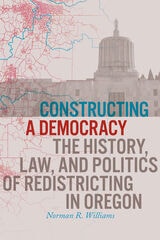
Constructing a Democracy
The History, Law, and Politics of Redistricting in OregonNorman R. Williams
Oregon State University Press, 2023
In Constructing a Democracy, legal scholar Norman Williams presents a comprehensive history of legislative and congressional redistricting in Oregon. Because redistricting impacts the representativeness of the ensuing legislative body, Oregon’s constitutional framers, legislators, and courts alike have understandably focused on developing legal rules to constrain the redistricting process. Williams is primarily interested in identifying and understanding the scope of those rules: What legal constraints have existed over time? How aggressively have the courts enforced those restraints? How have political actors undertaken the redistricting task in light of the various rules and the judicial pronouncements regarding those constraints?
The redistricting process in Oregon has not drawn national attention the way it has in states like North Carolina and Pennsylvania. But the process in Oregon is notable in several ways, including an early attention to malapportionment, the use of the initiative to reform the process, and and the impact of women leaders on the redistricting process. The Oregon process, however, has also notably lagged behind other states, particularly in considering issues of race and minority representation and preventing gerrymandering.
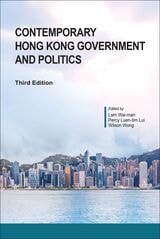
Contemporary Hong Kong Government and Politics, Third Edition
Edited by Wai-man Lam, Percy Luen-tim Lui, and Wilson Wong
Hong Kong University Press, 2024
An updated edition of a close and comprehensive look at modern Hong Kong politics up to the present.
In its third edition, Contemporary Hong Kong Government and Politics analyzes Hong Kong’s basic political institutions, mediating institutions, political actors, specific policy areas, and its relationships with the mainland and the international community. All chapters have either been significantly updated or rewritten by new contributors. This edition presents a comprehensive and systematic analysis of the main continuities and changes after the 2019 Anti-Extradition Law Amendment Bill. It examines various aspects of the Hong Kong government and politics such as the executive, the legislature, the judiciary, the civil service, district councils, and advisory and statutory bodies. It also investigates the structures of the wider society with particular attention to political parties and elections, civil society, political identity and political culture, the mass media, and public opinions.