Results by title
1272 books match the query 'Asia' and 112 start with c
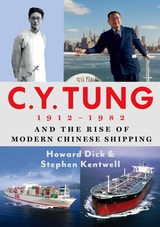
C. Y. Tung (1912–1982) and the Rise of Modern Chinese Shipping
Howard Dick and Stephen Kentwell
Hong Kong University Press, 2026
A business biography of C. Y. Tung, founder of the Orient Overseas Container Line and philanthropist.
Shanghai-born and later Hong Kong–resident shipowner Tung Chao-Yung (1912–1982) is remembered worldwide as a champion for Chinese shipping, founding the companies Chinese Maritime Transport and Island Navigation, and pioneering container shipping for Asia in Orient Overseas Container Line/OOCL. Despite coming from a humble background, by the time of his death he controlled a huge fleet of passenger liners, bulk carriers, tankers, and container ships, while also being diversified into port terminals, dockyards, banks, and prime real estate. This business biography sets out his pathway from a junior executive in the early 1930s to one of the world’s leading private shipowners. The authors argue that Tung achieved his desire to develop Chinese ocean shipping through his ability to learn, innovate, network, and devise strategies through decades of rapid technical and organizational change. He also earned respect for his generous philanthropy. After his death, sons Tung Chee-Hwa and Tung Chee-Chen were able to navigate a financial crisis, restructure the group in the face of intensifying competition in the 1980s, and grow through the challenges and opportunities of globalization and advancement in supply chain management and technology within the industry in the 1990s through 2010s. OOCL became one of the most competitive liner companies in the industry until divestment in 2017. Eight decades since their establishment, privately owned Island Navigation and, now independently, Chinese Maritime Transport continue to trade globally in dry-bulk and tanker markets. C. Y. Tung (1912–1982) and the Rise of Modern Chinese Shipping concludes with an overview of the emergence of the state-owned PRC fleet and brief histories of other multi-generational family companies.
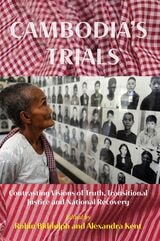
Cambodia's Trials
Contrasting Visions of Truth, Transitional Justice and National RecoveryEdited by Robin Biddulph and Alexandra Kent
National University of Singapore Press, 2023
More than four decades have passed since the end of Khmer Rouge rule in Cambodia in 1979. Even so, the country is still coming to terms with the destruction wrought by the Khmer Rouge during both the time they were in power and during the period of guerrilla resistance that lasted until 1998. The Khmer Rouge Tribunal, or the Extraordinary Chambers in the Court of Cambodia (ECCC), was established in 2006 to bring the Khmer Rouge leadership to justice. In many ways a product of the 1990s, when liberal democracy appeared to be on the rise both in Cambodia and internationally, the ECCC was imagined as a transitional justice initiative that would help ease the transition to liberal democracy.
The ECCC has long been the focus of scholarly attention in Cambodia’s recovery, but this compelling study argues that such an approach is dated, noting that the political circumstances in which the ECCC was born have since changed profoundly, both globally and locally. Cambodia’s current situation can no longer be analyzed solely in terms of transitional justice narratives or the work of the ECCC, and other ways in which Cambodians have come to terms with their past and built new lives must be considered. By decentering the ECCC in the scholarly narrative of Cambodia’s recovery, the volume’s authors offer fascinating new insights into the Khmer Rouge period and more recent years of social, cultural, and political change in Cambodia.
Camp Life Is Paradise for Freddy
A Childhood in the Dutch East Indies, 1933–1946Fred Lanzing
Ohio University Press, 2017
“Children see and hear what is there; adults see and hear what they are expected to and mainly remember what they think they ought to remember,” David Lowenthal wrote in The Past Is a Foreign Country. It is on this fraught foundation that Fred Lanzing builds this memoir of his childhood in a Japanese internment camp for Dutch colonialists in the East Indies during the World War II.
When published in the Netherlands in 2007, the book triggered controversy, if not vitriol, for Lanzing’s assertion that his time in the camp was not the compendium of horrors commonly associated with the Dutch internment experience. Despite the angry reception, Lanzing’s account corresponds more closely with the scant historical record than do most camp memoirs. In this way, Lanzing’s work is a substantial addition to ongoing discussions of the politics of memory and the powerful—if contentious—contributions that subjective accounts make to historiography and to the legacies of the past.
Lanzing relates an aspect of the war in the Pacific seldom discussed outside the Netherlands and, by focusing on the experiences of ordinary people, expands our understanding of World War II in general. His compact, beautifully detailed account will be accessible to undergraduate students and a general readership and, together with the introduction by William H. Frederick, is a significant contribution to literature on World War II, the Dutch colonial experience, the history of childhood, and Southeast Asian history.
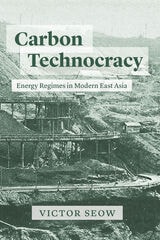
Carbon Technocracy
Energy Regimes in Modern East AsiaVictor Seow
University of Chicago Press, 2021
The coal-mining town of Fushun in China’s Northeast is home to a monstrous open pit. First excavated in the early twentieth century, this pit grew like a widening maw over the ensuing decades, as various Chinese and Japanese states endeavored to unearth Fushun’s purportedly “inexhaustible” carbon resources. Today, the depleted mine that remains is a wondrous and terrifying monument to fantasies of a fossil-fueled future and the technologies mobilized in attempts to turn those developmentalist dreams into reality.
In Carbon Technocracy, Victor Seow uses the remarkable story of the Fushun colliery to chart how the fossil fuel economy emerged in tandem with the rise of the modern technocratic state. Taking coal as an essential feedstock of national wealth and power, Chinese and Japanese bureaucrats, engineers, and industrialists deployed new technologies like open-pit mining and hydraulic stowage in pursuit of intensive energy extraction. But as much as these mine operators idealized the might of fossil fuel–driven machines, their extractive efforts nevertheless relied heavily on the human labor that those devices were expected to displace. Under the carbon energy regime, countless workers here and elsewhere would be subjected to invasive techniques of labor control, ever-escalating output targets, and the dangers of an increasingly exploited earth.
Although Fushun is no longer the coal capital it once was, the pattern of aggressive fossil-fueled development that led to its ascent endures. As we confront a planetary crisis precipitated by our extravagant consumption of carbon, it holds urgent lessons. This is a groundbreaking exploration of how the mutual production of energy and power came to define industrial modernity and the wider world that carbon made.
Carbon Technocracy
Energy Regimes in Modern East AsiaVictor Seow
University of Chicago Press, 2021
Audiobook edition
A forceful reckoning with the relationship between energy and power through the history of what was once East Asia’s largest coal mine.
The coal-mining town of Fushun in China’s Northeast is home to a monstrous open pit. First excavated in the early twentieth century, this pit grew like a widening maw over the ensuing decades, as various Chinese and Japanese states endeavored to unearth Fushun’s purportedly “inexhaustible” carbon resources. Today, the depleted mine that remains is a wondrous and terrifying monument to fantasies of a fossil-fueled future and the technologies mobilized in attempts to turn those developmentalist dreams into reality.
In Carbon Technocracy, Victor Seow uses the remarkable story of the Fushun colliery to chart how the fossil fuel economy emerged in tandem with the rise of the modern technocratic state. Taking coal as an essential feedstock of national wealth and power, Chinese and Japanese bureaucrats, engineers, and industrialists deployed new technologies like open-pit mining and hydraulic stowage in pursuit of intensive energy extraction. But as much as these mine operators idealized the might of fossil fuel–driven machines, their extractive efforts nevertheless relied heavily on the human labor that those devices were expected to displace. Under the carbon energy regime, countless workers here and elsewhere would be subjected to invasive techniques of labor control, ever-escalating output targets, and the dangers of an increasingly exploited earth.
Although Fushun is no longer the coal capital it once was, the pattern of aggressive fossil-fueled development that led to its ascent endures. As we confront a planetary crisis precipitated by our extravagant consumption of carbon, it holds urgent lessons. This is a groundbreaking exploration of how the mutual production of energy and power came to define industrial modernity and the wider world that carbon made.
Caring for Strangers
Filipino Medical Workers in AsiaMegah Amrith
National University of Singapore Press, 2017
Cartographic Japan
A History in MapsEdited by Kären Wigen, Sugimoto Fumiko, and Cary Karacas
University of Chicago Press, 2016
But this was not always the case: a thousand years ago, maps were solely a privilege of the ruling elite in Japan. Only in the past four hundred years has Japanese cartography truly taken off, and between the dawn of Japan’s cartographic explosion and today, the nation’s society and landscape have undergone major transformations. At every point, maps have documented those monumental changes. Cartographic Japan offers a rich introduction to the resulting treasure trove, with close analysis of one hundred maps from the late 1500s to the present day, each one treated as a distinctive window onto Japan’s tumultuous history.
Forty-seven distinguished contributors—hailing from Japan, North America, Europe, and Australia—uncover the meanings behind a key selection of these maps, situating them in historical context and explaining how they were made, read, and used at the time. With more than one hundred gorgeous full-color illustrations, Cartographic Japan offers an enlightening tour of Japan’s magnificent cartographic archive.
Cave of My Ancestors
Vishwakarma and the Artisans of ElloraKirin Narayan
University of Chicago Press, 2024
As a young girl in Bombay, Kirin Narayan was enthralled by her father’s stories about how their ancestors had made the ancient rock-cut cave temples at Ellora. Recalling those stories as an adult, she was inspired to learn more about the caves, especially the Buddhist worship hall known as the “Vishwakarma cave.” Immersing herself in family history, oral traditions, and works by archaeologists, art historians, scholars of Buddhism, Indologists, and Sanskritists, Narayan set out to answer the question of how this cave came to be venerated as the home of Vishwakarma, the god of making in Hindu and Buddhist traditions.
Cave of My Ancestors represents the perfect blend of Narayan’s skills as a researcher and writer. Her quest to trace her family’s stories took her to Ellora; through libraries, archives, and museums around the world; and across disciplinary borders. Equal parts scholarship, detective story, and memoir, Narayan’s book ably leads readers through centuries of history, offering a sensitive meditation on devotion, wonder, and all that connects us to place, family, the past, and the divine.

Celebrity Culture and the Entertainment Industry in Asia
Use of Celebrity and its Influence on Society, Culture and CommunicationBy Vivienne Leung, Kimmy Cheng, and Tommy Tse
Intellect Books, 2017
Through first-hand interviews with celebrities and entertainment industry practitioners, the authors discuss the social, cultural, and economic influences of celebrity. Dialogues with celebrities such as Kwok-Leung Kam, Bob Lam, Denise Ho, Hilary Tsui, and Francis Mak provide insider accounts of celebrity formation, management, and marketing in Hong Kong and Mainland China, as well as South Korea and Taiwan.
Celluloid China
Cinematic Encounters with Culture and SocietyHarry H. Kuoshu
Southern Illinois University Press, 2002
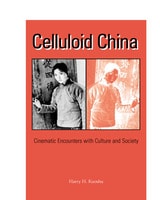
Celluloid China: Cinematic Encounters with Culture and Society by Harry H. Kuoshu is a lucid introduction to the cinema of mainland China from the early 1930s to the early 1990s. Emphasizing both film contexts and film texts, this study invites film scholars and students to a broad cinematic analysis that includes investigations of cultural, cross-cultural, intellectual, social, ethnic, and political issues. Such a holistic evaluation allows for a better understanding of both the genesis of a special kind of film art from the People’s Republic of China and the culture exemplified in those films.
The fifteen films include: Two Stage Sisters; Hibiscus Town; Farewell My Concubine; Street Angel; Three Women; Human, Woman, Demon; Judou; Girl from Hunan; Sacrificed Youth; Horse Thief; Yellow Earth; Old Well; Red Sorghum; Black Cannon Incident; and Good Morning, Beijing. Discussions of each film have an introduction, passages from the director’s own notes whenever available, and a scholarly article. Discussion questions are found in an appendix. Within its complete bibliography, the book also features a suggested reading list for Chinese film classes. Celluloid China is the first book to provide such an exhaustive study of the art and cultural context of Chinese cinema.
Censorium
Cinema and the Open Edge of Mass PublicityWilliam Mazzarella
Duke University Press, 2013
At the intersection of anthropology, media studies, and critical theory, Censorium is a pathbreaking analysis of Indian film censorship. The book encompasses two moments of moral panic: the consolidation of the cinema in the 1910s and 1920s, and the global avalanche of images unleashed by liberalization since the early 1990s. Exploring breaks and continuities in film censorship across colonial and postcolonial moments, William Mazzarella argues that the censors' obsessive focus on the unacceptable content of certain images and the unruly behavior of particular audiences displaces a problem that they constantly confront yet cannot directly acknowledge: the volatile relation between mass affect and collective meaning. Grounded in a close analysis of cinema regulation in the world's largest democracy, Censorium ultimately brings light to the elusive foundations of political and cultural sovereignty in mass-mediated societies.
Censorship and Sexuality in Bombay Cinema
By Monika Mehta
University of Texas Press, 2011
India produces an impressive number of films each year in a variety of languages. Here, Monika Mehta breaks new ground by analyzing Hindi films and exploring the censorship of gender and heterosexuality in Bombay cinema. She studies how film censorship on various levels makes the female body and female sexuality pivotal in constructing national identity, not just through the films themselves but also through the heated debates that occur in newspapers and other periodicals. The standard claim is that the state dictates censorship and various prohibitions, but Mehta explores how relationships among the state, the film industry, and the public illuminate censorship's role in identity formation, while also examining how desire, profits, and corruption are generated through the act of censoring.
Committed to extending a feminist critique of mass culture in the global south, Mehta situates the story of censorship in a broad social context and traces the intriguing ways in which the heated debates on sexuality in Bombay cinema actually produce the very forms of sexuality they claim to regulate. She imagines afresh the theoretical field of censorship by combining textual analysis, archival research, and qualitative fieldwork. Her analysis reveals how central concepts of film studies, such as stardom, spectacle, genre, and sound, are employed and (re)configured within the ambit of state censorship, thereby expanding the scope of their application and impact.
Central Asia
One Hundred Thirty Years of Russian Dominance, A Historical OverviewEdward A. Allworth, ed.
Duke University Press, 1994
Now in its third edition (it was first published in 1967 and revised in 1989), this new edition of Central Asia has been updated to include a new preface, a revised and updated bibliography, and a final chapter that brings the book up to 1994 in considering the crucial problems that stem from a deprivation of sovereign, indigenous leadership over the past 130 years. This volume provides a broad and essential background for understanding what has led up to the late twentieth-century configuration of Central Asia.
Central Peripheries
Nationhood in Central AsiaMarlene Laruelle
University College London, 2021
Committed to internationalism, Kazakhstan and other central Asian states nevertheless embrace classically nationalist conceptions of the nation-state. Their unabashed celebration of borders and citizenship challenges Western views of nationalism as a dying ideology transcended by cosmopolitanism. Drawing on twenty years of fieldwork, Central Peripheries reveals the origin of central Asian national consciousness in imaginary and ritualized efforts to grapple with the Soviet past.
Champa and the Archaeology of M? So'n (Vietnam)
Edited by Andrew Hardy, Mauro Cucarzi, and Patrizia Zolese
National University of Singapore Press, 2009
Champassak Royalty and Sovereignty
Within and between Nation-States in Mainland Southeast AsiaIan G. Baird
University of Wisconsin Press, 2024
In re-creating this story, Baird draws not only on a dazzling variety of primary sources in English, French, Lao, and Thai but also on many years spent in conversation with members of the Na Champassak family, who are now spread across a wide geographical area, from Laos and Thailand to France and the United States. Each chapter treats one historical period, identifying the Champassak approach to sovereignty during that time. Through this deep history, Baird shows how sovereign power, even within one case, takes a wide range of forms, always contingent, contested, and uneven across space and time.
Chandragupta Maurya
The Creation of a National Hero in IndiaSushma Jansari
University College London, 2023
The writing and reception of history fundamentally influence how we engage with the past, and nowhere is that more clear than in the rise from obscurity of Chandragupta Maurya (350–295 BCE), the first emperor of the Mauryan Empire. The key moment in the transformation of Chandragupta into a contemporary national icon was a peace-making meeting between Chandragupta and Seleucus, founder of the Seleucid empire and one of Alexander the Great’s generals. But no reliable account exists in early sources, and it is not even clear which ruler was victorious in battle. That uncertainty enabled British and Indian historians of the nineteenth and twentieth centuries to interpret the sources in radically different ways. With Chandragupta representing India and Seleucus standing in for Britain, British scholars argued that Seleucus defeated Chandragupta, while Indian academics contended the opposite. In India, the image of Chandragupta as an idealized hero who vanquished the foreign invader has prevailed and found expression in contemporary popular culture. In plays, films, television series, comic books, and historical novels, Chandragupta is the powerful and virtuous Hindu ruler par excellence. Sushma Jansari shows how that transformation came about and points out the lessons we can learn from it for understanding other historical figures.
Change and the Persistence of Tradition in India
Five LecturesRichard L. Park, Editor
University of Michigan Press, 1971
Changing the Subject
Feminist and Queer Politics in Neoliberal IndiaSrila Roy
Duke University Press, 2022
Cherishing Men from Afar
Qing Guest Ritual and the Macartney Embassy of 1793James L. Hevia
Duke University Press, 1995
The history of this encounter, like that of most colonial and imperial encounters, has traditionally been told from the Europeans’ point of view. In this book, James L. Hevia consults Chinese sources—many previously untranslated—for a broader sense of what Qing court officials understood; and considers these documents in light of a sophisticated anthropological understanding of Qing ritual processes and expectations. He also reexamines the more familiar British accounts in the context of recent critiques of orientalism and work on the development of the bourgeois subject. Hevia’s reading of these sources reveals the logics of two discrete imperial formations, not so much impaired by the cultural misunderstandings that have historically been attributed to their meeting, but animated by differing ideas about constructing relations of sovereignty and power. His examination of Chinese and English-language scholarly treatments of this event, both historical and contemporary, sheds new light on the place of the Macartney mission in the dynamics of colonial and imperial encounters.
Childhood Years
A MemoirTanizaki Jun'ichiro; Translated by Paul McCarthy
University of Michigan Press, 2017
Children of the Atomic Bomb
An American Physician’s Memoir of Nagasaki, Hiroshima, and the Marshall IslandsJames N. Yamazaki and Louis B. Fleming
Duke University Press, 1995
Children of the Atomic Bomb is Dr. Yamazaki’s account of a lifelong effort to understand and document the impact of nuclear explosions on children, particularly the children conceived but not yet born at the time of the explosions. Assigned in 1949 as Physician-in-Charge of the United States Atomic Bomb Casualty Commission in Nagasaki, Yamazaki had served as a combat surgeon at the Battle of the Bulge where he had been captured and held as a prisoner of war by the Germans. In Japan he was confronted with violence of another dimension—the devastating impact of a nuclear blast and the particularly insidious effects of radiation on children.
Yamazaki’s story is also one of striking juxtapositions, an account of a Japanese-American’s encounter with racism, the story of a man who fought for his country while his parents were interned in a concentration camp in Arkansas. Once the object of discrimination at home, Yamazaki paradoxically found himself in Japan for the first time as an American, part of the Allied occupation forces, and again an outsider. This experience resonates through his work with the children of Nagasaki and Hiroshima and with the Marshallese people who bore the brunt of America’s postwar testing of nuclear weapons in the Pacific.
Recalling a career that has spanned five decades, Dr. Yamazaki chronicles the discoveries that helped chart the dangers of nuclear radiation and presents powerful observations of both the medical and social effects of the bomb. He offers an indelible picture of human tragedy, a tale of unimaginable suffering, and a dedication to healing that is ultimately an unwavering, impassioned plea for peace.

China Forever
The Shaw Brothers and Diasporic CinemaEdited by Poshek Fu
University of Illinois Press, 2007
China Inside Out
Contemporary Chinese Nationalism and TransnationalismJoana Breidenbach
Central European University Press, 2005
The authors of this text believe that “areas” as assemblages of social processes requiring distinct, culture-bound explanations cannot be replaced with global theories, but that the meaning of “the area” can be different depending on the question one studies. The study of China and Chinese, in particular, is a good arena to challenge the disciplinary and geographic boundaries of conventional area studies for several reasons. First, because of the wealth of simultaneous processes of rapid political, social, and discursive change in contemporary Chinese society; second, because of the problematic relationship between state, territory, nation, and ethnicity in China; third, because China studies, perhaps more than any other area studies at the moment, is a highly competitive political and academic industry whose internal working must be critically examined. In addition, the subject of China has become one of the primary loci of contesting the meanings of globalization and the universality versus relativity of “values” and modernity.
China Marine
E. B. Sledge
University of Alabama Press, 2002
From the respected author of one of the best books on World War II combat, comes an equally captivating saga of battle recovery, healing, and homecoming.
China Marine is the long-awaited sequel to E. B. Sledge’s critically acclaimed memoir, With the Old Breed at Peleliu and Okinawa. Picking up where his previous memoir leaves off, Sledge, a young marine in the First Division, traces his company’s movements and charts his own difficult passage to peace following his horrific experiences in the Pacific. He reflects on his duty in the ancient city of Peiping (now Beijing) and recounts the difficulty of returning to his hometown of Mobile, Alabama, and resuming civilian life haunted by the shadows of close combat.
Distinguished historians have praised Sledge’s first book as the definitive rifleman’s account of World War II, ranking it with the Civil War’s Red Badge of Courage and World War I’s All Quiet on the Western Front. Although With the Old Breed ends with the surrender of Japan, marines in the Pacific were still faced with the mission of disarming the immense Japanese forces on the Asian mainland and reestablishing order. For infantrymen so long engaged in the savage and surreal world of close combat, there remained the personal tasks of regaining normalcy and dealing with suppressed memories, fears, and guilt.
In China Marine, E. B. Sledge completes his story and provides emotional closure to the searing events detailed in his first memoir. He speaks frankly about the real costs of war, emotional and psychological as well as physical, and explains the lifetime loyalties that develop between men who face fear, loss, and horror together. That bond becomes one of the newfound treasures of life after battle.
With his hallmark style of simplicity, directness, and lack of sentimentality, "Sledgehammer" has given us yet another great document of war literature.

China Marine
25th Anniversary EditionE. B. Sledge with a new foreword by John C. McManus and a new preface by John S. Sledge
University of Alabama Press, 2002
From the Pacific’s brutality to China’s uneasy peace—one Marine’s fight to reclaim himself.
In this powerful anniversary edition of China Marine, Eugene B. Sledge—acclaimed author of the classic WWII memoir With the Old Breed—offers an unforgettable portrait of a young Marine navigating the uneasy peace that followed history’s most brutal war. Already celebrated for his visceral honesty and humanity, Sledge deepened his legacy with this rare account of the U.S. occupation of North China, a period as volatile as it was transformative.
Sledge’s memoirs remain enduringly popular because they never flinch from the truth. His reflections resonate across generations, offering readers not only a veteran’s hard-won wisdom but a moving story of survival, friendship, trauma, and the long journey back to ordinary life. His life and words have become part of American cultural memory, featured prominently in both Ken Burns’s PBS series The War and the HBO production The Pacific.
This special anniversary edition honors that legacy with a new preface by his son, bestselling author John Sledge and a new foreword by the eminent military historian John McManus, who together illuminate Sledge’s continued relevance in understanding war and its aftermath.
Intimate, vivid, and deeply human, China Marine stands as a timeless testament to courage, resilience, and the costs of peace after war.
China as a Sea Power, 1127–1368
A Preliminary Survey of the Maritime Expansion and Naval Exploits of the Chinese People During the Southern Song and Yuan PeriodsLo Jung-pang
National University of Singapore Press, 2012
In the early 21st century, a strong and outward looking China is again building up its navy and seeking maritime dominance, with important implications for trade, diplomacy and naval affairs. Events will not necessarily follow the same course as in the past, but Lo Jung-pang's analysis suggests useful questions for the study of events as they unfold and decades to come.

China in Crisis, Volume 2
China's Policies in Asia and America's AlternativesEdited by Tang Tsou and Ping-ti Ho
University of Chicago Press, 1968
China in the World
Culture, Politics, and World VisionBan Wang
Duke University Press, 2022
China's Battler Poetry
Writing Like There's No TomorrowBy Maghiel van Crevel
University of Westminster Press, 2026
Three hundred million Chinese have left the countryside for the cities since the 1980s, in a flood wave of labor migration that has fueled China’s rise. Known as ‘battlers,’ they belong to a new underclass who face exploitation, discrimination, and harrowing insecurity. And they write poetry.
Battler poetry speaks of being ground down in the factory workshop, of being forced into sex work, of being robbed of your youth. It has made its way into mass media and labor activism, and developed uneasy relations with the literary establishment. It aligns with writing elsewhere in the world that shows the power of poetry as an expression of sociopolitical identity.
Who are China’s battler poets? Where do they find the time and energy, after a 12-hour shift on the assembly line or on a courier moped in big-city traffic? What is their poetry like? Where is it published? Who reads it? What happens when it travels abroad? How has the Chinese state responded? What can battler poetry tell us about the nexus of aesthetics and social experience, in a world where inequality reigns?
China’s Battler Poetry tells the gripping story of an ‘unlikely’ genre. Building on textual and cultural analysis, ethnographic fieldwork, and the collection of underground source material, it sits at the interface of the humanities and social science. It is driven by a desire to understand poetry as both art and social practice, looking at its words through the lifeworlds of its authors and the other way around.
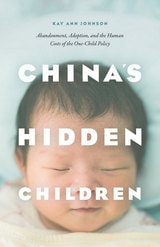
China's Hidden Children
Abandonment, Adoption, and the Human Costs of the One-Child PolicyKay Ann Johnson
University of Chicago Press, 2016
Johnson spent years talking with the Chinese parents driven to relinquish their daughters during the brutal birth-planning campaigns of the 1990s and early 2000s, and, with China’s Hidden Children, she paints a startlingly different picture. The decision to give up a daughter, she shows, is not a facile one, but one almost always fraught with grief and dictated by fear. Were it not for the constant threat of punishment for breaching the country’s stringent birth-planning policies, most Chinese parents would have raised their daughters despite the cultural preference for sons. With clear understanding and compassion for the families, Johnson describes their desperate efforts to conceal the birth of second or third daughters from the authorities. As the Chinese government cracked down on those caught concealing an out-of-plan child, strategies for surrendering children changed—from arranging adoptions or sending them to live with rural family to secret placement at carefully chosen doorsteps and, finally, abandonment in public places. In the twenty-first century, China’s so-called abandoned children have increasingly become “stolen” children, as declining fertility rates have left the dwindling number of children available for adoption more vulnerable to child trafficking. In addition, government seizures of locally—but illegally—adopted children and children hidden within their birth families mean that even legal adopters have unknowingly adopted children taken from parents and sent to orphanages.
The image of the “unwanted daughter” remains commonplace in Western conceptions of China. With China’s Hidden Children, Johnson reveals the complex web of love, secrecy, and pain woven in the coerced decision to give one’s child up for adoption and the profound negative impact China’s birth-planning campaigns have on Chinese families.
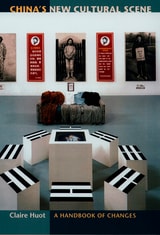
China's New Cultural Scene
A Handbook of ChangesClaire Huot
Duke University Press, 2000
Western observers who were impressed by the bravery of the demonstrators in Tiananmen Square—and stunned at the harshness of their suppression—will learn from this book how that political movement led to changes in cultural conditions and production. Attending to all the major elements of this vast nation’s high and low culture at the end of a landmark decade, Huot’s discussion ranges from the cinematic works of Zhang Yimou, Chen Kaige, and others to emerging musical forms such as rock, punk, and rap. Other topics include television, theater, and avant-garde art, the new electronic media, and subversive trends in both literature and the visual arts.
With a comprehensive index of artists and works, as well as a glossary of Chinese words, China’s New Cultural Scene will enlighten students of Chinese culture and general readers interested in contemporary Asia.
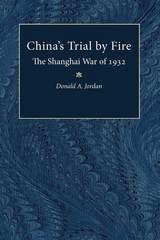
China's Trial by Fire
The Shanghai War of 1932Donald A. Jordan
University of Michigan Press, 2001
Unlike other histories' brief generalizations of the incident, this study traces the war from the initial January 28th Japanese marine raid on Chinese Shanghai. It also studies the roles played by the prevailing Japanese leaders, including the last prewar civilian Prime Minister, Emperor Hirohito, and Admiral Nomura, who was later assigned to pre-Pearl Harbor negotiations.
Not least, the work bridges scholarly boundaries by highlighting the economics of China's leading trade metropolis, Shanghai; the desperate attempts of Chinese politicians and press to manipulate anti-imperialist and anti-Japanese propaganda; and the ways in which the failure of positional trench warfare against Japanese mechanized mobility provided lessons to German observers and the Communists.
Donald Jordan has drawn from as complete a range of primary sources as are available. Both the Nanking and Taipei archives, as well as resources from Tokyo, Settlement Shanghai's police records, Washington, the League of Nations, and London were researched.
Knowing how greatly the Nationalist defense in 1932 influenced the Chinese Communists expands the relevance for scholars of this illustrated study. Others, especially those curious about the U. S. entanglement leading to Pearl Harbor, will find much more than the story of a regional skirmish.
Donald Jordan is Professor of East Asian History, Ohio University.
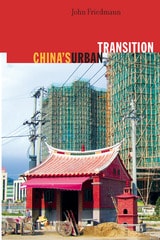
China's Urban Transition
John Friedmann
University of Minnesota Press, 2005
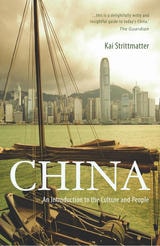
China
An Introduction to the Culture and PeopleKai Strittmatter
Haus Publishing, 2010
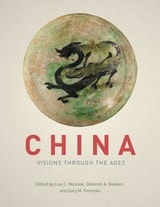
China
Visions through the AgesEdited by Lisa C. Niziolek, Deborah A. Bekken and Gary M. Feinman
University of Chicago Press, 2018
China’s long history is one of the richest and most complex in the known world, and the Cyrus Tang Hall of China offers visitors a wonderful, comprehensive survey of it through some 350 artifacts on display, spanning from the Paleolithic period to present day. Now, with China: Visions through the Ages, anyone can experience the marvels of this exhibition through the book’s beautifully designed and detailed pages. Readers will gain deeper insight into The Field Museum’s important East Asian collections, the exhibition development process, and research on key aspects of China’s fascinating history. This companion book, edited by the exhibition’s own curatorial team, takes readers even deeper into the wonders of the Cyrus Tang Hall of China and enables them to study more closely the objects and themes featured in the show. Mirroring the exhibition’s layout of five galleries, the volume is divided into five sections. The first section focuses on the Paleolithic and Neolithic periods; the second, the Bronze Age, the first dynasties, and early writing; the third, the imperial system and power; the fourth, religion and performance; and the fifth, interregional trade and the Silk Routes. Each section also includes highlights containing brief stories on objects or themes in the hall, such as the famous Lanting Xu rubbing.
With chapters from a diverse set of international authors providing greater context and historical background, China: Visions through the Ages is a richly illustrated volume that allows visitors, curious readers, and China scholars alike a chance to have an enduring exchange with the objects featured in the exhibition and with their multifaceted histories.
China’s Date Debate
How Manchurian Scholars Rewrote World War IIEmily Matson
University of Michigan Press, 2026
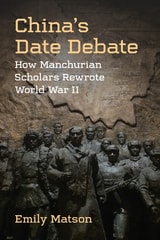
China’s Date Debate is an in-depth investigation of the Chinese Communist Party’s remapping of China’s World War II timeline from eight years (1937–1945) to fourteen years (1931–1945). Instead of the previously accepted starting date of the Marco Polo Bridge Incident on July 7, 1937, the Chinese Communist Party defined the war’s starting date as the Mukden Incident on September 18, 1931, which triggered the Japanese Kwantung Army’s invasion of Manchuria. Since the 1980s, scholars from Manchuria have demanded a fourteen-year war timeline to encompass the invasion of their homeland. By the 1990s, other scholars took notice and started to counter with claims that the eight-year timeline was the more accurate. Subsequently, a fierce “date debate” emerged between the two sides that was only resolved by the 2017 proclamation from the Ministry of Education.
Emily Matson demonstrates that the decision to set China’s World War II timeline at fourteen years was not merely a top-down decision, but was influenced by decades of Manchurian scholarship on the war. China’s Date Debate recenters Manchuria as a region of critical importance for China’s national identity today and the implications of this “date debate” on the Chinese Communist Party’s domestic legitimacy and international image.
China’s Engine of Environmental Collapse
Richard Smith
Pluto Press, 2020
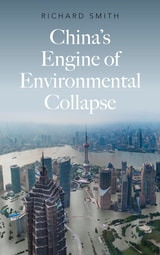
As the world hurtles towards environmental oblivion, China is leading the charge. The nation's CO2 emissions are more than twice those of the US with a GDP just two-thirds as large. China leads the world in renewable energy yet it is building new coal-fired power plants faster than renewables. The country's lakes, rivers, and farmlands are severely polluted yet China's police state can't suppress pollution, even from its own industries.
This is the first book to explain these contradictions. Richard Smith explains how the country's bureaucratic rulers are driven by nationalist-industrialist tendencies that are even more powerful than the drive for profit under 'normal' capitalism. In their race to overtake the US they must prioritise hyper-growth over the environment, even if this ends in climate collapse and eco-suicide.
Smith contends that nothing short of drastic shutdowns and the scaling back of polluting industries, especially in China and the US, will suffice to slash greenhouse gas emissions enough to prevent climate catastrophe.
China’s Foreign Places
The Foreign Presence in China in the Treaty Port Era, 1840–1943Robert Nield
Hong Kong University Press, 2015
China’s Revolutions and Intergenerational Relations
Martin K. Whyte, Editor
University of Michigan Press, 2003
Chinese American Transnational Politics
Him Mark Lai, Edited and with an Introduction by Madeline Y. Hsu
University of Illinois Press, 2010
Born and raised in San Francisco, Lai was trained as an engineer but blazed a trail in the field of Asian American studies. Long before the field had any academic standing, he amassed an unparalleled body of source material on Chinese America and drew on his own transnational heritage and Chinese patriotism to explore the global Chinese experience.
In Chinese American Transnational Politics, Lai traces the shadowy history of Chinese leftism and the role of the Kuomintang of China in influencing affairs in America. With precision and insight, Lai penetrates the overly politicized portrayals of a history shaped by global alliances and enmities and the hard intolerance of the Cold War era. The result is a nuanced and singular account of how Chinese politics, migration to the United States, and Sino-U.S. relations were shaped by Chinese and Chinese American groups and organizations.
Lai revised and expanded his writings over more than thirty years as changing political climates allowed for greater acceptance of leftist activities and access to previously confidential documents. Drawing on Chinese- and English-language sources and echoing the strong loyalties and mobility of the activists and idealists he depicts, Lai delivers the most comprehensive treatment of Chinese transnational politics to date.
Chinese Business in the Making of a Malay State, 1882-1941
Kedah and PenangWu Xiao An
National University of Singapore Press, 2010
Using Penang and Kedah as a case study, Wu draws on archival sources, family histories and an examination of legal arrangements and the press to show that personal business and business networks were not bound by the territorial borders of traditional or modern states, but extended across much of Southeast Asia and into China. His demonstration of the complexity of interactions involving new migrants, sojourners and settlers, both Chinese and non-Chinese, challenges understandings of state formation and economic growth in colonial Malaya based on ethnic stereotypes and accounts of events limited by fixed political boundaries.
Chinese Circulations
Capital, Commodities, and Networks in Southeast AsiaEric Tagliacozzo and Wen-Chin Chang, eds.
Duke University Press, 2011
Contributors. Leonard Blussé, Wen-Chin Chang, Lucille Chia, Bien Chiang, Nola Cooke, Jean DeBernardi, C. Patterson Giersch, Takeshi Hamashita, Kwee Hui Kian, Li Tana, Lin Man-houng, Masuda Erika, Adam McKeown, Anthony Reid , Sun Laichen, Heather Sutherland, Eric Tagliacozzo, Carl A. Trocki, Wang Gungwu, Kevin Woods, Wu Xiao
Chinese Migrant Networks and Cultural Change
Peru, Chicago, and Hawaii 1900-1936Adam McKeown
University of Chicago Press, 2001
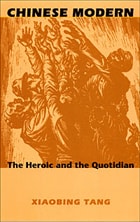
Chinese Modern
The Heroic and the QuotidianXiaobing Tang
Duke University Press, 2000
Tang uncovers crucial clues to modern Chinese literary and cultural practices through readings of Wu Jianren’s 1906 novel The Sea of Regret and works by canonical writers Lu Xun, Ding Ling, and Ba Jin. For the midcentury, he broadens his investigation by considering theatrical, cinematic, and visual materials in addition to literary texts. His reading of the 1963 play The Young Generation reveals the anxiety and terror underlying the exhilarating new socialist life portrayed on the stage. This play, enormously influential when it first appeared, illustrates the utopian vision of China’s lyrical age and its underlying discontents—both of which are critical for understanding late-twentieth-century China. Tang closes with an examination of post–Cultural Revolution nostalgia for the passion of the lyrical age.
Throughout Chinese Modern Tang suggests a historical and imaginative affinity between apparently separate literatures and cultures. He thus illuminates not only Chinese modernity but also the condition of modernity as a whole, particularly in light of the postmodern recognition that the market and commodity culture are both angel and devil.
This elegantly written volume will be invaluable to students of China, Asian studies, literary criticism, and cultural studies, as well as to readers who study modernity.
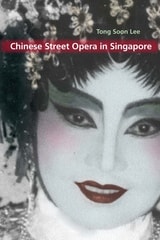
Chinese Street Opera in Singapore
Tong Soon Lee
University of Illinois Press, 2009
Since Singapore declared independence from Malaysia in 1965, Chinese street opera has played a significant role in defining Singaporean identity. Carefully tracing the history of amateur and professional performances in Singapore, Tong Soon Lee reflects on the role of street performance in fostering cultural nationalism and entrepreneurship. He explains that the government welcomes Chinese street opera performances because they combine tradition and modernism and promote a national culture that brings together Singapore's four main ethnic groups--Eurasian, Malay, Chinese, and South Asian.
Chinese Street Opera in Singapore documents the ways in which this politically motivated art form continues to be influenced and transformed by Singaporean politics, ideology, and context in the twenty-first century. By performing Chinese street opera, amateur troupes preserve their rich heritage, underscoring the Confucian mind-set that a learned person engages in the arts for moral and unselfish purposes. Educated performers also control behavior, emotions, and values. They are creative and innovative, and their use of new technologies indicates a modern, entrepreneurial spirit. Their performances bring together diverse ethnic groups to watch and perform, Lee argues, while also encouraging a national attitude focused on both remembering the past and preparing for the future in Singapore.
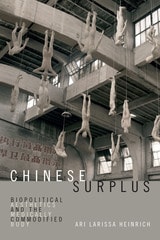
Chinese Surplus
Biopolitical Aesthetics and the Medically Commodified BodyAri Larissa Heinrich
Duke University Press, 2018
Chinese Visions of World Order
Tianxia, Culture, and World PoliticsBan Wang, editor
Duke University Press, 2017
Contributors. Daniel A. Bell, Chishen Chang, Kuan-Hsing Chen, Prasenjit Duara, Hsieh Mei-yu, Haiyan Lee, Mark Edward Lewis, Lin Chun, Viren Murthy, Lisa Rofel, Ban Wang, Wang Hui, Yiqun Zhou
Choosing Revolution
Chinese Women Soldiers on the Long MarchHelen Praeger Young
University of Illinois Press, 2001
Enormously rich in detail, Young's Choosing Revolution reveals the complex interplay between women's experiences and the official, almost mythic version of the Long March. In addition to their riveting stories of the march itself, Young's subjects reveal much about what it meant in China to grow up female and, in many cases, poor during the first decades of the twentieth century. In speaking about the work they did and how they adapted to the demands of being a soldier, these women--both educated individuals who were well-known leaders and illiterate peasants--reveal the Long March as only one of many segments of the revolutionary paths they chose.
Against a background of diverse perspectives on the Long March, Young presents the experiences of four women in detail: one who brought her infant daughter with her on the Long March, one who gave birth during the march, one who was a child participant, and one who attended medical school during the march. Young also includes the stories of three women who did not finish the Long March. Her unique record of ordinary women in revolutionary circumstances reveals the tenacity and resilience that led these individuals far beyond the limits of most Chinese women's lives.
Christian Converts and Social Protests in Meiji Japan
Irwin Scheiner
University of Michigan Press, 2002