Results by title
788 books match the query 'Caribbean & Latin American' and 78 start with c
Campaigns and Voters in Developing Democracies
Argentina in Comparative PerspectiveEdited by Noam Lupu, Virginia Oliveros, and Luis Schiumerini
University of Michigan Press, 2019
Can Literature Promote Justice?
Trauma Narrative and Social Action in Latin American TestimonioKimberly A. Nance
Vanderbilt University Press, 2006
The advent of the testimonio--loosely, a political autobiography of a Latin American activist who hopes, through the telling of her life story, to bring about change--was met with a great deal of excitement by scholars who posited it as a radical new form of literature. Those accolades were almost immediately followed by a series of critical problems. In what sense were testimonios "true"? What right did privileged scholars in the U.S. have to engage accounts of suffering with traditional modes of criticism? Were questions of veracity or aesthetics more important? Were these texts autobiography or political screeds? It seemed critics didn't know quite what to make of the testimonio and so, after a brief bout of engagement, disregarded it.
Nance, however, argues that any form as prolific as the testimonio is well worth examining and that these questions, rather than being insurmountable, are exactly the questions with which scholars ought to be wrestling. If, as critics claim, that the testimonio is one of the most pervasive contemporary Latin American cultural genres, then it is high time for a comprehensive study of the genre such as Nance's.

Cannibal Translation
Literary Reciprocity in Contemporary Latin AmericaIsabel C. Gómez
Northwestern University Press, 2023
Winner of the 2024 ACLA Harry Levin Prize • Honorable Mention MLA Katherine Singer Kovacs Prize
A bold comparative study illustrating the creative potential of translations that embrace mutuality and resist assimilation
Cannibal translators digest, recombine, transform, and trouble their source materials. Isabel C. Gómez makes the case for this model of literary production by excavating a network of translation projects in Latin America that includes canonical writers of the twentieth century, such as Haroldo and Augusto de Campos, Rosario Castellanos, Clarice Lispector, José Emilio Pacheco, Octavio Paz, and Ángel Rama. Building on the avant-garde reclaiming of cannibalism as an Indigenous practice meant to honorably incorporate the other into the self, these authors took up Brazilian theories of translation in Spanish to fashion a distinctly Latin American literary exchange, one that rejected normative and Anglocentric approaches to translation and developed collaborative techniques to bring about a new understanding of world literature.
By shedding new light on the political and aesthetic pathways of translation movements beyond the Global North, Gómez offers an alternative conception of the theoretical and ethical challenges posed by this artistic practice. Cannibal Translation: Literary Reciprocity in Contemporary Latin America mobilizes a capacious archive of personal letters, publishers’ records, newspapers, and new media to illuminate inventive strategies of collectivity and process, such as untranslation, transcreation, intersectional autobiographical translation, and transpeaking. The book invites readers to find fresh meaning in other translational histories and question the practices that mediate literary circulation.
Cannibal Writes
Eating Others in Caribbean and Indian Ocean Women's WritingNjeri Githire
University of Illinois Press, 2014
In Cannibal Writes, Njeri Githire concentrates on the gendered and sexualized dimensions of these visceral metaphors of consumption in works by women writers from Haiti, Jamaica, Mauritius, and elsewhere. Employing theoretical analysis and insightful readings of English- and French-language texts, she explores the prominence of alimentary-related tropes and their relationship to sexual consumption, writing, global geopolitics and economic dynamics, and migration. As she shows, the use of cannibalism in particular as a central motif opens up privileged modes for mediating historical and sociopolitical issues.
Ambitiously comparative, Cannibal Writes ranges across the works of well-known and lesser known writers to tie together two geographic and cultural spaces that have much in common but are seldom studied in parallel.
Capital Fictions
The Literature of Latin America's Export AgeEricka Beckman
University of Minnesota Press, 2012
Between 1870 and 1930, Latin American countries were incorporated into global capitalist networks like never before, mainly as exporters of raw materials and importers of manufactured goods. During this Export Age, entire regions were given over to the cultivation of export commodities such as coffee and bananas, capital and labor were relocated to new production centers, and barriers to foreign investment were removed. Capital Fictions investigates the key role played by literature in imagining and interpreting the rapid transformations unleashed by Latin America’s first major wave of capitalist modernization.
Using an innovative blend of literary and economic analysis and drawing from a rich interdisciplinary archive, Ericka Beckman provides the first extended evaluation of Export Age literary production. She traces the emergence of a distinct set of fictions, fantasies, and illusions that accompanied the rise of export-led, dependent capitalism. These “capital fictions” range from promotional pamphlets for Guatemalan coffee and advertisements for French fashions, to novels about stock market collapse in Argentina and rubber extraction in the Amazon.
Beckman explores how Export Age literature anticipated some of the key contradictions faced by contemporary capitalist societies, including extreme financial volatility, vast social inequality, and ever-more-intense means of exploitation. Questioning the opposition between culture and economics in Latin America and elsewhere, Capital Fictions shows that literature operated as a powerful form of political economy during this period.
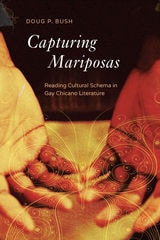
Capturing Mariposas
Reading Cultural Schema in Gay Chicano LiteratureDoug P. Bush
The Ohio State University Press, 2019
In Capturing Mariposas: Reading Cultural Schema in Gay Chicano Literature, Doug P. Bush looks at the book as only the beginning, considering how this literature has the power to bring understanding to disparate groups, speak truth about repressed sexuality and repressive communities, and recast traditional spaces as ones of inclusion, all through the idea of the cultural schema. Integrating elements of narratology and cognitive studies of literature, the cultural schema speaks to how these authors challenge, reaffirm, and transform commonly held experiences of gay Chicanos—or potentially any audience who reads their works. Focusing on twenty-first-century writers such as Manuel Muñoz, Rigoberto González, and Alex Espinoza, Bush examines the cultural schema of their works and then moves toward a more holistic discussion of the publishing and political implications of this genre. In addition to Bush’s important scholarship, the book includes extensive interviews with the authors themselves.
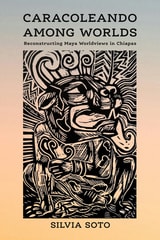
Caracoleando Among Worlds
Reconstructing Maya Worldviews in ChiapasSilvia Soto
University of Arizona Press, 2024
This shared vision emerges in Caracoleando Among Worlds, which provides an in-depth analysis of poetry, short stories, and one of the first novels written by a Maya Tsotsil writer of Chiapas alongside close readings of the EZLN’s six declarations of the Lacandon Jungle. Themes echoing ancestral connections, informing epistemologies, and sustaining cultural and spiritual practices emerge and weave the texts to each other. The work brings into the conversation literature that has been translated into English for the first time and places Maya writers of Chiapas in discussion with other Native American and Indigenous scholars.
This work shows how literature, culture, and activism intertwine, and offers a compelling narrative that transcends boundaries and fosters a deeper understanding of Maya identities and resilience.
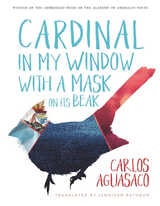
Cardinal in My Window with a Mask on Its Beak
Carlos Aguasaco, Translated by Jennifer Rathbun
University of Arizona Press, 2022
A first-generation immigrant to the United States, Aguasaco embraces his transborder/transnational/intercultural identity by building a bridge across time and distance to unite the great voices of the Renaissance with his lyrical poems. The collection offers bold and fascinating dialogue with Spanish authors such as Juan Boscán, Francisco de Quevedo, Garcilaso de la Vega, and Sor Juana Inés de la Cruz. The poems examine the fundamental liberties inherent to humanity through stunning verse. In a quest for freedom, the poems openly criticize the treatment of immigrants in the United States, drawing poignant parallels with human rights abuses throughout history.
Cardinal in My Window with a Mask on Its Beak brings potent voices of the past to life in poems that critically examine the present and future of the human experience.
Caribbean American Narratives of Belonging
Vivian Nun Halloran
The Ohio State University Press, 2023
In Caribbean American Narratives of Belonging, Vivian Nun Halloran analyzes memoirs, picture books, comic books, young adult novels, musicals, and television shows through which Caribbean Americans recount and celebrate their contributions to contemporary politics, culture, and activism in the United States. The writers, civil servants, illustrators, performers, and entertainers whose work is discussed here show what it is like to fit in and be included within the body politic. From civic memoirs by Sonia Sotomayor and others, to West Side Story, Hamilton, and Into the Spider-Verse, these texts share a forward-looking perspective, distinct from the more nostalgic rhetoric of traditional diasporic texts that privilege connections to the islands of origin.
There is no one way of being Caribbean. Diasporic communities exhibit a broad spectrum of ethnic, racial, religious, linguistic, and political qualities. Claiming a Caribbean American identity asks wider society to recognize and affirm hybridity in ways that challenge binaristic conceptions of race and nationality. Halloran provides a common language and critical framework to discuss the achievements of members of the Caribbean diaspora and their considerable cultural and political capital as evident in their contributions to literature and popular culture.
Caribbean Inhospitality
The Poetics of Strangers at HomeNatalie Lauren Belisle
Rutgers University Press, 2025
Caribbean Literary Discourse
Voice and Cultural Identity in the Anglophone CaribbeanBarbara Lalla
University of Alabama Press, 2013
Caribbean Literary Discourse opens the challenging world of language choices and literary experiments characteristic of the multicultural and multilingual Caribbean. In these societies, the language of the master— English in Jamaica and Barbados—overlies the Creole languages of the majority. As literary critics and as creative writers, Barbara Lalla, Jean D’Costa, and Velma Pollard engage historical, linguistic, and literary perspectives to investigate the literature bred by this complex history. They trace the rise of local languages and literatures within the English speaking Caribbean, especially as reflected in the language choices of creative writers.
The study engages two problems: first, the historical reality that standard metropolitan English established by British colonialists dominates official economic, cultural, and political affairs in these former colonies, contesting the development of vernacular, Creole, and pidgin dialects even among the region’s indigenous population; and second, the fact that literary discourse developed under such conditions has received scant attention.
Caribbean Literary Discourse explores the language choices that preoccupy creative writers in whose work vernacular discourse displays its multiplicity of origins, its elusive boundaries, and its most vexing issues. The authors address the degree to which language choice highlights political loyalties and tensions; the politics of identity, self-representation, and nationalism; the implications of code-switching—the ability to alternate deliberately between different languages, accents, or dialects—for identity in postcolonial society; the rich rhetorical and literary effects enabled by code-switching and the difficulties of acknowledging or teaching those ranges in traditional education systems; the longstanding interplay between oral and scribal culture; and the predominance of intertextuality in postcolonial and diasporic literature.

Caribbean Literature After Independence
The Case of Earl LovelaceEdited by Bill Schwarz
University of London Press, 2008
Louis), Chris Campbell (Queen Mary, University of London), Louis James (emeritus professor, University of Kent), Nicole King (Royal Holloway, University of London), Aaron Love (New York University), Patricia Murray (London Metropolitan University), James Procter (Newcastle University), Kate Quinn (Institute for the Study of the Americas, University of London), Tina K. Ramnarine (Royal Holloway, University of London), Bill Schwarz (Queen Mary, University of London), Lawrence Scott (University of Trinidad and Tobago), and John Thieme (University of East Anglia).
Caribbean Migrations
The Legacies of ColonialismAnke Birkenmaier
Rutgers University Press, 2021
With mass migration changing the configuration of societies worldwide, we can look to the Caribbean to reflect on the long-standing, entangled relations between countries and areas as uneven in size and influence as the United States, Cuba, Hispaniola, Puerto Rico, and Jamaica. More so than other world regions, the Caribbean has been characterized as an always already colonial region. It has long been a key area for empires warring over influence spheres in the new world, and where migration waves from Africa, Europe, and Asia accompanied every political transformation over the last five centuries. In Caribbean Migrations, an interdisciplinary group of humanities and social science scholars study migration from a long-term perspective, analyzing the Caribbean's "unincorporated subjects" from a legal, historical, and cultural standpoint, and exploring how despite often fractured public spheres, Caribbean intellectuals, artists, filmmakers, and writers have been resourceful at showcasing migration as the hallmark of our modern age.
Caribbean Women Writers
Essays from the First International ConferenceSelwyn R. Cudjoe
University of Massachusetts Press, 1990
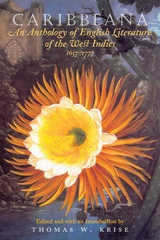
Caribbeana
An Anthology of English Literature of the West Indies, 1657-1777Edited by Thomas W. Krise
University of Chicago Press, 1999
Caribbeana offers invaluable period commentaries on slavery, colonialism, gender relations, African and European history, natural history, agriculture, and medicine. Highlights include several of the earliest protests against slavery; a superb ode by the Cambridge-educated Afro-Jamaican poet Francis Williams; James Grainger's extended georgic poem, The Sugar Cane; Frances Seymour's poignant tale of the Englishman Inkle who sells his Indian savior-lover Yarico into slavery; and several descriptions of the West Indies during the early years of settlement.

Carlos Fuentes, Mexico, and Modernity
Maarten van Delden
Vanderbilt University Press, 1998
Van Delden's thorough command of the subject matter, his innovative and sometimes iconoclastic conclusions, and his clear and engaging writing style make this study more than just an interpretation of Fuentes's work. Carlos Fuentes, Mexico, and Modernity offers nothing less than a comprehensive analysis of Fuentes's intellectual development in the context of modern Mexican political and cultural life.
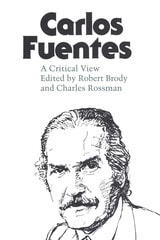
Carlos Fuentes
A Critical ViewEdited by Robert Brody and Charles Rossman
University of Texas Press, 1982
Carlos Fuentes is a master of modern world literature. With the translation of his major works into English and other languages, his reputation has surpassed the boundaries of his native Mexico and of Hispanic literature and has become international. Now each new novel stimulates popular and scholarly reviews in periodicals from Mexico City and Buenos Aires to Paris and New York.
Carlos Fuentes: A Critical View is the first full-scale examination in English of this major writer's work. The range and diversity of this critical view are remarkable and reflect similar characteristics in the creative work of Carlos Fuentes, a man of formidable intellectual energy and curiosity.
The whole of Fuentes' work is encompassed by Luis Leal as he explores history and myth in the writer's narrative. Insightful new views of single works are provided by other well-known scholars, such as Roberto González Echevarría, writing on Fuentes' extraordinary Terra Nostra, and Margaret Sayers Peden, exploring Distant Relations, for which she served as authorized translator. Here too are fresh approaches to Fuentes' other novels, among them Where the Air Is Clear, Aura, and The Hydra Head, as well as an examination by John Brushwood of the writer's short fiction and a look by Merlin Forster at Fuentes the playwright. Lanin Gyurko reaches outside Fuentes' canon for his fascinating study of the influence of Orson Welles' Citizen Kane on The Death of Artemio Cruz. Manuel Durán and George Wing consider Fuentes in his role as critic of both literature and art.
Carlos Fuentes: A Critical View has been prepared with the writer's many English-speaking readers in mind. Quotations are most frequently from standard, readily available English translations of Fuentes' works. A valuable chronology of the writer's life rounds off the volume.
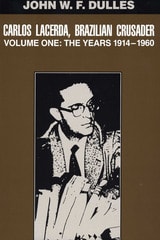
Carlos Lacerda, Brazilian Crusader
Volume I: The Years 1914-1960By John W. F. Dulles
University of Texas Press, 1991
Playwright, journalist, and spectacularly successful governor, Carlos Lacerda was Brazil's foremost orator in the 20th century and its most controversial politician. He might have become president in the 1960s had not the military taken over. In the words of eminent historian José Honório Rodrigues, "No one person influenced the Brazilian historical process as much as Carlos Lacerda from 1945 to 1968."
In this volume, the first of a two-volume biography, Professor Dulles paints a portrait of a rebellious youth, who had the willfulness of his prominent father and who crusaded for Communism before becoming its most outspoken foe. Recalling Lacerda's rallying cry, "Brazil must be shaken up," Dulles traces the career of the journalist whose unsparing attacks on the men in power led authorities to imprison him and employ thugs who pummeled him physically. The story covers events in which Lacerda helped alter Brazil, such as the redemocratization in 1945 and his revelation of scandals in high places in the early 1950s. An unsuccessful attempt by government men to murder him in 1954 led to the suicide of President Getulio Vargas in 1954.
Lacerda's spirited oratory helped him become Brazil's most popular congressman, but it scared the rulers of Brazil and they prohibited the broadcast of his speeches after he returned from exile in 1956. Their effort to deprive him of his mandate stirred the entire nation and culminated in one of the most dramatic sessions ever held in the Chamber of Deputies.
Dulles, who knew Lacerda well and had access to his papers, sheds light on Lacerda the man, ardent in courtship and in all his undertakings, intellectually restless, and scornful of routine and mediocrity. Lacerda had a vitriolic pen that made bitter enemies, but, as disclosed in these pages, his courage and incorruptibility attracted an enthusiastic following, evident in the landslide election victories that brought him seats on Rio de Janeiro's city council and in the federal Congress.
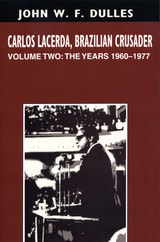
Carlos Lacerda, Brazilian Crusader
Volume II: The Years 1960-1977By John W. F. Dulles
University of Texas Press, 1991
From reviews of Volume I:
"Brazilian Crusader is no doubt the best biography yet produced on Lacerda and the second volume . . . is certainly worth waiting for."
—Luso-Brazilian Review
Journalist and spectacularly successful governor, Carlos Lacerda was Brazil's foremost orator in the 20th century and its most controversial politician. He might have become president in the 1960s had not the military taken over.
In the first volume, John F. W. Dulles paints a portrait of a rebellious youth, who had the willfulness of his prominent father and who crusaded for Communism before becoming its most outspoken foe. Recalling Lacerda's rallying cry, "Brazil must be shaken up," Dulles traces the career of the journalist whose unsparing attacks on the men in power led authorities to imprison him and employ thugs who pummeled him physically. Lacerda's spirited oratory helped him become Brazil's most popular congressman, but it scared the rulers of Brazil, who prohibited the broadcast of his speeches after he returned from exile in 1956. Their effort to deprive him of his mandate stirred the entire nation and culminated in one of the most dramatic sessions ever held in the Chamber of Deputies.
In the second and final volume, Dulles explores the political and private life of Lacerda from 1960, when he became governor of Brazil's Guanabara state, until his death in 1977. Dulles focuses particularly on the years 1960 to 1968, in which Lacerda played a central role in some of the most drastic political changes that Brazil has experienced in this century.
Lacerda's story ranges from the headlines constantly generated by his political attacks and journalistic sensationalism to private moments of personal tragedy. In telling his story, Dulles draws on hundreds of interviews, as well as extensive research in press archives, Lacerda's public papers, and the private collections of Lacerda's family and associates. This material paints a compelling portrait of an honest administrator who alienated top figures in politics, the press, and the military.
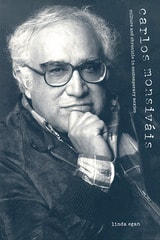
Carlos Monsiváis
Culture and Chronicle in Contemporary MexicoLinda Egan
University of Arizona Press, 2001
One of Mexico’s foremost social and political chroniclers and its most celebrated cultural critic, Carlos Monsiváis has read the pulse of his country over the past half century. The author of five collections of literary journalism pieces called crónicas, he is perhaps best known for his analytic and often satirical descriptions of Mexico City’s popular culture.
This comprehensive study of Monsiváis’s crónicas is the first book to offer an analysis of these works and to place Monsiváis’s work within a theoretical framework that recognizes the importance of his vision of Mexican culture. Linda Egan examines his ideology in relation to theoretical postures in Latin America, the United States, and Europe to cast Monsiváis as both a heterodox pioneer and a mainstream spokesman. She then explores the poetics of the contemporary chronicle in Mexico, reviewing the genre’s history and its relation to other narrative forms. Finally, she focuses on the canonical status of Monsiváis’s work, devoting a chapter to each of his five principal collections.
Egan argues that the five books that are the focus of her study tell a story of ever-renewing suspense: we cannot know “the end” until Monsiváis is through constructing his literary project. Despite this, she observes, his work between 1970 and 1995 documents important discoveries in his search for causes, effects, and deconstructions of historical obstacles to Mexico’s passage into modernity.
While anthropologists and historians continue to introduce new paradigms for the study of Mexico’s cultural space, Egan’s book provides a reflexive twist by examining the work of one of the thinkers who first inspired such a critical movement. More than an appraisal of Monsiváis, it offers a valuable discussion of theoretical issues surrounding the study of the chronicle as it is currently practiced in Mexico. It balances theory and criticism to lend new insight into the ties between Mexican society, social conscience, and literature.
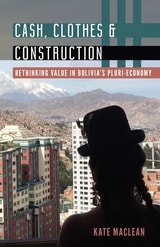
Cash, Clothes, and Construction
Rethinking Value in Bolivia's Pluri-economyKate Maclean
University of Minnesota Press, 2023
A groundbreaking feminist perspective on Movimiento al Socialismo (MAS) rule in Bolivia and the country’s radical transformation under Evo Morales
The presidency of Evo Morales in Bolivia (2006–2019) has produced considerable academic scholarship, much of it focused on indigenous social movements or extractivism, and often triumphalist about the successes of Morales’s Movimiento al Socialismo (MAS). Turning a new lens on the movement, Cash, Clothes, and Construction presents the first gender-based analysis of “pluri-economy,” a central pillar of Bolivia’s program under Morales, evaluating the potential of this vision of “an economy where all economies fit” to embrace feminist critiques of capitalism and economic diversity.
Based on more than twelve years of empirical research exploring the remarkable transformations in Bolivia since 2006, this book focuses on three sectors—finance, clothing, and construction—in which indigenous women have defied gendered expectations. Kate Maclean presents detailed case studies of women selling secondhand high street clothes from the United States in the vast, peri-urban markets of Bolivian cities; Aymaran designers of new pollera (traditional Andean dress) fashions, one of whom exhibited her collection in New York City; and the powerful and rich chola paceña, whose real estate investments have transformed the cultural maps of La Paz and El Alto.
Cash, Clothes, and Construction offers a gendered analysis of the mission of MAS to dismantle neoliberalism and decolonize politics and economy from the perspective of the Indigenous women who have radically transformed Bolivia’s economy from the ground up.
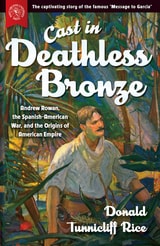
Cast in Deathless Bronze
Andrew Rowan, the Spanish-American War, and the Origins of American EmpireDonald Tunnicliff Rice
West Virginia University Press, 2016
Donald Tunnicliff Rice reveals the facts behind the story of “A Message to García” while using Rowan’s biography as a window into the history of the Spanish-American War, the Philippine War, and the Moro Rebellion. The result is a compellingly written narrative containing many details never before published in any form, and also an accessible perspective on American diplomatic and military history in the late nineteenth and early twentieth centuries.

Caste War Now and Never
Unreading Gender, Race, and Land in YucatánS. B. West
University of Arizona Press, 2026
In Caste War Now and Never scholar S. B. West considers Yucatán’s nineteenth-century Caste War, the longest and most violent Indigenous uprising of the Western Hemisphere, to argue that it actually never occurred.
Instead, West writes that the violent events grouped under the “Caste War” label must be understood through alternative frameworks that resist the emergent logics of race war and include related regulatory matrices like gender and land. Through this lens, the Caste War emerges as a discursive construct rooted in an anti-Indigenous archive that served the political interests of a frustrated regional elite during the rise of liberalism and nationhood. West argues that Caste War discourse unfolds as a technology that mobilized and legitimized genocidal actions against racialized rebels and inspired assimilation into hegemonic political and social structures.
In the second half of the book, West looks at the Caste War to engage its contemporary polysemic nature through close readings of Yucatec Maya texts, stories, and other forms of knowledge production. These sources reframe the Caste War as an important part of a framework of resistance that defies colonial time and reclaims narrative control of its events.
Caste War Now and Never captures how Maya communities understand the conflict as ongoing and demonstrates that although the Caste War never occurred as such, it continues to endure presently.
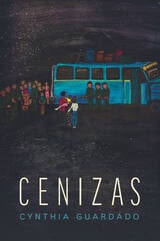
Cenizas
PoemsCynthia Guardado
University of Arizona Press, 2022
Guardado crafted the poems in Cenizas over a ten-year period, often traveling to El Salvador for research and to conduct interviews. The Salvadoran Civil War haunts the pages of this collection as it unflinchingly explores war, its aftermath, and the bittersweet legacies that are passed down from one generation to the next. The poems mourn those who were lost and honor the strength of the speaker’s ancestors. “All my people have been born from the ashes of volcanoes,” she writes, invoking a family lineage that has endured the atrocities committed against them. Even so, El Salvador keeps pulling the speaker back—and despite warnings of danger, she still manages to find beauty among the ruins.
Challenged Sovereignty
The Impact of Drugs, Crime, Terrorism, and Cyber Threats in the CaribbeanIvelaw Lloyd Griffith
University of Illinois Press, 2024
Informed and up to date, Challenged Sovereignty explains the effects of today’s globalized problems on the contemporary Caribbean.
Challenging the Black Atlantic
The New World Novels of Zapata Olivella and GonçalvesJohn T. Maddox IV
Bucknell University Press, 2021
Published by Bucknell University Press. Distributed worldwide by Rutgers University Press.
Changes in the Landscape
Humans and Nature in Nineteenth-Century Latin AmericaEdited by Jennifer L. French
Vanderbilt University Press, 2024
Ranging from the immediate aftermath of the Spanish‑American Wars of Independence (1810–1826) to the early twentieth century (1925), the volume’s essays cover a wide variety of genres and forms of cultural production, from José Hernández’s epic poem Martín Fierro to prose fiction, painting and photography, and the personal albums compiled by Spanish-American women. Individually and collectively, the essays engage with scientific writing as both a discourse of power and a source of potentially significant, even revelatory information about human and nonhuman nature. Changes in the Landscape enables readers to more fully understand the transition from colonial regimes to the ecocidal extractivism of the export boom (1870–1930) by drawing out and analyzing some of the cognitive resources and rhetorical strategies that were available to imagine, protest, or enact new norms and expectations regarding the relations between human and nonhuman life, be it the life of wildflowers, waterfalls, or Cuba’s Ciénaga de Zapata.
Changing Birth in the Andes
Culture, Policy, and Safe Motherhood in PeruLucia Guerra-Reyes
Vanderbilt University Press, 2019
Peru's Intercultural Birthing Policy of 2005 was intended to solve these longstanding issues by recognizing indigenous cultural values and making biomedical care more accessible and desirable for indigenous women. Yet many difficulties remain.
Guerra-Reyes also gives ethnographic attention to health care workers. She explains the class and educational backgrounds of traditional birth attendants and midwives, interviews doctors and health care administrators, and describes their interactions with local families. Interviews with national policy makers put the program in context.
Changing the Subject
Writing Women across the African DiasporaK. Merinda Simmons
The Ohio State University Press, 2014
The starting point for this study is the nineteenth-century Caribbean narrative The History of Mary Prince (1831). Simmons puts Prince’s narrative in conversation with three twentieth-century novels: Zora Neale Hurston’s Their Eyes Were Watching God, Gloria Naylor’s Mama Day, and Maryse Condé’s I, Tituba, Black Witch of Salem. She incorporates autobiography theory to shift the critical focus from the object of study—slave histories—to the ways people talk about those histories and to the guiding interests of such discourses. In its reframing of women’s migration narratives, Simmons’s study unsettles theoretical certainties and disturbs the very notion of a cohesive diaspora.
Channeling Knowledges
Water and Afro-Diasporic Spirits in Latinx and Caribbean WorldsRebeca L. Hey-Colón
University of Texas Press, 2023
2024 Honorable Mention, Isis Duarte Book Prize, Haiti/ Dominican Republic section, Latin American Studies Association
How water enables Caribbean and Latinx writers to reconnect to their pasts, presents, and futures.
Water is often tasked with upholding division through the imposition of geopolitical borders. We see this in the construction of the Rio Grande/Río Bravo on the US-Mexico border, as well as in how the Caribbean Sea and the Pacific Ocean are used to delineate the limits of US territory. In stark contrast to this divisive view, Afro-diasporic religions conceive of water as a place of connection; it is where spiritual entities and ancestors reside, and where knowledge awaits.
Departing from the premise that water encourages confluence through the sustainment of contradiction, Channeling Knowledges fathoms water’s depth and breadth in the work of Latinx and Caribbean creators such as Mayra Santos-Febres, Rita Indiana, Gloria Evangelina Anzaldúa, and the Border of Lights collective. Combining methodologies from literary studies, anthropology, history, and religious studies, Rebeca L. Hey-Colón’s interdisciplinary study traces how Latinx and Caribbean cultural production draws on systems of Afro-diasporic worship—Haitian Vodou, La 21 División (Dominican Vodou), and Santería/Regla de Ocha—to channel the power of water, both salty and sweet, in sustaining connections between past, present, and not-yet-imagined futures.
Checkerboards and Shatterbelts
The Geopolitics of South AmericaBy Philip Kelly
University of Texas Press, 1997
Geography has always played a major role in world politics. In this study, Philip Kelly maps the geopolitics of South America, a continent where relative isolation from the power centers in North America and Eurasia and often forbidding internal terrain have given rise to a fascinating and unique geopolitical structure.
Kelly uses the geographical concepts of "checkerboards" and "shatterbelts" to characterize much of South America's geopolitics and to explain why the continent has never been unified nor dominated by a single nation. This approach accounts for both historical relationships among South American countries and for such current situations as Brazil's inability to extend its authority across the continent from Atlantic to Pacific, its traditional competition with Argentina, its territorial expansion toward the continental heartlands, its encirclement by neighbors fearful of such expansion, and its recent rapprochement with Argentina.
An important component of this book is the incorporation of the thinking and writing of South American geopolitical analysts, which leads to an interesting inventory of viewpoints on frontier conflicts, territorial expansion, industrial development, economic cooperation, and United States and European relations. Kelly's findings will be important reading for geographers, political scientists, and students and scholars of Latin American history.
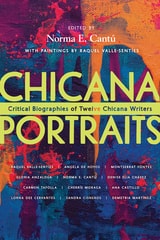
Chicana Portraits
Critical Biographies of Twelve Chicana WritersEdited by Norma E. Cantú; With paintings by Raquel Valle-Sentíes
University of Arizona Press, 2023
Artist Raquel Valle-Sentíes’s portraits bring visual dimension, while essays delve deeply into the authors’ lives for details that inform their literary, artistic, feminist, and political trajectories and sensibilities. The collection brilliantly intersects artistic visual and literary cultural productions, allowing complex themes to emerge, such as the fragility of life, sexism and misogyny, Chicana agency and forging one’s own path, the struggles of becoming a writer and battling self-doubt, economic instability, and political engagement and activism.
Arranged chronologically by birth order of the authors, the book can be read cover to cover for a genealogical overview, or scholars and general readers can easily jump in at any point and read about an individual author, regardless of the chronology.
Biographies included in this work include Raquel Valle-Sentíes, Angela de Hoyos, Montserrat Fontes, Gloria E. Anzaldúa, Norma E. Cantú, Denise Elia Chávez, Carmen Tafolla, Cherríe Moraga, Ana Castillo, Lorna Dee Cervantes, Sandra Cisneros, and Demetria Martínez.
Contributors
Cordelia E. Barrera
Mary Pat Brady
Norma E. Cantú
María Jesus Castro Dopacio
Carlos Nicolás Flores
Myrriah Gómez
Maria Magdalena Guerra de Charur
Gabriella Gutiérrez y Muhs
Georgina Guzmán
Cristina Herrera
María Esther Quintana
Eliza Rodríguez y Gibson
Meagan Solomon
Lourdes Torres
Raquel Valle-Sentíes
Jen Yáñez-Alaniz
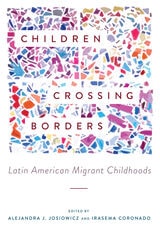
Children Crossing Borders
Latin American Migrant ChildhoodsEdited by Alejandra J. Josiowicz and Irasema Coronado
University of Arizona Press, 2022
Unified in their common interest in the well-being of children, the contributors bring an unrivaled breadth of experience and research to offer a transnational, multidimensional, and multilayered look at migrant childhoods in Latin America. Organized around three main themes—educational experiences; literature, art and culture, and media depictions; and the principle of the “best interest of the child”—this work offers both theoretical and practical approaches to the complexity of migrant childhood. The essays discuss family and school lives, children’s experience as wage laborers, and the legislation and policies that affect migrants.
This volume draws much-needed attention to the plight of migrant children and their families, illuminating the human and emotional toll that children experience as they crisscross the Americas. Exploring the connections between education, policy, cultural studies, and anthropology, the essays in this volume navigate a space of transnational children’s rights central to Latin American life in the twentieth and twenty-first centuries.
Contributors
Marissa Bejarano-Fernbaugh
Nancie Bouchard
Lina M. Caswell
Irasema Coronado
Valentina Glockner
Alejandra J. Josiowicz
Patrícia Nabuco Martuscelli
María Inés Pacecca
Martha Rodríguez-Cruz
Emily Ruehs-Navarro
Kathleen Tacelosky
Élisabeth Vallet
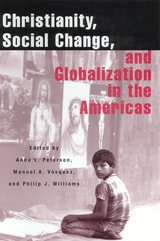
Christianity, Social Change, and Globalization in the Americas
Peterson, Anna L
Rutgers University Press, 2001
Organized around three central themes-family, youth, and community; democratization, citizenship, and political participation; and immigration and transnationalism-the book argues that, at the local level, religion helps people, especially women and youths, solidify their identities and confront the challenges of the modern world. Religious communities are seen as both peaceful venues for people to articulate their needs, and forums for building participatory democracies in the Americas. Finally, the contributors examine how religion enfranchises poor women, youths, and people displaced by war or economic change and, at the same time, drives social movements that seek to strengthen family and community bonds disrupted by migration and political violence.
Chronicle of My Worst Years
Tino Villanueva
Northwestern University Press, 1994
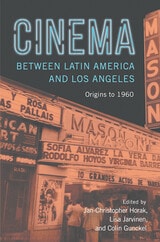
Cinema between Latin America and Los Angeles
Origins to 1960Horak, Jan-Christopher
Rutgers University Press, 2019
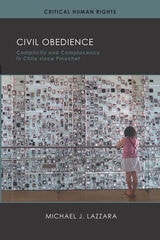
Civil Obedience
Complicity and Complacency in Chile since PinochetMichael J. Lazzara
University of Wisconsin Press, 2020
Michael J. Lazzara boldly argues that today's Chile is a product of both complicity and complacency. Combining historical analysis with deft literary, political, and cultural critique, he scrutinizes the post-Pinochet rationalizations made by politicians, artists, intellectuals, bystanders, former revolutionaries-turned-neoliberals, and common citizens. He looks beyond victims and perpetrators to unveil the ambiguous, ethically vexed realms of memory and experience that authoritarian regimes inevitably generate.
Civil Service Reform in Brazil
Principles Versus PracticeBy Lawrence S. Graham
University of Texas Press, 1968
In the 1930s, during the authoritarian government of Getúlio Vargas, the Brazilian civil service reform movement began. Thirty-five years later, the actual administrative practices of the country did not adequately reflect the philosophy underlying this movement, a philosophy drawn from the reform experience and public administration theories of the United States and Western Europe. This book examines why these ideas, when transplanted to another cultural setting, did not take root and, further, why they unexpectedly proved to be most applicable in Brazil during periods of autocratic rule.
These questions are highly relevant not only to Brazil, but equally to other developing countries struggling to create more effective national administrative systems. For this reason, and in order to evaluate the Brazilian reform experience within its total context (social, economic, and political), Lawrence S. Graham develops a broad conceptual framework. His focus is on the years between 1945 and 1964, a period which allowed a relatively free play of political forces but, ironically, produced a diminution in the success of the reform efforts when compared with the authoritarian governments which preceded and followed it. After a comparative consideration of the public administration theories behind the reform movement, Graham examines this period in terms of the political environment, the functions of political patronage, and the influences of a nascent national party. Finally, he juxtaposes the conditions and course of the Brazilian reform experience with those of the United States and Great Britain.
Graham’s study of the Brazilian example, which does not pass judgment on the prevailing public personnel system, reveals the importance of understanding the total cultural context within which administrative principles are put into practice. Such an approach, wider than generally held in the field of public administration, may prove to be the most vital factor in the future of the civil service in Brazil and several other countries facing the same problems.

Claribel Alegría and Central American Literature
Critical EssaysSandra M. Boschetto-Sandoval
Ohio University Press, 1993
These essays examine the multifaceted work of the Central American author whom Latin American literary historians consider precursor of “cultural dialogism” in poetry and fiction. As poet, essayist, journalist, novelist, and writer of “quasi–testimonio,” Alegría’s multiple discourses transgress the boundaries between traditional and postmodern political theories and practices. Her work reveals an allegory of relation and negotiation between “intelligentsia” and subaltern peoples as well as the need for a more socially extensive literature, not exclusive of more elite “magical literatures.”
The essays in the fist section frame Alegría’s discourses within sociohistorical, political, and literary contexts in order to illuminate the author’s singular place in the literary and political history of Central America. The essays in the second section engage in a feminist dialogic in which the reader encounters various critical validations and valorizations of Alegría’s many female voices. The third section involves the reader in the pursuit of extratextual or extraliterary resonances in Alegría’s work.
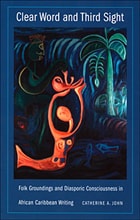
Clear Word and Third Sight
Folk Groundings and Diasporic Consciousness in African Caribbean WritingCatherine A. John
Duke University Press, 2003
Contesting popular discourses about what constitutes culture and maintaining that neglected strains in negritude discourse provide a crucial philosophical perspective on the connections between folk practices, cultural memory, and collective consciousness, John examines the diasporic principles in the work of the negritude writers Léon Damas, Aimé Césaire, and Léopold Senghor. She traces the manifestations and reworkings of their ideas in Afro-Caribbean writing from the eastern and French Caribbean, as well as the Caribbean diaspora in the United States. The authors she discusses include Jamaica Kincaid, Earl Lovelace, Simone Schwarz-Bart, Audre Lorde, Paule Marshall, and Edouard Glissant, among others. John argues that by incorporating what she calls folk groundings—such as poems, folktales, proverbs, and songs—into their work, Afro-Caribbean writers invoke a psychospiritual consciousness which combines old and new strategies for addressing the ongoing postcolonial struggle.
Codex Chimalpopoca
The Text in Nahuatl with a Glossary and Grammatical NotesJohn Bierhorst
University of Arizona Press, 2011
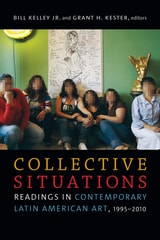
Collective Situations
Readings in Contemporary Latin American Art, 1995–2010Bill Kelley Jr. and Grant H. Kester, editors
Duke University Press, 2017
Contributors
Gavin Adams, Mariola V. Alvarez, Gustavo Buntinx, María Fernanda Cartagena, David Gutiérrez Castañeda, Fabian Cereijido, Paloma Checa-Gismero, Kency Cornejo, Raquel de Anda, Bill Kelley Jr., Grant H. Kester, Suzanne Lacy, Ana Longoni, Rodrigo Martí, Elize Mazadiego, Annie Mendoza, Alberto Muenala, Prerana Reddy, Maria Reyes Franco, Pilar Riaño-Alcalá, Juan Carlos Rodríguez
Collisions With History
Latin American Fiction and Social Science from “El Boom” to the New World OrderFrederick M. Nunn
Ohio University Press, 2001
Latin American intellectuals have traditionally debated their region’s history, never with so much agreement as in the fiction, commentary, and scholarship of the late twentieth century. Collisions with History shows how “fictional histories” of discovery and conquest, independence and early nationhood, and the recent authoritarian past were purposeful revisionist collisions with received national versions. These collisions occurred only because of El Boom, thus making Latin America’s greatest literary movement a historical phenomenon as well. Frederick M. Nunn discusses the cataclysmic view of history conveyed in Boom novels and examines the thought and self-perception of selected authors whose political activism enhanced the appeal of their works—historical and otherwise: Alejo Carpentier, Carlos Fuentes, Gabriel García Márquez, and Augusto Roa Bastos; Julio Cortázar, Isabel Allende, Mario Vargas Llosa, and Darcy Ribeiro.
Collisions with History demonstrates how their commentary on history, literature, politics, and international affairs reveals a conscious sense of purpose. From between the lines of their nonfiction emerges a consensus that outside forces have defined as well as controlled Latin America’s history.
Professor Nunn also suggests that, with novelists now no longer very interested in colliding with history, it may fall to social scientists to speak for what remains of the region’s past in the New World Order.
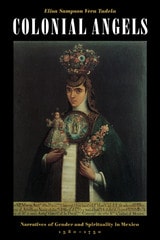
Colonial Angels
Narratives of Gender and Spirituality in Mexico, 1580-1750By Elisa Sampson Vera Tudela
University of Texas Press, 2000
Spain's attempt to establish a "New Spain" in Mexico never fully succeeded, for Spanish institutions and cultural practices inevitably mutated as they came in contact with indigenous American outlooks and ways of life. This original, interdisciplinary book explores how writing by and about colonial religious women participated in this transformation, as it illuminates the role that gender played in imposing the Spanish empire in Mexico.
The author argues that the New World context necessitated the creation of a new kind of writing. Drawing on previously unpublished writings by and about nuns in the convents of Mexico City, she investigates such topics as the relationship between hagiography and travel narratives, male visions of the feminine that emerge from the reworking of a nun's letters to her confessor into a hagiography, the discourse surrounding a convent's trial for heresy by the Inquisition, and the reports of Spanish priests who ministered to noble Indian women. This research rounds out colonial Mexican history by revealing how tensions between Spain and its colonies played out in the local, daily lives of women.
Colonial Itineraries of Contemporary Mexico
Literary and Cultural InquiriesEdited by Oswaldo Estrada and Anna M. Nogar
University of Arizona Press, 2014
Through a transformative interdisciplinary lens, this book studies the ultra-contemporary chronicles of Carlos Monsiváis, the poetry of Carmen Boullosa and Luis Felipe Fabre, and the novels of Enrique Serna, Héctor de Mauleón, Mónica Lavín, and Pablo Soler Frost, among others. The book also pays close attention to a good sample of recent children’s literature that revisit Mexico’s colonia. It includes the transatlantic perspective of Spanish novelist Inma Chacón, and a detailed analysis of the strategies employed by Laura Esquivel in the creation of a best seller. Other chapters are devoted to the study of transnational film productions, a play by Flavio González Mello, and a set of novels set in the nineteenth-century colonia that problematize static notions of both personal and national identity within specific cultural palimpsests. Taken together, these incisive readings open broader conversations about Mexican coloniality as it continues well into the twenty-first century.
Colonialism and Race in Luso-Hispanic Literature
Jerome C. Branche
University of Missouri Press, 2006
Coming of Age(ncy) on the Migrant Trail
Adolescent Journeys in Contemporary Latinx Young Adult LiteratureSusana S. Martínez
The Ohio State University Press, 2025
Communism in Mexico
A Study in Political FrustrationBy Karl M. Schmitt
University of Texas Press, 1965
The ease with which Cuba slipped into its relationship with Communism revived in the United States its recurring nightmare in which other Latin American countries, particularly Mexico, become satellites of Russia or Red China. But such an occurrence is most unlikely in Mexico, according to Karl Schmitt, former intelligence research analyst with the United States Department of State.
Communism in Mexico traces efforts during the early twentieth century to create a Soviet-style society in one of the largest and most strategically situated of the Latin American countries. Schmitt writes authoritatively of the Mexican Communist movement, tracing its development from an early and potentially powerful political-economic base to the increasingly fragmented and weakened collection of parties and front groups of the 1960s. He follows the various schisms and factional divisions to the mid-1950s, when the process of disintegration became most noticeable, and explores and analyzes in detail Communist attempts since then to establish unity among the many quarreling and frustrated groups of the now-splintered movement.
Three Communist parties in Mexico, a score of front groups, and numerous infiltration cells in non-Communist organizations such as student and labor groups, all recognize in a broad way a common and ultimate goal: the creation of a Soviet-style society. But their attempts at unity have consistently led only to further bickering and frustration. This period is subjected to a thorough study and analysis in an effort to understand and explain the Communists' lack of success. Schmitt presciently concludes that Communism's future in Mexico will be as cloudy as its past, and that the accelerating economy and improving social conditions there will serve to weaken the movement still further.
Conquest of the New Word
Experimental Fiction and Translation in the AmericasBy Johnny Payne
University of Texas Press, 1993
Latin American fiction won great acclaim in the United States during the 1960s, when many North American writers and critics felt that our national writing had reached a low ebb. In this study of experimental fiction from both Americas, Johnny Payne argues that the North American reception of the "boom" in Latin American fiction distorted the historical grounding of this writing, erroneously presenting it as mainly an exotic "magical realism." He offers new readings that detail the specific, historical relation between experimental fiction and various authors' careful, deliberate deformations and reformations of the political rhetoric of the modern state.
Payne juxtaposes writers from Argentina and Uruguay with North American authors, setting up suggestive parallels between the diverse but convergent practices of writers on both continents. He considers Nelson Marra in conjunction with Donald Barthelme and Gordon Lish; Teresa Porzecanski with Harry Mathews; Ricardo Piglia with John Barth; Silvia Schmid and Manuel Puig with Fanny Howe and Lydia Davis; and Jorge Luis Borges and Luisa Valenzuela with William Burroughs and Kathy Acker.
With this innovative, dual-continent approach, Conquest of the New Word will be of great interest to everyone working in Latin American literature, women's studies, translation studies, creative writing, and cultural theory.
Conservative Thought in Twentieth Century Latin America
The Ideas of Laureano GomezJames D. Henderson
Ohio University Press, 1988
Laureano Gómez was president of Colombia in the early 1950s until overthrown by a military coup. He was also, for some fifty years, the leading exponent of Latin American conservatism, a political philosophy with roots in both nineteenth–century politics and religion. Focusing on Gómez, and other prominent conservative politicians, Henderson traces the evolution of Latin American conservatism and demonstrates the scope of its influence throughout the continent.
While much has been written about particular Marxist movements and right–wing regimes in contemporary Latin America, little attention has been devoted, in recent years, to the more moderate political institutions and individuals which dominate twentieth–century Latin America. This first account of Latin American conservatism should be of interest to all students of the history and politics of the region.