Results by title
144 books match the query 'Communication' and 26 start with c

Celebrity Culture and the Entertainment Industry in Asia
Use of Celebrity and its Influence on Society, Culture and CommunicationBy Vivienne Leung, Kimmy Cheng, and Tommy Tse
Intellect Books, 2017
Through first-hand interviews with celebrities and entertainment industry practitioners, the authors discuss the social, cultural, and economic influences of celebrity. Dialogues with celebrities such as Kwok-Leung Kam, Bob Lam, Denise Ho, Hilary Tsui, and Francis Mak provide insider accounts of celebrity formation, management, and marketing in Hong Kong and Mainland China, as well as South Korea and Taiwan.
Cheap Talk
Disability and the Politics of CommunicationJoshua St. Pierre
University of Michigan Press, 2022
Civic Talk
Peers, Politics, and the Future of DemocracyAuthored by Casey A. Klofstad
Temple University Press, 2011
Does talking about civic issues encourage civic participation? In his innovative book, Civic Talk, Casey Klofstad shows that our discussions about politics and current events with our friends, colleagues, and relatives—"civic talk"—has the ability to turn thought into action—from voting to volunteering in civic organizations.
Klofstad’s path breaking research is the first to find evidence of a causal relationship between the casual chatting and civic participation. He employs survey information and focus groups consisting of randomly assigned college freshman roommates to show this behavior in action. Klofstad also illustrates how civic talk varies under different circumstances and how the effects can last years into the future. Based on these findings, Klofstad contends that social context plays a central role in maintaining the strength of democracy. This conclusion cuts against the grain of previous research, which primarily focuses on individual-level determinants of civic participation, and negates social-level explanations.

Coding Streams of Language
Techniques for the Systematic Coding of Text, Talk, and Other Verbal DataCheryl Geisler
University Press of Colorado, 2020

Communicating Faith
John Sullivan
Catholic University of America Press, 2011
Communication
Paula Bialski
University of Minnesota Press, 2018
On contemporary communication in its various human and nonhuman forms
Contemporary communication puts us not only in conversation with one another but also with our machinery. Machine communication—to communicate not just via but also with machines—is therefore the focus of this volume. Diving into digital communications history, Finn Brunton brings to the fore the alienness of computational communication by looking at network timekeeping, automated trolling, and early attempts at communication with extraterrestrial life. Picking up this fascination with inhuman communication, Mercedes Bunz then performs a close reading of interaction design and interfaces to show how technology addresses humans (as very young children). Finally, Paula Bialski shares her findings from a field study of software development, analyzing the communicative forms that occur when code is written by separate people. Today, communication unfolds merely between two or more conscious entities but often includes an invisible third party. Inspired by this drastic shift, this volume uncovers new meanings of what it means “to communicate.”

Communication Convergence in Contemporary China
International Perspectives on Politics, Platforms, and ParticipationPatrick Shaou-Whea Dodge
Michigan State University Press, 2020

Communication Ethics and Tenacious Hope
Contemporary Implications of the Scottish EnlightenmentRonald C. Arnett with Foreword by Thomas M. Lessl
Southern Illinois University Press, 2022
Tenacious hope, the heart of a just and free society
During the Enlightenment, Scottish intellectuals and administrators met the demands of profit and progress while shepherding concerns for self and other, individual and community, and family and work. Communication Ethics and Tenacious Hope captures the “unity of contraries,” offering the Scottish Enlightenment as an exemplar of tenacious hope countering the excesses of individualism. Ronald C. Arnett reveals two stories: the struggle between optimism and tenacious hope, and optimism’s ultimate triumph in the exclusion of difference and the reification of progress as an ultimate good.
In chapters that detail the legacies of Lord Provost George Drummond, Adam Smith, David Hume, Thomas Reid, George Campbell, Adam Ferguson, and Sir Walter Scott, Arnett highlights the problematic nature of optimism and the ethical agency of tenacious hope. Arnett illustrates the creative union of education and administration, the ability to accept doubt within systems of knowledge and imagination, and an abiding connection to local soil. As principles of progress, free will, and capitalism swept Europe, proponents of optimism envisioned a world of consumerism and absolutes. In contrast, practitioners of tenacious hope embraced uncertainty and compassion as pragmatic necessities.
This work continues Arnett’s scholarship, articulating the vital importance of communication ethics. Those seeking to discern and support a temporal sense of the good in this historical moment will find in this timely work the means to pursue, hold, and nourish tenacious hope. This insightful theorization of the Scottish Enlightenment distills the substance of a just and free society for meeting dangerous and uncertain times.
Communication Ethics in Dark Times
Hannah Arendt's Rhetoric of Warning and HopeRonald C. Arnett
Southern Illinois University Press, 2013
Renowned in the disciplines of political theory and philosophy, Hannah Arendt’s searing critiques of modernity continue to resonate in other fields of thought decades after she wrote them. In Communication Ethics in Dark Times: Hannah Arendt’s Rhetoric of Warning and Hope, author Ronald C. Arnett offers a groundbreaking examination of fifteen of Arendt’s major scholarly works, considering the German writer’s contributions to the areas of rhetoric and communication ethics for the first time.
Arnett focuses on Arendt’s use of the phrase “dark times” to describe the mistakes of modernity, defined by Arendt as the post-Enlightenment social conditions, discourses, and processes ruled by principles of efficiency, progress, and individual autonomy. These principles, Arendt argues, have led humanity down a path of folly, banality, and hubris. Throughout his interpretive evaluation, Arnett illuminates the implications of Arendt’s persistent metaphor of “dark times” and engages the question, How might communication ethics counter the tenets of dark times and their consequences? A compelling study of Hannah Arendt’s most noteworthy works and their connections to the fields of rhetoric and communication ethics, Communication Ethics in Dark Times provides an illuminating introduction for students and scholars of communication ethics and rhetoric, and a tool with which experts may discover new insights, connections, and applications to these fields.
Top Book Award for Philosophy of Communication Ethics by Communication Ethics Division of the National Communication Association, 2013
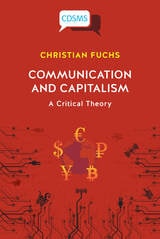
Communication and Capitalism
A Critical TheoryChristian Fuchs
University of Westminster Press, 2020
‘An authoritative analysis of the role of communication in contemporary capitalism and an important contribution to debates about the forms of domination and potentials for liberation in today’s capitalist society.’ — Professor Michael Hardt, Duke University, co-author of the tetralogy Empire, Commonwealth, Multitude, and Assembly
‘A comprehensive approach to understanding and transcending the deepening crisis of communicative capitalism. It is a major work of synthesis and essential reading for anyone wanting to know what critical analysis is and why we need it now more than ever.’ — Professor Graham Murdock, Emeritus Professor, University of Loughborough and co-editor of The Handbook of Political Economy of Communications
Communication and Capitalism outlines foundations of a critical theory of communication. Going beyond Jürgen Habermas’ theory of communicative action, Christian Fuchs outlines a communicative materialism that is a critical, dialectical, humanist approach to theorising communication in society and in capitalism. The book renews Marxist Humanism as a critical theory perspective on communication and society.
The author theorises communication and society by engaging with the dialectic, materialism, society, work, labour, technology, the means of communication as means of production, capitalism, class, the public sphere, alienation, ideology, nationalism, racism, authoritarianism, fascism, patriarchy, globalisation, the new imperialism, the commons, love, death, metaphysics, religion, critique, social and class struggles, praxis, and socialism.
Fuchs renews the engagement with the questions of what it means to be a human and a humanist today and what dangers humanity faces today.
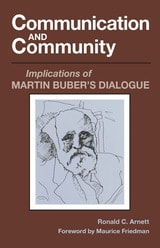
Communication and Community
Implications of Martin Buber's DialogueRonald C. Arnett. Foreword by Maurice Friedman
Southern Illinois University Press, 1986
Martin Buber’s work suggests that real life begins with two individuals engaged in dialogue, not just taking care of one’s own needs as described in social Darwinism.
Arnett argues that the end of the age of abundance demands that we give up the communicative strategies of the past and seek to work together in the midst of limited resources and an uncertain future. Today’s situation calls for an unwavering commitment to Buber’s “narrow ridge” concern for both self and community.
Arnett illustrates the narrow ridge definition of interpersonal communication with rich examples. His vignettes demonstrate effective and ineffective approaches to human community. An effective approach, he makes clear, incorporates not only openness to others’ points of view but also a willingness to be persuaded.
Communication and Development
A Study of Two Indian VillagesY.V. Lakshmana Rao
University of Minnesota Press, 1966
Communication and Development was first published in 1966. Minnesota Archive Editions uses digital technology to make long-unavailable books once again accessible, and are published unaltered from the original University of Minnesota Press editions.
What role does communication play in the economic, social, and political development of a community? The results of the study reported here, based on comprehensive field work in two small villages in India, throw considerable light on that question, one which is of fundamental importance to those concerned with rates and patterns of growth in any developing country.
In this study, the term "communication" refers to a social process—the flow of information, the circulation of knowledge and ideas in society, the propagation and internalization of thoughts. It does not refer to the media or means of communication, such as electronics, roads and railways, or vehicles.
The two villages studied, both in South India, were at contrasting stages of development. One was becoming industrialized, while the other still clung to such traditional ways as the barter system. To carry out the field work for his study, Dr. Rao lived in these villages for several months, talking at length with the people, obtaining information about their attitudes, beliefs, and opinions, and observing them and their surroundings with a trained eye. He also checked official records for pertinent information. He analyzes his findings from a psychological and sociological standpoint and, in addition, provides an intimate description of the village life.
The book will be of particular interest to communications specialists, anthropologists, sociologists, political scientists, economists, and others concerned with studies of the developing countries in Asia, Africa, and Latin America.
Communication and Discourse Theory
Collected Works of the Brussels Discourse Theory GroupEdited by Leen Van Brussel, Nico Carpentier, and Benjamin De Cleen
Intellect Books, 2019
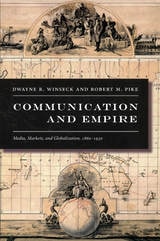
Communication and Empire
Media, Markets, and Globalization, 1860-1930Dwayne R. Winseck and Robert M. Pike
Duke University Press, 2007
Drawing on extensive research in corporate and government archives, Winseck and Pike illuminate the actions of companies and cartels during the late nineteenth century and early twentieth, in many different parts of the globe, including Africa, Asia, and Central and South America as well as Europe and North America. The complex history they relate shows how cable companies exploited or transcended national policies in the creation of the global cable network, how private corporations and government agencies interacted, and how individual reformers fought to eliminate cartels and harmonize the regulation of world communications. In Communication and Empire, the multinational conglomerates, regulations, and the politics of imperialism and anti-imperialism as well as the cries for reform of the late nineteenth century and early twentieth emerge as the obvious forerunners of today’s global media.

Communication and Litigation
Case Studies of Famous TrialsJanice Schuetz
Southern Illinois University Press, 1988
Examination of seven famous trials, each concluding with an evaluation of the trial by a lawyer, judge, law professor, or communication scholar.
The Washington Post coverage of the John Hinckley case preceding the trial demonstrates the effects media may have on a trial. The Haymarket riot trial serves as an example of opening statements in a storytelling form.
By analyzing the trial of Bruno Richard Hauptmann, Schuetz and Snedaker explain direct examination according to its purpose, legal rules, ordering of witnesses, verbal and nonverbal techniques of interrogation, and tactics for introducing evidence.
The cross-examination in the Sacco-Vanzetti case shows how advocates enhance or decrease their persuasiveness by adopting communication maneuvers. Closing arguments in the Rosenberg trial took the form of a refutative story with a dual persuasive and instructional content.
The Supreme Court appeal in the Sam Sheppard case demonstrates the procedures, form, content, and style of arguments of appellate briefs. The Chicago Eight trial is an example of trial as theatre.

Communication and Women's Friendships
Parallels and Intersections in Literature and LifeJanet Doubler Ward
University of Wisconsin Press, 1993
Communication and the Human Condition
W. Barnett Pearce
Southern Illinois University Press, 1989
Starting with the premise that we live in communication (rather than standing outside communication and using it for secondary purposes), Pearce claims that people who live in various cultures and historical epochs not only communicate differently but experience different ways of being human because they communicate differently.
This century, he notes, ushered in the "communication revolution," the discovery that communication is far more important and central to the human condition than ever before realized. Essential to the communication revolution is the recognition that multiple forms of discourse exist in contemporary human society. Further, these forms of discourse are not benign; they comprise alternative ways of being human.
Thus communication theory must encompass all that it "means to live a life, the shape of social institutions and cultural traditions, the pragmatics of social action, and the poetics of social order."

Communication, Control and Security Challenges for the Smart Grid
S.M. Muyeen
The Institution of Engineering and Technology, 2017

Communication, Control and Security Challenges for the Smart Grid
Advanced security, optimization, and emerging technologies in smart grids, Volume 2S.M. Muyeen
The Institution of Engineering and Technology, 2026

Communication, Control and Security Challenges for the Smart Grid
Foundations and core systems of smart grids, Volume 1S.M. Muyeen
The Institution of Engineering and Technology, 2026

Communication, Pedagogy, and the Gospel of Mark
Elizabeth E. Shively
SBL Press, 2016
Using Mark as a test case, scholars address questions like: How should my research and my approach to the text play out in the classroom? What differences should my academic context and my students' expectations make? How should new approaches and innovations inform interpretation and teaching? This resource enables biblical studies instructors to explore various interpretative approaches and to begin to engage pedagogical issues in our changing world.
Features:
- Ideas that may be adapted for teaching any biblical text
- Diverse perspectives from nine experts in their fields
- Essays include tips, ideas, and lesson plans for the classroom
Communications in Turkey and the Ottoman Empire
A Critical HistoryBurçe Çelik
University of Illinois Press, 2023
The history of communications in the Ottoman Empire and Turkey contradicts the widespread belief that communications is a byproduct of modern capitalism and other Western forces. Burçe Çelik uses a decolonial perspective to analyze the historical commodification and militarization of communications and how it affected production and practice for oppressed populations like women, the working class, and ethnic and religious minorities. Moving from the mid-nineteenth century through today, Çelik places networks within the changing geopolitical landscape and the evolution of modern capitalism in relationship to struggles involving a range of social and political actors. Throughout, she challenges Anglo- and Eurocentric assumptions that see the non-West as an ahistorical imitation of, or aberration from, the development of Western communications.
Ambitious and comprehensive, Communications in Turkey and the Ottoman Empire merges political economy with social history to challenge Western-centered assumptions about the origins and development of modern communications.
Community over Chaos
An Ecological Perspective on Communication EthicsJames A. Mackin
University of Alabama Press, 1997
This ecology of ethics seeks to balance the needs of the individual and those of the various levels of community.
As James A. Mackin, Jr., shows, both modernism and postmodernism have undermined the traditional foundations for ethics. Using an ecological model, however, Community over Chaos develops a common ground for ethical judgments about communication, thus countering the current theoretical climate of pessimistic cynicism toward the very possibility of ethics.
This theoretical pessimism is not merely an academic problem. The general public is becoming more and more disillusioned about the possibility of ethical communication. We are unable to teach principles of communicative ethics in our primary and secondary schools because we cannot agree on a common ground for those principles. Instead, we teach a narrow form of competence that is concerned primarily with short-term, individual success. Because our communities are built on our communicative practices, our inability to justify communicative ethics must ultimately lead to the disintegration of our communities.
Mackin's ecological model assumes that each of us is a communicative system operating within larger communicative systems that together form our communicative ecosystem. Virtues of the ecological approach are practical wisdom, based in fuzzy logic, and communicative openness and honesty.
Mackin recognizes the importance of both chaos and community in our communicative ecosystems. Chaos, as the source of originality and creativity, can contribute to growth and development; community provides the source of regularity and nurture that makes chaos endurable.
Critical Theory of Communication
New Readings of Lukács, Adorno, Marcuse, Honneth and Habermas in the Age of the InternetChristian Fuchs
University of Westminster Press, 2016
Critical Theory of Communication offers a vital set of new insights on how communication operates in the age of information, digital media and social media, arguing that we need to transcend the communication theory of Habermas by establishing a dialectical and cultural-materialist critical theory of communication.
It is the first title in a major new book series 'Critical Digital and Social Media Studies' published by the University of Westminster Press.
Cultural Crowdfunding
Platform Capitalism, Labour and GlobalizationVincent Rouzé
University of Westminster Press, 2019
This new book analyses the strategies, usages and wider implications of crowdsourcing and crowdfunding platforms in the culture and communication industries that are reshaping economic, organizational and social logics. Platforms are the object of considerable hype with a growing global presence. Relying on individual contributions coordinated by social media to finance cultural production (and carry out promotional tasks) is a significant shift, especially when supported by morphing public policies, supposedly enhancing cultural diversity and accessibility.
The aim of this book is to propose a critical analysis of these phenomena by questioning what follows from decisions to outsource modes of creation and funding to consumers. Drawing on research carried out within the ‘Collab’ programme backed by the French National Research Agency, the book considers how platforms are used to organize cultural labour and/or to control usages, following a logic of suggestion rather than overt injunction. Four key areas are considered: the history of crowdfunding as a system; whose interests crowdfunding may serve; the implications for digital labour and lastly crowdfunding’s interface with globalization and contemporary capitalism. The book concludes with an assessment of claims that crowdfunding can democratize culture.
Cultural Misunderstandings
The French-American ExperienceRaymonde Carroll
University of Chicago Press, 1990
Raymonde Carroll presents an intriguing and thoughtful analysis of the many ways French and Americans—and indeed any members of different cultures—can misinterpret each other, even when ostensibly speaking the same language.Cultural misunderstandings, Carroll points out, can arise even where we least expect them—in our closest relationships. The revealing vignettes that Carroll relates, and her perceptive comments, bring to light some fundamental differences in French and American presuppositions about love, friendship, and raising children, as well as such everyday activities as using the telephone or asking for information.