Results by title
1832 books match the query 'Essays' and 94 start with c
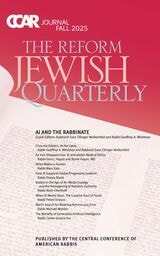
CCAR Journal - Fall 2025
The Reform Jewish Quarterly: AI and the RabbinateRabbanit Sara Tillinger Wolkenfeld and Rabbi Geoffrey A. Mitelman
Central Conference of American Rabbis, 2025
This issue of the CCAR Journal explores the rapidly evolving intersection of artificial intelligence and the rabbinate. Through a range of reflective articles, contributors examine how AI is shaping Jewish life, leadership, and ethical discourse. The issue also contains general articles, new book reviews, and poetry.
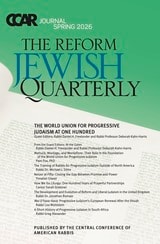
CCAR Journal - Spring 2026
The Reform Jewish Quarterly: The World Union for Progressive Judaism at One HundredRabbi Edwin C. Goldberg, Rabbi Daniel H. Freelander, Rabbi Professor Deborah Kahn-Harris
Central Conference of American Rabbis, 2026
This issue, which celebrates the centenary of the founding of the World Union for Progressive Judaism in 1926, examines the impact of the WUPJ on the growth of Progressive Judaism around the globe. The articles explore the early history of the WUPJ and the creation of rabbinic seminaries, youth movements, and liturgies, as well as key regions of the movement: the United Kingdom, Europe, South Africa, South America, Australia and Aotearoa-New Zealand, and Israel. The issue also contains new book reviews and poetry.
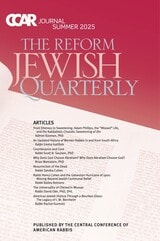
CCAR Journal - Summer 2025
The Reform Jewish QuarterlyRabbi Edwin C. Goldberg
Central Conference of American Rabbis, 2025
This edition of CCAR Journal includes articles on women rabbis in South Africa, resurrection of the dead, chesed in Mussar, the Jewish history of bourbon, and much more. The issue also contains a book review, poetry, and a CCAR responsum on splitting cremated ashes for burial in two places.
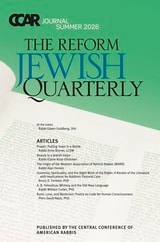
CCAR Journal - Summer 2026
The Reform Jewish QuarterlyRabbi Edwin C. Goldberg
Central Conference of American Rabbis, 2026
The Summer issue of CCAR Journal: The Reform Jewish Quarterly contains articles on prayer, beauty the Western Association of Reform Rabbis, a review of literature with implications for pastoral care, A.B. Yehoshua, and Rumi, along with book reviews and poetry.
CCAR Journal - Winter 2025
Opening the Doors to LGBTQIA+ Clergy: Past, Present, and FutureRabbi Edwin C. Goldberg
Central Conference of American Rabbis, 2025
CCAR Journal - Winter 2026
The Reform Jewish QuarterlyRabbi Edwin C. Goldberg
Central Conference of American Rabbis, 2026
The Winter 2026 issue of CCAR Journal: The Reform Jewish Quarterly contains articles on the golem, American civic health, Hebrew Union College's new rabbinical curriculum, and Jewish history in the Islamic world. A responsum on burial of a person in a pet cemetery and a translation of the preface to Jacob Sasportas’s Tol’dot Yaakov are also included, along with book reviews and poetry.
Cabin Stories
The Best of Dark Winter Nights: True Stories from AlaskaRob Prince
University of Alaska Press, 2022
From the humorous to the heart-wrenching, these are the stories told up north on dark winter nights. Anyone curious about what living in Alaska is really like will appreciate this wild and fun anthology.
Contributors: Glenner Anderson, Kat Betters, Randy Brown, Melissa Buchta, JB Carnahan, Philip Charette, Roy Churchwell, Richard Coleman, Michael Daku, Wendy Demers, Alexandra Dunlap, Alyssa Enriquez, Jan Hanscom, Mike Hopper, James Mennaker, Ken Moore, Steve Neumeth, Kaiti Ott, Lori Schoening, Bill Schnabel, Guy Schroder, Ed Shirk, Eric Stevens, Chris Zwolinski
Camp Sights
Sam Cook
University of Minnesota Press, 2002
Unforgettable stories perfect for sharing around the campfire-now in paperback!
Camp Sights welcomes you to the intimate beauty of camps-quiet camps for fathers and daughters, familiar camps on a favorite lake with good friends, hunting camps with their rich histories and traditions, serene camps under the starry sky of a summer night, peaceful camps warmed by supper cooking on the stove.
You’ll experience the challenges and adventures of life in the North Woods-a chance encounter with Arctic wolves on Canada’s Ellesmere Island, a night on the Gods River on a canoe trip to Hudson Bay, a whiteout storm in the barren lands of the Northwest Territories. But you’ll also learn of the everyday pleasures of the outdoors-stories of steelhead fishing, deer and duck hunting, and unforgettable characters like canoe builder Joe Seliga, legendary trout fisherman Benny Larson, and Ely’s "Jackpine" Bob Cary.Throughout the book, Sam Cook offers insights into the subtleties of the natural world that all too often go unnoticed, inviting you to see your world anew.In 1976 Sam Cook trekked north from his native Kansas to work for an outfitter in the Superior-Quetico canoe country. Now, as the Duluth News-Tribune’s outdoors writer, he uses Duluth, Minnesota, as "base camp" for creating his humorous, powerful, and compassionate columns.
Cancer and the Politics of Care
Inequalities and Interventions in Global PerspectiveEdited by Linda Rae Bennett, Lenore Manderson, and Belinda Spagnoletti
University College London, 2023
Taking an ethnographic approach, the contributors to this book offer new examinations of cancer and its treatment to show how social, economic, race, gender, and other structural inequalities intersect, compound, and complicate health inequalities. Cancer experiences and impacts are explored across eleven countries: Argentina, Brazil, Denmark, France, Greece, India, Indonesia, Italy, Senegal, the United Kingdom, and the United States. The volume engages with specific cancers from the point of primary prevention to screening, diagnosis, treatment (or its absence), and end-of-life care. Cancer and the Politics of Care traverses new theoretical terrain by explicitly critiquing cancer interventions, their limitations and success, the politics that drive them, and their embeddedness in local cultures and value systems. Its diversity and innovation ensure its wide utility among those working in and studying medical anthropology, social anthropology, and other fields at the intersections of social science, medicine, and health equity.
Canyon and Cosmos
Searching for Human Identity in the Grand CanyonDon Lago
University of Nevada Press, 2025
Named one of the 2026 Southwest Books of the Year
Throughout history, humans have sought creation stories to define our identity and affirm our connections with the universe, diverse life forms, and one another. Over the last two centuries, science has delivered a bold new creation story full of immense time and space, extraordinary objects, and powerful natural forces. Science ideas can seem mere abstractions, but at the Grand Canyon, better than anywhere else on Earth, our new creation story is manifested physically and powerfully.
A major work of literary nature writing, Canyon and Cosmos takes readers on a journey through the Grand Canyon's deep time, geological forces, and biological evolution, making them very real, personal, and meaningful. Through decades of hiking and kayaking, author Don Lago has gotten to know the canyon intimately. Ranging through world mythologies and Native American spirituality, he explores how humans have sought to understand the universe. He confronts existential questions of whether humans can find enough meaning in the scientific cosmos. Through poetic prose, symbolism, and philosophical insight, he shows how existence itself is our deepest source of life and meaning.
Canyon of Dreams
Stories from Grand Canyon HistoryDon Lago
University of Utah Press, 2014

Capitalism in Context
Essays on Economic Development and Cultural Change in Honor of R.M. HartwellEdited by John A. James and Mark Thomas
University of Chicago Press, 1994
Thirteen chapters cover: social progress during economic development; the influence of cultural values on social and economic change; economic foundations of development—labor, capital, and technology; and organizational arrangements—property rights, government, and markets. These studies will appeal to economists, historians, and social scientists alike for their wide-ranging treatments of economic development and cultural change.
The contributors are N. F. R. Crafts, Lance E. Davis, Stanley L. Engerman, David W. Galenson, Robert E. Gallman, Stephen Innes, John A. James, Eric L. Jones, Thomas W. Laqueur, Gary D. Libecap, Joel Mokyr, Douglass C. North, Mark Thomas, John J. Wallis, Jeffrey G. Williamson.
Carceral Humanitarianism
Logics of Refugee DetentionKelly Oliver
University of Minnesota Press, 2017
Coopted by military operations, humanitarianism has never been neutral. Rather than welcoming refugees, host countries assess the relative risks of taking them in versus turning them away, using a risk-benefit analysis that often reduces refugees to collateral damage in proxy wars fought in the war on terrorism. Carceral Humanitarianism testifies that humanitarian aid and human rights discourse are always political and partisan.
Forerunners is a thought-in-process series of breakthrough digital works. Written between fresh ideas and finished books, Forerunners draws on scholarly work initiated in notable blogs, social media, conference plenaries, journal articles, and the synergy of academic exchange. This is gray literature publishing: where intense thinking, change, and speculation take place in scholarship.
Caribbean Migration to Western Europe and the United States
Essays on Incorporation, Identity, and Citizenshipedited by Margarita Cervantes-Rodriguez, Ramon Grosfoguel and Eric Mielants
Temple University Press, 2009
Caribbean Migration to Western Europe and the United States features a diverse group of scholars from across academic disciplines studying the transnational paths of Caribbean migration. How has the colonial path of the Caribbean influenced migration with regard to power relations, ethnic identities and transnational processes?
Through a series of case studies, the contributors to this volume examine the experiences of Caribbean immigrants to Spain, France, the United Kingdom and the Netherlands as well as the United States. They show the demographic, socioeconomic, political and cultural impact migrants have, as well as their role in the development of transnational social fields. Caribbean Migration to Western Europe and the United States also examines how contrasting discourses of democracy and racism, xenophobia and globalization shape issues pertaining to citizenship and identity.
Contributors: Elizabeth Aranda, Mary Chamberlain, Michel Giraud, Lisa Maya Knauer, John R. Logan, Monique Milia-Marie-Luce, Laura Oso Casas, Livio Sansone, Nina Glick Schiller,Charles (Wenquan) Zhang and the editors.
Caribbean Women Writers
Essays from the First International ConferenceSelwyn R. Cudjoe
University of Massachusetts Press, 1990
Catharsis
On the Art of MedicineAndrzej Szczeklik
University of Chicago Press, 2005
The process of diagnosis, for instance, belongs to a world of magic and metaphor; the physician must embrace it like a poem or painting, with particular alertness and keen receptivity. Speculation on ways to slow aging through genetics, meanwhile, draws directly on the dream of immortality that artists and poets have nourished through the ages. And the concept of catharsis itself has made its way from the writings of Aristotle to today's growing interest in the benefits of music to health, especially in newborns. As Szczeklik explores such subjects as the mysteries of the heart rhythm, the secret history of pain relief, the enigmatic logic of epidemics, near-death or out-of-body experiences, and many more, he skillfully weaves together classical literature, the history of medicine, and moving anecdotes from his own clinical experiences. The result is a life-affirming book that will enrich the healing work of patients and doctors alike and make an invaluable contribution to our still-expanding vision of the art of medicine.
Cedar Mesa
A Place Where Spirits DwellText by David Petersen; Photographs by Branson Reynolds
University of Arizona Press, 2002
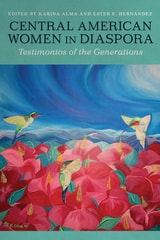
Central American Women in Diaspora
Testimonios of the GenerationsEdited by Karina Alma and Ester E. Hernández
University of Arizona Press, 2026
This collection centers Central American women’s voices within the growing narrative of the Central American diaspora. It provides a tapestry of testimonios—from grandmothers, mothers, daughters, and sisters—who explore what it means to be Central American women in the United States.
Through the practice of testimonio, contributors create intergenerational dialogues between mothers and daughters, engage with Indigenous oral traditions, and reflect on the violent histories of war in Guatemala, El Salvador, Honduras, and Nicaragua. The volume is organized around five themes: political histories, migration, gender and sexuality, navigating institutions, and healing. Within each theme contributors tackle a range of issues, including Central American political histories, healing, grief, Indigenous knowledge, memory, trauma, post-traumatic growth, organizing, creativity, and agency.
This anthology spans genres such as poetry, essay, and visual art to present diverse perspectives, including Indigenous, Afro-Indigenous, queer, and working-class voices. An intervention that centers gendered experiences and challenges oppressive structures, this volume celebrates the solidarity, cultural memory, and healing found within transnational ties.
Contributors
Leisy J. Abrego
Margoth Abrego
Bella
Juanita Cabrera López
Jennifer A. Cárcamo
Sandra Castro
Karla Cativo
Kency Cornejo
Gabriela Corona Valencia
Carolina Rivera Escamilla
Rafael Escamilla
Mildred Fuentes-Chung
Diana Gamez
Joanna Beltrán Girón
Ruth Girón
Victoria Gonzalez-Rivera
Claudia D. Hernández
Jessica Hernandez
Leticia Hernández-Linares
Leigh-Anna Hidalgo
Andrea Nikté Juarez Mendoza
Amanda Macal
Carla Macal
Patricia Veliz Macal
Kiara Aileen Machado
Beatriz Maldonado
Jacqueline Munguía
Joanna B. Pérez
Rossana Pérez
Katy Pinto
Claudia A. Portillo
Suyapa Portillo Villeda
Nalya Rodriguez
Jessica Saravia
Andrea Zelaya
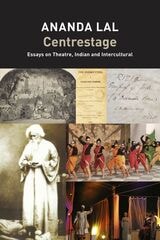
Centrestage
Essays on Theatre, Indian and InterculturalAnanda Lal
Seagull Books, 2026
In Centrestage, theater scholar Ananda Lal presents a compelling collection of essays encompassing over thirty years of research, reflection, and firsthand engagement with performance. From the emergence of Indian drama in English in the mid-nineteenth century to the diverse and sometimes contentious plays of the twenty-first century, Lal explores a two-hundred-year trajectory of Indian and intercultural theater with clarity and insight. The first part of the volume examines Indian theater history, proceeding from the colonial era to the contemporary scene in Kolkata and current theater pedagogy in India. The second part delves into the provocative world of intercultural theater, interrogating global academic representations of Indian performance and the work of such celebrated directors as Peter Brook and Tim Supple.
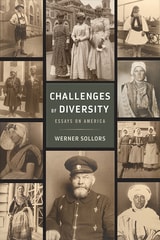
Challenges of Diversity
Essays on AmericaSollors, Werner
Rutgers University Press, 2017
What unites and what divides Americans as a nation? Who are we, and can we strike a balance between an emphasis on our divergent ethnic origins and what we have in common? Opening with a survey of American literature through the vantage point of ethnicity, Werner Sollors examines our evolving understanding of ourselves as an Anglo-American nation to a multicultural one and the key role writing has played in that process.
Challenges of Diversity contains stories of American myths of arrival (pilgrims at Plymouth Rock, slave ships at Jamestown, steerage passengers at Ellis Island), the powerful rhetoric of egalitarian promise in the Declaration of Independence and the heterogeneous ends to which it has been put, and the recurring tropes of multiculturalism over time (e pluribus unum, melting pot, cultural pluralism). Sollors suggests that although the transformation of this settler country into a polyethnic and self-consciously multicultural nation may appear as a story of great progress toward the fulfillment of egalitarian ideals, deepening economic inequality actually exacerbates the divisions among Americans today.
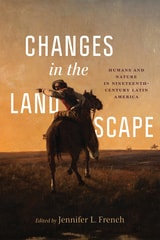
Changes in the Landscape
Humans and Nature in Nineteenth-Century Latin AmericaEdited by Jennifer L. French
Vanderbilt University Press, 2024
Ranging from the immediate aftermath of the Spanish‑American Wars of Independence (1810–1826) to the early twentieth century (1925), the volume’s essays cover a wide variety of genres and forms of cultural production, from José Hernández’s epic poem Martín Fierro to prose fiction, painting and photography, and the personal albums compiled by Spanish-American women. Individually and collectively, the essays engage with scientific writing as both a discourse of power and a source of potentially significant, even revelatory information about human and nonhuman nature. Changes in the Landscape enables readers to more fully understand the transition from colonial regimes to the ecocidal extractivism of the export boom (1870–1930) by drawing out and analyzing some of the cognitive resources and rhetorical strategies that were available to imagine, protest, or enact new norms and expectations regarding the relations between human and nonhuman life, be it the life of wildflowers, waterfalls, or Cuba’s Ciénaga de Zapata.
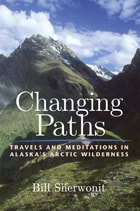
Changing Paths
Travels and Meditations in Alaska's Arctic WildernessBill Sherwonit
University of Alaska Press, 2009
Changing Paths: Travels and Meditations in Alaska’s Arctic Wilderness is an autobiographical exploration of author Bill Sherwonit’s relationship with the Alaska wilderness. Written in three parts, it first describes Sherwonit’s introduction to the Brooks Range and his years as an exploration geologist. Taking a step back, the author then takes us into the past to explore his childhood roots in rural Connecticut and his recognition of wild nature as a refuge. He concludes with his emergence as a nature writer and wilderness advocate.
An engrossing, fascinating, and eye-opening tale of one man’s life and of wilderness conceptions, this vivid description of an area of Alaska that few people get to experience is authentic and enlightening. It is an extraordinary contribution to the literature of place from one of Alaska’s most accomplished nature writers.

Chaos and the Automaton
Franco 'Bifo' Berardi
University of Minnesota Press, 2024
Facing real threats of extinction and futurelessness, a search for new ground on which to build projects toward emancipation
Chaos and the Automaton is the first volume to collect Franco “Bifo” Berardi’s extensive collaboration with e-flux, which has become one of his primary English-language publishers since 2010. The selection of key essays collected here presents Berardi’s prescient interventions into more than a decade of social turmoil, offering a tour through the cataclysms that have rocked the foundations of the global order since the 2008 financial crisis, from European austerity, Occupy, the Arab Spring, and Anonymous through the ascendance of Pope Francis, Brexit, Covid-19, the Trump–Biden sequence, the U.S. Capitol riots, and the Russian invasion of Ukraine—as well as bizarre new cultural occurrences that were consequences.
Berardi draws not only from current events but also movements and figures at the firmament of his thought, such as Guattari, Pasolini, and Italian street art of the 1970s. His essays represent a sustained and singular effort to reveal the psychic and material underpinnings of a society in which history came roaring back at the same moment as any vision of a sustainable future receded from sight. “I know that it is dangerous to write in simultaneity with events that nobody can precisely foresee, that can only be vaguely intuited,” he wrote on the eve of the 2020 American elections, “but the only way to imagine something about the becoming of the psycho-sphere is to run ahead of the dynamics of the disaster.”
Chaos, Creativity, Completion
New Approaches to Writing and ADHDEdited by Chloe Martinez and Lisa Van Orman Hadley
University of Chicago Press, 2026
A rising number of ADHD diagnoses, particularly among adults, is not only confirmed by medical studies and mainstream reporting but also borne out across social media and elsewhere among people who’d been privately coping with persistent, often inexpressible challenges. Many of the contributors to this collection can attest to how a later-in-life diagnosis radically demystified the patterns, impulses, and impasses that had affected their lives and their writing. The essays in Chaos, Creativity, Completion reflect the ways poets, novelists, memoirists, filmmakers, and others have come to understand and engage the relationship between their ADHD and their creative tool kits.
These essays consider how writers can embrace rather than mask their neurodifference, offering multiple ways of finding writing practices that work for ADHD brains—including techniques that often look quite different from traditional writing instruction. Some essays are analytical, some are reflective, and some are delightfully weird, employing humor, research, personal narrative, deep description, close reading, and experimental approaches to genre and form. Each essay also concludes with a writing prompt, providing readers with opportunities to expand their own creative toolkits. Finally, the book includes an interview with David Kessler, a licensed therapist and nationally recognized ADHD advocate, and an appendix with a glossary of helpful terms and a list of recommended resources, from books and organizations to apps and gadgets.
Just as the experience of ADHD varies from person to person, so, too, do the ways those experiences can be expressed. Chaos, Creativity, Completion is a kaleidoscopic, adventurous series of takes on what writing looks like today.
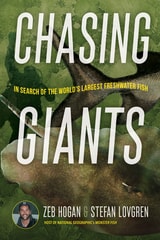
Chasing Giants
In Search of the World's Largest Freshwater FishZeb Hogan
University of Nevada Press, 2023
On May 1, 2005, a Thai fisherman caught a truly monstrous Mekong giant catfish. At 646 pounds, it captured the world’s attention, and with awe and wonder, it was deemed the largest freshwater fish on record. There was no denying its size, but when biologist and research associate professor Hogan saw a photo of the fish, he wondered if it really was the biggest in the world. To his surprise, no one had systematically sought to answer the question: Which of the giant freshwater species really was the largest?
Seeking to answer that question has brought Hogan face to face with massive arapaima and piranha in the Amazon, alligator gar in Texas, pigeon-eating wels catfish in France, stingrays in Cambodia, and the gnarled-toothed sawfish in Australia. Part of his scientific adventure has been captured on Monster Fish, and Hogan now tells the full story of his 25-year quest to understand the mysteries of some of the oldest, largest, most bizarre creatures on Earth.
The fate of these giant fish motivates Hogan to understand the various species he studies. The megafish’s numbers are dwindling, and the majority of them face extinction. In this book, he teams up with award-winning journalist Stefan Lovgren to tell, for the first time, the remarkable and troubling story of the world’s largest freshwater fish. It is a story that stretches across the globe, chronicling a race against the clock to find and protect these ancient leviathans before they disappear forever.
Chasing Giants: In Search of the World’s Largest Freshwater Fish combines science, adventure, and wonder to provide insights into the key role the massive fish of our lakes and rivers play in our past, present, and future.
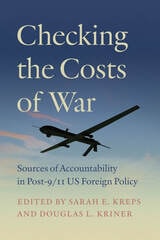
Checking the Costs of War
Sources of Accountability in Post-9/11 US Foreign PolicyEdited by Sarah E. Kreps and Douglas L. Kriner
University of Chicago Press, 2025
A thorough reassessment of how domestic factors do and do not constrain the use of American military force abroad in the early twenty-first century.
More than two decades have passed since the September 11th terrorist attacks resuscitated debates about the “imperial presidency” within the United States. During that same time, the United States has fought costly and inconclusive wars in Iraq and Afghanistan, pivoted to the Pacific to counter China, and pulled its gaze back to Europe and the Middle East in response to wars in Ukraine and Gaza. Moreover, new technologies and ways of funding and staffing wars have made the costs of war less visible to the public while polarization has increased and a new legal doctrine of presidential power has gained force.
Against this backdrop, Checking the Costs of War reassesses how domestic factors have both constrained and failed to constrain the use of military power across different contexts and over time. Richly empirical chapters explore the varying effects of different kinds of potential checks: legislative, public opinion, and bureaucratic. Collectively, chapters offer new insight into the prospects for war and peace today.
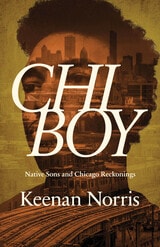
Chi Boy
Native Sons and Chicago ReckoningsKeenan Norris
The Ohio State University Press, 2022
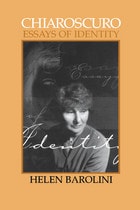
Chiaroscuro
Essays on Identity: Revised EditionHelen Barolini
University of Wisconsin Press, 1999
“A lively, lucid, and often extremely moving collection of essays.”—Sandra Gilbert, author of Wrongful Death: A Memoir
“Barolini’s essays moved me. Their commitment, their passion, their intelligence struck me very powerfully and made them among the most incisive essays on Italian-Americana, ethnicity, and diversity in literature that I have ever read.”—Fred Misurella, author of Understanding Milan Kundera: Public Events, Private Affairs and Short Time
Part memoir, part social commentary, and part literary criticism, Chiaroscuro is not only profoundly original but also of crucial importance in establishing the contours of an Italian-American tradition. Spanning a quarter century of work, the essays in Helen Barolini’s essays explore her personal search; literature as a formative influence; and the turning of the personal into the political. Included in Chiaroscuro is an updated re-introduction to Barolini’s American Book Award-winning collection, The Dream Book: An Anthology of Writings by Italian-American Women.
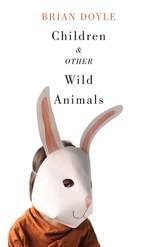
Children and Other Wild Animals
Notes on badgers, otters, sons, hawks, daughters, dogs, bears, air, bobcats, fishers, mascots, Charles Darwin, newts, sturgeon, roasting squirrels, parrots, elk, foxes, tigers and various other zoological mattersBrian Doyle
Oregon State University Press, 2014
In these short vignettes, Doyle explores the seethe of life on this startling planet, the astonishing variety of our riveting companions, and the joys available to us when we pause, see, savor, and celebrate the small things that are not small in the least.
Doyle’s trademark quirky prose is at once lyrical, daring, and refreshing; his essays poignant but not pap, sharp but not sermons, and revelatory at every turn. Throughout there is humor and humility and a palpable sense of wonder, with passages of reflection so true and hard earned they make you stop and reread a line, a paragraph, a page.
Children & Other Wild Animals gathers previously unpublished work with selections that have appeared in Orion, The Sun, Utne Reader, High Country News, and The American Scholar, as well as Best American Essays (“The Greatest Nature Essay Ever”) and Best American Nature and Science Writing (“Fishering”). “The Creature Beyond the Mountain,” Doyle’s paean to the mighty and mysterious sturgeon of the Pacific Northwest, won the John Burroughs Award for Outstanding Nature Essay. As he notes in that tribute to all things “sturgeonness”:
“Sometimes you want to see the forest and not the trees. Sometimes you find yourself starving for what’s true, and not about a person but about all people. This is how religion and fascism were born, but it’s also why music is the greatest of arts, and why stories matter, and why we all cannot help staring at fires and great waters.”
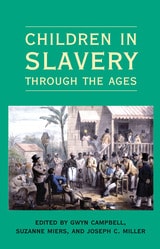
Children in Slavery through the Ages
Gwyn Campbell
Ohio University Press, 2009
Significant numbers of the people enslaved throughout world history have been children. The vast literature on slavery has grown to include most of the history of this ubiquitous practice, but nearly all of it concentrates on the adult males whose strong bodies and laboring capacities preoccupied the masters of the modern Americas. Children in Slavery through the Ages examines the children among the enslaved across a significant range of earlier times and other places; its companion volume will examine the children enslaved in recent American contexts and in the contemporary/modern world.
This is the first collection to focus on children in slavery. These leading scholars bring our thinking about slaving and slavery to new levels of comprehensiveness and complexity. They further provide substantial historical depth to the abuse of children for sexual and labor purposes that has become a significant humanitarian concern of governments and private organizations around the world in recent decades.
The collected essays in Children in Slavery through the Ages fundamentally reconstruct our understanding of enslavement by exploring the often-ignored role of children in slavery and rejecting the tendency to narrowly equate slavery with the forced labor of adult males. The volume’s historical angle highlights many implications of child slavery by examining the variety of children’s roles—as manual laborers and domestic servants to court entertainers and eunuchs—and the worldwide regions in which the child slave trade existed.
Children of Atlantis
Zdenko Lešic
Central European University Press, 1995
Children of the Dragonfly
Native American Voices on Child Custody and EducationRobert Bensen
University of Arizona Press, 2001
Native American children have long been subject to removal from their homes for placement in residential schools and, more recently, in foster or adoptive homes. The governments of both the United States and Canada, having reduced Native nations to the legal status of dependent children, historically have asserted a surrogate parentalism over Native children themselves.
Children of the Dragonfly is the first anthology to document this struggle for cultural survival on both sides of the U.S.-Canadian border. Through autobiography and interviews, fiction and traditional tales, official transcripts and poetry, these voices— Seneca, Cherokee, Mohawk, Navajo, and many others— weave powerful accounts of struggle and loss into a moving testimony to perseverance and survival. Invoking the dragonfly spirit of Zuni legend who helps children restore a way of life that has been taken from them, the anthology explores the breadth of the conflict about Native childhood.
Included are works of contemporary authors Sherman Alexie, Joy Harjo, Luci Tapahonso, and others; classic writers Zitkala-Sa and E. Pauline Johnson; and contributions from twenty important new writers as well. They take readers from the boarding school movement of the 1870s to the Sixties Scoop in Canada and the Indian Child Welfare Act of 1978 in the United States. They also spotlight the tragic consequences of racist practices such as the suppression of Indian identity in government schools and the campaign against Indian childbearing through involuntary sterilization.
CONTENTS
Part 1. Traditional Stories and Lives
Severt Young Bear (Lakota) and R. D. Theisz, To Say "Child"
Zitkala-Sa (Yankton Sioux), The Toad and the Boy
Delia Oshogay (Chippewa), Oshkikwe's Baby
Michele Dean Stock (Seneca), The Seven Dancers
Mary Ulmer Chiltoskey (Cherokee), Goldilocks Thereafter
Marietta Brady (Navajo), Two Stories
Part 2. Boarding and Residential Schools
Embe (Marianna Burgess), from Stiya: or, a Carlisle Indian Girl at Home
Black Bear (Blackfeet), Who Am I?
E. Pauline Johnson (Mohawk), As It Was in the Beginning
Lee Maracle (Stoh:lo), Black Robes
Gordon D. Henry, Jr. (White Earth Chippewa), The Prisoner of Haiku
Luci Tapahonso (Navajo), The Snakeman
Joy Harjo (Muskogee), The Woman Who Fell from the Sky
Part 3. Child Welfare and Health Services
Problems That American Indian Families Face in Raising Their Children, United States Senate, April 8 and 9, 1974
Mary TallMountain (Athabaskan), Five Poems
Virginia Woolfclan, Missing Sister
Lela Northcross Wakely (Potawatomi/Kickapoo), Indian Health
Sherman Alexie (Spokane/Coeur d'Alene), from Indian Killer
Milton Lee (Cheyenne River Sioux) and Jamie Lee, The Search for Indian
Part 4. Children of the Dragonfly
Peter Cuch (Ute), I Wonder What the Car Looked Like
S. L. Wilde (Anishnaabe), A Letter to My Grandmother
Eric Gansworth (Onondaga), It Goes Something Like This
Kimberly Roppolo (Cherokee/Choctaw/Creek), Breeds and Outlaws
Phil Young (Cherokee) and Robert Bensen, Wetumka
Lawrence Sampson (Delaware/Eastern Band Cherokee), The Long Road Home
Beverley McKiver (Ojibway), When the Heron Speaks
Joyce carlEtta Mandrake (White Earth Chippewa), Memory Lane Is the Next Street Over
Alan Michelson (Mohawk), Lost Tribe
Patricia Aqiimuk Paul (Inupiaq), The Connection
Terry Trevor (Cherokee/Delaware/Seneca), Pushing up the Sky
Annalee Lucia Bensen (Mohegan/Cherokee), Two Dragonfly Dream Songs
China's Gentry
Essays on Rural-Urban RelationsHsiao-tung Fei
University of Chicago Press, 1980
"The chief interest and charm of this book lie in the fact that it is not directed to the Western reader; these were studies written in Chinese, by an erudite Chinese, for a Chinese public. . . . Mrs. Redfield is to be complimented for her own careful research in preparing this translation for a non-Chinese public."—Robert F. Spencer, American Anthropologist
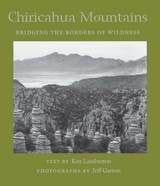
Chiricahua Mountains
Bridging the Borders of WildnessText by Ken Lamberton; Photographs by Jeff Garton
University of Arizona Press, 2003
Lamberton shares insights about the geology, habitats, and diversity of wildlife in a place of such isolation that species must either adapt or become extinct. The Chiricahuas are one link in a chain of mountains connecting the Rockies to the Sierra Madre Occidental in Mexico, and some Madrean species reach the northernmost extension of their ranges here: birds like sulphur-bellied flycatchers, mammals like jaguarundis, and trees like the Apache pine. But this is not an untraveled wilderness. We learn why the Chiricahuas are so popular with birders, who flock to these mountains from around the world in the hopes of spotting some of the nearly four hundred avian species found here. We also learn something of the Chiricahua's rich human culture, from Apache warriors to European settlers.
Gracing the text are more than a dozen black-and-white photographs by Jeff Garton that offer views of the Chiricahuas different from those usually found in tourist brochures: landscapes and riparian settings, rock formations and plant studies that give readers a lasting impression of the beauty and tranquility of this wilderness. Together words and images convey an intimate view of one of the Southwest's most exotic locations—stronghold, paradise, and everlasting island in the vast and rolling desert.

Christmas on the Great Plains
Dorothy Dodge Robbins
University of Iowa Press, 2004
Circling Faith
Southern Women on SpiritualityWendy Reed
University of Alabama Press, 2012

Circling the Bases
Essays on the Challenges and Prospects of the Sports IndustryAuthored by Andrew Zimbalist
Temple University Press, 2010
In Circling the Bases, leading sports economist Andrew Zimbalist continues his discussion and analysis of the major issues and challenges confronting the sports industry in the second decade of the 21st century. Presenting a general overview of the sports business at both the college and professional levels, this volume places concerns such as the antitrust status of sports leagues, the stalled progress of gender equity in college sports, and the control of Performance Enhancing Drugs in historical context.
Zimbalist also provides a deeper understanding of how sports have fared and changed with the sharpening financial crisis and 2009 economic downturn—from the morphing role of salary caps and revenue distribution and the rapid escalation of college coaches' compensation to the financing of sports facilities and the economic impact of hosting the Olympic Games.
In Circling the Bases, Zimbalist continues to show how the business of sports is evolving and how the sports industry is becoming more closely linked with the corporate sector and thus more vulnerable to the vicissitudes of the U.S. and world economies. Zimbalist deftly shows how sports are facing the uncertainties of the future and what the implications are for sports fans, players, owners, and leagues.
Cistem Failure
Essays on Blackness and CisgenderMarquis Bey
Duke University Press, 2022
Citizens of Everywhere
Searching for Identity in the Age of BrexitPeter Gumbel
Haus Publishing, 2020
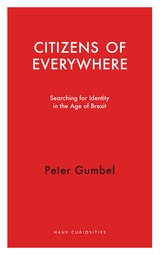
Drawing on one family’s migration stories, Citizens of Everywhere explores the nature of belonging amid cycles of pluralism and nationalism. In an increasingly global world, nativist and diasporic impulses pull many people in contradictory directions that can be difficult to even understand. In Citizens of Everywhere, Gumbel grapples with this complexity through his own family history, revealing the personal costs of Britain’s recent isolationist retreat. Along the way, he laments the decline of British pluralism at the worst possible moment—as it rejects the European project and engages in an ill-fated struggle against an ever more interconnected world.
City Dog
EssaysW.S. Di Piero
Northwestern University Press, 2009
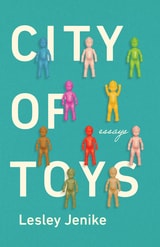
City of Toys
EssaysLesley Jenike
The Ohio State University Press, 2026
Composed in a postpartum blur and finessed as Lesley Jenike settled into established motherhood, the essays in City of Toys careen from exteriority to interiority, from high to low culture, and from the manufactured to the natural world, all on a quest to understand creativity, mothering, and how art drives and shapes us. With madcap acuity, Jenike casts her eye on cultural flash points from Harambe the gorilla to Steven Spielberg and Ada Lovelace to Yayoi Kusama. At times she doubles back to her own experience as a young performer, and at others hurtles into her children’s possible futures, when AI starts to dream, imagination is commodified, and the polar bear drowns. All the while she wonders what we owe our children and what we believe (rightly or wrongly) our children owe us. Fascinated by creativity and peopled by dolls, automatons, robots, ghosts, puppets, and historical figures, this exuberant and devastating debut asks, What world are we building, and what are we tearing down?

Closed Encounters
Literary Politics and Public CultureJeffrey Wallen
University of Minnesota Press, 1998
Closed Encounters was first published in 1998. Minnesota Archive Editions uses digital technology to make long-unavailable books once again accessible, and are published unaltered from the original University of Minnesota Press editions.
It's committed. It's political. It's socially engaged. It's academic criticism in the nineties. But what does it achieve? In a provocative and fair-minded look at current critical practices and the future of the academy, Jeffrey Wallen draws a disturbing picture of public intellectuals in search of a public and cultural critics unable to enter a dialogue with others.
Wallen argues that literary politics is no substitute for debate on genuine political issues. Taking up several of the most influential critics of recent years-Edward Said, Eve Kosofsky Sedgwick, Michael Bérubé, Gerald Graff, Richard Rorty, Stanley Fish, and many others-Wallen asks: Can their desire to persuade an audience beyond the classroom be fulfilled? And can cultural critics realize their ambitious social and institutional goals for change? In a work that is neither of the Left nor of the Right, but likely to unsettle both, Wallen argues that literary criticism actually undermines the prospects for the dialogue it calls out for.
In addition, Wallen argues that the institutionalization of critiques of truth and difference-critiques that appear to liberate us by revealing that knowledge and values are constructed, and can therefore be transformed-often leads to a further constraining of thought and narrowing of outlooks. In his analysis of the administration of conflict, Wallen describes the troubled state of academic freedom and points to a shift from the institutional protection of dissenting views to the institutional protection from views one finds unpleasant.
Yet the prospects are not bleak: Wallen emphasizes that academic critics continue to play a crucial role in crafting what we expect from discussion. In this spirit, Closed Encounters lays the groundwork for fashioning a truly public, socially engaged criticism.
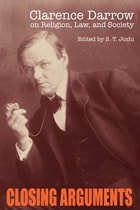
Closing Arguments
Clarence Darrow on Religion, Law, and SocietyClarence Darrow
Ohio University Press, 2005
Clarence Darrow, son of a village undertaker and coffinmaker, rose to become one of America’s greatest attorneys—and surely its most famous. The Ohio native gained renown for his central role in momentous trials, including his 1924 defense of Leopold and Loeb and his defense of Darwinian principles in the 1925 Scopes “Monkey Trial.” Some have traced Darrow’s lifelong campaign against capital punishment to his boyhood terror at seeing a Civil War soldier buried—and no client of Darrow’s was ever executed, not even black men who were accused of murder for killing members of a white mob.
Closing Arguments: Clarence Darrow on Religion, Law, and Society collects, for the first time, Darrow’s thoughts on his three main preoccupations, revealing a carefully conceived philosophy expressed with delightful pungency and clarity. His thoughts on social issues, especially on the dangers of religious fundamentalism, are uncannily prescient. A dry humor infuses his essays, and his reflections on himself and his philosophy reveal a quiet dignity at the core of a man better known for provoking Americans during an era of unprecedented tumult. From the wry “Is the Human Race Getting Anywhere?” to the scornful “Patriotism” and his elegiac summing up, “At Seventy-two,” Darrow’s writing still stimulates, pleases and challenges.
A rebel who always sided intellectually and emotionally with the minority, Darrow remains a figure to contend with sixty-seven years after his death. “Inside every lawyer is the wreck of a poet,” Darrow once said. Closing Arguments demonstrates that, in his case, that statement is true.
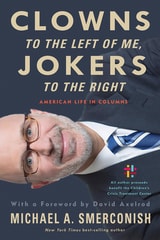
Clowns to the Left of Me, Jokers to the Right
American Life in ColumnsMichael A. Smerconish
Temple University Press, 2020
Opinionated talk show host and columnist Michael Smerconish has been chronicling local, state, and national events for the Philadelphia Daily News and the Philadelphia Inquirer for more than 15 years. He has sounded off on topics as diverse as the hunt for Osama bin Laden and what the color of your Christmas lights says about you. In this collection of 100 of his most memorable columns, Smerconish reflects on American political life with his characteristic feistiness. A new Afterword for each column provides updates on both facts and feelings, indicating how the author has evolved over the years, moving from a reliable Republican voter to a political Independent.
Clowns to the Left of Me, Jokers to the Right covers the post-9/11 years, Barack Obama’s ascension, and the rise of Donald Trump. Smerconish describes meeting Ronald Reagan, having dinner with Fidel Castro, barbequing with the band YES in his backyard, spending the same night with Pete Rose and Ted Nugent, drinking champagne from the Stanley Cup, and conducting Bill Cosby’s only pretrial interview. He also writes about local Philadelphia culture, from Sid Mark to the Rizzo statue.
Smerconish’s outlook as expressed in these impassioned opinion pieces goes beyond “liberal” or “conservative.” His thought process continues to evolve and change, and as it does, he aims to provoke readers to do the same.
All author proceeds benefit the Children’s Crisis Treatment Center, a Philadelphia- based, private, nonprofit agency that provides behavioral health services to children and their families.
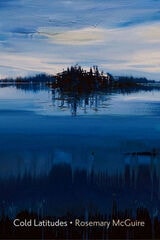
Cold Latitudes
Rosemary McGuire
University of Alaska Press, 2021
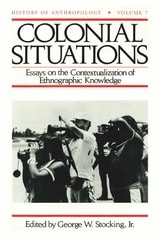
Colonial Situations
Essays on the Contextualization of Ethnographic KnowledgeEdited by George W. Stocking, Jr.
University of Wisconsin Press, 1993
As European colonies in Asia and Africa became independent nations, as the United States engaged in war in Southeast Asia and in covert operations in South America, anthropologists questioned their interactions with their subjects and worried about the political consequences of government-supported research. By 1970, some spoke of anthropology as “the child of Western imperialism” and as “scientific colonialism.” Ironically, as the link between anthropology and colonialism became more widely accepted within the discipline, serious interest in examining the history of anthropology in colonial contexts diminished.
This volume is an effort to initiate a critical historical consideration of the varying “colonial situations” in which (and out of which) ethnographic knowledge essential to anthropology has been produced. The essays comment on ethnographic work from the middle of the nineteenth century to nearly the end of the twentieth, in regions from Oceania through southeast Asia, the Andaman Islands, and southern Africa to North and South America.
The “colonial situations” also cover a broad range, from first contact through the establishment of colonial power, from District Officer administrations through white settler regimes, from internal colonialism to international mandates, from early “pacification” to wars of colonial liberation, from the expropriation of land to the defense of ecology. The motivations and responses of the anthropologists discussed are equally varied: the romantic resistance of Maclay and the complicity of Kubary in early colonialism; Malinowski’s salesmanship of academic anthropology; Speck’s advocacy of Indian land rights; Schneider’s grappling with the ambiguities of rapport; and Turner’s facilitation of Kaiapo cinematic activism.
“Provides fresh insights for those who care about the history of science in general and that of anthropology in particular, and a valuable reference for professionals and graduate students.”—Choice
“Among the most distinguished publications in anthropology, as well as in the history of social sciences.”—George Marcus, Anthropologica
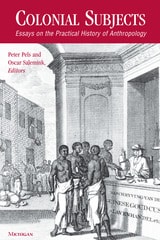
Colonial Subjects
Essays on the Practical History of AnthropologyPeter Pels and Oscar Salemink, Editors
University of Michigan Press, 2000
The essays in this volume share the assumption that "ethnography," far from being the unique purview of anthropology, is a broader field of practice out of which and alongside which anthropology attempted to distinguish itself as a scientific discipline. They explore a variety of situations in colonial South and Southeast Asia and Africa and in the treatment of the indigenous inhabitants of North America and Australia to provide genealogies of present-day anthropological practices, tracing them back to the subjects of colonial ethnography.
This book introduces into the history of anthropology many of the insights developed in recent studies in history, cultural studies, and the anthropology of colonialism. It can serve as a course book in the history of anthropology and the anthropology of colonialism, while at the same time addressing a much larger audience of students of colonial history, of the history of science and modernity, and of globalization.
Peter Pels is Lecturer in Anthropology, University of Amsterdam. Oscar Salemink is Program Officer for Social Sciences and Humanities, The Ford Foundation-Vietnam.

Colorado River Reader
Richard F. Fleck
University of Utah Press, 2000
"This canyon world where water yearns toward the ocean is a place so large I can’t take it in. Instead, I am taken in, traveling a near dream as we journey by water, contained by rock walls. In order to see this shorn-away world, I narrow my vision to the small and nearly secret. Never mind the stone’s illusion of permanence or the great strength of water. I look to the most fragile of things here, to the plant world of the canyon. The other river travelers seem taken in by stone, time, and water, and do not see the small things that tempt my attention, the minute fern between stones, the tiny black snails in a pond of water. I am drawn in by the growing life and not by the passing."
- from 'Plant Journey' by Linda Hogan
The mystique of the Colorado River is no less enduring and powerful than is its physical presence in the landscape of the West. Little wonder that narratives about the Colorado still arouse and intrigue readers, or that the river continues to inspire new writing among contemporary authors. What is surprising is that no anthology offering a comprehensive introduction to these works existed - until now.
A Colorado River Reader spans hundreds of years and many cultures and voices to capture an array of responses to this mighty river and tributaries. The collection opens with a Paiute creation myth set in the Grand Canyon and progresses through time, encompassing the Spanish and American exploration narratives of the eighteenth and nineteenth centuries and culminating in the adventure and nature writings of the twentieth.
This is a book that deserves a place next to every armchair and in a pocket of every backpack.
Colors and Textures of Roman North Africa
Essays in Memory of Maureen A. TilleyElizabeth A. Clark
Catholic University of America Press, 2023
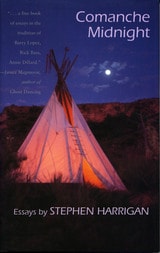
Comanche Midnight
Essays by Stephen Harrigan
University of Texas Press, 1995
Writing timeless essays that capture vanished worlds and elusive perceptions, Stephen Harrigan is emerging as a national voice with an ever-expanding circle of enthusiastic readers. For those who have already experienced the pleasures of his writing—and especially for those who haven't—Comanche Midnight collects fifteen pieces that originally appeared in the pages of Texas Monthly, Travel Holiday, and Audubon magazines.
The worlds Harrigan describes in these essays may be vanishing, but his writing invests them with an enduring reality. He ranges over topics from the past glories and modern-day travails of America's most legendary Indian tribe to the poisoning of Austin's beloved Treaty Oak, from the return-to-the-past realism of the movie set of Lonesome Dove to the intimate, off-season languor of Monte Carlo.
If the personal essay can be described as journalism about that which is timeless, then Stephen Harrigan is a reporter of people, events, and places that will be as newsworthy years from now as they are today. Read Comanche Midnight and see if you don't agree.