Results by title
377 books match the query 'French' and 28 start with c
C'est la Guerre
Louis Calaferte
Northwestern University Press, 1999
Cacaphonies
The Excremental Canon of French LiteratureAnnabel L. Kim
University of Minnesota Press, 2022
Exploring why there is so much fecal matter in literary works that matter
Cacaphonies takes fecal matter and its place in literature seriously. Readers and critics have too long overlooked excrement’s vital role in the twentieth- and twenty-first-century French canon. In a stark challenge to the tendency to view this literature through sanitizing abstractions, Annabel L. Kim undertakes close readings of key authors to argue for feces as a figure of radical equality, both a literary object and a reflection on literature itself, without which literary studies is impoverished and sterile.
Following the fecal through line in works by Céline, Beckett, Genet, Sartre, Duras, and Gary and the contemporary authors Anne Garréta and Daniel Pennac, Kim shows that shit, far from vanishing from the canon after the early modern period, remains present in the modern and contemporary French literature that follows. She argues that all the shit in the canon expresses a call to democratize literature, making literature for all, just as shit is for (or of) all. She attends to its presence in this prized element of French identity, treating it as a continually uttered desire to manifest the universality France aspires to—as encapsulated by the slogan Liberté, égalité, fraternité—but fails to realize. In shit there is a concrete universalism that traverses bodies with disregard for embodied differences.
Cacaphonies reminds us that literature, and the ideas to be found therein, cannot be separated from the corporeal envelopes that create and receive them. In so doing, it reveals the aesthetic, political, and ethical potential of shit and its capacity to transform literature and life.
Capital Letters
Hugo, Baudelaire, Camus, and the Death PenaltyÈve Morisi
Northwestern University Press, 2020

Captive Histories
English, French, and Native Narratives of the 1704 Deerfield RaidEvan Haefeli
University of Massachusetts Press, 2006
This volume draws together an unusually rich body of original sources that tell the story of the 1704 French and Indian attack on Deerfield, Massachusetts, from different vantage points. Texts range from one of the most famous early American captivity narratives, John Williams's The Redeemed Captive, to the records of French soldiers and clerics, to little-known Abenaki and Mohawk stories of the raid that emerged out of their communities' oral traditions. Evan Haefeli and Kevin Sweeney provide a general introduction, extensive annotations, and headnotes to each text.
Although the oft-reprinted Redeemed Captive stands at the core of this collection, it is juxtaposed to less familiar accounts of captivity composed by other Deerfield residents: Quentin Stockwell, Daniel Belding, Joseph Petty, Joseph Kellogg, and the teenaged Stephen Williams. Presented in their original form, before clerical editors revised and embellished their content to highlight religious themes, these stories challenge long-standing assumptions about classic Puritan captivity narratives.
The inclusion of three Abenaki and Mohawk narratives of the Deerfield raid is equally noteworthy, offering a rare opportunity not only to compare captors' and captives' accounts of the same experiences, but to do so with reference to different Native oral traditions. Similarly, the memoirs of French military officers and an excerpt from the Jesuit Relations illuminate the motivations behind the attack and offer fresh insights into the complexities of French-Indian alliances.
Taken together, the stories collected in this volume, framed by the editors' introduction and the assessments of two Native scholars, Taiaiake Alfred and Marge Bruchac, allow readers to reconstruct the history of the Deerfield raid from multiple points of view and, in so doing, to explore the interplay of culture and memory that shapes our understanding of the past.
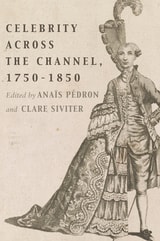
Celebrity Across the Channel, 1750–1850
Anaïs Pédron
University of Delaware Press, 2021
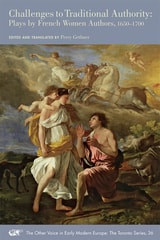
Challenges to Traditional Authority
Plays by French Women Authors, 1650-1700Françoise Pascal, Mary-Catherine Desjardins, Antoinette Deshoulières, and Catherine Durand
Iter Press, 2015

Changing Identities in Early Modern France
Michael Wolfe, ed.
Duke University Press, 1997
After examining the interplay between competing ideologies and public institutions, from the monarchy to the Parlement of Paris to the aristocratic household, the volume explores the dynamics of deviance and dissent, particularly in regard to women’s roles in religious reform movements and such sensationalized phenomena as the witch hunts and infanticide trials. Concluding essays examine how regional and confessional identities reshaped French identity in response to the discovery of the New World and the spectacular spread of Calvinism.
Contributors. Charmarie Blaisdell, William Bouwsma, Lawrence M. Bryant, Denis Crouzet, Robert Descimon, Barbara B. Diefendorf, Richard M. Golden, Sarah Hanley, Mack P. Holt, Donald R. Kelley, Kristen B. Neuschel, J. H. M. Salmon, Zachary Sayre Schiffman, Silvia Shannon, Alfred Soman, Michael Wolfe
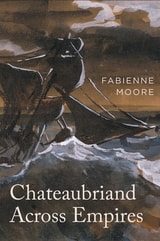
Chateaubriand Across Empires
Fabienne Moore
Bucknell University Press, 0
What happens when the liberty of ancient nobility collides with the revolutionary ideals of equality? This groundbreaking study explores how the American, French, Haitian, and Greek Revolutions redefined freedom—and how French Romantic figure Chateaubriand grappled with that transformation. Tracing his travels across England, North America, and the Mediterranean, this book uncovers Chateaubriand’s seductive visions of “paradises lost,” which were taken up, challenged, and reimagined by Anglophone and Hispanic writers.
From Charlotte Brontë to Harriet Beecher Stowe, from Byron to Bolaño authors found in Chateaubriand a conflicted but powerful voice at the crossroads of liberty, race, religion, and empire. This is the first comprehensive study to situate Chateaubriand within the histories of colonialism and global revolution, revealing a literary legacy that remains startlingly relevant in today’s struggles over equality.
Published by Bucknell University Press. Distributed worldwide by Rutgers University Press.
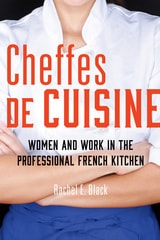
Cheffes de Cuisine
Women and Work in the Professional French KitchenRachel E. Black
University of Illinois Press, 2021
Works of Distinction, LDEI M.F.K. Fisher Prize for Excellence in Culinary Media Content, 2022
A rare woman’s-eye-view of working in the professional French kitchen
Though women enter France’s culinary professions at higher rates than ever, men still receive the lion’s share of the major awards and Michelin stars. Rachel E. Black looks at the experiences of women in Lyon to examine issues of gender inequality in France’s culinary industry. Known for its female-led kitchens, Lyon provides a unique setting for understanding the gender divide, as Lyonnais women have played a major role in maintaining the city’s culinary heritage and its status as a center for innovation. Voices from history combine with present-day interviews and participant observation to reveal the strategies women use to navigate male-dominated workplaces or, in many cases, avoid men in kitchens altogether. Black also charts how constraints imposed by French culture minimize the impact of #MeToo and other reform-minded movements.
Evocative and original, Cheffes de Cuisine celebrates the successes of women inside the professional French kitchen and reveals the obstacles women face in the culinary industry and other male-dominated professions.
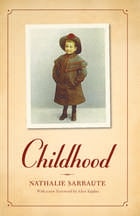
Childhood
Nathalie Sarraute
University of Chicago Press, 2013
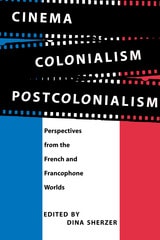
Cinema, Colonialism, Postcolonialism
Perspectives from the French and Francophone WorldsEdited by Dina Sherzer
University of Texas Press, 1996
In this first major study of French colonial and postcolonial cinema, Dina Sherzer compiles essays by some of the foremost scholars on the subject who interrogate and analyze the realities behind the images of the nation's past and present. Through an examination of France and its colonies, multiethnic contemporary France, and cinematic discourses which have been and are being produced about France's colonial past, these authors explore how the images relay underlying assumptions and their relation to historical and political facts. A variety of subjects and viewpoints inform these studies, which cover the entire range of films on that topic.
The authors expound upon the role French and Francophone films are currently playing in reconstructing and imagining France's colonial past. Not only do the essays examine how French cinema has represented the encounter of French citizens with individuals from former colonies during the colonial era; they examine how French cinema has portrayed and has come to terms with the immigration of former colonial subjects to France. In addition, the book features another postcolonial facet by analyzing films of directors from the former colonies who give their own representation of colonialism and presentation of their culture.
This study is a major contribution to postcolonial research. Race, gender, and geography are central themes throughout this book that presents innovative material that contributes to the history of French cinema and emphasizes how cinema participates in and is a part of national culture.
Citoyennes
Women and the Ideal of Citizenship in Eighteenth-Century FranceAnnie K. Smart
University of Delaware Press, 2012
Did women have a civic identity in eighteenth-century France? In Citoyennes: Women and the Ideal of Citizenship in Eighteenth-Century France, Annie Smart contends that they did. While previous scholarship has emphasized the ideal of domestic motherhood or the image of the republican mother, Smart argues persuasively that many pre-revolutionary and revolutionary texts created another ideal for women–the ideal of civic motherhood. Smart asserts that women were portrayed as possessing civic virtue, and as promoting the values and ideals of the public sphere.
Contemporary critics have theorized that the eighteenth-century ideal of the Republic intentionally excluded women from the public sphere. According to this perspective, a discourse of “Rousseauean” domestic motherhood stripped women of an active civic identity, and limited their role to breastfeeding and childcare. Eighteenth-century France marked thus the division between a male public sphere of political action and a female private sphere of the home.
Citoyennes challenges this position and offers an alternative model of female identity. This interdisciplinary study brings together a variety of genres to demonstrate convincingly that women were portrayed as civic individuals. Using foundational texts such as Jean-Jacques Rousseau’s Emile, or on Education (1762), revolutionary gouaches of Lesueur, and vaudeville plays of Year II of the Republic (1793/1794), this study brilliantly shows that in text and image, women were represented as devoted to both the public good and their families.
In addition, Citoyennes offers an innovative interpretation of the home. Through re-examining sphere theory, this study challenges the tendency to equate the home with private concerns, and shows that the home can function as a site for both private life and civic identity.
Citoyennes breaks new ground, for it both rectifies the ideal of domestic Rousseauean motherhood, and brings a fuller understanding to how female civic identity operated in important French texts and images.
Published by University of Delaware Press. Distributed worldwide by Rutgers University Press.
Code
From Information Theory to French TheoryBernard Dionysius Geoghegan
Duke University Press, 2022

Colonial Law Making
Cambodia under the FrenchSally Frances Low
National University of Singapore Press, 2023
Covering a previously neglected area of Cambodian history, Colonial Law Making explores the structural forces and contingent exchanges that shaped colonial law in Cambodia and examines its post-independence colonial legacy.
The court of King Norodom and the temples of Angkor Wat became orientalist icons in the French colonial imagination, perpetuating an image of the Protectorate (1863–1953) as special and worthy of preservation. This contributed to exceptionalism in the way the Kingdom was colonized, including through law. Drawing on previously unexamined archival material, Sally Low presents a comparative case study of French approaches to colonial law, jurisdiction, and protection. Although the voices of non-elite Cambodians are largely absent from the archives, their influence on colonial law is evident as they resisted efforts to regulate their lives and their land. Low argues that the result was a set of state legal institutions and an indigenous jurisdiction that blended Cambodian and French notions of patronage and royal power as the source and authority for law.
This work is a case study of colonial law as an instrument of control and administration in an indirectly ruled colony. It adds depth to our understanding of the impact of European colonial law and the significance of different forms of colonial rule—direct, indirect, and unofficial. It is easily accessible for non-lawyers and is a must-read for those interested in the recent past of Southeast Asia and the countries that were previously colonized as French Indochina.
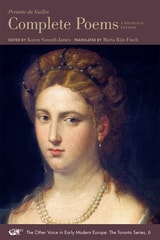
Complete Poems. A Bilingual Edition
Pernette du Guillet
Iter Press, 2010
This first complete English edition provides a fully-annotated bilingual text and a fresh perspective from which to appreciate the originality and beauty of this poetry.
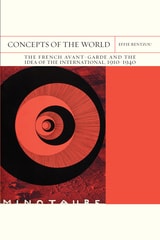
Concepts of the World
The French Avant-Garde and the Idea of the International, 1910–1940Effie Rentzou
Northwestern University Press, 2022
The writers and artists of the French avant-garde aspired to reach a global audience that would be wholly transformed by their work. In this study, Effie Rentzou delves deep into their depictions of the interwar world as an international and modern landscape, one marked by a varied cosmopolitanism. The avant-garde’s conceptualization of the world paralleled, rejected, or expanded prevailing notions of the global sphere.
The historical avant garde—which encompassed movements like futurism, Dada, and surrealism—was self-consciously international, operating across global networks and developed with the whole world as its horizon and its public. In the heady period between the end of the Belle Époque and the tumult of World War II, both individual artists (including Guillaume Apollinaire, Blaise Cendrars, Francis Picabia, Louis Aragon, Leonora Carrington, and Nicolas Calas) and collective endeavors (such as surrealist magazines and exhibitions) grappled with contemporary anxieties about economic growth, imperialism, and colonialism, as well as various universalist, cosmopolitan, and internationalist visions. By probing these works, Concepts of the World offers an alternative narrative of globalization, one that integrates the avant-garde’s enthusiasm for, as well as resistance to, the process. Rentzou identifies within the avant-garde a powerful political language that expressed the ambivalence of living and creating in an increasingly globalized world—a language that profoundly shaped the way the world has been conceptualized and is experienced today.
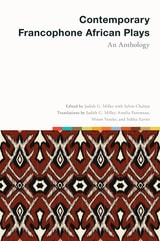
Contemporary Francophone African Plays
An AnthologyJudith G. Miller
Bucknell University Press, 2024

Contemporary French and Francophone Narratology
Edited by John Pier
The Ohio State University Press, 2020
The essays included in this collection seek to take the pulse of recent developments in narratological research in the French-speaking countries. Theorists in these countries heavily participated in and shaped narratology, an outgrowth of the structuralist movement during the 1960s and 1970s. While US, German, and Scandinavian theorists took the forefront in the 1990s, narratology in France faded into the background. It was not until the turn of the century that a new interest in narratological issues among French researchers emerged. Activity in the field has since intensified, spurred on, in part, by the realization that narratology cannot be summed up by its formalist and structuralist origins.
Well-versed in French narrative theory, both classical and more recent, the authors in this collection also draw on scholarship coming from other research traditions. The result is that these contributions offer a number of syntheses and perspectives representative of recent French-language scholarship in the field that readers may not be familiar with or that provide them with further insight into subjects they may have encountered in other contexts. This volume will leave readers with a greater awareness of the directions taken by present-day French-language narratology as well as new and developing themes in narrative theory generally.
Contributors
Raphaël Baroni, Denis Bertrand, Olivier Caïra, Claude Calame, Benoît Hennaut, Françoise Lavocat, Sylvie Patron, John Pier, Françoise Revaz, and Richard Saint-Gelais

Continental England
Form, Translation, and Chaucer in the Hundred Years’ WarElizaveta Strakhov
The Ohio State University Press, 2022
Cool Memories II, 1987-1990
Jean Baudrillard
Duke University Press, 1996
In this wide-ranging discussion of events and ideas, Baudrillard moves between poetry and waterfalls, strikes and stealth bombers, Freud and La Cicciolina, shadows and simulacra, deconstruction and the zodiac, Reagan’s smile and Kennedy’s death, the “curse” on South America and the future of the West, the last tango of French intellectual life and the exemplary disappearing act of Italian politics. Writing at the site where the philosophic and the poetic merge, he once again offers us commentary in the form of the riveting insight, the short distillation of reality that establishes its truth with the force of recognition.
Cool Memories II, Baudrillard’s latest commentary on the technopresent and future, an installment of his reflections on the reality of contemporary western culture, will entice all readers concerned with postmodernism and the current state of theory.
Countermodernism and Francophone Literary Culture
The Game of SlipknotKeith L. Walker
Duke University Press, 1999
Martinique, French Guyana, Senegal, Morocco, and Haiti serve as the stage for the struggle these writers have faced with French language and culture, a struggle influenced by the legacy of Aimé Césaire. In his stand against the modernist principles of Charles Baudelaire, Walker argues, Césaire has become the preeminent francophone countermodernist. A further examination of the relationships between Césaire and the writers Léon Gontron Damas, Mariama Bâ, Tahar Ben Jelloun, Ken Bugul, and Gérard Étienne forms the core of the book and leads to Walker’s characterization of francophone literature as having “slipped the knot,” or escaped the snares of the familiar binary oppositions of modernism. Instead, he discovers in these writers a shared consciousness rooted in an effort to counter and denounce modernist humanist discourse and pointing toward a new subjectivity formed through the negotiation of an alternative modernity.
Countermodernism and Francophone Literary Culture will engage readers interested in French literature and in postcolonial, Caribbean, African, American, and francophone studies.
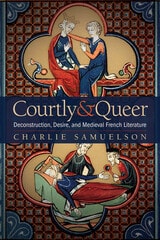
Courtly and Queer
Deconstruction, Desire, and Medieval French LiteratureCharlie Samuelson
The Ohio State University Press, 2022

Creole Medievalism
Colonial France and Joseph Bédier’s Middle AgesMichelle R. Warren
University of Minnesota Press, 2010
In Creole Medievalism, Michelle Warren demonstrates that Bédier's relationship to this multicultural and economically peripheral colony motivates his nationalism in complex ways. Simultaneously proud of his French heritage and nostalgic for the island, Bédier defends French sovereignty based on an ambivalent resistance to his creole culture. Warren shows that in the early twentieth century, influential intellectuals from Réunion helped define the new genre of the "colonial novel," adopting a pro-colonial spirit that shaped both medieval and Francophone studies. Probing the work of a once famous but little understood cultural figure, Creole Medievalism illustrates how postcolonial France and Réunion continue to grapple with histories too varied to meet expectations of national unity.
Critical Prefaces of the French Renaissance
Bernard Weinberg
Northwestern University Press, 1950

Crossing the Divide
Representations of Deafness in BiographyRachel M. Hartig
Gallaudet University Press, 2006
This remarkable volume examines the process by which three deaf, French biographers from the 19th and 20th centuries attempted to cross the cultural divide between deaf and hearing worlds through their work. The very different approach taken by each writer sheds light on determining at what point an individual’s assimilation into society endanger his or her sense of personal identity.
Author Hartig begins by assessing the publications of Jean-Ferdinand Berthier (1803-1886). Berthier wrote about Auguste Bébian, Abbé de l’Epée, and Abbé Sicard, all of whom taught at the National Institute for the Deaf in Paris. Although Berthier presented compelling portraits of their entire lives, he paid special attention to their political and social activism, his main interest.
Yvonne Pitrois (1880-1937) pursued her particular interest in the lives of deaf-blind people. Her biography of Helen Keller focused on her subject’s destiny in conjunction with her unique relationship with Anne Sullivan. Corinne Rocheleau-Rouleau (1881-1963) recounted the historical circumstances that led French-Canadian pioneer women to leave France. The true value of her work resides in her portraits of these pioneer women: maternal women, warriors, religious women, with an emphasis on their lives and the choices they made.
Crossing the Divide reveals clearly the passion these biographers shared for narrating the lives of those they viewed as heroes of an emerging French deaf community. All three used the genre of biography not only as a means of external exploration but also as a way to plumb their innermost selves and to resolve ambivalence about their own deafness.
Crusoes and Other Castaways in Modern French Literature
Solitary AdventuresJoseph Acquisto
University of Delaware Press, 2012
Published by University of Delaware Press. Distributed worldwide by Rutgers University Press.
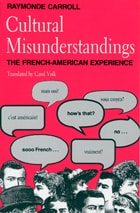
Cultural Misunderstandings
The French-American ExperienceRaymonde Carroll
University of Chicago Press, 1990
Raymonde Carroll presents an intriguing and thoughtful analysis of the many ways French and Americans—and indeed any members of different cultures—can misinterpret each other, even when ostensibly speaking the same language.Cultural misunderstandings, Carroll points out, can arise even where we least expect them—in our closest relationships. The revealing vignettes that Carroll relates, and her perceptive comments, bring to light some fundamental differences in French and American presuppositions about love, friendship, and raising children, as well as such everyday activities as using the telephone or asking for information.
Culture and Content in French
Frameworks for Innovative CurriculaAurélie Chevant-Aksoy
Lever Press, 2022