Results by title
477 books match the query 'Italy' and 33 start with c
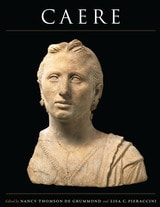
Caere
Edited by Nancy Thomson de Grummond and Lisa C. Pieraccini
University of Texas Press, 2016
The Etruscan city of Caere and eleven other Etruscan city-states were among the first urban centers in ancient Italy. Roman descriptions of Etruscan cities highlight their wealth, beauty, and formidable defenses. Although Caere left little written historical record outside of funerary inscriptions, its complex story can be deciphered by analyzing surviving material culture, including architecture, tomb paintings, temples, sanctuaries, and materials such as terracotta, bronze, gold, and amber found in Etruscan crafts. Studying Caere provides valuable insight not only into Etruscan history and culture but more broadly into urbanism and the development of urban centers across ancient Italy.
Comprehensive in scope, Caere is the first English-language book dedicated to the study of its eponymous city. Collecting the work of an international team of scholars, it features chapters on a wide range of topics, such as Caere’s formation and history, economy, foreign relations, trade networks, art, funerary traditions, built environment, religion, daily life, and rediscovery. Extensively illustrated throughout, Caere presents new perspectives on and analysis of not just Etruscan civilization but also the city’s role in the wider pan-Mediterranean basin.

Catalogue of Watermarks in Italian Printed Maps, ca. 1540-1600
David Woodward
University of Chicago Press, 1996
Fifteen years in the making, this catalogue will be an essential reference for bibliographers and archivists dealing with rare books and maps of the period, for map collectors, map librarians, and scholars and librarians working with early printed items and manuscripts.
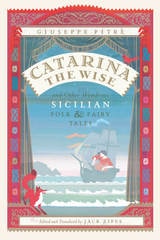
Catarina the Wise and Other Wondrous Sicilian Folk and Fairy Tales
Collected by Giuseppe Pitrè
University of Chicago Press, 2017
So begins the title story in this collection of fifty Sicilian folk and fairy tales edited and translated by noted folklore scholar Jack Zipes. But while some of the stories may sound as if they’ve been told time and again—such as variations on Cinderella and Puss in Boots—many will enchant English-language readers and storytellers for the first time. From “The Pot of Basil” to “The Talking Belly,” “The Little Mouse with the Stinky Tail” to “Peppi, Who Wandered out into the World,” the stories in Catarina the Wise range from simple tales of getting a new dress or something good to eat to fantastical plots for outwitting domineering husbands, rescuing impoverished fathers, or attracting wealthy suitors (frequently the Prince of Portugal). Many feature strong, clever women (usually daughters who become queen). Many are funny; many are wise. Some are very, very strange.
As Zipes relates, the true story of their origins is as extraordinary as the tales themselves. Born to a poor family of sailors in Palermo, Giuseppe Pitrè would go on to serve with Garibaldi, become a traveling country doctor, and gather one of the most colossal collections of folk and fairy tales of the nineteenth century. But while his work as a folklorist rivaled that of the Brothers Grimm, Pitrè remains a relative unknown. Catarina the Wise highlights some of the most delectable stories at the heart of his collection. Featuring new, original illustrations, this book is a beautiful, charming treasure for any fan of story, storytelling, and heroines and heroes living happily ever after—sometimes.
Catiline, The Monster of Rome
An Ancient Case of Political AssassinationFrancis Galassi
Westholme Publishing, 2014
In 62 BC, Roman Senator Lucius Sergius Catiline lay dead on a battlefield in Tuscany. He was slain along with his soldiers after his conspiracy to overthrow the Roman Republic had been exposed by his adversary Cicero. It was an ignominious end for a man described at the time as a perverted, insane monster who had attempted to return his family to fortune and social standing. Chroniclers were not kind to Catiline, and his name over the centuries was synonymous with treachery. Recently, scholars have been reappraising the life and influence of this ancient Roman. In Catiline, The Monster of Rome: An Ancient Case of Political Assassination, economic historian Francis Galassi provides the first book-length account of Catiline in more than a generation.
Rome first achieved a status as an empire during Catiline’s lifetime. The republic was, however, constantly at war with foreign powers and occasionally its own allies, and the disparity between the wealthy and the poor threatened to destabilize society. Catiline was from an aristocratic but impoverished family and first served as an officer with Cornelius Sulla during that general’s purges against Gaius Marius, the supposed champion of the oppressed masses. Catiline’s goal was to serve Sulla and then use that as a springboard to public office where he could recover his family’s former wealth and honor. However, the senatorial elite became suspicious if not threatened by the upstart Catiline and blocked his ambitions. Catiline was dogged by trumped-up charges, including raping a Vestal virgin and murdering his brother-in-law; he was acquitted each time, but his political life was ruined. With citizens demanding land and agrarian reform, Catiline genuinely embraced their dissatisfaction, and realizing that the elite would stop his attempt to gain status through elections, he organized a conspiracy to take control of Roman government through arms. Once his actions had been made public, many of his supporters and co-conspirators left him; but honoring the course he had chosen, he and his remaining soldiers fought a Roman army to their deaths. Rather than the “monster” as portrayed by his contemporaries, the author contends that Catiline was compelled to act for the benefit of common Romans to save Rome even if it meant overthrowing the government. As Galassi notes, Catiline’s contemporary, the slave Spartacus, has been a symbol of social reform for centuries, but it was actually Catiline, not Spartacus, who attempted to change Rome.
Catina’s Haircut
A Novel in StoriesPaola Corso
University of Wisconsin Press, 2010
Catina’s Haircut: A Novel in Stories spans four generations of a peasant family in the brutal poverty of post-Unification southern Italy and in an immigrant’s United States. The women in these tales dare to cross boundaries by discovering magical leaps inherent in the landscape, in themselves, and in the stories they tell and retell of family tragedy at a time of political unrest. Through an oral tradition embedded in the stone of memory and the flow of its reinvention, their passionate tale of resistance and transformation courses forward into new generations in a new world.
A woman threatens to join the land reform struggle in her Calabrian hill town, against her husband’s will, during a call for revolution in 1919. A brother and sister turn to the village sorceress in Fascist Italy to bring rain to their father’s drought-stricken farm. In Pittsburgh, new immigrants witness a miraculous rescue during the Great Flood of 1936. A young girl courageously dives into the Allegheny River to save her grandfather’s only memento of the old country. With only broken English to guide her, a widow hops a bus in search of live chickens to cook for Easter dinner in her husband’s memory. An aging woman in the title story is on a quest to cut the ankle-length hair as hard as the rocky soil of Calabria in a drought. A lonely woman who survived World War II bombings in her close-knit village, struggles to find community as a recent immigrant. A daughter visits her mother’s hill town to try and fulfill a wish for her to see the Fata Morgana. These haunting images permeate Corso’s linked stories of loss, hope, struggle, and freedom.
An official selection of The Sons of Italy® Book Club
Best Books for General Audiences, selected by the Public Library Association
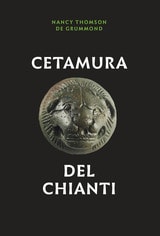
Cetamura del Chianti
By Nancy Thomson de Grummond
University of Texas Press, 2020
Expanding the study of Etruscan habitation sites to include not only traditional cities but also smaller Etruscan communities, Cetamura del Chianti examines a settlement that flourished during an exceptional time period, amid wars with the Romans in the fourth to first centuries BCE.
Situated in an ideal hilltop location that was easy to defend and had access to fresh water, clay, and timber, the community never grew to the size of a city, and no known references to it survive in ancient writings; its ancient name isn’t even known. Because no cities were ever built on top of the site, excavation is unusually unimpeded. Intriguing features described in Cetamura del Chianti include an artisans’ zone with an adjoining sanctuary, which fostered the cult worship of Lur and Leinth, two relatively little known Etruscan deities, and ancient wells that reveal the cultural development and natural environment, including the vineyards and oak forests of Chianti, over a period of some six hundred years. Deeply enhancing our understanding of an intriguing economic, political, and cultural environment, this is a compelling portrait of a singular society.
Charity and Children in Renaissance Florence
The Ospedale degli Innocenti, 1410-1536Philip Gavitt
University of Michigan Press, 1991
Alongside the architectural splendor and intellectual brilliance of early Renaissance Florence there existed a second world of poverty, misery, social despair, and child abandonment. The Ospedale degli Innocenti (Hospital of the Innocents), designed and built between 1419 and 1445 by the renowned architect Filippo Brunelleschi, united these disparate worlds. Christian charity and compassion, as well as the humanist commitment to social perfection, family values, and love for children, were intertwined with a civic pride in which charity curried God's favor and invoked God's blessings on the city's fortunes.
Based on a close and attentive reading of archival material from the hospital and from the Florentine State Archives, Charity and Children in Renaissance Florence both chronicles the concerns and ambivalence of parents who abandoned children and follows the lives of the hospital's inhabitants from childhood to death. The book also demonstrates how hospital officials deliberately duplicated the structure and values of the Florentine family within the hospital walls. Gavitt's research shows that early modern foundling hospitals were not charnel houses where parents knowingly and impersonally abandoned their unwanted children to certain death. Charity and Children in Renaissance Florence provokes reflection on the contrast between our own views on the care of homeless children and those of the Italian Renaissance.
Winner of the Society for Italian Historical Studies 1988 Award for Best Unpublished Manuscript.
Chaucer's Italian Tradition
Warren Ginsberg
University of Michigan Press, 2002
Because divergent political, municipal, and literary histories would have made the Italian cities--Genoa, Florence, and Milan--unfamiliar to an English poet from medieval London, Ginsberg argues that we must consider what Chaucer overlooked and mistook from his Italian models alongside the material he did appropriate. To make sense of premises in texts like Dante's Comedy that were peculiarly Italian, Chaucer would look to Boccaccio as a gloss; by reading these authors in conjunction with one another, Chaucer generates an "Italian tradition" that translates into the terms of his English experience works already mediated by a prior stage of transposition.
Ginsberg explores Chaucer's relationship to Italian poets not in terms of the interaction of individual talents with accredited authorities (Chaucer and Dante, Boccaccio and Petrarch, etc.). Rather, he focuses on the shifts in tension that occur when the civic engagements and disengagements of Florence's poets are brought into contact with Chaucer's growing metropolitanism and increasing reluctance to make London the locus of his poetic art.
Beyond its appeal to medievalists and those who study the Renaissance, Chaucer's Italian Tradition will be welcomed by readers interested in theoretical questions about translation and the development of tradition, including individuals who study history, literature, and the nature of the humanities.
Warren Ginsberg is Professor of English, University of Oregon.
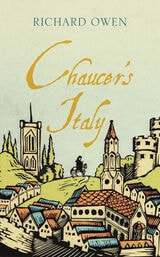
Chaucer's Italy
Richard Owen
Haus Publishing, 2023
Geoffrey Chaucer might be considered the quintessential English writer, but he drew much of his inspiration and material from Italy. In fact, without the tremendous influence of Francesco Petrarch and Giovanni Boccaccio (among others), the author of The Canterbury Tales might never have assumed his place as the “father” of English literature. Nevertheless, Richard Owen’s Chaucer’s Italy begins in London, where the poet dealt with Italian merchants in his roles as court diplomat and customs official. Next Owen takes us, via Chaucer’s capture at the siege of Rheims, to his involvement in arranging the marriage of King Edward III’s son Lionel in Milan and his missions to Genoa and Florence. By scrutinizing his encounters with Petrarch, Boccaccio, and the mercenary knight John Hawkwood—and with vividly evocative descriptions of the Arezzo, Padua, Florence, Certaldo, and Milan that Chaucer would have encountered—Owen reveals the deep influence of Italy’s people and towns on Chaucer’s poems and stories. Much writing on Chaucer depicts a misleadingly parochial figure, but as Owen’s enlightening short study of Chaucer’s Italian years makes clear, the poet’s life was internationally eventful. The consequences have made the English canon what it is today.
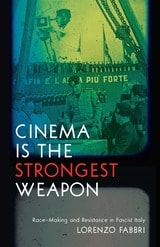
Cinema is the Strongest Weapon
Race-Making and Resistance in Fascist ItalyLorenzo Fabbri
University of Minnesota Press, 2023
A deep dive into Italian cinema under Mussolini’s regime and the filmmakers who used it as a means of antifascist resistance
Looking at Italy’s national film industry under the rule of Benito Mussolini and in the era that followed, Cinema Is the Strongest Weapon examines how cinema was harnessed as a political tool by both the reigning fascist regime and those who sought to resist it. Covering a range of canonical works alongside many of their neglected contemporaries, this book explores film’s mutable relationship to the apparatuses of state power and racial capitalism.
Exploiting realism’s aesthetic, experiential, and affective affordances, Mussolini’s biopolitical project employed cinema to advance an idealized vision of life under fascism and cultivate the basis for a homogenous racial identity. In this book, Lorenzo Fabbri crucially underscores realism’s susceptibility to manipulation from diametrically opposed political perspectives, highlighting the queer, Communist, Jewish, and feminist filmmakers who subverted Mussolini’s notion that “cinema is the regime’s strongest weapon” by developing film narratives and film forms that challenged the prevailing ethno-nationalist ideology.
Focusing on an understudied era of film history and Italian cultural production, Fabbri issues an important recontextualization of Italy’s celebrated neorealist movement and the structural ties it shares with its predecessor. Drawing incisive parallels to contemporary debates around race, whiteness, authoritarianism, and politics, he presents an urgent examination into the broader impact of visual media on culture and society.
Retail e-book files for this title are screen-reader friendly with images accompanied by short alt text and/or extended descriptions.
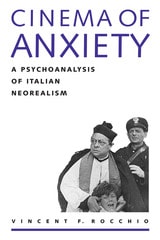
Cinema of Anxiety
A Psychoanalysis of Italian NeorealismBy Vincent F. Rocchio
University of Texas Press, 1999
The "new" realism of Italian cinema after World War II represented and in many ways attempted to contain the turmoil of a society struggling to rid itself of Fascism while fighting off the threat of radical egalitarianism at the same time. In this boldly revisionist book, Vincent F. Rocchio combines Lacanian psychoanalysis with narratology and Marxist critical theory to examine the previously neglected relationship between Neorealist films and the historical spectators they address.
Rocchio builds his analysis around case studies of the films Rome: Open City, Bicycle Thieves, La Terra Trema, Bitter Rice, and Senso. Through the lens of psychoanalysis, he challenges the traditional understanding of Neorealism as a progressive cinema and instead reveals the anxieties it encodes: a society in political turmoil, an economic system in collapse, and a national cinema in ruins; while war, occupation, collaboration, and retaliation remain a part of everyday life.
These case studies demonstrate how Lacanian psychoanalysis can play a key role in analyzing the structure of cinematic discourse and its strategies of containment. As one of the first books outside of feminist film theory to bring the ideas of Lacan to theories of cinema, this book offers innovative methods that reinvigorate film analysis. Clear and detailed insights into both Italian culture and the films under investigation will make this engaging reading for anyone interested in film and cultural studies.
City of the Soul
Rome and the RomanticsJohn A. Pinto
University Press of New England, 2016
Claiming a Tradition
Italian American Women WritersMary Jo Bona
Southern Illinois University Press, 1999
Bona discusses the novels in pairs according to their focus on Italian American life. She first examines the traditions of italianitá (a flavor of things Italian) that inform and enhance works of fiction. The novelists in that tradition were Mari Tomasi (Like Lesser Gods, 1949) and Marion Benasutti (No Steady Job for Papa, 1966).
Bona then turns to later novels that highlight the Italian American belief in the family's honor and reputation. Conflicts between generations, specifically between autocratic fathers and their children, are central to Octavia Waldo's 1961 A Cup of the Sun and Josephine Gattuso Hendin's 1988 The Right Thing to Do.
Even when writers choose to steer away from the familial focus, Bona notes, their developmental narratives trace the reintegration of characters suffering from a crisis of cultural identity. Relating the characters' struggles to their relationship to the family, Bona examines Diana Cavallo's 1961 A Bridge of Leaves and Dorothy Bryant's 1978 Miss Giardino.
Bona then discusses two innovative novels— Helen Barolini's 1979 Umbertina and Tina De Rosa's 1980 Paper Fish— both of which feature a granddaughter who invokes her grandmother, a godparent figure. Through Barolini's feminist and De Rosa's modernist perspectives, both novels present a young girl developing artistically.
Closing with a discussion of the contemporary terrain Italian American women traverse, Bona examines such topics as sexual identity when it meets cultural identity and the inclusion of italianitá when Italian American identity is not central to the story. Italian American women writers, she concludes, continue in the 1980s and 1990s to focus on the interplay between cultural identity and women's development.
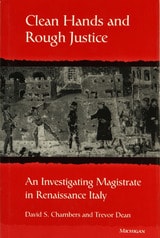
Clean Hands and Rough Justice
An Investigating Magistrate in Renaissance ItalyDavid S. Chambers and Trevor Dean
University of Michigan Press, 1997
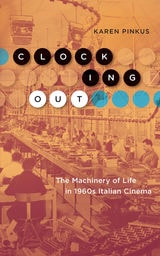
Clocking Out
The Machinery of Life in 1960s Italian CinemaKaren Pinkus
University of Minnesota Press, 2020
An original reflection on Italy’s postwar boom considers potentials for resistance in today’s neoliberal (dis)order
What can 1960s Italian cinema teach us about how to live and work today? Clocking Out challenges readers to think about labor, cinema, and machines as they are intertwined in complex ways in Italian cinema of the early ’60s. Drawing on critical theory and archival research, this book asks what kinds of fractures we might exploit for living otherwise, for resisting traditional narratives, and for anticapitalism.
Italy in the 1960s was a place where the mass-producing factory was the primary mode of understanding what it meant to work, but it was also a time when things might have gone another way. This thinking and living differently appears in the cracks, lapses, or moments of film. Clocking Out is organized into scenes from an obscure 1962 Italian comedy (Renzo e Luciana, from Boccaccio 70). Reconsidering the origins of paradigms such as clocking in and out, “society is a factory,” and the gendered division of labor, Karen Pinkus challenges readers to think through cinema, enabling us to see gaps and breakdowns in the postwar order. She focuses on the Olivetti typewriter company and a little-known film from an Italian anthology movie, thinking with cinema about the power of the Autonomia movement, the refusal to work, and the questions of wages, paternalism, and sexual difference.
Alternating microscopic attention to details and zooming outward, Pinkus examines rituals of production, automation, repetition, and fractures in a narrative of labor that begins in the 1960s and extends to the present—the age of the precariat, right-wing resentment, and nostalgia for an order that was probably never was.
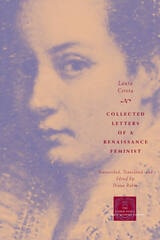
Collected Letters of a Renaissance Feminist
Laura Cereta
University of Chicago Press, 1997
Yet these letters also furnish a detailed portrait of an early modern woman’s private experience, for Cereta addressed many letters to a close circle of family and friends, discussing highly personal concerns such as her difficult relationships with her mother and her husband. Taken together, these letters are a testament both to an individual woman and to enduring feminist concerns.
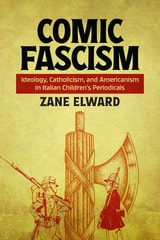
Comic Fascism
Ideology, Catholicism, and Americanism in Italian Children’s PeriodicalsZane Elward
The Ohio State University Press, 2025

Commentary and Ideology
Dante in the RenaissanceDeborah Parker
Duke University Press, 1993
Parker begins by tracing the criticism of Dante commentaries from the nineteenth century to the present and then examines the tradition of commentary from the Middle Ages to the Renaissance. She shows how the civic, institutional, and social commitments of commentators shaped their response to the Comedy, and how commentators tried to use the poem as an authoritative source for various kinds of social legitimation. Parker discusses how different commentators dealt with a deeply political section of the poem: the damnation of Brutus and Cassius.
The scope and importance of Commentary and Ideology will command the attention of a broad group of scholars, including Italian specialists on Dante, late medievalists, students and professionals in early modern European literature, bibliographers, critical theorists, historians of literary criticism and theory, and cultural and intellectual historians.
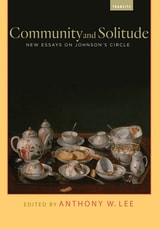
Community and Solitude
New Essays on Johnson’s CircleLee, Anthony W
Bucknell University Press, 2019
Contributors: Christopher Catanese, James Caudle, Marilyn Francus, Christine Jackson-Holzberg, Claudia Thomas Kairoff, Elizabeth Lambert, Anthony W. Lee, James E. May, John Radner, and Lance Wilcox.
Published by Bucknell University Press. Distributed worldwide by Rutgers University Press.
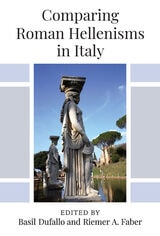
Comparing Roman Hellenisms in Italy
Edited by Basil Dufallo and Riemer A. Faber
University of Michigan Press, 2023
The story of Roman Hellenism—defined as the imitation or adoption of something Greek by those subject to or operating under Roman power—begins not with Roman incursions into the Greek mainland, but in Italy, where our most plentiful and spectacular surviving evidence is concentrated. Think of the architecture of the Roman capital, the Campanian towns of Pompeii and Herculaneum buried by Vesuvius, and the Hellenic culture of the Etruscans. Perhaps “everybody knows” that Rome adapted Greek culture in a steadily more “sophisticated” way as its prosperity and might increased. This volume, however, argues that the assumption of smooth continuity, let alone steady “improvement,” in any aspect of Roman Hellenism can blind us to important aspects of what Roman Hellenism really is and how it functions in a given context.
As the first book to focus on the comparison of Roman Hellenisms per se, Comparing Roman Hellenisms in Italy shows that such comparison is especially valuable in revealing how any singular instance of the phenomenon is situated and specific, and has its own life, trajectory, circumstances, and afterlife. Roman Hellenism is always a work in progress, is often strategic, often falls prey to being forgotten, decontextualized, or reread in later periods, and thus is in important senses contingent. Further, what we may broadly identify as a Roman Hellenism need not imply Rome as the only center of influence. Roman Hellenism is often decentralized, and depends strongly on local agents, aesthetics, and materials. With this in mind, the essays concentrate geographically on Italy to lend both focus and breadth to our topic, as well as to emphasize the complex interrelation of Hellenism at Rome with Rome’s surroundings. Because Hellenism, whether as practiced by Romans or Rome’s subjects, is in fact widely diffused across far-flung geographical regions, the final part of the collection gestures to this broader context.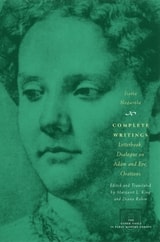
Complete Writings
Letterbook, Dialogue on Adam and Eve, OrationsIsotta Nogarola
University of Chicago Press, 2004
This volume presents English translations of all of Nogarola's extant works and highlights just how daring and original her convictions were. In her letters and orations, Nogarola elegantly synthesized Greco-Roman thought with biblical teachings. And striding across the stage in public, she lectured the Veronese citizenry on everything from history and religion to politics and morality. But the most influential of Nogarola's works was a performance piece, Dialogue on Adam and Eve, in which she discussed the relative sinfulness of Adam and Eve—thereby opening up a centuries-long debate in Europe on gender and the nature of woman and establishing herself as an important figure in Western intellectual history. This book will be a must read for teachers and students of Women's Studies as well as of Renaissance literature and history.
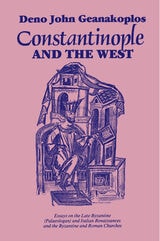
Constantinople and the West
Essays on the Late Byzantine (Palaeologan) and Italian Renaissances and the Byzantine and Roman ChurchesDeno John Geanakoplos
University of Wisconsin Press, 1989
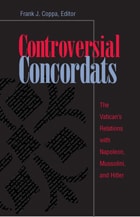
Controversial Concordats
The Vatican's Relations with Napoleon, Mussolini, and HitlerFrank J. Coppa
Catholic University of America Press, 1999
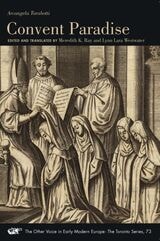
Convent Paradise
Arcangela Tarabotti
Iter Press, 2020
The Other Voice in Early Modern Europe - The Toronto Series volume 73
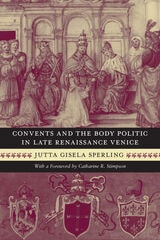
Convents and the Body Politic in Late Renaissance Venice
Jutta Gisela Sperling
University of Chicago Press, 2000
Sperling explains how women were not allowed to marry beneath their social status while men could, especially if their brides were wealthy. Faced with a shortage of suitable partners, patrician women were forced to offer themselves as "a gift not only to God, but to their fatherland," as Patriarch Giovanni Tiepolo told the Senate of Venice in 1619. Noting the declining birth rate among patrician women, Sperling explores the paradox of a marriage system that preserved the nobility at the price of its physical extinction. And on a more individual level, she tells the fascinating stories of these women. Some became scholars or advocates of women's rights, some took lovers, and others escaped only to survive as servants, prostitutes, or thieves.
Conversations with Primo Levi
Ferdinando Camon
Northwestern University Press, 1989

Corinne or Italy
Edited by Avriel H Goldberger
Rutgers University Press, 1987
Cosa V
An Intermittent Town, Excavations 1991-1997Elizabeth Fentress
University of Michigan Press, 2003
Cosa and the Colonial Landscape of Republican Italy (Third and Second Centuries BCE)
Andrea U. De Giorgi, Editor
University of Michigan Press, 2019
This important new volume examines archaeological evidence of Roman colonization of the Middle Republican period. Themes of land use, ethnic accommodation and displacement, colonial identity, and administrative schemes are also highlighted. In delving deeply into the uniqueness of select colonial contexts, these essays invite a novel discussion on the phenomenon of colonialism in the political landscape of Rome’s early expansion. Roman urbanism of the Middle Republican period brought to the Italian peninsula fundamental changes, an important example of which, highlighted by a wealth of studies, is the ebullience of a dense network of colonies, as well as a mix of senatorial tactics and individual initiatives that underpinned their foundation. Whether Latin, Roman, or Maritimae, colonies created a new mesh of communities and imposed a new topography; more subtly, they signified the mechanisms of the rising hegemony. This book brings to the fore the diversity, agendas, and overall impact of a “settlement device” that changed the Italian landscape and introduced a new idea of Roman town.
Cosa
The Roman and Greek AmphorasElizabeth Lyding Will and Kathleen Warner Slane
University of Michigan Press, 2019
At the time of Will’s death, her manuscript consisted of a typed catalogue of the amphora stamps from Cosa and an equal number of unstamped vessels, but was missing important elements. On the basis of extensive notes and photographs, Kathleen Warner Slane has reviewed and updated the manuscript, adding type descriptions and footnotes to materials that have appeared since Will’s death as well as a framing introduction and conclusions. Appendices highlight an Augustan amphora dump on the Arx and add a catalogue of the Greek amphora stamps found at Cosa.
Cosa: The Roman and Greek Amphoras will be of interest to scholars and students of Rome and its system of colonies, and also to those interested in Greek and Roman archaeology and trade in the ancient world.
Cosa
The Sculpture and Furnishings in Stone and MarbleJacquelyn Collins-Clinton
University of Michigan Press, 2020
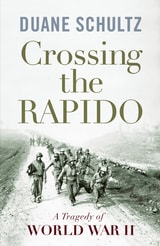
Crossing the Rapido
A Tragedy of World War IIDuane Schultz
Westholme Publishing, 2010
The True Story of an Impossible Mission During the Liberation of Italy
"World War II history writing at its best.” —Dallas Morning News
“Schultz convey stories of individual courage and fear. He presents the Rapido crossing as part of an experience that changed lives utterly.” —Publishers Weekly
“Well written, superbly documented and containing many helpful illustrations and maps, this fine book will appeal to military history enthusiasts of all ages.” —Read@MPL (Milwaukee Public Library)
“Duane Schultz has written another powerful account of the Second World War.” —Daily News, Iron Mountain, Michigan
“A fast-paced, dramatic account of World War II combat.”—Global War StudiesThe Rapido River was the last natural barrier between General Mark W. Clark’s Fifth U.S. Army and Rome. Ignoring intelligence reports that the Germans had significant forces protecting the opposite side of the river, Clark ordered the 36th Division to make a nighttime crossing on January 20, 1944. The division, already coming through some of the heaviest fighting in Italy, knew they could not succeed: they had to cross a fast-flowing river at night in bitter cold and face one of the strongest, most formidable German defensive lines in Europe, full of minefields, veteran troops, and withering artillery and mortar fire. Once in the water, men in full field gear were borne away by the current or vanished in massive explosions. The few who managed to reach the other side found themselves pinned down unable to move. Soldiers died by the hundreds, yet the stunned survivors who fell back to the launch site were ordered to attack again, this time in daylight. Of the 4,000 men who attempted the crossing, more than half did not return. General Clark never accepted blame for ordering the assault despite the numerous warnings he received from both British and American commanders. Although they were decimated, the division went on to lead a key surprise attack that opened Rome to Allied forces, and ultimately fought in France, where they had the distinction of capturing Hermann Goering and Field Marshal Gerd von Rundstedt.
In Crossing the Rapido: A Tragedy of World War II, Duane Schultz follows the action at the ground level using survivors’ interviews and army documents to tell the story of one division’s sacrifice in war. In doing so, he demonstrates that the American soldier will face the greatest odds without protest, but expects those in command to share any failure or success.“Those of us who were present will always remember the men of the 36th, climbing silently in the night behind the enemy, armed with little but their American competence and a personal faith in their quiet, retiring general who had never let them down. If Generals Alexander and Clark received the key to the city of Rome, it was General Walker who turned the key and handed it to them.” —Eric Sevareid, reporting from Italy during World War II
“I have never seen so many dead as on that day.” —John Huston, Academy Award winning director during his wartime filming of The Battle of San Pietro
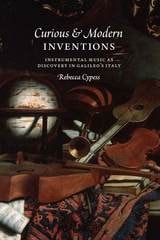
Curious and Modern Inventions
Instrumental Music as Discovery in Galileo's ItalyRebecca Cypess
University of Chicago Press, 2016
Rebecca Cypess shows that early modern thinkers were fascinated with instrumental technologies. The telescope, the clock, the pen, the lute—these were vital instruments for leading thinkers of the age, from Galileo Galilei to Giambattista Marino. No longer used merely to remake an object or repeat a process already known, instruments were increasingly seen as tools for open-ended inquiry that would lead to new knowledge. Engaging with themes from the history of science, literature, and the visual arts, this study reveals the intimate connections between instrumental music and the scientific and artisanal tools that served to mediate between individuals and the world around them.