Results by title
8113 books match the query 'Literary Criticism' and 522 start with c
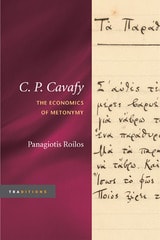
C. P. Cavafy
The Economics of MetonymyPanagiotis Roilos
University of Illinois Press, 2009
Konstantinos P. Kavafis--known to the English-reading world as C. P. Cavafy--has been internationally recognized as an important poet and attracted the admiration of eminent literary figures such as E. M. Forster, F. T. Marinetti, W. H. Auden, George Seferis, and James Merrill. Cavafy's idiosyncratic poetry remains one of the most influential and perplexing voices of European modernism.
Focusing on Cavafy's intriguing work, this book navigates new territories in critical theory and offers an interdisciplinary study of the construction of (homo)erotic desire in poetry in terms of metonymic discourse and anti-economic libidinal modalities. Panagiotis Roilos shows that problematizations of art production, market economy, and trafficability of erôs in diverse late-nineteenth and early twentieth-century European sociocultural and political contexts were re-articulated in Cavafy's poetry in new subversive ways that promoted an "unorthodox" discursive and libidinal anti-economy of jouissance.
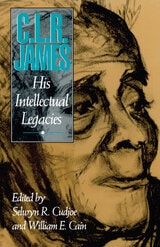
C.L.R. James
His Intellectual LegaciesEdited by Selwyn R. Cudjoe and William E. Cain
University of Massachusetts Press, 1995
C.L.R. James (1901–1989) made important contributions in a host of fields—literature, criticism, cultural studies, political theory, history, and philosophy. One of the most astute minds of this century, he served as mentor for two generations of international intellectuals. He contributed enormously to their understanding of the colonial question, the Negro question, the Russian question, the role of dialectics in proletarian struggle, and the theory and practice of Marxism in the Americas. In addition to The Black Jacobins, his incisive account of the Haitian revolution of the 1790s, and Notes on Dialectics, James published a range of other books, including a classic work on the game of cricket and a study of Herman Melville.
This collection of essays offers a variety of fresh perspectives on James's life and writings. Included are reminiscences of those who knew James well and critical essays by eminent scholars. The book is the first to offer a full treatment of James's many contributions to twentieth-century intellectual life.

CONSUMING FANTASIES
LABOR, LEISURE, AND THE LONDON SHOPGIRL,LISE SHAPIRO SANDERS
The Ohio State University Press, 2006

CONTESTED CASTLE
GOTHIC NOVELS AND THE SUBVERSION OF DOMEKate Ferguson Ellis
University of Illinois Press, 1989
CROSS-CULTURAL VISIONS IN AFRICAN AMERICAN MODERNISM
FROM SPATIAL NARRATIVE TO JAZZ HAIKUYOSHINOBU HAKUTANI
The Ohio State University Press, 2006
In writing Black Boy, the centerpiece of the Chicago Renaissance, Wright was inspired by Theodore Dreiser. Because the European and African cultural visions that Wright, Ralph Ellison, Alice Walker, and Toni Morrison acquired were buttressed by the universal humanism that is common to all cultures, this ideology is shown to transcend the problems of society. Fascinated by Eastern thought and art, Wright, Walker, Sonia Sanchez, and James Emanuel wrote highly accomplished poetry and prose. Like Ezra Pound, Wright was drawn to classic haiku, as reflected in the 4,000 haiku he wrote at the end of his life. As W. B. Yeats’s symbolism was influenced by his cross-cultural visions of noh theatre and Irish folklore, so is James Emanuel’s jazz haiku energized by his cross-cultural rhythms of Japanese poetry and African American music.
The book demonstrates some of the most visible cultural exchanges in modern and postmodern African American literature. Such a study can be extended to other contemporary African American writers whose works also thrive on their cross-cultural visions, such as Amiri Baraka, Ishmael Reed, Charles Johnson, and haiku poet Lenard Moore.
Cacaphonies
The Excremental Canon of French LiteratureAnnabel L. Kim
University of Minnesota Press, 2022
Exploring why there is so much fecal matter in literary works that matter
Cacaphonies takes fecal matter and its place in literature seriously. Readers and critics have too long overlooked excrement’s vital role in the twentieth- and twenty-first-century French canon. In a stark challenge to the tendency to view this literature through sanitizing abstractions, Annabel L. Kim undertakes close readings of key authors to argue for feces as a figure of radical equality, both a literary object and a reflection on literature itself, without which literary studies is impoverished and sterile.
Following the fecal through line in works by Céline, Beckett, Genet, Sartre, Duras, and Gary and the contemporary authors Anne Garréta and Daniel Pennac, Kim shows that shit, far from vanishing from the canon after the early modern period, remains present in the modern and contemporary French literature that follows. She argues that all the shit in the canon expresses a call to democratize literature, making literature for all, just as shit is for (or of) all. She attends to its presence in this prized element of French identity, treating it as a continually uttered desire to manifest the universality France aspires to—as encapsulated by the slogan Liberté, égalité, fraternité—but fails to realize. In shit there is a concrete universalism that traverses bodies with disregard for embodied differences.
Cacaphonies reminds us that literature, and the ideas to be found therein, cannot be separated from the corporeal envelopes that create and receive them. In so doing, it reveals the aesthetic, political, and ethical potential of shit and its capacity to transform literature and life.
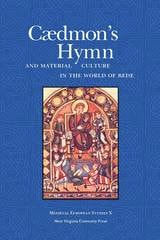
Caedmon's Hymn and Material Culture in the World of Bede
ALLEN J. FRANTZEN
West Virginia University Press, 2007
The essays in this book use the nine-line poem known as Cædmon’s Hymn as a lens on the world of Bede’s Ecclesiastical History. A cowherd who is given a divine gift, Cædmon retells the great narratives of Christian history in the traditional form of Anglo-Saxon verse. An immense amount has been written about this episode, much of it concentrating on the hymn’s significance in the history of English literature. Relatively little attention, however, has been paid to what the story of Cædmon and his hymn might tell us about the material, as well as the textual, culture of Bede’s world. The essays in this collection seek to connect Cædmon’s Hymn to Bede’s material world in various ways. Each chapter begins with the hymn and moves from the text to the worlds of scientific thought, settlements and social hierarchy, monastic reform, and ordinary things. The connections explored here are a sampling of the material concerns Cædmon’s Hymn raises.
Caesar in Gaul and Rome
War in WordsBy Andrew M. Riggsby
University of Texas Press, 2006
Winner, AAP/PSP Award for Excellence, Classics and Ancient History, 2006
Anyone who has even a passing acquaintance with Latin knows "Gallia est omnis divisa in partes tres" ("All Gaul is divided into three parts"), the opening line of De Bello Gallico, Julius Caesar's famous commentary on his campaigns against the Gauls in the 50s BC. But what did Caesar intend to accomplish by writing and publishing his commentaries, how did he go about it, and what potentially unforeseen consequences did his writing have? These are the questions that Andrew Riggsby pursues in this fresh interpretation of one of the masterworks of Latin prose.
Riggsby uses contemporary literary methods to examine the historical impact that the commentaries had on the Roman reading public. In the first part of his study, Riggsby considers how Caesar defined Roman identity and its relationship to non-Roman others. He shows how Caesar opens up a possible vision of the political future in which the distinction between Roman and non-Roman becomes less important because of their joint submission to a Caesar-like leader. In the second part, Riggsby analyzes Caesar's political self-fashioning and the potential effects of his writing and publishing the Gallic War. He reveals how Caesar presents himself as a subtly new kind of Roman general who deserves credit not only for his own virtues, but for those of his soldiers as well. Riggsby uses case studies of key topics (spatial representation, ethnography, virtus and technology, genre, and the just war), augmented by more synthetic discussions that bring in evidence from other Roman and Greek texts, to offer a broad picture of the themes of national identity and Caesar's self-presentation.
Cage Of Fireflies
Modern Japanese HaikuLucien Stryk
Ohio University Press, 1993
In all arts — music, painting, dance, theatre — change has come with that startling moment of dissatisfaction when the artist upends complacency, shocks the old to its foundations, and emerges with clear vision. He has had the courage to rescue his art from dullness. Two of Japan’s “Great Four” of haiku, Basho (1644-94) and Shiki (1862-1902), were such revolutionaries, albeit two hundred years apart. Before Basho, haiku was but a pleasant occupation for the idle. He set about transforming it with such success that experts to this day agree that his were the first true haiku.
Shiki, who lived into the 20th century, was passionate in his attempt to salvage haiku from its past, sending out shock waves by dismissing virtually all earlier work, including most of Basho’s. He saw it as his mission to make a difference — to let nothing, not even the most revered, stand in the way. He proclaimed, “A poem has no meaning. It is feeling alone.” And he practiced what he preached.
Autumn wind:
gods, Buddha—
lies, lies, lies.
These modern Japanese poets, many of whom are translated here into English for the first time, learned as much from Basho as from Shiki, and from Buson (1715-83) and Issa (1763-1827), the “Great Four.” Yet in a sense they are followers of Shiki, in spite of the harshness of his views and the impossibly high standards he demanded. They were forced to reckon with him, became willing participants in a heated dialogue with him. They had to: his spirit dominated the age. Stryk captures that spirit here, in this Cage of Fireflies.
Caliban's Curse
George Lamming and the Revisioning of HistorySupriya Nair
University of Michigan Press, 1996
Caliban's Curse draws upon a range of theories--postcolonial, Marxist, and feminist--to contextualize the black diaspora of the modern Caribbean through one of its primary anglophone novelists. Putting George Lamming in conversation with such contemporaries as C.L.R. James, Derek Walcott, and Wilson Harris, Nair argues that Lamming's works expand the protest of Shakespeare's Caliban to articulate a reinvention of Caribbean cultures. Both cursed by and cursing the weight of colonial history, Lamming works against the paralysis induced by such an encounter; his work serves to rewrite canonical icons and to reimagine popular cultures.
"Supriya Nair writes about the problems of history and social revolution with passion and clarity and an amazing range of critical and cultural reference. . . . She brings to existing studies of Lamming a wide and sustained knowledge of the forces that have shaped the West Indian novel, and the wider postcolonial debates in which these novels are read and discussed." --Simon Gikandi, University of Michigan
Supriya Nair is Associate Professor of English, Tulane University.
Calibrations
Reading For The SocialAto Quayson
University of Minnesota Press, 2003
Proposes an entirely new socially and politically conscious way of reading
Ato Quayson explores a practice of reading that oscillates rapidly between domains—the literary-aesthetic, the social, the cultural, and the political—in order to uncover the mutually illuminating nature of these domains. He does this not to assert the often repeated postmodernist view that there is nothing outside the text, but to outline a method of reading he calls calibrations: a form of close reading of literature with what lies beyond it as a way of understanding structures of transformation, process, and contradiction that inform both literature and society.
Quayson surveys a wide array of texts—ranging from Bob Marley lyrics, Toni Morrison’s work, Walter Benjamin’s Theses on the Philosophy of History, and Althusser’s reflections on political economy—and treats a broad range of themes: the comparative structures of alienation in literature and anthropology, cultural heroism as a trope in African society and politics, literary tragedy as a template for reading the life and activism of Ken Saro-Wiwa, trauma and the status of citizenship in post-apartheid South Africa, representations of physical disability, and the clash between enchanted and disenchanted time in postcolonial texts.
Calila
The Later Novels of Carmen Martín GaiteJoan L. Brown
Bucknell University Press, 2021
Calling the Soul Back
Embodied Spirituality in Chicanx NarrativeChristina Garcia Lopez
University of Arizona Press, 2019
Calling the Soul Back explores the spiritual and ancestral knowledge offered in narratives of bodies in trauma, bodies engaged in ritual, grieving bodies, bodies immersed in and becoming part of nature, and dreaming bodies. Reading across narrative nonfiction, performative monologue, short fiction, fables, illustrated children’s books, and a novel, Garcia Lopez asks how these narratives draw on the embodied intersections of ways of knowing and being to shift readers’ consciousness regarding relationships to space, time, and natural environments.
Using an interdisciplinary approach, Calling the Soul Back draws on literary and Chicanx studies scholars as well as those in religious studies, feminist studies, sociology, environmental studies, philosophy, and Indigenous studies, to reveal narrative’s healing potential to bring the soul into balance with the body and mind.
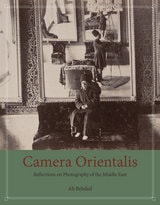
Camera Orientalis
Reflections on Photography of the Middle EastAli Behdad
University of Chicago Press, 2016
Considering a range of Western and Middle Eastern archival material from the late nineteenth and early twentieth centuries, Ali Behdad offers a rich account of how photography transformed Europe’s distinctly Orientalist vision into what seemed objective fact, a transformation that proved central to the project of European colonialism. At the same time, Orientalism was useful for photographers from both regions, as it gave them a set of conventions by which to frame exotic Middle Eastern cultures for Western audiences. Behdad also shows how Middle Eastern audiences embraced photography as a way to foreground status and patriarchal values while also exoticizing other social classes.
An important examination of previously overlooked European and Middle Eastern photographers and studios, Camera Orientalis demonstrates that, far from being a one-sided European development, Orientalist photography was the product of rich cultural contact between the East and the West.
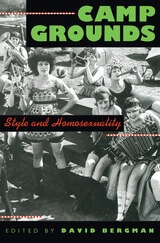
Camp Grounds
Style and HomosexualityEdited by David Bergman
University of Massachusetts Press, 1993
The concept of camp has never been easy to define. Derived from the French verb camper, “to pose,” it has been variously interpreted as a style that favors exaggeration, an ironic attitude toward the cultural mainstream, and a form of aestheticism that celebrates artifice over beauty. At the same time, camp has been long associated with homosexual culture, or at least with a self-conscious eroticism that questions traditional gender constructions.
The sixteen essays on camp included in this book explore further the relationship between style and homosexuality, showing how camp has made its way into every aspect of our cultural lives: theater, popular music, opera, film, and literature. Beginning with an overview of what camp is, where it came from, and how it operates, the chapter addresses topics ranging from the “high camp” of Whitman and Proust to the “low camp” of drag queen culture and gay fanzines. Together they carry forward a conversation that began more than twenty-five years ago, before Stonewall and AIDS, when Susan Sontag published her memorable “Notes on Camp.”
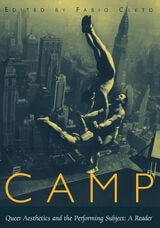
Camp
Queer Aesthetics and the Performing Subject--A ReaderFabio Cleto, Editor
University of Michigan Press, 1999
This groundbreaking collection addresses the multi-layered issue of camp, whose inexhaustible breadth of reference and theoretical relevance have made it one of the most salient and challenging issues on the contemporary critical stage. Reassessing the role and significance of the finest essays on camp written by leading intellectuals in cultural studies, lesbian and gay studies and queer theory, this critical anthology both "queers" camp as an issue and offers an excellent key to rethinking the history, theory, and practice of camp.
The anthology is divided into five thematic/historical sections: Tasting It; Flaunting the Closet; Gender, and Other Spectacles; Pop Camp, Surplus Counter-Value, or the Camp of Cultural Economy; and The Queer Issue. These groupings help the reader situate the critical debates around the subject. Fabio Cleto's introduction brings new theoretical insights to the subject of camp while tracing its history as an object of intellectual and cultural critique and analysis.
A comprehensive bibliography that traces the earliest use of the word 'camp' to the present completes this unique and exciting volume.
“Is ‘camp’ a kind of irony, an effect of one’s historic vantage point, an art form or an elitist aesthetic? … From landmark early works by Christopher Isherwood and Susan Sontag to influential contemporary pieces by Esther Newton, Andrew Ross and Judith Butler, this anthology encapsulates the philosophical discussion of this slippery postmodern concept.”
--Publishers Weekly
“As an object of critical inquiry, camp has proven notoriously difficult to define. Fabio Cleto takes this difficulty as his point of departure in the most recent anthology of a growing body of scholarly literature on the topic…Cleto resists defining camp [but] does not abandon the task of framing, in a coherent but flexible way, camp as a problematic.”
--Semiotica
“Fabio Cleto’s collection variously associates ‘camp’ with the 1960s, aestheticism, androgyny, cross-dressing, the cultural figure of the dandy, decadence, drag, exaggeration, kitsch, parody, pastiche, postmodernism, the sentimental, and the transvestite… The essayists in Camp disagree freely and fiercely over definitions. This is to be expected in a queer reader, one whose contributors endeavor to ‘read across’ the meanings of camp.”
--The Gay & Lesbian Review
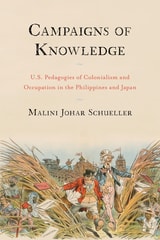
Campaigns of Knowledge
U.S. Pedagogies of Colonialism and Occupation in the Philippines and JapanMalini Johar Schueller
Temple University Press, 2019
The creation of a new school system in the Philippines in 1898 and educational reforms in occupied Japan, both with stated goals of democratization, speaks to a singular vision of America as savior, following its politics of violence with benevolent recuperation. The pedagogy of recovery—in which schooling was central and natives were forced to accept empire through education—might have shown how Americans could be good occupiers, but it also created projects of Orientalist racial management: Filipinos had to be educated and civilized, while the Japanese had to be reeducated and “de-civilized.”
In Campaigns of Knowledge, Malini Schueller contrapuntally reads state-sanctioned proclamations, educational agendas, and school textbooks alongside political cartoons, novels, short stories, and films to demonstrate how the U.S. tutelary project was rerouted, appropriated, reinterpreted, and resisted. In doing so, she highlights how schooling was conceived as a process of subjectification, creating particular modes of thought, behaviors, aspirations, and desires that would render the natives docile subjects amenable to American-style colonialism in the Philippines and occupation in Japan.
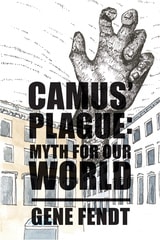
Camus' Plague
Myth for Our WorldGene Fendt
St. Augustine's Press, 2021
Fendt asserts that perhaps “the originality of the modern plague is that most people admit of no symptoms.” This chilling likeness to the asymptomatic Covid-19 victim is but one of the images of what the plague stands for in both the novel and contemporary society. The existentialist fiction of Camus is unwrapped by Fendt’s fidelity to realism and Camus’ motivations as an artist. As Camus calls nihilistic art and culture “barbaric,” Fendt calls the barbarian a natural slave. If we are moved by the forces of powers that be without sense or knowledge of a proper end, we too have been rendered worse than ignorant.
Beyond the presentation of The Plague as a myth, Fendt also provides generous insight into elements of this work that give an autobiographical portrait of Albert Camus´ artistic development. He provides an intelligent challenge to labeling Camus an atheist, if Camus is truly the artist Fendt believes him to be. It is also an unlikely but important contribution to the political philosophical study of solidarity.
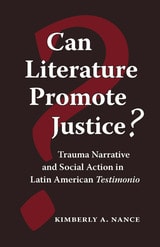
Can Literature Promote Justice?
Trauma Narrative and Social Action in Latin American TestimonioKimberly A. Nance
Vanderbilt University Press, 2006
The advent of the testimonio--loosely, a political autobiography of a Latin American activist who hopes, through the telling of her life story, to bring about change--was met with a great deal of excitement by scholars who posited it as a radical new form of literature. Those accolades were almost immediately followed by a series of critical problems. In what sense were testimonios "true"? What right did privileged scholars in the U.S. have to engage accounts of suffering with traditional modes of criticism? Were questions of veracity or aesthetics more important? Were these texts autobiography or political screeds? It seemed critics didn't know quite what to make of the testimonio and so, after a brief bout of engagement, disregarded it.
Nance, however, argues that any form as prolific as the testimonio is well worth examining and that these questions, rather than being insurmountable, are exactly the questions with which scholars ought to be wrestling. If, as critics claim, that the testimonio is one of the most pervasive contemporary Latin American cultural genres, then it is high time for a comprehensive study of the genre such as Nance's.
Canaan Bound
The African-American Great Migration NovelLawrence R. Rodgers
University of Illinois Press, 1997
The Great Migration--the exodus of more than six million blacks from
their southern homes hoping for better lives in the North--is a defining
event of post-emancipation African-American life and a central feature
of twentieth-century black literature. Lawrence Rodgers explores the historical
and literary significance of this event and in the process identifies
the Great Migration novel as a literary form that intertwines geography
and identity.
Drawing on a wide range of major literary voices, including Richard Wright,
Ralph Ellison, and Toni Morrison, as well as lesser-known writers such
as William Attaway (Blood on the Forge) and Dorothy West (The Living Is
Easy), Rodgers conducts a kind of literary archaeology of the Great Migration.
He mines the writers' biographical connections to migration and teases
apart the ways in which individual novels relate to one another, to the
historical situation of black America, and to African-American literature
as a whole.
In reading migration novels in relation to African-American literary
texts such as slave narratives, folk tales, and urban fiction, Rodgers
affirms the southern folk roots of African-American culture and argues
for a need to stem the erosion of southern memory.
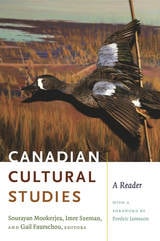
Canadian Cultural Studies
A ReaderSourayan Mookerjea, Imre Szeman, and Gail Faurschou, eds.
Duke University Press, 2009
Including essays by anglophone, francophone, and First Nations writers, the reader is divided into three parts, the first of which features essays by scholars who helped set the agenda for cultural and social analysis in Canada and remain important to contemporary intellectual formations: Harold Innis, Marshall McLuhan, and Anthony Wilden in communications theory; Northrop Frye in literary studies; George Grant and Harold Innis in a left-nationalist tradition of critical political economy; Fernand Dumont and Paul-Émile Borduas in Quebecois national and political culture; and Harold Cardinal in native studies.
The volume’s second section showcases work in which contemporary authors address Canada’s problematic and incomplete nationalism; race, difference, and multiculturalism; and modernity and contemporary culture. The final section includes excerpts from federal policy documents that are especially important to Canadians’ conceptions of their social, political, and cultural circumstances. The reader opens with a foreword by Fredric Jameson and concludes with an afterword in which the Quebecois scholar Yves Laberge explores the differences between English-Canadian cultural studies and the prevailing forms of cultural analysis in francophone Canada.
Contributors. Ian Angus, Himani Bannerji, Jody Berland, Paul-Émile Borduas, Harold Cardinal, Maurice Charland, Stephen Crocker, Ioan Davies, Fernand Dumont, Kristina Fagan, Gail Faurschou, Len Findlay, Northrop Frye, George Grant, Rick Gruneau, Harold Innis, Fredric Jameson, Yves Laberge, Jocelyn Létourneau, Eva Mackey, Lee Maracle, Marshall McLuhan, Katharyne Mitchell, Sourayan Mookerjea, Kevin Pask, Rob Shields, Will Straw, Imre Szeman, Serra Tinic, David Whitson, Tony Wilden

Cannibal Democracy
Race and Representation in the Literature of the AmericasZita Nunes
University of Minnesota Press, 2008
Zita Nunes argues that the prevailing narratives of identity formation throughout the Americas share a dependence on metaphors of incorporation and, often, of cannibalism. From the position of the incorporating body, the construction of a national and racial identity through a process of assimilation presupposes a remainder, a residue.
Nunes addresses works by writers and artists who explore what is left behind in the formation of national identities and speak to the limits of the contemporary discourse of democracy. Cannibal Democracy tracks its central metaphor’s circulation through the work of writers such as Mário de Andrade, W. E. B. Du Bois, and Toni Morrison and journalists of the black press, as well as work by visual artists including Magdalena Campos-Pons and Keith Piper, and reveals how exclusion-understood in terms of what is left out-can be fruitfully understood in terms of what is left over from a process of unification or incorporation.
Nunes shows that while this remainder can be deferred into the future-lurking as a threat to the desired stability of the present-the residue haunts discourses of national unity, undermining the ideologies of democracy that claim to resolve issues of race.
Zita Nunes is associate professor of English at the University of Maryland, College Park.
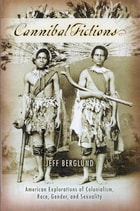
Cannibal Fictions
American Explorations of Colonialism, Race, Gender, and SexualityJeff Berglund
University of Wisconsin Press, 2006
Cannibal Fictions brings together two discrete periods in U.S. history: the years between the Civil War and World War I, the high-water mark in America's imperial presence, and the post-Vietnam era, when the nation was beginning to seriously question its own global agenda. Berglund shows how P. T. Barnum, in a traveling exhibit featuring so-called "Fiji cannibals," served up an alien "other" for popular consumption, while Edgar Rice Burroughs in his Tarzan of the Apes series tapped into similar anxieties about the eruption of foreign elements into a homogeneous culture. Turning to the last decades of the twentieth century, Berglund considers how treatments of cannibalism variously perpetuated or subverted racist, sexist, and homophobic ideologies rooted in earlier times. Fannie Flagg's novel Fried Green Tomatoes invokes cannibalism to new effect, offering an explicit critique of racial, gender, and sexual politics (an element to a large extent suppressed in the movie adaptation). Recurring motifs in contemporary Native American writing suggest how Western expansion has, cannibalistically, laid the seeds of its own destruction. And James Dobson's recent efforts to link the pro-life agenda to allegations of cannibalism in China testify still further to the currency and pervasiveness of this powerful trope.
By highlighting practices that preclude the many from becoming one, these representations of cannibalism, Berglund argues, call into question the comforting national narrative of e pluribus unum.
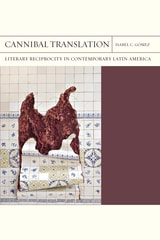
Cannibal Translation
Literary Reciprocity in Contemporary Latin AmericaIsabel C. Gómez
Northwestern University Press, 2023
Winner of the 2024 ACLA Harry Levin Prize • Honorable Mention MLA Katherine Singer Kovacs Prize
A bold comparative study illustrating the creative potential of translations that embrace mutuality and resist assimilation
Cannibal translators digest, recombine, transform, and trouble their source materials. Isabel C. Gómez makes the case for this model of literary production by excavating a network of translation projects in Latin America that includes canonical writers of the twentieth century, such as Haroldo and Augusto de Campos, Rosario Castellanos, Clarice Lispector, José Emilio Pacheco, Octavio Paz, and Ángel Rama. Building on the avant-garde reclaiming of cannibalism as an Indigenous practice meant to honorably incorporate the other into the self, these authors took up Brazilian theories of translation in Spanish to fashion a distinctly Latin American literary exchange, one that rejected normative and Anglocentric approaches to translation and developed collaborative techniques to bring about a new understanding of world literature.
By shedding new light on the political and aesthetic pathways of translation movements beyond the Global North, Gómez offers an alternative conception of the theoretical and ethical challenges posed by this artistic practice. Cannibal Translation: Literary Reciprocity in Contemporary Latin America mobilizes a capacious archive of personal letters, publishers’ records, newspapers, and new media to illuminate inventive strategies of collectivity and process, such as untranslation, transcreation, intersectional autobiographical translation, and transpeaking. The book invites readers to find fresh meaning in other translational histories and question the practices that mediate literary circulation.
Cannibal Writes
Eating Others in Caribbean and Indian Ocean Women's WritingNjeri Githire
University of Illinois Press, 2014
In Cannibal Writes, Njeri Githire concentrates on the gendered and sexualized dimensions of these visceral metaphors of consumption in works by women writers from Haiti, Jamaica, Mauritius, and elsewhere. Employing theoretical analysis and insightful readings of English- and French-language texts, she explores the prominence of alimentary-related tropes and their relationship to sexual consumption, writing, global geopolitics and economic dynamics, and migration. As she shows, the use of cannibalism in particular as a central motif opens up privileged modes for mediating historical and sociopolitical issues.
Ambitiously comparative, Cannibal Writes ranges across the works of well-known and lesser known writers to tie together two geographic and cultural spaces that have much in common but are seldom studied in parallel.
Canons
Edited by Robert von Hallberg
University of Chicago Press, 1984
Canons by Consensus
Critical Trends and American Literature AnthologiesJoseph Csicsila, with a foreword by Tom Quirk
University of Alabama Press, 2004
The first systematic analysis of American literature textbooks used by college instructors in the last century
Scholars have long noted the role that college literary anthologies play in the rising and falling reputations of American authors. Canons by Consensus examines this classroom fixture in detail to challenge and correct a number of assumptions about the development of the literary canon throughout the 20th century.
Joseph Csicsila analyzes more than 80 anthologies published since 1919 and traces not only the critical fortunes of individual authors, but also the treatment of entire genres and groupings of authors by race, region, gender, and formal approach. In doing so, he calls into question accusations of deliberate or inadvertent sexism and racism. Selections by anthology editors, Csicsila demonstrates, have always been governed far more by prevailing trends in academic criticism than by personal bias.
Academic anthologies are found to constitute a rich and often overlooked resource for studying American literature, as well as an irrefutable record of the academy’s changing literary tastes throughout the last century.
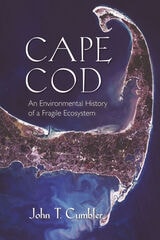
Cape Cod
An Environmental History of a Fragile EcosystemJohn T. Cumbler
University of Massachusetts Press, 2014
John T. Cumbler's book offers an environmental, social, and economic history of Cape Cod told through the experiences of residents as well as visitors. He notes that over the past four hundred years the Cape has experienced three regimes of resource utilization. The first regime of Native Americans who lived relatively lightly on the land was supplanted by European settlers who focused on production and extraction. This second regime began in the age of sail but declined through the age of steam as the soil and seas failed to yield the resources necessary to sustain continuing growth. Environmental and then economic crises during the second half of the nineteenth century eventually gave way to the third regime of tourism and recreation. But this regime has its own environmental costs, as residents have learned over the last half century.
Although the Cape remains a special place, its history of resource scarcity and its attempts to deal with that scarcity offer useful lessons for anyone addressing similar issues around the globe.
Capital Fictions
The Literature of Latin America's Export AgeEricka Beckman
University of Minnesota Press, 2012
Between 1870 and 1930, Latin American countries were incorporated into global capitalist networks like never before, mainly as exporters of raw materials and importers of manufactured goods. During this Export Age, entire regions were given over to the cultivation of export commodities such as coffee and bananas, capital and labor were relocated to new production centers, and barriers to foreign investment were removed. Capital Fictions investigates the key role played by literature in imagining and interpreting the rapid transformations unleashed by Latin America’s first major wave of capitalist modernization.
Using an innovative blend of literary and economic analysis and drawing from a rich interdisciplinary archive, Ericka Beckman provides the first extended evaluation of Export Age literary production. She traces the emergence of a distinct set of fictions, fantasies, and illusions that accompanied the rise of export-led, dependent capitalism. These “capital fictions” range from promotional pamphlets for Guatemalan coffee and advertisements for French fashions, to novels about stock market collapse in Argentina and rubber extraction in the Amazon.
Beckman explores how Export Age literature anticipated some of the key contradictions faced by contemporary capitalist societies, including extreme financial volatility, vast social inequality, and ever-more-intense means of exploitation. Questioning the opposition between culture and economics in Latin America and elsewhere, Capital Fictions shows that literature operated as a powerful form of political economy during this period.
Capital Letters
Authorship in the Antebellum Literary MarketDavid Dowling
University of Iowa Press, 2009
In the 1840s and 1850s, as the market revolution swept the United States, the world of literature confronted for the first time the gaudy glare of commercial culture. Amid growing technological sophistication and mounting artistic rejection of the soullessness of materialism, authorship passed from an era of patronage and entered the clamoring free market. In this setting, romantic notions of what it meant to be an author came under attack, and authors became professionals.
In lively and provocative writing, David Dowling moves beyond a study of the emotional toll that this crisis in self-definition had on writers to examine how three sets of authors—in pairings of men and women: Harriet Wilson and Henry David Thoreau, Fanny Fern and Walt Whitman, and Rebecca Harding Davis and Herman Melville—engaged with and transformed the book market. What were their critiques of the capitalism that was transforming the world around them? How did they respond to the changing marketplace that came to define their very success as authors? How was the role of women influenced by these conditions?
Capital Letters concludes with a fascinating and daring transhistorical comparison of how two superstar authors—Herman Melville in the nineteenth century and Stephen King today—have negotiated the shifty terrain of the literary marketplace. The result is an important contribution to our understanding of print culture and literary work.
Capital Letters
Hugo, Baudelaire, Camus, and the Death PenaltyÈve Morisi
Northwestern University Press, 2020

Capitalism's Other Times
Fiction, Speculation, and FuturityGreg Forter
Northwestern University Press, 2027
Reorienting critical theory and literary criticism to consider how the present contains seeds of a future beyond capitalism
Critical theorists have long held to the axiom that it is easier to imagine the end of the world than the end of capitalism. Greg Forter starts this wide-ranging study of contemporary literature by suggesting that this position is increasingly hard to maintain. In the wake of the 2008 financial crisis, the global rise of the New Right, and the mass disruptions and despair wrought by COVID-19, the story that capital had built about itself has begun to reveal cracks in its foundations. Capitalism has not succeeded in fully flattening or homogenizing time. Developing in combined and uneven fashion, it has retained the residues of pasts that suggest other futures are possible. Forter assembles a corpus of novels that theorize this insight. He names these fictions speculative realism to highlight how they map the closures of our present while opening that present onto other, more speculative orders of time. In the face of ongoing, overlapping crises, Forter posits, these fictions locate flickering intimations of a utopian somewhen; they illuminate a present charged with precipitates of a transfigured but now imaginable future.
Captain America and the Nationalist Superhero
Metaphors, Narratives, and GeopoliticsJason Dittmer
Temple University Press, 2012
Nationalist superheroes—such as Captain America, Captain Canuck, and Union Jack—often signify the “nation-state” for readers, but how do these characters and comic books address issues of multiculturalism and geopolitical order? In his engaging book Captain America and the Nationalist Superhero, geographer Jason Dittmer traces the evolution of the comic book genre as it adapted to new national audiences. He argues that these iconic superheroes contribute to our contemporary understandings of national identity, the righteous use of power, and the role of the United States, Canada, and Britain in the world.
Tracing the nationalist superhero genre from its World War II origins to contemporary manifestations throughout the world, Captain America and the Nationalist Superhero analyzes nearly one thousand comic books and audience responses to those books. Dittmer also interviews key comic book writers from Stan Lee and J. M. DeMatteis to Steve Englehart and Paul Cornell.
At a time when popular culture is saturated with superheroes and their exploits, Captain America and the Nationalist Superhero highlights the unique relationship between popular culture and international relations.

Captive Ecologies
The Environmental Afterlives of SlaveryJennifer C. James
Duke University Press, 2026

Captivity and Sentiment
Cultural Exchange in American Literature, 1682–1861Michelle Burnham
Dartmouth College Press, 2000
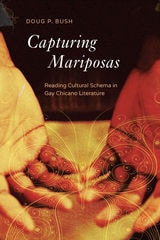
Capturing Mariposas
Reading Cultural Schema in Gay Chicano LiteratureDoug P. Bush
The Ohio State University Press, 2019
In Capturing Mariposas: Reading Cultural Schema in Gay Chicano Literature, Doug P. Bush looks at the book as only the beginning, considering how this literature has the power to bring understanding to disparate groups, speak truth about repressed sexuality and repressive communities, and recast traditional spaces as ones of inclusion, all through the idea of the cultural schema. Integrating elements of narratology and cognitive studies of literature, the cultural schema speaks to how these authors challenge, reaffirm, and transform commonly held experiences of gay Chicanos—or potentially any audience who reads their works. Focusing on twenty-first-century writers such as Manuel Muñoz, Rigoberto González, and Alex Espinoza, Bush examines the cultural schema of their works and then moves toward a more holistic discussion of the publishing and political implications of this genre. In addition to Bush’s important scholarship, the book includes extensive interviews with the authors themselves.
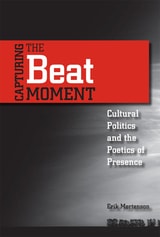
Capturing the Beat Moment
Cultural Politics and the Poetics of PresenceErik Mortenson
Southern Illinois University Press, 2010
CHOICE Outstanding Academic Title
Examining “the moment” as one of the primary motifs of Beat writing, Erik Mortenson offers the first book to investigate immediacy and its presence and importance in Beat writing. Capturing the Beat Moment: Cultural Politics and the Poetics of Presence places an expanded canon of Beat writers in an early postmodern context that highlights their importance in American poetics and provides an account of Beat practices that reveal how gender and race affect Beat politics of the moment.
Mortenson argues that Beat writers focused on action, desire, and spontaneity to establish an authentic connection to the world around them and believed that “living in the moment” was the only way in which they might establish the kind of life that led to good writing. With this in mind, he explores the possibility that, far from being the antithesis of their times, the Beats actually were a product of them. Mortenson outlines the effects of gender and race on Beat writing in the postwar years, as well as the Beats’ attempts to break free of the constrictive notions of time and space prevalent during the 1950s.
Mortenson discusses such topics as the importance of personal visionary experiences; the embodiment of sexuality and the moment of ecstasy in Beat writing; how the Beats used photographs to evoke the past; and the ways that Beat culture was designed to offer alternatives to existing political and social structures. Throughout the volume, Mortenson moves beyond the Kerouac-Ginsberg-Burroughs triumvirate commonly associated with Beat literature, discussing women—such as Diane di Prima, Janine Pommy Vega, and Joyce Johnson—and African American writers, including Bob Kaufman and Amiri Baraka. With the inclusion of these authors comes a richer understanding of the Beat writers’ value and influence in American literary history.
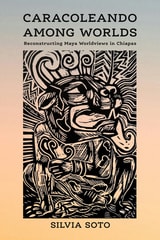
Caracoleando Among Worlds
Reconstructing Maya Worldviews in ChiapasSilvia Soto
University of Arizona Press, 2024
This shared vision emerges in Caracoleando Among Worlds, which provides an in-depth analysis of poetry, short stories, and one of the first novels written by a Maya Tsotsil writer of Chiapas alongside close readings of the EZLN’s six declarations of the Lacandon Jungle. Themes echoing ancestral connections, informing epistemologies, and sustaining cultural and spiritual practices emerge and weave the texts to each other. The work brings into the conversation literature that has been translated into English for the first time and places Maya writers of Chiapas in discussion with other Native American and Indigenous scholars.
This work shows how literature, culture, and activism intertwine, and offers a compelling narrative that transcends boundaries and fosters a deeper understanding of Maya identities and resilience.
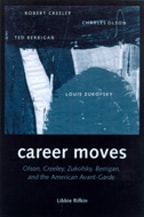
Career Moves
Olson, Creeley, Zukofsky, Berrigan, AndLibbie Rifkin
University of Wisconsin Press, 2000
How much did "making it new" have to do with "making it"? For the four "outsider poets" considered in this book—Charles Olson, Robert Creeley, Louis Zukofsky, and Ted Berrigan—the connection was everything. At once a social history of literary ambition in America in the fifties and sixties and a uniquely collective form of literary biography, Career Moves offers an intimate account of the postwar poetry underground.
Making the controversial claim that anti-Establishment poets were at least as "careerist" as their mainstream peers, Libbie Rifkin shows how the nature of these poets’ ambition actually defined postwar avant-garde identity. In doing so, she clarifies the complicated link between the crafting of a literary career and the defining of a literary canon.
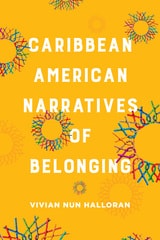
Caribbean American Narratives of Belonging
Vivian Nun Halloran
The Ohio State University Press, 2023
In Caribbean American Narratives of Belonging, Vivian Nun Halloran analyzes memoirs, picture books, comic books, young adult novels, musicals, and television shows through which Caribbean Americans recount and celebrate their contributions to contemporary politics, culture, and activism in the United States. The writers, civil servants, illustrators, performers, and entertainers whose work is discussed here show what it is like to fit in and be included within the body politic. From civic memoirs by Sonia Sotomayor and others, to West Side Story, Hamilton, and Into the Spider-Verse, these texts share a forward-looking perspective, distinct from the more nostalgic rhetoric of traditional diasporic texts that privilege connections to the islands of origin.
There is no one way of being Caribbean. Diasporic communities exhibit a broad spectrum of ethnic, racial, religious, linguistic, and political qualities. Claiming a Caribbean American identity asks wider society to recognize and affirm hybridity in ways that challenge binaristic conceptions of race and nationality. Halloran provides a common language and critical framework to discuss the achievements of members of the Caribbean diaspora and their considerable cultural and political capital as evident in their contributions to literature and popular culture.
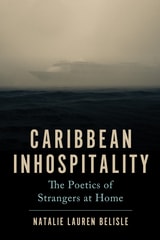
Caribbean Inhospitality
The Poetics of Strangers at HomeNatalie Lauren Belisle
Rutgers University Press, 2025
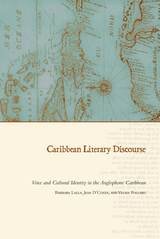
Caribbean Literary Discourse
Voice and Cultural Identity in the Anglophone CaribbeanBarbara Lalla
University of Alabama Press, 2013
Caribbean Literary Discourse opens the challenging world of language choices and literary experiments characteristic of the multicultural and multilingual Caribbean. In these societies, the language of the master— English in Jamaica and Barbados—overlies the Creole languages of the majority. As literary critics and as creative writers, Barbara Lalla, Jean D’Costa, and Velma Pollard engage historical, linguistic, and literary perspectives to investigate the literature bred by this complex history. They trace the rise of local languages and literatures within the English speaking Caribbean, especially as reflected in the language choices of creative writers.
The study engages two problems: first, the historical reality that standard metropolitan English established by British colonialists dominates official economic, cultural, and political affairs in these former colonies, contesting the development of vernacular, Creole, and pidgin dialects even among the region’s indigenous population; and second, the fact that literary discourse developed under such conditions has received scant attention.
Caribbean Literary Discourse explores the language choices that preoccupy creative writers in whose work vernacular discourse displays its multiplicity of origins, its elusive boundaries, and its most vexing issues. The authors address the degree to which language choice highlights political loyalties and tensions; the politics of identity, self-representation, and nationalism; the implications of code-switching—the ability to alternate deliberately between different languages, accents, or dialects—for identity in postcolonial society; the rich rhetorical and literary effects enabled by code-switching and the difficulties of acknowledging or teaching those ranges in traditional education systems; the longstanding interplay between oral and scribal culture; and the predominance of intertextuality in postcolonial and diasporic literature.

Caribbean Literature After Independence
The Case of Earl LovelaceEdited by Bill Schwarz
University of London Press, 2008
Louis), Chris Campbell (Queen Mary, University of London), Louis James (emeritus professor, University of Kent), Nicole King (Royal Holloway, University of London), Aaron Love (New York University), Patricia Murray (London Metropolitan University), James Procter (Newcastle University), Kate Quinn (Institute for the Study of the Americas, University of London), Tina K. Ramnarine (Royal Holloway, University of London), Bill Schwarz (Queen Mary, University of London), Lawrence Scott (University of Trinidad and Tobago), and John Thieme (University of East Anglia).
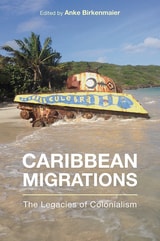
Caribbean Migrations
The Legacies of ColonialismAnke Birkenmaier
Rutgers University Press, 2021
With mass migration changing the configuration of societies worldwide, we can look to the Caribbean to reflect on the long-standing, entangled relations between countries and areas as uneven in size and influence as the United States, Cuba, Hispaniola, Puerto Rico, and Jamaica. More so than other world regions, the Caribbean has been characterized as an always already colonial region. It has long been a key area for empires warring over influence spheres in the new world, and where migration waves from Africa, Europe, and Asia accompanied every political transformation over the last five centuries. In Caribbean Migrations, an interdisciplinary group of humanities and social science scholars study migration from a long-term perspective, analyzing the Caribbean's "unincorporated subjects" from a legal, historical, and cultural standpoint, and exploring how despite often fractured public spheres, Caribbean intellectuals, artists, filmmakers, and writers have been resourceful at showcasing migration as the hallmark of our modern age.
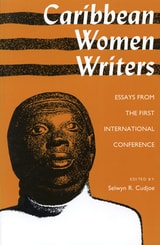
Caribbean Women Writers
Essays from the First International ConferenceSelwyn R. Cudjoe
University of Massachusetts Press, 1990
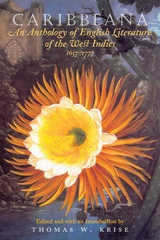
Caribbeana
An Anthology of English Literature of the West Indies, 1657-1777Edited by Thomas W. Krise
University of Chicago Press, 1999
Caribbeana offers invaluable period commentaries on slavery, colonialism, gender relations, African and European history, natural history, agriculture, and medicine. Highlights include several of the earliest protests against slavery; a superb ode by the Cambridge-educated Afro-Jamaican poet Francis Williams; James Grainger's extended georgic poem, The Sugar Cane; Frances Seymour's poignant tale of the Englishman Inkle who sells his Indian savior-lover Yarico into slavery; and several descriptions of the West Indies during the early years of settlement.

Carlos Fuentes, Mexico, and Modernity
Maarten van Delden
Vanderbilt University Press, 1998
Van Delden's thorough command of the subject matter, his innovative and sometimes iconoclastic conclusions, and his clear and engaging writing style make this study more than just an interpretation of Fuentes's work. Carlos Fuentes, Mexico, and Modernity offers nothing less than a comprehensive analysis of Fuentes's intellectual development in the context of modern Mexican political and cultural life.
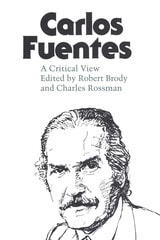
Carlos Fuentes
A Critical ViewEdited by Robert Brody and Charles Rossman
University of Texas Press, 1982
Carlos Fuentes is a master of modern world literature. With the translation of his major works into English and other languages, his reputation has surpassed the boundaries of his native Mexico and of Hispanic literature and has become international. Now each new novel stimulates popular and scholarly reviews in periodicals from Mexico City and Buenos Aires to Paris and New York.
Carlos Fuentes: A Critical View is the first full-scale examination in English of this major writer's work. The range and diversity of this critical view are remarkable and reflect similar characteristics in the creative work of Carlos Fuentes, a man of formidable intellectual energy and curiosity.
The whole of Fuentes' work is encompassed by Luis Leal as he explores history and myth in the writer's narrative. Insightful new views of single works are provided by other well-known scholars, such as Roberto González Echevarría, writing on Fuentes' extraordinary Terra Nostra, and Margaret Sayers Peden, exploring Distant Relations, for which she served as authorized translator. Here too are fresh approaches to Fuentes' other novels, among them Where the Air Is Clear, Aura, and The Hydra Head, as well as an examination by John Brushwood of the writer's short fiction and a look by Merlin Forster at Fuentes the playwright. Lanin Gyurko reaches outside Fuentes' canon for his fascinating study of the influence of Orson Welles' Citizen Kane on The Death of Artemio Cruz. Manuel Durán and George Wing consider Fuentes in his role as critic of both literature and art.
Carlos Fuentes: A Critical View has been prepared with the writer's many English-speaking readers in mind. Quotations are most frequently from standard, readily available English translations of Fuentes' works. A valuable chronology of the writer's life rounds off the volume.
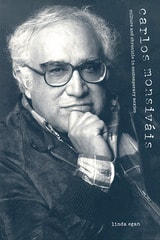
Carlos Monsiváis
Culture and Chronicle in Contemporary MexicoLinda Egan
University of Arizona Press, 2001
One of Mexico’s foremost social and political chroniclers and its most celebrated cultural critic, Carlos Monsiváis has read the pulse of his country over the past half century. The author of five collections of literary journalism pieces called crónicas, he is perhaps best known for his analytic and often satirical descriptions of Mexico City’s popular culture.
This comprehensive study of Monsiváis’s crónicas is the first book to offer an analysis of these works and to place Monsiváis’s work within a theoretical framework that recognizes the importance of his vision of Mexican culture. Linda Egan examines his ideology in relation to theoretical postures in Latin America, the United States, and Europe to cast Monsiváis as both a heterodox pioneer and a mainstream spokesman. She then explores the poetics of the contemporary chronicle in Mexico, reviewing the genre’s history and its relation to other narrative forms. Finally, she focuses on the canonical status of Monsiváis’s work, devoting a chapter to each of his five principal collections.
Egan argues that the five books that are the focus of her study tell a story of ever-renewing suspense: we cannot know “the end” until Monsiváis is through constructing his literary project. Despite this, she observes, his work between 1970 and 1995 documents important discoveries in his search for causes, effects, and deconstructions of historical obstacles to Mexico’s passage into modernity.
While anthropologists and historians continue to introduce new paradigms for the study of Mexico’s cultural space, Egan’s book provides a reflexive twist by examining the work of one of the thinkers who first inspired such a critical movement. More than an appraisal of Monsiváis, it offers a valuable discussion of theoretical issues surrounding the study of the chronicle as it is currently practiced in Mexico. It balances theory and criticism to lend new insight into the ties between Mexican society, social conscience, and literature.
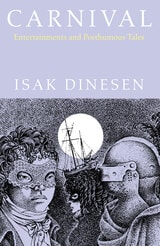
Carnival
Entertainments and Posthumous TalesIsak Dinesen
University of Chicago Press, 1979
"The editors have included only material that will stand easily with her more familiar work and satisfy her large following. . . . The rough drafts and variant treatments have been set aside for scholars."—Joseph McLellan, Washington Post
"The wit, the imagination, the elevated philosophical dialogue mark most of the stories in this volume as vintage Dinesen . . . of special interest to Dinesen fans."—Robert Langbaum, New York Times Book Review