Results by title
3785 books match the query 'Poetry' and 202 start with c
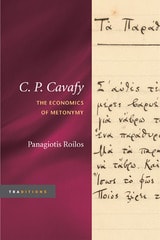
C. P. Cavafy
The Economics of MetonymyPanagiotis Roilos
University of Illinois Press, 2009
Konstantinos P. Kavafis--known to the English-reading world as C. P. Cavafy--has been internationally recognized as an important poet and attracted the admiration of eminent literary figures such as E. M. Forster, F. T. Marinetti, W. H. Auden, George Seferis, and James Merrill. Cavafy's idiosyncratic poetry remains one of the most influential and perplexing voices of European modernism.
Focusing on Cavafy's intriguing work, this book navigates new territories in critical theory and offers an interdisciplinary study of the construction of (homo)erotic desire in poetry in terms of metonymic discourse and anti-economic libidinal modalities. Panagiotis Roilos shows that problematizations of art production, market economy, and trafficability of erôs in diverse late-nineteenth and early twentieth-century European sociocultural and political contexts were re-articulated in Cavafy's poetry in new subversive ways that promoted an "unorthodox" discursive and libidinal anti-economy of jouissance.
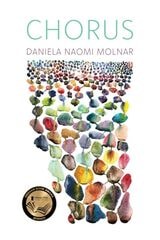
CHORUS
Daniela Naomi Molnar
Omnidawn, 2022
At a time of simultaneous isolation and interconnection, this book is an inquiry into the edges of the self. Pushing back on capitalist messages of individuality, CHORUS instead seeks the multifaceted self that engages with the radical diversity that characterizes any healthy ecosystem or society. Moving between a remote canyon in New Mexico, the Pacific Northwest, New York City, the virtual world, the past, and the unstable future, the author asks, “Whose afterimage am I?”
The sprawling, celebratory, mourning chorus of this book is the sum of many voices; the words of other writers, poets, and artists are interwoven with the author’s words. This is a celebration of language’s capacity to supersede bodily limits, mortality, and existential loneliness. Daniela Naomi Molnar’s chorus encompasses violence, love, empathy, fear, a burning planet, a pandemic, heartbreak, desire, joy, and grief. Rather than seeking resolution, these poems look through the lens of a fragmented self, dwelling in plurality, discord, and harmony.
CHORUS is the winner of Omnidawn’s 1st /2nd Book Prize, judged by Kazim Ali.
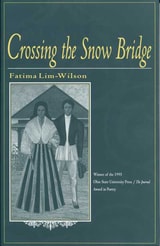
CROSSING THE SNOW BRIDGE
Fatima Lim-Wilson
The Ohio State University Press, 1995
An inhabitant of this country for five years, Lim-Wilson’s legal status is that of “resident alien,” a disturbing but apt description given the clash of cultures the immigrant encounters daily. Although she still dreams in her native Tagalog, Lim-Wilson writes in her borrowed language, and it is through attempting to understand the cleaving of her own tongue that she works to redefine her place and that of other immigrants here.
How can memories of green mangoes, miniature fish, and the landscape of seven thousand islands fit in with, let alone contribute to, a North American cultural identity? Yet a great part of that cultural identity is built upon the immigrant experience. In telling stories of the Philippines and of the United States, these poems build a metaphorical bridge over which we can cross between cultures.
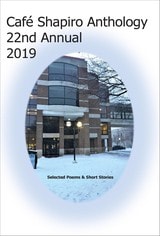
Café Shapiro Anthology 2019
Theresa Stanko
Michigan Publishing Services, 2019
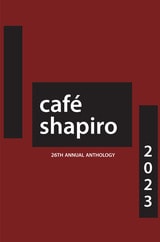
Café Shapiro Anthology 2023
Charles Saadiq
Michigan Publishing Services, 2023
Café Shapiro began in February 1998 as part of the University’s “Year of the Humanities and Arts” (YoHA). and was originally conceived as a student coffee break. Café Shapiro takes place in the Shapiro Undergraduate Library during winter evenings in March. For many student writers, Café Shapiro is a first opportunity to read publicly from their work.
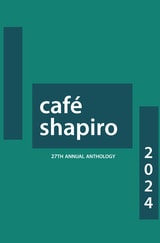
Café Shapiro Anthology 2024
Charles Saadiq
Michigan Publishing Services, 2024
Café Shapiro began in February 1998 as part of the University’s “Year of the Humanities and Arts” (YoHA). and was originally conceived as a student coffee break. Café Shapiro takes place in the Shapiro Undergraduate Library during winter evenings in March. For many student writers, Café Shapiro is a first opportunity to read publicly from their work.

Café Shapiro Anthology 2025
Charles Saadiq
Michigan Publishing Services, 2025
Café Shapiro is an annual event where undergraduate student writers, nominated by their instructors to participate, read from their creative works.
Café Shapiro began in February 1998 as part of the University’s “Year of the Humanities and Arts” (YoHA). and was originally conceived as a student coffee break. Café Shapiro takes place in the Shapiro Undergraduate Library during winter evenings in March. For many student writers, Café Shapiro is a first opportunity to read publicly from their work.
Café Shapiro features poems and short stories authored by University of Michigan students, becoming an annual celebration of undergraduate student writers as they think creatively and critically, reason, ask questions, and develop the skills that help them understand and participate in our world.
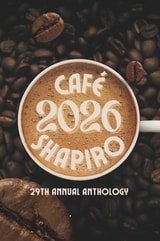
Café Shapiro Anthology 2026
Charles Saadiq
Michigan Publishing Services, 2026
Café Shapiro is an annual event where undergraduate student writers, nominated by their instructors to participate, read from their creative works.
Café Shapiro began in February 1998 as part of the University’s “Year of the Humanities and Arts” (YoHA). and was originally conceived as a student coffee break. Café Shapiro takes place in the Shapiro Undergraduate Library during winter evenings in March. For many student writers, Café Shapiro is a first opportunity to read publicly from their work.
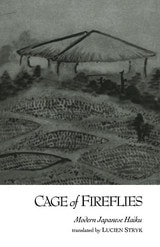
Cage Of Fireflies
Modern Japanese HaikuLucien Stryk
Ohio University Press, 1993
In all arts — music, painting, dance, theatre — change has come with that startling moment of dissatisfaction when the artist upends complacency, shocks the old to its foundations, and emerges with clear vision. He has had the courage to rescue his art from dullness. Two of Japan’s “Great Four” of haiku, Basho (1644-94) and Shiki (1862-1902), were such revolutionaries, albeit two hundred years apart. Before Basho, haiku was but a pleasant occupation for the idle. He set about transforming it with such success that experts to this day agree that his were the first true haiku.
Shiki, who lived into the 20th century, was passionate in his attempt to salvage haiku from its past, sending out shock waves by dismissing virtually all earlier work, including most of Basho’s. He saw it as his mission to make a difference — to let nothing, not even the most revered, stand in the way. He proclaimed, “A poem has no meaning. It is feeling alone.” And he practiced what he preached.
Autumn wind:
gods, Buddha—
lies, lies, lies.
These modern Japanese poets, many of whom are translated here into English for the first time, learned as much from Basho as from Shiki, and from Buson (1715-83) and Issa (1763-1827), the “Great Four.” Yet in a sense they are followers of Shiki, in spite of the harshness of his views and the impossibly high standards he demanded. They were forced to reckon with him, became willing participants in a heated dialogue with him. They had to: his spirit dominated the age. Stryk captures that spirit here, in this Cage of Fireflies.
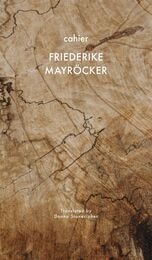
Cahier
Friedericke Mayröcker
Seagull Books, 2024
Friederike Mayröcker has no time. Not for summary and memory, not for excessive reviewing and reasoning, and certainly not for storytelling. She doesn’t even have time for life itself—unless it’s writing. What counts, in her view, is only the poetry and “the echoic inventions” of a life that lasted for almost a century, which is preserved in her writings.
Widely considered one of the most important European poets of the twentieth and twenty-first centuries, Mayröcker passed away in 2021 at the age of ninety-six. On the outside, her life may be subject to the impertinence of the finitude of all human existence. But on the inside, and in its transformation into the eternal moment, life only becomes richer and richer in forms of experience. In radically concentrated language and compellingly beautiful images, Mayröcker presents in this cahier a life that follows only one maxim: “Not just what is written, but existence, too, must be poetic.”
Cairo Traffic
Lloyd Schwartz
University of Chicago Press, 2000

Calazaza's Delicious Dereliction
Suzanne Dracius
Tupelo Press, 2015
Calendars
Annie Finch
Tupelo Press, 2003
Calendars of Fire
Lee Sharkey
Tupelo Press, 2013
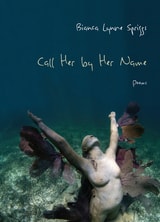
Call Her by Her Name
PoemsBianca Lynne Spriggs
Northwestern University Press, 2016
In Call Her by Her Name, the poet and performance artist Bianca Lynne Spriggs creates a twenty-first-century feminist manifesto suffused with metaphoric depth. This collection is a call-and-response of women—divine and domestic, legend and literal—who shape-shift and traverse generations. Through these narratives and cinematic poems, a chorus emerges of stories and lives rarely told.
Call Her by Her Name seeks to give voice to the voiceless, including lynched black women, the biblical "Potiphar’s wife," and women who tread the rims of phenomenal worlds—the goddess, the bird-woman, the oracle. While these poems reflect an array of women and women’s experiences, each piece could be considered a hue of the same woman, whether home-wrecker, Madonna, or midwife. The woman who sees dragons was perhaps once the roller-skating girl-child. The aging geisha may also be the roots woman next door. The woman who did not speak for ten years could have ended up sinking to the ocean floor. Spriggs gives each one life and limb, breath and voice, in a collection that adds up unequivocally to a poetic celebration of women.
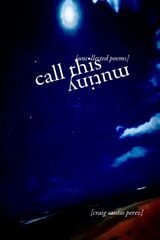
Call This Mutiny
[uncollected poems]Craig Santos Perez
Omnidawn, 2024
The seventh book from award-winning Chamoru author Craig Santos Perez, Call This Mutiny brings together poems that were originally published in journals and anthologies from 2008 to 2023. Throughout these selected poems, Perez offers critical explorations of native cultures, decolonial politics, colonial histories, and the entangled ecologies of his homeland of Guam, his current home of Hawaiʻi, and the larger Pacific region in relation to the Global South and the Indigenous Fourth World. Perez’s poetry draws on the power of storytelling to share Indigenous history and culture and to offer healing from the trauma of colonialism and injustice. As he writes, “If we can write the ocean, we will never be silenced.”
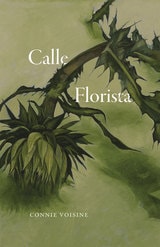
Calle Florista
Connie Voisine
University of Chicago Press, 2015
Sometimes you defy it,
I am not that, watching a stranger
cry like a dog when she thinks she’s alone
at the kitchen window, hands forgotten
under the running tap.
The curtains blow out, flap the other side of the sill.
In you one hole fills another,
stacked like cups.
You remember your hands.
Connie Voisine’s third book of poems centers on the border between the United States and Mexico, celebrating the stunning, severe desert landscape found there. This setting marks the occasion as well for Voisine to explore themes of splitting and friction in both human and political contexts. Whose space is this border, she asks, and what voice can possibly tell the story of this place?
In a wry, elegiac mode, the poems of Calle Florista take us both to the edge of our country and the edge of our faith in art and the world. This is mature work, offering us poems that oscillate between the articulation of complex, private sensibilities and the directness of a poet cracking the private self open—and making it vulnerable to the wider world.
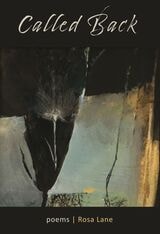
Called Back
Rosa Lane
Tupelo Press, 2024
In bold tribute with a title utilizing the last two words Emily Dickinson wrote, Rosa Lane’s Called Back converses with one of our greatest poets in theatrical monologue—decoding secrets amid the blatant. Evoked by epigraphs selected from Dickinson’s work, Lane’s poems, through her I-speaker, reveal the extraordinary to be found in the ordinary and speak to the struggle of sexual orientation, otherness, and the challenges of living in a Calvinistic socioreligious world of oughts and noughts as evidenced in Dickinson’s poems. From sapphic eroticism and subsequent pangs of nonbelonging to tacking next life as a welcome reprieve, poems in Called Back create a de novo dot-connecting lyrical narrative.
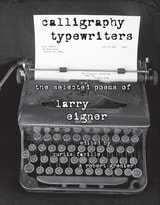
Calligraphy Typewriters
The Selected Poems of Larry EignerLarry Eigner, Edited and introduced by Curtis Faville and Robert Grenier, Foreword by Charles Bernstein
University of Alabama Press, 2016
The first and only single-volume collection of Larry Eigner’s most significant poems, gathering in one place the most celebrated of the several thousand poems that constitute his remarkable life’s work
Larry Eigner began writing poetry at age eight and was first published at age nine. Revered by poets and artists across a broad spectrum of generations and schools, Eigner’s remarkably moving poetry was created through enormous effort: because of severe physical disabilities, he produced his texts by typing with only one index finger and thumb on a 1940 Royal manual typewriter, creating a body of work that is unparalleled in its originality.
Calligraphy Typewriters showcases the most celebrated of Eigner's several thousand poems, which are an important part of the Black Mountain/Projectivist movement that began in the 1950s and which remain a primary inspiration for many younger writers, including those in the Language movement that began in the 1970s. In its two sections—Swampscott and Berkeley, named for the two locales where Eigner lived and worked—the volume traces his fantastic perception of the ordinary and his zeal for language. Eigner’s use of visual space, metaphor, and description provide fascinating insights into both his own life and the world that surrounded him. This volume maintains the distinctive visual spacing of his original typescripts, reminders of his method, aesthetic sensibility, and creative ability to compose on the typewriter.
A collection that reimagines the ordinary, Calligraphy Typewriters is the definitive selection of Eigner’s poems, and will serve well not only poets and students of poetry, but readers and writers of every vein.
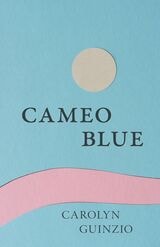
Cameo Blue
Carolyn Guinzio
Carnegie Mellon University Press, 2026
Cameo Blue is a spiritual topography, recording the traces of people in their environments, natural and otherwise, and the portents, memories, and signs they use to navigate their path or understand the precipices they face. Lush with color, weather, and imagery, some poems are driven by breathless conjecture, or propelled by the acute observation that often comes with shock, when time stands still and a camera flash reveals the gap between external and internal, hope and fear, past and future. Other poems cross physical and emotional space more quietly, with a narrative voice like the intimate whisper of a secret podcast. The collection is its own immersive environment for the reader to fall into, with poems that take on a talismanic quality, laden with haunted characters, resonant objects, and occult signs.
Camp Notes and Other Writings
Yamada, Mitsuye
Rutgers University Press, 1998
Honorable Mention of the 1999 Gustavus Myers Outstanding Book Awards
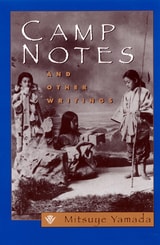
Two collections by an important Asian American writer -- Camp Notes and Other Poeems and Desert Run: Poems and Stories -- return to print in one volume.
Mitsuye Yamada was born in Kyushu, Japan, and raised in Seattle, Washington, until the outbreak of World War II when her family was removed to a concentration camp in Idaho. Camp Notes and Other Writings recounts this experience.
Yamada's poetry yields a terse blend of emotions and imagery. Her twist of words creates a twist of vision that make her poetry come alive. The weight of her cultural experience-the pain of being perceived as an outsider all of her life-permeates her work.
Yamada's strength as a poet stems from the fact that she has managed to integrate both individual and collective aspects of her background, giving her poems a double impact. Her strong portrayal of individual and collective life experience stands out as a distinct thread in the fabric of contemporary literature by women.
"The core poems of Camp Notes and the title come from the notes I had taken when I was in camp, and it wasn’t published until thirty years after most of it was written. I was simply describing what was happening to me, and my thoughts. But, in retrospect, the collection takes on a kind of expanded meaning about that period in our history. As invariably happens, because Japanese American internment became such an issue in American history, I suppose I will be forever identified as the author of Camp Notes. Of course, I try to show that it’s not the only thing I ever did in my whole life; I did other things besides go to an internment camp during World War II. So, in some ways I keep producing to counteract that one image that gets set in the public mind. At the time that I was writing it, I wasn’t necessarily a political person. Now, when I reread it, even to myself, I think it probably has a greater warning about the dangers of being not aware, not aware of one’s own rights, not aware of helping other people who may be in trouble. I think that it does speak to our present age very acutely." -- Mitsuye Yamada, "You should not be invisible”: An Interview with Mitsuye Yamada, Contemporary Women's Writing, March 2014, Vol. 8 Issue 1
Read the whole interview at: https://academic.oup.com/cww/article/8/1/1/414906/You-should-not-be-invisible-An-Interview-with
Can I Finish, Please?
Catherine Bowman
Four Way Books, 2016
Candlefish
PoemsElizabeth Chapman
University of Arkansas Press, 2004
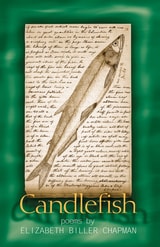
The candlefish, enormous schools of which enter the Pacific Northwest’s rivers in the spring, is so rich with oil that when supplied with a wick it can be used as a candle. Thus creatures of the water become transformed into instruments of fire and spirit, ultimately transcending this world.
Written as the author begins to navigate the second half of life, Candlefish unfolds along multiple lines of narrative and reflection. Each poem is rendered from experience and made incandescent by the spark of the author’s intellect and insight.
Whether tending the flower beds, skinnydipping on her birthday, conversing with a grown daughter, or bringing inside the teacup her husband can no longer carry, Elizabeth Biller Chapman distills each moment to its most vital components and makes them luminous with the necessity and surprise of relation.
Elizabeth Biller Chapman’s candlefish gracefully swim toward the pierced horizon all of us must face and are transformed by imaginative compassion as the book develops, season by season, from summer to spring.
Cannibal Translation
Literary Reciprocity in Contemporary Latin AmericaIsabel C. Gómez
Northwestern University Press, 2023
Winner of the 2024 ACLA Harry Levin Prize • Honorable Mention MLA Katherine Singer Kovacs Prize
A bold comparative study illustrating the creative potential of translations that embrace mutuality and resist assimilation
Cannibal translators digest, recombine, transform, and trouble their source materials. Isabel C. Gómez makes the case for this model of literary production by excavating a network of translation projects in Latin America that includes canonical writers of the twentieth century, such as Haroldo and Augusto de Campos, Rosario Castellanos, Clarice Lispector, José Emilio Pacheco, Octavio Paz, and Ángel Rama. Building on the avant-garde reclaiming of cannibalism as an Indigenous practice meant to honorably incorporate the other into the self, these authors took up Brazilian theories of translation in Spanish to fashion a distinctly Latin American literary exchange, one that rejected normative and Anglocentric approaches to translation and developed collaborative techniques to bring about a new understanding of world literature.
By shedding new light on the political and aesthetic pathways of translation movements beyond the Global North, Gómez offers an alternative conception of the theoretical and ethical challenges posed by this artistic practice. Cannibal Translation: Literary Reciprocity in Contemporary Latin America mobilizes a capacious archive of personal letters, publishers’ records, newspapers, and new media to illuminate inventive strategies of collectivity and process, such as untranslation, transcreation, intersectional autobiographical translation, and transpeaking. The book invites readers to find fresh meaning in other translational histories and question the practices that mediate literary circulation.
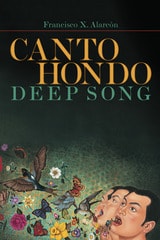
Canto hondo / Deep Song
Francisco X. Alarcón
University of Arizona Press, 2015
In this new collection, Alarcón creates poetry with roots in Gypsy songs clapped out in the distinctively short rhythms of flamenco music. Each page lifts the heart and stirs the soul by delving deep into the struggle for self and sexual identity.
Canto hondo / Deep Song includes 106 poems divided into four sections that articulate struggle, otherness, and the meaning of the poetic landscape. Like Lorca, Alarcón seeks out the fault lines where the lyric and the political bleed productively and proactively into one another.
An important voice in Chicano and GLBT poetry, Alarcón writes with a complex, emotionally powerful style that is accessible to students and all lovers of poetry and poetic traditions.
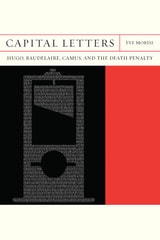
Capital Letters
Hugo, Baudelaire, Camus, and the Death PenaltyÈve Morisi
Northwestern University Press, 2020
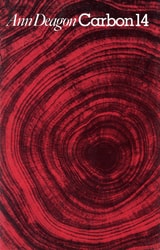
Carbon 14
Ann Deagon
University of Massachusetts Press, 1974
Ann Deagon first began writing poetry “vigorously” in 1970, “in some kind of forty-year-old renaissance.” Since then her poems have been published widely and have been received numerous awards.
“When I came to forty
that three-headed dog love death and poetry
took me in its teeth and shook me…”
Carbon 14 is the result, a counterpoint of serious and ironic excavations into the mythic and the personal past of a middle-aged woman. Although these poems have grown from her lifelong involvement in the Classics and are basically classical in their structure and concentration, their strength is not academic.
Ann Deagon's poems interweave past and present, person, place, and event, with unexpected and often violent insights. In “The Sybil's Bath,” for example, the sacrifice of a young girl to a god leads to unprecedented counterviolence and to questions which are both contemporary and absolute.
According to Deagon, “All identity is in some sense a translation from the Greek: it cannot be defined except with hyphens. The meaning hovers precisely at the hyphen.” in Carbon 14 Deagon proclaims her identity as poet-woman, woman-teacher, teacher-poet.
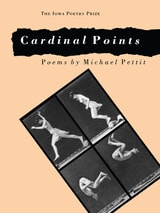
Cardinal Points
Pettit, Michael
University of Iowa Press, 1988
Strung throughout the book are poems based on the Scottish photographer Eadwaerd Muybridge's Animal Locomotion, a historic photographic document. Pettit uses these pioneering images as the basis for his poetic dreaming, and the result is a poignant, integrated sequence of highly moving poems, studded between other vivid lyrics.
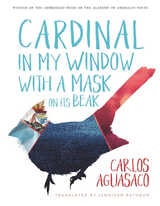
Cardinal in My Window with a Mask on Its Beak
Carlos Aguasaco, Translated by Jennifer Rathbun
University of Arizona Press, 2022
A first-generation immigrant to the United States, Aguasaco embraces his transborder/transnational/intercultural identity by building a bridge across time and distance to unite the great voices of the Renaissance with his lyrical poems. The collection offers bold and fascinating dialogue with Spanish authors such as Juan Boscán, Francisco de Quevedo, Garcilaso de la Vega, and Sor Juana Inés de la Cruz. The poems examine the fundamental liberties inherent to humanity through stunning verse. In a quest for freedom, the poems openly criticize the treatment of immigrants in the United States, drawing poignant parallels with human rights abuses throughout history.
Cardinal in My Window with a Mask on Its Beak brings potent voices of the past to life in poems that critically examine the present and future of the human experience.
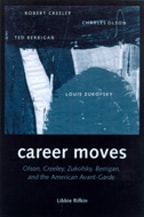
Career Moves
Olson, Creeley, Zukofsky, Berrigan, AndLibbie Rifkin
University of Wisconsin Press, 2000
How much did "making it new" have to do with "making it"? For the four "outsider poets" considered in this book—Charles Olson, Robert Creeley, Louis Zukofsky, and Ted Berrigan—the connection was everything. At once a social history of literary ambition in America in the fifties and sixties and a uniquely collective form of literary biography, Career Moves offers an intimate account of the postwar poetry underground.
Making the controversial claim that anti-Establishment poets were at least as "careerist" as their mainstream peers, Libbie Rifkin shows how the nature of these poets’ ambition actually defined postwar avant-garde identity. In doing so, she clarifies the complicated link between the crafting of a literary career and the defining of a literary canon.
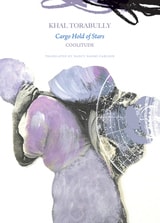
Cargo Hold Of Stars
CoolitudeKhal Torabully
Seagull Books, 2020
An arresting, musical ode to the forgotten voyages and resilient identities of indentured peoples.
Cargo Hold of Stars gives voice to the millions of indentured men and women, mostly from India and China, who were brought to Mauritius between 1849 and 1923. Kept in close quarters in the ship’s cargo hold, many died; most never returned home. Here, Khal Torabully introduces the concept of “Coolitude,” echoing Aimé Césaire’s “Negritude” to imbue the term with profound dignity, pride, and a resilient cultural identity. Stating that ordinary language could not capture these diverse voices, Torabully develops a new “poetics of Coolitude”: a French peppered with Mauritian Creole, brilliant wordplay, and neologisms.
The humor in these linguistic acrobatics only underscores the violence in which these poems are steeped. Deftly translated by Nancy Naomi Carlson, Cargo Hold of Stars is the song of an uprooting, destruction, and reconstruction. Yet it also celebrates setting down roots, conjuring an ideal homeland of fraternity and reconciliation in which bodies, memories, and languages mingle—a compelling odyssey defining the essence of humankind.
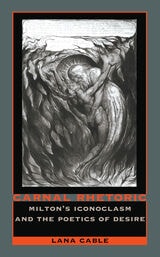
Carnal Rhetoric
Milton’s Iconoclasm and the Poetics of DesireLana Cable
Duke University Press, 1995
Cable traces the development of Milton’s iconoclastic poetics from its roots in the antiprelatical tracts, through the divorce tracts and Areopagitica, to its fullest dramatic representation in Eikonoklastes and Samson Agonistes. Arguing that, like every creative act, metaphor is by nature a radical and self-transgressing agent of change, she explores the site where metaphoric language and imaginative desire merge. Examining the demands Milton places on metaphor, particularly his emphasis on language as a vehicle for mortal redemption, Cable demonstrates the ways in which metaphor acts for him as that creative and radical agent of change. In the process, she reveals Milton’s engagement, at the deepest levels of linguistic creativity, with the early modern commitment to an imaginative and historic remaking of the world.
An insightful and synthetic book, Carnal Rhetoric will appeal to scholars of English literature, Milton, and the Renaissance, as well as to those with an interest in the theory of affective stylistics as it pertains to reader-response criticism, semantics, epistemology, and the philosophy and psychology of language.
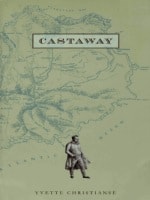
Castaway
Yvette Christiansë
Duke University Press, 1999
Instead of offering a linear narrative, Christiansë renders the poems as if they were emerging from the pages of imaginary books, documents now disrupted and scattered. An emperor’s point of view is juxtaposed with the perspectives of various explorers, sailors, and unknown slaves until finally they all open upon the book’s “castaway,” the authorial female voice that negotiates a way to write about love and desire after centuries of oppression and exploitation.
Daring and sophisticated, Castaway challenges and captivates the reader with not only its lyrical richness and conceptual depth but also its implicit and haunting reflections on diaspora and postcolonialism. It will be highly regarded by readers and writers of poetry and will appeal to those engaged with issues of race, gender, exile, multiculturalism, colonialism, and history.
Castings
Monuments and Monumentality in Poems by Elizabeth Bishop, Robert Lowell, James Merrill, Derek Walcott, and Seamus HeaneyGuy Rotella
Vanderbilt University Press, 2004
In Castings, Guy Rotella examines the work of five important poets who have engaged in that effort: Elizabeth Bishop, Robert Lowell, James Merrill, Derek Walcott, and Seamus Heaney. Considering their wider careers as well as particular poems--including Bishop's "The Monument," Lowell's "For the Union Dead," Merrill's "Bronze," Walcott's "The Sea Is History," and Heaney's "In Memoriam Francis Ledwidge"--Rotella argues that these writers are less concerned with defending or condemning monuments than with pursuing ancient and current debates about the political, aesthetic, and broadly cultural issues that monuments condense. Among these concerns are the competing claims of life and art, persistence and change, meaning and meaninglessness, the self and society, and the governing and the governed.
Original and provocative, Rotella's readings will make us ponder how the human impulse to build to last, to reify our culturally derived and ideologically driven faiths, might coexist with those other creeds of our place and time: relativism, multiculuralism, and diversity.
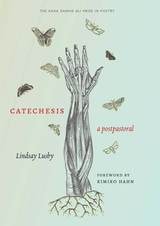
Catechesis
A PostpastoralLindsay Lusby
University of Utah Press, 2019
“A girl has two choices: / to be a tree or / to be the forest.” Catechesis combines Grimm fairy tales with horror movies and the Book of Revelation to construct a vision of the dangers and apocalyptic transformations inherent in girlhood. This lyric lore, which includes curious diagrams and collages of the botanical and the anatomical, contains hidden instructions to prepare girls for the hazards ahead.
In retelling lore alongside other Grimm-style stories, the poet turns horror classics The Silence of the Lambs and Alien into macabre fairy tales in their own right. Herein lurks violence and decay, but also a wild, overgrown beauty. Mothers and fathers are as much a part of this treacherous landscape as the carnivorous flora and shape-shifting fauna—and their effects are just as devastating. Framing all of this within biblical language and motifs gives these fabulist poems an ominous sense of urgency. Catechesis is a hybrid collection of textual and visual poems that examine belief and obsession. It explores how beauty leads to danger and danger births another kind of beauty, in a cycle of creation and destruction.
Catering an Affair
Alberta Skaggs
Southern Illinois University Press, 2018
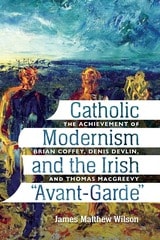
Catholic Modernism and the Irish "Avant-Garde
" The Achievement of Brian Coffey, Denis Devlin, and Thomas MacGreeveyJames Matthew Wilson
Catholic University of America Press, 2023
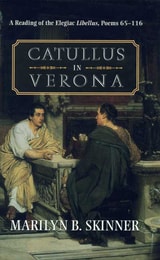
Catullus in Verona
A Reading of the Elegiac Libellus, Poems 65–116Marilyn B. Skinner
The Ohio State University Press, 2003
“Skinner’s Catullus in Verona . . . gives a dazzling demonstration of how even the seemingly over-familiar can yield fresh insights. Subtly interweaving old biographical platitudes and new literary theory, persona and person, she offers us a Catullus (sorry, construct of Catullus) faced with a public and private crisis of late Republican values—political, social, and literary—that forced him to abandon his neoteric models, to rethink all his relationships; plus a Lesbia, the ‘written woman,’ who here generates more semantic flux than heartbreak. Skinner’s readers, too, will end by rethinking a group of poems they thought they knew. This is no small achievement.” —Peter Green, The Times Literary Supplement
“This book is an important contribution to the study of Catullus, and more broadly to the study of Latin poetry. As an example of erudite scholarship and sensitive, supple criticism, I believe it will be of interest as well to a wider audience, including scholars and students working in other disciplines in the humanities.” —David Wray, assistant professor of classics, University of Chicago
Gaius Valerius Catullus is one of Rome’s greatest surviving poets and also one of the most popular Latin authors. Comprehensive treatments of his work have been hindered, however, by the problems posed by the Catullan collection as it has come down to us. Although many scholars now believe that Catullus did publish his verse in one or more small volumes (libelli), the theory that these books were rearranged after his death means that individual pieces continue to be read and analyzed separately, without reference to their placement within the collection. Skinner challenges this theory of posthumous editorship by offering a unified reading of Catullus’ elegiac poetry (poems 65–116 in our collection) and arguing that it constitutes what was once a separately circulated libellus whose authorial arrangement has been preserved intact. Purportedly issued from the poet’s native city, Verona, to his Roman readership, the volume presents itself as a valedictory.
This reading of the elegiac collection represents a major departure in Catullan studies. The methodological contention that Catullus’ elegiac poems are better approached as a single cohesive poetic statement makes this book a valuable new contribution to Catullan scholarship.
Cauterized
Laura Apol
Michigan State University Press, 2024
Cell Traffic
New and Selected PoemsHeid E. Erdrich
University of Arizona Press, 2012
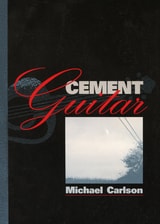
Cement Guitar
Michael Carlson
University of Massachusetts Press, 2003
In this striking debut collection, Michael Carlson offers poems that combine the concrete and the musical, while embodying a tendency toward contradiction. He writes by working with rhythms, structures, images, associational leaps, and an obsession with the sound of words, as opposed to narrative. The book begins, “A thing wants to pounce but can't,” and this spirit of hesitation continues throughout the volume.
The first section of the book contains heavily rhythmic poems measured sometimes by syllable, sometimes by stress, dealing with rural landscapes, a struggle with disillusionment, and a reconciliation of knowledge and belief. The second section confronts the terrain and people of Carlson's childhood in Rhode Island, using longer sentences, riskier enjambments, and a more colloquial and emotional language.
The poems in the third section—which range from Manhattan to Florida, Vietnam, and Paris—share a tendency to be more fantastic and are formal in weird ways. They include an homage to Ezra Pound borrowing the vocabulary of his first book and the syntax of his last, a nod to John Donne borrowing some of his stanza shapes, a sonnet whose constraint is that each of its fourteen lines contains a piece of armor, and a sestina composed of four syllable lines with four end words that rhyme. In the fourth section, Carlson returns to Brooklyn, speaks from the present, and resolves his stances in a brief notational way that is reminiscent of Chinese poetry.
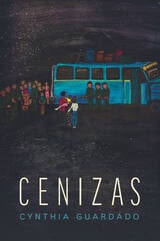
Cenizas
PoemsCynthia Guardado
University of Arizona Press, 2022
Guardado crafted the poems in Cenizas over a ten-year period, often traveling to El Salvador for research and to conduct interviews. The Salvadoran Civil War haunts the pages of this collection as it unflinchingly explores war, its aftermath, and the bittersweet legacies that are passed down from one generation to the next. The poems mourn those who were lost and honor the strength of the speaker’s ancestors. “All my people have been born from the ashes of volcanoes,” she writes, invoking a family lineage that has endured the atrocities committed against them. Even so, El Salvador keeps pulling the speaker back—and despite warnings of danger, she still manages to find beauty among the ruins.
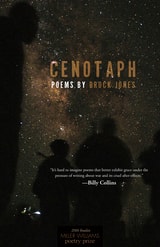
Cenotaph
PoemsBrock Jones
University of Arkansas Press, 2016
Finalist, 2016 Miller Williams Poetry Prize, edited by Billy Collins
Out of the contradiction, paradox, loss, and strange beauty of contemporary warfare, Brock Jones brings us Cenotaph, a collection of poems that have as their genesis Jones’s deployments to Iraq in 2002 and 2005, when he was in the US Army.
These are war poems, but also love poems and hate poems, poems about dying and living, poems about hope and hopelessness. These are poems that beautifully reflect Jones’s resignation to and rejection of the impossibility of saying anything definitive or honest about war.
These are poems that strive to do what poet Bruce Weigl described as the poet’s job: to find “some kind of miraculous way th at if you work hard enough to get the words right, that which you call horrific and wrong is defeated.”
Cenotaph is a poet doing the poet’s work: trying, hoping to get the words right.
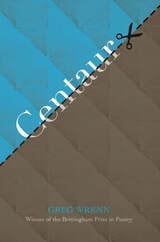
Centaur
Greg Wrenn
University of Wisconsin Press, 2013
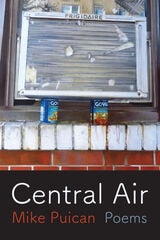
Central Air
PoemsMike Puican
Northwestern University Press, 2020
Puican’s focus on the city, its people and underbellied spaces, pays homage in the tradition of the great Chicago masters: Carl Sandburg, Gwendolyn Brooks, and Campbell McGrath. This contemporary Chicago son finds his own place with lyrical integrity.
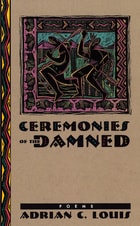
Ceremonies Of The Damned
PoemsAdrian C. Louis
University of Nevada Press, 1997
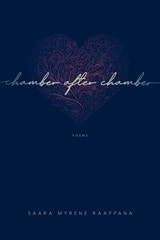
Chamber after Chamber
Saara Myrene Raappana
University of Massachusetts Press, 2024
Chamber after Chamber is about what fractures, fixes, and refills the hearts of two girls as they grow into women. A loose narrative in three sections, the poems follow a speaker and her cousin through their hardscrabble, backwoods childhood to their separation—both physical and emotional—as adults. From the make-believe apocalypses and cut-and-paste valentines of elementary school to the stadium-seating classrooms and multiplexes of southern China, our speaker tries to leave the shame and dysfunction of her family behind. In China, she begins to see America—and herself—clearly for the first time, and in doing so discovers that both her cousin and her country are inextricably woven into
[her body] part that never sleeps the blood
and chambered meat that’s like a rock squeezed
in a fist rapping its knuckles
on the sweet door of the body.
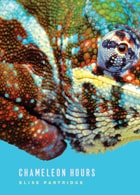
Chameleon Hours
Elise Partridge
University of Chicago Press, 2008
for Steve
Will it be like paragliding—
gossamer takeoff, seedlike drifting down
into a sunlit, unexpected grove?
Or ski-jumping—headlong soaring,
ski-tips piercing clouds,
crystal revelations astonishing my goggles?
. . . . Skittery flicker of a glare-weary lizard
startled into the sheltering wings of a leaf,
rusting freighter with a brimming hold
shimmering onto a crimson edge. . . .
Sad rower pushed from shore,
I'll disappear like circles summoned
by an oar's dip.
However I burn through to the next atmosphere,
let your dear face be the last thing I see.
Praise for Fielder’s Choice
“Partridge is a technical wizard for whom thinking and feeling are not separate activities. She is a hawk-like observer of the particular . . . many times ascending to pitch-perfect verse.”—Ken Babstock, Globe and Mail (Canada)
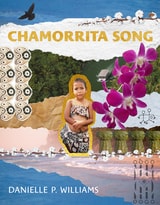
Chamorrita Song
Danielle P. Williams
University of Arizona Press, 2026
Rooted in oral tradition, Chamorrita Song pays homage to Black and Chamorro cultures, honoring the artistic expressions that these communities have created to reconcile lifetimes of imposed trauma. Bearing witness to these many narratives, Williams intertwines spoken word poetry and gospel music with Chamorro storytelling, weaving together the nuanced histories of queer, Black, and Indigenous existence and literature.
Here Williams reveals capacious contemporary forms that speak to the future as well as to the past and that further ground lineages in homelands, finding strength and beauty in collective pain and triumph. These poems transform and spread the messages of those long silenced. They act as song and prayer.
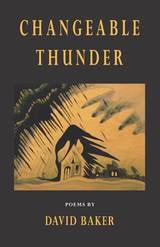
Changeable Thunder
PoemsDavid Baker
University of Arkansas Press, 2001