Results by title
213 books match the query 'Political parties' and 18 start with c
CHALLENGING PARTIES, CHANGING PARLIAMENT
Women and Elected Office in Contemporary Western EuropeMiki Caul Kittilson
The Ohio State University Press, 2006
CHEAP SEATS
The Democratic Party’s Advantage in U.S. House ElectionsJames E. Campbell
The Ohio State University Press, 1996
The longest continuous majority in the history of the U.S. House of Representatives came to a dramatic close with the 1994 midterm elections. The Democratic Party had controlled the House for forty years—two and a half times as long as any previous majority. In Cheap Seats, James E. Campbell considers the reasons why the Democrats dominated House elections for four decades and why they ultimately lost that control.
Examining the structural advantages that helped congressional Democrats, Campbell finds that their unprecedented success in the House was due in no small measure to a favorable election system, an advantage in the way in which votes are translated into House seats. His straightforward analysis indicates that Democrats consistently win most of the very-low-turnout districts, or “cheap seats.” In fact, because of the party's continued hold on such districts, the new Democratic minority is considerably larger than it would otherwise have been.
Cheap Seats is a thorough and innovative investigation into the electoral system's impact on partisan politics and representation in Congress. Campbell presents an impressive array of evidence, including both quantitative analysis of election returns from 1936 to 1994 and in-depth studies of several cheap-seat districts. He also explores the important theoretical issues of representation that cheap seats raise and offers several proposals to reform the system. This well-written and provocative volume is accessible to anyone interested in American politics, in addition to scholars especially interested in the areas of Congress, elections, electoral systems, and political parties.
COALITION GOVERNMENT, SUBNATIONAL STYLE
Multiparty Politics in Europe’s Regional ParliamentsWilliam M. Downs
The Ohio State University Press, 1998
Coalition Government, Subnational Style examines parliamentary democracy in subnational legislative assemblies. Comparing three different European democracies—Germany, France, and Belgium—William M. Downs provides a powerful account of the ways politicians and political parties negotiate the composition of new governments following elections in which no single party wins a clear majority.
Downs argues that postelection alliance building is a window onto many of the political processes fundamental to representative democracy: the interpretations of electoral verdicts; the compromises of campaign pledges; the trade-offs between policy and power; the temporary cooperation between long-term adversaries; the collective decision making; and the blurring of lines of accountability through collective responsibility.
The study reports findings from an unprecedented collection of information, including cross-national survey responses, interviews with political elites, and three decades of postelection studies of coalition building in the German state parliaments, the French regional assemblies, and the Belgian provincial councils and regional parliaments. Coalition Government, Subnational Style conclusively demonstrates that the struggles for government status at subnational levels are profoundly important to both parties and voters and that the outcomes of these struggles can result in governments of varying political complexions. Downs's findings question key assumptions of democratic theory and raise important concerns about individual and organizational behavior in changing institutional and electoral environments, ultimately allowing for a deeper understanding of representation, power, and cooperation outside the more familiar arena of national parliamentary politics.
Campaign Advertising and American Democracy
Michael M. Franz, Paul B. Freedman, Kenneth M. Goldstein and Travis N. Ridout
Temple University Press, 2007
Were viewers turned off by political advertising to the extent that it disuaded them from voting, as some critics suggest? Did they feel more connected to political issues and the political system or were they alienated? These are the questions this book answers, based on a unique, robust, and extensive database dedicated to political advertising.
Confronting prevailing opinion, the authors of this carefully researched work find that political ads may actually educate, engage, and mobilize American voters. Only in the rarest of circumstances do they have negative impacts.
Campaign Finance and Political Polarization
When Purists PrevailRaymond J. La Raja and Brian F. Schaffner
University of Michigan Press, 2015
La Raja and Schaffner conclude the book with policy recommendations for campaign finance in the United States. They are among the few non-libertarians who argue that less regulation, particularly for political parties, may in fact improve the democratic process.

Canada at the Polls, 1984
A Study of the Federal General ElectionsHoward R. Penniman, ed.
Duke University Press, 1988

Captured Peace
Elites and Peacebuilding in El SalvadorChristine J. Wade
Ohio University Press, 2015
El Salvador is widely considered one of the most successful United Nations peacebuilding efforts, but record homicide rates, political polarization, socioeconomic exclusion, and corruption have diminished the quality of peace for many of its citizens. In Captured Peace: Elites and Peacebuilding in El Salvador, Christine J. Wade adapts the concept of elite capture to expand on the idea of “captured peace,” explaining how local elites commandeered political, social, and economic affairs before war’s end and then used the peace accords to deepen their control in these spheres.
While much scholarship has focused on the role of gangs in Salvadoran unrest, Wade draws on an exhaustive range of sources to demonstrate how day-to-day violence is inextricable from the economic and political dimensions. In this in-depth analysis of postwar politics in El Salvador, she highlights the local actors’ primary role in peacebuilding and demonstrates the political advantage an incumbent party—in this case, the Nationalist Republican Alliance (ARENA—has throughout the peace process and the consequences of this to the quality of peace that results.
Choices and Changes
Interest Groups in the Electoral ProcessMichael M. Franz
Temple University Press, 2008
Choices and Changes is the most comprehensive examination to date of the impact of interest groups on recent American electoral politics. Richly informed, theoretically and empirically, it is the first book to explain the emergence of aggressive interest group electioneering tactics in the mid-1990s—including “soft money” contributions, issue ads, and “527s” (IRS-classified political organizations).
Michael Franz argues that changing political and legal contexts have clearly influenced the behavior of interest groups. To support his argument, he tracks in detail the evolution of campaign finance laws since the 1970s, examines all soft money contributions—nearly $1 billion in total—to parties by interest groups from 1991-2002, and analyzes political action committee (PAC) contributions to candidates and parties from 1983-2002. He also draws on his own interviews with campaign finance leaders.
Based on this rigorous data analysis and a formidable knowledge of its subject, Choices and Changes substantially advances our understanding of the significance of interest groups in U.S. politics.
Civil Movements in an Illiberal Regime
Political Activism in HungaryDániel Mikecz
Central European University Press, 2023
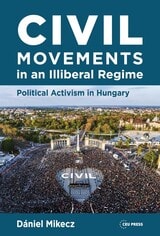
Dániel Mikecz addresses in this study the tensions between oppositional civil society and party-political actors. As successive elections demonstrate the increasing confidence of the illiberal regime of Viktor Orbán, left and liberal parties of the opposition have faced a prolonged crisis in credibility. At the same time, the civil society has not been immobile, and bottom-up initiatives, social and political movements, and non-governmental organizations have gained momentum in the public sphere. The ruling power is also active in the extra-parliamentary political arena. Through national consultations, Peace Marches, and other means, Orbán’s governing Fidesz party has mobilized voters outside of election campaigns and has implemented a so-called movement governance. The study offers a vivid examination of this top-down or astroturf mobilization of the regime.
Mikecz identifies the different patterns of activism and creates a coherent typology. He describes in detail each kind of activism based on opinion surveys, protest surveys and content analysis. The categorization and comprehensive exploration of civil movements provide a deep understanding of the mechanisms of illiberal postcommunist regimes.

Cleavage Politics and the Populist Right
The New Cultural Conflict in Western EuropeAuthored by Simon Bornschier
Temple University Press, 2010
Over the last two decades, right-wing populist parties in Western Europe have gained sizable vote shares and power, much to the fascination and consternation of political observers. Meshing traditionalism and communitarian ideals, right-wing populist parties have come to represent a polar normative ideal to the New Left in Western Europe. In his dynamic study Cleavage Politics and the Populist Right, Simon Bornschier applies a cultural as well as political dimension to analyze the parties of both the right and left in six countries. He develops a theory that integrates the role of political conflict around both established cleavages and party strategies regarding new divisions to explain the varying fortunes of the populist right.
Coalition Strategies of Marxist Parties
Trond Gilberg, ed.
Duke University Press, 1988
Combative Politics
The Media and Public Perceptions of LawmakingMary Layton Atkinson
University of Chicago Press, 2017
By the time a bill is pushed through Congress or ultimately defeated, we’ve often been exposed to weeks, months—even years—of media coverage that underscores the unpopular process of policymaking, and Mary Layton Atkinson argues that this leads us to reject the bill itself. Contrary to many Americans’ understandings of the policymaking process, the best answer to a complex problem is rarely self-evident, and politicians must weigh many potential options, each with merits and drawbacks. As the public awaits a resolution, the news media tend to focus not on the substance of the debate but on descriptions of partisan combat. This coverage leads the public to believe everyone in Washington has lost sight of the problem altogether and is merely pursuing policies designed for individual political gain. Politicians in turn exacerbate the problem when they focus their objections to proposed policies on the lawmaking process, claiming, for example, that a bill is being pushed through Congress with maneuvers designed to limit minority party input. These negative portrayals become linked in many people’s minds with the policy itself, leading to backlash against bills that may otherwise be seen as widely beneficial. Atkinson argues that journalists and educators can make changes to help inoculate Americans against the idea that debate always signifies dysfunction in the government. Journalists should strive to better connect information about policy provisions to the problems they are designed to ameliorate. Educators should stress that although debate sometimes serves political interests, it also offers citizens a window onto the lawmaking process that can help them evaluate the work their government is doing.
Congressional Parties, Institutional Ambition, and the Financing of Majority Control
Eric S. Heberlig and Bruce A. Larson
University of Michigan Press, 2013
With the need for ever increasing sums of money to fuel the ongoing campaign for majority control, both Republicans and Democrats have made large donations to the party and its candidates mandatory for members seeking advancement within party and congressional committee hierarchies. Eric S. Heberlig and Bruce A. Larson analyze this development and discuss its implications for American government and democracy. They address the consequences of selecting congressional leaders on the basis of their fundraising skills rather than their legislative capacity and the extent to which the battle for majority control leads Congress to prioritize short-term electoral gains over long-term governing and problem-solving.
Congressional Realignment, 1925-1978
By Barbara Sinclair
University of Texas Press, 1982
Ronald Reagan's election in 1980 brought with it a major shift in the composition of the U.S. Congress for the first time in several decades. The subsequent introduction of an enormous amount of new legislation sparked debate among many political observers that a new coalition was being built in American politics and that a significant change in the issues on the agenda before Congress heralded a Republican realignment.
Barbara Sinclair's study is a major contribution to our understanding of realignment politics in the House of Representatives. It also provides important insight into the changes in American political life in the late twentieth century.
Congressional Realignment poses three basic, related questions: What are the sources of agenda change? What determines congressional voting alignments and alignment change? Under what conditions are the barriers to major policy change overcome? Sinclair's answers are impressive both in their scholarship and in the depth and intelligence of her insights.
Constitutional Democracy
János Kis
Central European University Press, 2003
Contested City
Municipal Politics and the Rise of Nazism in Altona, 1917-1937Anthony McElligott
University of Michigan Press, 1998
Creating Political Presence
The New Politics of Democratic RepresentationEdited by Dario Castiglione and Johannes Pollak
University of Chicago Press, 2018
In Creating Political Presence, a diverse and international group of scholars explores the implications of such a turn. Two broad, overlapping perspectives emerge. In the first section, the contributions investigate how political representation relates to empowerment, either facilitating or interfering with the capacity of citizens to develop autonomous judgment in collective decision making. Contributions in the second section look at representation from the perspective of inclusion, focusing on how representative relationships and claims articulate the demands of those who are excluded or have no voice. The final section examines political representation from a more systemic perspective, exploring its broader environmental conditions and the way it acquires democratic legitimacy.
Cultural Dilemmas of Progressive Politics
Styles of Engagement among Grassroots ActivistsStephen Hart
University of Chicago Press, 2001
Through case studies of grassroots movements—particularly the economic justice work carried on by congregation-based community organizing and the pursuit of human rights by local members of Amnesty International—Hart shows how these groups develop distinctive ways of talking about politics and create characteristic stories, ceremonies, and practices. According to Hart, the way people engage in politics matters just as much as the content of their ideas: when activists make the moral basis for their activism clear, engage issues with passion, and articulate a unified social vision, they challenge the recent ascendancy of conservative discourse.
On the basis of these case studies, Hart addresses currently debated topics such as individualism in America and whether strains of political thought strongly informed by religion and moral values are compatible with tolerance and liberty.