Results by title
2916 books match the query 'Politics and government' and 214 start with c
CHEAP SEATS
The Democratic Party’s Advantage in U.S. House ElectionsJames E. Campbell
The Ohio State University Press, 1996
The longest continuous majority in the history of the U.S. House of Representatives came to a dramatic close with the 1994 midterm elections. The Democratic Party had controlled the House for forty years—two and a half times as long as any previous majority. In Cheap Seats, James E. Campbell considers the reasons why the Democrats dominated House elections for four decades and why they ultimately lost that control.
Examining the structural advantages that helped congressional Democrats, Campbell finds that their unprecedented success in the House was due in no small measure to a favorable election system, an advantage in the way in which votes are translated into House seats. His straightforward analysis indicates that Democrats consistently win most of the very-low-turnout districts, or “cheap seats.” In fact, because of the party's continued hold on such districts, the new Democratic minority is considerably larger than it would otherwise have been.
Cheap Seats is a thorough and innovative investigation into the electoral system's impact on partisan politics and representation in Congress. Campbell presents an impressive array of evidence, including both quantitative analysis of election returns from 1936 to 1994 and in-depth studies of several cheap-seat districts. He also explores the important theoretical issues of representation that cheap seats raise and offers several proposals to reform the system. This well-written and provocative volume is accessible to anyone interested in American politics, in addition to scholars especially interested in the areas of Congress, elections, electoral systems, and political parties.
Calculating Visions
Kennedy, Johnson, and Civil RightsMark Stern
Rutgers University Press, 1992
Callaghan
Harry Conroy
Haus Publishing, 2006
Calling State Power to Account
Reparations in Morality, Law, and PoliticsJennifer M. Page
University of Chicago Press, 2027
An incisive philosophical examination of reparations claims within today’s political and legal landscapes.
For generations, Black Americans have demanded reparations, and, for generations, the US government has ignored or denied these claims. In Calling State Power to Account, Jennifer M. Page puts forward a novel case for reparations owed to Black Americans for slavery, Jim Crow, and subsequent injustices.
Navigating conflicting insights that reparations are owed for blameworthy wrongdoing and that present iniquities to Black Americans are structural rather than the result of intentional offenses by a clearly identifiable party, Page theorizes how unredressed state-sponsored injustices can be the basis of present reparative duties. Split into two parts, the book first makes a philosophical case for reparations before then examining reparations from both legal and political perspectives. This analysis includes considering practical challenges to reparations, such as the limits of legal accountability in a system with formal barriers designed to shield the government from liability. Despite formidable obstacles, Page argues that there is deep moral and democratic significance to the pursuits of reparations claimants. The aim of reparations is not only monetary compensation but also a moral reckoning and assertion of equality against the backdrop of social and political inequalities.
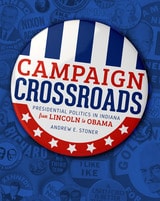
Campaign Crossroads
Presidential Politics in Indiana from Lincoln to ObamaAndrew E. Stoner
Indiana Historical Society Press, 2017
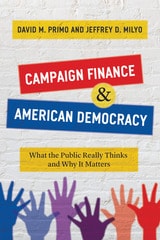
Campaign Finance and American Democracy
What the Public Really Thinks and Why It MattersDavid M. Primo and Jeffrey D. Milyo
University of Chicago Press, 2020
Primo and Milyo probe original survey data to determine Americans’ sentiments on the role of money in politics, what drives these sentiments, and why they matter. What Primo and Milyo find is that while many individuals support the idea of reform, they are also skeptical that reform would successfully limit corruption, which Americans believe stains almost every fiber of the political system. Moreover, support for campaign finance restrictions is deeply divided along party lines, reflecting the polarization of our times. Ultimately, Primo and Milyo contend, American attitudes toward money in politics reflect larger fears about the health of American democracy, fears that will not be allayed by campaign finance reform.
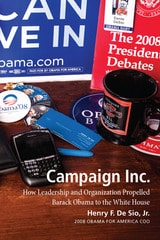
Campaign Inc.
How Leadership and Organization Propelled Barack Obama to the White HouseHenry F. De Sio., Jr.
University of Iowa Press, 2014
De Sio shows readers that Obama himself was direct about his vision for the campaign when he instructed his staff to “run it like a business.” Thus, this is less the story of Barack Obama, candidate, and more the story of Barack Obama, CEO. Because campaigns are launched from scratch during every election cycle, they are the ultimate entrepreneurial experience. In the course of the election, the Obama campaign scaled up from a scrappy start-up to a nearly $1 billion operation, becoming a hothouse environment on which the glare of the media spotlight was permanently trained.
Campaign Inc. allows readers to peek behind the curtain at the underdog organization that brought down the Clinton campaign and later went on to defeat the Republican machine, while offering lessons in leadership and organization to innovators, executives, and entrepreneurs.
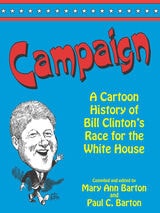
Campaign
A Cartoon History of Bill Clinton's Race for the White HouseMary Ann Barton
University of Arkansas Press, 1993
For many people, in the United States and abroad, the dramas of the campaign created the character of Clinton. From the Gennifer Flowers debacle to Clinton’s
resurrection at the Democratic National Convention and the triumph of the election win, the incisive cartoons in this collection capture Clinton’s emerging image in a way that no written word can. The forty-five contributing artists use these cartoons to depict the breathtaking and colorful events that only a presidential campaign can produce and offer hours of entertainment for any reader.
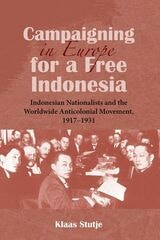
Campaigning in Europe for a Free Indonesia
Indonesian Nationalists and the Worldwide Anticolonial Movement, 1917–1932Klaas Stutje
National University of Singapore Press, 2019

Campbell-Bannerman
Roy Hattersley
Haus Publishing, 2006
Can a Liberal be a Chief? Can a Chief be a Liberal?
Some Thoughts on an Unfinished Business of ColonialismOlúfémi Táíwò
Prickly Paradigm Press, 2021
Across Africa, it is not unusual for proponents of liberal democracy and modernization to make room for some aspects of indigenous culture, such as the use of a chief as a political figure. Yet for Olúfẹ́mi Táíwò, no such accommodation should be made. Chiefs, he argues, in this thought-provoking and wide-ranging pamphlet, cannot be liberals—and liberals cannot be chiefs. If we fail to recognize this, we fail to acknowledge the metaphysical underpinnings of modern understandings of freedom and equality, as well as the ways in which African intellectuals can offer a distinctive take on the unfinished business of colonialism.
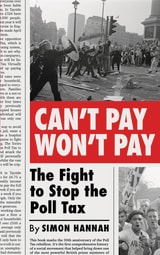
Can't Pay, Won't Pay
The Fight to Stop the Poll TaxSimon Hannah
Pluto Press, 2020
Starting in Scotland where the 'Community Charge' was first trialled, Can't Pay, Won't Pay immerses the reader in the gritty history of the rebellion. Amidst the drama of large scale protests and blockaded estates a number of key figures and groups emerge: Neil Kinnock and Tommy Sheridan; Militant, Class War and the Metropolitan Police.
Assessing this legacy today, Hannah demonstrates the centrality of the Poll Tax resistance as a key chapter in the history of British popular uprisings, Labour Party factionalism, the anti-socialist agenda and failed Tory ideology.

Canada Votes, 1935-1989
Frank Feigert
Duke University Press, 1989
The result is a compendium of data and analysis that can be found nowhere else and which will be an invaluable sourcebook for students of Canadian political behavior.

Canada at the Polls, 1984
A Study of the Federal General ElectionsHoward R. Penniman, ed.
Duke University Press, 1988
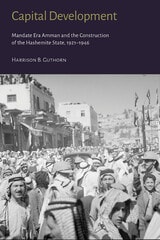
Capital Development
Mandate Era Amman and the Construction of the Hashemite State (1921–1946)Harrison B. Guthorn
Gingko, 2021
Amman, the capital of Jordan, contends with a crisis of identity rooted in how it grew to become a symbol for the Anglo-Hashemite government first, and a city second. As a representation of the new centralized authority, Amman became the seat of the Mandatory government that orchestrated the development of Transjordan, the British mandate established in 1921.
Despite its diminutive size, the city grew to house all the components necessary for a thriving and cohesive state by the end of the British mandate in 1946. However, in spite of its modernizing and regulatory ambitions, the Transjordan government did not control all facets of life in the region. Instead, the story of Transjordan is one of tensions between the state and the realities of the region, and these limitations forced the government to scale down its aspirations. This book presents the history of Amman’s development under the rule of the British mandate from 1921–46 and illustrates how the growth of the Anglo-Hashemite state imbued the city with physical, political, and symbolic significance.
Capital, State, Empire
The New American Way of Digital WarfareScott Timcke
University of Westminster Press, 2017
The United States presents the greatest source of global geo-political violence and instability. Guided by the radical political economy tradition, this book offers an analysis of the USA’s historical impulse to weaponize communication technologies.
Scott Timcke explores the foundations of this impulse and how the militarization of digital society creates structural injustices and social inequalities. He analyses how new digital communication technologies support American paramountcy and conditions for worldwide capital accumulation. Identifying selected features of contemporary American society, Capital, State, Empire undertakes a materialist critique of this digital society and of the New American Way of War. At the same time it demonstrates how the American security state represses activists—such as Black Lives Matter—who resist this emerging security leviathan. The book also critiques the digital positivism behind the algorithmic regulation used to control labour and further diminish prospects for human flourishing for the ‘99%’.
Capital, State, Empire contributes to a broader understanding of the dynamics of global capitalism and political power in the early 21st century.
Capitalism, Politics, and Railroads in Jacksonian New England
Michael J. Connolly
University of Missouri Press, 2003
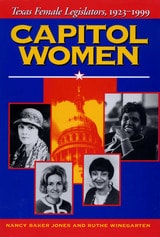
Capitol Women
Texas Female Legislators, 1923-1999By Nancy Baker Jones and Ruthe Winegarten
University of Texas Press, 2000
Along with bar rooms and bordellos, there has hardly been a more male-focused institution in Texas history than the Texas Legislature. Yet the eighty-six women who have served there have made a mark on the institution through the legislation they have passed, much of which addresses their concerns as citizens who have been inadequately represented by male lawmakers.
This first complete record of the women of the Texas Legislature places such well-known figures as Kay Bailey Hutchison, Sissy Farenthold, Barbara Jordan, Irma Rangel, Eddie Bernice Johnson, Susan Combs, and Judith Zaffirini in the context of their times and among the women and men with whom they served. Drawing on years of primary research and interviews, Nancy Baker Jones and Ruthe Winegarten offer concise biographies and profiles of all eighty-six women who have served or currently hold office in the Texas Legislature.
The biographies describe the women lawmakers' lives, campaign strategies, and legislative successes and defeats. Four introductory essays provide historical and cultural context for the biographies, which are arranged chronologically to give a sense of the passage of time, of relationships among and between women, and of the issues of their eras.

Captured Peace
Elites and Peacebuilding in El SalvadorChristine J. Wade
Ohio University Press, 2015
El Salvador is widely considered one of the most successful United Nations peacebuilding efforts, but record homicide rates, political polarization, socioeconomic exclusion, and corruption have diminished the quality of peace for many of its citizens. In Captured Peace: Elites and Peacebuilding in El Salvador, Christine J. Wade adapts the concept of elite capture to expand on the idea of “captured peace,” explaining how local elites commandeered political, social, and economic affairs before war’s end and then used the peace accords to deepen their control in these spheres.
While much scholarship has focused on the role of gangs in Salvadoran unrest, Wade draws on an exhaustive range of sources to demonstrate how day-to-day violence is inextricable from the economic and political dimensions. In this in-depth analysis of postwar politics in El Salvador, she highlights the local actors’ primary role in peacebuilding and demonstrates the political advantage an incumbent party—in this case, the Nationalist Republican Alliance (ARENA—has throughout the peace process and the consequences of this to the quality of peace that results.
Carbon Sovereignty
Coal, Development, and Energy Transition in the Navajo NationAndrew Curley
University of Arizona Press, 2023
This comprehensive new work offers a deep dive into the complex inner workings of energy shift in the Navajo Nation. Geographer Andrew Curley, a member of the Navajo Nation, examines the history of coal development within the Navajo Nation, including why some Diné supported coal and the consequences of doing so. He explains the Navajo Nation’s strategic choices to use the coal industry to support its sovereignty as a path forward in the face of ongoing colonialism. Carbon Sovereignty demonstrates the mechanism of capitalism through colonialism and the construction of resource sovereignty, in both the Navajo Nation’s embrace and its rejection of a coal economy.
For the people of the Navajo Nation, energy sovereignty is dire and personal. Thanks to on-the-ground interviews with Diné coal workers, environmental activists, and politicians, Curley documents the real consequences of change as they happened. While some Navajo actors have doubled down for coal, others have moved toward transition. Curley argues that political struggles ultimately shape how we should understand coal, capitalism, and climate change. The rise and fall of coal magnify the nuance and complexity of change. Historical and contemporary issues intermingle in everyday life with lasting consequences.
Career Patterns in the Ch’ing Dynasty
The Office of the Governor GeneralRaymond W. Chu and William G. Saywell
University of Michigan Press, 1981
Carl B. Stokes and the Rise of Black Political Power
Leonard N. Moore
University of Illinois Press, 2002
In this wide-ranging political biography, Leonard N. Moore examines the convictions and alliances that brought Stokes to power. Impelled by the problems plaguing Cleveland's ghettos in the decades following World War II, Stokes and other Clevelanders questioned how the sit-ins and marches of the civil rights movement could correct the exclusionary zoning practices, police brutality, substandard housing, and de facto school segregation that African Americans in the country's northern urban centers viewed as evidence of their oppression.
As civil unrest in the country's ghettos turned to violence in the 1960s, Cleveland was one of the first cities to heed the call of Malcolm X's infamous "The Ballot or the Bullet" speech. Understanding the importance of controlling the city's political system, Cleveland's blacks utilized their substantial voting base to put Stokes in office in 1967.
Stokes was committed to showing the country that an African American could be an effective political leader. He employed an ambitious and radically progressive agenda to clean up Cleveland's ghettos, reform law enforcement, move public housing to middle-class neighborhoods, and jump-start black economic power. Hindered by resistance from the black middle class and the Cleveland City Council, spurned by the media and fellow politicians who deemed him a black nationalist, and unable to prove that black leadership could thwart black unrest, Stokes finished his four years in office with many of his legislative goals unfulfilled.
Focusing on Stokes and Cleveland, but attending to themes that affected many urban centers after the second great migration of African Americans to the North, Moore balances Stokes's failures and successes to provide a thorough and engaging portrait of his life and his pioneering contributions to a distinct African American political culture that continues to shape American life.
Carlos Lacerda, Brazilian Crusader
Volume I: The Years 1914-1960By John W. F. Dulles
University of Texas Press, 1991
Playwright, journalist, and spectacularly successful governor, Carlos Lacerda was Brazil's foremost orator in the 20th century and its most controversial politician. He might have become president in the 1960s had not the military taken over. In the words of eminent historian José Honório Rodrigues, "No one person influenced the Brazilian historical process as much as Carlos Lacerda from 1945 to 1968."
In this volume, the first of a two-volume biography, Professor Dulles paints a portrait of a rebellious youth, who had the willfulness of his prominent father and who crusaded for Communism before becoming its most outspoken foe. Recalling Lacerda's rallying cry, "Brazil must be shaken up," Dulles traces the career of the journalist whose unsparing attacks on the men in power led authorities to imprison him and employ thugs who pummeled him physically. The story covers events in which Lacerda helped alter Brazil, such as the redemocratization in 1945 and his revelation of scandals in high places in the early 1950s. An unsuccessful attempt by government men to murder him in 1954 led to the suicide of President Getulio Vargas in 1954.
Lacerda's spirited oratory helped him become Brazil's most popular congressman, but it scared the rulers of Brazil and they prohibited the broadcast of his speeches after he returned from exile in 1956. Their effort to deprive him of his mandate stirred the entire nation and culminated in one of the most dramatic sessions ever held in the Chamber of Deputies.
Dulles, who knew Lacerda well and had access to his papers, sheds light on Lacerda the man, ardent in courtship and in all his undertakings, intellectually restless, and scornful of routine and mediocrity. Lacerda had a vitriolic pen that made bitter enemies, but, as disclosed in these pages, his courage and incorruptibility attracted an enthusiastic following, evident in the landslide election victories that brought him seats on Rio de Janeiro's city council and in the federal Congress.
Carlos Lacerda, Brazilian Crusader
Volume II: The Years 1960-1977By John W. F. Dulles
University of Texas Press, 1991
From reviews of Volume I:
"Brazilian Crusader is no doubt the best biography yet produced on Lacerda and the second volume . . . is certainly worth waiting for."
—Luso-Brazilian Review
Journalist and spectacularly successful governor, Carlos Lacerda was Brazil's foremost orator in the 20th century and its most controversial politician. He might have become president in the 1960s had not the military taken over.
In the first volume, John F. W. Dulles paints a portrait of a rebellious youth, who had the willfulness of his prominent father and who crusaded for Communism before becoming its most outspoken foe. Recalling Lacerda's rallying cry, "Brazil must be shaken up," Dulles traces the career of the journalist whose unsparing attacks on the men in power led authorities to imprison him and employ thugs who pummeled him physically. Lacerda's spirited oratory helped him become Brazil's most popular congressman, but it scared the rulers of Brazil, who prohibited the broadcast of his speeches after he returned from exile in 1956. Their effort to deprive him of his mandate stirred the entire nation and culminated in one of the most dramatic sessions ever held in the Chamber of Deputies.
In the second and final volume, Dulles explores the political and private life of Lacerda from 1960, when he became governor of Brazil's Guanabara state, until his death in 1977. Dulles focuses particularly on the years 1960 to 1968, in which Lacerda played a central role in some of the most drastic political changes that Brazil has experienced in this century.
Lacerda's story ranges from the headlines constantly generated by his political attacks and journalistic sensationalism to private moments of personal tragedy. In telling his story, Dulles draws on hundreds of interviews, as well as extensive research in press archives, Lacerda's public papers, and the private collections of Lacerda's family and associates. This material paints a compelling portrait of an honest administrator who alienated top figures in politics, the press, and the military.
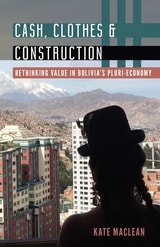
Cash, Clothes, and Construction
Rethinking Value in Bolivia's Pluri-economyKate Maclean
University of Minnesota Press, 2023
A groundbreaking feminist perspective on Movimiento al Socialismo (MAS) rule in Bolivia and the country’s radical transformation under Evo Morales
The presidency of Evo Morales in Bolivia (2006–2019) has produced considerable academic scholarship, much of it focused on indigenous social movements or extractivism, and often triumphalist about the successes of Morales’s Movimiento al Socialismo (MAS). Turning a new lens on the movement, Cash, Clothes, and Construction presents the first gender-based analysis of “pluri-economy,” a central pillar of Bolivia’s program under Morales, evaluating the potential of this vision of “an economy where all economies fit” to embrace feminist critiques of capitalism and economic diversity.
Based on more than twelve years of empirical research exploring the remarkable transformations in Bolivia since 2006, this book focuses on three sectors—finance, clothing, and construction—in which indigenous women have defied gendered expectations. Kate Maclean presents detailed case studies of women selling secondhand high street clothes from the United States in the vast, peri-urban markets of Bolivian cities; Aymaran designers of new pollera (traditional Andean dress) fashions, one of whom exhibited her collection in New York City; and the powerful and rich chola paceña, whose real estate investments have transformed the cultural maps of La Paz and El Alto.
Cash, Clothes, and Construction offers a gendered analysis of the mission of MAS to dismantle neoliberalism and decolonize politics and economy from the perspective of the Indigenous women who have radically transformed Bolivia’s economy from the ground up.
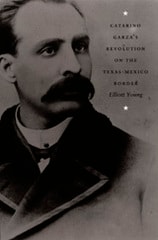
Catarino Garza's Revolution on the Texas-Mexico Border
Elliott Young
Duke University Press, 2004
Elliott Young provides the first full-length analysis of the revolt and its significance, arguing that Garza’s rebellion is an important and telling chapter in the formation of the border between Mexico and the United States and in the histories of both countries. Throughout the nineteenth century, the borderlands were a relatively coherent region. Young analyzes archival materials, newspapers, travel accounts, and autobiographies from both countries to show that Garza’s revolution was more than just an effort to overthrow Díaz. It was part of the long struggle of borderlands people to maintain their autonomy in the face of two powerful and encroaching nation-states and of Mexicans in particular to protect themselves from being economically and socially displaced by Anglo Americans. By critically examining the different perspectives of military officers, journalists, diplomats, and the Garzistas themselves, Young exposes how nationalism and its preeminent symbol, the border, were manufactured and resisted along the Rio Grande.
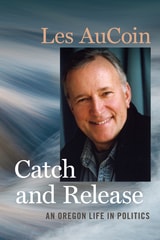
Catch and Release
An Oregon Life in PoliticsLes AuCoin
Oregon State University Press, 2019
In this compelling collection of life stories, AuCoin traces his unlikely rise from a fatherless childhood in Central Oregon to the top ranks of national power. Then came a painful defeat in one of the most controversial races in US Senate history, against incumbent Bob Packwood.
A fly fisher, AuCoin uses “catch and release” as a metaphor for succeeding and letting go of loss with dignity and equanimity. His memories are in turn funny, suspenseful, and revealing. AuCoin takes us to the Kremlin, pre-industrial China, the Arctic National Wildlife Refuge, and into the tortuous politics of the Northwest spotted owl crisis. He interacted with world figures like Mikhail Gorbachev, Ronald Reagan, House Speakers Tip O’Neill and Jim Wright, and Oregon legends Tom McCall and Mark Hatfield. Closer to home, AuCoin allied himself with activists like Sidney Lasseigne of the Newport Fishermen’s Wives.
Catch and Release offers readers a revealing glimpse behind the scenes of congressional life, as lived by the 535 souls who inhabit the US House and Senate—including the author, who assesses his own strengths and foibles with humility and candor.
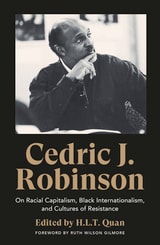
Cedric J. Robinson
On Racial Capitalism, Black Internationalism, and Cultures of ResistanceCedric J. Robinson
Pluto Press, 2019
"Like W. E. B. Du Bois, Michel Foucault, Sylvia Wynter, and Edward Said, Robinson was that rare polymath capable of seeing the whole....He left behind a body of work to which we must return constantly and urgently"—Robin D. G. Kelley, author of Freedom Dreams
Cedric J. Robinson is one of the doyens of Black Studies and a pioneer in study of the Black Radical Tradition. His works have been essential texts, deconstructing racial capitalism and inspiring insurgent movements from Ferguson, Missouri to the West Bank. For the first time, Robinson's essays come together, spanning over four decades and reflective of his diverse interests in the interconnections between culture and politics, radical social theory, and classic and modern political philosophy.
Themes explored include Africa and Black internationalism, World politics, race and US Foreign Policy, representations of blackness in popular culture, and reflections on popular resistance to racial capitalism, white supremacy and more. Essays here include:
*The Black Detective and American Memory
*Slavery and the Platonic Origins of Anti-Democracy
*Africa: In Hock to History and the Banks
*Blaxploitation and the Misrepresentation of Liberalism
*The Mulatta on Film
*Race, Capitalism, and Anti-democracy
*The Killing in Ferguson
*And much more!
Accompanied by an introduction by H. L. T. Quan and a foreword by Ruth Wilson Gilmore, this collection, which includes previously unpublished materials, extends the many contributions by a giant in Black radical thought.
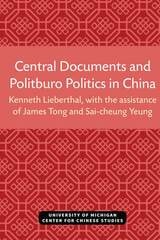
Central Documents and Politburo Politics in China
Kenneth Lieberthal, with the assistance of James Tong and Sai-cheung Yeung
University of Michigan Press, 1978
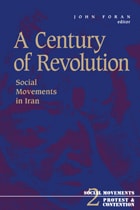
Century Of Revolution
Social Movements in IranJohn Foran
University of Minnesota Press, 1994
Provides insight into the political currents that led to the Iranian revolution.
Before late 1978 Iran did not occupy a large place in the public mind, mass media, or academic pursuits. With the massive upheaval of the next few months, all this changed-and the world is still trying to catch up with the dramatic events that brought Iran to its attention. This volume offers a much needed look into the historical, social, and political developments leading up to the Iranian revolution. Bringing together a group of scholars, historians, and social scientists, most of them Iranian in origin, the book documents an extraordinary revolutionary heritage that predates this century.
Each contributor examines a critical moment in Iranian social history-on its own terms as well as within a larger theoretical and comparative context. The topics they take up include: • the Tobacco Rebellion of 1890-91 • the Constitutional Revolution of 1905-11 • the rise of Reza Khan between 1921 and 1925• the autonomy movement in Azerbaijan and Kurdistan after World War II• the oil nationalization movement under Musaddiq between 1951and 1953• the unrest of the 1960-63 period• the Iranian revolution of 1977-79 • the state of Iran since the revolution Thoughout, common themes emerge, especially the heterogeneous bases of Iranian social movements with respect to class, gender, and ethnicity, as well as the diverse discourses-nationalist, Islamic, socialist, populist, and radical-that have animated these movements. Representing a wide variety of perspectives and approaches, this volume provides crucial insight into the widely watched but poorly understood phenomenon of present-day Iran.Contributors: Janet Afary, Purdue University; John Foran, University of California, Santa Barbara; Amir Hassanpour, Uppsala University; Mansoor Moaddel, Eastern Michigan University; Val Moghadam, United Nations University; Misgah Parsa, Dartmouth College; Sussan Siavoshi, Trinity University; Michael Zirinsky, Boise State University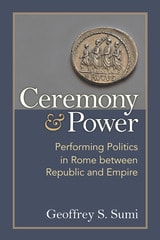
Ceremony and Power
Performing Politics in Rome between Republic and EmpireGeoffrey S. Sumi
University of Michigan Press, 2015
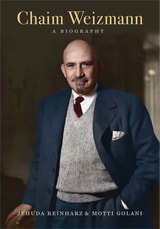
Chaim Weizmann
A BiographyJehuda Reinharz and Motti Golani
Brandeis University Press, 2024
In Chaim Weizmann: A Biography, Jehuda Reinharz and Motti Golani show how Weizmann, a leader of the World Zionist Organization who became the first president of Israel, advocated for a Jewish state by gaining the support of influential politicians and statesmen as well as Jews around the world. Beginning with his childhood in Belorussia and concluding with his tenure as president, Reinharz and Golani describe how a Russian Jew, who immigrated to the United Kingdom in the early twentieth century, was able to advance the goals of Theodor Herzl, the founder of the Zionist Organization. Weizmann is also shown as a man of human foibles—his infatuations, political machinations, and elitism—as well as a man of admirable qualities—intelligence, wit, charisma, and dedication.
Weizmann, who came to the UK to work as a biochemist, was in regular communication with British political figures, including prime ministers Arthur James Balfour, David Lloyd George, Winston Churchill, and Ramsay MacDonald. He also met presidents of the United States from Woodrow Wilson to Harry Truman. His success in earning the support of British political figures helped lead to the Balfour Declaration, which advocated for a “national home” for the Jewish people in Palestine.
As the authors show in this authoritative account of Weizmann’s life, Weizmann was guided by the belief that “Zion shall be redeemed in justice,” a phrase that recurs often in his writings.
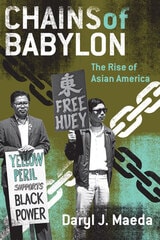
Chains of Babylon
The Rise of Asian AmericaDaryl J. Maeda
University of Minnesota Press, 2009
In Chains of Babylon, Daryl J. Maeda presents a cultural history of Asian American activism in the late 1960s and early 1970s, showing how the movement created the category of "Asian American" to join Asians of many ethnicities in racial solidarity. Drawing on the Black Power and antiwar movements, Asian American radicals argued that all Asians in the United States should resist assimilation and band together to oppose racism within the country and imperialism abroad.
As revealed in Maeda's in-depth work, the Asian American movement contended that people of all Asian ethnicities in the United States shared a common relationship to oppression and exploitation with each other and with other nonwhite peoples. In the early stages of the civil rights era, the possibility of assimilation was held out to Asian Americans under a model minority myth. Maeda insists that it was only in the disruption of that myth for both African Americans and Asian Americans in the 1960s and 1970s that the full Asian American culture and movement he describes could emerge. Maeda challenges accounts of the post-1968 era as hopelessly divisive by examining how racial and cultural identity enabled Asian Americans to see eye-to-eye with and support other groups of color in their campaigns for social justice.
Asian American opposition to the war in Vietnam, unlike that of the broader antiwar movement, was predicated on understanding it as a racial, specifically anti-Asian genocide. Throughout he argues that cultural critiques of racism and imperialism, the twin "chains of Babylon" of the title, informed the construction of a multiethnic Asian American identity committed to interracial and transnational solidarity.
Challenged Sovereignty
The Impact of Drugs, Crime, Terrorism, and Cyber Threats in the CaribbeanIvelaw Lloyd Griffith
University of Illinois Press, 2024
Informed and up to date, Challenged Sovereignty explains the effects of today’s globalized problems on the contemporary Caribbean.
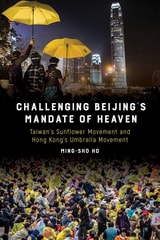
Challenging Beijing's Mandate of Heaven
Taiwan's Sunflower Movement and Hong Kong's Umbrella MovementMing-sho Ho
Temple University Press, 2019
In 2014, the Sunflower Movement in Taiwan grabbed international attention as citizen protesters demanded the Taiwan government withdraw its free-trade agreement with China. In that same year, in Hong Kong, the Umbrella Movement sustained 79 days of demonstrations, protests that demanded genuine universal suffrage in electing Hong Kong’s chief executive. It too, became an international incident before it collapsed. Both of these student-led movements featured large-scale and intense participation and had deep and far-reaching consequences. But how did two massive and disruptive protests take place in culturally conservative societies? And how did the two “occupy”-style protests against Chinese influences on local politics arrive at such strikingly divergent results?
Challenging Beijing’s Mandate of Heaven aims to make sense of the origins, processes, and outcomes of these eventful protests in Taiwan and Hong Kong. Ming-sho Ho compares the dynamics of the two movements, from the existing networks of activists that preceded protest, to the perceived threats that ignited the movements, to the government strategies with which they contended, and to the nature of their coordination. Moreover, he contextualizes these protests in a period of global prominence for student, occupy, and anti-globalization protests and situates them within social movement studies.
Challenging U.S. Apartheid
Atlanta and Black Struggles for Human Rights, 1960–1977Winston A. Grady-Willis
Duke University Press, 2006
Grady-Willis describes Black activism within a framework of human rights rather than in terms of civil rights. As he demonstrates, civil rights were only one part of a larger struggle for self-determination, a fight to dismantle a system of inequalities that he conceptualizes as “apartheid structures.” Drawing on archival research and interviews with activists of the 1960s and 1970s, he illuminates a wide range of activities, organizations, and achievements, including the neighborhood-based efforts of Atlanta’s Black working poor, clandestine associations such as the African American women’s group Sojourner South, and the establishment of autonomous Black intellectual institutions such as the Institute of the Black World. Grady-Willis’s chronicle of the politics within the Black freedom movement in Atlanta brings to light overlapping ideologies, gender and class tensions, and conflicts over divergent policies, strategies, and tactics. It also highlights the work of grassroots activists, who take center stage alongside well-known figures in Challenging U.S. Apartheid. Women, who played central roles in the human rights struggle in Atlanta, are at the foreground of this history.
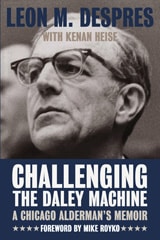
Challenging the Daley Machine
A Chicago Alderman's MemoirLeon M. Despres
Northwestern University Press, 2005
Winner, 2007 The Hyde Park Historical Society Paul Cornell Award
Political war stories from a thorn in the side of Chicago's famous Boss
In 1955, south-sider Leon Despres was elected to the Chicago City Council-the same year that Paddy Bauler famously uttered that "Chicago ain't ready for reform." Ready or not, Chicago got twenty years of reform efforts from Despres, one of the few independents in the council and the most liberal alderman in the city. His demand to cut out the corrupt sale of city driveway permits made him enemies from the very beginning. Over the years his crusades to ban discrimination, preserve Chicago landmark buildings, and gain equality for African-Americans-when Daley-beholden African-American council members refused to help-threw wrench after wrench into the Machine. And, not incidentally, changed the city.
But Challenging the Daley Machine is more than a memoir. It's a historical portrait of the way things were done under the Boss, when changing times and a changing city forced the Machine to confront the problems Despres championed. His battles against the seemingly monolithic Machine are also an inspiration to anyone who is facing long odds, but is convinced he/she is on the side of right.
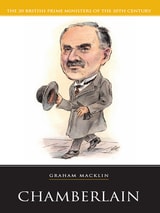
Chamberlain
Graham Macklin
Haus Publishing, 2006

Chances for Peace
Missed Opportunities in the Arab-Israeli ConflictBy Elie Podeh
University of Texas Press, 2015
Drawing on a newly developed theoretical definition of “missed opportunity,” Chances for Peace uses extensive sources in English, Hebrew, and Arabic to systematically measure the potentiality levels of opportunity across some ninety years of attempted negotiations in the Arab-Israeli conflict. With enlightening revelations that defy conventional wisdom, this study provides a balanced account of the most significant attempts to forge peace, initiated by the world’s superpowers, the Arabs (including the Palestinians), and Israel. From Arab-Zionist negotiations at the end of World War I to the subsequent partition, the aftermath of the 1967 War and the Sadat Initiative, and numerous agreements throughout the 1980s and 1990s, concluding with the Annapolis Conference in 2007 and the Abu Mazen-Olmert talks in 2008, pioneering scholar Elie Podeh uses empirical criteria and diverse secondary sources to assess the protagonists’ roles at more than two dozen key junctures.
A resource that brings together historiography, political science, and the practice of peace negotiation, Podeh’s insightful exploration also showcases opportunities that were not missed. Three agreements in particular (Israeli-Egyptian, 1979; Israeli-Lebanese, 1983; and Israeli-Jordanian, 1994) illuminate important variables for forging new paths to successful negotiation. By applying his framework to a broad range of power brokers and time periods, Podeh also sheds light on numerous incidents that contradict official narratives. This unique approach is poised to reshape the realm of conflict resolution.
Chang Ch’un-ch’iao and Shanghai’s January Revolution
Andrew G. Walder
University of Michigan Press, 1977
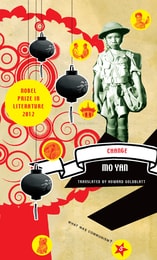
Change
Mo Yan
Seagull Books, 2010
In Change, Mo Yan, the 2012 Nobel Laureate in Literature, personalizes the political and social changes in his country over the past few decades in this novella disguised as autobiography—or vice-versa. Unlike most historical narratives from China, which are pegged to political events, Change is a representative of “people’s history,” a bottom-up rather than top-down view of a country in flux. By moving back and forth in time and focusing on small events and everyday people, Mo Yan breathes life into history by describing the effects of larger-than-life events on the average citizen.
“Through a mixture of fantasy and reality, historical and social perspectives, Mo Yan has created a world reminiscent in its complexity of those in the writings of William Faulkner and Gabriel García Márquez, at the same time finding a departure point in old Chinese literature and in oral tradition.”— Nobel Committee for Literature
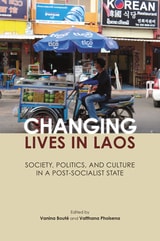
Changing Lives in Laos
Society, Politics, and Culture in a Post-Socialist StateEdited by Vanina Bouté and Vatthana Pholsena
National University of Singapore Press, 2017

Changing Minds or Changing Channels?
Partisan News in an Age of ChoiceKevin Arceneaux and Martin Johnson
University of Chicago Press, 2013
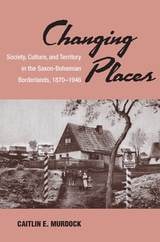
Changing Places
Society, Culture, and Territory in the Saxon-Bohemian Borderlands, 1870-1946Caitlin E. Murdock
University of Michigan Press, 2010
"Changing Places is an interesting meditation on the varying identities and rights claimed by residents of borderlands, the limits placed on the capacities of nation-states to police their borders and enforce national identities, and the persistence of such contact zones in the past and present. It is an extremely well-written and engaging study, and an absolute pleasure to read."
---Dennis Sweeney, University of Alberta
"Changing Places offers a brilliantly transnational approach to its subject, the kind that historians perennially demand of themselves but almost never accomplish in practice."
---Pieter M. Judson, Swarthmore College
Changing Places is a transnational history of the birth, life, and death of a modern borderland and of frontier peoples' changing relationships to nations, states, and territorial belonging. The cross-border region between Germany and Habsburg Austria---and after 1918 between Germany and Czechoslovakia---became an international showcase for modern state building, nationalist agitation, and local pragmatism after World War I, in the 1930s, and again after 1945.
Caitlin Murdock uses wide-ranging archival and published sources from Germany and the Czech Republic to tell a truly transnational story of how state, regional, and local historical actors created, and eventually destroyed, a cross-border region. Changing Places demonstrates the persistence of national fluidity, ambiguity, and ambivalence in Germany long after unification and even under fascism. It shows how the 1938 Nazi annexation of the Czechoslovak "Sudetenland" became imaginable to local actors and political leaders alike. At the same time, it illustrates that the Czech-German nationalist conflict and Hitler's Anschluss are only a small part of the larger, more complex borderland story that continues to shape local identities and international politics today.
Caitlin E. Murdock is Associate Professor of History at California State University, Long Beach.
Jacket Credit: Cover art courtesy of the author

Changing Uganda
Dilemmas of Structural AdjustmentHölger Bernt Hansen
Ohio University Press, 1992
Yoweri Museveni battled to power in 1986. His government has impressed many observers as Uganda’s most innovative since it gained independence from Britain in 1962. The Economist recommended it as a model for other African states struggling to develop their resources in the best interests of their peoples.
But where was change to start? At the bottom in building resistance committees, or at the top in tough negotiations with the IMF? How was it to continue? Was it in the restructuring of the national army, in increasing respect for human rights, in the reform of education, in tackling AIDS, or in getting Ugandans to speak a common language? Was it in building more viable survival strategies for the poorest Ugandans or in restructuring the national constitution? The last five years have shown a radical approach to Uganda’s dilemmas.
Holger Bernt Hansen and Michael Twaddle previously edited Uganda Now. It was brought together at a significant moment just as President Museveni was gaining power in 1985-6. It was so much in demand that it even entered the magendo market on the streets of Kampala. The book, which is still in print, was described by The Canadian Journal of African Studies as ‘virtually a mini-encyclopedia of Uganda’ and by The African Studies Review as ‘the best overview of Uganda’s trauma in the last two decades.’
The editors have assembled another team of Ugandan and international scholars to review the dilemmas of introducing revolutionary changes in an African country deeply affected by structural adjustment plans which have been imposed from outside.
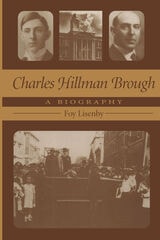
Charles Hillman Brough
A BiographyFoy Lisenby
University of Arkansas Press, 1996
Chic Ironic Bitterness
R. Jay Magill, Jr.
University of Michigan Press, 2009
A brilliant and timely reflection on irony in contemporary American culture
“This book is a powerful and persuasive defense of sophisticated irony and subtle humor that contributes to the possibility of a genuine civic trust and democratic life. R. Jay Magill deserves our congratulations for a superb job!”
—Cornel West, University Professor, Princeton University
“A well-written, well-argued assessment of the importance of irony in contemporary American social life, along with the nature of recent misguided attacks and, happily, a deep conviction that irony is too important in our lives to succumb. The book reflects wide reading, varied experience, and real analytical prowess.”
—Peter Stearns, Provost, George Mason University
“Somehow, Americans—a pragmatic and colloquial lot, for the most part—are now supposed to speak the Word, without ironic embellishment, in order to rebuild the civic culture. So irony’s critics decide it has become ‘worthy of moral condemnation.’ Magill pushes back against this new conventional wisdom, eloquently defending a much livelier American sensibility than the many apologists for a somber ‘civic culture’ could ever acknowledge."
—William Chaloupka, Chair and Professor, Department of Political Science, Colorado State University
The events of 9/11 had many pundits on the left and right scrambling to declare an end to the Age of Irony. But six years on, we're as ironic as ever. From The Simpsons and Borat to The Daily Show and The Colbert Report, the ironic worldview measures out a certain cosmopolitan distance, keeping hypocrisy and threats to personal integrity at bay.
Chic Ironic Bitterness is a defense of this detachment, an attitude that helps us preserve values such as authenticity, sincerity, and seriousness that might otherwise be lost in a world filled with spin, marketing, and jargon. And it is an effective counterweight to the prevailing conservative view that irony is the first step toward cynicism and the breakdown of Western culture.
R. Jay Magill, Jr., is a writer and illustrator whose work has appeared in American Prospect, American Interest, Atlantic Monthly, Foreign Policy, International Herald Tribune, New York Times, Wall Street Journal, and Print, amongother periodicals and books. A former Harvard Teaching Fellow and Executive Editor of DoubleTake, he holds a Ph.D. in American Studies from the University of Hamburg in Germany. This is his first book.

Chicago '68
David Farber
University of Chicago Press, 1988
"Chicago '68 was a watershed summer. Chicago '68 is a watershed book. Farber succeeds in presenting a sensitive, fairminded composite portrait that is at once a model of fine narrative history and an example of how one can walk the intellectual tightrope between 'reporting one's findings' and offering judgements about them."—Peter I. Rose, Contemporary Sociology
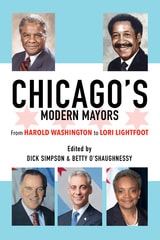
Chicago’s Modern Mayors
From Harold Washington to Lori LightfootEdited by Dick Simpson and Betty O'Shaughnessy
University of Illinois Press, 2024
Chicago’s transformation into a global city began at City Hall. Dick Simpson and Betty O’Shaughnessy edit in-depth analyses of the five mayors that guided the city through this transition beginning with Harold Washington’s 1983 election: Washington, Eugene Sawyer, Richard M. Daley, Rahm Emmanuel, and Lori Lightfoot. Though the respected political science, sociologist, and journalist contributors approach their subjects from distinct perspectives, each essay addresses three essential issues: how and why each mayor won the office; whether the City Council of their time acted as a rubber stamp or independent body; and the ways the unique qualities of each mayor’s administration and accomplishments influenced their legacy.
Filled with expert analysis and valuable insights, Chicago’s Modern Mayors illuminates a time of transition and change and considers the politicians who--for better and worse--shaped the Chicago of today.
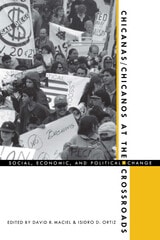
Chicanas/Chicanos at the Crossroads
Social, Economic, and Political ChangeEdited by David R. Maciel and Isidro D. Ortiz
University of Arizona Press, 1996
Chicanas/Chicanos at the Crossroads is a state-of-the-art assessment of the most significant developments in the conditions, fortunes, and experiences of Chicanas/os since the late seventies, with an emphasis on the years after 1980, which have thus far received little scholarly attention. Ten essays by leading Chicana and Chicano scholars on economic, social, educational, and political trends in Chicana/o life examine such issues as the rapid population growth of Chicanas/os and other Latinos; the ascendancy of Reaganomics and the turn to the right of American politics; the rise of anti-immigrant sentiment; the launching of new initiatives by the Mexican government toward the Chicano community; and the emergence of a new generation of political activists. The authors have been drawn from a broad array of disciplines, ranging from economics to women's studies, in order to offer a multidisciplinary perspective on Chicana/o developments in the contemporary era. The inclusion of authors from different regions of the United States and from divergent backgrounds enhances the broad perspective of the volume.
The editors offer this anthology with the intent of providing timely and useful insights and stimulating reflection and scholarship on a diverse and complex population. A testament to three decades of intense social struggle, Chicanas/Chicanos at the Crossroads is ample evidence that the legacy of the Movimiento is alive and well.
Contents
Part One: Demographic and Economic Trends Among Chicanas/os
1. Demographic Trends in the Chicano Population: Policy Implications for the Twenty First Century, Susan Gonzalez-Baker
2. Mexican Immigration in the 1980s and Beyond: Implications for Chicanos/as, Leo R. Chavez and Rebecca Martinez
3. Chicanas/os in the Economy: Issues and Challenges Since 1970, Refugio Rochin and Adela de la Torre
Part Two: Chicano Politics: Trajectories and Consequences
4. The Chicano Movement: Its Legacy for Politics and Policy, John A. Garcia
5. Chicano Organizational Politics and Strategies in the Era of Retrenchment, Isidro D. Ortiz
6. Return to Aztlan: Mexican Policy Design Toward Chicanos, María Rosa Garcia-Acevedo
Part Three: Chicana/o Educational Struggles: Dimensions, Accomplishments and Challenges
7. Actors Not Victims: Chicanos in the Struggle for Educational Equality, Guadalupe San Miguel
8. Juncture in the Road: Chincano Studies Since El Plan de Santa Barbara, Ignacio Garcia
Part Four: Gender Feminism and Chicanas/os: Developments and Perspectives
9. Gender and Its Discontinuities in Male/Female Domestic Relations: Mexicans in Cross Cultural Context, Adelaida R. Del Castillo
10. With Quill and Torch: A Chicana Perspective on the American Women's Movement and Feminist Theories, Beatríz Pesquera and Denise A. Segura