Results by title
1761 books match the query 'Public Policy' and 139 start with c
COVID-19 and Public Health
Global Responses to the PandemicCaroline Kingori
Ohio University Press, 2024
Calling State Power to Account
Reparations in Morality, Law, and PoliticsJennifer M. Page
University of Chicago Press, 2027
An incisive philosophical examination of reparations claims within today’s political and legal landscapes.
For generations, Black Americans have demanded reparations, and, for generations, the US government has ignored or denied these claims. In Calling State Power to Account, Jennifer M. Page puts forward a novel case for reparations owed to Black Americans for slavery, Jim Crow, and subsequent injustices.
Navigating conflicting insights that reparations are owed for blameworthy wrongdoing and that present iniquities to Black Americans are structural rather than the result of intentional offenses by a clearly identifiable party, Page theorizes how unredressed state-sponsored injustices can be the basis of present reparative duties. Split into two parts, the book first makes a philosophical case for reparations before then examining reparations from both legal and political perspectives. This analysis includes considering practical challenges to reparations, such as the limits of legal accountability in a system with formal barriers designed to shield the government from liability. Despite formidable obstacles, Page argues that there is deep moral and democratic significance to the pursuits of reparations claimants. The aim of reparations is not only monetary compensation but also a moral reckoning and assertion of equality against the backdrop of social and political inequalities.
Campaigns and Voters in Developing Democracies
Argentina in Comparative PerspectiveEdited by Noam Lupu, Virginia Oliveros, and Luis Schiumerini
University of Michigan Press, 2019

Can She Bake a Cherry Pie?
American Women and the Kitchen in the Twentieth CenturyMary Drake McFeely
University of Massachusetts Press, 2000
In the rural America of the past, a woman's reputation was sometimes made by her cherry pie—or her chocolate layer cake, or her biscuits. As America modernized and as women left the home, entered the paid labor force, and battled their way to success in the professions, mastery of cooking remained an accepted sign that a woman took her gendered responsibilities seriously. Ironically, over the course of the twentieth century, as ready-made foods and kitchen appliances made home cooking less essential and labor-intensive, skill in the kitchen continued to be perceived not only by society but often by women themselves as a measure of a woman's true value.
This book shows how cooking developed and evolved during the twentieth century. From Fannie Farmer to Julia Child, new challenges arose to replace the old. Women found themselves still tied to the kitchen, but for different reasons and with the need to acquire new skills. Instead of simply providing sustenance for the family, they now had to master more complex cooking techniques, the knowledge of “ethnic” cuisines, the science of nutrition, the business of consumerism, and, perhaps most important of all, the art of keeping their husbands and children happy and healthy.
Cancer Activism
Gender, Media, and Public PolicyKaren M. Kedrowski and Marilyn Stine Sarow
University of Illinois Press, 2010
Cancer Activism explores the interplay between advocacy, the media, and public perception through an analysis of breast cancer and prostate cancer activist groups over a nearly twenty-year period. Despite both diseases having nearly identical mortality and morbidity rates, Karen M. Kedrowski and Marilyn Stine Sarow present evidence from more than 4,200 news articles to show that the different groups have had markedly different impacts. They trace the rise of each movement from its beginning and explore how discussions about the diseases appeared on media, public, and government agendas. In an important exception to the feminist tenet that women as a group hold less power than men, Kedrowski and Sarow demonstrate that the breast cancer movement is not only larger and better organized than the prostate cancer movement, it is also far more successful at shaping media coverage, public opinion, and government policy.
Canfield Drive
A History of Race and the American City on a Street in St. LouisMatthew Knox Averett
University of Missouri Press, 2027
Winner of the 2026 Missouri Conference on History Book Award; the 2026 Missouri History Book Award; and shortlisted for the 2026 ASU Humanities Book Award
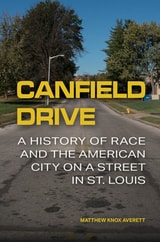
On August 9, 2014, Michael Brown and a friend were walking down Canfield Drive, a residential street in the St. Louis suburb of Ferguson. There, they encountered Ferguson Police Officer Darren Wilson. Moments later, Brown was dead on the street—shot by Wilson at least six times. That evening, a memorial appeared on the pavement where he had fallen. In the days that followed, vigils turned into protests, and protests into an Uprising, as police in riot gear faced off with a grieving, outraged community. For nearly two weeks, Ferguson commanded the nation’s attention. The killing of Michael Brown was an outrage and it should not have happened. But Canfield Drive was primed for tragedy long before that fatal encounter because the street was already a place of racial conflict. This was no accident.
Canfield Drive: A History of Race and the American City on a Street in St. Louis uncovers the deeper history behind the street where Brown died, tracing how race and the built environment have long intersected in St. Louis—from the city’s founding to the Ferguson Uprising. The book follows the story of Black space across two centuries: from early Black communities, to the birth of the St. Louis Blues, to the Halcyon days of The Ville, to the destruction of Mill Creek Valley, to the tragedy of Pruitt-Igoe, and to the construction of Canfield Drive. Though Canfield Drive is the first comprehensive history of St. Louis’s Black urban landscape, it is more than just St. Louis's story. Canfield Drive details the racial engineering of the American city. Here is the machinery of American segregation laid bare: occupancy covenants, court decisions, racial steering, white flight, public housing, voucher systems, and predatory policing that combine to transform neighborhoods into traps. Here too are the people who fought back, building community against staggering odds and securing civil rights reforms that transformed America's understanding of government's obligations to its citizens.
Canfield Drive provides a powerful lens on the national story of race and the American city and reveals how Michael Brown's death was not just one officer's deadly decision, but the inevitable outcome of America's built environment—a tragedy centuries in the making, on a street designed for violence. This is how a place becomes a powder keg. This is how history erupts into headlines. This is the story behind the story that America couldn't look away from. This is the story of how a street came to matter, and how it came to stand for something far greater than itself.
Capital Development
Mandate Era Amman and the Construction of the Hashemite State (1921–1946)Harrison B. Guthorn
Gingko, 2021
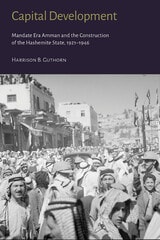
Amman, the capital of Jordan, contends with a crisis of identity rooted in how it grew to become a symbol for the Anglo-Hashemite government first, and a city second. As a representation of the new centralized authority, Amman became the seat of the Mandatory government that orchestrated the development of Transjordan, the British mandate established in 1921.
Despite its diminutive size, the city grew to house all the components necessary for a thriving and cohesive state by the end of the British mandate in 1946. However, in spite of its modernizing and regulatory ambitions, the Transjordan government did not control all facets of life in the region. Instead, the story of Transjordan is one of tensions between the state and the realities of the region, and these limitations forced the government to scale down its aspirations. This book presents the history of Amman’s development under the rule of the British mandate from 1921–46 and illustrates how the growth of the Anglo-Hashemite state imbued the city with physical, political, and symbolic significance.
Capital of the American Century
The National and International Influence of New York CityMartin Shefter
Russell Sage Foundation, 1993

Capitalism and Its Economics
A Critical HistoryDouglas Dowd
Pluto Press, 2004
Capitalism, Not Globalism
Capital Mobility, Central Bank Independence, and the Political Control of the EconomyWilliam Roberts Clark
University of Michigan Press, 2009
Carbon Criminals, Climate Crimes
Ronald C. Kramer
Rutgers University Press, 2020
Carbon Criminals, Climate Crimes analyzes the looming threats posed by climate change from a criminological perspective. It advances the field of green criminology through a examination of the criminal nature of catastrophic environmental harms resulting from the release of greenhouse gases. The book describes and explains what corporations in the fossil fuel industry, the U.S. government, and the international political community did, or failed to do, in relation to global warming. Carbon Criminals, Climate Crimes integrates research and theory from a wide variety of disciplines, to analyze four specific state-corporate climate crimes: continued extraction of fossil fuels and rising carbon emissions; political omission (failure) related to the mitigation of these emissions; socially organized climate change denial; and climate crimes of empire, which include militaristic forms of adaptation to climate disruption. The final chapter reviews policies that could mitigate greenhouse gas emissions, adapt to a warming world, and achieve climate justice.
Carbon Sovereignty
Coal, Development, and Energy Transition in the Navajo NationAndrew Curley
University of Arizona Press, 2023
This comprehensive new work offers a deep dive into the complex inner workings of energy shift in the Navajo Nation. Geographer Andrew Curley, a member of the Navajo Nation, examines the history of coal development within the Navajo Nation, including why some Diné supported coal and the consequences of doing so. He explains the Navajo Nation’s strategic choices to use the coal industry to support its sovereignty as a path forward in the face of ongoing colonialism. Carbon Sovereignty demonstrates the mechanism of capitalism through colonialism and the construction of resource sovereignty, in both the Navajo Nation’s embrace and its rejection of a coal economy.
For the people of the Navajo Nation, energy sovereignty is dire and personal. Thanks to on-the-ground interviews with Diné coal workers, environmental activists, and politicians, Curley documents the real consequences of change as they happened. While some Navajo actors have doubled down for coal, others have moved toward transition. Curley argues that political struggles ultimately shape how we should understand coal, capitalism, and climate change. The rise and fall of coal magnify the nuance and complexity of change. Historical and contemporary issues intermingle in everyday life with lasting consequences.
Carceral Humanitarianism
Logics of Refugee DetentionKelly Oliver
University of Minnesota Press, 2017
Coopted by military operations, humanitarianism has never been neutral. Rather than welcoming refugees, host countries assess the relative risks of taking them in versus turning them away, using a risk-benefit analysis that often reduces refugees to collateral damage in proxy wars fought in the war on terrorism. Carceral Humanitarianism testifies that humanitarian aid and human rights discourse are always political and partisan.
Forerunners is a thought-in-process series of breakthrough digital works. Written between fresh ideas and finished books, Forerunners draws on scholarly work initiated in notable blogs, social media, conference plenaries, journal articles, and the synergy of academic exchange. This is gray literature publishing: where intense thinking, change, and speculation take place in scholarship.
Carey Act and Conservation in Colorado
Gerald C. Morton
University Press of Colorado, 2024
Morton contextualizes the Carey Act’s significance in Colorado through a study of the Two Buttes and Muddy Creek projects in the state’s southeastern corner—tragic examples of the disconnect among developers seeking windfall profits in the face of financial rollercoasters, the challenge of reclaiming remote sagebrush country, and settlers seeking viable livelihoods that eventually led conservationists to reimagine the failures as public wildlife refuges. A collision of values between developers and settlers lay at the center of those wildlife habitat conservation efforts, forcing people to rethink their relationship with the land and ephemeral streams—an awareness that correlated with the advent of modern ecology.
The Carey Act and Conservation in Colorado is the untold story of the manipulation of nature and the reconceived use of land for public wildlife areas on the southern plains of the American West. Offering original research on arid lands policy, federal and state agency oversight, irrigation bond financing, heartbroken settlers’ grievances, individual developers’ motives, and the rise of wildlife conservation, this compelling tale of misfortune will appeal to scholars and general readers interested in conservationist and environmental history in the American West.
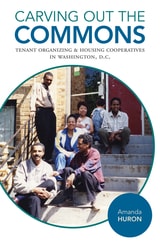
Carving Out the Commons
Tenant Organizing and Housing Cooperatives in Washington, D.C.Amanda Huron
University of Minnesota Press, 2018
An investigation of the practice of “commoning” in urban housing and its necessity for challenging economic injustice in our rapidly gentrifying cities
Provoked by mass evictions and the onset of gentrification in the 1970s, tenants in Washington, D.C., began forming cooperative organizations to collectively purchase and manage their apartment buildings. These tenants were creating a commons, taking a resource—housing—that had been used to extract profit from them and reshaping it as a resource that was collectively owned by them.
In Carving Out the Commons, Amanda Huron theorizes the practice of urban “commoning” through a close investigation of the city’s limited-equity housing cooperatives. Drawing on feminist and anticapitalist perspectives, Huron asks whether a commons can work in a city where land and other resources are scarce and how strangers who may not share a past or future come together to create and maintain commonly held spaces in the midst of capitalism. Arguing against the romanticization of the commons, she instead positions the urban commons as a pragmatic practice. Through the practice of commoning, she contends, we can learn to build communities to challenge capitalism’s totalizing claims over life.
Cash, Crisis, and Corporate Governance
The Role of National Financial Systems in Industrial RestructuringVictoria Marklew
University of Michigan Press, 1995
Catching a Case
Inequality and Fear in New York City's Child Welfare SystemLee, Tina
Rutgers University Press, 2016
Challenges and Developments in Public Service Journalism
Edited by Alessandro D'Arma, Maria Michalis, Gregory Ferrell Lowe, and Michael-Bernhard Zita
University of Westminster Press, 2024
Challenging Inequality
Variation across Postindustrial SocietiesEvelyne Huber and John D. Stephens
University of Chicago Press, 2024
A wide-ranging examination of how policies, parties, and labor strength affect inequality in post-industrial societies.
Not all countries are unequal in the same ways or to the same degree. In Challenging Inequality, Evelyne Huber and John D. Stephens analyze different patterns of increasing income inequality in post-industrial societies since the 1980s, assessing the policies and social structures best able to mitigate against the worst effects of market inequality. Combining statistical data analysis from twenty-two countries with a comparative historical analysis of Germany, Spain, Sweden, and the United States, Huber and Stephens identify the factors that drive increases in inequality and shape persistent, marked differences between countries. Their statistical analysis confirms generalizable patterns and in-depth country studies help to further elucidate the processes at work.
Challenging Inequality shows how the combination of globalization and skill-biased technological change has led to both labor market dualization and rising unemployment levels, which in turn have had important effects on inequality and poverty. Labor strength—at both the society level and the enterprise level—has helped to counter rising market income inequality, as has a history of strong human capital spending. The generosity of the welfare state remains the most important factor shaping redistribution, while the consistent power of left parties is the common denominator behind both welfare state generosity and human capital investment.
Change in Putin's Russia
Power, Money and PeopleSimon Pirani
Pluto Press, 2010
Simon Pirani investigates the interaction of power, money and people in Russia during the presidencies of Vladimir Putin and his successor Dmitry Medvedev.
Profiling the Putin team, including contingents from the security services and pro-market economic "reformers", Pirani argues that the economic growth it presided over during the oil boom was one-sided. The gap between rich and poor widened. Now the boom is over, inequalities will multiply further. As well as explaining Russia's economic trajectory, the book provides a unique account of the social movements that are working against an increasingly authoritarian government to change Russia for the better.
This is the perfect introduction for undergraduates approaching Russia for the first time and those who wish to know how Russia will change during the economic crisis.
Changing Paths
International Development and the New Politics of InclusionPeter P. Houtzager and Mick Moore, Editors
University of Michigan Press, 2005
The contributors suggest there is little basis for the radical polycentrism that colors so much contemporary development thought. They focus on how the political capabilities of different societal and state actors develop over time and how their development is influenced by state action and a variety of institutional and other factors. The final chapter draws insightful conclusions about the political limitations and opportunities presented by current international discourse on poverty.
Peter P. Houtzager is a Fellow at the Institute of Development Studies, University of Sussex. He has been a visiting scholar at the Center for Latin American Studies, University of California, Berkeley, visiting lecturer at Stanford University, and lecturer at St. Mary's College. A political scientist with broad training in comparative politics and historical-institutional analysis, he has written extensively on the institutional roots of collective action.
Mick Moore is a Fellow at the Institute of Development Studies, University of Sussex, as well as Director of the Centre for the Future State. He has been a visiting professor at the Massachusetts Institute of Technology. His professional interests include political and institutional aspects of poverty reduction and of economic policy and performance, the politics and administration of development, and good government.
Channeling the Past
Politicizing History in Postwar AmericaErik Christiansen
University of Wisconsin Press, 2013
With insight and wit, Erik Christiansen uncovers in Channeling the Past the ways that powerful corporations rewrote history to strengthen the postwar corporate state, while progressives, communists, and other leftists vied to make their own versions of the past more popular. Christiansen looks closely at several notable initiatives—CBS’s flashback You Are There program; the Smithsonian Museum of American History, constructed in the late 1950s; the Cavalcade of America program sponsored by the Du Pont Company; the History Book Club; and the Freedom Train, a museum on rails that traveled the country from 1947 to 1949 exhibiting historic documents and flags, including original copies of the U.S. Constitution and the Magna Carta.
It is often said that history is written by the victors, but Christiansen offers a more nuanced perspective: history is constantly remade to suit the objectives of those with the resources to do it. He provides dramatic evidence of sophisticated calculations that influenced both public opinion and historical memory, and shows that Americans’ relationships with the past changed as a result.
Chasing World-Class Urbanism
Global Policy versus Everyday Survival in Buenos AiresJacob Lederman
University of Minnesota Press, 2020
Questions increasingly dominant urban planning orthodoxies and whether they truly serve everyday city dwellers
What makes some cities world class? Increasingly, that designation reflects the use of a toolkit of urban planning practices and policies that circulates around the globe. These strategies—establishing creative districts dedicated to technology and design, “greening” the streets, reinventing historic districts as tourist draws—were deployed to build a globally competitive Buenos Aires after its devastating 2001 economic crisis. In this richly drawn account, Jacob Lederman explores what those efforts teach us about fast-evolving changes in city planning practices and why so many local officials chase a nearly identical vision of world-class urbanism.
Lederman explores the influence of Northern nongovernmental organizations and multilateral agencies on a prominent city of the global South. Using empirical data, keen observations, and interviews with people ranging from urban planners to street vendors he explores how transnational best practices actually affect the lives of city dwellers. His research also documents the forms of resistance enacted by everyday residents and the tendency of local institutions and social relations to undermine the top-down plans of officials. Most important, Lederman highlights the paradoxes of world-class urbanism: for instance, while the priorities identified by international agencies are expressed through nonmarket values such as sustainability, inclusion, and livability, local officials often use market-centric solutions to pursue them. Further, despite the progressive rhetoric used to describe urban planning goals, in most cases their result has been greater social, economic, and geographic stratification.
Chasing World-Class Urbanism is a much-needed guide to the intersections of culture, ideology, and the realities of twenty-first-century life in a major Latin American city, one that illuminates the tension between technocratic aspirations and lived experience.
Checklist for Change
Making American Higher Education a Sustainable EnterpriseZemsky, Robert
Rutgers University Press, 2013
Robert Zemsky details the complications that have impeded every credible reform intended to change American higher education. He demythologizes such initiatives as the Morrill Act, the GI Bill, and the Higher Education Act of 1972, shedding new light on their origins and the ways they have shaped higher education in unanticipated and not commonly understood ways. Next, he addresses overly simplistic arguments about the causes of the problems we face and builds a convincing argument that well-intentioned actions have combined to create the current mess for which everyone is to blame.
Using provocative case studies, Zemsky describes the reforms being implemented at a few institutions with the hope that these might serve as harbingers of the kinds of change needed: the University of Minnesota at Rochester’s compact curriculum in the health sciences only, Whittier College’s emphasis on learning outcomes, and the University of Wisconsin Oshkosh’s coherent overall curriculum.
In conclusion, Zemsky describes the principal changes that must occur not singly but in combination. These include a fundamental recasting of federal financial aid; new mechanisms for better channeling the competition among colleges and universities; recasting the undergraduate curriculum; and a stronger, more collective faculty voice in governance that defines not why, but how the enterprise must change.
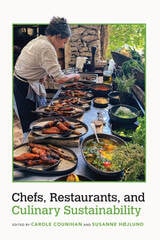
Chefs, Restaurants, and Culinary Sustainability
Carole Counihan
University of Arkansas Press, 2025
Chefs, Restaurants, and Culinary Sustainability explores how chefs around the world approach culinary sustainability in highly unstable times while working in myriad professional domains. Building on empirical data collected from a wide range of cultural, historical, political, and economic settings, the contributors to this collection provide a sophisticated and engaging examination of how chefs in diverse culinary contexts tackle the increasingly urgent societal and environmental need for a more secure food future.
Chicago Metropolis 2020
The Chicago Plan for the Twenty-First CenturyElmer W. Johnson
University of Chicago Press, 2001
Nearly a century later, Chicago, like all cities, faces similar dilemmas: how to reconcile privatism with public control, growth with restraint, wealth with poverty, and beauty with industry. And as it did a hundred years ago with the Burnham Plan, the Commercial Club has sponsored a wholly contemporary plan for the city's future development. Written by Elmer W. Johnson, a lawyer and civic leader, Chicago Metropolis 2020 is a guide for those in all spheres of influence who are working to make cities economically and socially vigorous while addressing the greatest problems modern metropolises face. While Burnham's plan primarily addressed architecture and spatial planning, Chicago Metropolis 2020 addresses all facets of urban life, from public education to suburban sprawl, from transportation to social and economic segregation, with the expressed goal of continuing Chicago's tradition of renewal and foresight.
Chicago Metropolis 2020 is an ambitious and necessary plan for a major city at the turn of the century. In scope and execution, it aims at nothing less than economic vibrancy, quality of life, and equity of opportunity.
Child Abuse in the Deep South
Geographical Modifiers of Abuse CharacteristicsLee W. Badger
University of Alabama Press, 1988
A powerful, data-driven investigation into how race, geography, and community shape the reporting and response to child abuse in Alabama.
Child Abuse in the Deep South is a groundbreaking examination of how child maltreatment is reported, confirmed, and understood in Alabama—a state shaped by deep historical, racial, and geographic divides. Drawing on over 7,000 case reports, this study reveals how factors such as race, community size, and regional culture influence the identification and handling of abuse cases. With a focus on both rural and urban settings, the book uncovers patterns of systemic bias, underreporting, and institutional response that have long gone unaddressed.
Through rigorous data analysis and a compassionate lens, this work challenges assumptions about child welfare in the American South and offers critical insights for policymakers, social workers, legal professionals, and scholars. Child Abuse in the Deep South is both a call to action and a vital resource for understanding the intersection of social justice, public policy, and child protection in one of the nation’s most complex regions.
Child Abuse in the Deep South provides a quantitative benchmark that investigators and policy-makers will find invaluable on the path to defining at-risk populations, effective interventions, and treatments.
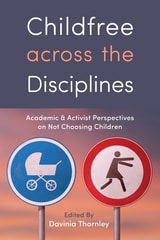
Childfree across the Disciplines
Academic and Activist Perspectives on Not Choosing ChildrenDavinia Thornley
Rutgers University Press, 2022
Recently, childfree people have been foregrounded in mainstream media. More than seven percent of Western women choose to remain childfree and this figure is increasing. Being childfree challenges the ‘procreation imperative’ residing at the center of our hetero-normative understandings, occupying an uneasy position in relation to—simultaneously—traditional academic ideologies and prevalent social norms. After all, as Adi Avivi recognizes, "if a woman is not a mother, the patriarchal social order is in danger." This collection engages with these (mis)perceptions about childfree people: in media representations, demographics, historical documents, and both psychological and philosophical models. Foundational pieces from established experts on the childfree choice--Rhonny Dam, Laurie Lisle, Christopher Clausen, and Berenice Fisher--appear alongside both activist manifestos and original scholarly work, comprehensively brought together. Academics and activists in various disciplines and movements also riff on the childfree life: its implications, its challenges, its conversations, and its agency—all in relation to its inevitability in the 21st century. Childfree across the Disciplines unequivocally takes a stance supporting the subversive potential of the childfree choice, allowing readers to understand childfreedom as a sense of continuing potential in who—or what—a person can become.
China and the Internet
Using New Media for Development and Social ChangeSong Shi
Rutgers University Press, 2024
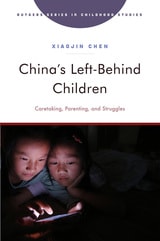
China's Left-Behind Children
Caretaking, Parenting, and StrugglesXiaojin Chen
Rutgers University Press, 2024
China’s Allocation of Fixed Capital Investment, 1952–1957
Cheng Chu-yuan
University of Michigan Press, 1974
Chinese Marriages in Transition
From Patriarchy to New FamilismXiaoling Shu
Rutgers University Press, 2023
This book is freely available in an open access edition thanks to TOME (Toward an Open Monograph Ecosystem)— a collaboration of the Association of American Universities, the Association of University Presses, and the Association of Research Libraries—and the generous support of the University of California, Davis. Learn more at the TOME website, available at: openmonographs.org.
Download the open access book here.
Choice Over Time
George Loewenstein
Russell Sage Foundation, 1992

Choices Women Make
Agency in Domestic Violence, Assisted Reproduction, and Sex WorkCarisa R. Showden
University of Minnesota Press, 2010
In Showden’s analysis, women’s agency emerges as an individual and social construct, rooted in concrete experience, complex and changing over time. She traces the development and deployment of agency, illustrating how it plays out in the messy workings of imperfect lives. In a series of case studies, she considers women within situations of intimate partner violence, reproductive decision making, and sex work such as prostitution and pornography. Each narrative offers insight into how women articulate their self-understanding and political needs in relation to the pressures they confront.
Showden’s understanding of women’s agency ultimately leads her to review possible policy and legal interventions that could improve the conditions within which agency develops and that could positively enhance women’s ability to increase and exercise their political and personal options.
Chop Suey and Sushi from Sea to Shining Sea
Chinese and Japanese Restaurants in the United StatesBruce Makoto Arnold
University of Arkansas Press, 2018
The essays in Chop Suey and Sushi from Sea to Shining Sea fill gaps in the existing food studies by revealing and contextualizing the hidden, local histories of Chinese and Japanese restaurants in the United States.
The writer of these essays show how the taste and presentation of Chinese and Japanese dishes have evolved in sweat and hardship over generations of immigrants who became restaurant owners, chefs, and laborers in the small towns and large cities of America. These vivid, detailed, and sometimes emotional portrayals reveal the survival strategies deployed in Asian restaurant kitchens over the past 150 years and the impact these restaurants have had on the culture, politics, and foodways of the United States.
Some of these authors are family members of restaurant owners or chefs, writing with a passion and richness that can only come from personal investment, while others are academic writers who have painstakingly mined decades of archival data to reconstruct the past. Still others offer a fresh look at the amazing continuity and domination of the “evil Chinaman” stereotype in the “foreign” world of American Chinatown restaurants. The essays include insights from a variety of disciplines, including history, sociology, anthropology, ethnography, economics, phenomenology, journalism, food studies, and film and literary criticism.
Chop Suey and Sushi from Sea to Shining Sea not only complements the existing scholarship and exposes the work that still needs to be done in this field, but also underscores the unique and innovative approaches that can be taken in the field of American food studies.
Cities and the Health of the Public
Nicholas Freudenberg
Vanderbilt University Press, 2006
This book assesses the primary determinants of well-being in cities, including the social and physical environments, diet, and health care and social services. The book includes chapters on the history of public health in cities, the impact of urban sprawl and urban renewal on health, and the challenges facing cities in the developing world. It also examines conditions such as infectious diseases, violence and disasters, and mental illness.
Cities in the Anthropocene
New Ecology and Urban PoliticsIhnji Jon
Pluto Press, 2021
Climate change is real, and extreme weather events are its physical manifestations. These extreme events affect how we live and work in cities, and subsequently the way we design, plan, and govern them. Taking action ‘for the environment’ is not only a moral imperative; instead, it is activated by our everyday experience in the city.
Based on the author’s site visits and interviews in Darwin (Australia), Tulsa (Oklahoma), Cleveland (Ohio), and Cape Town (South Africa), this book tells the story of how cities can lead a transformative pro-environment politics.
National governments often fail to make binding agreements that bring about radical actions for the environment. This book shows how cities, as local sites of mobilizing a collective, political agenda, can be frontiers for activating the kind of environmental politics that appreciates the role of ‘nature’ in the everyday functioning of our urban life.
Cities of Farmers
Urban Agricultural Practices and ProcessesJulie C. Dawson and Alfonso Morales
University of Iowa Press, 2016
Implementing urban agriculture often requires change in the physical, political, and social-organizational landscape. Beginning with a look at how and why city people grew their own food in the early twentieth century, the contributors to Cities of Farmers examine the role of local and regional regulations and politics, especially the creation of food policy councils, in making cities into fertile ground for farming. The authors describe how food is produced and distributed in cities via institutions as diverse as commercial farms, community gardens, farmers’ markets, and regional food hubs. Growing food in vacant lots and on rooftops affects labor, capital investment, and human capital formation, and as a result urban agriculture intersects with land values and efforts to build affordable housing. It also can contribute to cultural renewal and improved health.
This book enables readers to understand and contribute to their local food system, whether they are raising vegetables in a community garden, setting up a farmers’ market, or formulating regulations for farming and composting within city limits.
CONTRIBUTORS
Catherine Brinkley, Benjamin W. Chrisinger, Nevin Cohen, Michèle Companion, Lindsey Day-Farnsworth, Janine de la Salle, Luke Drake, Sheila Golden, Randel D. Hanson, Megan Horst, Nurgul Fitzgerald, Becca B. R. Jablonski, Laura Lawson, Kara Martin, Nathan McClintock, Alfonso Morales, Jayson Otto, Anne Pfeiffer, Anne Roubal, Todd M. Schmit, Erin Silva, Michael Simpson, Lauren Suerth, Dory Thrasher, Katinka Wijsman
Citizen Lawmakers
David D. Schmidt
Temple University Press, 1991
Citizen Lobbyists
Local Efforts to Influence Public PolicyBrian Adams
Temple University Press, 2006
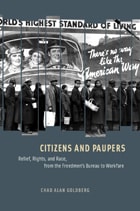
Citizens and Paupers
Relief, Rights, and Race, from the Freedmen's Bureau to WorkfareChad Alan Goldberg
University of Chicago Press, 2008
Citizens and Paupers explores this contentious history by analyzing and comparing three major programs: the Freedmen’s Bureau, the Works Progress Administration, and the present-day system of workfare that arose in the 1990s. Each of these overhauls of the welfare state created new groups of clients, new policies for aiding them, and new disputes over citizenship—conflicts that were entangled in racial politics and of urgent concern for social activists.
This combustible mix of racial tension and social reform continues to influence how we think about welfare, and Citizens and Paupers is an invaluable analysis of the roots of the debate.
Citizens, Experts, and the Environment
The Politics of Local KnowledgeFrank Fischer
Duke University Press, 2000
Where information ideologues see the modern increase in information as capable of making everyone smarter, others see the emergence of a society divided between those with and those without knowledge. Suggesting realistic strategies to bridge this divide, Fischer calls for meaningful nonexpert involvement in policymaking and shows how the deliberations of ordinary citizens can help solve complex social and environmental problems by contributing local contextual knowledge to the professionals’ expertise. While incorporating theoretical critiques of positivism and methodology, he also offers hard evidence to demonstrate that the ordinary citizen is capable of a great deal more participation than is generally recognized. Popular epidemiology in the United States, the Danish consensus conference, and participatory resource mapping in India serve as examples of the type of inquiry he proposes, showing how the local knowledge of citizens is invaluable to policy formation. In his conclusion Fischer examines the implications of the approach for participatory democracy and the democratization of contemporary deliberative structures.
This study will interest political scientists, public policy practitioners, sociologists, scientists, environmentalists, political activists, urban planners, and public administrators along with those interested in understanding the relationship between democracy and science in a modern technological society.
Citizenship and Governance in a Changing City
Somerville, MASusan Ostrander
Temple University Press, 2013
In Citizenship and Governance in a Changing City, Susan Ostrander shows how beneath current high levels of engagement by Somerville residents lies a struggle about who should be the city's elected leaders and how they should conduct the city's affairs. It is a struggle waged between diverse residents--relatively new immigrants and a new middle class-trying to gain a foothold in democratic participation, and the city's political "old guard."
Citizenship and Governance in a Changing City informs current debates about the place of immigrants in civic and political life, and the role of voluntary associations in local politics and government. In the process, Ostrander provides useful lessons for many midsize urban communities.
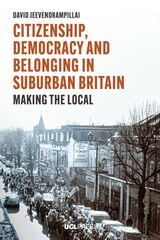
Citizenship, Democracy and Belonging in Suburban Britain
Making the LocalDavid Jeevendrampillai
University College London, 2021
An activist group in outer London’s Surbiton suburb, the Seething Villagers commemorate a fictional local history through tongue-in-cheek community festivals. These admittedly “stupid” gatherings celebrate a mythical village of Seething and its many adventures, including a run-in with a mountain-crushing giant. Citizenship, Democracy and Belonging in Suburban Britain explores how the Seething Villagers and other suburbanite fantasies fashion community in the face of neoliberal isolation. By taking the artists’ playfulness seriously, David Jeevendrampillai demonstrates how suburbanites develop fellow-feeling without access to traditional community centers.
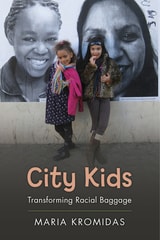
City Kids
Transforming Racial BaggageKromidas, Maria
Rutgers University Press, 2016
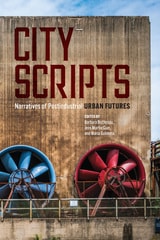
City Scripts
Narratives of Postindustrial Urban FuturesEdited by Barbara Buchenau, Jens Martin Gurr, and Maria Sulimma
The Ohio State University Press, 2023
Storytelling shapes how we view our cities, legitimizing histories, future plans, and understandings of the urban. City Scripts responds to calls by literary theorists to engage a new kind of narrative analysis that recalibrates close reading and interpretation to the multiple ways in which narratives “do things”—how they intervene in the world and take action in everyday life. A multidisciplinary cast of contributors approaches this new way of looking at cities through the stories people tell about them, looking especially at political activism and urban planning, which depend on the invention of plausible stories of connectedness and of a redemptive future.
The stakes are especially high in cities where economic, ecological, and social futures are delimited by histories of large-scale extraction and racialized industrial labor. Contributors thus focus on cities in postindustrial areas of Germany and the United States, examining how narratives about cities become scripts and how these scripts produce real-life results. This approach highlights how uses of narrative and scripting appeal to stakeholders in urban change. These actors continually deploy narrative, media, and performance, with consequences for urban futures worldwide.
Contributors:
Lieven Ameel, Juliane Borosch, Barbara Buchenau, Florian Deckers, Barbara Eckstein, Kornelia Freitag, Walter Grünzweig, Randi Gunzenhäuser, Jens Martin Gurr, Elisabeth Haefs, Chris Katzenberg, Johannes Maria Krickl, Renee M. Moreno, Hanna Rodewald, Julia Sattler, Maria Sulimma, James A. Throgmorton, Michael Wala, Katharina Wood
City and Environment
Christopher G. Boone and Ali Modarres
Temple University Press, 2006
City and Regime in the American Republic
Stephen L. Elkin
University of Chicago Press, 1987
The present workings of American urban political institutions are, Elkin maintains, characterized by a close relationship between politicians and businessmen, a relationship that promotes neither political equality nor effective social problem-solving. Elkin pays particular attention to the issue of land-use in his analysis of these failures of popular control in traditional city politics. Urban political institutions, however, are not just instruments for the dispensing of valued outcomes or devices for social problem-solving—they help to form the citizenry. Our present institutions largely define citizens as interest group adversaries and do little to encourage them to focus on the commercial public interest of the city. Elkin concludes by proposing new institutional arrangements that would be better able to harness the self-interested behavior of individuals for the common good of a commercial republic.
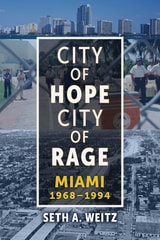
City of Hope, City of Rage
Miami, 1968–1994Weitz, Seth A.
University of Alabama Press, 2024
Examines Miami’s turbulent transformation from a segregated vacation destination to a global, multicultural metropolis
City of Hope, City of Rage gives a fascinating account of three turbulent and transformative decades in the history of Miami. Marked by mass immigration, racially motivated uprisings, economic inequity, rising crime, and social change, Miami’s history from 1968 to 1994 saw the city evolve rapidly from a predominantly white southern city and vacation spot into a global, Hispanic-majority metropolis with an international tourist base. And yet Miami remains highly segregated today.
Exploring beyond the clichés of the Magic City as a bastion of hope for immigrants, a fantasy of beaches and art deco architecture, or a hotbed of drugs and crime, historian Seth A. Weitz reveals the social, political, and cultural shifts that transformed the city. Utilizing archival research and personal stories to reveal the diverse experiences of Miami’s Black, Latinx, Jewish, and LGBTQ+ communities, Weitz explores the struggles for social justice, the rise of the drug trade, and the ongoing fight to mold Miami’s image.
A Miami native, Weitz challenges simplistic narratives about the city, revealing a place defined by hope, rage, and struggle for identity. Illuminating the way Miami is defined and who gets to define it, City of Hope, City of Rage offers a fresh perspective on this vibrant and complex city, making it a valuable resource for anyone interested in Miami’s unique history.