Results by title
2194 books match the query 'Women's Studies' and 132 start with c
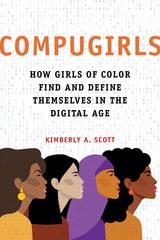
COMPUGIRLS
How Girls of Color Find and Define Themselves in the Digital AgeKimberly A. Scott
University of Illinois Press, 2021
Kimberly A. Scott explores this question and others as she details the National Science Foundation-funded enrichment project COMPUGIRLS. This groundbreaking initiative teaches tech skills to adolescent girls of color but, as importantly, offers a setting that emphasizes empowerment, community advancement, and self-discovery. Scott draws on her experience as an architect of COMPUGIRLS to detail the difficulties of translating participants' lives into a digital context while tracing how the program evolved. The dramatic stories of the participants show them blending newly developed technical and communication skills in ways designed to spark effective action and bring about important change.
A compelling merger of theory and storytelling, COMPUGIRLS provides a much-needed roadmap for understanding how girls of color can find and define their selves in today's digital age.
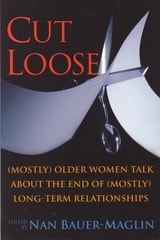
CUT LOOSE
(Mostly) Older Women on the End of their (Mostly) Long-Term RelationshipsBauer-Maglin, Nan
Rutgers University Press, 2006
Although breakups—whether celebrity or everyday—are a constant source of fascination, surprisingly little attention has been given to women who are cut loose in their later years. This is a book about (mostly) long-term relationships that have come apart. Each woman involved, the majority of whom are over sixty, tells of her experience through journal entries, essays, poetry, or stories. Although in many senses they have been abandoned, they have also been set free, untethered, and, for some, liberated sexually, mentally, or emotionally.
The book is divided into two major sections. The pieces in the first part are personal narratives. Among the varied voices, we hear from women in both heterosexual and same-sex relationships who have been left by their partners or who have decided to leave them. In the second section, the contributors look at being left and leaving from psychological, sociological, economic, sexual, medical, anthropological, and literary perspectives. Other essays explore the shared experiences of specific classes of women, such as single women, widows, or abandoned daughters.

Cajun Women and Mardi Gras
Reading the Rules BackwardCarolyn E. Ware
University of Illinois Press, 2006
Cajun Women and Mardi Gras is the first book to explore the importance of women’s contributions to the country Cajun Mardi Gras tradition, or Mardi Gras “run.” Most Mardi Gras runs--masked begging processions through the countryside, led by unmasked capitaines--have customarily excluded women. Male organizers explain that this rule protects not only the tradition’s integrity but also women themselves from the event’s rowdy, often drunken, play.
Throughout the past twentieth century, and especially in the past fifty years, women in some prairie communities have insisted on taking more active and public roles in the festivities. Carolyn E. Ware traces the history of women’s participation as it has expanded from supportive roles as cooks and costume makers to increasingly public performances as Mardi Gras clowns and (in at least one community) capitaines. Drawing on more than a decade of fieldwork interviews and observation in Mardi Gras communities, Ware focuses on the festive actions in Tee Mamou and Basile to reveal how women are reshaping the celebration as creative artists and innovative performers.
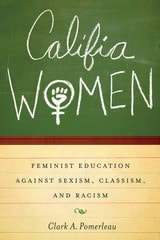
Califia Women
Feminist Education against Sexism, Classism, and RacismBy Clark A. Pomerleau
University of Texas Press, 2013
A dynamic exploration of the Califia Community, a long-running Los Angeles based grassroots alternative education group formed in the mid-1970s, whose richly diverse membership offered a compelling array of responses to feminism’s key issues.
Launched in 1975, the Califia Community organized activist educational camps and other programs in southern California until its dissolution in 1987. An alternative to mainstream academia’s attempts to tie feminism to university courses, Califia blended aspects of feminism that spanned the labels “second wave” and “radical,” attracting women from a range of gender expressions, sexual orientations, class backgrounds, and races or ethnicities. Califia Women captures the history of the organization through oral history interviews, archives, and other forms of primary research. The result is a lens for re-reading trends in feminist and social justice activism of the time period, contextualized against a growing conservative backlash.
Throughout each chapter, readers learn about the triumphs and frictions feminists encountered as they attempted to build on the achievements of the postwar Civil Rights movement. With its backdrop of southern California, the book emphasizes a region that has often been overlooked in studies of East Coast or San Francisco Bay–area activism. Califia Women also counters the notions that radical and lesbian feminists were unwilling to address intersectional identities generally and that they withdrew from political activism after 1975. Instead, the Califia Community shows evidence that these and other feminists intentionally created an educational forum that embraced oppositional consciousness and sought to serve a variety of women, including radical Christian reformers, Wiccans, scholars of color, and GLBT activists.
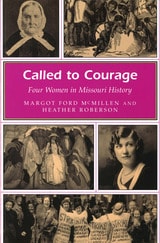
Called to Courage
Four Women in Missouri HistoryMargot Ford McMillen & Heather Roberson
University of Missouri Press, 2002
Calling Home
Working-Class Women's WritingsZandy, Janet
Rutgers University Press, 1990
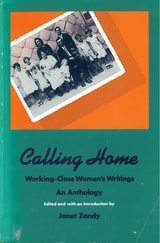
The geography of home, identity, parents, sex, motherhood, the dominance of the job, the overlapping of private and public worlds, the promise of solidarity and community are a few of the themes of this book. Here is a chorus of working class women's voices: Sandra Cisneros, Barbara Garson, Meridel Le Sueur, Tillie Olsen, Barbara Smith, Endesha I. M. Holland, Mother Jones, Nellie Wong, Agnes Smedley, Bobbie Louise Hawkins, Sharon Doubiago, Carol Tarlen, Hazel Hall, Margaret Randall, Judy Grahn, and many others!
The aesthetic impulse is shaped by class, but not limited to one ruling class. What connects these writers is a collective consciousness, a class, which rejects bondage and lays claim to liberation through all the possibilities of language. Calling Home is illustrated with family photographs as well as images of working women by professional photographers.

Calling Memory into Place
Dora Apel
Rutgers University Press, 2021
In this deeply personal work, acclaimed art historian Dora Apel examines how memorials, photographs, artworks, and autobiographical stories can be used to fuel a process of “unforgetting”—reinterpreting the past by recalling the events, people, perspectives, and feelings that get excluded from conventional histories. The ten essays in Calling Memory into Place feature explorations of the controversy over a painting of Emmett Till in the Whitney Biennial and the debates about a national lynching memorial in Montgomery, Alabama. They also include personal accounts of Apel’s return to the Polish town where her Holocaust survivor parents grew up, as well as the ways she found strength in her inherited trauma while enduring treatment for breast cancer.
These essays shift between the scholarly, the personal, and the visual as different modes of knowing, and explore the intersections between racism, antisemitism, and sexism, while suggesting how awareness of historical trauma is deeply inscribed on the body. By investigating the relations among place, memory, and identity, this study shines a light on the dynamic nature of memory as it crosses geography and generations.
Calling the Soul Back
Embodied Spirituality in Chicanx NarrativeChristina Garcia Lopez
University of Arizona Press, 2019
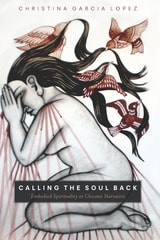
Calling the Soul Back explores the spiritual and ancestral knowledge offered in narratives of bodies in trauma, bodies engaged in ritual, grieving bodies, bodies immersed in and becoming part of nature, and dreaming bodies. Reading across narrative nonfiction, performative monologue, short fiction, fables, illustrated children’s books, and a novel, Garcia Lopez asks how these narratives draw on the embodied intersections of ways of knowing and being to shift readers’ consciousness regarding relationships to space, time, and natural environments.
Using an interdisciplinary approach, Calling the Soul Back draws on literary and Chicanx studies scholars as well as those in religious studies, feminist studies, sociology, environmental studies, philosophy, and Indigenous studies, to reveal narrative’s healing potential to bring the soul into balance with the body and mind.
Camp Notes and Other Writings
Yamada, Mitsuye
Rutgers University Press, 1998
Honorable Mention of the 1999 Gustavus Myers Outstanding Book Awards
Two collections by an important Asian American writer -- Camp Notes and Other Poeems and Desert Run: Poems and Stories -- return to print in one volume.
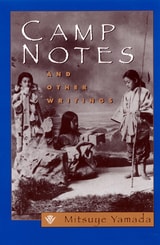
Mitsuye Yamada was born in Kyushu, Japan, and raised in Seattle, Washington, until the outbreak of World War II when her family was removed to a concentration camp in Idaho. Camp Notes and Other Writings recounts this experience.
Yamada's poetry yields a terse blend of emotions and imagery. Her twist of words creates a twist of vision that make her poetry come alive. The weight of her cultural experience-the pain of being perceived as an outsider all of her life-permeates her work.
Yamada's strength as a poet stems from the fact that she has managed to integrate both individual and collective aspects of her background, giving her poems a double impact. Her strong portrayal of individual and collective life experience stands out as a distinct thread in the fabric of contemporary literature by women.
"The core poems of Camp Notes and the title come from the notes I had taken when I was in camp, and it wasn’t published until thirty years after most of it was written. I was simply describing what was happening to me, and my thoughts. But, in retrospect, the collection takes on a kind of expanded meaning about that period in our history. As invariably happens, because Japanese American internment became such an issue in American history, I suppose I will be forever identified as the author of Camp Notes. Of course, I try to show that it’s not the only thing I ever did in my whole life; I did other things besides go to an internment camp during World War II. So, in some ways I keep producing to counteract that one image that gets set in the public mind. At the time that I was writing it, I wasn’t necessarily a political person. Now, when I reread it, even to myself, I think it probably has a greater warning about the dangers of being not aware, not aware of one’s own rights, not aware of helping other people who may be in trouble. I think that it does speak to our present age very acutely." -- Mitsuye Yamada, "You should not be invisible”: An Interview with Mitsuye Yamada, Contemporary Women's Writing, March 2014, Vol. 8 Issue 1
Read the whole interview at: https://academic.oup.com/cww/article/8/1/1/414906/You-should-not-be-invisible-An-Interview-with
Campus Whisper Networks
Knowing with Sexual Assault SurvivorsJanet Hinson Shope
Rutgers University Press, 2026
Campus Whisper Networks examines how personal knowledge about student sexual assault circulates within college campus communities. Based upon both qualitative and quantitative survey data, Janet Hinson Shope and Richard Pringle's research demonstrates that students who have been sexually assaulted tell someone—almost always a friend. Most college students know someone who has been assaulted. Simply knowing, by means of relationships, that one or more peers have been assaulted affects the knowers, and the effects reverberate unevenly across campuses.
Shope and Pringle highlight the structural properties that prohibit relational knowledge from becoming official institutional knowledge, confining it to whispers and secrecy within informal spheres of knowledge. The rules governing the circulation of such knowledge create an uneven epistemic field of sexual assault. This uneven field is consequential for the communities, affecting survivors and their confidants and shaping student views of the college community. Campus Whisper Networks demonstrates how personal and institutional avoidance, both the “need to not know” and “no need to know,” creates knowledge gaps that hide the community’s wounds and prevent personal knowledge from becoming social knowledge.
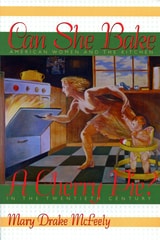
Can She Bake a Cherry Pie?
American Women and the Kitchen in the Twentieth CenturyMary Drake McFeely
University of Massachusetts Press, 2000
In the rural America of the past, a woman's reputation was sometimes made by her cherry pie—or her chocolate layer cake, or her biscuits. As America modernized and as women left the home, entered the paid labor force, and battled their way to success in the professions, mastery of cooking remained an accepted sign that a woman took her gendered responsibilities seriously. Ironically, over the course of the twentieth century, as ready-made foods and kitchen appliances made home cooking less essential and labor-intensive, skill in the kitchen continued to be perceived not only by society but often by women themselves as a measure of a woman's true value.
This book shows how cooking developed and evolved during the twentieth century. From Fannie Farmer to Julia Child, new challenges arose to replace the old. Women found themselves still tied to the kitchen, but for different reasons and with the need to acquire new skills. Instead of simply providing sustenance for the family, they now had to master more complex cooking techniques, the knowledge of “ethnic” cuisines, the science of nutrition, the business of consumerism, and, perhaps most important of all, the art of keeping their husbands and children happy and healthy.
Can We Wear Our Pearls and Still Be Feminists?
Memoirs of a Campus StruggleJoan D. Mandle
University of Missouri Press, 2000
When Joan Mandle accepted the position of Director of Women's Studies at Colgate University, she had specific goals in mind—to make the program stronger, more academically rigorous, and publicly open. The program would resist becoming the captive of identity politics and would refuse to allow itself to become marginalized on the campus. It would reach beyond the negative stereotypes of feminism on campus by appealing to and challenging all students and faculty interested in gender issues and social change.
Just as Mandle anticipated, she faced obstacles during the transformation. Among her critics were feminist students and faculty whose views of a successful program directly contradicted Mandle's. While the new director called for outreach, they insisted on isolation. While she set forth a policy of inclusiveness, they sought to maintain an exclusive community. These individuals preferred the former model of the women's studies program, despite its tendency toward separatism.
Can We Wear Our Pearls and Still Be Feminists? explores women's studies from Mandle's perspective as a program director, feminist activist, and scholar. She offers a vivid account of being forced to grapple with fundamental issues of what women's studies is and should be. Her strong commitment to feminism and women's studies does not prevent her from voicing her concerns; instead, it compells her to share the story of her directorship in hopes of shedding light on the strengths and weaknesses, pitfalls and triumphs of women's studies as an academic discipline.
Through her examination of the battles involved in creating an academically significant and ideologically open program, Mandle provides insight into a possible avenue of change for feminism. By showing how the program at Colgate University was able to encourage campuswide discussions on feminism, Mandle demonstrates that women's studies can succeed as an inclusive and rigorous field. This enlightening memoir provides readers with a window on important debates concerning feminism and women in academia.
Carceral Liberalism
Feminist Voices against State ViolenceEdited by Shreerekha Pillai. Foreword by Demita Frazier
University of Illinois Press, 2023
One of Ms. Magazine's Most Anticipated Books of 2023
Carceral liberalism emerges from the confluence of neoliberalism, carcerality, and patriarchy to construct a powerful ruse disguised as freedom. It waves the feminist flag while keeping most women still at the margins. It speaks of a post-race society while one in three Black men remain incarcerated. It sings the praises of capital while the dispossessed remain mired in debt.
Shreerekha Pillai edits essays on carceral liberalism that continue the trajectory of the Combahee River Collective and the many people inspired by its vision of feminist solidarity and radical liberation. Academics, activists, writers, and a formerly incarcerated social worker look at feminist resurgence and resistance within, at the threshold of, and outside state violence; observe and record direct and indirect forms of carcerality sponsored by the state and shaped by state structures, traditions, and actors; and critique carcerality. Acclaimed poets like Honorée Fanonne Jeffers and Solmaz Sharif amplify the volume’s themes in works that bookend each section.
Cutting-edge yet historically grounded, Carceral Liberalism examines an American ideological creation that advances imperialism, anti-blackness, capitalism, and patriarchy.
Contributors: Maria F. Curtis, Joanna Eleftheriou, Autumn Elizabeth and Zarinah Agnew and D Coulombe, Jeremy Eugene, Demita Frazier, Honorée Fanonne Jeffers, Alka Kurian, Cassandra D. Little, Beth Matusoff Merfish, Francisco Argüelles Paz y Puente, Shreerekha Pillai, Marta Romero-Delgado, Ravi Shankar, Solmaz Sharif, Shailza Sharma, Tria Blu Wakpa and Jennifer Musial, Javier Zamora
Care Activism
Migrant Domestic Workers, Movement-Building, and Communities of CareEthel Tungohan
University of Illinois Press, 2023

Care and Capitalism in the Twentieth Century
Kirsten Swinth and Sarah Knott, editors
Duke University Press, 2027
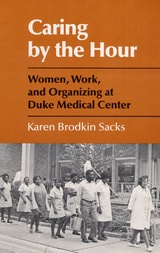
Caring by the Hour
Women, Work, and Organizing at Duke Medical CenterKaren Brodkin Sacks
University of Illinois Press, 1988
In addition to an analysis of the dynamics of women's activism, Caring by the Hour provides a comparative study of Duke Medical Center's treatment of both black and white female workers. Sacks links patterns of racial segregation in clerical jobs to the relationship between race, working conditions, and unequal opportunities for black and white women, and to their differing work cultures and patterns of public militance. She also discusses recent changes in service, clerical, and professional work and their effects on white and black women, placing them in the context of national changes in health funding and policies.
Carrying On
Another School of Thought on Pregnancy and HealthBrittany Clair
Rutgers University Press, 2022
Carrying On investigates the origin stories of prevailing prenatal health norms by exploring the evolution of issues at the center of pregnancy, ranging from morning sickness and weight gain to ultrasounds and induction. When did women start taking prenatal vitamins, and why? When did the notion that pregnant women should “eat for two” originate? Where did exercise guidelines come from? And when did women start formulating birth plans?
A learning project with one foot in the past and the other in the present, Carrying On considers what history and medicine together can teach us about how and why we treat pregnancy–and pregnant women–the way we do. In a world of information overload, Carrying On offers expecting parents the context and background they need to approach pregnancy and prenatal health from a new place of understanding.
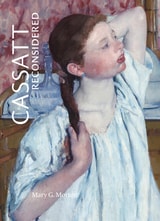
Cassatt Reconsidered
Mary G. Morton
J. Paul Getty Trust, The, 0
A sweeping reconsideration of the artist we thought we knew—and the forces that obscured her legacy.
Fiercely ambitious and independent, Mary Cassatt defied expectations to become one of the most radical artists of the Impressionist movement, though she was—and remains—the least understood. Cassatt commanded and manipulated strains of old master and contemporary painting to express her female subjectivity through a brilliantly modern oeuvre on par with those of the most revered Impressionists. However, mishandled by the Parisian art establishment during her lifetime, and later by art historians and curators, she became known almost exclusively as a sentimentalizing painter of mothers and children.
How did this happen to the most aspiring, revolutionary female artist of the late nineteenth and early twentieth centuries? In Cassatt Reconsidered, author Mary G. Morton probes this central question and more, demonstrating how Cassatt disturbed conventional ideals of femininity, childhood, and maternity, an uncompromising feat for which she paid dearly during her lifetime and in the annals of art historiography.
Vibrantly illustrated with more than 100 images, Cassatt Reconsidered rewards readers with a fuller understanding of an artist who stands apart for daring to express, on her own terms, the unique, intimate experiences of modern women.
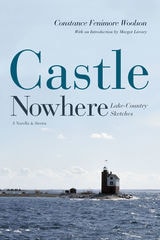
Castle Nowhere
Lake-Country SketchesConstance Fenimore Woolson
University of Michigan Press, 2004
Castle Nowhere is Constance Woolson's collection of stories set for the most part in the Great Lakes, in particular northern Lake Michigan and Lake Huron near Detroit.
Several themes inhabit Woolson's writing: an environmental consciousness and concern with landscapes; an awareness of the complexities of race; and an abidingly careful eye for the shallowness that sometimes accompanies wealth or social pretensions. She also had a unique perspective as a woman who pioneered the use of controversial subjects---such as unrequited or misplaced passion---and methods in fiction during a time that valorized domesticity.
As Margot Livesey notes in her introduction, reading about thwarted love is only one of the pleasures to be found in Castle Nowhere. "The majority of these stories are set in remote areas on the shores of Lake Michigan, which Woolson evokes with great vividness and beauty while always remaining keenly aware that beauty in no way mitigates hardship. As a writer, she was nearly always looking over her shoulder, and many, if not all, of these stories were written at a time when she no longer visited the Lake and her beloved Mackinac Island."
Contemporary readers will find a curiously modern atmosphere in Woolson's stories, as well as a distinct regional flavor in her careful renderings of the Great Lakes landscape. As such, Castle Nowhere represents a rare woman's voice in literature of its period and setting.
Constance Fenimore Woolson (1840-1894) was born in New Hampshire and moved to Cleveland shortly thereafter. She spent time on Mackinac Island, Michigan, then traveled to Florida before moving to Europe. Much of her time there was spent in Italy. She died in Venice in 1894. Novelist Margot Livesey is the author of Eva Moves the Furniture and Homework.
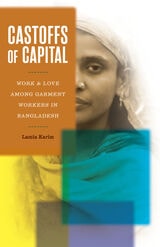
Castoffs of Capital
Work and Love among Garment Workers in BangladeshLamia Karim
University of Minnesota Press, 2022
FINALIST FOR THE GREGORY BATESON PRIZE FROM THE AMERICAN ANTHROPOLOGICAL ASSOCIATION
Dispelling stereotypes about garment workers in the global apparel industry
Castoffs of Capital examines how female garment workers experience their work and personal lives within the stranglehold of global capital. Drawing on fieldwork in Bangladesh, anthropologist Lamia Karim focuses attention onto the lives of older women aged out of factory work, heretofore largely ignored, thereby introducing a new dimension to the understanding of a female-headed workforce that today numbers around four million in Bangladesh.
Bringing a feminist labor studies lens, Castoffs of Capital foregrounds these women not only as workers but as mothers, wives, sisters, lovers, friends, and political agents. Focusing on relations among work, gender, and global capital’s targeting of poor women to advance its market penetration, Karim shows how women navigate these spaces by adopting new subject formations. She locates these women’s aspirations for the “good life” not only in material comforts but also in their longings for love and sexual fulfillment that help them momentarily forget the precarity of their existence under the shadow of capital.
Through richly detailed ethnographic studies, this innovative and beautifully written book examines the making and unmaking of these women’s wants and desires, loves and tribulations, hopes and despairs, and triumphs and struggles.
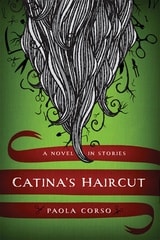
Catina’s Haircut
A Novel in StoriesPaola Corso
University of Wisconsin Press, 2010
Catina’s Haircut: A Novel in Stories spans four generations of a peasant family in the brutal poverty of post-Unification southern Italy and in an immigrant’s United States. The women in these tales dare to cross boundaries by discovering magical leaps inherent in the landscape, in themselves, and in the stories they tell and retell of family tragedy at a time of political unrest. Through an oral tradition embedded in the stone of memory and the flow of its reinvention, their passionate tale of resistance and transformation courses forward into new generations in a new world.
A woman threatens to join the land reform struggle in her Calabrian hill town, against her husband’s will, during a call for revolution in 1919. A brother and sister turn to the village sorceress in Fascist Italy to bring rain to their father’s drought-stricken farm. In Pittsburgh, new immigrants witness a miraculous rescue during the Great Flood of 1936. A young girl courageously dives into the Allegheny River to save her grandfather’s only memento of the old country. With only broken English to guide her, a widow hops a bus in search of live chickens to cook for Easter dinner in her husband’s memory. An aging woman in the title story is on a quest to cut the ankle-length hair as hard as the rocky soil of Calabria in a drought. A lonely woman who survived World War II bombings in her close-knit village, struggles to find community as a recent immigrant. A daughter visits her mother’s hill town to try and fulfill a wish for her to see the Fata Morgana. These haunting images permeate Corso’s linked stories of loss, hope, struggle, and freedom.
An official selection of The Sons of Italy® Book Club
Best Books for General Audiences, selected by the Public Library Association
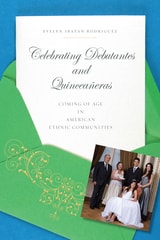
Celebrating Debutantes and Quinceañeras
Coming of Age in American Ethnic CommunitiesEvelyn Ibatan Rodriguez
Temple University Press, 2013
Drawing on over fifty in-depth interviews with members of these fast-growing American Asian and Latino populations, Rodriguez shows how these communal celebrations of daughters have been adapted by immigrant families to assert their cultural pride and affirm their American belonging. Celebrating Debutantes and Quinceañeras provides an intimate and compelling portrait of the various ways immigrants and their children are purposefully, strategically, and creatively employing Filipino American debutantes and Mexican American quinceañeras to simultaneously challenge and assimilate into U.S. culture and forge new understandings of what it means to be "Mexican," "Filipino," and "American."
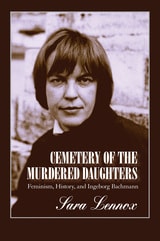
Cemetery of the Murdered Daughters
Feminism, History, and Ingeborg BachmannSara Lennox
University of Massachusetts Press, 2006
Although Austrian writer Ingeborg Bachmann (1926–1973) is widely regarded as one of the most important twentieth-century authors writing in German, her novels and stories have sometimes been viewed narrowly as portraits of women as victims. In this innovative study, Sara Lennox provides a much broader perspective on Bachmann's work, at the same time undertaking an experiment in feminist methodology. Lennox examines Bachmann's poetry and prose in historical context, arguing that the varied feminist interpretations of her writings are the result of shifts in theoretical emphases over a period of more than three decades. Lennox then places her own essays on Bachmann in similar perspective, showing how each piece reflects the historical moment in which it was written. Making use of recent interdisciplinary approaches—Foucauldian theories of sexuality, post-colonial theory, materialist feminism—she explores the extent to which each of her earlier readings was shaped by the methods employed, the questions asked, and the political issues that seemed most germane at the time. Out of this analysis comes a new understanding of the significance of Bachmann's work and new insight into the theory and practice of feminist criticism.
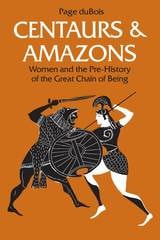
Centaurs and Amazons
Women and the Pre-History of the Great Chain of BeingPage duBois
University of Michigan Press, 1991
In Centaurs and Amazons, Page duBois offers a prehistory of hierarchy. Using structural anthropology, symbolic analysis, and recent literary theory, she demonstrates a shift in Greek thought from the fifth to the fourth century B.C. that had a profound influence upon subsequent Western culture and politics.
Through an analysis of mythology, drama, sculpture, architecture, and Greek vase painting, duBois documents the transition from a system of thought that organized the experience of difference in terms of polarity and analogy to one based upon a relatively rigid hierarchical scheme. This was the beginning of "the great chain of being," the philosophical construct that all life was organized in minute gradations of superiority and inferiority. This scheme, in various guises, has continued to influence philosophical and political thought.
The author's intelligent and discriminating use of scholarship from various fields makes Centaurs and Amazons an impressive interdisciplinary study of interest to classicists, feminist scholars, historians, art historians, anthropologists, and political scientists.
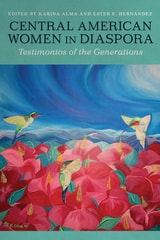
Central American Women in Diaspora
Testimonios of the GenerationsEdited by Karina Alma and Ester E. Hernández
University of Arizona Press, 2026
This collection centers Central American women’s voices within the growing narrative of the Central American diaspora. It provides a tapestry of testimonios—from grandmothers, mothers, daughters, and sisters—who explore what it means to be Central American women in the United States.
Through the practice of testimonio, contributors create intergenerational dialogues between mothers and daughters, engage with Indigenous oral traditions, and reflect on the violent histories of war in Guatemala, El Salvador, Honduras, and Nicaragua. The volume is organized around five themes: political histories, migration, gender and sexuality, navigating institutions, and healing. Within each theme contributors tackle a range of issues, including Central American political histories, healing, grief, Indigenous knowledge, memory, trauma, post-traumatic growth, organizing, creativity, and agency.
This anthology spans genres such as poetry, essay, and visual art to present diverse perspectives, including Indigenous, Afro-Indigenous, queer, and working-class voices. An intervention that centers gendered experiences and challenges oppressive structures, this volume celebrates the solidarity, cultural memory, and healing found within transnational ties.
Contributors
Leisy J. Abrego
Margoth Abrego
Bella
Juanita Cabrera López
Jennifer A. Cárcamo
Sandra Castro
Karla Cativo
Kency Cornejo
Gabriela Corona Valencia
Carolina Rivera Escamilla
Rafael Escamilla
Mildred Fuentes-Chung
Diana Gamez
Joanna Beltrán Girón
Ruth Girón
Victoria Gonzalez-Rivera
Claudia D. Hernández
Jessica Hernandez
Leticia Hernández-Linares
Leigh-Anna Hidalgo
Andrea Nikté Juarez Mendoza
Amanda Macal
Carla Macal
Patricia Veliz Macal
Kiara Aileen Machado
Beatriz Maldonado
Jacqueline Munguía
Joanna B. Pérez
Rossana Pérez
Katy Pinto
Claudia A. Portillo
Suyapa Portillo Villeda
Nalya Rodriguez
Jessica Saravia
Andrea Zelaya
Certificate of Absence
By Sylvia Molloy
University of Texas Press, 1989
Originally published in 1981 as En breve cárcel,Certificate of Absence is the first novel of the Argentinian scholar-critic Sylvia Molloy. Innovative in its treatment of women's relationships and in its assertion of woman's right to author her own text, the novel has won wide approval in Latin America and the United States.
The novel centers around a woman writing in a small room. As she writes, remembering a past relationship and anticipating a future one, the room becomes a repository for nostalgia, violence, and desire, a space in which writing and remembering become life-sustaining ceremonies. The narrator reflects on the power of love to both shelter and destroy. She meditates on the act of writing, specifically on writing as a woman, in a voice that goes against the grain of established, canonical voices.
Latin American male writers are prone to self-portrayal in their texts. Certifcate of Absence is one of the few novels by Latin American women that successfully use this technique to open new windows on women's experiences.
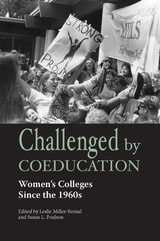
Challenged by Coeducation
Women's Colleges Since the 1960sLeslie Miller-Bernal
Vanderbilt University Press, 2007
In the mid-twentieth century colleges' concerns about finances and enrollments, as well as ideological pressures to integrate formerly separate social groups, led men's colleges, and some women's colleges, to become coeducational. The admission of women to practically all men's colleges created a serious challenge for women's colleges. Most people no longer believed women's colleges were necessary since women had virtually unlimited access to higher education. Even though research spawned by the women's movement indicated the benefits to women of a "room of their own," few young women remained interested in applying to women's colleges.
Challenged by Coeducation details the responses of women's colleges to this latest wave of coeducation. Case studies written expressly for this volume include many types of women's colleges-Catholic and secular; Seven Sisters and less prestigious; private and state; liberal arts and more applied; northern, southern, and western; urban and rural; independent and coordinated with a coeducational institution. They demonstrate the principal ways women's colleges have adapted to the new coeducational era: some have been taken over or closed, but most have changed by admitting men and thereby becoming coeducational, or by offering new programs to different populations. Some women's colleges, mostly those that are in cities, connected to other colleges, and prestigious with a high endowment, still enjoy success.
Despite their dramatic drop in numbers, from 250 to fewer than 60 today, women's colleges are still important, editors Miller-Bernal and Poulson argue. With their commitment to enhancing women's lives, women's colleges and formerly women's colleges can serve as models of egalitarian coeducation.
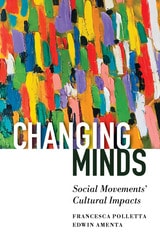
Changing Minds
Social Movements’ Cultural ImpactsFrancesca Polletta
Russell Sage Foundation, 2025
Polletta and Amenta examine the trajectories of U.S. social movements, including the old-age pension movements of the 1930s and 1940s, the Black rights movement of the 1950s and 1960s, the women’s movement of the 1970s, right-wing movements in the 1980s and 1990s, and the environmental movement up to the present, to determine when, why, and how social movements change culture. They find that influential movements are featured in the news, but not only in the news. Movement perspectives may appear also in opinion and commentary outlets, on television talk shows and dramas, in movies, stand-up comedy, and viral memes. Popular culture producers remake movement messages as they transmit them, sometimes in ways that make those messages compelling. For example, while the news largely ignored feminists’ challenge to inequality in the home, popular cultural outlets turned “liberation” into a resonant demand for women’s right to self-fulfillment outside the home and within it. Widespread attention to the movement may lead people to change their minds individually. But more substantial change is likely when companies, schools, and other organizations outside government strive to get out in front of a newly legitimate issue, whether environmental sustainability or racial equity, by adopting movement-supportive norms and practices. Eventually, ideas associated with a movement may become a new common sense—though not always the ideas that the movement intended.
Throughout Changing Minds, Polletta and Amenta provide activists with strategies for getting their message heard and acted on. They suggest how movement actors can get into the news as political players or experts rather than lawbreakers or zealots. They show when it makes sense for activists to work with popular cultural producers and when they should create their own cultural outlets. They explain why the routes to cultural influence have changed and why urging people to take one easy step to save the planet can do more harm than good.
Changing Minds is a fascinating exploration of why and how some social movements have caused profound shifts in society.
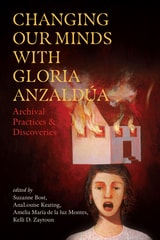
Changing Our Minds with Gloria Anzaldúa
Archival Practices and Discoveriesedited by Suzanne Bost, AnaLouise Keating, Amelia María de la luz Montes, Kelli D. Zaytoun
University of Texas Press, 2026
A collection of essays using Gloria Anzaldúa’s archival works to further explore and reassess the meaning of her legacy.
In the 1980s, Gloria Anzaldúa’s pioneering Borderlands/La Frontera and This Bridge Called My Back created new and durable trajectories for feminist, queer, Latinx, and postcolonial thought. Still, much of her writing was never published. Drawing on Anzaldúa’s impressive archive—manuscript drafts, personal memorabilia, correspondence, and drawings held at the Benson Collection at the University of Texas, Austin—this volume explores what we are still learning from a pathbreaking scholar more than twenty years after her death.
Changing Our Minds with Gloria Anzaldúa gathers essays from eleven writers working in diverse fields, including philosophy, literature, geography, performance studies, and visual arts. All have been powerfully influenced by Anzaldúa, and after examining her archives, all came to know her work anew. Each chapter relates discoveries among the unpublished materials, illuminating Anzaldúa’s celebrated texts and raising novel questions. A meditation, as well, on archivalism itself, Changing Our Minds reckons with the power of dusty papers to motivate new generations of readers outside the geographies and academic departments in which Anzaldúa has long been a fixture.
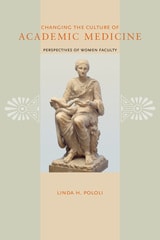
Changing the Culture of Academic Medicine
Perspectives of Women FacultyLinda H. Pololi
Dartmouth College Press, 2010
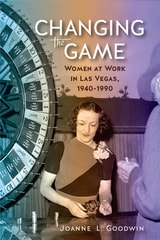
Changing the Game
Women at Work in Las Vegas, 1940-1990Joanne L. Goodwin
University of Nevada Press, 2014
Their experiences anticipated major trends in post-World War II labor history: the national migration of workers during and after the war, the growing proportion of women in the labor force, balancing work with family life, the unionization of service workers, and, above all, the desegregation of the labor force by sex and race. These narratives show women in Las Vegas resisting preassigned roles, seeing their work as a testimony of skill, a measure of independence, and a fulfillment of needs. Overall, these stories of women who lived and worked in Las Vegas in the last half of the twentieth century reveal much about the broader transitions for women in America between 1940 and 1990.
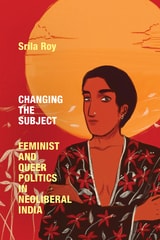
Changing the Subject
Feminist and Queer Politics in Neoliberal IndiaSrila Roy
Duke University Press, 2022
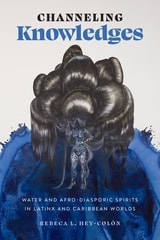
Channeling Knowledges
Water and Afro-Diasporic Spirits in Latinx and Caribbean WorldsRebeca L. Hey-Colón
University of Texas Press, 2023
2024 Honorable Mention, Isis Duarte Book Prize, Haiti/ Dominican Republic section, Latin American Studies Association
How water enables Caribbean and Latinx writers to reconnect to their pasts, presents, and futures.
Water is often tasked with upholding division through the imposition of geopolitical borders. We see this in the construction of the Rio Grande/Río Bravo on the US-Mexico border, as well as in how the Caribbean Sea and the Pacific Ocean are used to delineate the limits of US territory. In stark contrast to this divisive view, Afro-diasporic religions conceive of water as a place of connection; it is where spiritual entities and ancestors reside, and where knowledge awaits.
Departing from the premise that water encourages confluence through the sustainment of contradiction, Channeling Knowledges fathoms water’s depth and breadth in the work of Latinx and Caribbean creators such as Mayra Santos-Febres, Rita Indiana, Gloria Evangelina Anzaldúa, and the Border of Lights collective. Combining methodologies from literary studies, anthropology, history, and religious studies, Rebeca L. Hey-Colón’s interdisciplinary study traces how Latinx and Caribbean cultural production draws on systems of Afro-diasporic worship—Haitian Vodou, La 21 División (Dominican Vodou), and Santería/Regla de Ocha—to channel the power of water, both salty and sweet, in sustaining connections between past, present, and not-yet-imagined futures.
Character Is Destiny
The Autobiography of Alice SalomonAndrew Lees, Editor
University of Michigan Press, 2004

Charlotte Perkins Gilman and a Woman's Place in America
Edited by Jill Bergman
University of Alabama Press, 2017
Charlotte Perkins Gilman and a Woman’s Place in America is a pioneering collection that probes how depictions of space, confinement, and liberation establish both the difficulty and necessity of female empowerment. Turning Victorian notions of propriety and a woman’s place on its ear, this finely crafted essay collection studies Gilman’s writings and the manner in which they push back against societal norms and reject male-dominated confines of space.
The contributors present fascinating and innovative readings of some of Gilman’s most significant works. By examining the settings in “The Yellow Wallpaper” and Herland, for example, the volume analyzes Gilman’s construction of place, her representations of male dominance and female subjugation, and her analysis of the rules and obligations that women feel in conforming to their assigned place: the home.
Additionally, this volume delineates female resistance to this conformity. Contributors highlight how Gilman’s narrators often choose resistance over obedient captivity, breaking free of the spaces imposed upon them in order to seek or create their own habitats. Through biographical interpretations of Gilman’s work that focus on the author’s own renouncement of her “natural” role of wife and mother, contributors trace her relocation to the American West in an attempt to appropriate the masculinized spaces of work and social organization.
Engaging, well-researched, and deftly written, the essays in this collection will appeal to scholars of Gilman, literature, and gender issues alike.
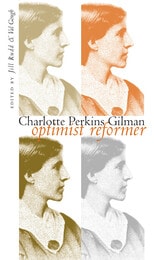
Charlotte Perkins Gilman
Optimist ReformerJill Rudd
University of Iowa Press, 1999
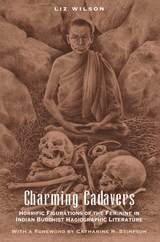
Charming Cadavers
Horrific Figurations of the Feminine in Indian Buddhist Hagiographic LiteratureLiz Wilson
University of Chicago Press, 1996
Liz Wilson investigates first-millennium Buddhist notions of
spirituality. She argues that despite the marginal role women played in
monastic life, they occupied a very conspicuous place in Buddhist
hagiographic literature. In narratives used for the edification of
Buddhist monks, women's bodies in decay (diseased, dying, and after
death) served as a central object for meditation, inspiring spiritual
growth through sexual abstention and repulsion in the immediate world.
Taking up a set of universal concerns connected with the representation
of women, Wilson displays the pervasiveness of androcentrism in Buddhist
literature and practice. She also makes persuasive use of recent
historical work on the religious lives of women in medieval
Christianity, finding common ground in the role of miraculous
afflictions.
This lively and readable study brings provocative new tools and insights
to the study of women in religious life.
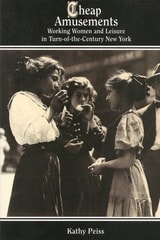
Cheap Amusements
Kathy Peiss
Temple University Press, 1987
Kathy Peiss follows working women into saloons, dance halls, Coney Island amusement parks, social clubs, and nickelodeons to explore the culture of these young women between 1880 and 1920 as expressed in leisure activities. By examining the rituals and styles they adopted and placing that culture in the larger context of urban working-class life, she offers us a complex picture of the dynamics shaping a working woman's experience and consciousness at the turn-of-the-century. Not only does her analysis lead us to new insights into working-class culture, changing social relations between single men and women, and urban courtship, but it also gives us a fuller understanding of the cultural transformations that gave rise to the commercialization of leisure.
The early twentieth century witnessed the emergence of "heterosocial companionship" as a dominant ideology of gender, affirming mixed-sex patterns of social interaction, in contrast to the nineteenth century's segregated spheres. Cheap Amusements argues that a crucial part of the "reorientation of American culture" originated from below, specifically in the subculture of working women to be found in urban dance halls and amusement resorts.
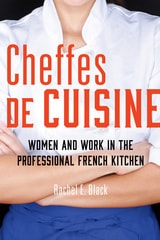
Cheffes de Cuisine
Women and Work in the Professional French KitchenRachel E. Black
University of Illinois Press, 2021
Works of Distinction, LDEI M.F.K. Fisher Prize for Excellence in Culinary Media Content, 2022
A rare woman’s-eye-view of working in the professional French kitchen
Though women enter France’s culinary professions at higher rates than ever, men still receive the lion’s share of the major awards and Michelin stars. Rachel E. Black looks at the experiences of women in Lyon to examine issues of gender inequality in France’s culinary industry. Known for its female-led kitchens, Lyon provides a unique setting for understanding the gender divide, as Lyonnais women have played a major role in maintaining the city’s culinary heritage and its status as a center for innovation. Voices from history combine with present-day interviews and participant observation to reveal the strategies women use to navigate male-dominated workplaces or, in many cases, avoid men in kitchens altogether. Black also charts how constraints imposed by French culture minimize the impact of #MeToo and other reform-minded movements.
Evocative and original, Cheffes de Cuisine celebrates the successes of women inside the professional French kitchen and reveals the obstacles women face in the culinary industry and other male-dominated professions.
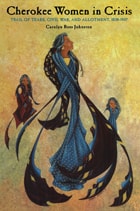
Cherokee Women In Crisis
Trail of Tears, Civil War, and Allotment, 1838-1907Carolyn Johnston
University of Alabama Press, 2003
American Indian women have traditionally played vital roles in social hierarchies at the family, clan, and tribal levels. In the Cherokee Nation, specifically, women and men are considered equal contributors to the culture. With this study, however, we learn that three key historical events in the 19th and early 20th centuries—removal, the Civil War, and allotment of their lands—forced a radical renegotiation of gender roles and relations in Cherokee society.
Carolyn Johnston (who is related to John Ross, principal chief of the Nation) looks at how Cherokee women navigated these crises in ways that allowed them to retain their traditional assumptions, ceremonies, and beliefs and to thereby preserve their culture. In the process, they both lost and retained power. The author sees a poignant irony in the fact that Europeans who encountered Native societies in which women had significant power attempted to transform them into patriarchal ones and that American women struggled for hundreds of years to achieve the kind of equality that Cherokee women had enjoyed for more than a millennium.
Johnston examines the different aspects of Cherokee women’s power: authority in the family unit and the community, economic independence, personal autonomy, political clout, and spirituality. Weaving a great-grandmother theme throughout the narrative, she begins with the protest of Cherokee women against removal and concludes with the recovery of the mother town of Kituwah and the elections of Wilma Mankiller and Joyce Dugan as principal chiefs of the Cherokee Nation and the Eastern Band of Cherokees.
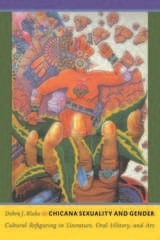
Chicana Sexuality and Gender
Cultural Refiguring in Literature, Oral History, and ArtDebra J. Blake
Duke University Press, 2008
Blake looks at how the Chicana professional intellectuals and the U.S. Mexicana women refigure confining and demeaning constructions of female gender roles and racial, ethnic, and sexual identities. She organizes her analysis around re-imaginings of La Virgen de Guadalupe, La Llorona, indigenous Mexica goddesses, and La Malinche, the indigenous interpreter for Hernán Cortés during the Spanish conquest. In doing so, Blake reveals how the professional intellectuals and the working-class and semiprofessional women rework or invoke the female icons to confront the repression of female sexuality, limiting gender roles, inequality in male and female relationships, and violence against women. While the representational strategies of the two groups of women are significantly different and the U.S. Mexicanas would not necessarily call themselves feminists, Blake nonetheless illuminates a continuum of Chicana feminist thinking, showing how both groups of women expand lifestyle choices and promote the health and well-being of women of Mexican origin or descent.
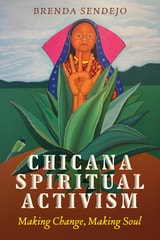
Chicana Spiritual Activism
Making Change, Making SoulBrenda Sendejo
University of Arizona Press, 2026
This book explores the profound impact of spiritual activism within the Chicana feminist movement in Texas. It illuminates how a cohort of Texas Chicanas embraced spiritual activism in pursuit of social change during the movement and into the present day.
The book draws on an array of qualitative methodologies—including interviews, autoethnography, testimonio, pláticas, and archival analysis—to develop what the author formulates as “methodologies of the spirit.” Focusing on the lived experiences, histories, and spiritual activism of sixteen Chicanas/Tejanas, Sendejo shows how these trailblazing women confronted the enduring impacts and repercussions of colonial legacies in Texas through their involvement in movement initiatives such as electoral politics through Mujeres Por La Raza, the cultural arts movement, developing Chicana feminist thought, and the establishment of bilingual education and Chicana/o studies programs.
The activists highlighted in the book include well-known figures such as Santa Barraza, Norma E. Cantú, Rosie Castro, Martha P. Cotera, Inés Hernández-Ávila, and others. Through their work, these activists emerged as architects of their own healing and transformation. Simultaneously, they opened avenues for others to embark on similar journeys reshaping religious practices and unearthing and disseminating spiritual, feminist, and ancestral knowledges.

Chick Lit Postfeminist Fiction
Cris Mazza
University of Alabama Press, 2000
A provocative critique of chick lit’s glossy narratives and their complex relationship with postfeminist ideals.
Chick-Lit: Postfeminist Fiction is the fourth volume in “On the Edge: New Women’s Fiction,” FC2’s ongoing effort to discover new and innovative voices in women’s fiction. Determined to contradict the myth that “women don't write experimental fiction,” Chick-Lit discovers women writers with a fresh and irreverent wit and honesty, but no less powerful in their rendering of human experience.
Chick-Lit collects the original fiction of newly discovered writers, but also the award winning work of notable writers like Carole Maso, Jonis Agee, Stacy Levinne and Carolyn Banks. Marked by innovations in form and point-of-view, the writers in this collection are not satisfied with the terrain commonly referred to as “women’s writing.” Insane asylum sex, board games that control people’s lives, a masochistic pedophile humiliated by his victim, an obese woman paying nickels and quarters for attention from teenage girls, a deranged hair stylist and her disloyal dog, a men's impotence therapy group, a surreal landscape constantly producing the body of a woman's mother: this is writing that shouts, yes, there is such a thing as postfeminist fiction.
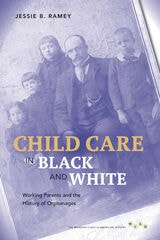
Child Care in Black and White
Working Parents and the History of OrphanagesJessie B. Ramey
University of Illinois Press, 2013
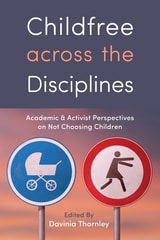
Childfree across the Disciplines
Academic and Activist Perspectives on Not Choosing ChildrenDavinia Thornley
Rutgers University Press, 2022
Recently, childfree people have been foregrounded in mainstream media. More than seven percent of Western women choose to remain childfree and this figure is increasing. Being childfree challenges the ‘procreation imperative’ residing at the center of our hetero-normative understandings, occupying an uneasy position in relation to—simultaneously—traditional academic ideologies and prevalent social norms. After all, as Adi Avivi recognizes, "if a woman is not a mother, the patriarchal social order is in danger." This collection engages with these (mis)perceptions about childfree people: in media representations, demographics, historical documents, and both psychological and philosophical models. Foundational pieces from established experts on the childfree choice--Rhonny Dam, Laurie Lisle, Christopher Clausen, and Berenice Fisher--appear alongside both activist manifestos and original scholarly work, comprehensively brought together. Academics and activists in various disciplines and movements also riff on the childfree life: its implications, its challenges, its conversations, and its agency—all in relation to its inevitability in the 21st century. Childfree across the Disciplines unequivocally takes a stance supporting the subversive potential of the childfree choice, allowing readers to understand childfreedom as a sense of continuing potential in who—or what—a person can become.
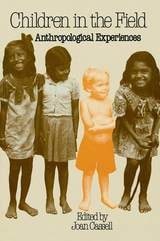
Children In The Field
edited by Joan Cassell
Temple University Press, 1994
Choices Women Make
Agency in Domestic Violence, Assisted Reproduction, and Sex WorkCarisa R. Showden
University of Minnesota Press, 2010
In Showden’s analysis, women’s agency emerges as an individual and social construct, rooted in concrete experience, complex and changing over time. She traces the development and deployment of agency, illustrating how it plays out in the messy workings of imperfect lives. In a series of case studies, she considers women within situations of intimate partner violence, reproductive decision making, and sex work such as prostitution and pornography. Each narrative offers insight into how women articulate their self-understanding and political needs in relation to the pressures they confront.
Showden’s understanding of women’s agency ultimately leads her to review possible policy and legal interventions that could improve the conditions within which agency develops and that could positively enhance women’s ability to increase and exercise their political and personal options.
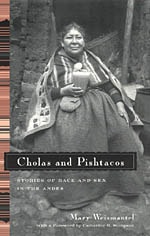
Cholas and Pishtacos
Stories of Race and Sex in the AndesMary Weismantel
University of Chicago Press, 2001
Cholas and Pishtacos are two provocative characters from South American popular culture—a sensual mixed-race woman and a horrifying white killerwho show up in everything from horror stories and dirty jokes to romantic novels and travel posters. In this elegantly written book, these two figures become vehicles for an exploration of race, sex, and violence that pulls the reader into the vivid landscapes and lively cities of the Andes. Weismantel's theory of race and sex begins not with individual identity but with three forms of social and economic interaction: estrangement, exchange, and accumulation. She maps the barriers that separate white and Indian, male and female-barriers that exist not in order to prevent exchange, but rather to exacerbate its inequality.
Weismantel weaves together sources ranging from her own fieldwork and the words of potato sellers, hotel maids, and tourists to classic works by photographer Martin Chambi and novelist José María Arguedas. Cholas and Pishtacos is also an enjoyable and informative introduction to a relatively unknown region of the Americas.
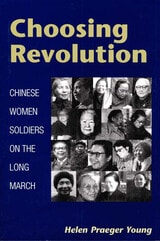
Choosing Revolution
Chinese Women Soldiers on the Long MarchHelen Praeger Young
University of Illinois Press, 2001
Enormously rich in detail, Young's Choosing Revolution reveals the complex interplay between women's experiences and the official, almost mythic version of the Long March. In addition to their riveting stories of the march itself, Young's subjects reveal much about what it meant in China to grow up female and, in many cases, poor during the first decades of the twentieth century. In speaking about the work they did and how they adapted to the demands of being a soldier, these women--both educated individuals who were well-known leaders and illiterate peasants--reveal the Long March as only one of many segments of the revolutionary paths they chose.
Against a background of diverse perspectives on the Long March, Young presents the experiences of four women in detail: one who brought her infant daughter with her on the Long March, one who gave birth during the march, one who was a child participant, and one who attended medical school during the march. Young also includes the stories of three women who did not finish the Long March. Her unique record of ordinary women in revolutionary circumstances reveals the tenacity and resilience that led these individuals far beyond the limits of most Chinese women's lives.
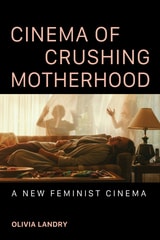
Cinema of Crushing Motherhood
A New Feminist CinemaOlivia Landry
University of Illinois Press, 2025