Results by title
8113 books match the query 'Literary Criticism' and 522 start with c
Critical Inquiry, volume 52 number 4 (Summer 2026)
The University of Chicago Press
University of Chicago Press Journals, 2026
Critical Inquiry, volume 53 number 1 (Autumn 2026)
The University of Chicago Press
University of Chicago Press Journals, 2026

Critical Passions
Selected EssaysJean Franco
Duke University Press, 1999
A key participant in the major debates in Latin American studies—beginning with the “boom” period of the 1960s and continuing through debates on ideology and discourse, Marxism, mass culture, and postmodernism—Franco is recognized for her feminist critique of Latin American writing. While her principal books are all readily available, Franco’s several dozen articles are dispersed in a variety of periodicals in Latin America, Europe, and the United States. Although many of these essays are considered pioneering and classic, they have never before been collected in a single work. In this volume, Mary Louise Pratt and Kathleen Newman have organized the essays into four interrelated sections: feminism and the critique of authoritarianism, mass and popular culture, Latin American literature from the “boom” onward, and the cultural history of Mexico. As a group, these writings demonstrate Franco’s ability to reflect on and judge with equal seriousness all spheres of expression, whether subway graffiti, a fashion manual, or an avant-garde haiku. A bona fide fan of popular and mass media, Franco never allows her critiques to dissolve into the puritanical or reductive; instead, she finds ways to present and debate complex theoretical questions in direct and accessible language.
This volume will draw an extensive readership in Latin American, cultural, and women’s studies.
Critical Paths
Blake and the Argument of MethodDan Miller, Mark Bracher and Donald Ault, eds.
Duke University Press, 1987
The contributors assembled here, leading exponents of contemporary critical methods as well as close students of Blake, argue the grounds, purposes, and validity of each approach and then apply its method in detailed readings of Blake's works. We see deconstruction, psychoanalytic interpretation, feminist critique, semiotic analysis, Marxist criticism, revisionism, and other methods brought to bear on Blake's texts and into confrontation with one another by those best able to do so.
Through the essays themselves and in the reaction they will certainly provoke, Critical Paths will bring increased theoretical awareness to the study of Blake and will further the ongoing redefinition of Blake's art. At the same time, the collection investigates the general problem of methodology in literary studies by means of a casebook examination of modern critical approaches. Blake criticism and current literary theory here come together; the encounter illuminates and enriches both.

Critical Practices in Post-Franco Spain
Silvia L. Lopez, Jenaro Talens, and Dario Villanueva, Editors
University of Minnesota Press, 1994
Critical Practices in Post-Franco Spain was first published in 1994. Minnesota Archive Editions uses digital technology to make long-unavailable books once again accessible, and are published unaltered from the original University of Minnesota Press editions.
This volume offers a sample of Spanish critical work in literary theory and cultural studies. Like all critical histories, Spain's is political: Philology dominated the critical scene during the Franco years, and after Franco, this hegemony has been contested by semiotics, poststructuralism, psychoanalysis, and feminisms. Without trying to represent all the theoretical projects presently underway in Spanish criticism, this book opens a window on the vast field of new critical practices in Spain and provides a general picture of influential theoretical currents.
The essays collected here range widely in topic and style, and they reflect a new generation's preoccupation with critical problems that go beyond the field of literary studies. The authors focus on new discourse in various print and electronic media, on the discursive construction of the museum space, and on literary theory as it confronts issues of translation, subjectivity, writing, and narratology.Silvia López is assistant professor of Spanish at Carlton Collegea doctoral candidate in the departments of cultural studies and comparative literature at the University of Minnesota. Jenaro Talens is professor of Hispanic literature and comparative literature at the University of Geneva. He is the author of The Branded Eye: Buñuel's Un Chien Andalou, (Minnesota 1993). Darío Villanueva is professor of theory of literature at the University of Santiago de Compostela, Spain.
Critical Prefaces of the French Renaissance
Bernard Weinberg
Northwestern University Press, 1950
Critical Terms for Literary Study, Second Edition
Edited by Frank Lentricchia and Thomas McLaughlin
University of Chicago Press, 1995
Critical Terms for Literary Study is an essential handbook and introduction to the work of literary theory. Covering a broad range of key terms that include popular culture, diversity, imperialism, ethics, desire, class, gender, race, canon, representation, and much more through essays by leading scholars, it provides a concise history of each term alongside a critical exploration of the issues and questions for the field that it raises, followed by demonstrations of reading strategies driven by the term.
Exploring the concepts that shape the way we read, the essays combine to provide an extraordinary introduction to the work of literature and literary study, as the nation's most distinguished scholars put the tools of critical practice vividly to use.
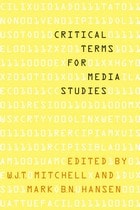
Critical Terms for Media Studies
Edited by W. J. T. Mitchell and Mark B. N. Hansen
University of Chicago Press, 2010
Communications, philosophy, film and video, digital culture: media studies straddles an astounding array of fields and disciplines and produces a vocabulary that is in equal parts rigorous and intuitive. Critical Terms for Media Studies defines, and at times, redefines, what this new and hybrid area aims to do, illuminating the key concepts behind its liveliest debates and most dynamic topics.
Part of a larger conversation that engages culture, technology, and politics, this exciting collection of essays explores our most critical language for dealing with the qualities and modes of contemporary media. Edited by two outstanding scholars in the field, W. J. T. Mitchell and Mark B. N. Hansen, the volume features works by a team of distinguished contributors. These essays, commissioned expressly for this volume, are organized into three interrelated groups: “Aesthetics” engages with terms that describe sensory experiences and judgments, “Technology” offers entry into a broad array of technological concepts, and “Society” opens up language describing the systems that allow a medium to function.
A compelling reference work for our media landscape, Critical Terms for Media Studies will engage and deepen any reader’s knowledge of one of our most important new fields.
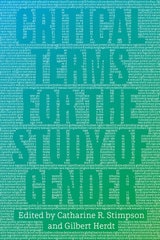
Critical Terms for the Study of Gender
Edited by Catharine R. Stimpson and Gilbert Herdt
University of Chicago Press, 2014
So write women’s studies pioneer Catharine R. Stimpson and anthropologist Gilbert Herdt in their introduction to Critical Terms for the Study of Gender, laying out the wide-ranging nature of this interdisciplinary and rapidly changing field. The sixth in the series of “Critical Terms” books, this volume provides an indispensable introduction to the study of gender through an exploration of key terms that are a part of everyday discourse in this vital subject.
Following Stimpson and Herdt’s careful account of the evolution of gender studies and its relation to women’s and sexuality studies, the twenty-one essays here cast an appropriately broad net, spanning the study of gender and sexuality across the humanities and social sciences. Written by a distinguished group of scholars, each essay presents students with a history of a given term—from bodies to utopia—and explains the conceptual baggage it carries and the kinds of critical work it can be made to do. The contributors offer incisive discussions of topics ranging from desire, identity, justice, and kinship to love, race, and religion that suggest new directions for the understanding of gender studies. The result is an essential reference addressed to students studying gender in very different disciplinary contexts.
Critical Understanding
The Powers and Limits of PluralismWayne C. Booth
University of Chicago Press, 1979
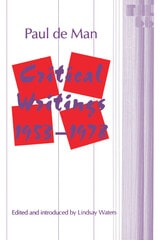
Critical Writings, 1953-1978
Paul De Man
University of Minnesota Press, 1989
Twenty-five essays and reviews not previously collected, most of which were written before 1970, and eight of which are appearing in English for the first time. Valuable for the insights they afford into his development as a critic the essays are also significant in addressing de Man’s consistent views of romanticism, modernism and the dilemmas central to literature in recent centuries.
Criticism and Truth
On Method in Literary StudiesJonathan Kramnick
University of Chicago Press, 2023
Does literary criticism offer truths about the world? In Criticism and Truth, Jonathan Kramnick offers a new and surprising account of criticism’s power by zeroing in on its singular method: close reading. Long recognized as the distinctive technique of literary studies, close reading is the critic’s way of pursuing arguments and advancing knowledge, as well as the primary skill taught in the English major. But it is also more than that—a creative, immersive, and transformative writing practice that fosters a unique kind of engagement with the world. Drawing on the rich and varied landscape of contemporary criticism, Kramnick changes how we think about the basic tools of literary analysis, including the art of in-text quotation, summary, and other reading methods, helping us to see them as an invaluable form of humanistic expertise. Criticism and Truth is a call to arms, making a powerful case for the necessity of both literature and criticism within a multidisciplinary university.
As the humanities fight for survival in contemporary higher education, the study of literature doesn’t need more plans for reform. Rather, it needs a defense of the work already being done and an account of why it should flourish. This is what Criticism and Truth offers, in vivid and portable form.
Criticism in the Borderlands
Studies in Chicano Literature, Culture, and IdeologyHéctor Calderón and José David Saldívar, eds.
Duke University Press, 1991
The editors have organized essays around four board themes: the situation of Chicano literary studies within American literary history and debates about the “canon”; representations of the Chicana/o subject; genre, ideology, and history; and the aesthetics of Chicano literature. The volume as a whole aims at generating new ways of understanding what counts as culture and “theory” and who counts as a theorist. A selected and annotated bibliography of contemporary Chicano literary criticism is also included.
By recovering neglected authors and texts and introducing readers to an emergent Chicano canon, by introducing new perspectives on American literary history, ethnicity, gender, culture, and the literary process itself, Criticism in the Borderlands is an agenda-setting collection that moves beyond previous scholarship to open up the field of Chicano literary studies and to define anew what is American literature.
Contributors. Norma Alarcón, Héctor Calderón, Angie Chabram, Barbara Harlow, Rolando Hinojosa, Luis Leal, José E. Limón, Terese McKenna, Elizabeth J. Ordóñez, Genero Padilla, Alvina E. Quintana, Renato Rosaldo, José David Saldívar, Sonia Saldívar-Hull, Rosaura Sánchez, Roberto Trujillo
Critique and Cosmos
After Misao MiyoshiRob Wilson and Paul A. Bové, special issue editors
Duke University Press, 0
Contributors. Tsering Wangmo Dhompa, Arif Dirlik, Harry Harootunian, Reginald Jackson, Mary Layoun, Christine L. Marran, George Solt, Keijiro Suga, Stefan Tanaka, Chih-ming Wang, Rob Wilson
Critique and Postcritique
Elizabeth S. Anker and Rita Felski, editors
Duke University Press, 2017
Contributors: Elizabeth S. Anker, Christopher Castiglia, Russ Castronovo, Simon During, Rita Felski, Jennifer L. Fleissner, Eric Hayot, Heather Love, John Michael, Toril Moi, Ellen Rooney, C. Namwali Serpell
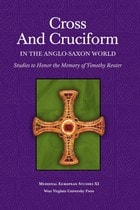
Cross and Cruciform in the Anglo-Saxon World
Studies to Honor the Memory of Timothy ReuterSARAH LARRATT KEEFER
West Virginia University Press, 2010
Cross and Cruciform in the Anglo-Saxon World: Studies to Honor the Memory of Timothy Reuter is edited by Sarah Larratt Keefer, Karen Louise Jolly, and Catherine E. Karkov and is the third and final volume of an ambitious research initiative begun in 1999 concerned with the image of the cross, showing how its very material form cuts across both the culture of a society and the boundaries of academic disciplines—history, archaeology, art history, literature, philosophy, and religion—providing vital insights into how symbols function within society. The flexibility, portability, and adaptability of the Anglo-Saxon understanding of the cross suggest that, in pre-Conquest England, at least, the linking of word, image, and performance joined the physical and spiritual, the temporal and eternal, and the earthly and heavenly in the Anglo-Saxon imaginative landscape.
This volume is divided into three sections. The first section of the collection focuses on representations of “The Cross: Image and Emblem,” with contributions by Michelle P. Brown, David A. E. Pelteret, and Catherine E. Karkov. The second section, “The Cross: Meaning and Word,” deals in semantics and semeology with essays by Éamonn Ó Carragáin, Helen Damico, Rolf Bremmer, and Ursula Lenker. The third section of the book, “The Cross: Gesture and Structure,” employs methodologies drawn from archaeology, new media, and theories of rulership to develop new insights into subjects as varied as cereal production, the little-known Nunburnholme Cross, and early medieval concepts of political power.
Cross and Cruciform in the Anglo-Saxon World: Studies to Honor the Memory of Timothy Reuter is a major collection of new research, completing the publication series of the Sancta Crux/Halig Rod project. Cross and Culture in Anglo-Saxon England: Studies in Honor of George Hardin Brown, Volume 2 in this series, remains available from West Virginia University Press.
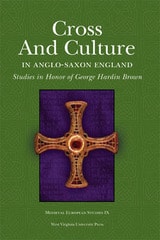
Cross and Culture in Anglo-Saxon England
Studies in Honor of George Hardin BrownKAREN L. JOLLY
West Virginia University Press, 2008
As Volume One in the Sancta Crux/Halig Rod series, this collection of new research offers fascinating glimpses into how the way the cross, the central image of Christianity in the Anglo-Saxon period, was textualized, reified, visualized, and performed. The cross in early medieval England was so ubiquitous it became invisible to the modern eye, and yet it played an innovative role in Anglo-Saxon culture, medicine, and popular practice. It represented one of the most powerful relics, emblems, and images in medieval culture because it could be duplicated in many forms and was accessible to every layer of society. The volume speaks to critical issues of cultural interpretation for Anglo-Saxonists, medievalists of all disciplines, and those interested in cultural studies in general.
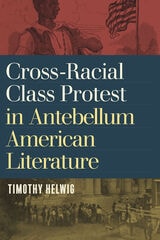
Cross-Racial Class Protest in Antebellum American Literature
Timothy Helwig
University of Massachusetts Press, 2020
Timothy Helwig analyzes the shared strategies of class protest in popular and canonical texts from a range of antebellum white and black American authors, including George Lippard, Ned Buntline, Harry Hazel, Frederick Douglass, William Wells Brown, and Frank J. Webb. This pathbreaking study offers original perspectives on racial representations in antebellum American print culture and provides a new understanding of black and white authors' strivings for socioeconomic justice across racial lines in the years leading up to the Civil War.
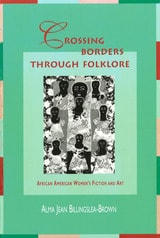
Crossing Borders through Folklore
African American Women's Fiction and ArtAlma Jean Billingslea-Brown
University of Missouri Press, 1999
Examining works by Toni Morrison, Paule Marshall, Faith Ringgold, and Betye Saar, this innovative book frames black women's aesthetic sensibilities across art forms. Investigating the relationship between vernacular folk culture and formal expression, this study establishes how each of the four artists engaged the identity issues of the 1960s and used folklore as a strategy for crossing borders in the works they created during the following two decades.
As a dynamic, open-ended process, folklore historically has enabled African-descended people to establish differential identity, resist dominance, and affirm group solidarity. This book documents the use of expressive forms of folklore in the fiction of Morrison and Marshall and the use of material forms of folklore in the visual representations of Ringgold and Saar. Offering a conceptual paradigm of a folk aesthetic to designate the practices these women use to revise and reverse meanings—especially meanings imposed on images such as Aunt Jemima and Sambo—Crossing Borders through Folklore explains how these artists locate sites of intervention and reconnection. From these sites, in keeping with the descriptive and prescriptive formulations for art during the sixties, Morrison, Marshall, Ringgold, and Saar articulate new dimensions of consciousness and creatively theorize identity.
Crossing Borders through Folklore is a significant and creative contribution to scholarship in both established and still- emerging fields. This volume also demonstrates how recent theorizing across scholarly disciplines has created elastic metaphors that can be used to clarify a number of issues. Because of its interdisciplinary approach, this study will appeal to students and scholars in many fields, including African American literature, art history, women's studies, diaspora studies, and cultural studies.
Crossing Borders
Reception Theory, Poststructuralism, DeconstructionRobert C. Holub
University of Wisconsin Press, 1992
Robert C. Holub critically investigates the histories of reception theory, poststructuralism, and deconstruction in postwar Germany and the United States. He looks at how imported theories assume a place in the political discourse of a country, and how indigenous intellectual traditions and prejudices affect, modify, or even distort foreign theories.
Holub addresses many timely questions: Why did reception theory, so prominent in Germany in the 1960s and 1970s, fail to have an impact on American academics until the 1980s? Why did postructuralism, and specifically the writings of Michel Foucault, fail to find a home in German academia while becoming an important theoretical voice in the United States? How did deconstruction, originally considered by American scholars as merely a sophisticated tool for analysis, get taken up by leftists who argued for an affinity between the critique of language and the critique of capitalism? And finally, how have American intellectuals responded to revelations of fascism in the pasts of Paul de Man and Martin Heidegger?
Crossing Borders effectively demonstrates the extent to which theoretical work needs to be understood in cultural, intellectual, and institutional contexts. Holub argues that the praxis of theories is determined not only by their content and style, but also by the environment in which they must function. The success of a transplanted theory, he contends, is due less to its inherent merits than to the hospitability of the environment on to which it is grafted.
Crossing Cultures
Creating Identity in Chinese and Jewish American LiteratureJudith Oster
University of Missouri Press, 2003
Crossing Ocean Parkway
Marianna De Marco Torgovnick
University of Chicago Press, 1994
Included are autobiographical moments interwoven with engrossing interpretations of American cultural icons from Dr. Dolittle to Lionel Trilling, The Godfather to Camille Paglia. Her experiences allow her to probe the cultural tensions in America caused by competing ideas of individuality and community, upward mobility and ethnic loyalty, acquisitiveness and spirituality.
Crossing Unmarked Snow
Further Views on the Writer's VocationWilliam Stafford
University of Michigan Press, 1998
--William Stafford
A plain-spoken but eminently effective poet, the late William Stafford (1914-1993) has managed to shape part of the mainstream of American poetry by distancing himself from its trends and politics. Though his work has always inspired controversy, he was widely admired by students and poetry lovers as well as his own peers. His fascination with the process of writing joined with his love of the land and his faith in the teaching power of nature to produce a unique poetic voice in the last third of the twentieth century.
Crossing Unmarked Snow continues--in the tradition of Stafford's well-loved collections Writing the Australian Crawl and You Must Revise Your Life-- collecting prose and poetry on the writer's profession. The book includes reviews and reflections on poets from Theodore Roethke to Carolyn Forche, from May Sarton to Philip Levine; conversations on the making of poems; and a selection of Stafford's own poetry. The book also includes a section on the art of teaching, featuring interviews, writing exercises, and essays on the writer's vocation.
William Stafford authored more than thirty-five books of poetry and prose during his lifetime, including the highly acclaimed Writing the Australian Crawl: Views on the Writer's Vocation and You Must Revise Your Life.
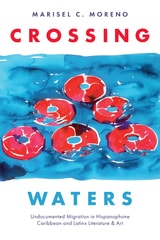
Crossing Waters
Undocumented Migration in Hispanophone Caribbean and Latinx Literature & ArtMarisel C. Moreno
University of Texas Press, 2022
2023 Honorable Mention, Isis Duarte Book Prize, Haiti/ Dominican Republic section (LASA)
2023 Winner, Gordon K. and Sybil Lewis Book Award, Caribbean Studies Association
An innovative study of the artistic representations of undocumented migration within the Hispanophone Caribbean
Debates over the undocumented migration of Latin Americans invariably focus on the southern US border, but most migrants never cross that arbitrary line. Instead, many travel, via water, among the Caribbean islands. The first study to examine literary and artistic representations of undocumented migration within the Hispanophone Caribbean, Crossing Waters relates a journey that remains silenced and largely unknown.
Analyzing works by novelists, short-story writers, poets, and visual artists replete with references to drowning and echoes of the Middle Passage, Marisel Moreno shines a spotlight on the plight that these migrants face. In some cases, Puerto Rico takes on a new role as a stepping-stone to the continental United States and the society migrants will join there. Meanwhile the land border between Haiti and the Dominican Republic, the only terrestrial border in the Hispanophone Caribbean, emerges as a complex space within this cartography of borders. And while the Border Patrol occupies US headlines, the Coast Guard occupies the nightmares of refugees.
An untold story filled with beauty, possibility, and sorrow, Crossing Waters encourages us to rethink the geography and experience of undocumented migration and the role that the Caribbean archipelago plays as a border zone.
Crossing between Tradition and Modernity
Essays in Commemoriation of Milena Doležalová-Velingerová (1932–2012)Edited by Kirk A. Denton
Karolinum Press, 2017
Crossing the Divide
Representations of Deafness in BiographyRachel M. Hartig
Gallaudet University Press, 2006
This remarkable volume examines the process by which three deaf, French biographers from the 19th and 20th centuries attempted to cross the cultural divide between deaf and hearing worlds through their work. The very different approach taken by each writer sheds light on determining at what point an individual’s assimilation into society endanger his or her sense of personal identity.
Author Hartig begins by assessing the publications of Jean-Ferdinand Berthier (1803-1886). Berthier wrote about Auguste Bébian, Abbé de l’Epée, and Abbé Sicard, all of whom taught at the National Institute for the Deaf in Paris. Although Berthier presented compelling portraits of their entire lives, he paid special attention to their political and social activism, his main interest.
Yvonne Pitrois (1880-1937) pursued her particular interest in the lives of deaf-blind people. Her biography of Helen Keller focused on her subject’s destiny in conjunction with her unique relationship with Anne Sullivan. Corinne Rocheleau-Rouleau (1881-1963) recounted the historical circumstances that led French-Canadian pioneer women to leave France. The true value of her work resides in her portraits of these pioneer women: maternal women, warriors, religious women, with an emphasis on their lives and the choices they made.
Crossing the Divide reveals clearly the passion these biographers shared for narrating the lives of those they viewed as heroes of an emerging French deaf community. All three used the genre of biography not only as a means of external exploration but also as a way to plumb their innermost selves and to resolve ambivalence about their own deafness.
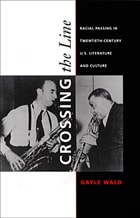
Crossing the Line
Racial Passing in Twentieth-Century U.S. Literature and CultureGayle Wald
Duke University Press, 2000
Wald begins her reading of twentieth-century passing narratives by analyzing works by African American writers James Weldon Johnson, Jessie Fauset, and Nella Larsen, showing how they use the “passing plot” to explore the negotiation of identity, agency, and freedom within the context of their protagonists' restricted choices. She then examines the 1946 autobiography Really the Blues, which details the transformation of Milton Mesirow, middle-class son of Russian-Jewish immigrants, into Mezz Mezzrow, jazz musician and self-described “voluntary Negro.” Turning to the 1949 films Pinky and Lost Boundaries, which imagine African American citizenship within class-specific protocols of race and gender, she interrogates the complicated representation of racial passing in a visual medium. Her investigation of “post-passing” testimonials in postwar African American magazines, which strove to foster black consumerism while constructing “positive” images of black achievement and affluence in the postwar years, focuses on neglected texts within the archives of black popular culture. Finally, after a look at liberal contradictions of John Howard Griffin’s 1961 auto-ethnography Black Like Me, Wald concludes with an epilogue that considers the idea of passing in the context of the recent discourse of “color blindness.”
Wald’s analysis of the moral, political, and theoretical dimensions of racial passing makes Crossing the Line important reading as we approach the twenty-first century. Her engaging and dynamic book will be of particular interest to scholars of American studies, African American studies, cultural studies, and literary criticism.
Crossing through Chueca
Lesbian Literary Culture in Queer MadridJill Robbins
University of Minnesota Press, 2010
Jill Robbins traverses the various literary spaces of the city associated with queer culture, in particular the gay barrio of Chueca, revealing how it is a product of interrelations—a site crisscrossed by a multiplicity of subjects who constitute it as a queer space through the negotiation of their sexual, racial, gender, and class identities. Robbins recognizes Chueca as a political space as well, a refuge from homophobia. She also shows how the spatial and literary practices of Chueca relate to economic issues.
In examining how women’s sexual identities have become visible in and through the Chueca phenomenon, this work is a revealing example of transnational queer studies within the broader Western discussion on gender and sexuality.

Crossings in Text and Textile
Katherine Joslin
University of New Hampshire Press, 2015
A true “state of the field” work, Crossings in Text and Textile charts new scholarly ground at the nexus between fashion, textiles, and literature, appealing to a broad interdisciplinary audience of scholars and students.
Crossings
Creative Ecologies of CruisingJoão Florêncio
Rutgers University Press, 2025
A creative dialogue between a queer artist and a queer academic reminiscing about and thinking with their cruising experiences, Crossings takes queer sex practices and cultures seriously as ways of knowing and world-making. The result is an erotic hybrid form hovering between scholarship and avant-garde experimentation, between critical manifesto and sex memoir. Here, the voices of each author, merged together in one, invite the reader to inhabit the erotic spacetime between self and other, the familiar and the strange, desire and pleasure, climax and release. That is, the spaces and temporalities of cruising itself.
Crossroads Modernism
Descent And Emergence In African-American Literary CultureEdward M. Pavlic
University of Minnesota Press, 2002
An essential reconsideration of black literature and culture and its response to modernity
In the African American encounter with modernism, all was not confrontation. Rather, as Edward M. Pavli´c demonstrates here, African American artists negotiated the intersection of high modernism in Europe and American discourse to fashion their own distinctive response to American modernity. A deft repositioning of black literature and culture, Pavli´c’s book re-envisions the potentials and dilemmas where the different traditions of modernism meet and firmly establishes African American modernism at this cultural crossroads.
Offering new insights into the work of a variety of African American artists—including Ralph Ellison, Richard Wright, Zora Neale Hurston, James Baldwin, Toni Morrison, Robert Hayden, David Bradley, Yusef Komunyakaa, Romare Bearden, and John Coltrane—Pavli´c explores the complex ways in which key modernist philosophical ideas and creative techniques have informed black culture. Crossroads Modernism also provides an in-depth look at how West African cultural legacies are brought to bear in the structure of a truly African American modernist creative process. The book brings to light two interrelated strains of black modernism: Afro-Modernism, which employs established modernist concerns and conceits to illuminate internal and psychological experience; and Diasporic Modernism, which places greater emphasis on shared cultural space and builds on traditions rooted in West African cultures.Whereas much has been said about the (generally racist) use of "blackness" in constituting modernism, Crossroads Modernism is the first book to expose the key role that modernism has played in the constitution of "blackness" in African-American aesthetics. In light of this work, canonical texts in African American literature can no longer be read as devoid of their own singular contribution to international modernism.
Cruel Optimism
Lauren Berlant
Duke University Press, 2011
Arguing that the historical present is perceived affectively before it is understood in any other way, Berlant traces affective and aesthetic responses to the dramas of adjustment that unfold amid talk of precarity, contingency, and crisis. She suggests that our stretched-out present is characterized by new modes of temporality, and she explains why trauma theory—with its focus on reactions to the exceptional event that shatters the ordinary—is not useful for understanding the ways that people adjust over time, once crisis itself has become ordinary. Cruel Optimism is a remarkable affective history of the present.
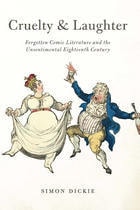
Cruelty and Laughter
Forgotten Comic Literature and the Unsentimental Eighteenth CenturySimon Dickie
University of Chicago Press, 2011
Eighteenth-century British culture is often seen as polite and sentimental—the creation of an emerging middle class. Simon Dickie disputes these assumptions in Cruelty and Laughter, a wildly enjoyable but shocking plunge into the forgotten comic literature of the age. Beneath the surface of Enlightenment civility, Dickie uncovers a rich vein of cruel humor that forces us to recognize just how slowly ordinary human sufferings became worthy of sympathy.
Delving into an enormous archive of comic novels, jestbooks, farces, variety shows, and cartoons, Dickie finds a vast repository of jokes about cripples, blind men, rape, and wife-beating. Epigrams about syphilis and scurvy sit alongside one-act comedies about hunchbacks in love. He shows us that everyone—rich and poor, women as well as men—laughed along. In the process, Dickie also expands our understanding of many of the century’s major authors, including Samuel Richardson, Lady Mary Wortley Montagu, Tobias Smollett, Frances Burney, and Jane Austen. He devotes particular attention to Henry Fielding’s Joseph Andrews, a novel that reflects repeatedly on the limits of compassion and the ethical problems of laughter. Cruelty and Laughter is an engaging, far-reaching study of the other side of culture in eighteenth-century Britain.
Cruising with Robert Louis Stevenson
Travel, Narrative, and the Colonial BodyOliver S. Buckton
Ohio University Press, 2007
Crusoes and Other Castaways in Modern French Literature
Solitary AdventuresJoseph Acquisto
University of Delaware Press, 2012
Published by University of Delaware Press. Distributed worldwide by Rutgers University Press.
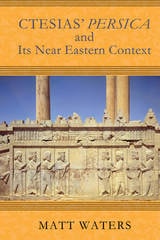
Ctesias’ Persica in Its Near Eastern Context
Matt Waters
University of Wisconsin Press, 2020
Waters, as a historian of Persia with command of Akkadian, Elamite, and Old Persian languages in addition to Latin and Greek, offers a fresh interdisciplinary analysis of the Persica. He shows in detail how Ctesias’ history, though written in a Greek literary style, was infused with two millennia of Mesopotamian and Persian motifs, legends, and traditions. This Hellenized version of Persian culture was enormously influential in antiquity, shaping Greek stereotypes of effeminate Persian monarchs, licentious and vengeful queens, and conniving eunuchs. Waters’ revealing study contributes significantly to knowledge of ancient historiography, Persian dynastic traditions and culture, and the influence of Near Eastern texts and oral tradition on Greek literature.
Cuir Dissidence
Tracing Restorative Criticism and Breaking Bonds with the Mexican CanonFrancesca Dennstedt
Vanderbilt University Press, 2025
Culinary Fictions
Food in South Asian Diasporic CultureAnita Mannur
Temple University Press, 2009
For South Asians, food regularly plays a role in how issues of race, class, gender, ethnicity, and national identity are imagined as well as how notions of belonging are affirmed or resisted. Culinary Fictions provides food for thought as it considers the metaphors literature, film, and TV shows use to describe Indians abroad. When an immigrant mother in Jhumpa Lahiri’s The Namesake combines Rice Krispies, Planters peanuts, onions, salt, lemon juice, and green chili peppers to create a dish similar to one found on Calcutta sidewalks, it evokes not only the character’s Americanization, but also her nostalgia for India.
Food, Anita Mannur writes, is a central part of the cultural imagination of diasporic populations, and Culinary Fictions maps how it figures in various expressive forms. Mannur examines the cultural production from the Anglo-American reaches of the South Asian diaspora. Using texts from novels—Chitra Divakaruni’s Mistress of Spices and Shani Mootoo’s Cereus Blooms at Night—and cookbooks such as Madhur Jaffrey’s Invitation to Indian Cooking and Padma Lakshmi’s Easy Exotic, she illustrates how national identities are consolidated in culinary terms.
Culinary Poetics and Edible Images in Twentieth-Century American Literature
Stacie Cassarino
The Ohio State University Press, 2018
Cassarino takes the reader through the changing dynamics of food production and consumption, from wartime sensibilities of patriotic eating to the postwar excess of culinary cosmopolitanism and finally to contemporary supermarket pastorals. She pairs chefs and poets—Julia Child and Gertrude Stein, Poppy Cannon and Frank O’Hara, Vertamae Smart-Grosvenor and Harryette Mullen—to argue that each converts eating into an aesthetic opportunity that has the power to impact how people consume. In this way, Cassarino reveals the modern cookbook not just as a literary counterpart to contemporary poetry but also as vital to the literature and art occurring around it. From Futurist cookbooks to fast food lyrics, from Gullah recipes to Eat Art, she reminds us that global foodscapes are connected to aesthetic movements in literature and art.
Cultivating Environmental Justice
A Literary History of U.S. Garden WritingRobert S. Emmett
University of Massachusetts Press, 2016
Drawing on ecocriticism, environmental history, landscape architecture, and recent work in environmental justice and food studies, Emmett explores how the language of environmental justice emerged in descriptions of gardening across a variety of literary forms. He reveals early egalitarian associations found in garden writing, despite a popular focus on elite sites such as suburban lawns and formal southern gardens. Cultivating Environmental Justice emphasizes the intergenerational work of gardeners and garden writers who, from the 1930s on, asserted increasingly radical socioeconomic and ecological claims to justice. Emmett considers a wide range of texts by authors including Bernard M'Mahon, Scott and Helen Nearing, Katharine S. White, Elizabeth Lawrence, Alice Walker, and Novella Carpenter.
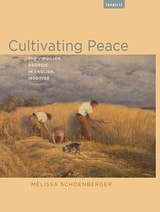
Cultivating Peace
The Virgilian Georgic in English, 1650-1750Schoenberger, Melissa
Bucknell University Press, 2019
Published by Bucknell University Press. Distributed worldwide by Rutgers University Press.
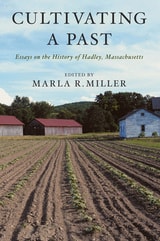
Cultivating a Past
Essays on the History of Hadley, MassachusettsMarla R. Miller
University of Massachusetts Press, 2009
Edited with an introduction by Marla R. Miller, Cultivating a Past brings together fifteen essays, some previously published and others new, that tell the story of Hadley from a variety of disciplinary vantage points. Archaeologists Elizabeth Chilton, Siobhan Hart, Christopher Donta, Edward Hood, and Rita Reinke investigate relations between Native and European communities, while historians Gregory Nobles, Alice Nash, and Pulitzer Prize winner Laurel Thatcher Ulrich explore the social, cultural, and political past of this New England town. Musicologist Andrea Olmstead surveys the career of composer Roger Sessions, costume specialist Lynne Bassett interprets the wardrobes of the town's seventeenth-century residents, Douglas Wilson investigates the connection between Hadley and the regicides William Goffe and Edward Whalley, and Martin Antonetti charts the course of a 1599 Bible alleged to have belonged Goffe.
Taken together, the essays capture how men and women in this small community responded to the same challenges that have faced other New Englanders from the seventeenth century to the present. They also reveal how the town's historical sense of itself evolved along the way, as stories of the alleged "Angel of Hadley," of favorite sons Joseph Hooker and Clarence Hawkes, and of daughters Mary Webster and Elizabeth Porter Phelps contributed to a civic identity that celebrates strength of character.
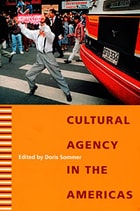
Cultural Agency in the Americas
Doris Sommer, ed.
Duke University Press, 2006
Based in North and South America, scholars from fields including anthropology, performance studies, history, literature, and communications studies explore specific variations of cultural agency across Latin America. Contributors reflect, for example, on the paradoxical programming and reception of a state-controlled Cuban radio station that connects listeners at home and abroad; on the intricacies of indigenous protests in Brazil; and the formulation of cultural policies in cosmopolitan Mexico City. One contributor notes that trauma theory targets individual victims when it should address collective memory as it is worked through in performance and ritual; another examines how Mapuche leaders in Argentina perceived the pitfalls of ethnic essentialism and developed new ways to intervene in local government. Whether suggesting modes of cultural agency, tracking exemplary instances of it, or cautioning against potential missteps, the essays in this book encourage attentiveness to, and the multiplication of, the many extraordinary instantiations of cultural resourcefulness and creativity throughout Latin America and beyond.
Contributors. Arturo Arias, Claudia Briones, Néstor García Canclini, Denise Corte, Juan Carlos Godenzzi, Charles R. Hale, Ariana Hernández-Reguant, Claudio Lomnitz, Jesús Martín Barbero, J. Lorand Matory, Rosamel Millamán, Diane M. Nelson, Mary Louise Pratt, Alcida Rita Ramos, Doris Sommer, Diana Taylor, Santiago Villaveces
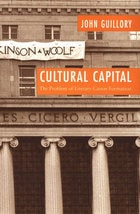
Cultural Capital
The Problem of Literary Canon FormationJohn Guillory
University of Chicago Press, 1993
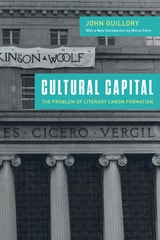
Cultural Capital
The Problem of Literary Canon FormationJohn Guillory
University of Chicago Press, 2023
Since its publication in 1993, John Guillory’s Cultural Capital has been a signal text for understanding the codification and uses of the literary canon. Cultural Capital reconsiders the social basis for aesthetic judgment and exposes the unequal distribution of symbolic and linguistic knowledge on which culture has long been based. Drawing from Pierre Bourdieu’s sociology, Guillory argues that canon formation must be understood less as a question of the representation of social groups and more as a question of the distribution of cultural capital in schools, which regulate access to literacy, to the practices of reading and writing.
Now, as the crisis of the canon has evolved into the so-called crisis of the humanities, Guillory’s groundbreaking, incisive work has never been more urgent. As scholar and critic Merve Emre writes in her introduction to this enlarged edition: “Exclusion, selection, reflection, representation—these are the terms on which the canon wars of the last century were fought, and the terms that continue to inform debates about, for instance, decolonizing the curriculum and the rhetoric of antiracist pedagogy.”

Cultural Conservatism, Political Liberalism
From Criticism to Cultural StudiesJames Seaton
University of Michigan Press, 1996
Chapters on Lionel Trilling, H. L. Mencken and Irving Babbitt, Ralph Ellison, Dwight Macdonald, Diana Trilling, and Edmund Wilson affirm the continuing pertinence of their work to today's concerns. Seaton then turns to the careers of Leslie Fiedler and Susan Sontag to explore the impact of the cultural radicalism of the sixties on literary criticism. Subsequent chapters analyze the successes and failures of contemporary cultural studies through the writings of Richard Rorty, Edward Said, Stanley Fish and Fredric Jameson.
Separately, these chapters provide provocative readings of the individual critics; together they make a case for the tradition exemplified by these critics as an alternative to contemporary cultural studies. The issues the book discusses extend beyond literary criticism and the academic world to the political-religious- cultural conflicts of today's culture wars.
"These lively, closely argued essays explain very clearly what the issues are, how they arose, and why they are important." --Christopher Lasch
"A forceful argument about the relationship between literary studies and politics that will add something important to the vigorous, and often fierce, discussion of the canon, the politics of literature, and educational reform."--William Cain, Wellesley College
James Seaton is Professor of English, Michigan State University. He is co-editor, with William K. Buckley, of Beyond Cheering and Bashing: New Perspectives on the Closing of the American Mind.
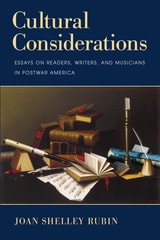
Cultural Considerations
Essays on Readers, Writers, and Musicians in Postwar AmericaJoan Shelley Rubin
University of Massachusetts Press, 2013
Focusing on aspects of American literary and musical culture in the decades after World War II, Rubin examines the contests between critics and their readers over the authority to make aesthetic judgments; the effort of academics to extend the university outward by bringing the humanities to a wide public; the politics of setting poetic texts to music; the role of ideology in the practice of commissioning and performing choral works; and the uses of reading in the service of both individualism and community. Specific topics include the 1957 attack by the critic John Ciardi on the poetry of Anne Morrow Lindbergh in the Saturday Review; the radio broadcasts of the classicist Gilbert Highet; Dwight Macdonald's vitriolic depiction of the novelist James Gould Cozzens as a pernicious middlebrow; the composition and reception of Howard Hanson's "Song of Democracy"; the varied career of musician Gunther Schuller; the liberal humanism of America's foremost twentieth-century choral conductor, Robert Shaw; and the place of books in the student and women's movements of the 1960s.
What unites these essays is the author's ongoing concern with cultural boundaries, mediation, and ideology--and the contradictions they frequently entail.

Cultural Difference and the Literary Text
Pluralism and the Limits of Authenticity in North American LiteratureWinfried Siemerling
University of Iowa Press, 1997
This dynamic, open-minded collection of essays responds to the issues raised by Werner Sollors when he argues against the rigidity of cultural pluralism, against the ethnic group-by-group segregation of American literature. Instead he calls for an openly transethinic recognition of cross-cultural interplays and connections among all so-called groups and their canons. In enthusiastic response to such issues, the contributors explore a variety of approaches to pluralism, multiculturalism, group identity, and the problematics of authenticity in literary texts and criticism both historically and currently.
The scholars in this civil, persuasive volume are at home in an international world that crosses linguistic, cultural, and national boundaries. They thus transcend the customary restrictions of earlier, relatively isolationist scholarship to form new, nonpolemical links among cultural identities. This relationship between oral modes of communal identity and writing in tribal cultures joins an examination of Houston Baker's discursive strategies. A consideration of ethnic humor in the writings of Zora Neale Hurston and Jerre Mangione and a discussion of Jean Toomer's racial persona offer striking contextualizations. Two contributors study discursive constructions of mestizaje in Chicano/a texts, followed by essays on cultural difference in Faulkner's Light in August and Roth's Call It Sleep.Finally, Werner Sollers's essay extends the interactions among all these energetic, nonjudgmental dialogues.
Cultural Erotics in Cuban America
Ricardo L. Ortíz
University of Minnesota Press, 2006
In this wide-ranging work Ortíz argues for the authentically diasporic quality of postrevolutionary, off-island Cuban experience. Highlighting various forms of cultural expression, Cultural Erotics in Cuban America traces underrepresented communities’ responses to the threat of cultural disappearance in an overwhelming and hegemonic U.S. culture. Ortíz shows how the work of Cuban-American writers and artists challenges the heteronormativity of both home and host culture. Focusing on artists who have had an ambivalent, indirect, or nonexistent connection to Miami, he presents close readings of such novelists as Reinaldo Arenas, Roberto G. Fernández, Achy Obejas, and Cristina García, the playwright Eduardo Machado, the poet Rafael Campo, and musical performers Albita Rodríguez and Celia Cruz.
Ortíz charts the legacies of sexism and homophobia in patriarchal Cuban culture, as well as their influence on Cuban-revolutionary and Cuban-exile ideologies. Moving beyond the outdated cultural terms of the Cold War, he looks forward to envision queer futures for Cuban-American culture free from the ties to restrictive—indeed, oppressive—constructions of nation, place, language, and desire.
Ricardo L. Ortíz is associate professor of English at Georgetown University.
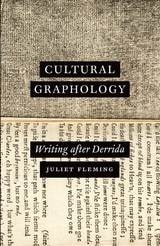
Cultural Graphology
Writing after DerridaJuliet Fleming
University of Chicago Press, 2016
Fleming shows that the single most important lesson to survive from Derrida’s early work is that we do not know what writing is. Channeling Derrida’s thought into places it has not been seen before, she examines printed errors, spaces, and ornaments (topics that have hitherto been marginal to our accounts of print culture) and excavates the long-forgotten reading practice of cutting printed books. Proposing radical deformations to the meanings of fundamental and apparently simple terms such as “error,” “letter,” “surface,” and “cut,” Fleming opens up exciting new pathways into our understanding of writing all told.