Results by title
1882 books match the query 'Criticism and interpretation' and 112 start with c
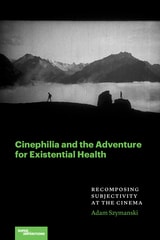
Cinephilia and the Adventure for Existential Health
Recomposing Subjectivity at the CinemaAdam Szymanski
Northwestern University Press, 2025
Exploring how art cinema cultivates existential health through the films of Olivier Assayas
This book proposes that cinephilia can facilitate existential health, which makes palpable the potential for subjectivity to be recomposed through meaningful encounters with cinema. Adam Szymanskidraws on the ethos of psychoanalyst Félix Guattari and thinks with select films from director Olivier Assayas—including Clouds of Sils Maria and Personal Shopper—to theorize how the cinema can be invested with therapeutic value. Cinephilia and the Adventure for Existential Health engages the history of psychoanalytic film theory, excavates its long-standing concern with the production of spectatorial subjectivity, and challenges pathologizing understandings of cinema spectatorship couched in identification, fetishism, and voyeurism. By embracing the indeterminacy of the cinematic experience and the adventurous disposition of cinephilia, the book allies itself to the pursuit of collective health and challenges the logic of medical power.
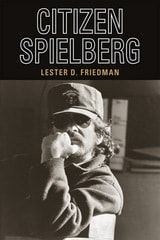
Citizen Spielberg
Lester D. Friedman
University of Illinois Press, 2010
In Citizen Spielberg, Lester D. Friedman fills that void with a systematic analysis of the various genres in which the director has worked, including science fiction (E.T.), adventure (Raiders trilogy), race films (The Color Purple, Amistad), and war films (Saving Private Ryan, Schindler’s List). Friedman concludes that Spielberg’s films present a sustained artistic vision combined with a technical flair matched by few other filmmakers, and makes a compelling case for Spielberg to be considered as a major film artist.
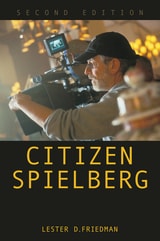
Citizen Spielberg
Lester D. Friedman
University of Illinois Press, 2022
This new edition of Citizen Spielberg expands Friedman’s original analysis to include films of the 2010s like Lincoln and Ready Player One. Breaking down the works by genre, Friedman looks at essential aspects of Spielberg’s art, from his storytelling concerns and worldview to the uncanny connection with audiences that has powered his longtime influence as a cultural force. Friedman's examination reveals a sustained artistic vision--a vision that shows no sign of exhausting itself or audiences after Spielberg's nearly fifty years as a high-profile filmmaker.
Incisive and discerning, Citizen Spielberg offers a career-spanning appraisal of a moviemaking icon.
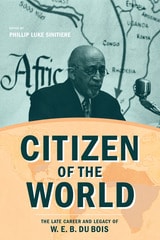
Citizen of the World
The Late Career and Legacy of W. E. B. Du BoisEdited by Phillip Luke Sinitiere
Northwestern University Press, 2019
From his birth in 1868 until his death in 1963, Du Bois sought the liberation of black people in the United States and across the world through intellectual and political labor. His tireless efforts documented and demonstrated connections between freedom for African-descended people abroad and black freedom at home.
In concert with growing scholarship on his twilight years, the essays in this volume assert the fundamental importance of considering Du Bois’s later decades not as a life in decline that descended into blind ideological allegiance to socialism and communism but as the life of a productive, generative intellectual who responded rationally, imaginatively, and radically to massive mid-century changes around the world, and who remained committed to freedom’s realization until his final hour.
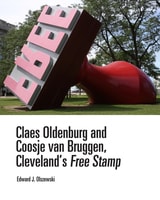
Claes Oldenburg and Coosje van Bruggen, Cleveland’s Free Stamp
Cleveland’s Free StampEdward J. Olszewski
Ohio University Press, 2017
In 1985, the Sohio oil company commissioned Claes Oldenburg and Coosje van Bruggen to design and construct a large outdoor sculpture for its new corporate headquarters in Cleveland, Ohio. The result was Free Stamp, a bold and distinctive installation that captured both a Pop Art sensibility and a connection to the city’s industrial past. Sohio executives approved the design, and work was already underway, when British Petroleum acquired the company. The new owners quickly decided that the sculpture was “inappropriate” for their building and attempted to rid themselves of Free Stamp by donating it to the city of Cleveland—a gift that the city initially had no desire to accept. After much debate and public protest, the sculpture found a home in Willard Park, where it stands today.
This is the first study of any sculpture by Oldenburg and van Bruggen to examine the genesis of their art from conception to installation. Edward J. Olszewski has put together a fascinating narrative based on interviews with the artists, archival material from city records, and in-house corporate memoranda, as well as letters to the editor and political cartoons. He traces the development of the sculpture from the artists’ first sketches and models to the installation of the completed work in its urban environment.
Claire Denis
Judith Mayne
University of Illinois Press, 2005
Widely regarded as one of the most innovative and passionate filmmakers working in France today, Claire Denis has continued to make beautiful and challenging films since the 1988 release of her first feature, Chocolat. Judith Mayne's comprehensive study traces Denis's career and discusses her major feature films in rich detail.
Born in Paris but raised in West Africa, Denis explores in her films the legacies of French colonialism and the complex relationships between sexuality, gender, and race. From the adult woman who observes her past as a child in Cameroon to the Lithuanian immigrant who arrives in Paris and watches a serial killer to the disgraced French Foreign Legionnaire attempting to make sense of his past, the subjects of Denis's films continually revisit themes of watching, bearing witness, and making contact, as well as displacement, masculinity, and the migratory subject.

Claribel Alegría and Central American Literature
Critical EssaysSandra M. Boschetto-Sandoval
Ohio University Press, 1993
These essays examine the multifaceted work of the Central American author whom Latin American literary historians consider precursor of “cultural dialogism” in poetry and fiction. As poet, essayist, journalist, novelist, and writer of “quasi–testimonio,” Alegría’s multiple discourses transgress the boundaries between traditional and postmodern political theories and practices. Her work reveals an allegory of relation and negotiation between “intelligentsia” and subaltern peoples as well as the need for a more socially extensive literature, not exclusive of more elite “magical literatures.”
The essays in the fist section frame Alegría’s discourses within sociohistorical, political, and literary contexts in order to illuminate the author’s singular place in the literary and political history of Central America. The essays in the second section engage in a feminist dialogic in which the reader encounters various critical validations and valorizations of Alegría’s many female voices. The third section involves the reader in the pursuit of extratextual or extraliterary resonances in Alegría’s work.
Classics Beyond the Pleasure Principle
Edited by Paul Allen Miller and Mario Telò
The Ohio State University Press, 2026
Contributors:
Karen Bassi, Martin Devecka, Micaela Janan, Hagi Kenaan, Vered Lev Kenaan, Sara Lindheim, Paul Allen Miller, Helen Morales, Jay Oliver, Victoria Rimell, Mario Telò
Clear-Cutting Eden
Ecology and the Pastoral in Southern LiteratureChristopher Rieger
University of Alabama Press, 2009
Examines how Southern literary depictions of the natural world were influenced by the historical, social, and ecological changes of the 1930s and 1940s
Rieger studies the ways that nature is conceived of and portrayed by four prominent Southern writers of the era: Erskine Caldwell, Marjorie Kinnan Rawlings, Zora Neale Hurston, and William Faulkner. Specifically, he argues that these writers created new versions of an old literary mode—the pastoral—in response to the destabilizing effects of the Great Depression, the rise of Southern modernism, and the mechanization of agricultural jobs.
Mass deforestation, soil erosion, urban development, and depleted soil fertility are issues that come to the fore in the works of these writers. In response, each author depicts a network model of nature, where humans are part of the natural world, rather than separate, over, or above it, as in the garden pastorals of the Old South, thus significantly revising the pastoral mode proffered by antebellum and Reconstruction-era writers.
Each writer, Rieger finds, infuses the pastoral mode with continuing relevance, creating new versions that fit his or her ideological positions on issues of race, class, and gender. Despite the ways these authors represent nature and humankind’s place in it, they all illustrate the idea that the natural environment is more than just a passive background against which the substance of life, or fiction, is played out.
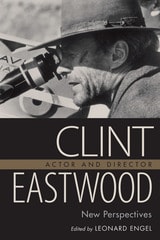
Clint Eastwood, Actor and Director
New PerspectivesLeonard Engel
University of Utah Press, 2007
The contributors to this volume revisit and examine his career as an actor and director, and are part of a growing critical evaluation of Eastwood's films. A common thread, however, is their respect for his cinematic storytelling. They examine how he put his individual stamp on particular genres, while extending and enriching our understanding of his achievements.
Clio's Other Sons
Berossus and ManethoJohn Dillery
University of Michigan Press, 2015
Close Writing
Kathy Acker, Cookie Mueller, and Love-in-PiecesAlice Butler
Duke University Press, 2026
Cognitive Fictions
Joseph Tabbi
University of Minnesota Press, 2002
The first comprehensive look at the effect of new technologies on contemporary American fiction
Bringing together cognitive science and literary analysis to map a new "media ecology," Cognitive Fictions limns an evolutionary process in which literature must find its place in an artificial environment partly produced and thoroughly mediated by technological means. Joseph Tabbi provides a penetrating account of a developing consciousness emerging from the struggle between print and electronic systems of communication.
Central to Tabbi’s work is the relation between the arrangement of communicating "modules" that cognitive science uses to describe the human mind and the arrangement of visual, verbal, and aural media in our technological culture. He looks at particular literary works by Thomas Pynchon, Richard Powers, David Markson, Lynne Tillman, Paul Auster, and others as both inscriptions of thought consistent with distributed cognitive models, and as self-creations out of the media environment. The first close reading of contemporary American writing in the light of systems theory and cognitive science, Cognitive Fictions makes needed sense of how the moment-by-moment operations of human thought find narrative form in a world increasingly defined by competing and often incompatible representations.
Collective Body
Aleksandr Deineka at the Limit of Socialist RealismChristina Kiaer
University of Chicago Press, 2024
Dislodging the avant-garde from its central position in the narrative of Soviet art, Collective Body presents painter Aleksandr Deineka’s haptic and corporeal version of Socialist Realist figuration as an alternate experimental aesthetic that, at its best, activates and organizes affective forces for collective ends. Christina Kiaer traces Deineka’s path from his avant-garde origins as the inventor of the proletarian body in illustrations for mass magazines after the revolution through his success as a state-sponsored painter of monumental, lyrical canvases during the Terror and beyond. In so doing, she demonstrates that Socialist Realism is best understood not as a totalitarian style but as a fiercely collective art system that organized art outside the market and formed part of the legacy of the revolutionary modernisms of the 1920s. Collective Body accounts for the way the art of the October Revolution continues to capture viewers’ imaginations by evoking the elation of collectivity, making viewers not just comprehend but truly feel socialism, and retaining the potential to inform our own art-into-life experiments within contemporary political art. Deineka figures in this study not as a singular master, in the spirit of a traditional monograph, but as a limit case of the system he inhabited and helped to create.
Collusions of Fact and Fiction
Performing Slavery in the Works of Suzan-Lori Parks and Kara WalkerSaal, Ilka
University of Iowa Press, 2021
Saal argues that the attempt to reconstruct or recuperate the experience of African Americans under slavery is no longer at stake in the works of artists growing up in the post–Civil Rights era. Instead, they lay bare the discursive dimension of our contemporary understanding of the past and address the continued impact of its various verbal and visual signs upon contemporary identities. In this manner, Parks and Walker stake out new possibilities for engaging the past and inhabiting the present and future.
Colonial Strangers
Women Writing the End of the British EmpireLassner, Phyllis
Rutgers University Press, 2004
Drawing on memoirs, fiction, reportage, and film adaptations, Colonial Strangers explores the critical perspectives of writers who correct prevailing stereotypes of British women as agents of imperialism. They also question their own participation in British claims of moral righteousness and British politics of cultural exploitation. These authors take center stage in debates about connections between the racist ideologies of the Third Reich and the British Empire.
Colonial Strangers reveals how the literary responses of key artists represent not only compelling reading, but also a necessary intervention in colonial and postcolonial debates and the canons of modern British fiction.
Colonization, Violence, and Narration in White South African Writing
André Brink, Breyten Breytenbach, and J. M. CoetzeeRosemary Jane Jolly
Ohio University Press, 1995
The representation of pain and suffering in narrative form is an ongoing ethical issue in contemporary South African literature. Can violence be represented without sensationalistic effects, or, alternatively, without effects that tend to be conservative because they place the reader in a position of superiority over the victim or the perpetrator?
Jolly looks at three primary South African authors—André Brink, Breyten Breytenbach, and J. M. Coetzee—to consider violence in the context of apartheid and colonialism and their inherent patriarchies.
Jolly also discusses the violence attendant upon the act of narration in the broader context of critiques of Kafka, Freud, Hegel, the postcolonial critics Jan Mohamed and Bhabha, and feminists such as Susan Suleiman.
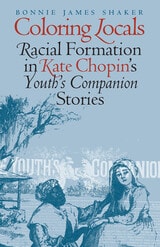
Coloring Locals
Racial Formation in Katie Chopin's "Youth's Companion" StoriesBonnie James Shaker
University of Iowa Press, 2003
Chopin's canonical status as a feminist rebel and reformer conflicts with the fact that one of her most supportive publishers throughout her life was the Youth's Companion, a juvenile periodical whose thoroughly orthodox “family values” contributed to its success as the longest-running and, at one time, most widely circulating periodical in nineteenth-century America. Not surprisingly, Chopin’s Youth’s Companion stories differ from her canonical texts in that they embrace and advance ideals of orthodox white femininity and masculinity. Rather than viewing these two representations as being at odds with each other, Bonnie Shaker asserts that Chopin's endorsement of conventional gender norms is done in the service of a second political agenda beyond her feminism, one that can help the reader appreciate nuances of identity construction previously misunderstood or overlooked in the body of her work.
Comic Faith
The Great Tradition from Austen to JoyceRobert M. Polhemus
University of Chicago Press, 1980
Coming Close
Forty Essays on Philip LevineMari L'Esperance and Tomas Morin
University of Iowa Press, 2013
Coming To
Consciousness and Natality in Early Modern EnglandTimothy M. Harrison
University of Chicago Press, 2020
Commentary and Ideology
Dante in the RenaissanceDeborah Parker
Duke University Press, 1993
Parker begins by tracing the criticism of Dante commentaries from the nineteenth century to the present and then examines the tradition of commentary from the Middle Ages to the Renaissance. She shows how the civic, institutional, and social commitments of commentators shaped their response to the Comedy, and how commentators tried to use the poem as an authoritative source for various kinds of social legitimation. Parker discusses how different commentators dealt with a deeply political section of the poem: the damnation of Brutus and Cassius.
The scope and importance of Commentary and Ideology will command the attention of a broad group of scholars, including Italian specialists on Dante, late medievalists, students and professionals in early modern European literature, bibliographers, critical theorists, historians of literary criticism and theory, and cultural and intellectual historians.
Communities of Death
Whitman, Poe, and the American Culture of MourningAdam C. Bradford
University of Missouri Press, 2014
Community across Time
Robert Morgan’s Words for HomeRebecca Godwin
West Virginia University Press, 2023
One of the first book-length considerations of the Appalachian writer Robert Morgan.
One of the first book-length studies of Robert Morgan, Community across Time considers the Appalachian writer’s explorations of memory, family history, and landscape. It provides a study of all of Morgan’s fiction to date, as well as a chapter on his poetry and some reference, where appropriate, to his nonfiction. Rebecca Godwin examines the family history that informs much of this body of work, offering an extended biographical essay that ties characters and plot details to Morgan’s ancestors’ lives and to his own experiences growing up in the Blue Ridge Mountains.
Religious rifts, economic hardships, class conflicts, the place of women and Indigenous peoples, and the failure of humans to recognize the divinity of the natural world are among the motifs centering Morgan’s writing. Community across Time explores those themes as it looks to Morgan’s relationship to the Appalachian South.
Comparative Essays on the Poetry and Prose of John Donne and George Herbert
Combined LightsRussell M. Hillier
University of Delaware Press, 2022
Complete Poems. A Bilingual Edition
Pernette du Guillet
Iter Press, 2010
This first complete English edition provides a fully-annotated bilingual text and a fresh perspective from which to appreciate the originality and beauty of this poetry.
Complete Poems
A Bilingual EditionVeronica Gambara
Iter Press, 2014
Confessions of a Prosaic Dreamer
Charles Lamb's Art of AutobiographyGerald Monsman
Duke University Press, 1984
Gerald Monsman in this study abandons the customary chronological approach to Lamb's life in favor of a more incisive, open-ended discussion of the Elia essays. By a close textual examination of Lamb's language, he relates the essayist's use of symbol and autobiographical concerns. Monsman contends and demonstrates that "as sharply and as pertinently as any artistic voice, Elia, the most celebrated persona in the nineteenth century, focuses the problems inherent in the modern literary imagination." Elia's "textual identity is a function of the author's actual life, of losses and imperfections artistically utilized and harmonized, employed against themselves to produce the rehabilitating symbol."
Congenial Souls
Reading Chaucer from Medieval to PostmodernStephanie Trigg
University of Minnesota Press, 2001
Conrad's Shadow
Catastrophe, Mimesis, TheoryNidesh Lawtoo
Michigan State University Press, 2016
Considering Maus
Approaches to Art Spiegelman's "Survivor's Tale" of the HolocaustDeborah R. Geis
University of Alabama Press, 2007
The first collection of critical essays on Maus, the searing account of one Holocaust survivor's experiences rendered in comic book form.
In 1992, Art Spiegelmans two-volume illustrated work Maus: A Survivor’s Tale was awarded a special-category Pulitzer Prize. In a comic book form, Spiegelman tells the gripping, heart-rending story of his father's experiences in the Holocaust. The book renders in stark clarity the trials Spiegelman's father endured as a Jewish refugee in the ghettos and concentration camps of Poland during World War II, his American life following his immigration to New York, and the author's own troubled sense of self as he grapples with his father's history. Mixing autobiography, biography, and oral history in the comic form, Maus has been hailed as a daring work of postmodern narration and as a vivid example of the power of the graphic narrative.
Now, for the first time in one collection, prominent scholars in a variety of fields take on Spiegelman's text and offer it the critical and artistic scrutiny it deserves. They explore many aspects of the work, including Spiegelman’s use of animal characters, the influence of other "comix" artists, the role of the mother and its relation to gender issues, the use of repeating images such as smoke and blood, Maus's position among Holocaust testimonials, its appropriation of cinematic technique, its use of language and styles of dialect, and the implications of the work’s critical and commercial success.
Informed readers in many areas of study, from popular culture and graphic arts to psychoanalysis and oral history, will value this first substantial collection of criticism on a revered work of literature.

Conspicuous Bodies
Provincial Belief and the Making of Joyce and RushdieJean Kane
The Ohio State University Press, 2014
Conspicuous Bodies presents Joyce as a founder and Rushdie as an inheritor of a distinctive discourse of belief about the importance of physical bodies and knowledge in religious practice. In doing so, it moves the reception of Joyce and Rushdie away from what previous critics have emphasized—away from questions of aesthetics and from a narrow understanding of belief—and instead questions the assumption that belief should be segregated from matters of physicality and knowledge. Kane reintroduces the concept of spiritual embodiment in order to expand our understanding of what counts as spiritual agency in non-western and minority literatures.
Conspiracy Theory in Latin Literature
By Victoria Emma Pagán
University of Texas Press, 2012
Conspiracy theory as a theoretical framework has emerged only in the last twenty years; commentators are finding it a productive way to explain the actions and thoughts of individuals and societies. In this compelling exploration of Latin literature, Pagán uses conspiracy theory to illuminate the ways that elite Romans invoked conspiracy as they navigated the hierarchies, divisions, and inequalities in their society. By seeming to uncover conspiracy everywhere, Romans could find the need to crush slave revolts, punish rivals with death or exile, dismiss women, denigrate foreigners, or view their emperors with deep suspicion. Expanding on her earlier Conspiracy Narratives in Roman History, Pagán here interprets the works of poets, satirists, historians, and orators—Juvenal, Tacitus, Suetonius, Terence, and Cicero, among others—to reveal how each writer gave voice to fictional or real actors who were engaged in intrigue and motivated by a calculating worldview.
Delving into multiple genres, Pagán offers a powerful critique of how conspiracy and conspiracy theory can take hold and thrive when rumor, fear, and secrecy become routine methods of interpreting (and often distorting) past and current events. In Roman society, where knowledge about others was often lacking and stereotypes dominated, conspiracy theory explained how the world worked. The persistence of conspiracy theory, from antiquity to the present day, attests to its potency as a mechanism for confronting the frailties of the human condition.
Constraining Chance
Georges Perec and the OulipoAlison Sian James
Northwestern University Press, 2008
A token of the world’s instability and of human powerlessness, chance is inevitably a crucial literary theme. It also presents formal problems: Must the artist struggle against chance in pursuit of a flawless work? Or does chance have a place in the artistic process or product? This book examines the representation and staging of chance in literature through the study of a specific case—the work of the twentieth-century French writer Georges Perec (1936–82).
In Constraining Chance, James explores the ways in which Perec’s texts exploit the possibilities of chance, by both tapping into its creative potential and controlling its operation. These works, she demonstrates, strive to capture essential aspects of human life: its "considerable energy" (Perec’s phrase), its boundless possibilities, but also the constraints and limitations that bind it. A member of the Ouvroir de littérature potentielle (known as Oulipo), Perec adopted the group’s dictum that the literary work should be "anti-chance"—a product of fully conscious creative processes. James shows how Perec gave this notion a twist, using Oulipian precepts both to explore the role of chance in human existence and to redefine the possibilities of literary form. Thus the investigation of chance links Perec’s writing methods, which harness chance for creative purposes, to the thematic exploration of causality, chance, and fate in his writings.
Constraining Chance has received early praise from scholars in the field. Warren F. Motte calls it "an erudite, engaging, intellectually intrepid reflection on the ways in which one of the most powerful authors of the twentieth century grappled with the notion of chance. [James] writes with both elegance and authority, inviting us to see Georges Perec's work through a new lens, one where chance may be viewed as a positive potential, fully enlisted in the service of ‘intentional’ literature."
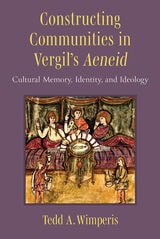
Constructing Communities in Vergil's Aeneid
Cultural Memory, Identity, and IdeologyTedd A. Wimperis
University of Michigan Press, 2024
Where previous studies of identity and memory in the Aeneid have focused on the poem’s constructions of Roman identity, Constructing Communities turns the spotlight onto the characters themselves to show how the world inside the poem is replicating, as if in miniature, real forms of contemporary political and cultural discourse, reflecting an historical milieu where appeals to Roman identity were vigorously asserted in political rhetoric. The book applies this evidence to a broad literary analysis of the Aeneid, as well as a reevaluation of its engagement with Roman imperial ideology in the Age of Augustus.
Constructing German Walt Whitman
Walter Grunzweig
University of Iowa Press, 1994
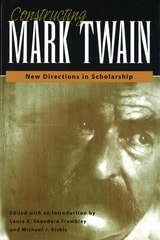
Constructing Mark Twain
New Directions in ScholarshipEdited with an introduction by Laura E. Skandera-Trombley and Michael J. Kiskis
University of Missouri Press, 2001
The thirteen essays in this collection combine to offer a complex and deeply nuanced picture of Samuel Clemens. With the purpose of straying from the usual notions of Clemens (most notably the Clemens/Twain split that has ruled Twain scholarship for over thirty years), the editors have assembled contributions from a wide range of Twain scholars. As a whole, the collection argues that it is time we approach Clemens not as a shadow behind the literary persona but as a complex and intricate creator of stories, a creator who is deeply embedded in the political events of his time and who used a mix of literary, social, and personal experience to fuel the movements of his pen.
The essays illuminate Clemens's connections with people and events not usually given the spotlight and introduce us to Clemens as a man deeply embroiled in the process of making literary gold out of everyday experiences. From Clemens's wonderings on race and identity to his looking to family and domesticity as defining experiences, from musings on the language that Clemens used so effectively to consideration of the images and processes of composition, these essays challenge long-held notions of why Clemens was so successful and so influential a writer. While that search itself is not new, the varied approaches within this collection highlight markedly inventive ways of reading the life and work of Samuel Clemens.
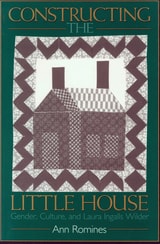
Constructing the Little House
Gender, Culture, and Laura Ingalls WilderAnn Romines
University of Massachusetts Press, 1997
Ann Romines interweaves personal observation with scholarly analysis to address these questions. Writing from a feminist perspective and drawing on resources of gender studies, cultural studies, and new historicist reading, she examines both the content of the novels and the process of their creation. She explores the relationship between mother and daughter working as collaborative authors and calls into question our assumptions about plot, juvenile fiction, and constructions of gender on the nineteenth-century frontier and in the Depression years when the Little House books were written.
This is a book that will appeal both to scholars and to general readers who might welcome an engaging and accessible companion volume to the Little House novels.
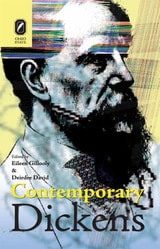
Contemporary Dickens
Edited by Eileen Gillooly and Deirdre David
The Ohio State University Press, 2008
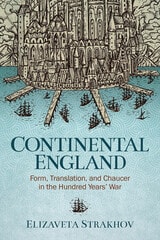
Continental England
Form, Translation, and Chaucer in the Hundred Years’ WarElizaveta Strakhov
The Ohio State University Press, 2022
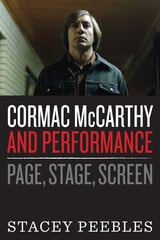
Cormac McCarthy and Performance
Page, Stage, ScreenBy Stacey Peebles
University of Texas Press, 2017
Cormac McCarthy is renowned as the author of popular and acclaimed novels such as Blood Meridian, All the Pretty Horses, and The Road. Throughout his career, however, McCarthy has also invested deeply in writing for film and theater, an engagement with other forms of storytelling that is often overlooked. He is the author of five screenplays and two plays, and he has been significantly involved with three of the seven film adaptations of his work. In this book, Stacey Peebles offers the first extensive overview of this relatively unknown aspect of McCarthy’s writing life, including the ways in which other artists have interpreted his work for the stage and screen.
Drawing on many primary sources in McCarthy’s recently opened archive, as well as interviews, Peebles covers the 1977 televised film The Gardener’s Son; McCarthy’s unpublished screenplays from the 1980s that became the foundation for his Border Trilogy novels and No Country for Old Men; various successful and unsuccessful productions of his two plays; and all seven film adaptations of his work, including John Hillcoat’s The Road (2009) and the Coen brothers’ Oscar-winning No Country for Old Men (2007). Emerging from this narrative is the central importance of tragedy—the rich and varied portrayals of violence and suffering and the human responses to them—in all of McCarthy’s work, but especially his writing for theater and film.
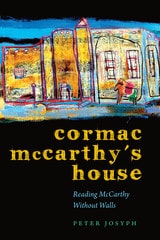
Cormac McCarthy's House
Reading McCarthy Without WallsBy Peter Josyph
University of Texas Press, 2013
Novelist Cormac McCarthy’s brilliant and challenging work demands deep engagement from his readers. In Cormac McCarthy’s House, author, painter, photographer, and actor-director Peter Josyph draws on a wide range of experience to pose provocative, unexpected questions about McCarthy’s work, how it is achieved, and how it is interpreted.
As a visual artist, Josyph wrestles with the challenge of rendering McCarthy’s former home in El Paso as a symbol of a great writer’s workshop. As an actor and filmmaker, he analyzes the high art of Tommy Lee Jones in The Sunset Limited and No Country for Old Men. Invoking the recent suicide of a troubled friend, he grapples with the issue of “our brother’s keeper” in The Crossing and The Sunset Limited. But for Josyph, reading the finest prose-poet of our day is a project into which he invites many voices, and his investigations include a talk with Mark Morrow about photographing McCarthy while he was writing Blood Meridian; an in-depth conversation with director Tom Cornford on the challenges of staging The Sunset Limited and The Stonemason; a walk through the streets, waterfronts, and hidden haunts of Suttree with McCarthy scholar and Knoxville resident Wesley Morgan; insights from the cast of The Gardener’s Son about a controversial scene in that film; actress Miriam Colon’s perspective on portraying the Dueña Alfonsa opposite Matt Damon in All the Pretty Horses; and a harsh critique of Josyph’s views on The Crossing by McCarthy scholar Marty Priola, which leads to a sometimes heated debate. Illustrated with thirty-one photographs, Josyph’s unconventional journeys into the genius of Cormac McCarthy form a new, highly personal way of appreciating literary greatness.
Cormac McCarthy's Western Novels
Barcley Owens
University of Arizona Press, 2000
In the continuing redefinition of the American West, few recent writers have left a mark as indelible as Cormac McCarthy. A favorite subject of critics and fans alike despite—or perhaps because of—his avoidance of public appearances, the man is known solely through his writing. Thanks to his early work, he is most often associated with a bleak vision of humanity grounded in a belief in man's primordial aggressiveness.
McCarthy scholar Barcley Owens has written the first book to concentrate exclusively on McCarthy's acclaimed western novels: Blood Meridian, National Book Award winner All the Pretty Horses, The Crossing, and Cities of the Plain. In a thought-provoking analysis, he explores the differences between Blood Meridian and the Border Trilogy novels and shows how those differences reflect changing conditions in contemporary American culture.
Owens captures both Blood Meridian's wanton violence and the Border Trilogy's fond remembrance of the Old West. He shows how this dramatic shift from atavistic brutality to nostalgic Americana suggests that McCarthy has finally given his readers what they most want—the stuff of their mythic dreams.
Owens's study is both an incisive look at one of our most important and demanding authors and a penetrating analysis of violence and myth in American culture. Fans of McCarthy's work will find much to consider for ongoing discussions of this influential body of work.
Cormac McCarthy
An American ApocalypseMarkus Wierschem
Michigan State University Press, 2024
Cornelius Nepos
A Study in the Evidence and InfluenceJohn Alexander Lobur
University of Michigan Press, 2021
Cornelius Nepos: A Study in the Evidence and Influence begins by exploring the writer's ancient reception, which suggests he was in no way seen as beneath consideration by the Romans themselves. The volume then deconstructs the critical framework that cast him as an "inferior" author in the classical canon. What emerges is an author who reworked Greek historical narratives in a learned, sophisticated way, yet one still limited by the compositional logistics and limitations inherent in ancient scholarship. The study then explores his contemporary relationships and embeds his work among the crucial ideological activity at play in the late Republic and Triumviral periods. Cornelius Nepos spends considerable time on the fragmentary evidence (which highlights Nepos' interest in changes in fashion and consumption) to suggest that he was a valued cultural elder who informed a public eager to recover a sense of tradition during a period of bewilderingly fast social and cultural change. The book finishes with a thematic examination of the entire Lives of the Foreign Commanders (a set of biographies on ancient non-Roman generals) to show that despite the expression of very “Republican” sentiments, he was in fact fashioning an ideological framework for something imperial and quasi-monarchic which, though autocratic, was still antityrannical and imagined as resting on a broad and “democratic” foundation of social consent. Nepos saw that Rome would soon be ruled by one person, and his biographies show how the elites of the day both processed that reality and attempted to circumscribe it for good ends through the creation of new models of legitimacy.
Corridors of Deceit
The World of John le CarréPeter Wolfe
University of Wisconsin Press, 1987
Peter Wolfe has produced an informative study of le Carré’s works, showing how le Carré’s five years in the Service (British Intelligence) helped him become a keen observer, social historian, and expert in bureaucratic politics. He has supplanted the technological flair marking much of today's spy fiction with moral complexity and psychological depth. He shows us what spies are like, how they feel about spying, and how spying affects their minds and hearts.
Cosmas of Prague
Lisa Wolverton
Catholic University of America Press, 2014
Cosmopolitan Love
Utopian Vision in D. H. Lawrence and Eileen ChangSijia Yao
University of Michigan Press, 2023
Finalist: 2024 Southern Atlantic Modern Language Association (SAMLA) Book Award Finalist | 05/21/2024
Love, and the different manifestations of it, is a common theme in literature around the world. In Cosmopolitan Love, Sijia Yao examines the writings of D. H. Lawrence, a British writer whose literature focused primarily on interpersonal relationships in domestic settings, and Eileen Chang, a Chinese writer who migrated to the United States and explored Chinese heterosexual love in her writing. While comparing the writings of a Chinese writer and an English one, Yao avoids a direct comparison between East and West that could further enforce binaries. Instead, she uses the comparison to develop an idea of cosmopolitanism that shows how the writers are in conversation with their own culture and with each other. Both D. H. Lawrence and Eileen Chang wrote stories that are influenced by—but sometimes stand in opposition to—their own cultures. They offer alternative understandings of societies dealing with modernism and cultural globalization. Their stories deal with emotional pain caused by the restrictions of local politics and economics and address common themes of incestuous love, sexual love, adulterous love, and utopian love. By analyzing their writing, Yao demonstrates that the concept of love as a social and political force can cross cultural boundaries and traditions to become a basis for human meaning, the key to a cosmopolitan vision.
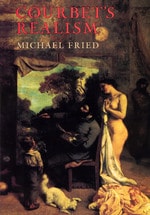
Courbet's Realism
Michael Fried
University of Chicago Press, 1990
Courbet's Realism is clearly a major contribution to the highly active field of Courbet studies. . . . But to contribute here and now is necessarily also to contribute to central debates about art history itself, and so the book is also—I hesitate to say 'more importantly,' because of the way object and method are woven together in it—a major contribution to current attempts to rethink the foundations and objects of art history. . . . It will not be an easy book to come to terms with; for all its engagement with contemporary literary theory and related developments, it is not an application of anything, and its deeply thought-through arguments will not fall easily in line with the emerging shapes of the various 'new art histories' that tap many of the same theoretical resources. At this moment, there may be nothing more valuable than such a work."—Stephen Melville, Art History
Coyote In The Maze
Peter Quigley
University of Utah Press, 1999
The works of Edward Abbey have been well known to general readers since the 1960’s. This volume, the first comprehensive collection of literary criticism devoted to the entire challenging corpus of Abbey’s fiction and nonfiction, couldn’t be more timely or significant.
From the perspective of his scholarly critics in Western American literature and environmental studies Ed Abbey is, in a word, problematic. As Peter Quigley, volume editor, comments, "The title of this collection refers to a number of references within Abbey’s work. The maze is a place of myriad canyons, of wonder, and a place where the desperadoes in The Monkey Wrench Gang could lose the authorities. The coyote refers to the slippery figure in Native American myth, a figure, known to Abbey, that always eluded definition an could slip out of every trap set to catch him." In this long-awaited anthology, eighteen intrepid scholars have chosen to ignore the coyote’s reputation, tracking Abbey in one masterful and illuminating essay after another through the canyons of anarchist politics, philosophy, feminist literary criticism, post-structuralism, and rhetoric, as well as nature and environmental theory and activism.