Results by title
22279 books match the query 'Social Science' and 1700 start with c
Concepts and the Social Order
Robert K. Merton and the Future of SociologyAndras Szigeti
Central European University Press, 2011
Conceptual Activism
Radical Sense-Making and the Struggle for GenderDavina Cooper
Duke University Press, 2026
Conceptualising "Home"
The Question of Belonging among Turkish Families in GermanyEsin Bozkurt
Campus Verlag, 2009
Concerning Consequences
Studies in Art, Destruction, and TraumaKristine Stiles
University of Chicago Press, 2016
The essays in this book focus primarily on performance art and photography. From war and environmental pollution to racism and sexual assault, Stiles analyzes the consequences of trauma as seen in the works of artists like Marina Abramovic, Pope.L, and Chris Burden. Assembling rich intellectual explorations on everything from Paleolithic paintings to the Bible’s patriarchal legacies to documentary images of nuclear explosions, Concerning Consequences explores how art can provide a distinctive means of understanding trauma and promote individual and collective healing.
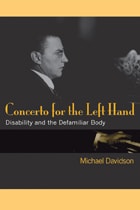
Concerto for the Left Hand
Disability and the Defamiliar BodyMichael Davidson
University of Michigan Press, 2008
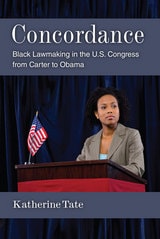
Concordance
Black Lawmaking in the U.S. Congress from Carter to ObamaKatherine Tate
University of Michigan Press, 2014
During the height of the civil rights movement, Blacks were among the most liberal Americans. Since the 1970s, however, increasing representation in national, state, and local government has brought about a more centrist outlook among Black political leaders.
Focusing on the Congressional Black Caucus (CBC), Katherine Tate studies the ways in which the nation’s most prominent group of Black legislators has developed politically. Organized in 1971, the CBC set out to increase the influence of Black legislators. Indeed, over the past four decades, they have made progress toward the goal of becoming recognized players within Congress. And yet, Tate argues, their incorporation is transforming their policy preferences. Since the Clinton Administration, CBC members—the majority of whom are Democrats—have been less willing to oppose openly congressional party leaders and both Republican and Democratic presidents. Tate documents this transformation with a statistical analysis of Black roll-call votes, using the important Poole-Rosenthal scores from 1977 to 2010. While growing partisanship has affected Congress as a whole, not just minority caucuses, Tate warns that incorporation may mute the independent voice of Black political leaders.
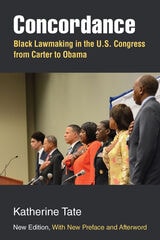
Concordance
Black Lawmaking in the U.S. Congress from Carter to ObamaKatherine Tate
University of Michigan Press, 2020
Focusing on the Congressional Black Caucus (CBC), Katherine Tate studies the ways in which the nation’s most prominent group of Black legislators has developed politically. Organized in 1971, the CBC set out to increase the influence of Black legislators. Indeed, over the past four decades, they have made progress toward the goal of becoming recognized players within Congress. And yet, Tate argues, their incorporation is transforming their policy preferences. Since the Clinton Administration, CBC members—the majority of whom are Democrats—have been less willing to oppose openly congressional party leaders and both Republican and Democratic presidents. Tate documents this transformation with a statistical analysis of Black roll-call votes, using the important Poole-Rosenthal scores from 1977 to 2010. While growing partisanship has affected Congress as a whole, not just minority caucuses, Tate warns that incorporation may mute the independent voice of Black political leaders.
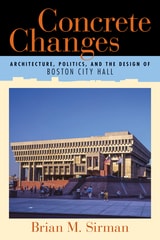
Concrete Changes
Architecture, Politics, and the Design of Boston City HallBrian M. Sirman
University of Massachusetts Press, 2018
And yet Boston City Hall frequently ranks among the country's ugliest buildings. Concrete Changes seeks to answer a common question for contemporary viewers: How did this happen? In a lively narrative filled with big personalities and newspaper accounts, Brian M. Sirman argues that this structure is more than a symbol of Boston's modernization; it acted as a catalyst for political, social, and economic change.
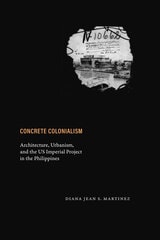
Concrete Colonialism
Architecture, Urbanism, and the US Imperial Project in the PhilippinesDiana Jean S. Martinez
Duke University Press, 2025
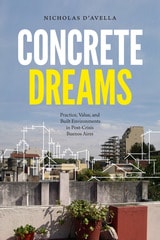
Concrete Dreams
Practice, Value, and Built Environments in Post-Crisis Buenos AiresNicholas D'Avella
Duke University Press, 2019
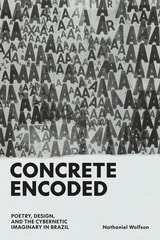
Concrete Encoded
Poetry, Design, and the Cybernetic Imaginary in BrazilNathaniel Wolfson
University of Texas Press, 2025
A study of concrete art and poetry, its implications, and influence in Brazil.
Concrete art and poetry burst onto Brazil’s cultural stage in the 1950s, while the country was embarking on a dizzying period of modernization. Bringing together key poets and visual artists alongside less recognized figures, Nathaniel Wolfson shows that concretism was hardly socially inert, as pundits have suggested. Rather, it presciently grappled with an emerging information age that would soon reorganize human relations globally.
Concrete Encoded describes a nascent cybernetic imaginary. Concretism has long been considered Brazil’s most global aesthetic movement. Wolfson traces new circles of international theorists and practitioners involved in critical technological thought. Wolfson argues that concrete poetry is the quintessential literary genre of the early information age. He shows that Brazilian poets, artists, and designers contested the military dictatorship’s technological authoritarianism and information-gathering operations. Vigorous experimentalists, their attention to form and semantics unveiled both the creative and nefarious possibilities of algorithmic writing. A highly original work, Concrete Encoded reckons with aesthetic responses from Brazil to an advancing capitalist and digital era.

Concrete Futures
Technology and Decolonization in Modern MoroccoDaniel Williford
University of Chicago Press, 2026
Struggles over critical urban technologies during and after Morocco’s French Protectorate reveal a fundamental conflict over the nature of decolonization in the country.
Concrete Futures is a history of concrete that complicates our view of the building material, revealing it as a site of contestation over resources and authority in twentieth-century Morocco. Beginning with the French protectorate period between 1912 and 1956 and continuing into the post-independence era, Daniel Williford uses debates surrounding concrete building technologies as a conduit through which to explore struggles over colonization, modernization, and decolonization. The half-finished cinder block buildings found in cities all over Morocco, he shows, are a product of the system that colonial engineers and officials developed to deal with labor disputes, contests over knowledge, and anticolonial unrest.
By exploring concrete and its uses, Williford discloses how conflicts between experts, workers, and residents over construction and urban renewal—from the introduction of reinforced concrete to strategies of slum clearance—shaped the meaning and the trajectory of decolonization in Morocco.
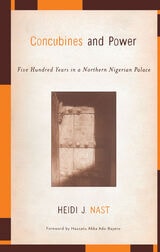
Concubines And Power
Five Hundred Years In A Northern Nigerian PalaceHeidi J. Nast
University of Minnesota Press, 2004
African Studies Association Women’s Caucus’s Aidoo-Snyder Book Prize winner
A Choice Outstanding Academic Title
The monumental palace of Kano, Nigeria, was built circa 1500 and is today inhabited by more than one thousand persons. Historically, its secluded interior housed hundreds of concubines whose role in the politics, economics, and culture of Kano city-state has been largely overlooked. In this pioneering work, Heidi J. Nast demonstrates how human-geographical methods can tell us much about a site like the palace, a place bereft of archaeological work or relevant primary sources.
Drawing on extensive ethnographic work and mapping data, Concubines and Power presents new evidence that palace concubines controlled the production of indigo-dyed cloth centuries before men did. The women were also key players in the assessment and collection of the state's earliest grain taxes, forming a complex and powerful administrative hierarchy that used the taxes for palace community needs. In addition, royal concubines served as representatives of their places of origin, their freeborn children providing the king with additional human capital to cement territorial alliances through marriage.
Social forces undoubtedly shaped and changed concubinage for hundreds of years, but Nast shows how the women’s reach extended far beyond the palace walls to the formation of the state itself.
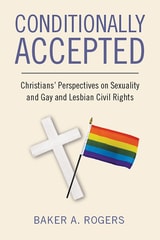
Conditionally Accepted
Christians' Perspectives on Sexuality and Gay and Lesbian Civil RightsBaker A. Rogers
Rutgers University Press, 2020
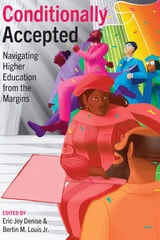
Conditionally Accepted
Navigating Higher Education from the MarginsEdited by Eric Joy Denise and Bertin M. Louis, Jr.
University of Texas Press, 2024
A collection of essays that provides advice and strategies for BIPOC scholars on how to survive, thrive, and resist in academic institutions.
Conditionally Accepted builds upon an eponymous blog on InsideHigherEd.com, which is now a decade-old national platform for BIPOC academics in the United States. Bringing together perspectives from academics of color on navigating intersecting forms of injustice in the academy, each chapter offers situated knowledge about experiencing—and resisting—marginalization in academia. Contextualized within existing scholarship, these personal narratives speak to institutional betrayals while highlighting agency and sharing stories of surviving on treacherous terrain. Covering topics from professional development to the emptiness of diversity, equity, and inclusion efforts, and redefining what it means to be an academic in our contemporary moment, this edited collection directly confronts issues of systemic exclusion, discrimination, harassment, microaggressions, tokenism, and surveillance. Letting marginalized scholars know they are not alone, Conditionally Accepted offers concrete wisdom for readers seeking to navigate and transform oppressive academic institutions.
Conditions of the Present
Selected EssaysLindon Barrett
Duke University Press, 2018
Contributors. Elizabeth Alexander, Jennifer DeVere Brody, Daphne A. Brooks, Linh U. Hua, Janet Neary, Marlon B. Ross, Robyn Wiegman
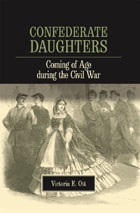
Confederate Daughters
Coming of Age during the Civil WarVictoria E. Ott
Southern Illinois University Press, 2008
Confederate Daughters: Coming of Age during the Civil War explores gender, age, and Confederate identity by examining the lives of teenage daughters of Southern slaveholding, secessionist families. These young women clung tenaciously to the gender ideals that upheld marriage and motherhood as the fulfillment of female duty and to the racial order of the slaveholding South, an institution that defined their status and afforded them material privileges. Author Victoria E. Ott discusses how the loyalty of young Southern women to the fledgling nation, born out of a conservative movement to preserve the status quo, brought them into new areas of work, new types of civic activism, and new rituals of courtship during the Civil War.
Social norms for daughters of the elite, their preparation for their roles as Southern women, and their material and emotional connections to the slaveholding class changed drastically during the Civil War. When differences between the North and South proved irreconcilable, Southern daughters demonstrated extraordinary agency in seeking to protect their futures as wives, mothers, and slaveholders.
From a position of young womanhood and privilege, they threw their support behind the movement to create a Confederate identity, which was in turn shaped by their participation in the secession movement and the war effort. Their political engagement is evident from their knowledge of military battles, and was expressed through their clothing, social activities, relationships with peers, and interactions with Union soldiers.
Confederate Daughters also reveals how these young women, in an effort to sustain their families throughout the war, adjusted to new domestic duties, confronting the loss of slaves and other financial hardships by seeking paid work outside their homes.
Drawing on their personal and published recollections of the war, slavery, and the Old South, Ott argues that young women created a unique female identity different from that of older Southern women, the Confederate bellehood. This transformative female identity was an important aspect of the Lost Cause mythology—the version of the conflict that focused on Southern nationalism—and bridged the cultural gap between the antebellum and postbellum periods.
Augmented by twelve illustrations, this book offers a generational understanding of the transitional nature of wartime and its effects on women’s self-perceptions. Confederate Daughters identifies the experiences of these teenage daughters as making a significant contribution to the new woman in the New South.
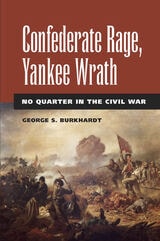
Confederate Rage, Yankee Wrath
No Quarter in the Civil WarGeorge S. Burkhardt
Southern Illinois University Press, 2006
Author George S. Burkhardt details a fascinating case that the Confederates followed a consistent pattern of murder against the black soldiers who served in Northern armies after Lincoln’s 1863 Emancipation Proclamation. He shows subsequent retaliation by black soldiers and further escalation by the Confederates, including the execution of some captured white Federal soldiers, those proscribed as cavalry raiders, foragers, or house-burners, and even some captured in traditional battles.
Further disproving the notion of Confederates as victims who were merely trying to defend their homes, Burkhardt explores the motivations behind the soldiers’ actions and shows the Confederates’ rage at the sight of former slaves—still considered property, not men—fighting them as equals on the battlefield.
Burkhardt’s narrative approach recovers important dimensions of the war that until now have not been fully explored by historians, effectively describing the systemic pattern that pushed the conflict toward a black flag, take-no-prisoners struggle.

Conferencing on the Edge
A Queer History of Feminist Field FormationRachel Corbman
Duke University Press, 2027
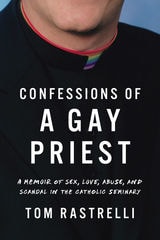
Confessions of a Gay Priest
A Memoir of Sex, Love, Abuse, and Scandal in the Catholic SeminaryTom Rastrelli
University of Iowa Press, 2020
Tom Rastrelli is a survivor of clergy-perpetrated sexual abuse who then became a priest in the early days of the Catholic Church’s ongoing scandals. Confessions of a Gay Priest divulges the clandestine inner workings of the seminary, providing an intimate and unapologetic look into the psychosexual and spiritual dynamics of celibacy and lays bare the “formation” system that perpetuates the cycle of abuse and cover-up that continues today.
Under the guidance of a charismatic college campus minister, Rastrelli sought to reconcile his homosexuality and childhood sexual abuse. When he felt called to the priesthood, Rastrelli began the process of “priestly discernment.” Priests welcomed him into a confusing clerical culture where public displays of piety, celibacy, and homophobia masked a closeted underworld in which elder priests preyed upon young recruits.
From there he ventured deeper into the seminary system seeking healing, hoping to help others, and striving not to live a double life. Trained to treat sexuality like an addiction, he and his brother seminarians lived in a world of cliques, competition, self-loathing, alcohol, hidden crushes, and closeted sex. Ultimately, the “formation” intended to make Rastrelli a compliant priest helped to liberate him.
Confessions of a Presidential Speechwriter
Craig R. Smith
Michigan State University Press, 2014
Confidence Culture
Shani Orgad and Rosalind Gill
Duke University Press, 2022
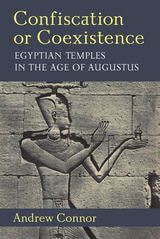
Confiscation or Coexistence
Egyptian Temples in the Age of AugustusAndrew Connor
University of Michigan Press, 2022
The interpretative consensus developed after the publication of a handful of key documents—P.Tebt. 2.302 especially, alongside BGU 4.1198 and 1200, and P.Berl.Leihg. 1.5. Connor offers a fundamentally revised interpretation of these texts, building from a fresh examination of the papyri themselves. The book frames the interpretation in a wider discussion of Roman interactions with Egyptian religion, including material from inside and outside Egypt, and locates the development of an interpretative consensus in early 20th-century scholarship within the wider context of empire and colonization at the time. In doing so, Connor explores these papyri through their historical, intellectual, and linguistic contexts, alongside a number of other important texts bearing on the relationship between the temples and the Roman state.

Conflict Bodies
The Politics of Rape Representation in the Francophone ImaginaryRégine Michelle Jean-Charles
The Ohio State University Press, 2014
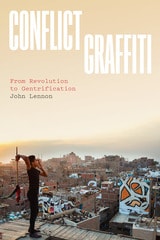
Conflict Graffiti
From Revolution to GentrificationJohn Lennon
University of Chicago Press, 2021
Graffiti makes for messy politics. In film and television, it is often used to create a sense of danger or lawlessness. In bathroom stalls, it is the disembodied expression of gossip, lewdness, or confession. But it is also a resistive tool of protest, making visible the disparate voices and interests that come together to make a movement.
In Conflict Graffiti, John Lennon dives into the many permutations of graffiti in conflict zones—ranging from the protest graffiti of the Black Lives Matter movement in Ferguson and the Tahrir Square demonstrations in Egypt, to the tourist-attraction murals on the Israeli Separation Wall and the street art that has rebranded Detroit and post-Katrina New Orleans. Graffiti has played a crucial role in the revolutionary movements of these locales, but as the conflict subsides a new graffiti and street art scene emerges—often one that ushers in postconflict consumerism, gentrification, militarization, and anesthetized forgetting.
Graffiti has an unstable afterlife, fated to be added to, transformed, overlaid, photographed, reinterpreted, or painted over. But as Lennon concludes, when protest movements change and adapt, graffiti is also uniquely suited to shapeshift with them.
Conflict, Heritage and World-Making in the Chaco
War at the End of the Worlds?Esther Breithoff
University College London, 2020
Framing the study as an exploration of modern, industrialized warfare as a sort of “hyper object”, Breithoff shows how the material culture and heritage of modern conflict fuse together objects, people, and landscapes, connecting them physically and conceptually across vast, almost unimaginable distances and time periods. This book makes a major contribution to key debates in anthropology, archaeology, critical heritage, and material culture studies on the significance of conflict in understanding the Anthropocene, and the roles played by its persistent heritages in assembling worlds.
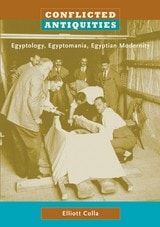
Conflicted Antiquities
Egyptology, Egyptomania, Egyptian ModernityElliott Colla
Duke University Press, 2007
Colla draws on medieval and modern Arabic poetry, novels, and travel accounts; British and French travel writing; the history of archaeology; and the history of European and Egyptian museums and exhibits. The struggle over the ownership of Pharaonic Egypt did not simply pit Egyptian nationalists against European colonial administrators. Egyptian elites found arguments about the appreciation and preservation of ancient objects useful for exerting new forms of control over rural populations and for mobilizing new political parties. Finally, just as the political and expressive culture of Pharaonism proved critical to the formation of new concepts of nationalist identity, it also fueled Islamist opposition to the Egyptian state.
Conflicting Counsels to Confuse the Age
A Documentary Study of Political Economy in Qing China, 1644–1840Helen Dunstan
University of Michigan Press, 1996
Conflicts over Coca Fields in Sixteenth-Century Perú
María Rostworowski de Diez Canseco
University of Michigan Press, 1988
Confronting Child Sexual Abuse
Knowledge to ActionAnne M. Nurse
Lever Press, 2020
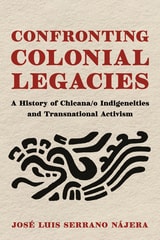
Confronting Colonial Legacies
A History of Chicana/o Indigeneities and Transnational ActivismJosé Luis Serrano Nájera
University of Arizona Press, 2026
This work offers a groundbreaking account of how Chicana/o activists have engaged in sustained efforts to reclaim Indigenous identity through political struggle, cultural expression, and transnational solidarity.
Author José Luis Serrano Nájera takes an in-depth look at the history of Chicana/o indigeneity, starting with the Chicana/o Movement of the 1960s and 1970s and through twenty-first century transnational activism and solidarity movements. Serrano Nájera reveals how claims to indigeneity were rooted in reciprocal relationships with Indigenous communities and driven by a shared commitment to decolonization. Through chapters on visual and performing arts, ceremony, education, and grassroots organizing, this book challenges reductive narratives of cultural appropriation and instead foregrounds the complex and historically grounded nature of Chicana/o indigeneity.
Drawing on extensive archival research, Serrano Nájera demonstrates how Chicana/o indigeneity has contributed to broader Indigenous rights movements, including efforts that culminated in the 2007 United Nations Declaration on the Rights of Indigenous Peoples. This work highlights the intercontinental dimensions of Chicana/o activism and offers a vital source for scholars and students in Chicana/o studies, Indigenous studies, ethnic studies, history, and political science. Confronting Colonial Legacies is a compelling call to rethink the politics of identity, sovereignty, and solidarity across the Americas.
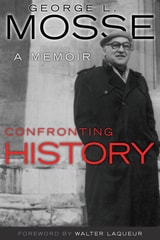
Confronting History
A MemoirGeorge L. Mosse; Foreword by Walter Laqueur
University of Wisconsin Press, 2000
Confronting History describes Mosse's opulent childhood in Weimar Berlin; his exile in Paris and England, including boarding school and study at Cambridge University; his second exile in the U.S. at Haverford, Harvard, Iowa, and Wisconsin; and his extended stays in London and Jerusalem. Mosse discusses being a Jew and his attachment to Israel and Zionism, and he addresses his gayness, his coming out, and his growing scholarly interest in issues of sexuality. This touching memoir—told with the clarity, passion, and verve that entranced thousands of Mosse's students—is guided in part by his belief that "what man is, only history tells" and, most of all, by the importance of finding one's self through the pursuit of truth and through an honest and unflinching analysis of one's place in the context of the times.
Confronting Margaret Mead
Scholarship, Empire, and the South Pacificedited by Lenora Foerstel and Angela Gilliam
Temple University Press, 1994

Confronting Technopoly
Charting a Course towards Human SurvivalEdited by Phil Rose
Intellect Books, 2017
Confronting Theory
The Psychology of Cultural StudiesPhilip Bell
Intellect Books, 2010
Confronting Theory presents a critique of what has come to be known as theory in cross-disciplinary humanities education. Rather than dismissing theory writing as pretentious and abstract, Confronting Theory examines its principal concepts from the perspective of academic psychology and shows that although many of these analyses sound like revolutionary psychological theory, few, if any, have empirical implications that students can evaluate. By considering the educational implications of cultural theory, Confronting Theory will empower students with arguments, not just opinions, about the increasingly idealist and irrelevant anti-realist curricula they confront in their humanities education in today’s universities.
Confronting the Nation
Jewish and Western NationalismGeorge L. Mosse
University of Wisconsin Press, 2024
Mosse considers a broad range of topics, from Nazi book burnings to Americans’ search for unifying national symbols during the Great Depression, exploring how the development of particular modes of art, architecture, and mass movements served nationalist agendas by dictating who was included in the image of the nation. These essays retain their significance today in their examination of the cultural and social implications of contemporary nationalism. A new critical introduction by Shulamit Volkov, professor emerita of history at Tel Aviv University, situates Mosse’s analysis within its historiographical context.
Congo's Dancers
Women and Work in KinshasaLesley Nicole Braun
University of Wisconsin Press, 2023
In Congo’s Dancers, Lesley Nicole Braun uses the prism of the Congolese danseuse to examine the politics of control and the ways in which notions of visibility, virtue, and socio-economic opportunity are interlinked in this urban African context. The work of the danseuse highlights the fact that public visibility is necessary to build the social networks required for economic independence, even as this visibility invites social opprobrium for women. The concert dancer therefore exemplifies many of the challenges that women face in Kinshasa as they navigate the public sphere, and she illustrates the gendered differences of local patronage politics that shape public morality. As an ethnographer, Braun had unusual access to the world she documents, having been invited to participate as a concert dancer herself.
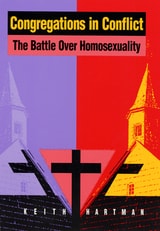
Congregations in Conflict
The Battle over HomosexualityHartman, Keith
Rutgers University Press, 1996
A Methodist church puts its minister on trial after he marches in a gay rights parade. A Quaker meeting struggles to decide whether to marry a lesbian couple. An entire congregation is thrown out of the Southern Baptist Convention for deciding that a gay divinity student had a sincere calling to the ministry, and an order of celibate monks comes out of the closet. An Episcopal priest blesses two same-sex relationships--then a closeted gay lawyer leads the charge to have him fired.
Homosexuality is the most divisive issue facing churches today. Like the issue of slavery 150 years ago, it is a matter that ignites passionate convictions on both sides, a matter that threatens to turn members of the same faith against each other, to divide congregations, and possibly even to fragment several denominations. Like slavery, it is an issue that calls up basic questions about what it means to be a Christian. How does one know right from wrong? Is the Bible fallible? Do good Christians always follow their church's teachings, or are they allowed to think for themselves on moral issues? And to what source does one finally look to determine what God really wants?
While many books have been written analyzing the scriptural and theological dimensions of the conflict, none has yet shown how it is being played out in the pews. Congregations in Conflict examines nine churches that were split by disagreements over gay and lesbian issues, and how the congregations resolved them.
Hartman explores in very readable prose how different denominations have handled their conflicts and what it says about the nature of their faith. He shows some churches coming through their struggles stronger and more unified, while others irrevocably split. Most importantly, he illuminates how people with a passionate clash of beliefs can still function together as a community of faith.
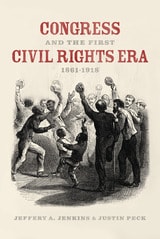
Congress and the First Civil Rights Era, 1861-1918
Jeffery A. Jenkins and Justin Peck
University of Chicago Press, 2021
The authors examine in detail how the Republican Party slowly withdrew its support for a meaningful civil rights agenda, as well as how Democrats and Republicans worked together to keep civil rights off the legislative agenda at various points. In doing so, Jenkins and Peck show how legal institutions can be used both to liberate and protect oppressed minorities and to assert the power of the white majority against those same minority groups.
Congress and the People’s Contest
The Conduct of the Civil WarPaul Finkelman
Ohio University Press, 2018
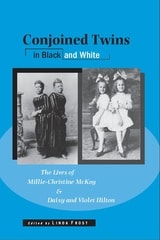
Conjoined Twins in Black and White
The Lives of Millie-Christine McKoy and Daisy and Violet HiltonEdited by Linda Frost
University of Wisconsin Press, 2009
Conjoined Twins in Black and White provides contemporary readers with the twins’ autobiographies, the first two “show histories” to be republished since their original appearance, a previously unpublished novella, and a nineteenth-century medical examination, each of which attempts to define these women and reveal the issues of race, gender, and the body prompted by the twins themselves. The McKoys, born slaves, were kidnapped and taken to Britain, where they worked as entertainers until they were reunited with their mother in an emotional chance encounter. The Hiltons, cast away by their horrified mother at birth, worked the carnival circuit as vaudeville performers until the WWII economy forced them to the burlesque stage. The hardships, along with the triumphs, experienced by these very different sister sets lend insight into our fascination with conjoined twins.
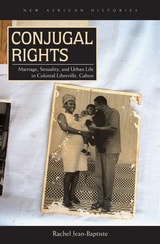
Conjugal Rights
Marriage, Sexuality, and Urban Life in Colonial Libreville, GabonRachel Jean-Baptiste
Ohio University Press, 2014
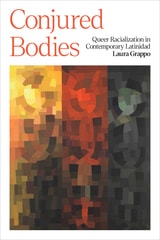
Conjured Bodies
Queer Racialization in Contemporary LatinidadLaura Grappo
University of Texas Press, 2022
2022 Honorable Mention, John Leo & Dana Heller Award for Best Single Work, Anthology, Multi-Authored, or Edited Book in LGBTQ Studies, Popular Culture Association (PCA)
2023 Honorable Mention, Outstanding Book, Latinx Studies Section of Latin American Studies Association (LASA)
2024 Honorable Mention — Best LGBTQ+ Themed Book, Empowering Latino Futures’ International Latino Book Awards
This study argues that powerful authorities and institutions exploit the ambiguity of Latinidad in ways that obscure inequalities in the United States.
Is Latinidad a racial or an ethnic designation? Both? Neither? The increasing recognition of diversity within Latinx communities and the well-known story of shifting census designations have cast doubt on the idea that Latinidad is a race, akin to white or Black. And the mainstream media constantly cover the “browning” of the United States, as though the racial character of Latinidad were self-evident.
Many scholars have argued that the uncertainty surrounding Latinidad is emancipatory: by queering race—by upsetting assumptions about categories of human difference—Latinidad destabilizes the architecture of oppression. But Laura Grappo is less sanguine. She draws on case studies including the San Antonio Four (Latinas who were wrongfully accused of child sex abuse); the football star Aaron Hernandez’s incarceration and suicide; Lorena Bobbitt, the headline-grabbing Ecuadorian domestic-abuse survivor; and controversies over the racial identities of public Latinx figures to show how media institutions and state authorities deploy the ambiguities of Latinidad in ways that mystify the sources of Latinx political and economic disadvantage. With Latinidad always in a state of flux, it is all too easy for the powerful to conjure whatever phantoms serve their interests.
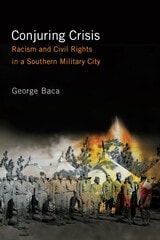
Conjuring Crisis
Racism and Civil Rights in a Southern Military CityBaca, George
Rutgers University Press, 2010
In the 1990s at Fort Bragg and Fayetteville, North Carolina, the city's dominant political coalition of white civic and business leaders had lost control of the city council. Amid accusations of racism in the police department, two white council members joined black colleagues in support of the NAACP's demand for an investigation. George Baca's ethnographic research reveals how residents and politicians transformed an ordinary conflict into a "crisis" that raised the specter of chaos and disaster. He explores new territory by focusing on the broader intersection of militarization, urban politics, and civil rights.
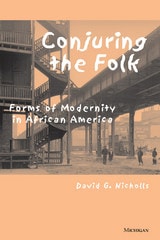
Conjuring the Folk
Forms of Modernity in African AmericaDavid G. Nicholls
University of Michigan Press, 2000
In a series of revisionary readings, Nicholls studies how the "folk" is shaped by the ideology of form. He examines the presence of a spectral "folk" in Toomer's modernist pastiche, Cane. He explores how Hurston presents folklore as a contemporary language of resistance in her ethnography, Mules and Men. In Claude McKay's naturalistic romance, Banana Bottom, Nicholls discovers the figuration of an alternative modernity in the heroine's recovery of her lost "folk" identity. He unearths the individualist ethos of Booker T. Washington in two novels by George Wylie Henderson. And he reveals how Richard Wright's photo-documentary history, 12 Million BlackVoices, places the "folk" in a Marxian narrative of modernization toward class-consciousness.
A provocative rereading of the cultural politics of the Harlem Renaissance, Conjuring the Folk offers a new way of understanding literary responses to migration, modernization, and the concept of the "folk" itself.
David G. Nicholls is a post-doctoral fellow in the Center for the Study of Race, Politics, and Culture, University of Chicago.
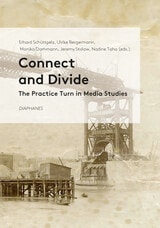
Connect and Divide
The Practice Turn in Media StudiesEdited by Erhard Schüttpelz, Ulrike Bergermann, Monika Dommann, Jeremy Stolow, and Nadine Taha
Diaphanes, 2018
This new anthology takes stock of our empirical and historical understanding of the two-sided nature of media and tracks the recent turn in media studies to examining practice itself. A unique discussion of the intersection of media theory and practice theory, Connect and Divide explores how distributions of knowledge, labor, and power may be hidden in what remains untraceable about media, shedding vital light on the social implications of media theory today.
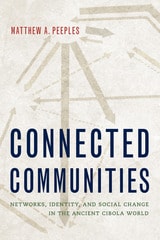
Connected Communities
Networks, Identity, and Social Change in the Ancient Cibola WorldMatthew A. Peeples
University of Arizona Press, 2018
In Connected Communities, Matthew A. Peeples examines a period of dramatic social and political transformation in the ancient Cibola region (ca. A.D. 1150–1325). He analyzes archaeological data generated during a century of research through the lens of new and original social theories and methods focused on exploring identity, social networks, and social transformation. In so doing, he demonstrates the value of comparative, synthetic analysis.
The book addresses some of the oldest enduring questions in archaeology: How do large-scale social identities form? How do they change? How can we study such processes using material remains? Peeples approaches these questions using a new set of methods and models from the broader comparative social sciences (relational sociology and social networks) to track the trajectories of social groups in terms of both networks of interactions (relations) and expressions of similarity or difference (categories). He argues that archaeological research has too often conflated these different kinds of social identity and that this has hindered efforts to understand the drivers of social change.
In his strikingly original approach, Peeples combines massive amounts of new data and comparative explorations of contemporary social movements to provide new insights into how social identities formed and changed during this key period.
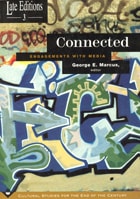
Connected
Engagements with MediaEdited by George E. Marcus
University of Chicago Press, 1996
Connected, the third volume in the groundbreaking and highly acclaimed Late Editions series, confronts these provocative questions through unique experiments with the interview format. It explores both the new pathways being forged through media and the predicaments of those struggling to find their way in the twilight of the twentieth century.
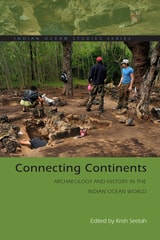
Connecting Continents
Archaeology and History in the Indian Ocean WorldKrish Seetah
Ohio University Press, 2018
Winner, Society for American Archaeology Book Award
In recent decades, the vast and culturally diverse Indian Ocean region has increasingly attracted the attention of anthropologists, historians, political scientists, sociologists, and other researchers. Largely missing from this growing body of scholarship, however, are significant contributions by archaeologists and consciously interdisciplinary approaches to studying the region’s past and present.
Connecting Continents addresses two important issues: how best to promote collaborative research on the Indian Ocean world, and how to shape the research agenda for a region that has only recently begun to attract serious interest from historical archaeologists. The archaeologists, historians, and other scholars who have contributed to this volume tackle important topics such as the nature and dynamics of migration, colonization, and cultural syncretism that are central to understanding the human experience in the Indian Ocean basin.
This groundbreaking work also deepens our understanding of topics of increasing scholarly and popular interest, such as the ways in which people construct and understand their heritage and can make use of exciting new technologies like DNA and environmental analysis. Because it adopts such an explicitly comparative approach to the Indian Ocean, Connecting Continents provides a compelling model for multidisciplinary approaches to studying other parts of the globe.
Contributors: Richard B. Allen, Edward A. Alpers, Atholl Anderson, Nicole Boivin, Diego Calaon, Aaron Camens, Saša Čaval, Geoffrey Clark, Alison Crowther, Corinne Forest, Simon Haberle, Diana Heise, Mark Horton, Paul Lane, Martin Mhando, and Alistair Patterson.
Connecting in College
How Friendship Networks Matter for Academic and Social SuccessJanice M. McCabe
University of Chicago Press, 2016
As McCabe and the students she talks to show, the friendships we forge in college are deeply meaningful, more meaningful than we often give them credit for. They can also vary widely. Some students have only one tight-knit group, others move between several, and still others seem to meet someone new every day. Some students separate their social and academic lives, while others rely on friendships to help them do better in their coursework. McCabe explores how these dynamics lead to different outcomes and how they both influence and are influenced by larger factors such as social and racial inequality. She then looks toward the future and how college friendships affect early adulthood, ultimately drawing her findings into a set of concrete solutions to improve student experiences and better guarantee success in college and beyond.