2706 books match the query 'European' and 156 start with c
cover of Conrad and Empire

Conrad and Empire

Stephen Ross

University of Missouri Press, 2004
In Conrad and Empire, Stephen Ross challenges the orthodoxy of the last thirty years of Conrad criticism by arguing that to focus on issues of race and imperialism in Conrad’s work is to miss the larger and more important engagement with developing globalization undertaken there. Drawing on the conceptual model provided by Arjun Appadurai and by Michael Hardt and Antonio Negri, Ross maintains that Conrad’s major novels confront an emergent new world order that replaces nation-state-based models of geopolitics with the global rule of capitalism, and shows how Conrad supplements this conceptualization by tracing the concrete effects of such a change on the psyches of individual subjects. Borrowing from Slavoj Žižek and Jacques Lacan, Ross contends that Conrad’s major novels present us with an astute vision of a truly global world order.
Devoting a chapter to each novel, the author analyzes Heart of Darkness,Lord Jim, Nostromo, and The Secret Agent to expose their social vision, their concern with individual experience, and their philosophical synthesis of the two. After showing how Conrad sets the stage, Ross considers selected characters’ personal histories and the family romances by which Conrad sheds light on individual characters’ motives, exposing the penetration of ideological forces into personal lives. He then shows how the drama of slave morality in each of the novels synthesizes their critique of social organization and their attention to personal history by revealing how each novel follows an individual character’s doomed attempt to transcend the totalizing dimensions of Empire.
Ross claims that though postcolonial criticisms of Conrad’s work have produced excellent insights, they remain inadequate to understanding its complexity. Instead, he argues, Conrad’s novels should be read for their compellingly prescient vision of a postnational world under the sway of global capitalism. Although Conrad’s vision of that world is undeniably bleak, Ross believes, his almost willful reaffirmation of the very values he has shown to be bankrupt constitutes a “weak idealism.” Consequently, Ross argues, Conrad’s fiction is profoundly ethical and pertinent to the pressing project of how to live in a bewilderingly variable world.
[more]
cover of Conrad's Shadow: Catastrophe, Mimesis, Theory

Conrad's Shadow

Catastrophe, Mimesis, Theory

Nidesh Lawtoo

Michigan State University Press, 2016

Western thought has often dismissed shadows as fictional, but what if fictions reveal original truths? Drawing on an anti-Platonic tradition in critical theory, Lawtoo adopts ethical, anthropological, and philosophical lenses to offer new readings of Joseph Conrad’s novels and the postcolonial and cinematic works that respond to his oeuvre. He argues that Conrad’s fascination with doubles urges readers to reflect on the two sides of mimesis: one side is dark and pathological, and involves the escalation of violence, contagious epidemics, and catastrophic storms; the other side is luminous and therapeutic, and promotes communal survival, postcolonial reconciliation, and plastic adaptations to changing environments. Once joined, the two sides reveal Conrad as an author whose Janus-faced fictions are powerfully relevant to our contemporary world of global violence and environmental crisis.
[more]
cover of Conspicuous Bodies: Provincial Belief and the Making of Joyce and Rushdie

Conspicuous Bodies

Provincial Belief and the Making of Joyce and Rushdie

Jean Kane

The Ohio State University Press, 2014

In Conspicuous Bodies: Provincial Belief and the Making of Joyce and Rushdie, Jean Kane re-examines the literature of James Joyce and Salman Rushdie from a post-secularist perspective, arguing that their respective religions hold critical importance in their works. Though Joyce and Rushdie were initially received as cosmopolitans, both authors subsequently reframed their public images and aligned themselves instead with a provincial religious identity, which emphasized the interconnections between religious devotion and embodiment. At the same time, both Joyce and Rushdie managed to resist the doctrinal content of their religions.
 
Conspicuous Bodies presents Joyce as a founder and Rushdie as an inheritor of a distinctive discourse of belief about the importance of physical bodies and knowledge in religious practice. In doing so, it moves the reception of Joyce and Rushdie away from what previous critics have emphasized—away from questions of aesthetics and from  a narrow understanding of belief—and instead questions the assumption that belief should be segregated from matters of physicality and knowledge. Kane reintroduces the concept of spiritual embodiment in order to expand our understanding of what counts as spiritual agency in non-western and minority literatures.
[more]
cover of Constance Ring

Constance Ring

Amalie Skram

Northwestern University Press, 2002

Initially rejected by the author's scandalized publisher, Constance Ring is now considered a classic of Scandinavian-and world-literature, a passionate condemnation of marriage and moral hypocrisy that has drawn comparisons to Madame Bovary and The Awakening. The story of a naive young woman who sets out to divorce her loving but adulterous husband, Constance Ring is an intimate portrayal of a vibrant woman's refusal to yield to the forces that constrict women's lives in a society that offers them few choices.
[more]
cover of Constancy and the Ethics of Jane Austen's 'Mansfield Park'

Constancy and the Ethics of Jane Austen's 'Mansfield Park'

Joyce Kerr Tarpley

Catholic University of America Press, 2010
Constancy and the Ethics of Jane Austen's Mansfield Park offers a rigorous philosophical examination of the novel, the first book-length, close reading to do so.
[more]
cover of Constructing Nineteenth-Century Religion: Literary, Historical, and Religious Studies in Dialogue

Constructing Nineteenth-Century Religion

Literary, Historical, and Religious Studies in Dialogue

Edited by Joshua King and Winter Jade Werner

The Ohio State University Press, 2019

Bringing together scholars from literary, historical, and religious studies,Constructing Nineteenth-Century Religioninterrogates the seemingly obvious category of “religion.” This collection argues that any application of religion engages in complex and relatively modern historical processes. In considering the various ways that nineteenth-century religion was constructed, commodified, and practiced, contributors to this volume “speak” to each other, finding interdisciplinary links and resonances across a range of texts and contexts.
 
The participle in its title—Constructing—acknowledges that any articulation of nineteenth-century religion is never just a work of the past: scholars also actively construct religion as their disciplinary assumptions (and indeed personal and lived investments) shape their research and findings. Constructing Nineteenth­Century Religion newly analyzes the diverse ways in which religion was debated and deployed in a wide range of nineteenth­century texts and contexts. While focusing primarily on nineteenth­century Britain, the collection also contributes to the increasingly transnational and transcultural outlook of postsecular studies, drawing connections between Britain and the United States, continental Europe, and colonial India.
 
[more]
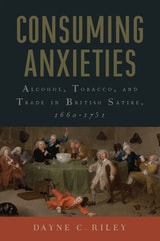
cover of Consuming Anxieties: Alcohol, Tobacco, and Trade in British Satire, 1660-1751

Consuming Anxieties

Alcohol, Tobacco, and Trade in British Satire, 1660-1751

Dayne C. Riley

Bucknell University Press, 2024

Writers of the late seventeenth and early eighteenth centuries—a period of vast economic change—recognized that the global trade in alcohol and tobacco promised a brighter financial future for England, even as overindulgence at home posed serious moral pitfalls. This engaging and original study explores how literary satirists represented these consumables—and related anxieties about the changing nature of Britishness—in their work. Riley traces the satirical treatment of wine, beer, ale, gin, pipe tobacco, and snuff from the beginning of Charles II’s reign, through the boom in tobacco’s popularity, to the end of the Gin Craze in libertine poems and plays, anonymous verse, ballad operas, and the satire of canonical writers such as Gay, Pope, and Swift. Focusing on social concerns about class, race, and gender, Consuming Anxieties examines how satirists championed Britain’s economic strength on the world stage while critiquing the effects of consumable luxuries on the British body and consciousness.
[more]
cover of Consumption and Violence: Radical Protest in Cold-War West Germany

Consumption and Violence

Radical Protest in Cold-War West Germany

Alexander Sedlmaier

University of Michigan Press, 2014
Combining the tools of political, social, cultural, and intellectual history, Consumption and Violence: Radical Protest in Cold-War West Germany explores strategies of legitimization developed by advocates of militant resistance to certain manifestations of consumer capitalism. The book contributes to a more sober evaluation of West German protest movements, not just terrorism, as it refrains from emotional and moral judgments, but takes the protesters’ approaches seriously, which, regarding consumer society, had a rational core. Political violence is not presented as the result of individual shortcomings, but emerges in relation to major societal changes, i.e., the unprecedented growth of consumption. This new perspective sheds important light on violence and radical protest in post-war Germany, as previous books have failed to examine to what extent these forms of resistance should be regarded as reactions to changing regimes of provision. Continuing the recently growing interest in the interdependence of countercultures and consumer society, the focus on violence gives the argument a unique twist, making the book thought-provoking and engaging.
[more]
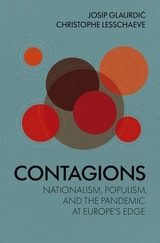
cover of Contagions: Nationalism, Populism, and the Pandemic at Europe’s Edge

Contagions

Nationalism, Populism, and the Pandemic at Europe’s Edge

Josip Glaurdic

Central European University Press, 2026
Contagions: Nationalism, Populism, and the Pandemic at Europe’s Edge offers a sweeping account of how COVID-19 collided with the political fault lines of Southeast Europe. Drawing on original surveys and rich comparative analysis, the book reveals how the crisis interacted with the power of nationalism and populism—reshaping trust, compliance, conspiracy beliefs, economic grievances, and even the memory of the pandemic itself. From the early months of surprising effectiveness to the region’s descent into some of the world’s worst mortality outcomes, the study shows how political ideologies acted like contagions of their own, undermining collective resilience. Southeast Europe emerges here not as an anomaly, but as a diagnostic lens onto broader European and global patterns of crisis governance and democratic fragility. Accessible yet deeply grounded in evidence, this book speaks both to scholars and to readers seeking to understand how ideology shapes societies under strain.
[more]
cover of Contemporary Advances in Theoretical and Applied Spanish Linguistic Variation

Contemporary Advances in Theoretical and Applied Spanish Linguistic Variation

Juan J. Colomina-Almiñana

The Ohio State University Press, 2017

Contemporary Advances in Theoretical and Applied Spanish Linguistic Variation by Juan J. Colomina-Almiñana, reframes the understanding of language variation and change as an intimate interplay between both linguistic features and social factors always occurring in unison in the same historical process. Its ten chapters, divided into four parts, provide both a synchronic and a diachronic view of Hispanic sociolinguistics, focusing not only on the historical development of Spanish as a Romance language, but also analyzing certain idiosyncratic elements of non-standard Spanish varieties across multiple regions, nations, and diasporas. In addition, the volume offers an enchronic perspective of this phenomenon by analyzing how certain sustained cultural practices may drive concrete linguistic developments.
 
This volume makes three major contributions to Hispanic sociolinguistics. First, it covers variation in less commonly studied varieties, which are new areas of interest in a broader world where certain minorities and their languages are crucial. Second, it offers recent and innovative approaches to variation coming from formal theories in order to spark a debate about methodology that is more comprehensive of the diverse approaches to variation currently practiced in the field. Finally, it includes chapters that combine quantitative and qualitative analysis of different linguistic variables.
 
[more]
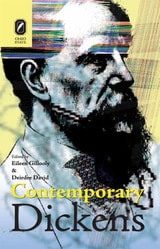
cover of Contemporary Dickens

Contemporary Dickens

Edited by Eileen Gillooly and Deirdre David

The Ohio State University Press, 2008
Edited by Eileen Gillooly and Deirdre David, Contemporary Dickens is a collection of essays that presents some of the most intriguing work being undertaken in Dickens studies today. Through an emphasis on the nineteenth-century origins of our current critical preoccupations and ways of knowing, these essays reveal Dickens to be our contemporary. The contributors argue that such issues as gender and sexuality, environmentalism, and the construction of national identity were frequently explored and sometimes problematically resolved by Dickens himself. They also illuminate the importance of Dickens’s place in our current reassessment of critical methodologies.
 
Drawing freely upon a variety of reading strategies (materialist, deconstructive, new historical, psychoanalytic, and feminist), the essays disclose new aspects of Dickens’s engagements with a number of Victorian concerns—moral philosophy, the psychology of the emotions, and life writing among them—that have once again emerged as significant objects of study in early-twenty-first century criticism. Looking at such familiar topics from fresh perspectives, Contemporary Dickens is an original and challenging contribution to Dickens studies in particular and Victorian criticism in general.
 
Contemporary Dickens will appeal to general readers and students of Victorian culture, as well as specialists in nineteenth-century literature, cultural studies, literary formalism, psychology, and gender studies.
 
 
[more]
cover of Contemporary Francophone African Plays: An Anthology

Contemporary Francophone African Plays

An Anthology

Judith G. Miller

Bucknell University Press, 2024
Bringing together in English translation eleven Francophone African plays dating from 1970 to 2021, this essential collection includes satirical portraits of colonizers and their collaborators (Bernard Dadié’s Béatrice du Congo; Sony Labou Tansi’s I, Undersigned, Cardiac Case; Sénouvo Agbota Zinsou’s We’re Just Playing) alongside contemporary works questioning diasporic identity and cultural connections (Koffi Kwahulé’s SAMO: A Tribute to Basquiat and Penda Diouf’s Tracks, Trails, and Traces…). The anthology memorializes the Rwandan genocide (Yolande Mukagasana’s testimony from Rwanda 94), questions the status of women in entrenched patriarchy (Werewere Liking’s Singuè Mura: Given That a Woman…), and follows the life of Elizabeth Nietzsche, who perverted her brother’s thought to colonize Paraguay (José Pliya’s The Sister of Zarathustra). Gustave Akakpo’s The True Story of Little Red Riding Hood and Kossi Efoui’s The Conference of the Dogs offer parables about what makes life livable, while Kangni Alem’s The Landing shows the dangers of believing in a better life, through migration, outside of Africa.
[more]
cover of Contemporary French and Francophone Narratology

Contemporary French and Francophone Narratology

Edited by John Pier

The Ohio State University Press, 2020

The essays included in this collection seek to take the pulse of recent developments in narratological research in the French-speaking countries. Theorists in these countries heavily participated in and shaped narratology, an outgrowth of the structuralist movement during the 1960s and 1970s. While US, German, and Scandinavian theorists took the forefront in the 1990s, narratology in France faded into the background. It was not until the turn of the century that a new interest in narratological issues among French researchers emerged. Activity in the field has since intensified, spurred on, in part, by the realization that narratology cannot be summed up by its formalist and structuralist origins.

Well-versed in French narrative theory, both classical and more recent, the authors in this collection also draw on scholarship coming from other research traditions. The result is that these contributions offer a number of syntheses and perspectives representative of recent French-language scholarship in the field that readers may not be familiar with or that provide them with further insight into subjects they may have encountered in other contexts. This volume will leave readers with a greater awareness of the directions taken by present-day French-language narratology as well as new and developing themes in narrative theory generally.

Contributors
Raphaël Baroni, Denis Bertrand, Olivier Caïra, Claude Calame, Benoît Hennaut, Françoise Lavocat, Sylvie Patron, John Pier, Françoise Revaz, and Richard Saint-Gelais

[more]
cover of Contemporary Irish Drama and Cultural Identity

Contemporary Irish Drama and Cultural Identity

Margaret Llewellyn-Jones

Intellect Books, 2013
Within the last ten years there has been a renaissance in Irish drama from both sides of the border, including award-winning work which has transfered to London and New York, and has toured Britain as well as Europe and Australia. This book explores the dynamics of the relationship between these representations of Ireland and the fluid nature of cultural identity, especially during a period of economic and political change. Although the book establishes the historical context for contemporary Irish drama, and does include discussion of some of the earlier works of Brian Friel, Frank MacGuinness and Tom Murphy, the emphasis lies on their more recent work from 1980, and especially upon work created by new writers performed during the 1990's, during the emergence of the 'Celtic tiger economy' in the Republic, and the Peace Process in the North. Key themes provide the structure of the book, which examines especially those theatrical strategies which have been associated with the performance of identity, particularly in a post-colonial situation. References are also made to interviews with writers, performers, directors and groups, as well as performances seen across Ireland and Britain. Contemporary critical perspectives from post-colonial theory to psychoanalysis and performance praxis are deployed, but in an accessible way. In contrast to the tensions associated with the colonising relationship between Ireland and Britain, the relationship between Ireland and Europe are considered in terms of cultural and economic influences and performance practices, and that between Ireland and America in terms of the 'dream of the West', the diaspora and tourism.
[more]
cover of Contemporary Irish Poetry and the Pastoral Tradition

Contemporary Irish Poetry and the Pastoral Tradition

Donna L. Potts

University of Missouri Press, 2011

In Contemporary Irish Poetry and the Pastoral Tradition, Donna L. Potts closely examines the pastoral genre in the work of six Irish poets writing today. Through the exploration of the poets and their works, she reveals the wide range of purposes that pastoral has served in both Northern Ireland and the Republic: a postcolonial critique of British imperialism; a response to modernity, industrialization, and globalization; a way of uncovering political and social repercussions of gendered representations of Ireland; and, more recently, a means for conveying environmentalism’s more complex understanding of the value of nature.

Potts traces the pastoral back to its origins in the work of Theocritus of Syracuse in the third century and plots its evolution due to cultural changes. While all pastoral poems share certain generic traits, Potts makes clear that pastorals are shaped by social and historical contexts, and Irish pastorals in particular were influenced by Ireland’s unique relationship with the land, language, and industrialization due to England’s colonization.
For her discussion, Potts has chosen six poets who have written significant collections of pastoral poetry and whose work is in dialogue with both the pastoral tradition and other contemporary pastoral poets. Three poets are men—John Montague, Seamus Heaney, Michael Longley—while three are women—Eavan Boland, Medbh McGuckian, Nuala Ní Dhomhnaill. Five are English-language authors, while the sixth—Ní Dhomhnaill—writes in Irish. Additionally, some of the poets hail from the Republic, while others originate from Northern Ireland. Potts contends that while both Irish Republic and Northern Irish poets respond to a shared history of British colonization in their pastorals, the 1921 partition of the country caused the pastoral tradition to evolve differently on either side of the border, primarily because of the North’s more rapid industrialization; its more heavily Protestant population, whose response to environmentalism was somewhat different than that of the Republic’s predominantly Catholic population; as well the greater impact of the world wars and the Irish Troubles.

In an important distinction from other studies of Irish poetry, Potts moves beyond the influence of history and politics on contemporary Irish pastoral poetry to consider the relatively recent influence of ecology. Contemporary Irish poets often rely on the motif of the pastoral retreat to highlight various environmental threats to those retreats—whether they be high-rises, motorways, global warming, or acid rain. Potts concludes by speculating on the future of pastoral in contemporary Irish poetry through her examination of more recent poets—including Moya Cannon and Paula Meehan—as well as other genres such as film, drama, and fiction.
 
 
[more]
cover of Contesting Cultural Rhetorics: Public Discourse and Education, 1890-1900

Contesting Cultural Rhetorics

Public Discourse and Education, 1890-1900

Margaret J. Marshall

University of Michigan Press, 1995

Contesting Cultural Rhetorics is a groundbreaking and original study that demonstrates how "education" is viewed as a contested term and a set of contested practices in American culture because it is inevitably linked to highly contested, value-laden terms. An examination of the public discourse of education not only reveals the ideologies and conceptions embedded in educative acts and institutions but also provides a means of examining how education itself functions in American culture as a site of contest between ideologies, values, and the constitution of individual and nation. Margaret J. Marshall's analysis employs a range of contemporary theorists from Bakhtin to Foucault and draws on a number of disciplinary perspectives, including law, history, and ethnography, where scholars have been examining discursive practices and where rhetoric is understood to be a means of examining cultural conceptions and embedded ideologies. Through these lenses she examines four influential and popular texts of the 1890s that serve to illuminate current public debates on education: Joseph Mayer Rice's articles in Forum, a well-respected magazine; Matthew Arnold's introduction to a government report; W. E. B. Du Bois's "A Negro Schoolmaster in the New South;" and Jane Addams's "A Function of the Social Settlement." Neither a history of education nor a typical literary analysis of the texts in question, this book considers the rhetorical stance of authors, the constitution of audience and subject, and the use of references and narratives as devices of authority. Taken together, these texts reveal the complicated public discussion of education in the 1890s—a period of transformation in culture, schooling, and the organization of knowledge. Moreover, they reveal the rhetorical structure of many of the questions Americans ask about education today: who should be educated, by whom, for what purposes, using what methods or materials? What of the past should we pass on to the future, and how? Contesting Cultural Rhetorics will be useful to readers interested in the history of education and nineteenth-century popular culture, as well as those involved in current debates on education and public policy.
[more]
cover of Continental England: Form, Translation, and Chaucer in the Hundred Years’ War

Continental England

Form, Translation, and Chaucer in the Hundred Years’ War

Elizaveta Strakhov

The Ohio State University Press, 2022
Scholars have often viewed the Hundred Years’ War (c. 1337–1453) between England and France as sharpening animosity and isolationism. Further, medievalists have often characterized translator–source relationships as adversarial. In Continental England, Elizaveta Strakhov develops a new model, reparative translation, as a corrective to both formulations. Zeroing in on formes fixes poetry—and Chaucer as a leading practitioner—she shows that translation played two essential, interrelated roles: it became a channel for rebuilding fragmented communities, and it restored unity to Francophone cultural landscapes fractured by war. Further, used in particular to express England’s aspirational relationship to Francophone culture despite the ongoing war, translation became the means by which England negotiated a new vision of itself as Continental rather than self-contained. Chaucer’s own translation work and fusion of Francophone and Italian humanist influences in his poetry rendered him a paradigmatic figure for England’s new bid for Continental relevance. Interpreting Chaucer’s posthumous canonization as a direct result of reparative translation, Strakhov shows how England’s transition from island to Continental constituent problematizes our contemporary understandings of nation-bound authors and canons.
[more]
cover of Contraband of Hoopoe

Contraband of Hoopoe

Ewa Chrusciel

Omnidawn, 2014

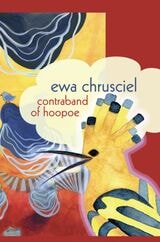
Contraband of Hoopoe explores issues of dislocation, immigration and desire. Chrusciel invents a poetics of smuggling as she crosses national, historical and linguistic borders. The migratory narrative is distinctly errant, haunted by a childhood lived under a Communist regime, by the austerity of Eastern block politics, and by the possibility of discovering a fleeting language to carry the seeds of illicit revelation, spiritual transformation, and insight. The book elevates smuggling to a noble art, recording how the Jewish people were hidden and transported during the Holocaust. Chrusciel tracks a series of historical objects and secret messages that immigrants throughout history have been sneaking through customs, past border checkpoints, and across the seas.
[more]
cover of Convent Paradise

Convent Paradise

Arcangela Tarabotti

Iter Press, 2020

The radical Venetian writer Arcangela Tarabotti (1604–1652), compelled against her will to become a nun, is well known for her scathing attacks on patriarchal institutions for forcing women into convents. Convent Paradise (1643), Tarabotti’s first published work, instead invites the reader into the cloister to experience not only the trials of enclosure, but also its spiritual joys. In stark contrast to her other works, Convent Paradise aims to celebrate the religious culture that colored every aspect of Tarabotti’s experience as a seventeenth-century Venetian and a nun. At the same time, this nuanced exploration of monastic life conveys a markedly feminist spirituality. Tarabotti’s meditative portrait of the convent enriches our understanding of her own life and writing, while also providing a window into a spiritual destiny shared by thousands of early modern women.

The Other Voice in Early Modern Europe - The Toronto Series volume 73
[more]
cover of Conversations on Science, Culture, and Time: Michel Serres with Bruno Latour

Conversations on Science, Culture, and Time

Michel Serres with Bruno Latour

Michel Serres

University of Michigan Press, 1995
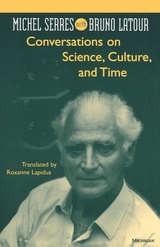
Although elected to the prestigious French Academy in 1990, Michel Serres has long been considered a maverick--a provocative thinker whose prolific writings on culture, science and philosophy have often baffled more than they have enlightened. In these five lively interviews with sociologist Bruno Latour, this increasingly important cultural figure sheds light on the ideas that inspire his highly original, challenging, and transdisciplinary essays.
Serres begins by discussing the intellectual context and historical events-- including the impact of World War II and Hiroshima, which for him marked the beginning of science's ascendancy over the humanities--that shaped his own philosophical outlook and led him to his lifelong mission of bringing together the texts of the humanities and the conceptual revolutions of modern science. He then confronts the major difficulties encountered by his readers: his methodology, his mathematician's fondness for "shortcuts" in argument, and his criteria for juxtaposing disparate elements from different epochs and cultures in extraordinary combinations. Finally, he discusses his ethic for the modern age--a time when scientific advances have replaced the natural necessities of disease and disaster with humankind's frightening new responsibility for vital things formerly beyond its control.
In the course of these conversations Serres revisits and illuminates many of his themes: the chaotic nature of knowledge, the need for connections between science and the humanities, the futility of traditional criticism, and what he calls his "philosophy of prepositions"--an argument for considering prepositions, rather than the conventionally emphasized verbs and substantives, as the linguistic keys to understanding human interactions. For readers familiar with Serres's works as well as for the uninitiated, Conversations on a Life in Philosophy provides fascinating insights into the mind of this appealing, innovative and ardent thinker.
Michel Serres has taught at Clermont-Ferrand, at the University of Paris VIII (Vincennes) and at the Sorbonne. He has served as visiting professor at Johns Hopkins University and has been on the faculty of Stanford University since 1984. Bruno Latour, a philosopher and anthropologist, is Professor of Sociology, L'Ecole Nationale Supérieure des Mines in Paris. He has written several books and numerous articles on the ties between the sciences and the rest of culture and society.
Roxanne Lapidus is Managing Editor of SubStance: A Review of Theory and Literary Criticism. Conversations on a Life in Philosophy was originally published in France as Eclaircissements.
[more]
cover of Conversations with Scottish Poets

Conversations with Scottish Poets

Marco Fazzini

Aberdeen University Press, 2015

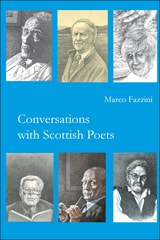
Conversations with Scottish Poets presents fourteen interviews conducted by Italian literary critic and translator Marco Fazzini since the 1980s. By asking the same or similar questions of Scottish poets of different generations, the interviews provide insight both into the ideas and working methods of the individual poets and also into the ways in which the poets’ relationship with their country and its languages have changed between the twentieth and twenty first centuries.The poets interviewed are Norman MacCaig, Sorley Maclean, Edwin Morgan, Derick Thomson, Iain Crichton Smith, Alasdair Gray, Kenneth White, Douglas Dunn, Valerie Gillies, Christopher Whyte, John Burnside, David Kinloch, Robert Crawford and Don Paterson. The. interviews are illustrated with portraits of the poets by Italian artists Franco Dugo, Paolo Annibali, Nicola Nannini and Doriano Scazzosi.
[more]
cover of Cool Memories II, 1987-1990

Cool Memories II, 1987-1990

Jean Baudrillard

Duke University Press, 1996

Jean Baudrillard is widely recognized as one of the most important and provocative writers of our age. Variously termed “France’s leading philosopher of postmodernism” and “a sharp-shooting Lone Ranger of the post-Marxist left,” he might also be called our leading philosopher of seduction or of mass culture. Following his acclaimed America and Cool Memories, this book is the third in a series of personal records in hyperreality. Idiosyncratic, outrageous, and brilliantly original, Baudrillard here casts his net widely and combines autobiographical memories with further reflections on America, the crisis of cultural production, new ideas in fiction/theory, and the “verbal fornication” of the postmodern.
In this wide-ranging discussion of events and ideas, Baudrillard moves between poetry and waterfalls, strikes and stealth bombers, Freud and La Cicciolina, shadows and simulacra, deconstruction and the zodiac, Reagan’s smile and Kennedy’s death, the “curse” on South America and the future of the West, the last tango of French intellectual life and the exemplary disappearing act of Italian politics. Writing at the site where the philosophic and the poetic merge, he once again offers us commentary in the form of the riveting insight, the short distillation of reality that establishes its truth with the force of recognition.
Cool Memories II, Baudrillard’s latest commentary on the technopresent and future, an installment of his reflections on the reality of contemporary western culture, will entice all readers concerned with postmodernism and the current state of theory.
[more]
cover of Coriolanus

Coriolanus

William Shakespeare

Arizona Center for Medieval and Renaissance Studies, 2023

A powerfully topical new translation of Shakespeare’s study of military power and political folly.

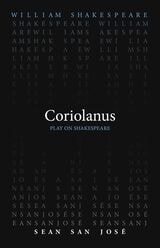
Bay Area director, actor, and producer Sean San José takes on the themes of power and politics in his version of Coriolanus, Shakespeare’s exploration of militaristic might and political folly. San José’s take on this little-known classic reimagines the text to be spoken by and for a community of “others.” The translation, which brings Shakespeare’s language into our era, rendering its thematic and dramatic power broadly accessible, is powered by a reexamination of populism in our current political moment.
 
This translation of Coriolanus was written as part of the Oregon Shakespeare Festival’s Play On! project, which commissioned new translations of thirty-nine Shakespeare plays. These translations present the work of “The Bard” in language accessible to modern audiences while never losing the beauty of Shakespeare’s verse. Enlisting the talents of a diverse group of contemporary playwrights, screenwriters, and dramaturges from diverse backgrounds, this project reenvisions Shakespeare for the twenty-first century. These volumes make these works available for the first time in print—a new First Folio for a new era.
[more]
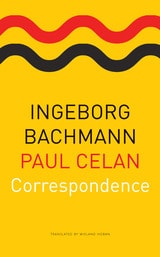
cover of Correspondence

Correspondence

Paul Celan and Ingeborg Bachmann

Seagull Books, 2019

Paul Celan (1920–70) is one of the best-known German poets of the Holocaust; many of his poems, admired for their spare, precise diction, deal directly with its stark themes. Austrian writer Ingeborg Bachmann (1926–73) is recognized as one of post–World War II German literature’s most important novelists, poets, and playwrights. It seems only appropriate that these two contemporaries and masters of language were at one time lovers, and they shared a lengthy, artful, and passionate correspondence.

            Collected here for the first time in English are their letters written between 1948 and 1961. Their correspondence forms a moving testimony of the discourse of love in the age after Auschwitz, with all the symptomatic disturbances and crises caused by their  conflicting backgrounds and their hard-to-reconcile designs for living—as a woman, as a man, as writers. In addition to the almost 200 letters, the volume includes an important exchange between Bachmann and Gisèle Celan-Lestrange, who married Celan in 1951, as well as the letters between Paul Celan and Swiss writer Max Frisch.

“Scarcely more breathlessly and desperately can two lovers ever have struggled for words. Little known among German literary historians, the relationship between these two poets amounts to one of the most dramatic and momentous occurrences in German literature.”—FAZ, on the German edition

[more]
cover of Cosmopolitan Love: Utopian Vision in D. H. Lawrence and Eileen Chang

Cosmopolitan Love

Utopian Vision in D. H. Lawrence and Eileen Chang

Sijia Yao

University of Michigan Press, 2023

Finalist: 2024 Southern Atlantic Modern Language Association (SAMLA) Book Award Finalist | 05/21/2024

Love, and the different manifestations of it, is a common theme in literature around the world. In Cosmopolitan Love, Sijia Yao examines the writings of D. H. Lawrence, a British writer whose literature focused primarily on interpersonal relationships in domestic settings, and Eileen Chang, a Chinese writer who migrated to the United States and explored Chinese heterosexual love in her writing. While comparing the writings of a Chinese writer and an English one, Yao avoids a direct comparison between East and West that could further enforce binaries. Instead, she uses the comparison to develop an idea of cosmopolitanism that shows how the writers are in conversation with their own culture and with each other. Both D. H. Lawrence and Eileen Chang wrote stories that are influenced by—but sometimes stand in opposition to—their own cultures. They offer alternative understandings of societies dealing with modernism and cultural globalization. Their stories deal with emotional pain caused by the restrictions of local politics and economics and address common themes of incestuous love, sexual love, adulterous love, and utopian love. By analyzing their writing, Yao demonstrates that the concept of love as a social and political force can cross cultural boundaries and traditions to become a basis for human meaning, the key to a cosmopolitan vision.
[more]
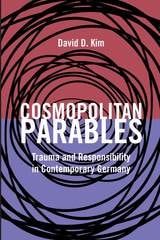
cover of Cosmopolitan Parables: Trauma and Responsibility in Contemporary Germany

Cosmopolitan Parables

Trauma and Responsibility in Contemporary Germany

David D. Kim

Northwestern University Press, 2017

Cosmopolitan Parables explores the global rise of the heavily debated concept of cosmopolitanism from a unique German literary perspective. Since the early 1990s, the notion of cosmopolitanism has acquired a new salience because of an alarming rise in nationalism, xenophobia, migration, international war, and genocide. This upsurge has transformed how artists and scholars worldwide assess the power of international civil society and its moral obligation to unite regardless of cultural background, religious affiliation, or national citizenship. It rejuvenates an ancient yet timely framework within which contemporary political crises are to be overcome, especially after the collapse of communist states and the intersection of postwar and postcolonial trajectories.

To exemplify this global challenge, Kim examines three internationally acclaimed writers of German origin—Hans Christoph Buch, Michael Krüger, and W. G. Sebald—joined by their own harrowing experiences and stunning entanglements with Holocaust memory, postcolonial responsibility, and communist legacy. This bold new study is the first of its kind, interrogating transnational memories of trauma alongside globally shared responsibilities for justice. More important, it addresses the question of remembrance—whether the colonial past or the postwar legacy serves as a proper foundation upon which cosmopolitanism is to be pursued in today's era of globalization.

 
[more]
cover of Cosmopolitical Claims: Turkish-German Literatures from Nadolny to Pamuk

Cosmopolitical Claims

Turkish-German Literatures from Nadolny to Pamuk

B. Venkat Mani

University of Iowa Press, 2007

When both France and Holland rejected the proposed constitution for the European Union in 2005, the votes reflected popular anxieties about the entry of Turkey into the European Union as much as they did ambivalence over ceding national sovereignty. Indeed, the votes in France and Holland echoed long standing tensions between Europe and Turkey. If there was any question that tensions were high, the explosive reaction of Europe’s Muslim population to a series of cartoons of Mohammed in a Danish newspaper put them to rest. Cosmopolitical Claims is a profoundly original study of the works of Sten Nadonly, Emine Sevgi Özdamar, Feridun Zaimoglu, and 2006 Nobel prize in literature recipient Orhan Pamuk. Rather than using the proverbial hyphen in “Turkish-German” to indicate a culture caught between two nations, Venkat Mani is interested in how Turkish-German literature engages in a scrutiny of German and Turkish national identity.
    Moving deftly from the theoretical literature to the texts themselves, Mani’s groundbreaking study explores these conflicts and dialogues and the resulting cultural hybridization as they are expressed in four novels that document the complexity of Turkish-German cultural interactions in the late twentieth and early twenty-first centuries. His innovative readings will engage students of contemporary German literature as well as illuminate the discussion of minority literature in a multicultural setting.
    As Salman Rushdie said in the 2002 Tanner Lecture at Yale, “The frontier is an elusive line, visible and invisible, physical and metaphorical, amoral and moral. . . . To cross a frontier is to be transformed.” It is in this vein that Mani’s dynamic and subtle work posits a still evolving discourse between Turkish and German writers.
[more]
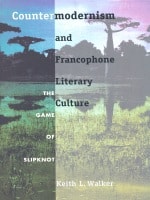
cover of Countermodernism and Francophone Literary Culture: The Game of Slipknot

Countermodernism and Francophone Literary Culture

The Game of Slipknot

Keith L. Walker

Duke University Press, 1999

Keith L. Walker traverses the traditionally imposed boundaries of geography and race as he examines the literary culture produced by French speakers and writers born outside France. Focusing on the commonalities revealed in their shared language and colonial history, Walker examines for the first time the work of six writers who, while artistically distinct and geographically scattered, share complex sensibilities regarding their own relationship to France and the French language and, as he demonstrates, produce a counterdiscourse to their colonizers’ modern literary traditions.
Martinique, French Guyana, Senegal, Morocco, and Haiti serve as the stage for the struggle these writers have faced with French language and culture, a struggle influenced by the legacy of Aimé Césaire. In his stand against the modernist principles of Charles Baudelaire, Walker argues, Césaire has become the preeminent francophone countermodernist. A further examination of the relationships between Césaire and the writers Léon Gontron Damas, Mariama Bâ, Tahar Ben Jelloun, Ken Bugul, and Gérard Étienne forms the core of the book and leads to Walker’s characterization of francophone literature as having “slipped the knot,” or escaped the snares of the familiar binary oppositions of modernism. Instead, he discovers in these writers a shared consciousness rooted in an effort to counter and denounce modernist humanist discourse and pointing toward a new subjectivity formed through the negotiation of an alternative modernity.
Countermodernism and Francophone Literary Culture will engage readers interested in French literature and in postcolonial, Caribbean, African, American, and francophone studies.
[more]
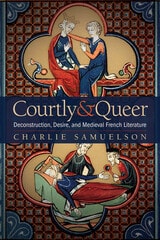
cover of Courtly and Queer: Deconstruction, Desire, and Medieval French Literature

Courtly and Queer

Deconstruction, Desire, and Medieval French Literature

Charlie Samuelson

The Ohio State University Press, 2022
In Courtly and Queer, Charlie Samuelson casts queerness in medieval French texts about courtly love in a new light by bringing together for the first time two exemplary genres: high medieval verse romance, associated with the towering figure of Chrétien de Troyes, and late medieval dits, primarily associated with Guillaume de Machaut. In close readings informed by deconstruction and queer theory, Samuelson argues that the genres’ juxtaposition opens up radical new perspectives on the deviant poetics and gender and sexual politics of both. Contrary to a critical tradition that locates the queer Middle Ages at the margins of these courtly genres, Courtly and Queer emphasizes an unflagging queerness that is inseparable from poetic indeterminacy and that inhabits the core of a literary tradition usually assumed to be conservative and patriarchal. Ultimately, Courtly and Queer contends that one facet of texts commonly referred to as their “courtliness”—namely, their literary sophistication—powerfully overlaps with modern conceptions of queerness.
[more]
cover of Courts, Jurisdictions, and Law in John Milton and His Contemporaries

Courts, Jurisdictions, and Law in John Milton and His Contemporaries

Alison A. Chapman

University of Chicago Press, 2020

John Milton is widely known as the poet of liberty and freedom. But his commitment to justice has been often overlooked. As Alison A. Chapman shows, Milton’s many prose works are saturated in legal ways of thinking, and he also actively shifts between citing Roman, common, and ecclesiastical law to best suit his purpose in any given text. This book provides literary scholars with a working knowledge of the multiple, jostling, real-world legal systems in conflict in seventeenth-century England and brings to light Milton’s use of the various legal systems and vocabularies of the time—natural versus positive law, for example—and the differences between them.

Surveying Milton’s early pamphlets, divorce tracts, late political tracts, and major prose works in comparison with the writings and cases of some of Milton’s contemporaries—including George Herbert, John Donne, Ben Jonson, and John Bunyan—Chapman reveals the variety and nuance in Milton’s juridical toolkit and his subtle use of competing legal traditions in pursuit of justice.
 
[more]
cover of Crafting the Female Subject: Narrative Innovation in the Short Fiction of Emilia Pardo Bazán

Crafting the Female Subject

Narrative Innovation in the Short Fiction of Emilia Pardo Bazán

Susan M. McKenna

Catholic University of America Press, 2009

Susan McKenna presents the innovative narratives of Emilia Pardo Bazán, Spain's preeminent nineteenth-century female writer, in Crafting the Female Subject.
[more]
cover of Creole Medievalism: Colonial France and Joseph Bédier’s Middle Ages

Creole Medievalism

Colonial France and Joseph Bédier’s Middle Ages

Michelle R. Warren

University of Minnesota Press, 2010

Joseph Bédier (1864-1938) was one of the most famous scholars of his day. He held prestigious posts and lectured throughout Europe and the United States, an activity unusual for an academic of his time. A scholar of the French Middle Ages, he translated Tristan and Isolde as well as France's national epic, The Song of Roland. Bédier was publicly committed to French hegemony, yet he hailed from a culture that belied this ideal-the island of Réunion in the southern Indian Ocean.

In Creole Medievalism, Michelle Warren demonstrates that Bédier's relationship to this multicultural and economically peripheral colony motivates his nationalism in complex ways. Simultaneously proud of his French heritage and nostalgic for the island, Bédier defends French sovereignty based on an ambivalent resistance to his creole culture. Warren shows that in the early twentieth century, influential intellectuals from Réunion helped define the new genre of the "colonial novel," adopting a pro-colonial spirit that shaped both medieval and Francophone studies. Probing the work of a once famous but little understood cultural figure, Creole Medievalism illustrates how postcolonial France and Réunion continue to grapple with histories too varied to meet expectations of national unity.
[more]
cover of Crime in Verse: The Poetics of Murder in the Victorian Era

Crime in Verse

The Poetics of Murder in the Victorian Era

Ellen L. O’Brien

The Ohio State University Press, 2008
Over the last few decades, Victorian scholars have produced many nuanced studies connecting the politics of crime to the generic developments of the novel—and vice versa. Ellen L. O’Brien’s Crime in Verse grants the same attention and status to poetic representations of crime. Considering the literary achievements and cultural engagements of poetry while historicizing murder’s entanglement in legal fictions, punitive practices, medical theories, class conflicts, and gender codes, O’Brien argues that shifting approaches to poetry and conflicted understandings of murder allowed poets to align problems of legal and literary interpretation in provocative, disruptive, and innovative ways.
 
Developing focused analyses of generic and discursive meanings, individual chapters examine the classed politics of crime and punishment in the broadside ballad, the epistemological tensions of homicidal lunacy and criminal responsibility in the dramatic monologue, and the legal and ideological frictions of domestic violence in the verse novel and verse drama. Their juxtaposition of the rhymes of anonymous street balladeers, the underexamined verse of “minor” poets, and the familiar poems of canonical figures suggests the interactive and intertextual relationships informing poetic agendas and political arguments. As it simultaneously reconsiders the institutional and ideological status of murder and the aesthetic and political interests of poetry, Crime in Verse offers new ways of thinking about Victorian poetry’s contents and contexts.
          
[more]
cover of Crip Authority: Disability and the Art of Consolation  in the Renaissance

Crip Authority

Disability and the Art of Consolation in the Renaissance

Elizabeth B. Bearden

University of Michigan Press, 2025

Crip Authority explores how Renaissance writers and artists with disabilities drew on consolatory literature to enhance their authority and create a sense of disability community across the centuries. Elizabeth B. Bearden considers how Renaissance writers and artists understood their lived experiences of disability by drawing on the ancient genre of consolation, which aims to comfort people for a variety of hardships, including mental and physical disability. Renaissance writers used the art of consolation to resignify the mental and physical disabilities that their society frequently scorned into an expression of their military, spiritual, political, and most importantly for this study, writerly authority. Bearden names this kind of defiant authorial self-representation crip authority, thereby transgressively cripping our society’s ableist notions of who has the ability and authority to write.  

Disabled authors include Francesco Petrarca, Teresa de Cartagena, Giovani Paolo Lomazzo, Miguel de Cervantes Saavedra, Robert Burton, and John Milton. They all explore their experiences of disability, but their work has rarely or never been considered from a disability studies perspective. Bearden thus brings today’s models of disability studies and crip theory together with early modern articulations of disability based on ancient and Renaissance models of military, political, biblical, and literary authority. In sum, Crip Authority makes a significant contribution to the growing field of early modern disability studies and invites us to rethink the extent of crip history and the endurance of disability gain.
[more]
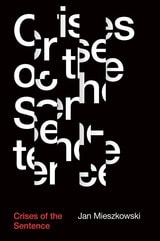
cover of Crises of the Sentence

Crises of the Sentence

Jan Mieszkowski

University of Chicago Press, 2019

There are few forms in which so much authority has been invested with so little reflection as the sentence. Though a fundamental unit of discourse, it has rarely been an explicit object of inquiry, often taking a back seat to concepts such as the word, trope, line, or stanza.
            To understand what is at stake in thinking—or not thinking—about the sentence, Jan Mieszkowski looks at the difficulties confronting nineteenth- and twentieth-century authors when they try to explain what a sentence is and what it can do. From Romantic debates about the power of the stand-alone sentence, to the realist obsession with precision and revision, to modernist experiments with ungovernable forms, Mieszkowski explores the hidden allegiances behind our ever-changing stylistic ideals. By showing how an investment in superior writing has always been an ethical and a political as well as an aesthetic commitment, Crises of the Sentence offers a new perspective on our love-hate relationship with this fundamental compositional category.
 
[more]
cover of Crisis and Conversion in Apuleius' Metamorphoses

Crisis and Conversion in Apuleius' Metamorphoses

Nancy Shumate

University of Michigan Press, 1996

Apuleius' wonderful Latin novel Metamorphoses, written in the second century C.E., was for a long time neglected. In recent years some have attempted to understand the Metamorphoses by applying contemporary critical theory to the work, without notable success. In Crisis and Conversion in Apuleius' "Metamorphoses" Nancy Shumate takes a new and profitable approach: she uses an epistemologically oriented model of religious conversion to study the experiences of the novel's central character, Lucius, who is turned into an ass and back again.
Shumate draws on a wide range of literary and nonliterary representations of conversion in order to establish a useful theoretical framework. The Metamorphoses is exposed as a text anticipating later narratives in its concern with world-building, with the narrator's subjective reality, and with the invocation and critique of religious experience.
Crisis and Conversion in Apuleius' "Metamorphoses" will be of interest to classicists and scholars of Silver Latin and of the increasingly popular ancient novel, as well as to students of psychology and the sociology of religious experience.
Nancy Shumate is Associate Professor of Classical Languages and Literatures, Smith College.
[more]
cover of Critical Paths: Blake and the Argument of Method

Critical Paths

Blake and the Argument of Method

Dan Miller, Mark Bracher and Donald Ault, eds.

Duke University Press, 1987

The great expositors of Blake and those who have followed in their footsteps have clarified the most minute particulars of Blake's vision. Now, in the place of traditional exegesis, comes a significantly new set of critical problems and interpretive methods. In this volume of essays, the major shift in Blake studies, already under way in practice, is addressed, gauged, analyzed, and debated.

The contributors assembled here, leading exponents of contemporary critical methods as well as close students of Blake, argue the grounds, purposes, and validity of each approach and then apply its method in detailed readings of Blake's works. We see deconstruction, psychoanalytic interpretation, feminist critique, semiotic analysis, Marxist criticism, revisionism, and other methods brought to bear on Blake's texts and into confrontation with one another by those best able to do so.

Through the essays themselves and in the reaction they will certainly provoke, Critical Paths will bring increased theoretical awareness to the study of Blake and will further the ongoing redefinition of Blake's art. At the same time, the collection investigates the general problem of methodology in literary studies by means of a casebook examination of modern critical approaches. Blake criticism and current literary theory here come together; the encounter illuminates and enriches both.

[more]
cover of Critical Practices in Post-Franco Spain

Critical Practices in Post-Franco Spain

Silvia L. Lopez, Jenaro Talens, and Dario Villanueva, Editors

University of Minnesota Press, 1994

Critical Practices in Post-Franco Spain was first published in 1994. Minnesota Archive Editions uses digital technology to make long-unavailable books once again accessible, and are published unaltered from the original University of Minnesota Press editions.

This volume offers a sample of Spanish critical work in literary theory and cultural studies. Like all critical histories, Spain's is political: Philology dominated the critical scene during the Franco years, and after Franco, this hegemony has been contested by semiotics, poststructuralism, psychoanalysis, and feminisms. Without trying to represent all the theoretical projects presently underway in Spanish criticism, this book opens a window on the vast field of new critical practices in Spain and provides a general picture of influential theoretical currents.

The essays collected here range widely in topic and style, and they reflect a new generation's preoccupation with critical problems that go beyond the field of literary studies. The authors focus on new discourse in various print and electronic media, on the discursive construction of the museum space, and on literary theory as it confronts issues of translation, subjectivity, writing, and narratology.

Silvia López is assistant professor of Spanish at Carlton Collegea doctoral candidate in the departments of cultural studies and comparative literature at the University of Minnesota. Jenaro Talens is professor of Hispanic literature and comparative literature at the University of Geneva. He is the author of The Branded Eye: Buñuel's Un Chien Andalou, (Minnesota 1993). Darío Villanueva is professor of theory of literature at the University of Santiago de Compostela, Spain.
[more]
cover of Critical Prefaces of the French Renaissance

Critical Prefaces of the French Renaissance

Bernard Weinberg

Northwestern University Press, 1950
Critical Prefaces of the French Renaissance contains nearly 30 prefaces from the works of French poets and dramatists published from 1525 to 1611. Bernard Weinberg’s helpful book collects prefaces from the works of satirical poets, as well as dramatists, and provides a short introduction to each preface setting it in its literary and historical context. Lyrical and satirical poets represented vary from Marot to Du Bellay to Ronsard. Dramatists represented include Jean de la Tille and Larivey, among others. The larger introduction to the volume provides literary analysis of five longer texts by Sebillet, Du Bellay, Peletier du Mans, the obscure Pierre De-laudun, and Horace. Weinberg’s study brings attention back to these primary writings that are crucial for an understanding of the period.
[more]
cover of Crossing between Tradition and Modernity: Essays in Commemoriation of Milena Doležalová-Velingerová (1932–2012)

Crossing between Tradition and Modernity

Essays in Commemoriation of Milena Doležalová-Velingerová (1932–2012)

Edited by Kirk A. Denton

Karolinum Press, 2017
Crossing Between Tradition and Modernity presents thirteen essays written in honor of Milena Doleželová-Velingerová (1932–2012), a member of the Prague School of Sinology and an important scholar of Chinese literature who was at the forefront in introducing literary theory into sinology. Doleželová-Velingerová was that rare scholar who wrote with equal knowledge and skill about both modern and premodern Chinese literature. The essays emulate Doleželová-Velingerová’s scholarship in terms of treating a broad range of historical periods, literary genres, and topics—from Tang travel essays to cultural identity in postcolonial Hong Kong. Organized into two parts, “Language, Structure, and Genre,” and “Identities and Self-Representations,” the essays are motivated by an abiding concern with issues of language, narrative structure, and the complex nature of literary meaning that were at the heart of Doleželová-Velingerová’s work.
[more]
cover of Crossing the Divide: Representations of Deafness in Biography

Crossing the Divide

Representations of Deafness in Biography

Rachel M. Hartig

Gallaudet University Press, 2006

This remarkable volume examines the process by which three deaf, French biographers from the 19th and 20th centuries attempted to cross the cultural divide between deaf and hearing worlds through their work. The very different approach taken by each writer sheds light on determining at what point an individual’s assimilation into society endanger his or her sense of personal identity.

Author Hartig begins by assessing the publications of Jean-Ferdinand Berthier (1803-1886). Berthier wrote about Auguste Bébian, Abbé de l’Epée, and Abbé Sicard, all of whom taught at the National Institute for the Deaf in Paris. Although Berthier presented compelling portraits of their entire lives, he paid special attention to their political and social activism, his main interest.

Yvonne Pitrois (1880-1937) pursued her particular interest in the lives of deaf-blind people. Her biography of Helen Keller focused on her subject’s destiny in conjunction with her unique relationship with Anne Sullivan. Corinne Rocheleau-Rouleau (1881-1963) recounted the historical circumstances that led French-Canadian pioneer women to leave France. The true value of her work resides in her portraits of these pioneer women: maternal women, warriors, religious women, with an emphasis on their lives and the choices they made.

Crossing the Divide reveals clearly the passion these biographers shared for narrating the lives of those they viewed as heroes of an emerging French deaf community. All three used the genre of biography not only as a means of external exploration but also as a way to plumb their innermost selves and to resolve ambivalence about their own deafness.
[more]
cover of Crossing through Chueca: Lesbian Literary Culture in Queer Madrid

Crossing through Chueca

Lesbian Literary Culture in Queer Madrid

Jill Robbins

University of Minnesota Press, 2010

In the past two decades the city of Madrid has been marked by pride, feminism, and globalization—but also by the vestiges of the machismo nurtured during the long years of the Franco dictatorship. Crossing through Chueca examines how lesbian literary culture fares in this mix from the end of the countercultural movement la movida madrileña in 1988 until the gay marriage march in 2005.

Jill Robbins traverses the various literary spaces of the city associated with queer culture, in particular the gay barrio of Chueca, revealing how it is a product of interrelations—a site crisscrossed by a multiplicity of subjects who constitute it as a queer space through the negotiation of their sexual, racial, gender, and class identities. Robbins recognizes Chueca as a political space as well, a refuge from homophobia. She also shows how the spatial and literary practices of Chueca relate to economic issues.

In examining how women’s sexual identities have become visible in and through the Chueca phenomenon, this work is a revealing example of transnational queer studies within the broader Western discussion on gender and sexuality.
[more]
cover of Cruelty and Laughter: Forgotten Comic Literature and the Unsentimental Eighteenth Century

Cruelty and Laughter

Forgotten Comic Literature and the Unsentimental Eighteenth Century

Simon Dickie

University of Chicago Press, 2011

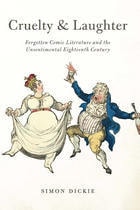
Eighteenth-century British culture is often seen as polite and sentimental—the creation of an emerging middle class. Simon Dickie disputes these assumptions in Cruelty and Laughter, a wildly enjoyable but shocking plunge into the forgotten comic literature of the age. Beneath the surface of Enlightenment civility, Dickie uncovers a rich vein of cruel humor that forces us to recognize just how slowly ordinary human sufferings became worthy of sympathy.

Delving into an enormous archive of comic novels, jestbooks, farces, variety shows, and cartoons, Dickie finds a vast repository of jokes about cripples, blind men, rape, and wife-beating. Epigrams about syphilis and scurvy sit alongside one-act comedies about hunchbacks in love. He shows us that everyone—rich and poor, women as well as men—laughed along. In the process, Dickie also expands our understanding of many of the century’s major authors, including Samuel Richardson, Lady Mary Wortley Montagu, Tobias Smollett, Frances Burney, and Jane Austen. He devotes particular attention to Henry Fielding’s Joseph Andrews, a novel that reflects repeatedly on the limits of compassion and the ethical problems of laughter. Cruelty and Laughter is an engaging, far-reaching study of the other side of culture in eighteenth-century Britain.
[more]
cover of Cruising with Robert Louis Stevenson: Travel, Narrative, and the Colonial Body

Cruising with Robert Louis Stevenson

Travel, Narrative, and the Colonial Body

Oliver S. Buckton

Ohio University Press, 2007
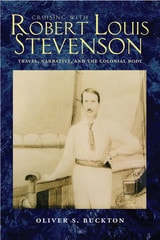
Cruising with Robert Louis Stevenson: Travel, Narrative, and the Colonial Body is the first book-length study about the influence of travel on Robert Louis Stevenson’s writings, both fiction and nonfiction. Within the contexts of late-Victorian imperialism and ethnographic discourse, the book offers original close readings of individual works by Stevenson while bringing new theoretical insights to bear on the relationship between travel, authorship, and gender identity in the Victorian fin de siècle. Oliver S. Buckton develops “cruising” as a critical term, linking Stevenson’s leisurely mode of travel with the striking narrative motifs of disruption and fragmentation that characterize his writings. Buckton traces the development of Stevenson’s career from his early travel books to show how Stevenson’s major works of fiction, such as Treasure Island, Kidnapped, and The Ebb-Tide, draw on innovative techniques and materials Stevenson acquired in the course of his global travels. Exploring Stevenson’s pivotal role in the revival of “romance” in the late nineteenth century, Cruising with Robert Louis Stevenson highlights Stevenson’s treatment of the human body as part of his resistance to realism, arguing that the energies and desires released by travel are often routed through disturbingly resistant or darkly comic corporeal figures. Buckton gives extensive attention to Stevenson’s writing about the South Seas, arguing that his groundbreaking critiques of European colonialism are formed in awareness of the fragility and desirability of Polynesian bodies and island landscapes. Cruising with Robert Louis Stevenson will be indispensable to all admirers of Stevenson as well as of great interest to readers of travel writing, Victorian ethnography, gender studies, and literary criticism.
[more]
cover of Crusoes and Other Castaways in Modern French Literature: Solitary Adventures

Crusoes and Other Castaways in Modern French Literature

Solitary Adventures

Joseph Acquisto

University of Delaware Press, 2012

Crusoes and Other Castaways in Modern French Literature: Solitary Adventures by Joseph Acquisto examines the many ways in which the castaway, particularly in the form of engagement with Robinson Crusoe, has been reinterpreted and appropriated in nineteenth through twenty-first century French literature. The book is not merely a literary history of the robinsonnade in France; rather, Acquisto demonstrates how what he calls the genre of “solitary adventure” becomes a vehicle for exploration of much larger questions about the reception of texts, modes of reading, and the relationship between popular and serious literary traditions. The heart of Crusoes and Other Castaways in Modern French Literature examines a crucial moment in the late nineteenth and early twentieth centuries when the history of cultural perspectives on reading and solitude intersect, catalyzing a reconsideration of Defoe’s tale. Acquisto’s philosophically inflected readings of works by writers from Rousseau to Balzac, Verne to Gide, Valéry to Tournier enhance intertextual and cultural approaches to the castaway myth and broaden our appreciation of the dynamic relation it has to modern French literature writ large.

Published by University of Delaware Press. Distributed worldwide by Rutgers University Press.
 
[more]
cover of Cultural Capital: The Problem of Literary Canon Formation

Cultural Capital

The Problem of Literary Canon Formation

John Guillory

University of Chicago Press, 1993
John Guillory challenges the most fundamental premises of the canon debate by resituating the problem of canon formation in an entirely new theoretical framework. The result is a book that promises to recast not only the debate about the literary curriculum but also the controversy over "multiculturalism" and the current "crisis of the humanities." Employing concepts drawn from Pierre Bourdieu's sociology, Guillory argues that canon formation must be understood less as a question of the representation of social groups than as a question of the distribution of "cultural capital" in the schools, which regulate access to literacy, to the practices of reading and writing.
[more]
cover of Cultural Capital: The Problem of Literary Canon Formation

Cultural Capital

The Problem of Literary Canon Formation

John Guillory

University of Chicago Press, 2023

An enlarged edition to celebrate the thirtieth anniversary of John Guillory’s formative text on the literary canon.

Since its publication in 1993, John Guillory’s Cultural Capital has been a signal text for understanding the codification and uses of the literary canon. Cultural Capital reconsiders the social basis for aesthetic judgment and exposes the unequal distribution of symbolic and linguistic knowledge on which culture has long been based. Drawing from Pierre Bourdieu’s sociology, Guillory argues that canon formation must be understood less as a question of the representation of social groups and more as a question of the distribution of cultural capital in schools, which regulate access to literacy, to the practices of reading and writing.
 
Now, as the crisis of the canon has evolved into the so-called crisis of the humanities, Guillory’s groundbreaking, incisive work has never been more urgent. As scholar and critic Merve Emre writes in her introduction to this enlarged edition: “Exclusion, selection, reflection, representation—these are the terms on which the canon wars of the last century were fought, and the terms that continue to inform debates about, for instance, decolonizing the curriculum and the rhetoric of antiracist pedagogy.”
[more]
cover of Cultural Offensive: America's Impact on British Art Since 1945

Cultural Offensive

America's Impact on British Art Since 1945

John A. Walker

Pluto Press, 1998

The vibrant fine arts and mass culture that the United Stated exported to Britain in the postwar period had a powerful and far-reaching impact on many British artists, art students and critics. In a fascinating social and cultural history covering the period from the 1940s to the 1990s, but with emphasis on the 1950s and 1960s, John A. Walker offers a scholarly but accessible account of America's Cold War cultural offensive and the role played by American artists living in Britain.

This is the first text to document in detail the variegated responses of British artists to postwar America and its art, criticism and mass media. Their reactions that ranged from Americanism – enthusiasm and compliance – to Anti-Americanism – criticism and resistance. Covering significant art movements such as Abstract Expressionism, the Independent Group and Pop Art, Walker synthesises information from hundreds of published sources and interviews to paint a vivid picture of a crucial period in British culture. 

Many of the critics, painters and sculptors featured – Lawrence Alloway, Peter Blake, Reyner Banham, Anthony Caro, Clement Greenberg, David Hockney, Richard Hamilton, R.B. Kitaj,  John Latham, Claes Oldenburg, Eduardo Paolozzi, Herbert Read, Bridget Riley, Larry Rivers – are now internationally famous. The study is brought up to date with an overview of the decline in American influence during in the 1980s and 1990s and the rise of Brit Art.
[more]
cover of Culture and Money in the Nineteenth Century: Abstracting Economics

Culture and Money in the Nineteenth Century

Abstracting Economics

Daniel Bivona

Ohio University Press, 2016

Since the 1980s, scholars have made the case for examining nineteenth-century culture—particularly literary output—through the lens of economics. In Culture and Money in the Nineteenth Century: Abstracting Economics, two luminaries in the field of Victorian studies, Daniel Bivona and Marlene Tromp, have collected contributions from leading thinkers that push New Economic Criticism in new and exciting directions.

Spanning the Americas, India, England, and Scotland, this volume adopts an inclusive, global view of the cultural effects of economics and exchange. Contributors use the concept of abstraction to show how economic thought and concerns around money permeated all aspects of nineteenth-century culture, from the language of wills to arguments around the social purpose of art.

The characteristics of investment and speculation; the fraught symbolic and practical meanings of paper money to the Victorians; the shifting value of goods, services, and ideas; the evolving legal conceptualizations of artistic ownership—all of these, contributors argue, are essential to understanding nineteenth-century culture in Britain and beyond.

Contributors: Daniel Bivona, Suzanne Daly, Jennifer Hayward, Aeron Hunt, Roy Kreitner, Kathryn Pratt Russell, Cordelia Smith, and Marlene Tromp.
[more]
cover of Curiosity: A Cultural History of Early Modern Inquiry

Curiosity

A Cultural History of Early Modern Inquiry

Barbara M. Benedict

University of Chicago Press, 2001

"Pithy and wide-ranging. . . . This study provides a fresh new lens through which to reinvestigate the whole of early modern English literature."—Library Journal

In this striking social history, Barbara M. Benedict draws on the texts of the early modern period to discover the era's attitudes toward curiosity, a trait we learn was often depicted as an unsavory form of transgression or cultural ambition.
[more]