8128 books match the query 'Literary Criticism' and 523 start with c
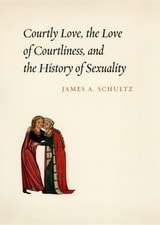
cover of Courtly Love, the Love of Courtliness, and the History of Sexuality

Courtly Love, the Love of Courtliness, and the History of Sexuality

James A. Schultz

University of Chicago Press, 2006

One of the great achievements of the Middle Ages, Europe’s courtly culture gave the world the tournament, the festival, the knighting ceremony, and also courtly love. But courtly love has strangely been ignored by historians of sexuality. With Courtly Love, the Love of Courtliness, and the History of Sexuality, James Schultz corrects this oversight with careful analysis of key courtly texts of the medieval German literary tradition.
 
Courtly love, Schultz finds, was provoked not by the biological and intrinsic factors that play such a large role in our contemporary thinking about sexuality—sex difference or desire—but by extrinsic signs of class: bodies that were visibly noble and behaviors that represented exemplary courtliness. Individuals became “subjects” of courtly love only to the extent that their love took the shape of certain courtly roles such as singer, lady, or knight. They hoped not only for physical union but also for the social distinction that comes from realizing these roles to perfection. To an extraordinary extent, courtly love represented the love of courtliness—the eroticization of noble status and the courtly culture that celebrated noble power and refinement
[more]
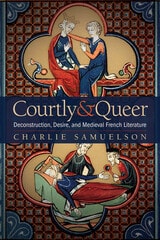
cover of Courtly and Queer: Deconstruction, Desire, and Medieval French Literature

Courtly and Queer

Deconstruction, Desire, and Medieval French Literature

Charlie Samuelson

The Ohio State University Press, 2022
In Courtly and Queer, Charlie Samuelson casts queerness in medieval French texts about courtly love in a new light by bringing together for the first time two exemplary genres: high medieval verse romance, associated with the towering figure of Chrétien de Troyes, and late medieval dits, primarily associated with Guillaume de Machaut. In close readings informed by deconstruction and queer theory, Samuelson argues that the genres’ juxtaposition opens up radical new perspectives on the deviant poetics and gender and sexual politics of both. Contrary to a critical tradition that locates the queer Middle Ages at the margins of these courtly genres, Courtly and Queer emphasizes an unflagging queerness that is inseparable from poetic indeterminacy and that inhabits the core of a literary tradition usually assumed to be conservative and patriarchal. Ultimately, Courtly and Queer contends that one facet of texts commonly referred to as their “courtliness”—namely, their literary sophistication—powerfully overlaps with modern conceptions of queerness.
[more]
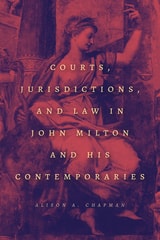
cover of Courts, Jurisdictions, and Law in John Milton and His Contemporaries

Courts, Jurisdictions, and Law in John Milton and His Contemporaries

Alison A. Chapman

University of Chicago Press, 2020

John Milton is widely known as the poet of liberty and freedom. But his commitment to justice has been often overlooked. As Alison A. Chapman shows, Milton’s many prose works are saturated in legal ways of thinking, and he also actively shifts between citing Roman, common, and ecclesiastical law to best suit his purpose in any given text. This book provides literary scholars with a working knowledge of the multiple, jostling, real-world legal systems in conflict in seventeenth-century England and brings to light Milton’s use of the various legal systems and vocabularies of the time—natural versus positive law, for example—and the differences between them.

Surveying Milton’s early pamphlets, divorce tracts, late political tracts, and major prose works in comparison with the writings and cases of some of Milton’s contemporaries—including George Herbert, John Donne, Ben Jonson, and John Bunyan—Chapman reveals the variety and nuance in Milton’s juridical toolkit and his subtle use of competing legal traditions in pursuit of justice.
 
[more]
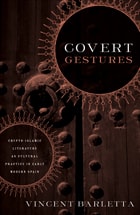
cover of Covert Gestures: Crypto-Islamic Literature as Cultural Practice in Early Modern Spain

Covert Gestures

Crypto-Islamic Literature as Cultural Practice in Early Modern Spain

Vincent Barletta

University of Minnesota Press, 2005

Forcibly expelled from Spain in the early seventeenth century, the substantial Muslim community known as the moriscos left behind them a hidden yet extremely rich corpus of manuscripts. Copied out in Arabic script and concealed in walls, false floors, and remote caves, these little-known texts now offer modern readers an absorbing look into the cultural life of the moriscos during the hundred years between their forced conversion to Christianity and their eventual expulsion. Covert Gestures reveals how the traditional Islamic narratives of the moriscos both shaped and encoded a wide range of covert social activity characterized by a profound and persistent concern with time and temporality. Using a unique blend of literary analysis, linguistic anthropology, and phenomenological philosophy, Barletta explores the narratives as testimonials of past human experiences and discovers in them evidence of community resistance. In its interdisciplinary approach, Vincent Barletta's work is nothing less than a rewriting of the cultural history of Muslim Spain, as well as a replotting of the future course of medieval and early modern literary studies.
[more]
cover of Coyote Country: Fictions of the Canadian West

Coyote Country

Fictions of the Canadian West

Arnold E. Davidson

Duke University Press, 1994

For most North Americans—Canadians as well as Americans—the term "Western" evokes images of the frontier, brave sheriffs and ruthless outlaws, good cowboys and bad Indians. As Arnold E. Davidson shows in this groundbreaking study, a number of Canada’s most interesting and experimental Western writers parody, reverse, or otherwise defuse the paraphernalia of the classic U.S. Western. Lacking both a real and imagined frontier—Canadian settlers rode trains into the new territory, already policed by Mounties—the writers of Canadian Westerns were set a different task from their American counterparts and were subsequently freed to create some of the most complex and engrossing fiction yet produced in Canada.
Davidson details the evolution of the U.S. and Canadian Western forms, tracing the divergence between the two as Canadian writers responded to their unique historical circumstances by reinventing the West as well as the Western and establishing a new literary landscape where author and reader could work out new possibilities of being. Surveying a range of texts by Canada’s most innovative writers, with special attention to women writers and Native stories of Coyote, he provides close readings of novels by Howard O’Hagan, Sheila Watson, Robert Kroetsch, Aritha van Herk, Anne Cameron, Peter Such, W. O. Mitchell, Beatrice Culleton, and Thomas King. A unique study, Coyote Country offers at one and the same time a theory of Canadian Western fiction, a history of crosscultural paradigms of the West as manifested in novels, and an intensive reading of some of Canada’s best literature.
[more]
cover of Coyote In The Maze

Coyote In The Maze

Peter Quigley

University of Utah Press, 1999

The works of Edward Abbey have been well known to general readers since the 1960’s. This volume, the first comprehensive collection of literary criticism devoted to the entire challenging corpus of Abbey’s fiction and nonfiction, couldn’t be more timely or significant.

From the perspective of his scholarly critics in Western American literature and environmental studies Ed Abbey is, in a word, problematic. As Peter Quigley, volume editor, comments, "The title of this collection refers to a number of references within Abbey’s work. The maze is a place of myriad canyons, of wonder, and a place where the desperadoes in The Monkey Wrench Gang could lose the authorities. The coyote refers to the slippery figure in Native American myth, a figure, known to Abbey, that always eluded definition an could slip out of every trap set to catch him." In this long-awaited anthology, eighteen intrepid scholars have chosen to ignore the coyote’s reputation, tracking Abbey in one masterful and illuminating essay after another through the canyons of anarchist politics, philosophy, feminist literary criticism, post-structuralism, and rhetoric, as well as nature and environmental theory and activism.

[more]
cover of Cozy Time: Resistance Through Comfort in Youth(ful) Media and Popular Culture

Cozy Time

Resistance Through Comfort in Youth(ful) Media and Popular Culture

Emily Midkiff

University of Iowa Press, 2027
[more]
cover of Crack Wars: LITERATURE ADDICTION MANIA

Crack Wars

LITERATURE ADDICTION MANIA

Avital Ronell

University of Illinois Press, 1992

Avital Ronell asks why "there is no culture without drug culture." She deals with the usual drugs and alcohol (and their celebrities: Freud's cocaine, Baudelaire's hashish, the Victorians' laudanum), and moves beyond them to addictions that are culturally accepted--an insatiable appetite for romance novels, for instance, and romance itself. 
 
It is a commonplace of modern culture to presume that there is a subculture or counterculture deeply saturated with drugs, but such modern cultures need subcultures, and need drugs on every level. Culture defines itself, its classes, its power structures, and its economy in terms of how it allows and encourages drugs to circulate. If drugs are dangerous, that danger seems to increase their appeal for millions. If drugs are unnatural and addictive, gasoline is a drug. What is art but a kind of drug, and what is art criticism but a kind of criticism of drugs and drug-induced states?
                                                           
Gustave Flaubert's Madame Bovary takes up the problems of drugs and addiction in numerous ways, which Ronnell unpacks and presents as examples of the safe and unsafe. From Emma Bovary's romantic hallucinations to her suicide by arsenic, she moves through this realistic novel constantly reaching for the unreal. For Ronell, Emma Bovary represents the first addict, embodying a yearning that calls from the bottom of her humanity, and which it seems can only be satisfied by some sort of drug.
 
[more]
cover of Crafting the Female Subject: Narrative Innovation in the Short Fiction of Emilia Pardo Bazán

Crafting the Female Subject

Narrative Innovation in the Short Fiction of Emilia Pardo Bazán

Susan M. McKenna

Catholic University of America Press, 2009

Susan McKenna presents the innovative narratives of Emilia Pardo Bazán, Spain's preeminent nineteenth-century female writer, in Crafting the Female Subject.
[more]
cover of Crash Cultures: Modernity, Mediation and the Material

Crash Cultures

Modernity, Mediation and the Material

Edited by Jane Arthurs and Iain Grant

Intellect Books, 1995

Since Diana's car crash in August 1997, media interest in the crash as an event needing explanation has proliferated. A glut of documentaries on television have investigated the social and scientific history of our responses to the car crash, as well as showing the personal impact of the crash on individual lives.

In trying to give meaning to one celebrity crash, the more general significance of the car crash, its challenge to rational control or explanation, its disregard for the subject and its will, became the focus for attention. Coincidentally, the two most newsworthy films of 1997 were David Cronenberg's Crash and James Cameron's Titanic, both of which generated intense popular interest.

The principal purpose of this collection of essays is to subject texts, within which crashes figure, to well-defined cultural study. The themes that emerge from this collection, which is truly experimental in attempting to draw together the resources for a cultural study of events, are many and varied. Moreover, they vary in format, in order to bring as many modes of address as possible to bear on the crashes that catastrophically and fantastically punctuate the fabric of everyday life.
[more]
cover of Crash: Cinema and the Politics of Speed and Stasis

Crash

Cinema and the Politics of Speed and Stasis

Karen Beckman

Duke University Press, 2010
Artists, writers, and filmmakers from Andy Warhol and J. G. Ballard to Alejandro González Iñárritu and Ousmane Sembène have repeatedly used representations of immobilized and crashed cars to wrestle with the conundrums of modernity. In Crash, Karen Beckman argues that representations of the crash parallel the encounter of film with other media, and that these collisions between media offer useful ways to think about alterity, politics, and desire. Examining the significance of automobile collisions in film genres including the “cinema of attractions,” slapstick comedies, and industrial-safety movies, Beckman reveals how the car crash gives visual form to fantasies and anxieties regarding speed and stasis, risk and safety, immunity and contamination, and impermeability and penetration. Her reflections on the crash as the traumatic, uncertain moment of inertia that comes in the wake of speed and confidence challenge the tendency in cinema studies to privilege movement above film’s other qualities. Ultimately, Beckman suggests that film studies is a hybrid field that cannot apprehend its object of study without acknowledging the ways that cinema’s technology binds it to capitalism’s industrial systems and other media, technologies, and disciplines.
[more]
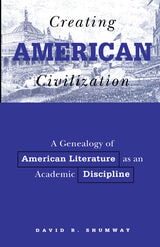
cover of Creating American Civilization: A Genealogy of American Literature as an Academic Discipline

Creating American Civilization

A Genealogy of American Literature as an Academic Discipline

David Shumway

University of Minnesota Press, 1994

“Shumway has written a penetrating and provocative account of the making of American civilization as an academic field.”

Gerald GraffUniversity of ChicagoDavid R. Shumway contends that American literature is the product of study - the deliberate invention of a discipline seeking to define the character and legitimate the existence of a specifically American civilization. He traces the various reconstitutions of American literature by examining the discipline’s practices and techniques, discourses and structures, paradigms and unstated assumptions.This genealogy begins around 1890, when American literature as defined by institutions outside the academy, such as magazines and publishing houses, acquired much of the ideology it would display in later phases, including sexism, racism, and class bias. Singular in its treatment of American literary study as a discipline rather than as criticism and in its insistence on the cultural and political work carried on by this discipline, Creating American Civilization will engage literary theorists and historians as well as individuals with an interest in American literature.
[more]
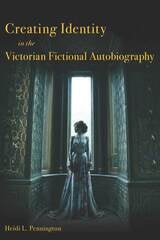
cover of Creating Identity in the Victorian Fictional Autobiography

Creating Identity in the Victorian Fictional Autobiography

Heidi L. Pennington

University of Missouri Press, 2018

This is the first book-length study of the fictional autobiography, a subgenre that is at once widely recognizable and rarely examined as a literary form with its own history and dynamics of interpretation. Heidi L. Pennington shows that the narrative form and genre expectations associated with the fictional autobiography in the Victorian period engages readers in a sustained meditation on the fictional processes that construct selfhood both in and beyond the text. Through close readings of Jane Eyre, David Copperfield, and other well-known examples of the subgenre, Pennington shows how the Victorian fictional autobiography subtly but persistently illustrates that all identities are fictions.

Despite the subgenre’s radical implications regarding the nature of personal identity, fictional autobiographies were popular in their own time and continue to inspire devotion in readers. This study sheds new light on what makes this subgenre so compelling, up to and including in the present historical moment of precipitous social and technological change. As we continue to grapple with the existential question of what determines “who we really are,” this book explores the risks and rewards of embracing conscious acts of fictional self-production in an unstable world.
[more]
cover of Creative Critical Interventions for Social Justice

Creative Critical Interventions for Social Justice

Edited by Natasha Tanna, Abeyamí Ortega Domínguez, and Hakan Sandal-Wilson

University College London, 2026

This volume reimagines conventional academic forms to highlight creative-critical approaches grounded in queer, antiracist, transfeminist, and decolonial frameworks. 

Creative Critical Interventions for Social Justice is an edited volume grounded in a commitment to politically engaged research. It examines knowledge that is often excluded from conventional academic production and explores the potential for creative critical writing and cultural production to advance social justice-focused research and practice. It highlights creative-critical research by queer and/or racialized scholars, accompanied by reflections on the possibilities and pitfalls of drawing on researcher positionality in knowledge production. 
[more]
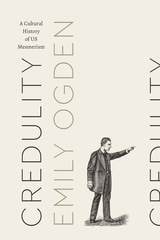
cover of Credulity: A Cultural History of US Mesmerism

Credulity

A Cultural History of US Mesmerism

Emily Ogden

University of Chicago Press, 2018

From the 1830s to the Civil War, Americans could be found putting each other into trances for fun and profit in parlors, on stage, and in medical consulting rooms. They were performing mesmerism. Surprisingly central to literature and culture of the period, mesmerism embraced a variety of phenomena, including mind control, spirit travel, and clairvoyance. Although it had been debunked by Benjamin Franklin in late eighteenth-century France, the practice nonetheless enjoyed a decades-long resurgence in the United States. Emily Ogden here offers the first comprehensive account of those boom years.
 
Credulity tells the fascinating story of mesmerism’s spread from the plantations of the French Antilles to the textile factory cities of 1830s New England. As it proliferated along the Eastern seaboard, this occult movement attracted attention from Ralph Waldo Emerson’s circle and ignited the nineteenth-century equivalent of flame wars in the major newspapers. But mesmerism was not simply the last gasp of magic in modern times. Far from being magicians themselves, mesmerists claimed to provide the first rational means of manipulating the credulous human tendencies that had underwritten past superstitions. Now, rather than propping up the powers of oracles and false gods, these tendencies served modern ends such as labor supervision, education, and mediated communication. Neither an atavistic throwback nor a radical alternative, mesmerism was part and parcel of the modern. Credulity offers us a new way of understanding the place of enchantment in secularizing America.
[more]
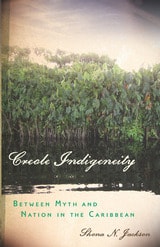
cover of Creole Indigeneity: Between Myth and Nation in the Caribbean

Creole Indigeneity

Between Myth and Nation in the Caribbean

Shona N. Jackson

University of Minnesota Press, 2012

During the colonial period in Guyana, the country’s coastal lands were worked by enslaved Africans and indentured Indians. In Creole Indigeneity, Shona N. Jackson investigates how their descendants, collectively called Creoles, have remade themselves as Guyana’s new natives, displacing indigenous peoples in the Caribbean through an extension of colonial attitudes and policies.

Looking particularly at the nation’s politically fraught decades from the 1950s to the present, Jackson explores aboriginal and Creole identities in Guyanese society. Through government documents, interviews, and political speeches, she reveals how Creoles, though unable to usurp the place of aboriginals as First Peoples in the New World, nonetheless managed to introduce a new, more socially viable definition of belonging, through labor. The very reason for bringing enslaved and indentured workers into Caribbean labor became the organizing principle for Creoles’ new identities.

Creoles linked true belonging, and so political and material right, to having performed modern labor on the land; labor thus became the basis for their subaltern, settler modes of indigeneity—a contradiction for belonging under postcoloniality that Jackson terms “Creole indigeneity.” In doing so, her work establishes a new and productive way of understanding the relationship between national power and identity in colonial, postcolonial, and anticolonial contexts.

[more]
cover of Creole Medievalism: Colonial France and Joseph Bédier’s Middle Ages

Creole Medievalism

Colonial France and Joseph Bédier’s Middle Ages

Michelle R. Warren

University of Minnesota Press, 2010

Joseph Bédier (1864-1938) was one of the most famous scholars of his day. He held prestigious posts and lectured throughout Europe and the United States, an activity unusual for an academic of his time. A scholar of the French Middle Ages, he translated Tristan and Isolde as well as France's national epic, The Song of Roland. Bédier was publicly committed to French hegemony, yet he hailed from a culture that belied this ideal-the island of Réunion in the southern Indian Ocean.

In Creole Medievalism, Michelle Warren demonstrates that Bédier's relationship to this multicultural and economically peripheral colony motivates his nationalism in complex ways. Simultaneously proud of his French heritage and nostalgic for the island, Bédier defends French sovereignty based on an ambivalent resistance to his creole culture. Warren shows that in the early twentieth century, influential intellectuals from Réunion helped define the new genre of the "colonial novel," adopting a pro-colonial spirit that shaped both medieval and Francophone studies. Probing the work of a once famous but little understood cultural figure, Creole Medievalism illustrates how postcolonial France and Réunion continue to grapple with histories too varied to meet expectations of national unity.
[more]
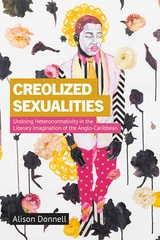
cover of Creolized Sexualities: Undoing Heteronormativity in the Literary Imagination of the Anglo-Caribbean

Creolized Sexualities

Undoing Heteronormativity in the Literary Imagination of the Anglo-Caribbean

Alison Donnell

Rutgers University Press, 2022
Creolized Sexualities: Undoing Heteronormativity in the Literary Imagination of the Anglo-Caribbean draws attention to a wide, and surprising, range of writings that craft inclusive and pluralizing representations of sexual possibilities within the Caribbean imagination. Reading across an eclectic range of writings from V.S. Naipaul to Marlon James, Shani Mootoo to Junot Diaz, Andrew Salkey to Thomas Glave, Curdella Forbes to Colin Robinson, this bold work of literary criticism brings into view fictional worlds where Caribbeanness and queerness correspond and reconcile. Through inspired close readings Donnell gathers evidence and argument for the Caribbean as an exemplary creolized ecology of fluid possibilities that can illuminate the prospect of a non-heteronormalizing future. Indeed, Creolized Sexualities hows how writers have long rendered sexual plasticity, indeterminacy, and pluralism as an integral part of Caribbeanness and as one of the most compelling if unacknowledged ways of resisting the disciplining regimes of colonial and neocolonial power.
[more]
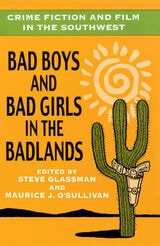
cover of Crime Fiction and Film in the Southwest: Bad Boys and Bad Girls in the Badlands

Crime Fiction and Film in the Southwest

Bad Boys and Bad Girls in the Badlands

Edited by Steve Glassman and Maurice O'Sullivan

University of Wisconsin Press, 2001

When Joe Leaphorn and Jim Chee, Tony Hillerman’s oddly matched tribal police officers, patrol the mesas and canyons of their Navajo reservation, they join a rich traditon of Southwestern detectives. In Crime Fiction and Film in the Southwest, a group of literary critics tracks the mystery and crime novel from the Painted Desert to Death Valley and Salt Lake City. In addition, the book includes the first comprehensive bibliography of mysteries set in the Southwest and a chapter on Southwest film noir from Humphrey Bogart’s tough hood in The Petrified Forest to Russell Crowe’s hard-nosed cop in L.A. Confidential.

[more]
cover of Crime Uncovered: Anti-hero

Crime Uncovered

Anti-hero

Edited by Fiona Peters and Rebecca Stewart

Intellect Books, 2015

There are few figures as captivating as the antihero: the character we can’t help but root for, even as we turn away in revulsion from many of the things they do. What is it that draws us to characters like Breaking Bad’s Walter White, Patricia Highsmith’s Tom Ripley, and Stieg Larsson’s Lisbeth Salander even as we decry the trail of destruction they leave in their wake?

Crime Uncovered: Antihero tackles that question and more. Mixing the popular and iconic, contemporary and ancient, the book explores the place and appeal of the antihero. Using figures from books, TV, film, and more, including such up-to-the-minute examples as True Detective’s Rust Cole, the book places the antihero’s actions within the society he or she is rejecting, showing how expectations and social and familial structures create the backdrop against which the antihero’s posture becomes compelling. Featuring interviews with genre masters James Ellroy and Paul Johnston, Crime Uncovered: Antiherois an accessible, engaging analysis of what drives us to embrace those characters who acknowledge—or even flaunt—the dark side we all have somewhere deep inside.
[more]
cover of Crime Uncovered: Private Investigator

Crime Uncovered

Private Investigator

Edited by Alistair Rolls and Rachel Franks

Intellect Books, 2016

The private investigator is one of the most enduring characters within crime fiction. From Dashiell Hammett’s Sam Spade— the hard-boiled loner trawling the mean streets—to Agatha Christie’s Captain Hastings—the genteel companion in greener surrounds—the P. I. has taken on any number of guises. In Crime Uncovered: Private Investigator, editors Alistair Rolls and Rachel Franks dive deep into crime literature and culture, challenging many of the assumptions we make about the hardy P. I.

Assembling a cast of notable crime fiction experts, including Stephen Knight and Carolyn Beasley, the book covers characters from the whole world of international noir—Giorgio Scerbanenco’s Duca Lambert, Léo Malet’s Nestor Burma, and many more. Including essays on the genealogy and emergence of the protagonist in nineteenth-century fiction; interviews with crime writers Leigh Redhead, Nick Quantrill, and Fernando Lalana; and analyses of the transatlantic exchanges that helped to develop public perception of a literary icon, Crime Uncovered: Private Investigator will redefine what we think we know about the figure of the P. I.

Rolls and Franks have engaged here the tension between the popular and scholarly that is inherent in any critical examination of a literary type, along the way unraveling the mystery of the alluring, enigmatic private investigator. Crime Uncovered: Private Investigator will be a handy companion for any crime fiction fan.
[more]
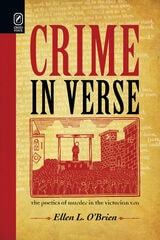
cover of Crime in Verse: The Poetics of Murder in the Victorian Era

Crime in Verse

The Poetics of Murder in the Victorian Era

Ellen L. O’Brien

The Ohio State University Press, 2008
Over the last few decades, Victorian scholars have produced many nuanced studies connecting the politics of crime to the generic developments of the novel—and vice versa. Ellen L. O’Brien’s Crime in Verse grants the same attention and status to poetic representations of crime. Considering the literary achievements and cultural engagements of poetry while historicizing murder’s entanglement in legal fictions, punitive practices, medical theories, class conflicts, and gender codes, O’Brien argues that shifting approaches to poetry and conflicted understandings of murder allowed poets to align problems of legal and literary interpretation in provocative, disruptive, and innovative ways.
 
Developing focused analyses of generic and discursive meanings, individual chapters examine the classed politics of crime and punishment in the broadside ballad, the epistemological tensions of homicidal lunacy and criminal responsibility in the dramatic monologue, and the legal and ideological frictions of domestic violence in the verse novel and verse drama. Their juxtaposition of the rhymes of anonymous street balladeers, the underexamined verse of “minor” poets, and the familiar poems of canonical figures suggests the interactive and intertextual relationships informing poetic agendas and political arguments. As it simultaneously reconsiders the institutional and ideological status of murder and the aesthetic and political interests of poetry, Crime in Verse offers new ways of thinking about Victorian poetry’s contents and contexts.
          
[more]
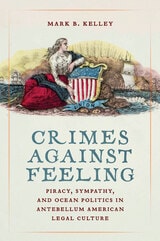
cover of Crimes Against Feeling: Piracy, Sympathy, and Ocean Politics in Antebellum American Legal Culture

Crimes Against Feeling

Piracy, Sympathy, and Ocean Politics in Antebellum American Legal Culture

Mark B. Kelley

University of Massachusetts Press, 2026

Demonstrating how emotion became central to the legal and literary meanings of piracy in nineteenth-century America

Pirates have long occupied a central yet unstable place in American law and national identity. In the decades leading up to and including the U.S. Civil War, the charge of piracy was leveled against an unusually wide range of figures: foreign heads of state, imperial filibusters, transoceanic enslavers, enslaved mutineers, radical abolitionists, and others who challenged established forms of authority. Early American literature reflects this instability, portraying pirates who vary dramatically in politics, race, gender, and allegiance. As Mark B. Kelley shows, these characters are united less by ideology than by their challenge to landed social norms and fixed national belonging. The pirate, in both law and literature, emerges as an individual defined by multiplicity rather than political coherence. 

Crimes Against Feeling examines how Americans made sense of this ambiguous figure by turning to emotion. Drawing on legal materials including treaties, trial transcripts, congressional debates, and U.S. Supreme Court decisions, as well as popular sentimental fiction (often written by women), Kelley argues that piracy was codified as an offense against moral feeling rather than being a singular political position. Legal thinkers and writers such as John Quincy Adams, Abraham Lincoln, Jefferson Davis, Catharine Maria Sedgwick, Harriet Beecher Stowe, and Maria S. Cummins relied on shared affective frameworks—sympathy, sentiment, and domestic vulnerability—to render piracy legible and punishable. American pirate law, Kelley demonstrates, was shaped by the same emotional logics that structured the era’s popular fiction. 

By tracing piracy across debates over domestic sovereignty, global enslavement and abolition, imperial expansion, postbellum reparations, and international copyright, Crimes Against Feeling reveals the pirate as a key figure for understanding gender, home, family, and nation in early America. Reading law and literature together, the book shows how emotional judgment—not political consensus—became a foundational tool for managing oceanic violence and transnational disorder in the nineteenth-century United States. 
[more]
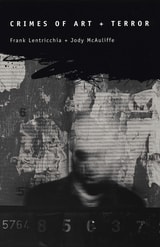
cover of Crimes of Art and Terror

Crimes of Art and Terror

Frank Lentricchia and Jody McAuliffe

University of Chicago Press, 2003

Do killers, artists, and terrorists need one another? In Crimes of Art and Terror, Frank Lentricchia and Jody McAuliffe explore the disturbing adjacency of literary creativity to violence and even political terror. Lentricchia and McAuliffe begin by anchoring their penetrating discussions in the events of 9/11 and the scandal provoked by composer Karlheinz Stockhausen's reference to the destruction of the World Trade Center as a great work of art, and they go on to show how political extremism and avant-garde artistic movements have fed upon each other for at least two centuries.

Crimes of Art and Terror reveals how the desire beneath many romantic literary visions is that of a terrifying awakening that would undo the West's economic and cultural order. This is also the desire, of course, of what is called terrorism. As the authority of writers and artists recedes, it is criminals and terrorists, Lentricchia and McAuliffe suggest, who inherit this romantic, destructive tradition. Moving freely between the realms of high and popular culture, and fictional and actual criminals, the authors describe a web of impulses that catches an unnerving spirit.

Lentricchia and McAuliffe's unorthodox approach pairs Dostoevsky's Crime and Punishment with Martin Scorsese's King of Comedy and connects the real-life Unabomber to the surrealist Joseph Cornell and to the hero of Bret Easton Ellis's bestselling novel American Psycho. They evoke a desperate culture of art through thematic dialogues among authors and filmmakers as varied as Don DeLillo, Joseph Conrad, Francis Ford Coppola, Jean Genet, Frederick Douglass, Hermann Melville, and J. M. Synge, among others. And they conclude provocatively with an imagined conversation between Heinrich von Kleist and Mohamed Atta. The result is a brilliant and unflinching reckoning with the perilous proximity of the impulse to create transgressive art and the impulse to commit violence.
[more]
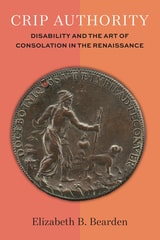
cover of Crip Authority: Disability and the Art of Consolation  in the Renaissance

Crip Authority

Disability and the Art of Consolation in the Renaissance

Elizabeth B. Bearden

University of Michigan Press, 2025

Crip Authority explores how Renaissance writers and artists with disabilities drew on consolatory literature to enhance their authority and create a sense of disability community across the centuries. Elizabeth B. Bearden considers how Renaissance writers and artists understood their lived experiences of disability by drawing on the ancient genre of consolation, which aims to comfort people for a variety of hardships, including mental and physical disability. Renaissance writers used the art of consolation to resignify the mental and physical disabilities that their society frequently scorned into an expression of their military, spiritual, political, and most importantly for this study, writerly authority. Bearden names this kind of defiant authorial self-representation crip authority, thereby transgressively cripping our society’s ableist notions of who has the ability and authority to write.  

Disabled authors include Francesco Petrarca, Teresa de Cartagena, Giovani Paolo Lomazzo, Miguel de Cervantes Saavedra, Robert Burton, and John Milton. They all explore their experiences of disability, but their work has rarely or never been considered from a disability studies perspective. Bearden thus brings today’s models of disability studies and crip theory together with early modern articulations of disability based on ancient and Renaissance models of military, political, biblical, and literary authority. In sum, Crip Authority makes a significant contribution to the growing field of early modern disability studies and invites us to rethink the extent of crip history and the endurance of disability gain.
[more]
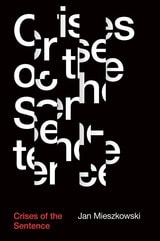
cover of Crises of the Sentence

Crises of the Sentence

Jan Mieszkowski

University of Chicago Press, 2019

There are few forms in which so much authority has been invested with so little reflection as the sentence. Though a fundamental unit of discourse, it has rarely been an explicit object of inquiry, often taking a back seat to concepts such as the word, trope, line, or stanza.
            To understand what is at stake in thinking—or not thinking—about the sentence, Jan Mieszkowski looks at the difficulties confronting nineteenth- and twentieth-century authors when they try to explain what a sentence is and what it can do. From Romantic debates about the power of the stand-alone sentence, to the realist obsession with precision and revision, to modernist experiments with ungovernable forms, Mieszkowski explores the hidden allegiances behind our ever-changing stylistic ideals. By showing how an investment in superior writing has always been an ethical and a political as well as an aesthetic commitment, Crises of the Sentence offers a new perspective on our love-hate relationship with this fundamental compositional category.
 
[more]
cover of Crisis and Conversion in Apuleius' Metamorphoses

Crisis and Conversion in Apuleius' Metamorphoses

Nancy Shumate

University of Michigan Press, 1996

Apuleius' wonderful Latin novel Metamorphoses, written in the second century C.E., was for a long time neglected. In recent years some have attempted to understand the Metamorphoses by applying contemporary critical theory to the work, without notable success. In Crisis and Conversion in Apuleius' "Metamorphoses" Nancy Shumate takes a new and profitable approach: she uses an epistemologically oriented model of religious conversion to study the experiences of the novel's central character, Lucius, who is turned into an ass and back again.
Shumate draws on a wide range of literary and nonliterary representations of conversion in order to establish a useful theoretical framework. The Metamorphoses is exposed as a text anticipating later narratives in its concern with world-building, with the narrator's subjective reality, and with the invocation and critique of religious experience.
Crisis and Conversion in Apuleius' "Metamorphoses" will be of interest to classicists and scholars of Silver Latin and of the increasingly popular ancient novel, as well as to students of psychology and the sociology of religious experience.
Nancy Shumate is Associate Professor of Classical Languages and Literatures, Smith College.
[more]
cover of Critical Conditions: Regarding the Historical Moment

Critical Conditions

Regarding the Historical Moment

Hays, Michael

University of Minnesota Press, 1992
A significant, masterfully executed contribution to the debate surrounding the “New Historicism.”
[more]
cover of Critical Digital Humanities: The Search for a Methodology

Critical Digital Humanities

The Search for a Methodology

James E. Dobson

University of Illinois Press, 2019
Can established humanities methods coexist with computational thinking? It is one of the major questions in humanities research today, as scholars increasingly adopt sophisticated data science for their work. James E. Dobson explores the opportunities and complications faced by humanists in this new era. Though the study and interpretation of texts alongside sophisticated computational tools can serve scholarship, these methods cannot replace existing frameworks. As Dobson shows, ideas of scientific validity cannot easily nor should be adapted for humanities research because digital humanities, unlike science, lack a leading-edge horizon charting the frontiers of inquiry. Instead, the methods of digital humanities require a constant rereading. At the same time, suspicious and critical readings of digital methodologies make it unwise for scholars to defer to computational methods. Humanists must examine the tools--including the assumptions that went into the codes and algorithms--and questions surrounding their own use of digital technology in research. Insightful and forward thinking, Critical Digital Humanities lays out a new path of humanistic inquiry that merges critical theory and computational science.
[more]
cover of Critical Essays

Critical Essays

Roland Barthes

Northwestern University Press, 1972
The essays in this volume were written during the years that its author's first four books were published in France. They chart the course of Barthe's criticism from the vocabularies of existentialism and Marxism (reflections on the social situation of literature and writer's responsibility before History) to a psychoanalysis of substances (after Bachelard) and a psychoanalytical anthropology (which evidently brought Barthes to his present terms of understanding with Levi-Strauss and Lacan).
[more]
cover of Critical Essays: Volume 1: 1944–1948

Critical Essays

Volume 1: 1944–1948

Georges Bataille

Seagull Books, 2023

This first book in a three-volume collection of Georges Bataille’s essays introduces English readers to his philosophical and critical writings.

In the aftermath of the Second World War, French thinker and writer Georges Bataille forged a singular path through the moral and political impasses of his age. In 1946, animated by “a need to live events in an increasingly conscious way,” and to reject any compartmentalization of intellectual life, Bataille founded the journal Critique. Adopting the format of the review essay, he surveyed the post-war cultural landscape while advancing his reflections on excess, non-knowledge, and the general economy. Focusing on literature as a mode of sovereign uselessness, he tackled prominent and divisive figures such as Henry Miller and Albert Camus.
 
In keeping with Critique’s mission to explore the totality of human knowledge, Bataille’s articles did not just focus on the literary but featured important reflections on the science of sexuality, the Chinese Revolution, and historical accounts of drunkenness, among other matters. Throughout, he was attuned to how humanity would deal with the excessive forces of production and destruction it had unleashed, his aim being a way of thinking and living that would inhabit that excess.
 
This is the first of three volumes collecting Bataille’s post-war essays. Beginning with an article on Nietzsche and fascism written shortly after the liberation of Paris and running to the end of 1948, these texts make available for the first time in English the systematic diversity of Bataille’s post-war thought.
 
[more]
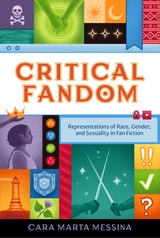
cover of Critical Fandom: Representations of Race, Gender, and Sexuality in Fan Fiction

Critical Fandom

Representations of Race, Gender, and Sexuality in Fan Fiction

Cara Marta Messina

University of Iowa Press, 2026

Critical Fandom positions fan authors as rhetoricians and fan fiction as an action. Every fan author navigates—implicitly or explicitly—the politics of their fandom, the media they love, their lived experiences, digital technologies, reader expectations, and a larger culture. To better understand critical fans, Cara Marta Messina analyzes Archive of Our Own tagging practices, fan fictions, and interviews from four different fandoms.

Fans of The Legend of Korra celebrate queer relationships while understanding representation is just the first step in the face of systemic homophobia. Game of Thrones fan authors challenge racism and heteronormativity in both the community and the show. In online forums for Black Panther, fans make space for sapphic romances and explore the humanity of Erik Killmonger, ultimately contending with harmful stereotypes of radical Black men. And the Our Flag Means Death fandom demonstrates how a show can flourish when it centers queerness, especially for trans fans. Even in these moments of joy, there’s conflict. Critical Fandom seeks to answer what comes next.
[more]
cover of Critical Inquiry, volume 48 number 1 (Autumn 2021)

Critical Inquiry, volume 48 number 1 (Autumn 2021)

The University of Chicago Press

University of Chicago Press Journals, 2021
This is volume 48 issue 1 of Critical Inquiry. Critical Inquiry is a peer-reviewed interdisciplinary journal devoted to the best critical thought in the arts and humanities. Combining a commitment to rigorous scholarship with a vital concern for dialogue and debate, the journal presents articles by eminent and emerging scholars, critics, and artists on a wide variety of issues in contemporary criticism and culture. Associated with no single school of thought, tied to no single discipline, Critical Inquiry is dedicated to providing a forum for cutting-edge thought while reconsidering traditional concepts and practices.
[more]
cover of Critical Inquiry, volume 48 number 2 (Winter 2022)

Critical Inquiry, volume 48 number 2 (Winter 2022)

The University of Chicago Press

University of Chicago Press Journals, 2022
This is volume 48 issue 2 of Critical Inquiry. Critical Inquiry is a peer-reviewed interdisciplinary journal devoted to the best critical thought in the arts and humanities. Combining a commitment to rigorous scholarship with a vital concern for dialogue and debate, the journal presents articles by eminent and emerging scholars, critics, and artists on a wide variety of issues in contemporary criticism and culture. Associated with no single school of thought, tied to no single discipline, Critical Inquiry is dedicated to providing a forum for cutting-edge thought while reconsidering traditional concepts and practices.
[more]
cover of Critical Inquiry, volume 48 number 3 (Spring 2022)

Critical Inquiry, volume 48 number 3 (Spring 2022)

The University of Chicago Press

University of Chicago Press Journals, 2022
This is volume 48 issue 3 of Critical Inquiry. Critical Inquiry is a peer-reviewed interdisciplinary journal devoted to the best critical thought in the arts and humanities. Combining a commitment to rigorous scholarship with a vital concern for dialogue and debate, the journal presents articles by eminent and emerging scholars, critics, and artists on a wide variety of issues in contemporary criticism and culture. Associated with no single school of thought, tied to no single discipline, Critical Inquiry is dedicated to providing a forum for cutting-edge thought while reconsidering traditional concepts and practices.
[more]
cover of Critical Inquiry, volume 48 number 4 (Summer 2022)

Critical Inquiry, volume 48 number 4 (Summer 2022)

The University of Chicago Press

University of Chicago Press Journals, 2022
This is volume 48 issue 4 of Critical Inquiry. Critical Inquiry is a peer-reviewed interdisciplinary journal devoted to the best critical thought in the arts and humanities. Combining a commitment to rigorous scholarship with a vital concern for dialogue and debate, the journal presents articles by eminent and emerging scholars, critics, and artists on a wide variety of issues in contemporary criticism and culture. Associated with no single school of thought, tied to no single discipline, Critical Inquiry is dedicated to providing a forum for cutting-edge thought while reconsidering traditional concepts and practices.
[more]
cover of Critical Inquiry, volume 49 number 1 (Autumn 2022)

Critical Inquiry, volume 49 number 1 (Autumn 2022)

The University of Chicago Press

University of Chicago Press Journals, 2022
This is volume 49 issue 1 of Critical Inquiry. Critical Inquiry is a peer-reviewed interdisciplinary journal devoted to the best critical thought in the arts and humanities. Combining a commitment to rigorous scholarship with a vital concern for dialogue and debate, the journal presents articles by eminent and emerging scholars, critics, and artists on a wide variety of issues in contemporary criticism and culture. Associated with no single school of thought, tied to no single discipline, Critical Inquiry is dedicated to providing a forum for cutting-edge thought while reconsidering traditional concepts and practices.
[more]
cover of Critical Inquiry, volume 49 number 2 (Winter 2023)

Critical Inquiry, volume 49 number 2 (Winter 2023)

The University of Chicago Press

University of Chicago Press Journals, 2023
This is volume 49 issue 2 of Critical Inquiry. Critical Inquiry is a peer-reviewed interdisciplinary journal devoted to the best critical thought in the arts and humanities. Combining a commitment to rigorous scholarship with a vital concern for dialogue and debate, the journal presents articles by eminent and emerging scholars, critics, and artists on a wide variety of issues in contemporary criticism and culture. Associated with no single school of thought, tied to no single discipline, Critical Inquiry is dedicated to providing a forum for cutting-edge thought while reconsidering traditional concepts and practices.
[more]
cover of Critical Inquiry, volume 49 number 3 (Spring 2023)

Critical Inquiry, volume 49 number 3 (Spring 2023)

The University of Chicago Press

University of Chicago Press Journals, 2023
This is volume 49 issue 3 of Critical Inquiry. Critical Inquiry is a peer-reviewed interdisciplinary journal devoted to the best critical thought in the arts and humanities. Combining a commitment to rigorous scholarship with a vital concern for dialogue and debate, the journal presents articles by eminent and emerging scholars, critics, and artists on a wide variety of issues in contemporary criticism and culture. Associated with no single school of thought, tied to no single discipline, Critical Inquiry is dedicated to providing a forum for cutting-edge thought while reconsidering traditional concepts and practices.
[more]
cover of Critical Inquiry, volume 49 number 4 (Summer 2023)

Critical Inquiry, volume 49 number 4 (Summer 2023)

The University of Chicago Press

University of Chicago Press Journals, 2023
This is volume 49 issue 4 of Critical Inquiry. Critical Inquiry is a peer-reviewed interdisciplinary journal devoted to the best critical thought in the arts and humanities. Combining a commitment to rigorous scholarship with a vital concern for dialogue and debate, the journal presents articles by eminent and emerging scholars, critics, and artists on a wide variety of issues in contemporary criticism and culture. Associated with no single school of thought, tied to no single discipline, Critical Inquiry is dedicated to providing a forum for cutting-edge thought while reconsidering traditional concepts and practices.
[more]
cover of Critical Inquiry, volume 50 number 1 (Autumn 2023)

Critical Inquiry, volume 50 number 1 (Autumn 2023)

The University of Chicago Press

University of Chicago Press Journals, 2023
This is volume 50 issue 1 of Critical Inquiry. Critical Inquiry is a peer-reviewed interdisciplinary journal devoted to the best critical thought in the arts and humanities. Combining a commitment to rigorous scholarship with a vital concern for dialogue and debate, the journal presents articles by eminent and emerging scholars, critics, and artists on a wide variety of issues in contemporary criticism and culture. Associated with no single school of thought, tied to no single discipline, Critical Inquiry is dedicated to providing a forum for cutting-edge thought while reconsidering traditional concepts and practices.
[more]
cover of Critical Inquiry, volume 50 number 2 (Winter 2024)

Critical Inquiry, volume 50 number 2 (Winter 2024)

The University of Chicago Press

University of Chicago Press Journals, 2024
This is volume 50 issue 2 of Critical Inquiry. Critical Inquiry is a peer-reviewed interdisciplinary journal devoted to the best critical thought in the arts and humanities. Combining a commitment to rigorous scholarship with a vital concern for dialogue and debate, the journal presents articles by eminent and emerging scholars, critics, and artists on a wide variety of issues in contemporary criticism and culture. Associated with no single school of thought, tied to no single discipline, Critical Inquiry is dedicated to providing a forum for cutting-edge thought while reconsidering traditional concepts and practices.
[more]
cover of Critical Inquiry, volume 50 number 3 (Spring 2024)

Critical Inquiry, volume 50 number 3 (Spring 2024)

The University of Chicago Press

University of Chicago Press Journals, 2024
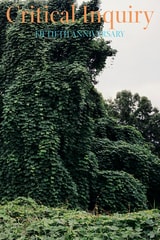
This is volume 50 issue 3 of Critical Inquiry. Critical Inquiry is a peer-reviewed interdisciplinary journal devoted to the best critical thought in the arts and humanities. Combining a commitment to rigorous scholarship with a vital concern for dialogue and debate, the journal presents articles by eminent and emerging scholars, critics, and artists on a wide variety of issues in contemporary criticism and culture. Associated with no single school of thought, tied to no single discipline, Critical Inquiry is dedicated to providing a forum for cutting-edge thought while reconsidering traditional concepts and practices.
[more]
cover of Critical Inquiry, volume 50 number 4 (Summer 2024)

Critical Inquiry, volume 50 number 4 (Summer 2024)

The University of Chicago Press

University of Chicago Press Journals, 2024
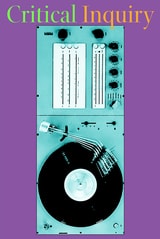
This is volume 50 issue 4 of Critical Inquiry. Critical Inquiry is a peer-reviewed interdisciplinary journal devoted to the best critical thought in the arts and humanities. Combining a commitment to rigorous scholarship with a vital concern for dialogue and debate, the journal presents articles by eminent and emerging scholars, critics, and artists on a wide variety of issues in contemporary criticism and culture. Associated with no single school of thought, tied to no single discipline, Critical Inquiry is dedicated to providing a forum for cutting-edge thought while reconsidering traditional concepts and practices.
[more]
cover of Critical Inquiry, volume 51 number 1 (Autumn 2024)

Critical Inquiry, volume 51 number 1 (Autumn 2024)

The University of Chicago Press

University of Chicago Press Journals, 2024
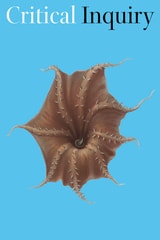
This is volume 51 issue 1 of Critical Inquiry. Critical Inquiry is a peer-reviewed interdisciplinary journal devoted to the best critical thought in the arts and humanities. Combining a commitment to rigorous scholarship with a vital concern for dialogue and debate, the journal presents articles by eminent and emerging scholars, critics, and artists on a wide variety of issues in contemporary criticism and culture. Associated with no single school of thought, tied to no single discipline, Critical Inquiry is dedicated to providing a forum for cutting-edge thought while reconsidering traditional concepts and practices.
[more]
cover of Critical Inquiry, volume 51 number 2 (Winter 2025)

Critical Inquiry, volume 51 number 2 (Winter 2025)

The University of Chicago Press

University of Chicago Press Journals, 2025
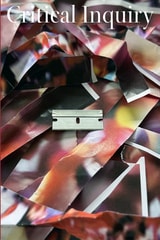
This is volume 51 issue 2 of Critical Inquiry. Critical Inquiry is a peer-reviewed interdisciplinary journal devoted to the best critical thought in the arts and humanities. Combining a commitment to rigorous scholarship with a vital concern for dialogue and debate, the journal presents articles by eminent and emerging scholars, critics, and artists on a wide variety of issues in contemporary criticism and culture. Associated with no single school of thought, tied to no single discipline, Critical Inquiry is dedicated to providing a forum for cutting-edge thought while reconsidering traditional concepts and practices.
[more]
cover of Critical Inquiry, volume 51 number 3 (Spring 2025)

Critical Inquiry, volume 51 number 3 (Spring 2025)

The University of Chicago Press

University of Chicago Press Journals, 2025
This is volume 51 issue 3 of Critical Inquiry. Critical Inquiry is a peer-reviewed interdisciplinary journal devoted to the best critical thought in the arts and humanities. Combining a commitment to rigorous scholarship with a vital concern for dialogue and debate, the journal presents articles by eminent and emerging scholars, critics, and artists on a wide variety of issues in contemporary criticism and culture. Associated with no single school of thought, tied to no single discipline, Critical Inquiry is dedicated to providing a forum for cutting-edge thought while reconsidering traditional concepts and practices.
[more]
cover of Critical Inquiry, volume 51 number 4 (Summer 2025)

Critical Inquiry, volume 51 number 4 (Summer 2025)

The University of Chicago Press

University of Chicago Press Journals, 2025
This is volume 51 issue 4 of Critical Inquiry. Critical Inquiry is a peer-reviewed interdisciplinary journal devoted to the best critical thought in the arts and humanities. Combining a commitment to rigorous scholarship with a vital concern for dialogue and debate, the journal presents articles by eminent and emerging scholars, critics, and artists on a wide variety of issues in contemporary criticism and culture. Associated with no single school of thought, tied to no single discipline, Critical Inquiry is dedicated to providing a forum for cutting-edge thought while reconsidering traditional concepts and practices.
[more]
cover of Critical Inquiry, volume 52 number 1 (Autumn 2025)

Critical Inquiry, volume 52 number 1 (Autumn 2025)

The University of Chicago Press

University of Chicago Press Journals, 2025
This is volume 52 issue 1 of Critical Inquiry. Critical Inquiry is a peer-reviewed interdisciplinary journal devoted to the best critical thought in the arts and humanities. Combining a commitment to rigorous scholarship with a vital concern for dialogue and debate, the journal presents articles by eminent and emerging scholars, critics, and artists on a wide variety of issues in contemporary criticism and culture. Associated with no single school of thought, tied to no single discipline, Critical Inquiry is dedicated to providing a forum for cutting-edge thought while reconsidering traditional concepts and practices.
[more]
cover of Critical Inquiry, volume 52 number 2 (Winter 2026)

Critical Inquiry, volume 52 number 2 (Winter 2026)

The University of Chicago Press

University of Chicago Press Journals, 2026

This is volume 52 issue 2 of Critical Inquiry. Critical Inquiry is a peer-reviewed interdisciplinary journal devoted to the best critical thought in the arts and humanities. Combining a commitment to rigorous scholarship with a vital concern for dialogue and debate, the journal presents articles by eminent and emerging scholars, critics, and artists on a wide variety of issues in contemporary criticism and culture. Associated with no single school of thought, tied to no single discipline, Critical Inquiry is dedicated to providing a forum for cutting-edge thought while reconsidering traditional concepts and practices.
[more]