Results by title
3258 books match the query 'Art' and 125 start with d
D-Passage
The Digital WayTrinh T. Minh-ha
Duke University Press, 2013
D. H. Lawrence
The Failure and the Triumph of ArtEliseo Vivas
Northwestern University Press, 1960

DAVID HUNTER STRUTHER
ONE OF THE BEST DRAUGHTSMEN THE COUNTRY POSSESSESJOHN A. CUTHBERT
West Virginia University Press, 1997
Dada and Photomontage across Borders, Volume 36
David Bathrick, Andreas Huyssen, and Anson Rabinbach, eds.
Duke University Press, 0
The central figure of the issue is John Heartfield, a Dadaist who influenced much of the art world in Europe after World War I. The collection investigates Heartfield’s lesser-known early work with cinema in the service of the German High Command. Believing that photographic cinema was akin to war propaganda, Heartfield rejected live-action war footage in favor of American cinematic animation to promote an honest discussion about the horror and realities of war. One essay explores Heartfield’s photomontages while turning to film theory as a way of interpreting the politics of his work, demonstrating how his photomontages retain the organic and traditional nature of photography even as they produce cognitive dissonance and satire. Another essay on Heartfield’s role in Soviet discussions of the 1930s offers fascinating insights based on new archival research. The issue also looks at the relationship between Heartfield and the illustrated German magazine Arbeiter-Illustrierte-Zeitung and how that magazine influenced photomontage across Europe.

Daguerreotypes
Fugitive Subjects, Contemporary ObjectsLisa Saltzman
University of Chicago Press, 2015
By examining this idea of photography as articulated in literature, film, and the graphic novel, Daguerreotypes demonstrates how photography secures identity for figures with an otherwise unstable sense of self. Lisa Saltzman argues that in many modern works, the photograph asserts itself as a guarantor of identity, whether genuine or fabricated. From Roland Barthes’s Camera Lucida to Ridley Scott’s Blade Runner, W. G. Sebald’s Austerlitz to Alison Bechdel’s Fun Home—we find traces of photography’s “fugitive subjects” throughout contemporary culture. Ultimately, Daguerreotypes reveals how the photograph, at once personal memento and material witness, has inspired a range of modern artistic and critical practices.
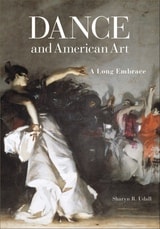
Dance and American Art
A Long EmbraceSharyn R. Udall
University of Wisconsin Press, 2012
From ballet to burlesque, from the frontier jig to the jitterbug, Americans have always loved watching dance, whether in grand ballrooms, on Mississippi riverboats, or in the streets. Dance and American Art is an innovative look at the elusive, evocative nature of dance and the American visual artists who captured it through their paintings, sculpture, photography, and prints from the early nineteenth century through the mid-twentieth century. The scores of artists discussed include many icons of American art: Winslow Homer, George Caleb Bingham, Mary Cassatt, James McNeill Whistler, Alexander Calder, Joseph Cornell, Edward Steichen, David Smith, and others.
As a subject for visual artists, dance has given new meaning to America’s perennial myths, cherished identities, and most powerful dreams. Their portrayals of dance and dancers, from the anonymous to the famous—Anna Pavlova, Isadora Duncan, Loïe Fuller, Josephine Baker, Martha Graham—have testified to the enduring importance of spatial organization, physical pattern, and rhythmic motion in creating aesthetic form.
Through extensive research, sparkling prose, and beautiful color reproductions, art historian Sharyn R. Udall draws attention to the ways that artists’ portrayals of dance have defined the visual character of the modern world and have embodied culturally specific ideas about order and meaning, about the human body, and about the diverse fusions that comprise American culture.
Dance of Values
Sergei Eisenstein’s Capital ProjectElena Vogman
Diaphanes, 2018
Dance, Politics & Co-Immunity
Current Perspectives on Politics and Communities in the Arts Vol. 1Edited by Stefan Hölscher and Gerald Siegmund
Diaphanes, 2013
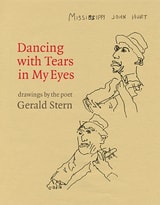
Dancing with Tears in My Eyes
Gerald Stern
University of Iowa Press, 2014
Long recognized as one of the most original poets in America, Stern is known for his tragi-comic, irascible vision that has been vividly rendered in hundreds of poems. All along, he has also been drafting these whimsical sketches. The Thurber-esque drawings represented here are daft, graphic expressions of Stern’s fearless and shameless sense of self.
In addition to expressing a forgiving and cavalier attitude toward aging, these saucy drawings, until now a well-kept secret of Stern’s creative life, capture something essential about his character. By turns profane and playfully romantic, they are another expression of the cutting wit and inimitable charm of Gerald Stern.

Dangerous Knowledge
The JFK Assassination in Art and FilmArt Simon
Temple University Press, 2013
In his new Preface to this edition of Dangerous Knowledge, Art Simon discusses public fascination with celebrity deaths and recent assassination-related media-from documentaries to scholarly books to the scandalous video game JFK Reloaded-to show that the assassination continues to inspire writers, artists, and filmmakers.
Dangerous Knowledge examines the seminal works of art associated with the assassination, including Andy Warhol's silk screens, the underground films of Bruce Conner, and provocative Hollywood films like The Parallax View and JFK. Simon's investigation places assassination art and images within a historical context-one that helps us understand what the assassination has meant to American culture.
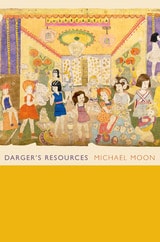
Darger's Resources
Michael Moon
Duke University Press, 2012

Daring
The Life and Art of Elisabeth Vigée Le BrunJordana Pomeroy
J. Paul Getty Trust, The, 2025
Supremely talented and strategically charming, Elisabeth Vigée Le Brun (1755–1842) overcame tragedy and broke gender barriers to reach the height of success as a portrait painter, first in Paris, and then across Europe. After losing her father at age twelve and facing financial insecurity, she fought to gain access to artistic training and opportunity. She was pressured to marry at age twenty, to an art dealer who both helped and harmed her career. Vigée Le Brun deployed her intelligence and beauty to attract powerful clients, who relied on her to style the personal identities they projected to the world.
Vigée Le Brun’s salons were the talk of Paris, and she became court painter to Marie Antoinette. Then came the French Revolution, when marginalized groups demanded change to centuries-old systems of oppression. Vigée Le Brun was forced to reexamine her alliances and run for her life, taking her young daughter but leaving her husband behind. Making her way through the countrysides and capitals of Europe and Russia—including a stay at the imperial court of Catherine the Great—the artist conquered fear and adversity to refashion her life and art.
Ages thirteen and up.

Dark Film, Blood Money
The Economic Unconscious of American Neo-Noir CinemaVernon Shetley
Intellect Books, 2027
Neo-noir films exert their fascination not only through their suspense, shadowy atmosphere, and moral ambiguity, but also through their registration of the experience of American life in the long twilight of the American Dream. With a sharp curatorial eye and an elegant critical voice, Vernon Shetley interprets landmark works from the noir revival of the early 1970s to the present, showing how neo-noir reflects the darkening national mood as postwar prosperity gave way to economic stagnation and inequality, social alienation, and a deepening sense of crisis.
Through close readings of key films and overviews of neo-noir’s treatment of the genre’s defining themes and archetypes—desire and betrayal, corruption and alienation, the private detective and the femme fatale—Shetley delineates neo-noir’s exploration of anxieties about work, money, trust, and exchange. From Chinatown to Mulholland Drive, from Night Moves to Nightmare Alley, neo-noir’s marginalized characters and extreme situations emerge in Shetley’s account as powerful representations of concerns central to economic and social life. Combining illuminating analysis with lucid prose, this book offers scholars and general readers alike a fresh, penetrating understanding of the dynamics of neo-noir filmmaking and its continually renewed vitality over the last five decades.

Dark Matter
Art and Politics in the Age of Enterprise CultureGregory Sholette
Pluto Press, 2011
Gregory Sholette, a politically engaged artist, argues that imagination and creativity in the art world originate thrive in the non-commercial sector shut off from prestigious galleries and champagne receptions. This broader creative culture feeds the mainstream with new forms and styles that can be commodified and used to sustain the few artists admitted into the elite.
This dependency, and the advent of inexpensive communication, audio and video technology, has allowed this 'dark matter' of the alternative art world to increasingly subvert the mainstream and intervene politically as both new and old forms of non-capitalist, public art. This book is essential for anyone interested in interventionist art, collectivism, and the political economy of the art world.
Data Dating
Love, Technology, DesireEdited by Ania Malinowska and Valentina Peri
Intellect Books, 2021
Data Dating is a collection of eleven academic essays accompanied by eleven works of media art that provide a comprehensive insight into the construction of love and its practices in the time of digitally mediated relationships. The essays come from recognized researchers in the field of media and cultural studies.
Database Aesthetics
Art in the Age of Information OverflowVictoria Vesna
University of Minnesota Press, 2007
Database Aesthetics examines the database as cultural and aesthetic form, explaining how artists have participated in network culture by creating data art. The essays in this collection look at how an aesthetic emerges when artists use the vast amounts of available information as their medium. Here, the ways information is ordered and organized become artistic choices, and artists have an essential role in influencing and critiquing the digitization of daily life.
Contributors: Sharon Daniel, U of California, Santa Cruz; Steve Deitz, Carleton College; Lynn Hershman Leeson, U of California, Davis; George Legrady, U of California, Santa Barbara; Eduardo Kac, School of the Art Institute of Chicago; Norman Klein, California Institute of the Arts; John Klima; Lev Manovich, U of California, San Diego; Robert F. Nideffer, U of California, Irvine; Nancy Paterson, Ontario College of Art and Design; Christiane Paul, School of Visual Arts in New York; Marko Peljhan, U of California, Santa Barbara; Warren Sack, U of California, Santa Cruz; Bill Seaman, Rhode Island School of Design; Grahame Weinbren, School of Visual Arts, New York.
Victoria Vesna is a media artist, and professor and chair of the Department of Design and Media Arts at the University of California, Los Angeles.
Day of the Dead in the USA, Second Edition
The Migration and Transformation of a Cultural PhenomenonRegina M Marchi
Rutgers University Press, 2022
Focusing on the power of public ritual to serve as a communication medium, this revised and updated edition combines a mix of ethnography, historical research, oral history, and critical cultural analysis to explore the manifold and unexpected transformations that occur when the tradition is embraced by the mainstream. A testament to the complex role of media and commercial forces in constructions of ethnic identity, Day of the Dead in the USA provides insight into the power of art and ritual to create community, transmit oppositional messages, and advance educational, political, and economic goals.
Today Chicano-style Day of the Dead events take place in all fifty states. This revised edition provides new information about:
- The increase in events across the US, incorporating media coverage and financial aspects,
- Recent political movements expressed in contemporary Day of the Dead celebrations, including #BlackLivesMatter and #MeToo
- Greater media coverage and online presence of the celebration in blogs, websites, and streaming video
- Día de los Muertos themes and iconography in video games and films
- The proliferation of commercialized merchandise such as home goods, apparel, face paints and jewelry at mainstream big box and web retailers, as well as the widespread proliferation of calavera-themed decorations and costumes for Halloween
- 24 new full color illustrations

De Grazia
The Man and the MythsJames W. Johnson with Marilyn D. Johnson
University of Arizona Press, 2014
Born in Arizona Territory to Italian immigrant parents, De Grazia had a humble childhood as a copper miner’s son, which later influenced his famous persona. De Grazia often held forth at his gallery in Tucson’s Catalina foothills dressed in a pseudo-prospector’s getup of scraggly beard, jeans, flannel shirt, boots, and beat-up cowboy hat. Outrageous stories of womanizing, scores of children, and drinking binges created an eclectic image that fueled stories of mythic proportions, along with global sales of his colorful paintings inspired by the Southwest and Mexico. He made millions through his paintings and the licensing of his art for greeting cards and trinkets. Critics called his work kitsch or commercial, yet thousands of admirers continue to love it.
Calling De Grazia a complicated man doesn’t begin to explain him. He once described himself as “not saint nor devil, but both.” In this first comprehensive biography of De Grazia, authors James W. Johnson with Marilyn D. Johnson tell the story of a life remarkably lived.
Dead Funny
The Humor of American HorrorDavid Gillota
Rutgers University Press, 2023
Dead Funny locates humor as a key element in the American horror film, one that is not merely used for extraneous “comic relief” moments but often serves to underscore major themes, intensify suspense, and disorient viewers. Each chapter focuses on a different comic style or device, from the use of funny monsters and scary clowns in movies like A Nightmare on Elm Street to the physical humor and slapstick in movies ranging from The Evil Dead to Final Destination. Along the way, humor scholar David Gillota explores how horror films employ parody, satire, and camp to comment on gender, sexuality, and racial politics. Covering everything from the grotesque body in Freaks to the comedy of awkwardness in Midsommar, this book shows how integral humor has been to the development of the American horror film over the past century.

Dear Friend
Rainer Maria Rilke and Paula Modersohn-BeckerEric Torgersen
Northwestern University Press, 2000
Dearth
Deconstruction After Speculative Realism. Art and DwellingPhilippe Lynes
Northwestern University Press, 2026
Proposing new insight into the legacies of Derridean thought for contemporary philosophy
In Art and Dwelling, the second volume of his Dearth sequence, Philippe Lynes sheds new light on the most enduring offshoot of the speculative realist movement, object-oriented ontology. Through careful readings of Graham Harman and Timothy Morton, Lynes shows how Jacques Derrida’s seminars offer critical insights into the spacing and distancing that precede and exceed all human practices of art and dwelling, with a deep sensitivity to the ecological and ethico-political consequences that follow.
Dearth: Deconstruction After Speculative Realism argues that Derrida’s seminars on Martin Heidegger and Maurice Blanchot, La Chose (The Thing), anticipated many of the philosophical, literary, and aesthetic questions animating speculative realism today: an anti-anthropocentric critique of Kantian correlationism; an overcoming of the apocalyptic nihilism of extinction through a deeper, affirmative habituation to nothingness; and poignant reflections on the literary and poetic aspects of living and dying in impossible worlds. His is an anti-correlationist plea that resounds now more urgently than ever.
Death Be Not Proud
The Art of Holy AttentionDavid Marno
University of Chicago Press, 2016
If, in Malebranche’s view, attention is a hidden bond between religion and philosophy, devotional poetry is the area where this bond becomes visible. Marno shows that in works like “Death be not proud,” Donne’s most triumphant poem about the resurrection, the goal is to allow the poem’s speaker to experience a given doctrine as his own thought, as an idea occurring to him. But while the thought must feel like an unexpected event for the speaker, the poem itself is a careful preparation for it. And the key to this preparation is attention, the only state in which the speaker can perceive the doctrine as a cognitive gift. Along the way, Marno illuminates why attention is required in Christian devotion in the first place and uncovers a tradition of battling distraction that spans from ascetic thinkers and Church Fathers to Catholic spiritual exercises and Protestant prayer manuals.

Death Tourism
Disaster Sites as Recreational LandscapeEdited by Brigitte Sion
Seagull Books, 2014
Death's Futurity
The Visual Life of Black PowerSampada Aranke
Duke University Press, 2023

Decadent Style
John Robert Reed
Ohio University Press, 1985
In Decadent Style, John Reed defines “decadent art” broadly enough to encompass literature, music, and the visual arts and precisely enough to examine individual works in detail. Reed focuses on the essential characteristics of this style and distinguishes it from non–esthetic categories of “decadent artists” and “decadent themes.”
Like the natural sciences and psychology, the arts in the late nineteenth century reflect an interest in the process of atomization. Literature and the other arts mirror this interest by developing, or rather elaborating, existing forms to the point of what appears to be dissolution. Instead of these forms dissolving, however, they require their audience’s participation and thus involve a new order. Reed argues that this process of reordering characterizes decadent style, which depends upon sensory provocation resolvable only through negation and is therefore bounded by philosophical and emotional assumptions of inevitable frustration.
Drawing upon the literature, music, and visual arts of England and Europe at the end of the nineteenth century, Reed provides a widely ranging and authoritative overview of decadent style, which relates such artists as Huysmans, Wilde, D’Annunzio, Moreau, Bresdin, Klimt, Klinger, Wagner, and Strauss. He related decadent style to Pre–Raphaelite and Naturalist preoccupation with detail and to aesthetic and Symbolist fascination with sensibility and idealism. Ultimately, Reed argues, decadent style is a late stage of Romanticism, overshadowed by Symbolism but anticipating, in its attempt to yoke incompatibilities and to engender a new cerebral form, some of the main traits of Modernism.

Declaration House
Edited by Anna Arabindan-Kesson, Paul M. Farber, and Yolanda Wisher
Temple University Press, 2026
During the drafting of the Declaration of Independence in 1776, Thomas Jefferson and enslaved valet Robert Hemmings spent several months at 700 Market Street in Philadelphia. The editors and contributors to Declaration House reflect on the history of this site and illuminate the entangled legacy of freedom and enslavement at the core of our nation’s founding. They expand our history by revisiting and mapping this historic place in the city and nation, past and present, as a way to tend to our democracy today.
At the center of the book is artist Sonya Clark’s revelatory public artwork “The Descendants of Monticello,” a multichannel video installation created in collaboration with Hemmings’ collateral descendants and others who are related to the hundreds of people enslaved at Monticello. Interviews and essays about the project and the site consider history, memory, and the founding of our country. Like Clark’s project, Declaration House asks the timely question, "What does the Declaration of Independence mean to us today?"
Contributors: Niya Bates, Kerry Bickford, Paul Buchanan, Sonya Clark, Andrew M. Davenport, Kai Davis, Husnaa Haajarah Hashim, J. Calvin Jefferson Sr., Jabari Jefferson, Jane Kamensky, Matthew Kenyatta, Salamishah Tillet, Gayle Jessup White, Auriana Woods, and the editors

Decolonizing Science in Latin American Art
Joanna Page
University College London, 2021
Projects that bring the sciences into art are increasingly being exhibited in galleries and museums across the world. In a surge of publications on the subject, few have focused on regions beyond the Global North. This book assembles a new corpus of art-science projects by Latin American artists, ranging from big-budget collaborations with NASA and MIT to homegrown experiments in artists’ kitchens. Page shows how these artworks also “decolonize” science by resisting the exploitation of the natural world that has attended the creation of knowledge in western contexts. Instead, the artists featured in this volume emphasize the subjectivity and intelligence of other species, staging new forms of collaboration and co-creativity beyond the human. Establishing critical dialogues between Western science and indigenous thought, this book interrogates how artistic practices may communicate, extend, supplement, and challenge scientific ideas.
Deconstituting Museums
Participation's Affective WorkHelen Graham
University College London, 2025
In recent years, museums have turned to encouraging visitor participation in hopes of becoming more inclusive, accessible, and diverse. Despite these efforts, significant gaps between the politics of museum administration and those of participatory practice have often led to disappointment and anger. According to Helen Graham, while museums embody a logic of representational liberalism whereby museum professionals make decisions on behalf of “future generations” and “the public,” participation pulls from direct and horizontal political traditions. In light of this problem, Deconstituting Museums develops critical and creative interventions in implementing museum participation, envisioning how the affective component of participatory practice could enable new possibilities in both museum practice and political ontology.
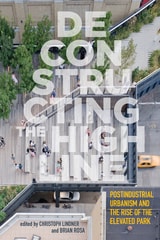
Deconstructing the High Line
Postindustrial Urbanism and the Rise of the Elevated ParkLindner, Christoph
Rutgers University Press, 2017
The High Line, an innovative promenade created on a disused elevated railway in Manhattan, is one of the world’s most iconic new urban landmarks. Since the opening of its first section in 2009, this unique greenway has exceeded all expectations in terms of attracting visitors, investment, and property development to Manhattan’s West Side. Frequently celebrated as a monument to community-led activism, adaptive re-use of urban infrastructure, and innovative ecological design, the High Line is being used as a model for numerous urban redevelopment plans proliferating worldwide.
Deconstructing the High Line is the first book to analyze the High Line from multiple perspectives, critically assessing its aesthetic, economic, ecological, symbolic, and social impacts. Including several essays by planners and architects directly involved in the High Line’s design, this volume also brings together a diverse range of scholars from the fields of urban studies, geography, anthropology, sociology, and cultural studies. Together, they offer insights into the project’s remarkable success, while also giving serious consideration to the critical charge that the High Line is “Disney World on the Hudson,” a project that has merely greened, sanitized, and gentrified an urban neighborhood while displacing longstanding residents and businesses.
Deconstructing the High Line is not just for New Yorkers, but for anyone interested in larger issues of public space, neoliberal redevelopment, creative design practice, and urban renewal.

Decorative Games
Ornament, Rhetoric, and Noble Culture in the Work of Gilles-Marie Oppenord (1672-1742)Jean-François Bédard
University of Delaware Press, 2011
This book features an extraordinary album of ornament designs by the French architect Gilles-Marie Oppenord (1672-1742). In charge of the buildings and grounds of Philippe, duke of Orléans, regent of France during the minority of Louis XV, Oppenord was at the center of the architectural practice of his time. As made evident by this album, his consummate draftsmanship, praised by his contemporaries and coveted by collectors, exceeded by far the practical demands usually required of architects.
On a copy of the first French edition of Cesare Ripa’s Iconologia, published by Jean Baudoin in 1636 with engravings by Jacques de Bié, Oppenord drew vignettes, head and tail pieces, borders and other ornamental motifs. For the first time, this publication reproduces Oppenord’s album in its initial state. Today’s reassembled and rebound album of sixty sheets bears little resemblance to Oppenord’s original copy. A bibliographic analysis of the Ripa-Baudoin book, based on a copy kept at the Bibliothèque nationale de France, and confirmed by a previously unnoticed numbering by Oppenord, guided this first reconstitution. In lieu of a haphazard succession of sketches, it reveals Oppenord’s fascinating interplay between text, engraved and drawn images.
Published by University of Delaware Press. Distributed worldwide by Rutgers University Press.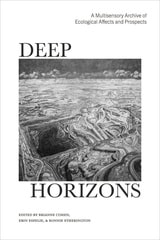
Deep Horizons
A Multisensory Archive of Ecological Affects and ProspectsBrianne Cohen
Amherst College Press, 2023
The specifics of ecological destruction often take a cruel turn, affecting those who can least resist its impacts and are least responsible for it. Deep Horizons: A Multisensory Archive of Ecological Affects and Prospects gathers contributions from multiple disciplines to investigate intersectional questions of how the changing planet affects specific peoples, communities, wildlife species, and ecosystems in varying and inequitable ways. A multisensory, artistic-archival supplement to the Mellon Sawyer Environmental Futures Project, the volume enriches current conversations bridging the environmental humanities and affect theory with insights from Native and Indigenous philosophies as well as by highlighting artistic practices that make legible the long-term durational effects of ecological catastrophe.
Poems, nonfiction essays, sound-texts, photographs, and other artworks invite readers and viewers to consider the less visible losses and prospects of environmental transformation. Gathering contributions from multiple disciplines, this multimodal, multisensorial volume pushes the boundaries of scholarship with an experimental, born-digital format that offers a set of responses to collective traumas such as climate change, environmental destruction, and settler colonialism. The artists and authors honor the specificity of real historical and material injustices while also reflecting the eclectic nature of such assorted feelings, working through them in creative and border-crossing modes.
With contributions from Robert Bailey, Nina Elder, Erin Espelie, Hock E Aye Vi Edgar Heap of Birds, Maya Livio, Erika Osborne, Craig Santos Perez, Kim Tallbear, Julianne Warren, and Kyle Powys White.
"The compelling juxtaposition of poetry, music, video, audio, photography, printmaking, and traditional essays is among Deep Horizons' considerable strengths. I don’t know of any other project quite like this one. The subject is timely—indeed, urgent—and the innovative approach to archiving environmental change will interest scholars and artists in a range of disciplines and resonate with a wide audience." —Jennifer Ladino, University of Idaho
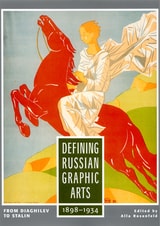
Defining Russian Graphic Arts
From Diaghilev to Stalin, 1898-1934Rosenfeld, Alla
Rutgers University Press, 1999
Defining Russian Graphic Arts explores the energy and innovation of Russian graphic arts during the period which began with the explosion of artistic creativity initiated by Serge Diaghilev at the end of the nineteenth century and which ended in the mid-1930s with Stalin's devastating control over the arts. This beautifully illustrated book represents the development of Russian graphic arts as a continuum during these forty years, and places Suprematism and Constructivism in the context of the other major, but lesser-known, manifestations of early twentieth-century Russian art.
The book includes such diverse categories of graphic arts as lubki (popular prints), posters and book designs, journals, music sheets, and ephemera. It features not only standard types of printed media and related studies and maquettes, but also a number of watercolor and gouache costume and stage designs.
About 100 works borrowed from the National Library of Russia and the Research Museum of the Academy of Fine Arts in St. Petersburg, Russia-many seen here for the first time outside of Russia-are featured in this book. Additional works have been drawn from the Zimmerli Art Museum, The New York Public Library, and from other public and private collections. Together they provide a rare opportunity to view and learn about a wide variety of artists, from the acclaimed to the lesser known.
This book is a companion volume to an exhibition appearing at the Jane Voorhees Zimmerli Art Museum at Rutgers University.
Deleuze and Film Music
Building a Methodological Bridge between Film Theory and MusicGregg Redner
Intellect Books, 2011
The analysis of film music is emerging as one of the fastest-growing areas of interest in film studies. Yet scholarship in this up-and-coming field has been beset by the lack of a common language and methodology between film and music theory. Drawing on the philosophy of Gilles Deleuze, film studies scholar Gregg Redner provides a much-needed analysis of the problem which then forms the basis of his exploration of the function of the film score and its relation to film's other elements. Not just a groundbreaking examination of persistent difficulties in this new area of study, Deleuze and Film Music also offers a solution—a methodological bridge—that will take film music analysis to a new level.
Delirious Consumption
Aesthetics and Consumer Capitalism in Mexico and BrazilBy Sergio Delgado Moya
University of Texas Press, 2017
In the decades following World War II, the creation and expansion of massive domestic markets and relatively stable economies allowed for mass consumption on an unprecedented scale, giving rise to the consumer society that exists today. Many avant-garde artists explored the nexus between consumption and aesthetics, questioning how consumerism affects how we perceive the world, place ourselves in it, and make sense of it via perception and emotion.
Delirious Consumption focuses on the two largest cultural economies in Latin America, Mexico and Brazil, and analyzes how their artists and writers both embraced and resisted the spirit of development and progress that defines the consumer moment in late capitalism. Sergio Delgado Moya looks specifically at the work of David Alfaro Siqueiros, the Brazilian concrete poets, Octavio Paz, and Lygia Clark to determine how each of them arrived at forms of aesthetic production balanced between high modernism and consumer culture. He finds in their works a provocative positioning vis-à-vis urban commodity capitalism, an ambivalent position that takes an assured but flexible stance against commodification, alienation, and the politics of domination and inequality that defines market economies. In Delgado Moya’s view, these poets and artists appeal to uselessness, nonutility, and noncommunication—all markers of the aesthetic—while drawing on the terms proper to a world of consumption and consumer culture.
Delirium and Resistance
Activist Art and the Crisis of CapitalismGregory Sholette
Pluto Press, 2017
In this follow-up to his influential 2010 book, Dark Matter: Art and Politics in the Age of Enterprise Culture, Sholette engages in critical dialogue with artists’ collectives, counter-institutions, and activist groups to offer an insightful firsthand account of the relationship between politics and art in neoliberal society. Sholette lays out clear examples of art’s deep involvement in capitalism: the dizzying prices achieved by artists who pander to the financial elite, the proliferation of museums that contribute to global competition between cities in order to attract capital, and the strange relationship between art and rampant gentrification that restructures the urban landscape.
With a preface by noted author Lucy R. Lippard and an introduction by theorist Kim Charnley, Delirium and Resistance draws on over thirty years of critical debates and practices both in and beyond the art world to historicize and advocate for the art activist tradition that radically—and, at times, deliriously—entangles the visual arts with political struggles.
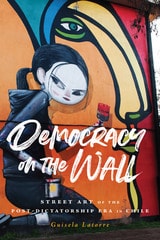
Democracy on the Wall
Street Art of the Post-Dictatorship Era in ChileGuisela Latorre
The Ohio State University Press, 2019
Exploring the resurgence and impact of the muralist brigades, women graffiti artists, the phenomenon of “open-sky museums,” and the transnational impact on the development of Chilean street art, Latorre argues that mural and graffiti artists are enacting a “visual democracy,” a form of artistic praxis that seeks to create alternative images to those produced by institutions of power. Keenly aware of Latin America’s colonial legacy and deeply flawed democratic processes, and distrustful of hegemonic discourses promoted by government and corporate media, the artists in Democracy on the Wall utilize graffiti and muralism as an alternative means of public communication, one that does not serve capitalist or nationalist interests. Latorre posits that through these urban interventions that combine creativity with social action, Chilean street artists formulate visions of what a true democracy looks like.
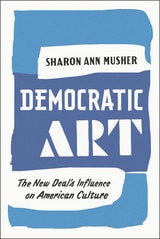
Democratic Art
The New Deal's Influence on American CultureSharon Ann Musher
University of Chicago Press, 2015
In Democratic Art, Sharon Musher explores these questions and uses them as a springboard for an examination of the role art can and should play in contemporary society. Drawing on close readings of government-funded architecture, murals, plays, writing, and photographs, Democratic Art examines the New Deal’s diverse cultural initiatives and outlines five perspectives on art that were prominent at the time: art as grandeur, enrichment, weapon, experience, and subversion. Musher argues that those engaged in New Deal art were part of an explicitly cultural agenda that sought not just to create art but to democratize and Americanize it as well. By tracing a range of aesthetic visions that flourished during the 1930s, this highly original book outlines the successes, shortcomings, and lessons of the golden age of government funding for the arts.
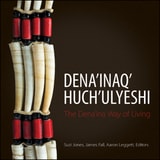
Dena'inaq' Huch'ulyeshi
The Dena'ina Way of LivingEdited by Suzi Jones, James Fall, and Aaron Leggett
University of Alaska Press, 2013
Lavishly illustrated with more than six hundred photographs, maps, and drawings, Dena’inaq’ Huch’ulyeshi contains 469 entries on Dena’ina objects in European and American collections. It is enriched with examples of traditional Dena’ina narratives, first-person accounts, and interviews. Thirteen essays on the history and culture of the Athabascan people put the pieces into a larger historical context. This catalog is a comprehensive reference that will also accompany a large-scale exhibition running September 2013 through January 2014 at the Anchorage Museum.
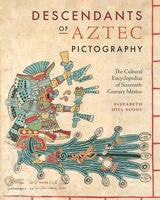
Descendants of Aztec Pictography
The Cultural Encyclopedias of Sixteenth-Century MexicoBy Elizabeth Hill Boone
University of Texas Press, 2021
In the aftermath of the sixteenth-century Spanish conquest of Mexico, Spanish friars and authorities partnered with indigenous rulers and savants to gather detailed information on Aztec history, religious beliefs, and culture. The pictorial books they created served the Spanish as aids to evangelization and governance, but their content came from the native intellectuals, painters, and writers who helped to create them. Examining the nine major surviving texts, preeminent Latin American art historian Elizabeth Hill Boone explores how indigenous artists and writers documented their ancestral culture.
Analyzing the texts as one distinct corpus, Boone shows how they combined European and indigenous traditions of documentation and considers questions of motive, authorship, and audience. For Spanish authorities, she shows, the books revealed Aztec ideology and practice, while for the indigenous community, they preserved venerated ways of pictorial expression as well as rhetorical and linguistic features of ancient discourses. The first comparative analysis of these encyclopedias, Descendants of Aztec Pictography analyzes how the painted compilations embraced artistic traditions from both sides of the Atlantic.

Desert Jewels
Cactus Flowers of the Southwest and MexicoJohn P. Schaefer
University of Arizona Press, 2023
Stunning up-close images by a renowned desert photographer
Cactus flowers are jewels of the desert—they add brilliant pops of color to our arid surroundings. In this book, renowned Tucson photographer John P. Schaefer brings the exquisite and unexpected beauty of the cactus flower to the page. Hundreds of close-up photographs of cactus flowers native to the U.S. Southwest and Mexico offer a visual feast of color and texture, nuance and light.
These stunning photographs allow us to appreciate the spectacular range of color and form cactus flowers have to offer. For the cactus enthusiast, the book offers a comprehensive collection of high-quality flower photographs unlike any other. The photographs cover more than 250 cactus species organized by genus. The book starts with an introduction by the photographer that is both autobiographical and informative. It offers a glimpse into his process for capturing these elusive desert gems, resulting in photographs so beautiful they were featured as a book of stamps issued by the U.S. Postal Service.
This collection of cactus flowers in bloom is a one-of-a-kind work by a master photographer.
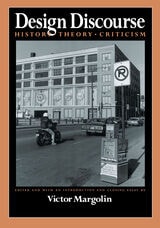
Design Discourse
History, Theory, CriticismEdited by Victor Margolin
University of Chicago Press, 1989
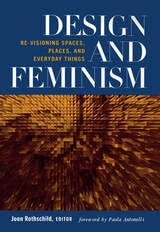
Design and Feminism
Re-visioning Spaces, Places, and Everyday ThingsJoan Rothschild
Rutgers University Press, 1999
The interdisciplinary essays reflect the writers' diverse fields- architecture, planning, industrial and graphic design, and architectural, urban, and design history. Essays cover such subject as rethinking the American city, graphic design and the urban landscape, working at home, theories of women and design, and a trio of essays on industrial designs. A review essay of the literature in these fields- the first of its kind- rounds out the collection.
Contributors are Amelia Amon, Wendy E. Brawer, Cheryl Buckley, Sue Cavanagh, Alethea Cheng, Roberta M. Feldman, Etain Fitzpatrick, Alice T. Friedman, Dolores Hayden, Ghislaine Hermanuz, Barbara Knecht, Ellen Lupton, Maggie Mahboubian, Francine Monaco, Nancy Perkins, Victoria Rosner, Joan Rothschild, Susana Torre, Lynne Walker, and Leslie Kanes Weismann.
Design for Business
Volume 1Edited by Gjoko Muratovski
Intellect Books, 2012
Design for Business
Volume 2Edited by Gjoko Muratovski
Intellect Books, 2014
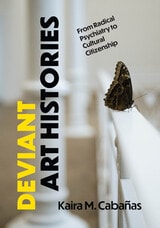
Deviant Art Histories
From Radical Psychiatry to Cultural CitizenshipKaira M. Cabañas
University of Chicago Press, 2027
A groundbreaking examination of the entanglement between psychiatry, art, and art history.
Looking beyond the white walls of art galleries and museums, Kaira M. Cabañas explores art history through the psychiatric wards of the twentieth century, offering a reevaluation of the relationship between madness, making, and the art world and considering the deeply intertwined fields of psychiatry and art.
Putting aside romanticized myths about “outsider art,” Cabañas argues for a radical revisioning that centers artists in psychiatric settings not as deviants and curiosities but rather as skilled, sophisticated innovators and active participants in shared culture. Beginning with the story of legendary art historian Aby Warburg, whose own psychiatric internment and subsequent recovery serve as a point of departure, the narrative then covers the globe, following visionary reformers such as Nise da Silveira in Brazil and Franco and Franca Basaglia in Italy. The book tracks how psychiatrists collaborated with professional artists and patients to turn clinical spaces into laboratories of liberation. By documenting how patient-artists moved from being subjects of clinical study to recognized cultural producers, Deviant Art Histories demonstrates how art was a primary vehicle for reclaiming their agency. Featuring a diverse cast of figures—including Lygia Clark, Ornette Coleman, and Antonin Artaud—the book offers a powerful testament to art’s ability to break the clinical frame and transform the definition of what it means to be a creative citizen in the modern world.
Dewey for Artists
Mary Jane Jacob
University of Chicago Press, 2018
Dewey argued that there is strong social value to be found in art, and it is artists who often most challenge our preconceived notions. Dewey for Artists shows us how Dewey advocated for an “art of democracy.” Identifying the audience as co-creator of a work of art by virtue of their experience, he made space for public participation. Moreover, he believed that societies only become—and remain—truly democratic if its citizens embrace democracy itself as a creative act, and in this he advocated for the social participation of artists.
Throughout the book, Mary Jane Jacob draws on the experiences of contemporary artists who have modeled Dewey’s principles within their practices. We see how their work springs from deeply held values. We see, too, how carefully considered curatorial practice can address the manifold ways in which aesthetic experience happens and, thus, enable viewers to find greater meaning and purpose. And it is this potential of art for self and social realization, Jacob helps us understand, that further ensures Dewey’s legacy—and the culture we live in.
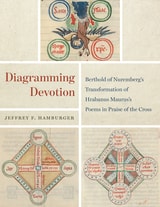
Diagramming Devotion
Berthold of Nuremberg’s Transformation of Hrabanus Maurus’s Poems in Praise of the CrossJeffrey F. Hamburger
University of Chicago Press, 2020
Dialectic
A scholarly journal of thought leadership, education and practice in the discipline of visual communication design - Volume II, Issue I - Summer 2018Michael R. Gibson
Michigan Publishing Services, 2018
Dialectic seeks to publish scholarship, analytical study and criticism that will enlighten and inform a diverse audience of design educators engaged not only in classroom teaching experiences but also in differing forms of research and professional practice. The journal's advisory and editorial boards recognize that design education, along with design research and professional practice, exist in relationships that are now broadly informed by theoretical frameworks and applications of knowledge derived from the social and applied sciences, the humanities, and other professions such as business, education, information technology and media studies. The outcomes of these synergies often result in the invention, discovery, understanding, and dissemination of new knowledge, innovation, and best practices.
Dialogical Imaginations
Aisthesis as Social Perception and New Ideas of HumanismEdited by Michael F. Zimmermann with Gernot Müller, Christian Sauer, Kerstin Schmidt, Robert Schmidt, and Fosca Mariani Zini
Diaphanes, 0
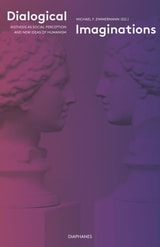
“Aisthesis” means perception, but, in this volume, as the cover illustration the artist Giulio Paolini made for us demonstrates, it is treated as inscribed into dialogue. Furthermore, the range of its meaning is extended to include societies’ capacities to perceive their own conditions and dispositions—those concerning their inner structures and their external, cultural, and natural contexts. The essays present a wide variety of cultural manifestations of social perception—from the documentary to the fictional. Philosophers and sociologists, literary and art historians, media and film analysts deal with figurations, topoi, and stereotypes as created in various communal spheres and as resulting from media and epistemological practices.
Many of the debates turn around dialogical humanism, but this is certainly not aimed at returning to normative models more regulating than describing the human. Our period has been marked by debates around the post-human, biopolitics, and an increasing awareness of crisis and of global interdependence. Previously, the concept of humanism had been criticized, for good reasons, by Foucault and by philosophers such as Judith Butler. If the editors propose to discuss humanism again, a reevaluation of the dialogical character of humanism—and a reconstruction of its history as marked by dialogical strategies—is the starting point. In dialogical humanism, man, instead of being defined by a system of norms, is and remains an argument—even if, in the final instance, inscrutable, inexhaustible.
Dialogues
Ilya Kabakov and Viktor Pivovarov, Stories about OurselvesKsenia Nouril
Rutgers University Press, 2020
This exhibition catalog brings together Kabakov and Pivovarov’s key works for the first time, putting the two artists in dialogue and recreating their artistic community. It not only includes nearly hundred pages of full-color illustrations, but also provides complete English translations of the Russian texts that appear in the volume, plus new interviews with each artist. Taken together, they give viewers a new appreciation of the different aesthetic strategies each artist used to depict the absurdities of everyday life in the Soviet era. Published in partnership with the Zimmerli Museum.