Results by title
4030 books match the query 'Language Arts & Disciplines' and 161 start with d

Dances with Sheep
The Quest for Identity in the Fiction of Murakami HarukiMatthew Carl Strecher
University of Michigan Press, 2002
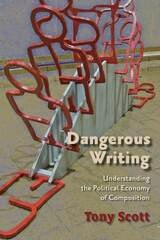
Dangerous Writing
Understanding the Political Economy of CompositionTony Scott
Utah State University Press, 2009
Since the 1980s and the “social turn” in composition studies and other disciplines, scholars in this field have conceived writing in college as explicitly embedded in socio-rhetorical situations beyond the classroom. From this conviction develops a commitment to teach writing with an emphasis on analyzing the social and political dimensions of rhetoric.
Ironically, though a leftist himself, Tony Scott’s analysis finds the academic left complicit with the forces in American culture that tend, in his view, to compromise education. By focusing on the structures of labor and of institutions that enforce those structures, Scott finds teachers and administrators are too easily swept along with the inertia of a hyper-commodified society in which students---especially working class students---are often positioned as commodities, themselves. Dangerous Writing, then, is a critique of the field as much as it is a critique of capitalism. Ultimately, Scott’s eye is on the institution and its structures, and it is these that he finds most in need of transformation.

Dark Alphabet
Jennifer Maier
Southern Illinois University Press, 2006
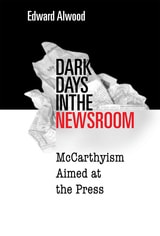
Dark Days in the Newsroom
McCarthyism Aimed at the PressEdward Alwood
Temple University Press, 2007
Dark Days in the Newsroom traces how journalists became radicalized during the Depression era, only to become targets of Senator Joseph McCarthy and like-minded anti-Communist crusaders during the 1950s. Edward Alwood, a former news correspondent describes this remarkable story of conflict, principle, and personal sacrifice with noticeable élan. He shows how McCarthy's minions pried inside newsrooms thought to be sacrosanct under the First Amendment, and details how journalists mounted a heroic defense of freedom of the press while others secretly enlisted in the government's anti-communist crusade.
Relying on previously undisclosed documents from FBI files, along with personal interviews, Alwood provides a richly informed commentary on one of the most significant moments in the history of American journalism. Arguing that the experiences of the McCarthy years profoundly influenced the practice of journalism, he shows how many of the issues faced by journalists in the 1950s prefigure today's conflicts over the right of journalists to protect their sources.
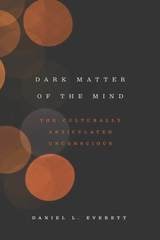
Dark Matter of the Mind
The Culturally Articulated UnconsciousDaniel L. Everett
University of Chicago Press, 2016
Everett sketches a blank-slate picture of human cognition that focuses not on what is in the mind but, rather, what the mind is in—namely, culture. He draws on years of field research among the Amazonian people of the Pirahã in order to carefully scrutinize various theories of cognitive instinct, including Noam Chomsky’s foundational concept of universal grammar, Freud’s notions of unconscious forces, Adolf Bastian’s psychic unity of mankind, and works on massive modularity by evolutionary psychologists such as Leda Cosmides, John Tooby, Jerry Fodor, and Steven Pinker. Illuminating unique characteristics of the Pirahã language, he demonstrates just how differently various cultures can make us think and how vital culture is to our cognitive flexibility. Outlining the ways culture and individual psychology operate symbiotically, he posits a Buddhist-like conception of the cultural self as a set of experiences united by various apperceptions, episodic memories, ranked values, knowledge structures, and social roles—and not, in any shape or form, biological instinct.
The result is fascinating portrait of the “dark matter of the mind,” one that shows that our greatest evolutionary adaptation is adaptability itself.

Das Arkansas Echo
A Year in the Life of Germans in the Nineteenth-Century SouthKathleen Condray
University of Arkansas Press, 2020
“Das Arkansas Echo”: A Year in the Life of Germans in the Nineteenth-Century South examines topics the newspaper covered during its inaugural year. Kathleen Condray illuminates the newspaper’s crusade against Prohibition, its advocacy for the protection of German schools and the German language, and its promotion of immigration. We also learn about aspects of daily living, including food preparation and preservation, religion, recreation, the role of women in the family and society, health and wellness, and practical housekeeping. And we see how the paper assisted German speakers in navigating civic life outside their immigrant community, including the racial tensions of the post-Reconstruction South.
“Das Arkansas Echo”: A Year in the Life of Germans in the Nineteenth-Century South offers a fresh perspective on the German speakers who settled in a modernizing Arkansas. Mining a valuable newspaper archive, Condray sheds light on how these immigrants navigated their new identity as southern Americans.
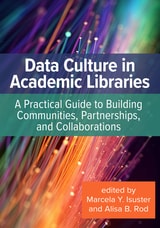
Data Culture in Academic Libraries
A Practical Guide to Building Communities, Partnerships, and CollaborationsMarcela Y. Isuster
Assoc of College & Research Libraries, 2025
In five parts, Data Culture in Academic Libraries: A Practical Guide to Building Communities, Partnerships, and Collaborations can help you foster an institutional culture that favors the curation, creation, and wider use of datasets.
- Data at all Levels
- Data Services and Instruction
- Data Outreach
- Data Communities
- Data Partnerships
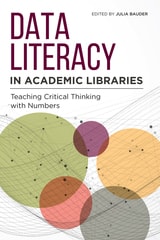
Data Literacy in Academic Libraries
Teaching Critical Thinking with NumbersJulia Bauder
American Library Association, 2021
We live in a data-driven world, much of it processed and served up by increasingly complex algorithms, and evaluating its quality requires its own skillset. As a component of information literacy, it's crucial that students learn how to think critically about statistics, data, and related visualizations. Here, Bauder and her fellow contributors show how librarians are helping students to access, interpret, critically assess, manage, handle, and ethically use data. Offering readers a roadmap for effectively teaching data literacy at the undergraduate level, this volume explores such topics as
- the potential for large-scale library/faculty partnerships to incorporate data literacy instruction across the undergraduate curriculum;
- how the principles of the ACRL Framework for Information Literacy for Higher Education can help to situate data literacy within a broader information literacy context;
- a report on the expectations of classroom faculty concerning their students’ data literacy skills;
- various ways that librarians can partner with faculty;
- case studies of two initiatives spearheaded by Purdue University Libraries and University of Houston Libraries that support faculty as they integrate more work with data into their courses;
- Barnard College’s Empirical Reasoning Center, which provides workshops and walk-in consultations to more than a thousand students annually;
- how a one-shot session using the PolicyMap data mapping tool can be used to teach students from many different disciplines;
- diving into quantitative data to determine the truth or falsity of potential “fake news” claims; and
- a for-credit, librarian-taught course on information dissemination and the ethical use of information.
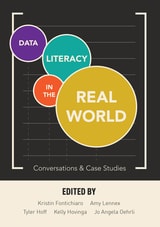
Data Literacy in the Real World
Conversations & Case StudiesEdited by Kristin Fontichiaro, Amy Lennex, Tyler Hoff, Kelly Hovinga, Jo Angela Oehrli
Michigan Publishing Services, 2017

Data Management for Libraries
Carly A. Strasser
American Library Association, 2013
Data-Oriented Parsing
Edited by Rens Bod, Remko Scha, and Khalil Sima'an
CSLI, 2003
This handbook begins with the theoretical background of DOP and introduces the algorithms used in DOP as well as in other probabilistic grammar models. After surveying extensions to the basic DOP model, the volume concludes with close study of the applications that use DOP as a backbone: speech understanding, machine translation, and language learning.

Databrarianship
The Academic Data Librarian in Theory and PracticeLynda Kellam
Assoc of College & Research Libraries, 2016
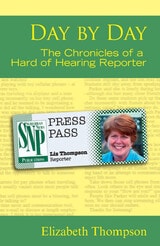
Day by Day
The Chronicles of a Hard of Hearing ReporterElizabeth Thompson
Gallaudet University Press, 2008
The Seventh Volume in the Deaf Lives Series
Elizabeth Thompson’s hearing loss was detected when she was in elementary school, and her hearing continued to deteriorate until she became completely deaf. Like many other hard of hearing and late-deafened individuals, her hearing loss complicated the general challenges of life. She struggled through school, worked as a secretary, married, had a daughter, and then found herself living as a single mother. She remarried, and soon after learned that she had contracted Multiple Sclerosis (MS). Despite these hurdles, Thompson always expressed her determination to enjoy the best life had to offer. Her astonishing exuberance might have gone unnoticed if she hadn’t accepted a new position as a reporter/columnist in 1998 for the Suburban News Publications (SNP). Day by Day: The Chronicles of a Hard of Hearing Reporter presents a marvelous blend of her experiences and best SNP columns that illustrate how she crafted her remarkable outlook.
In her columns, Thompson presented how she handled her hearing loss as a personal guide for readers. She used every stratagem available to function full-throttle – hearing aids, FM systems, lights for alarms, TTYs, even training her dog Snert. She also gently counseled readers on how to treat deaf and hard of hearing people with practical consideration and respect. Her pursuit of a fully realized life enabled her to do what she loved most, to meet and write about inspiring persons, many of whom are profiled in her memoir. Thompson eventually underwent cochlear implantation that restored 95% of her hearing, an exalting moment for her. Yet, Day by Day celebrates the entire arc of her life, a wonderful testament to her joyous resilience.

Deadline
200 Years of Violence Against Journalists in the United StatesElizabeth Atwood
University of Missouri Press, 2025
To help us understand these attacks, Atwood presents a framework for categorizing them, built on John Nerone’s studies on assaults on American media workers. Atwood categorizes attacks against journalists as attacks against individuals, ideas, and media institutions, and undertaken to suppress reporting on certain topics and in the context of wars and other international or conflicts. Crucially, Deadline utilizes this framework to offer possible solutions to the issue of violence against journalists.
Atwood was inspired to explore the pressing issue of violence against American journalists after the tragic death of one of her colleagues at the Baltimore Sun, Rob Hiaasen, in the Capital Gazette shooting in 2018. Throughout, she demonstrates that distrust of the media and violence against the press in the United States are hardly new developments. Her work examines how intimidation, violence, and censorship have, in fact, been used against the American press since both its and the nation’s founding.
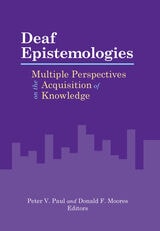
Deaf Epistemologies
Multiple Perspectives on the Acquisition of KnowledgePeter V. Paul
Gallaudet University Press, 2012
Epistemology is the study of how “knowledge” is formed. Standard epistemology isolates the “known” from the “knowers,” thereby defining “knowledge” as objectively constant. Multiple epistemologies suggest that individuals learn in different ways shaped by life factors such as education, family, ethnicity, history, and regional beliefs. In this groundbreaking volume, editors Peter V. Paul and Donald F. Moores call on ten other noted scholars and researchers to join them in examining the many ways that deaf people see and acquire deaf knowledge.
This collection considers three major groups of deaf knowledge perspectives: sociological and anthropological, historical/psychological and literary, and educational and philosophical. The first explores the adoption of a naturalized, critical epistemological stance in evaluating research; the epistemology of a positive deaf identity; how personal epistemologies can help form deaf education policies; and valuing deaf indigenous knowledge in research. The next part considers dueling epistemologies in educating deaf learners; reforms in deaf education; the role of deaf children of hearing parents in creating Deaf epistemologies; and the benefit of reading literature with deaf characters for all students. The final part explores the application of the Qualitative-Similarity Hypothesis to deaf students’ acquisition of knowledge; a metaparadigm for literacy instruction in bilingual-bicultural education; collaborative knowledge-building to access academia; and examination of the benefits and disadvantages of being deaf.
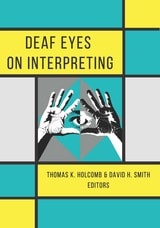
Deaf Eyes on Interpreting
Thomas K. Holcomb
Gallaudet University Press, 2018
Deaf Eyes on Interpreting brings Deaf people to the forefront of the discussions about what constitutes quality interpreting services. The contributors are all Deaf professionals who use interpreters on a regular basis, and their insights and recommendations are based on research as well as on personal experiences. These multiple perspectives reveal strategies to maximize access to interpreted work and hearing environments and to facilitate trust and understanding between interpreters and Deaf consumers. Interpreter educators, interpreting students, professional interpreters, and Deaf individuals will all benefit from the approaches offered in this collection.
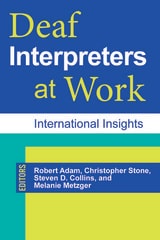
Deaf Interpreters at Work
International InsightsRobert Adam
Gallaudet University Press, 2014
Along with volume coeditors Robert Adam, Christopher Stone, and Steven D. Collins, contributors include Markus Aro, Karen Bontempo, Juan Carlos Druetta, Senan Dunne, Eileen Forestal, Della Goswell, Juli af Klintberg, Patricia Levitzke-Gray, Jemina Napier, Brenda Nicodemus, Debra Russell, Stephanie Sforza, Marty Taylor, and Linda Warby. The scope of their research spans the world, including many unique facets of interpreting by deaf people in Argentina, Australia, Canada, England, Finland, Ireland, Sweden, and the United States, establishing this work as the standard in this burgeoning discipline.
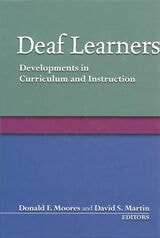
Deaf Learners
Developments in Curriculum and InstructionDonald F. Moores
Gallaudet University Press, 2006
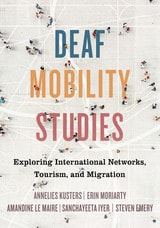
Deaf Mobility Studies
Exploring International Networks, Tourism, and MigrationAnnelies Kusters
Gallaudet University Press, 2024
The text is augmented by direct links to clips in nine ethnographic films, analysis of selected film excerpts and screenshots, and compelling data visualizations. QR codes throughout the book link to the film clips to create this dual narrative experience. Deaf Mobility Studies is an expansive odyssey through the complexities and opportunities inherent in deaf international mobility.
Deaf Mobility Studies: Exploring International Networks, Tourism, and Migration © 2024 by Gallaudet University is licensed under CC BY-NC-ND 4.0.
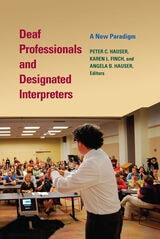
Deaf Professionals and Designated Interpreters
A New ParadigmPeter C. Hauser
Gallaudet University Press, 2008
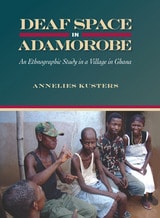
Deaf Space in Adamorobe
An Ethnographic Study in a Village in GhanaAnnelies Kusters
Gallaudet University Press, 2015
Deaf Space in Adamorobe reveals one example of the considerable variation in shared signing communities regarding rates of sign language proficiency and use, deaf people’s marriage rates, deaf people’s participation in village economies and politics, and the role of deaf education. Kusters describes spaces produced by both deaf and hearing people as a cohesive community where living together is an integral fact of their sociocultural environments. At the same time, Kusters identifies tension points between deaf and hearing perspectives and also between outside perspectives and discourses that originated within the community. Because of these differences and the relatively high number of deaf people in the community, Kusters concludes it is natural that they form deaf spaces within the shared space of the village community.
Deaf Studies for Educators
Onudeah D. Nicolarakis
Gallaudet University Press, 2025
This is the second volume in the Early Papers in Deaf Studies series, which consists of reissued works originally published by the Gallaudet University College for Continuing Education but long out of print. The aim of this series is to restore these foundational papers to the scholarly community. Deaf Studies for Educators is available in both print and open digital formats, ensuring broad access to this important contribution to the literature.

Deaf in DC
A MemoirMadan Vasishta
Gallaudet University Press, 2011
In his first memoir, Madan Vasishta described being a deaf boy in his homeland India, where “deaf” meant someone who is not human. After rising from herding cattle to being a respected photographer in Delhi, his first memoir concluded with his acceptance at Gallaudet College far away in America. Vasishta’s new memoir begins with his arrival in Washington, DC in 1967 with $40.00 in his pocket and very little knowledge of the new worlds he was entering.
Vasishta faced myriad challenges from the outset— he knew no American Sign Language and could not speech read, yet he found himself thrust into classes at Gallaudet two weeks into the semester. Cultural differences mystified him, such as how all American car accidents were someone else’s fault even when one’s car hits a stationary object. He was amazed that his fellow students did not deride him for his mistakes, unlike in India where he would have been scorned for his weakness. After five years, he returned home to India for a visit and was stunned to learn that he no longer fit in, that “even if you do not have an American Dream, the American Dream will have you.”
Deaf in DC follows Vasishta through half a century living in America. He witnessed the transformation from facing bias as a deaf, foreign man of color who could not get a job despite having a Ph.D., to receiving five offers as a school superintendent in the wake of the Civil Rights movement and Deaf President Now. His new memoir reflects a genuine worldview informed by the sage perceptions of a person who has lived widely in many worlds.
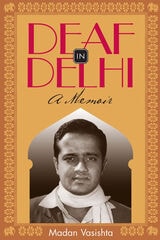
Deaf in Delhi
A MemoirMadan Vasishta
Gallaudet University Press, 2006
Vasishta’s story reflects the India of his youth, an emerging nation where most people struggled with numbing poverty and depended upon close family ties, tradition, and faith to see them through. His family’s search for a cure took him to a host of medical specialists and just as many sadhus and mahatmas, holy men and priests. The school in his small village was ill-prepared to educate deaf students then, so he herded the family cattle, usually the work of hired servants. Vasishta refused to accept this as his final lot in life and fantasized constantly about better jobs. Eventually, he moved to Delhi where his dream of becoming a photographer came true. He also discovered the Delhi Deaf community that, with his family, helped him to achieve an even higher goal, traveling to America to earn a degree at Gallaudet College.
Vasishta, a natural raconteur, imbues Deaf in Delhi with the ever-present ebullience that served him so well in his journey. Readers will savor his good humor and honest observations and look forward to his next book with great relish.
Dealing with Difficult People in the Library
American Library Association, 1999
Dear World
Contemporary Uses of the DiaryKylie Cardell
University of Wisconsin Press, 2014
In Dear World, Kylie Cardell is sensitive to how changes to our notions of privacy and the personal—spurred by the central presence the Internet has come to occupy in our daily lives—impact how and why diaries are written, and for whom. She considers what these new uses of the diary tell us about the cultural politics of self-representation in a time of mass attention to (and anxiety about) the personal. Cardell sees the twenty-first-century diary as a vibrant and popular cultural practice as much as a literary form, one that plays a key role in mass-mediated notions of authenticity, subjectivity, and truth. Dear World provides much-needed new attention to the innovation, evolution, and persistence of a familiar yet complex autobiographical mode.
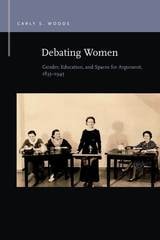
Debating Women
Gender, Education, and Spaces for Argument, 1835-1945Carly S. Woods
Michigan State University Press, 2018

Deception in High Places
A History of Bribery in Britain's Arms TradeNicholas Gilby
Pluto Press, 2014
Based on painstaking research in government archives, collections of private and court papers and documents won by the author in a landmark Freedom of Information Tribunal against the Foreign and Commonwealth Office, the book illuminates a shadow world of bribery and elite enrichment.
Deception in High Places charts British government involvement in arms trade corruption and presents the fullest history yet of bribery in Britain’s arms deals with Saudi Arabia. It includes the backstory of the controversial termination of a Serious Fraud Office corruption investigation following pressure by the Saudi Royal Family and the British establishment.
Decision-Making in the Absence of Certainty
A Study in the Context of Technology and the Construction of the 21St Century Academic LibrarySamuel David Mash
Assoc of College & Research Libraries, 2011
Decision-Making in the Absence of Certainty
A Study in the Context of Technology and the Construction of the 21St Century Academic LibrarySamuel David Mash
Assoc of College & Research Libraries, 2011
Decisions, Agency, and Advising
Key Issues in the Placement of Multilingual Writers into First-Year Composition CoursesTanita Saenkhum
Utah State University Press, 2016
Tanita Saenkhum follows eleven multilingual students who made their decisions about placement into first-year composition courses during one academic year at a large public university. She identifies the need for the process of making placement decisions to be understood more clearly, describes how to use that knowledge to improve placement practices for these students—particularly in advising—and offers hands-on recommendations for writing programs.
Decisions, Agency, and Advising is a significant contribution to the field and particularly valuable to writing program administrators, academic advisors, writing teachers, researchers investigating second language writing and writing program administration, composition and second language writing scholars, and graduate students.
Decoding Abortion Rhetoric
Communicating Social ChangeCeleste Michelle Condit
University of Illinois Press, 1990
Decoding the Digital Church
Evangelical Storytelling and the Election of Donald J. TrumpStephanie A. Martin
University of Alabama Press, 2021
"This investigation tries to understand why many Evangelical pastors were blamed for endorsing Trump when, in fact, most did not. This book joins other attempts by scholars and journalists to analyze the relationship between Trump and Evangelicals. Recommended.” —CHOICE
Tracing the digital narratives that shaped evangelical identity in a pivotal political moment.
As a political constituency, white conservative evangelicals are generally portrayed as easy to dupe, disposed to vote against their own interests, and prone to intolerance and knee-jerk reactions. In Decoding the Digital Church: Evangelical Storytelling and the Election of Donald J. Trump, Stephanie A. Martin challenges this assumption and moves beyond these overused stereotypes to develop a refined explanation for this constituency’s voting behavior.
This volume offers a fresh perspective on the study of religion and politics and stems from the author’s personal interest in the ways her experiences with believers differ from how scholars often frame this group’s rationale and behaviors. To address this disparity, Martin examines sermons, drawing on her expertise in rhetoric and communication studies with the benefits of ethnographic research in an innovative hybrid approach she terms a “digital rhetorical ethnography.” Martin’s thorough research surveys more than 150 online sermons from America’s largest evangelical megachurches in 37 different states. Through listening closely to the words of the pastors who lead these conservative congregations, Martin describes a gentler discourse less obsessed with issues like abortion or marriage equality than stereotypes of evangelicals might suggest. Instead, the politicaleconomic sermons and stories from pastors encourage true believers
to remember the exceptional nature of the nation’s founding while also deemphasizing how much American citizenship really means.
Martin grapples with and pays serious, scholarly attention to a seeming contradiction: while the large majority of white conservative evangelicals voted in 2016 for Donald J. Trump, Martin shows that many of their pastors were deeply concerned about the candidate, the divisive nature of the campaign, and the potential effect of the race on their congregants’ devotion to democratic process itself. In-depth chapters provide a fuller analysis of our current political climate, recapping previous scholarship on the history of this growing divide and establishing the groundwork to set up the dissonance between the political commitments of evangelicals and their faith that the rhetorical ethnography addresses.
Decolonial Conversations in Posthuman and New Material Rhetorics
Edited by Jennifer Clary-Lemon and David M. Grant
The Ohio State University Press, 2022

Deconstructing Morphology
Word Formation in Syntactic TheoryRochelle Lieber
University of Chicago Press, 1992
Linguists have typically posited phonological, morphological, and syntactic levels, each with its own distinct vocabulary and organizing principles, but in Deconstructing Morphology Rochelle Lieber persuasively challenges the existence of a morphological level of language. Her argument, that rules and vocabulary claimed to belong to the morphological level in fact belong to the levels of syntax and phonology, follows the work of Sproat, Toman, and others. Her study, however, is the first to draw jointly on Chomsky's Government-Binding Theory of syntax and on recent research in phonology.
Ranging broadly over data from many languages—including Tagalog, English, French, and Dutch—Deconstructing Morphology addresses key questions in current morphological and phonological research and provides an innovative view of the overall architecture of grammar.
Deeds Done in Words
Presidential Rhetoric and the Genres of GovernanceKarlyn Kohrs Campbell and Kathleen Hall Jamieson
University of Chicago Press, 1990
"Deeds Done in Words is a thoughtful survey of how a democracy uses language to transact its business. Based on an enlivened understanding of genre theory and on numerous pieces of original criticism, Campbell and Jamieson vividly show how central public discourse has become the lifeblood of the American polity."—Roderick Hart, author of The Sound of Leadership
"The rhetoric that issues from the White House is becoming an ever more salient part of what the presidency means and does. This acute inquiry provides a great many insights into the forms, meanings, and functions of presidential discourse. It is an enlightening contribution to our understanding of American politics."—Murray Edelman, author of Constructing the Political Spectacle
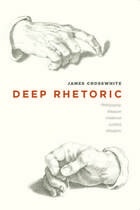
Deep Rhetoric
Philosophy, Reason, Violence, Justice, WisdomJames Crosswhite
University of Chicago Press, 2013
Chapter by chapter, Deep Rhetoric develops an understanding of rhetoric not only in its philosophical dimension but also as a means of guiding and conducting conflicts, achieving justice, and understanding the human condition. Along the way, Crosswhite restores the traditional dignity and importance of the discipline and illuminates the twentieth-century resurgence of rhetoric among philosophers, as well as the role that rhetoric can play in future discussions of ontology, epistemology, and ethics. At a time when the fields of philosophy and rhetoric have diverged, Crosswhite returns them to their common moorings and shows us an invigorating new way forward.
Defining Reality
Definitions and the Politics of MeaningEdward Schiappa
Southern Illinois University Press, 2003
In Defining Reality, Edward Schiappa argues that definitional disputes should be treated less as philosophical questions of “is”and more as sociopolitical questions of “ought.” Instead of asking “What is X?” he advocates that definitions be considered as proposals for shared knowledge and institutional norms, as in “What should count as X in context Y, given our needs and interests?”
Covering a broad scope of argument in rhetorical theory, as well as in legal, medical, scientific, and environmental debates, Schiappa shows the act of defining to be a specialized and learned behavior, and therefore one that can be studied and improved. In response to theories that deem discourse to be persuasive, the author asserts that all discourse is definitive discourse that contributes to our construction of a shared reality.
Defining Reality sheds light on our methods of creating common truths through language and argumentation and forces us to reconsider the contexts, limitations, and adaptability of our definitions. Hinging on a synthesis of arguments regarding the significance of definitional practices, the book is bolstered by a series of case studies of debates about rape, euthanasia, abortion, and political and environmental issues. These case studies ground Schiappa’s concepts in reality and delineate the power of public discourse within legal contexts. Ranging widely among disciplines from philosophy and classical philology to constitutional law and cognitive psychology, this study substantially contributes to the scholarship of rhetoric and argumentation, particularly as they function in the realm of public discourse.
Defining, Locating, and Addressing Bullying in the WPA Workplace
Cristyn L. Elder
Utah State University Press, 2018
Contributors of varying status in different types of programs across many kinds of institutions describe various forms of bullying, including microaggressions, incivility, mobbing, and emotional abuse. They define bullying as institutional racism, “academic systemic incivility,” a crisis of insularity, and faculty fundamentalism. They locate bullying in institutional contexts, including research institutions, small liberal arts colleges, community colleges, and writing programs and writing centers. These locations are used as points of departure to further theorize bullying and to provide clear advice about agentive responses.
A culture of silence discourages discussions of this behavior, making it difficult to address abuse. This silence also normalizes patterns and cultivates the perception that bullying arises naturally. Defining, Locating, and Addressing Bullying in the WPA Workplace helps the field to name these patterns of behaviors as bullying and resist ideologies of normalcy, encouraging and empowering readers to take an active role in defining, locating, and addressing bullying in their own workplaces.
Contributors: Sarah Allen, Andrea Dardello, Harry Denny, Dawn Fels, Bre Garrett, W. Gary Griswold, Amy C. Heckathorn, Aurora Matzke, Staci Perryman-Clark, Sherry Rankins-Robertson, Erec Smith
Deflective Whiteness
Co-Opting Black and Latinx Identity PoliticsHannah Noel
The Ohio State University Press, 2022
White deflection offers a script for how social justice rhetoric and the emotions of victimization are appropriated to conjure a hegemonic White identity. Using derivative language, deflection claims Whiteness as the aggrieved social status. Through case studies of cultural moments and archives including Twitter, country music, the Black Lives Matter movement, and more, Deflective Whiteness exposes the various forms of tacit White supremacy that operate under the alibi of injury and that ultimately serve to deepen racial inequities. By understanding how, where, and why White deflection is used, Noel argues, scholars and social justice advocates can trace, tag, and deconstruct covert White supremacy at its rhetorical foundations.
Defusing the Angry Patron
A How-To-Do-It Manual for LibrariansRhea Joyce Rubin
American Library Association, 2010
Del Otro Lado
Literacy and Migration across the U.S.-Mexico BorderSusan V. Meyers
Southern Illinois University Press, 2014
In Del OtroLado: Literacy and Migration across the U.S.-Mexico Border, author Susan V. Meyers draws on her year-long ethnographic study in Mexico and the United States to analyze the literacy practices of Mexican-origin students on both sides of the border.
Meyers begins by taking readers through the historical development of the rural Mexican town of Villachuato. Through a series of case studies spanning the decades between the Mexican Revolution and the modern-day village, Meyers explores the ever-widening gulf between the priorities of students and the ideals of the public education system. As more and more of Villachuato’s families migrate in an effort to find work in the wake of shifting transnational economic policies like NAFTA, the town’s public school teachers find themselves frustrated by spiraling drop-out rates. Meyers discovers that students often consider the current curriculum irrelevant and reject the established value systems of Mexico’s public schools. Meyers debunks the longstanding myth that literacy is tied to economic development, arguing that a “literacy contract” model, in which students participate in public education in exchange for access to increased earning potential, better illustrates the situation in rural Mexico.
Meyers next explores literacy on the other side of the border, traveling to Marshalltown, Iowa, where many former citizens of Villachuato have come to reside because of the availability of jobs for unskilled workers at the huge Swift meat-packing plant there. Here she discovers that Mexican-origin families in the United States often consider education a desirable end in itself rather than a means to an end. She argues that migration has a catalyzing effect on literacy, particularly as Mexican migrant families tend to view education as a desirable form of prestige.
Meyers reveals the history and policies that have shaped the literacy practices of Mexican-origin students, and she raises important questions about not only the obligation of the United States to educate migrant students, but also those students’ educational struggles and ways in which these difficulties can be overcome. This transnational study is essential reading for scholars, students, educators and lawmakers interested in shaping the future of educational policy.
Deliberate Conflict
Argument, Political Theory, and Composition ClassesPatricia Roberts-Miller
Southern Illinois University Press, 2004
In Deliberate Conflict: Argument, Political Theory, and Composition Classes, Patricia Roberts-Miller argues that much current discourse about argument pedagogy is hampered by fundamental unspoken disagreements over what democratic public discourse should look like. The book’s pivotal question is, In what kind of public discourse do we want our students to engage? To answer this, the text provides a taxonomy, discussion, and evaluation of political theories that underpin democratic discourse, highlighting the relationship between various models of the public sphere and rhetorical theory.
Deliberate Conflict cogently advocates reintegrating instruction in argumentation with the composition curriculum. By linking effective argumentation in the public sphere with the ability to effect social change, Roberts-Miller pushes compositionists beyond a simplistic Aristotelian conception of how argumentation works and offers a means by which to prepare students for active participation in public discourse.
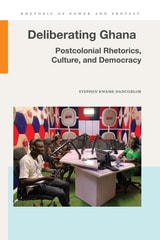
Deliberating Ghana
Postcolonial Rhetorics, Culture, and DemocracyStephen Kwame Dadugblor
Michigan State University Press, 2025
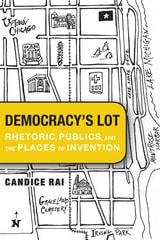
Democracy's Lot
Rhetoric, Publics, and the Places of InventionCandice Rai
University of Alabama Press, 2016
Candice Rai’s Democracy’s Lot is an incisive exploration of the limitations and possibilities of democratic discourse for resolving conflicts in urban communities. Rai roots her study of democratic politics and publics in a range of urban case studies focused on public art, community policing, and urban development. These studies examine the issues that erupted within an ethnically and economically diverse Chicago neighborhood over conflicting visions for a vacant lot called Wilson Yard. Tracing how residents with disparate agendas organized factions and deployed language, symbols, and other rhetorical devices in the struggle over Wilson Yard’s redevelopment and other contested public spaces, Rai demonstrates that rhetoric is not solely a tool of elite communicators, but rather a framework for understanding the agile communication strategies that are improvised in the rough-and-tumble work of democratic life.
Wilson Yard, a lot eight blocks north of Wrigley Field in Chicago’s gentrifying Uptown neighborhood, is a diverse enclave of residents enlivened by recent immigrants from Guatemala, Mexico, Vietnam, Ethiopia, and elsewhere. The neighborhood’s North Broadway Street witnesses a daily multilingual hubbub of people from a wide spectrum of income levels, religions, sexual identifications, and interest groups. When a fire left the lot vacant, this divided community projected on Wilson Yard disparate and conflicting aspirations, the resolution of which not only determined the fate of this particular urban space, but also revealed the lot of democracy itself as a process of complex problem-solving. Rai’s detailed study of one block in an iconic American city brings into vivid focus the remarkable challenges that beset democratic urban populations anywhere on the globe—and how rhetoric supplies a framework to understand and resolve those challenges.
Based on exhaustive field work, Rai uses rhetorical ethnography to study competing publics, citizenship, and rhetoric in action, exploring “rhetorical invention,” the discovery or development by individuals of the resources or methods of engaging with and persuading others. She builds a case for democratic processes and behaviors based not on reflexive idealism but rather on the hard work and practice of democracy, which must address apathy, passion, conflict, and ambivalence.
Demonstrating Results
Using Outcome Measurement in Your LibraryRhea Joyce Rubin
American Library Association, 2006
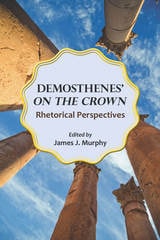
Demosthenes' "On the Crown"
Rhetorical PerspectivesEdited by James J. Murphy
Southern Illinois University Press, 2016
The volume includes biographical and historical background on Demosthenes and his political situation; a structural analysis of On the Crown; and an abstract of Aeschines’ speech Against Ctesiphon to which Demosthenes was responding. Four essays by contributors analyze Demosthenes’ speech using key elements of rhetoric defined by Aristotle: ēthos, the speaker’s character or authority; pathos, or emotional appeals; logos, or logical appeals; and lexis, a speaker’s style. An introduction and an epilogue by Murphy frame the speech and the rhetorical analysis of it.
By bringing together contextual material about Demosthenes and his speech with a translation and astute rhetorical analyses, Demosthenes’“On the Crown”:Rhetorical Perspectives highlights the oratorical artistry of Demosthenes and provides scholars and students with fresh insights into a landmark speech.

Demystifying Online Instruction in Libraries
People, Process, and ToolsDominique Turnbow and Amanda Roth
American Library Association, 2019
The design of information literacy instruction and the building of it are two distinct skillsets and processes; yet all too often everything gets mashed together, creating needless confusion and stress. In this book Turnbow, an instructional designer, and Roth, an instructional technologist, suggest a better way to organize the work. They shed light on the people, processes, and resources required to create a sustainable portfolio of online instruction. With the goal of fostering conversations in your library about the most streamlined and effective ways to get the work done, they provide guidance on such topics as
- design and development processes, complete with “I.D. in Action” examples and sample design documents;
- thumbnail descriptions of ADDIE, SAM, and design thinking methods;
- creating learning objects;
- types of software tools and how to evaluate them;
- crafting the best documentation of your work for efficient maintenance and reuse;
- adapting assessment to your learning outcomes and purpose;
- when to design for performance support, an underutilized method in libraries; and
- starting points for those interested in developing instructional design and development skills.
Demystifying the instructional design and development process used to create online learning objects, this book will help you understand how instructional design principles and approaches can benefit your learners.
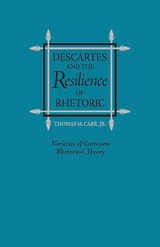
Descartes and the Resilience of Rhetoric
Varieties of Cartesian Rhetorical TheoryThomas M. Carr, Jr.
Southern Illinois University Press, 2009
A careful analysis of the rhetorical thought of René Descartes and of a distinguished group of post-Cartesians. Covering a unique range of authors, including Bernard Lamy and Nicolas Malebranche, Carr attacks the idea, which has become commonplace in contemporary criticism, that the Cartesian system is incompatible with rhetoric.
Carr analyzes the writings of Balzac, the Port-Royalists Arnauld and Nicole, Malebranche, and Lamy, exploring the evolution of Descartes’ thought into their different theories of rhetoric. He constructs his arguments, probing each author’s writings on rhetoric, persuasion, and attention, to demonstrate the basis for rhetorical thought present in Descartes’ theory of persuasion when it is combined with his psychophysiology of attention.
Describing Electronic, Digital, and Other Media Using AACR2 and RDA
Fay Angela Austin
American Library Association, 2010