Results by title
1917 books match the query 'Law' and 66 start with d
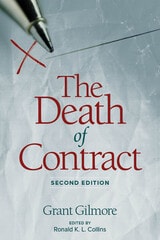
DEATH OF CONTRACT
SECOND EDITIONGrant Gilmore / Edited by Ronald K. L. Collins
The Ohio State University Press, 1995
The second edition, with an instructive and timely foreword by Ronald K. L. Collins, challenges anyone interested in the life of the law to think about where it has come from and where it is trending. A new bibliography of early reviews and contemporary responses reveals how considerable the interest was, and continues to be, in this modern anti-classic.
DOING THE RIGHT THING
Collective Action and Procedural Choice in the New Legislative ProcessLawrence Becker
The Ohio State University Press, 2005
Doing the Right Thing examines the use of extraordinary legislative procedures in four cases in the U.S. Congress to accomplish policy objectives that many political scientists would argue are impossible to achieve. It not only shows that Congress is capable of imposing parochial costs in favor of general benefits but it argues that Congress is able to do so in a variety of policy areas through the use of very different kinds of procedural mechanisms that are underappreciated.
The book opens by developing a theory of procedural choice to explain why Congress chooses to delegate in differing degrees in dealing with similar kinds of policy problems. The theory is then applied to four narrative case studies—military base closures, the Yucca Mountain Project, NAFTA, and the Tax Reform Act of 1986—that both show the variety of factors that impact procedural choice and highlight how our national legislature was able to “do the right thing.”
The book concludes by pointing to the variety of ways in which Congress will be confronted with similar policy problems in the coming years and offering some lessons from these cases about what kinds of procedures and policy outcomes we might expect. In short, Congress is remarkably adept at “doing the right thing,” even under difficult circumstances, but only when legislators are willing to manipulate procedures in all the necessary ways.

Damming the Gila
The Gila River Indian Community and the San Carlos Irrigation Project, 1900–1942David H. DeJong
University of Arizona Press, 2024
This volume continues to chronicle the history of water rights and activities on the Gila River Indian Reservation. Centered on the San Carlos Irrigation Project and Coolidge Dam, it details the history and development of the project, including the Gila Decree and the Winters Doctrine. Embedded in the narrative is the underlying tension between tribal growers on the Gila River Indian Reservation and upstream users. Told in seven chapters, the story underscores the idea that the Gila River Indian Community believed the San Carlos Irrigation Project was first and foremost for their benefit and how the project and the Gila Decree fell short of restoring their water and agricultural economy.
Damming the Gila is the third in a trio of important documentary works, beginning with DeJong’s Stealing the Gila and followed by Diverting the Gila. It continues the story of the Gila River Indian Community’s fight to regain access to their water.

Dance, Disability and Law
InVisible DifferenceEdited by Sarah Whatley, Charlotte Waelde, Shawn Harmon, Abbe Brown, Karen Wood, and Hetty Blades
Intellect Books, 2018

Dangerous Idea
The Alaska Native Brotherhood and the Struggle for Indigenous RightsPeter Metcalfe
University of Alaska Press, 2014
A Dangerous Idea tells an overlooked but powerful story of Alaska Natives fighting for their rights under American law and details one of the rare successes for Native Americans in their nearly two-hundred-year effort to define and protect their rights.

Dangerous Supplements
Resistance and Renewal in JurisprudencePeter Fitzpatrick, ed.
Duke University Press, 1991
Taking as a point of departure H. L. A. Hart’s The Concept of the Law, Peter Fitzgerald shows how Hart adopted Wittgenstein’s linguistic theory to overthrow J. L. Austin’s “simple” conception of rules and habits in law, only to jettison this theory in order to locate the essence of law in its evolution from a “primal scene.” Other chapters examine the way in which the setting of English law above social relations has masked an imperial mission; how the philosophies of Hayek and Marx, as well as the discourses of liberalism, feminism, semiotics, and poststructuralism, have been assiduously marginalized and rendered inessential to jurisprudence.

Dante and the Limits of the Law
Justin Steinberg
University of Chicago Press, 2013
Examining how Dante probes the limits of the law in this juridical otherworld, Steinberg argues that exceptions were vital to the medieval legal order and that Dante’s otherworld represents an ideal “system of exception.” In the real world, Dante saw this system as increasingly threatened by the dual crises of church and empire: the abuses and overreaching of the popes and the absence of an effective Holy Roman Emperor. Steinberg shows that Dante’s imagination of the afterlife seeks to address this gap between the universal validity of Roman law and the lack of a sovereign power to enforce it. Exploring the institutional role of disgrace, the entwined phenomena of judicial discretion and artistic freedom, medieval ideas about privilege and immunity, and the place of judgment in the poem, this cogently argued book brings to life Dante’s sense of justice.

Dawn at Mineral King Valley
The Sierra Club, the Disney Company, and the Rise of Environmental LawDaniel P. Selmi
University of Chicago Press, 2022
In our current age of climate change–induced panic, it’s hard to imagine a time when private groups were not actively enforcing environmental protection laws in the courts. It wasn’t until 1972, however, that a David and Goliath–esque Supreme Court showdown involving the Sierra Club and Disney set a revolutionary legal precedent for the era of environmental activism we live in today.
Set against the backdrop of the environmental movement that swept the country in the late 1960s and early 1970s, Dawn at Mineral King Valley tells the surprising story of how the US Forest Service, the Disney company, and the Sierra Club each struggled to adapt to the new, rapidly changing political landscape of environmental consciousness in postwar America. Proposed in 1965 and approved by the federal government in 1969, Disney’s vast development plan would have irreversibly altered the practically untouched Mineral King Valley, a magnificently beautiful alpine area in the Sierra Nevada mountains. At first, the plan met with unanimous approval from elected officials, government administrators, and the press—it seemed inevitable that this expanse of wild natural land would be radically changed and turned over to a private corporation. Then the scrappy Sierra Club forcefully pushed back with a lawsuit that ultimately propelled the modern environmental era by allowing interest groups to bring litigation against environmentally destructive projects.
An expert on environmental law and appellate advocacy, Daniel P. Selmi uses his authoritative narrative voice to recount the complete history of this revolutionary legal battle and the ramifications that continue today, almost 50 years later.

Dawn at Mineral King Valley
The Sierra Club, the Disney Company, and the Rise of Environmental LawDaniel P. Selmi
University of Chicago Press, 2022
This is an auto-narrated audiobook edition of this book.
The story behind the historic Mineral King Valley case, which reveals how the Sierra Club battled Disney’s ski resort development and launched a new environmental era in America.
In our current age of climate change–induced panic, it’s hard to imagine a time when private groups were not actively enforcing environmental protection laws in the courts. It wasn’t until 1972, however, that a David and Goliath–esque Supreme Court showdown involving the Sierra Club and Disney set a revolutionary legal precedent for the era of environmental activism we live in today.
Set against the backdrop of the environmental movement that swept the country in the late 1960s and early 1970s, Dawn at Mineral King Valley tells the surprising story of how the US Forest Service, the Disney company, and the Sierra Club each struggled to adapt to the new, rapidly changing political landscape of environmental consciousness in postwar America. Proposed in 1965 and approved by the federal government in 1969, Disney’s vast development plan would have irreversibly altered the practically untouched Mineral King Valley, a magnificently beautiful alpine area in the Sierra Nevada mountains. At first, the plan met with unanimous approval from elected officials, government administrators, and the press—it seemed inevitable that this expanse of wild natural land would be radically changed and turned over to a private corporation. Then the scrappy Sierra Club forcefully pushed back with a lawsuit that ultimately propelled the modern environmental era by allowing interest groups to bring litigation against environmentally destructive projects.
An expert on environmental law and appellate advocacy, Daniel P. Selmi uses his authoritative narrative voice to recount the complete history of this revolutionary legal battle and the ramifications that continue today, almost 50 years later.
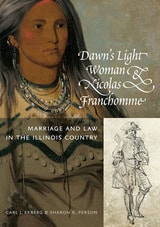
Dawn's Light Woman & Nicolas Franchomme
Marriage and Law in the Illinois CountryCarl J. Ekberg and Sharon K. Person
Southern Illinois University Press, 2022
Native women’s marital rights and roles in colonial Illinois society
Kaskaskia, Illinois, once the state’s capital, torn from the state by flood waters, and now largely forgotten, was once the home to a couple who helped transform the region in the 1720s from a frontier village to a civil society. In the heart of France’s North American empire, the village was a community of French-Canadian fur traders and Kaskaskia Indians who not only lived together but often intermarried. These Indigenous and French intermarriages were central to colonial Illinois society, and the coupling of Marguerite 8assecam8c8e (Dawn’s Light Woman) and Nicolas Franchomme, in particular, was critical to expanding the jurisdiction of French law.
While the story of Marguerite and Nicolas is unknown today, it is the story of how French customary law (Coutume de Paris) governed colonial marriage, how mixed Indian-French marriages stood at the very core of early colonial Illinois society, and how Illinois Indian women benefited, socially and legally, from being married to French men. All of this came about due to a lawsuit in which Nicolas successfully argued that his wife had legal claim to her first husband’s estate—a legal decision that created a precedent for society in the Illinois Country.
Within this narrative of a married couple and their legal fight—based on original French manuscripts and supported by the comprehensively annotated 1726 Illinois census—is also the story of the village of Kaskaskia during the 1720s, of the war between Fox Indians and French settlers, with their Indian allies, in Illinois, and of how the spread of plow agriculture dramatically transformed the Illinois Country’s economy from largely fur trade–based to expansively agricultural.
Dead Wrong
A Death Row Lawyer Speaks Out Against Capital PunishmentMichael A. Mello
University of Wisconsin Press, 1999
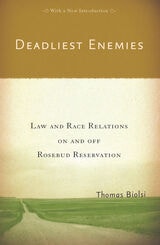
Deadliest Enemies
Law and Race Relations on and off Rosebud ReservationThomas Biolsi
University of Minnesota Press, 2007
Many people living far away from Indian reservations express sympathy for the poverty and misery experienced by Native Americans, yet, Thomas Biolsi argues, the problems faced by Native Americans are the results of white privilege.
In Deadliest Enemies, Biolsi connects the origins of racial tension between Indians and non-Indians on the Rosebud Reservation in South Dakota to federal laws, showing how the courts have created opposing political interests along race lines. Biolsi demonstrates that the court’s definitions of legal rights—both constitutional and treaty rights—make solutions to racial tensions intractable.
This powerful work sheds much-needed light on racial conflicts in South Dakota and in the rest of the United States, and holds white people accountable for the benefits of their racial privilege that come at the expense of Native Americans.
Thomas Biolsi is professor of Native American studies at the University of California at Berkeley.
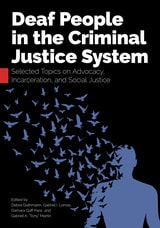
Deaf People in the Criminal Justice System
Selected Topics on Advocacy, Incarceration, and Social JusticeDebra Guthmann
Gallaudet University Press, 2021
The contributors address issues such as accessibility needs; gaps regarding data collection and the need for more research; additional training for attorneys, court personnel, and prison staff; the need for more qualified sign language interpreters, including Certified Deaf Interpreters who provide services in court, prison, and juvenile facilities; substance use disorders; the school to prison nexus; and the need for advocacy. Students in training programs, researchers, attorneys, mental health professionals, sign language interpreters, family members, and advocates will be empowered by this much-needed resource to improve the experiences and outcomes for deaf people in the criminal justice system.
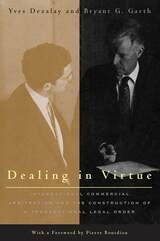
Dealing in Virtue
International Commercial Arbitration and the Construction of a Transnational Legal OrderYves Dezalay and Bryant G. Garth
University of Chicago Press, 1996
Building on Pierre Bourdieu's structural approach, the authors show how an informal, settlement-oriented system became formalized and litigious. Integral to this new legal field is the intense personal competition among arbitrators to gain a reputation for virtue, hoping to be selected for arbitration panels. Since arbitration fees have skyrocketed, this is a high-stakes game.
Using multiple examples, Yves Dezalay and Bryant G. Garth explore how international developments can transform domestic methods for handling disputes and analyze the changing prospects for international business dispute resolution given the growing presence of such international market and regulatory institutions as the EEC, the WTO, and NAFTA.
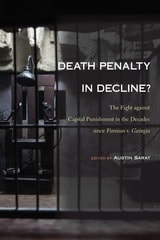
Death Penalty in Decline?
The Fight against Capital Punishment in the Decades since Furman v. GeorgiaAustin Sarat
Temple University Press, 2024
At a time when the United States is undertaking an unprecedented national reconsideration of the death penalty, Death Penalty in Decline? seeks to evaluate how abolitionists might succeed today.
Contributors: John Bessler, Corinna Barrett Lain, James R. Martel, Linda Ross Meyer, Carol S. Steiker, Jordan M. Steiker, and the editor

Deathwork
Defending The CondemnedMichael Mello
University of Minnesota Press, 2002
A gripping exposé of what lawyers face when they defend prisoners in capital cases.
Legal cases are stories, and some of the most compelling-and the most disturbing-are those that take place on death row: the innocent man executed, juveniles and the mentally ill condemned to die, a smoking electric chair, a napping defense attorney, a senile hit man. These are the stories in which Michael Mello, as a capital public defender, played a crucial role, and they are the cases that make up Deathwork, a moment-by-moment, behind-the-scenes look at the life and work of a death row lawyer and his clients.
Part memoir, part legal casebook, Deathwork offers a gritty, often anguishing picture of what Supreme Court Justice Harry Blackmun called the American legal "machinery of death." The stories Mello tells raise questions about legal issues-from prosecutorial misconduct to the racial inequities of sentencing, from the rules of evidence to the rights of the mentally ill-that here take on a life-and-death urgency. They describe in detail how constitutional issues are raised postconviction, and how those issues are adjudicated by the courts and in accordance with bizarre claims of objectivity. And they show, with a painful immediacy and authenticity, what it is like to live and work under an impending death sentence, the adrenaline rush of the stay or unexpected success, the inconsolable sadness upon the execution of the sick, the afflicted, the innocent.As DNA reversals, last-minute confessions, and revelations of corruption are bringing capital punishment to the forefront of public debate nationwide, this firsthand account of the legalities and realities of the death penalty is as relevant as it is enthralling, as edifying as it is impossible to ignore.
Debating Women's Equality
Toward a Feminist Theory of Law from a European PerspectiveGerhard, Ute
Rutgers University Press, 2001
Ute Gerhard places women's rights at the center of legal philosophy and sees the struggle for equality as a driving force in the history of law. Focusing on Europe and taking the course of German feminism and law as primary examples, she incorporates the various social contexts in which questions of equality and gender difference have been raised into an analysis that challenges misconceptions about the principle of equality itself.
Gerhard reviews the history of women's movements in the nineteenth and twentieth centuries and traces the historical development of claims to gender equality as well as obstacles to these claims. Critically exploring the influence of philosophers such as Rousseau, Fichte, and Kant, Gerhard concludes that women need to be recognized as both equal and different-that claims to equality do not simply eliminate difference, but also articulate it. Mindful of the social and political contexts surrounding equality arguments, Gerhard probes three legal issues: women's rights in the public sphere, especially the right to vote; women's legal capacities in private law, or the legal doctrine of so-called gender tutelage; and women's human rights, a prominent concern in the current international women's movement.
Debunking Creation Myths about America's Public Lands
John D. Leshy
University of Utah Press, 2018
This lecture was presented on March 14, 2018, at the 23rd annual symposium of the Wallace Stegner Center for Land, Resources and the Environment at the S.J. Quinney College of Law, University of Utah
Decisiveness and Fear of Disorder
Political Decision-Making in Times of CrisisJulius Maximilian Rogenhofer
University of Michigan Press, 2024
Rogenhofer shows how his theoretical approach allows us to reinterpret a range of crisis situations beyond the irregular migration context, including democracies’ initial responses to Covid-19, the European Sovereign Debt Crisis, and United States climate politics. These additional case studies help position concerns with decisiveness amid the challenges that populism and technocracy increasingly pose to representative democracies.

Decoding Gender
Law and Practice in Contemporary MexicoBaitenmann, Helga
Rutgers University Press, 2007
By bringing new interdisciplinary perspectives to issues such as the quality of citizenship and the rule of law in present-day Mexico, this book raises important issues for research on the relationship between law and gender more widely.

Defence and the UK Constitution
Nigel D. White
Haus Publishing, 2025
Defense and security policy lies at the heart of the British state but can appear entirely untrammeled by the constitution. In fact, when political and military leaders exercise their executive powers, the UK Parliament and the judiciary have limited oversight, let alone control, over their actions. Defence and the UK Constitution introduces key constitutional issues to a general audience and pinpoints the differences between the “legal constitution” and the “political constitution,” with reference to the lack of accountability within modern British security structures. Nigel White traces this imbalance back to the 1680 Bill of Rights and examines the evolution of war and emergency powers, placing them within the context of international law.
Advocating for a rebalancing of the efficient and democratic, as well as the legal and political, elements of the constitution, this short work aims to address the inherent “defense paradox” in the UK constitution and to indicate which constitutional changes are needed to safeguard Britain’s democratic principles and limit excessive uses of discretionary power.
Defending Diversity
Affirmative Action at the University of MichiganPatricia Gurin, Jeffrey S. Lehman, and Earl Lewis, with Eric L. Dey, Gerald Gurin, and Sylvia Hurtado
University of Michigan Press, 2004

Defending Nazis in Postwar Czechoslovakia
Life of K. Resler, Defense Councel Ex Officio of K. H. FrankJakub Drápal
Karolinum Press, 2018
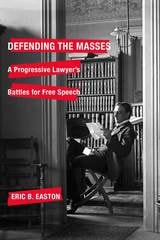
Defending the Masses
A Progressive Lawyer's Battles for Free SpeechEric B. Easton
University of Wisconsin Press, 2018
Roe was the principal trial lawyer of the Free Speech League—a precursor of the American Civil Liberties Union. His cases involved such activists as Emma Goldman, Lincoln Steffens, Margaret Sanger, Max Eastman, Upton Sinclair, John Reed, and Eugene Debs, as well as the socialist magazine The Masses and the New York City Teachers Union. A friend of Wisconsin's progressive senator Robert La Follette since their law partnership as young men, Roe defended "Fighting Bob" when the Senate tried to expel him for opposing America's entry into World War I.
In articulating and upholding Americans' fundamental right to free expression against charges of obscenity, libel, espionage, sedition, or conspiracy during turbulent times, Roe was rarely successful in the courts. But his battles illuminate the evolution of free speech doctrine and practice in an era when it was under heavy assault. His greatest victory, including the 1917 decision by Judge Learned Hand in The Masses Publishing Co. v. Patten, is still influential today.
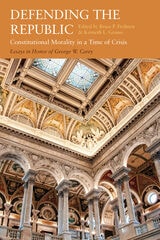
Defending the Republic
Constitutional Monarchy in a Time of Crisis: Essays in Honor of George W. CareyBruce Frohnen
Catholic University of America Press, 2022

Defining Girlhood in India
A Transnational History of Sexual Maturity LawsAshwini Tambe
University of Illinois Press, 2019
Defining Reality
Definitions and the Politics of MeaningEdward Schiappa
Southern Illinois University Press, 2003
In Defining Reality, Edward Schiappa argues that definitional disputes should be treated less as philosophical questions of “is”and more as sociopolitical questions of “ought.” Instead of asking “What is X?” he advocates that definitions be considered as proposals for shared knowledge and institutional norms, as in “What should count as X in context Y, given our needs and interests?”
Covering a broad scope of argument in rhetorical theory, as well as in legal, medical, scientific, and environmental debates, Schiappa shows the act of defining to be a specialized and learned behavior, and therefore one that can be studied and improved. In response to theories that deem discourse to be persuasive, the author asserts that all discourse is definitive discourse that contributes to our construction of a shared reality.
Defining Reality sheds light on our methods of creating common truths through language and argumentation and forces us to reconsider the contexts, limitations, and adaptability of our definitions. Hinging on a synthesis of arguments regarding the significance of definitional practices, the book is bolstered by a series of case studies of debates about rape, euthanasia, abortion, and political and environmental issues. These case studies ground Schiappa’s concepts in reality and delineate the power of public discourse within legal contexts. Ranging widely among disciplines from philosophy and classical philology to constitutional law and cognitive psychology, this study substantially contributes to the scholarship of rhetoric and argumentation, particularly as they function in the realm of public discourse.
Democracy Declined
The Failed Politics of Consumer Financial ProtectionMallory E. SoRelle
University of Chicago Press, 2020
In Democracy Declined, Mallory E. SoRelle argues that the failure of federal policy makers to curb risky practices can be explained by the evolution of consumer finance policies aimed at encouraging easy credit in part by foregoing more stringent regulation. Furthermore, SoRelle explains how angry borrowers’ experiences with these policies teach them to focus their attention primarily on banks and lenders instead of demanding that lawmakers address predatory behavior. As a result, advocacy groups have been mostly unsuccessful in mobilizing borrowers in support of stronger consumer financial protections. The absence of safeguards on consumer financing is particularly dangerous because the consequences extend well beyond harm to individuals—they threaten the stability of entire economies. SoRelle identifies pathways to mitigate these potentially disastrous consequences through greater public participation.
Democracy Vouchers and the Promise of Fairer Elections in Seattle
Jennifer A. Heerwig and Brian J. McCabe
Temple University Press, 2024
Democracy Vouchers and the Promise of Fairer Elections in Seattle critically evaluates the success and impact of this program. Jennifer Heerwig and Brian J. McCabe emphasize how local elections now attract a much wider and more diverse field of both donors and candidates. They also consider external threats to the program, from litigation about the constitutionality of a voucher program to the rise of independent expenditures.
Offering important lessons on how other cities can adopt a similar program, this compelling case study also highlights the obstacles that will likely arise in its implementation.
Democracy and Deliberation
The Law and Politics of Sex Offender LegislationCary Federman
University of Michigan Press, 2021
Sex offender laws include residency restrictions, registration and notification requirements, and post-conviction civil commitment. These laws and regulations impose serious restrictions on the movements of convicted sex offenders. This is controversial because these laws and regulations occur after the sex offender has completed his time in prison. These laws and regulations are intended to have both a deterrent and therapeutic effect. Residency restrictions seek to prevent sex offenders from re-committing their crimes and civil commitment provides psychological services while incarcerated in a forensic facility. Most works on this subject are deeply critical of these laws.
Cary Federman takes a more sympathetic approach to sex offender legislation. He focuses on the deliberative intentions of legislators, exploring the limits of judicial review and the rights of interested parties to influence lawmaking. Leaders of these interested parties are usually the parents of children who have been sexually violated and murdered. Critics of sex offender legislation tend to focus on the convicted parties, arguing that their rights have been violated. The Law and Politics of Sex Offender Legislation asserts that these laws are expressions of the deliberative intentions of lawmakers concerned about public safety—they are thus constitutional, if not always wise.
Democracy and Dysfunction
Sanford Levinson and Jack M. Balkin
University of Chicago Press, 2019
Democracy and Dysfunction brings together two of the leading constitutional law scholars of our time, Sanford Levinson and Jack M. Balkin, in an urgently needed conversation that seeks to uncover the underlying causes of our current crisis and their meaning for American democracy. In a series of letters exchanged over a period of two years, Levinson and Balkin travel—along with the rest of the country—through the convulsions of the 2016 election and Trump’s first year in office. They disagree about the scope of the crisis and the remedy required. Levinson believes that our Constitution is fundamentally defective and argues for a new constitutional convention, while Balkin, who believes we are suffering from constitutional rot, argues that there are less radical solutions. As it becomes dangerously clear that Americans—and the world—will be living with the consequences of this pivotal period for many years to come, it is imperative that we understand how we got here—and how we might forestall the next demagogue who will seek to beguile the American public.
Democracy in Session
A History of the Ohio General AssemblyDavid M. Gold
Ohio University Press, 2009
For more than 200 years no institution has been more important to the development of the American democratic polity than the state legislature, yet no political institution has been so neglected by historians. Although more lawmaking takes place in the state capitals than in Washington D.C., scholars have lavished their attention on Congress, producing only a handful of histories of state legislatures. Most of those histories have focused on discrete legislative acts rather than on legislative process, and all have slighted key aspects of the legislative environment: the parliamentary rules of play, the employees who make the game possible, the physical setting—the arena—in which the people’s representatives engage in conflict and compromise to create public policy.
This book relates in fascinating detail the history of the Ohio General Assembly from its eighteenth-century origins in the Northwest Territory to its twenty-first-century incarnation as a full-time professional legislature. Democracy in Session explains the constitutional context within which the General Assembly functions, examines the evolution of legislative committees, and explores the impact of technology on political contests and legislative procedure. It sheds new light on the operations of the House and Senate clerks’ offices and on such legislative rituals as seat selection, opening prayers, and the Pledge of Allegiance. Partisan issues and public policy receive their due, but so do ethics and decorum, the election of African American and female legislators, the statehouse, and the social life of the members. Democracy in Session is, in short, the most comprehensive history of a state legislature written to date and an important contribution to the story of American democracy.

Democracy, Governance, and Growth
Stephen Knack, Editor
University of Michigan Press, 2003
The difference between developmental success and failure in this view has little to do with natural resource availability, climate, aid, or developed nations' policies. Rather, it is largely a function of whether incentives within a given society steer wealth-maximizing individuals toward producing new wealth or toward diverting it from others. The chapters, seminal essays written by Mancur Olson and his IRIS Center colleagues, provide theoretical and/or empirical underpinnings for the emerging consensus that differences in the way governments and societies are organized have enormous implications for the structure of incentives faced by politicians, bureaucrats, investors, and workers, which in turn determines the level of a nation's material well-being.
Overall this volume applies tools and concepts from the "New Institutional Economics" to some of the major issues in economic development. It will be of interest to scholars and students of various disciplines--including political science, law, and sociology as well as economics--interested in the determinants of economic development and global economic change. The book will also be of interest to many aid practitioners, particularly those working in anticorruption and public sector reform issues.
Stephen Knack is Senior Research Economist, Development Research Group, the World Bank.
Democracy, Inc.
The Press and Law in the Corporate Rationalization of the Public SphereDavid S. Allen
University of Illinois Press, 2005
Allen utilizes historical, philosophical, sociological, and legal sources to trace America's gradual embrace of corporate values. He argues that such values, including winning, efficiency, and profitability actually limit democratic involvement by devaluing discursive principles, creating an informed yet inactive public. Through an examination of professionalization in both the press and the law, corporate free speech rights, and free speech as property, Democracy, Inc. demonstrates that today's democracy is more about trying to control and manage citizens than giving them the freedom to participate. Allen not only calls on institutions to reform the way they understand and promote citizenship but also asks citizens to adopt a new ethic of public discourse that values understanding rather than winning.
Democratic Law in Classical Athens
By Michael Gagarin
University of Texas Press, 2020
The democratic legal system created by the Athenians was completely controlled by ordinary citizens, with no judges, lawyers, or jurists involved. It placed great importance on the litigants’ rhetorical performances. Did this make it nothing more than a rhetorical contest judged by largely uneducated citizens that had nothing to do with law, a criticism that some, including Plato, have made?
Michael Gagarin argues to the contrary, contending that the Athenians both controlled litigants’ performances and incorporated many other unusual features into their legal system, including rules for interrogating slaves and swearing an oath. The Athenians, Gagarin shows, adhered to the law as they understood it, which was a set of principles more flexible than our current understanding allows. The Athenians also insisted that their legal system serve the ends of justice and benefit the city and its people. In this way, the law ultimately satisfied most Athenians and probably produced just results as often as modern legal systems do. Comprehensive and wide-ranging, Democratic Law in Classical Athens offers a new perspective for viewing a legal system that was democratic in a way only the Athenians could achieve.
Democratization and the Politics of Constitution-Making in Turkey
Ömer Faruk Gençkaya
Central European University Press, 2009

Deported Americans
Life after Deportation to MexicoBeth Caldwell
Duke University Press, 2019
Desperately Seeking Certainty
The Misguided Quest for Constitutional FoundationsDaniel A. Farber and Suzanna Sherry
University of Chicago Press, 2002
Developing Educators for The Digital Age
A Framework for Capturing Knowledge in ActionPaul Breen
University of Westminster Press, 2018
Evaluating skills and knowledge capture lies at the cutting edge of contemporary higher education where there is a drive towards increasing evaluation of classroom performance and use of digital technologies in pedagogy. Developing Educators for the Digital Age is a book that provides a narrative account of teacher development geared towards the further usage of technologies (including iPads, MOOCs and whiteboards) in the classroom presented via the histories and observation of a diverse group of teachers engaged in the multiple dimensions of their profession.
Drawing on the insights of a variety of educational theories and approaches (including TPACK) it presents a practical framework for capturing knowledge in action of these English language teachers – in their own voices – indicating how such methods, processes and experiences shed light more widely on related contexts within HE and may be transferable to other situations.
This book will be of interest to the growing body of scholars interested in TPACK theory, or communities of practice theory and more widely anyone concerned with how new pedagogical skills and knowledge with technology may be incorporated in better practice and concrete instances of teaching.

Dies Irae
Jean-Luc Nancy
University of Westminster Press, 2019
Edited by Angela Condello, Carlo Grassi and Andreas Philippopoulos-Mihalopoulos
With an introduction by Carlo Grassi
Translated by Cadenza Academic Translations and Angela Condello
What does it mean to judge when there is no general and universal norm to define what is right and what is wrong? Can laws be absent and is law always necessary?
This is the first English translation published of Jean- Luc Nancy’s acclaimed consideration of the law’s most pervasive principles in the context of actual systems and contemporary institutions, power, norms, laws. In a world where it is impossible to imagine the realisation of an ideal of justice that corresponds to every person’s ideal of justice, Nancy probes the limits of legal normativity. Moreover, the question is asked: how can legal normativity be legitimised? A legal order based on performativity and formal validity is questionable and other forces than juridical normativity are at the heart of Dies Irae. Such leads inevitably to the processes of inclusion and exclusion that characterise contemporary juridical systems and those issues of identity, hostility and self-representation central to contemporary political and legal debates

Digital Copyright
Jessica Litman
Michigan Publishing Services, 2017
Jessica Litman questions whether copyright laws crafted by lawyers and their lobbyists really make sense for the vast majority of us. Should every interaction between ordinary consumers and copyright-protected works be restricted by law? Is it practical to enforce such laws, or expect consumers to obey them? What are the effects of such laws on the exchange of information in a free society? Litman’s critique exposes the 1998 copyright law as an incoherent patchwork. She argues for reforms that reflect the way people actually behave in their daily digital interactions.
The Maize Books edition includes both an afterword written in 2006 exploring the rise of peer-to-peer file sharing and a new Postscript reflecting on the consequences of the Digital Millennium Copyright Act as it nears its twentieth birthday.

Digital Rights at the Periphery
Making Brazil's Marco CivilGuy T. Hoskins
University of Illinois Press, 2025
Signed into law in 2014, the Marco Civil da Internet (Brazilian Civil Rights Framework for the Internet) appeared to offer pioneering legislation for a digital bill of rights that addressed issues like network neutrality and privacy. Guy T. Hoskins chronicles the Marco Civil’s development and its failure to confront the greatest concentration of power in the digital age: informational capitalism. Combining interviews with discourse and political-economic analysis, Hoskins reveals why the legislation fell short while examining the implications of its emergence in Brazil, which remains on the margins of the global system of informational capitalism. Hoskins places collectivist and public service principles at the core of any framework’s effectiveness. He also shows why we must create systems sensitive to the sociocultural and political-economic contexts that will shape digital rights and their usefulness.
Compelling and contrarian, Digital Rights at the Periphery looks at communications policy and internet governance in the Global South and the lessons they provide for the rest of the world.
Dilemma of Duties
The Conflicted Role of Juvenile DefendersAnne M. Corbin
Southern Illinois University Press, 2018
In Dilemma of Duties, Corbin outlines patterns of role conflict that defenders experience, details its impact on counselors and clients in the juvenile justice system, and addresses the powerful influence of the juvenile court culture and the lack of resources for defenders. Tasked with guiding these children, counselors frequently must contend with and manage their clients’ general distrust of adults as they attempt to serve as their voices to the court.
Understanding how juvenile defenders define their role and experience role conflict provides valuable insights into our juvenile justice system, especially its role in upholding due process rights. Such knowledge points to the importance of the training and practices of juvenile court functionaries and the efficacy, credibility, and legitimacy of the juvenile justice system itself.
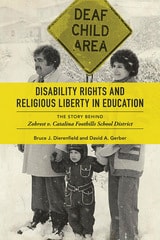
Disability Rights and Religious Liberty in Education
The Story behind Zobrest v. Catalina Foothills School DistrictBruce J. Dierenfield and David A. Gerber
University of Illinois Press, 2020
Bruce J. Dierenfield and David A. Gerber use the Zobrests' story to examine the complex history and jurisprudence of disability accommodation and educational mainstreaming. They look at the family's effort to acquire educational resources for their son starting in early childhood and the choices the Zobrests made to prepare him for life in the hearing world rather than the deaf community. Dierenfield and Gerber also analyze the thorny church-state issues and legal controversies that informed the case, its journey to the U.S. Supreme Court, and the impact of the high court's ruling on the course of disability accommodation and religious liberty.
Disability, Civil Rights, and Public Policy
The Politics of ImplementationStephen L. Percy
University of Alabama Press, 1989
Following on the heels of other Civil Rights movements, disability rights laws emerged in the late 1960s and early 1970s. Often these laws were more symbolic than precise in terms of objectives and strategies to guide the implementation of antidiscrimination policies. Policy refinement, the process of translating legislative mandates into strategies and procedures to govern administrative action, is both dynamic and controversial.
The premise of Disability, Civil Rights, and Public Policy is that implementation policies in these areas evolved through protracted political struggles among a variety of persons and groups affected by disability rights laws. Efforts to influence policies extended far beyond the process of legislative enactment and resulted in struggles that were played out in the courts and in the executive branch. Included within this examination of federal disability rights laws are the role of symbolic politics, the strengths and weaknesses of contemporary models used for the study of policy implementation, and the politics of administrative policymaking.
Disinflation in Transition Economies
Marek Dabrowski
Central European University Press, 2003
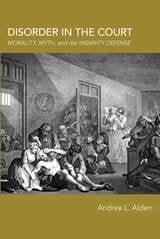
Disorder in the Court
Morality, Myth, and the Insanity DefenseAndrea L. Alden
University of Alabama Press, 2018
The first book-length rhetorical history and analysis of the legal and moral questions behind the insanity defense.
The insanity defense is considered one of the most controversial, most misunderstood, and least straightforward subjects in the American legal system. Disorder in the Court: Morality, Myth, and the Insanity Defense traces the US legal standards for the insanity defense as they have evolved from 1843, when they were first codified in England, to 1984, when the US government attempted to revise them through the Insanity Defense Reform Act. Throughout this period “insanity” existed primarily as a legal term rather than a medical one; yet the testimony of psychiatric experts is required in cases in which an insanity defense is raised.
The adjudication of such cases by courtroom practice is caught between two different but overlapping discourses, the legal and the medical, both of which have historically sought to assert and maintain firm disciplinary boundaries. Both expert and lay audiences have struggled to understand and apply commonplace definitions of sanity, and the portrayal of the insanity defense in popular culture has only served to further frustrate such understandings.
Andrea L. Alden argues that the problems with understanding the insanity defense are, at their foundation, rhetorical. The legal concept of what constitutes insanity and, therefore, an abdication of responsibility for one’s actions does not map neatly onto the mental health professions’ understandings of mental illness and how that affects an individual’s ability to understand or control his or her actions. Additionally, there are multiple layers of persuasion involved in any effort to convince a judge, jury—or a public, for that matter—that a defendant is or is not responsible for his or her actions at a particular moment in time.
Alden examines landmark court cases such as the trial of Daniel McNaughtan, Durham v. United States, and the trial of John Hinckley Jr. that signal the major shifts in the legal definitions of the insanity defense. Combining archival, textual, and rhetorical analysis, Alden offers a close reading of texts including trial transcripts, appellate court opinions, and relevant medical literature from the time period. She contextualizes these analyses through popular texts—for example, newspaper articles and editorials—showing that while all societies have maintained some version of mental illness as a mitigating factor in their penal systems, the insanity defense has always been fraught with controversy.
Disputes and Democracy
The Consequences of Litigation in Ancient AthensBy Steven Johnstone
University of Texas Press, 1999
Athenians performed democracy daily in their law courts. Without lawyers or judges, private citizens, acting as accusers and defendants, argued their own cases directly to juries composed typically of 201 to 501 jurors, who voted on a verdict without deliberation. This legal system strengthened and perpetuated democracy as Athenians understood it, for it emphasized the ideological equality of all (male) citizens and the hierarchy that placed them above women, children, and slaves.
This study uses Athenian court speeches to trace the consequences for both disputants and society of individuals' decisions to turn their quarrels into legal cases. Steven Johnstone describes the rhetorical strategies that prosecutors and defendants used to persuade juries and shows how these strategies reveal both the problems and the possibilities of language in the Athenian courts. He argues that Athenian "law" had no objective existence outside the courts and was, therefore, itself inherently rhetorical. This daring new interpretation advances an understanding of Athenian democracy that is not narrowly political, but rather links power to the practices of a particular institution.

Dissent in Dangerous Times
Austin Sarat, Editor
University of Michigan Press, 2004
While dissent has played a central role in our national history and in the American cultural imagination, it is usually dangerous to those who practice it, and always unpalatable to its targets. War does not encourage the tolerance of opposition at home any more than it does on the front: if the War on Terror is to be a permanent war, then the consequences for American political freedoms cannot be overestimated.
"Dissent in Dangerous Times examines the nature of political repression in liberal societies, and the political and legal implications of living in an environment of fear. This profound, incisive, at times even moving volume calls upon readers to think about, and beyond, September 11, reminding us of both the fragility and enduring power of freedom."
--Nadine Strossen, President, American Civil Liberties Union, and Professor of Law, New York Law School.
Contributors to this volume
Lauren Berlant
Wendy Brown
David Cole
Hugh Gusterson
Nancy L. Rosenblum
Austin Sarat
Distinguishing the Righteous from the Roguish
The Arkansas Supreme Court, 1836–1874J.W. Looney
University of Arkansas Press, 2016
During the period from 1836 to 1874, the legal system in the new state of Arkansas developed amid huge social change. While the legislature could, and did, determine what issues were considered of importance to the populace, the Arkansas Supreme Court determined the efficacy of legislation in cases involving land titles, banks, transportation, slavery, family law, property, debt, contract, criminal law, and procedure.
Distinguishing the Righteous from the Roguish examines the court’s decisions in this era and shows how Arkansas, as a rural slave-holding state, did not follow the transformational patterns typical of some other states during the nineteenth century. Rather than using the law to promote broad economic growth and encourage social change, the Arkansas court attempted to accommodate the interests of the elite class by preserving the institution of slavery. The ideology of paternalism is reflected in the decisions of the court, and Looney shows how social and political stability—an emphasis on preserving the status quo of the so-called “righteous”—came at the expense of broader economic development.