Results by title
5159 books match the query 'Biography' and 191 start with d

Deaf Peddler
Confessions of an Inside ManDennis S. Buck
Gallaudet University Press, 2000
In airports and train stations it is not unusual for waiting passengers to be approached by a person who will hand out a brochure or trinket, then indicate that he or she is deaf and ask for payment, anything they can afford. In many instances, the travelers feel pity for the poor unfortunate and dole out a dollar or two, yet most are utterly unaware that these pitiful beggars earn hundred of dollars this way in a matter of a few hours. Dennis Buck knows this unique form of panhandling intimately because, despite holding a degree in computer science and receiving Supplemental Security Income (SSI) and Social Security Disability Insurance (SSDI), he was a deaf peddler for 11 years.
In Deaf Peddler: Confessions of an Inside Man, Buck unveils all of the ins and outs of exploiting his “disabilities” to earn easy money. Buck details the day-to-day life of a deaf peddler, including where to go to make the most money in the least time (airports with their constant transient clientele, malls on weekends, and fast food restaurants), how to live on the cheap (wait for people checking out to leave their motel rooms, then sneak in to use the shower), and how to live well when business is good. He also explains how he organized his rounds using a spreadsheet program.
Deaf Peddler also provides a historical perspective on deaf peddling as a way for under-educated deaf people to make a living when jobs were hard to find, wages were low, and Social Security did not exist. The “no good” life served as the rationale to many deaf people for peddling, but many more in the Deaf community deplored their actions, and the National Association of the Deaf campaigned to discourage this behavior that reinforced deaf stereotypes. Buck abandoned peddling himself for this reason, but he points out that deaf peddling survives today, frequently in the highly exploitative form of rings of deaf workers completely controlled by oppressive deaf and hearing overseers. Deaf Peddler presents in engaging fashion a little-known cultural phenomenon that offers a revealing turn on the general issue of panhandling in our society today.
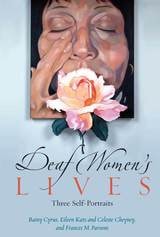
Deaf Women's Lives
Three Self-PortraitsBainy Cyrus
Gallaudet University Press, 2005
Three deaf women with widely varying stories share their experiences in this unique collection, revealing the vast differences in the circumstances of their lives, but also striking similarities. In Bainy Cyrus’s All Eyes, she vividly describes her life as a young child who was taught using the oral method at the Clarke School for the Deaf in Northampton, MA. Her account of the methods used (for example, repeating the same word over and over again, as many as 35 times), animates the extraordinary amount of work performed by deaf children to learn to read and speak. Cyrus also relates the importance of her lifelong friendships with two girls she met at Clarke, and how the different paths that they took influenced her as an adult.
Eileen Katz’s story, as told to Celeste Cheyney, offers a glimpse into a deaf girl’s life a generation before Cyrus. In Making Sense of It All: The Battle of Britain Through a Jewish Deaf Girl’s Eyes, Katz juxtaposes the gradual learning of the words who, what, where, and why with the confusing events of 1938 to 1941. As she and her fellow students grasped the meanings of these questions, they also realized the threat from the Nazi air attacks upon England. Katz also understood the compound jeopardy that she and her classmates faced by being both deaf and Jewish.
In contrast to the predominantly oral orientation of Cyrus and Katz, Frances M. Parsons writes of a year-long journey overseas in 1976 to lecture about Total Communication. Parsons traveled to Iran, India, Ceylon, Thailand, Malaysia, Singapore, Hong Kong, Taipei, the Philippines, Australia, and seven countries in Africa to teach administrators, teachers, and deaf students to communicate using sign, speechreading, writing, and any other means available. Her harrowing and fascinating anecdotes detail visits to ministries of education, schools, hospitals, clinics, palaces, hovels for the poorest of the poor, and all kinds of residential homes and apartments. Taken together, her travels testify to the aptness of her title I Dared!
The combined effect of these three Deaf women’s stories, despite the variation in their experiences, reveals the common thread that weaves through the lives of all deaf individuals.

Deaf in DC
A MemoirMadan Vasishta
Gallaudet University Press, 2011
In his first memoir, Madan Vasishta described being a deaf boy in his homeland India, where “deaf” meant someone who is not human. After rising from herding cattle to being a respected photographer in Delhi, his first memoir concluded with his acceptance at Gallaudet College far away in America. Vasishta’s new memoir begins with his arrival in Washington, DC in 1967 with $40.00 in his pocket and very little knowledge of the new worlds he was entering.
Vasishta faced myriad challenges from the outset— he knew no American Sign Language and could not speech read, yet he found himself thrust into classes at Gallaudet two weeks into the semester. Cultural differences mystified him, such as how all American car accidents were someone else’s fault even when one’s car hits a stationary object. He was amazed that his fellow students did not deride him for his mistakes, unlike in India where he would have been scorned for his weakness. After five years, he returned home to India for a visit and was stunned to learn that he no longer fit in, that “even if you do not have an American Dream, the American Dream will have you.”
Deaf in DC follows Vasishta through half a century living in America. He witnessed the transformation from facing bias as a deaf, foreign man of color who could not get a job despite having a Ph.D., to receiving five offers as a school superintendent in the wake of the Civil Rights movement and Deaf President Now. His new memoir reflects a genuine worldview informed by the sage perceptions of a person who has lived widely in many worlds.
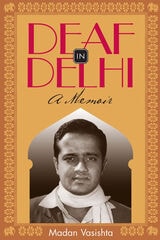
Deaf in Delhi
A MemoirMadan Vasishta
Gallaudet University Press, 2006
Vasishta’s story reflects the India of his youth, an emerging nation where most people struggled with numbing poverty and depended upon close family ties, tradition, and faith to see them through. His family’s search for a cure took him to a host of medical specialists and just as many sadhus and mahatmas, holy men and priests. The school in his small village was ill-prepared to educate deaf students then, so he herded the family cattle, usually the work of hired servants. Vasishta refused to accept this as his final lot in life and fantasized constantly about better jobs. Eventually, he moved to Delhi where his dream of becoming a photographer came true. He also discovered the Delhi Deaf community that, with his family, helped him to achieve an even higher goal, traveling to America to earn a degree at Gallaudet College.
Vasishta, a natural raconteur, imbues Deaf in Delhi with the ever-present ebullience that served him so well in his journey. Readers will savor his good humor and honest observations and look forward to his next book with great relish.
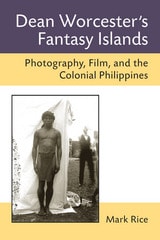
Dean Worcester's Fantasy Islands
Photography, Film, and the Colonial PhilippinesMark Rice
University of Michigan Press, 2014
Dean Worcester’s Fantasy Islands brings to life one of the most significant (but under examined) figures in the history of U.S. colonialism in the Philippines. Upon the outbreak of the Spanish-American War, Worcester, a scientist who had traveled twice to the Philippines on zoological expeditions, established himself as one of America’s leading experts on the Philippines. Over a fourteen-year career as a member of the U.S. colonial regime, Worcester devoted much of his time and energy to traveling among and photographing non-Christian minority groups in the Philippines. He amassed an archive of several thousand photographs taken by him or by government photographers. Worcester deployed those photographs in books, magazine articles, and lectures to promote his belief that the United States should maintain control of the Philippines for decades to come. While many historians have examined American colonial photography in the Philippines, this book is the first lengthy treatment of Worcester’s role in shaping American perceptions of the Philippines in the early twentieth century.

Dear Denise
Letters to the Sister I Never KnewLisa McNair
University of Alabama Press, 2022
Poignant, honest, and heartfelt letters to a sister who perished in the 16th Street Baptist Church bombing.
Lisa McNair was born in 1964, one year after her older sister, Denise, was murdered in the bombing of the 16th Street Baptist Church in Birmingham, Alabama. Dear Denise is a collection of forty letters from Lisa addressed to the sister she never knew, but in whose shadow of sacrifice and lost youth she was raised. These letters offer an intimate look into the life of a family touched by one of the most heinous tragedies of the Civil Rights Movement.
Written in a genuine, accessible, familiar, and easy-to-read voice, Lisa’s letters apprise her late sister of all that has come to pass in the years since her death. Lisa considers her own challenges and accomplishments as a student in remarkably different—and very racially complex—schools; the birth of their baby sister, Kim; their father’s election to the Alabama legislature; her evolving sense of faith and place, and sometimes lack thereof, within the Black church; her college experiences; and her own sense of self as she’s matured into adulthood. She reveals some of the family’s difficulties and health challenges, and shares some of their joys and celebrations.
The letters are accompanied by 29 black-and-white photographs, most of them from the McNair family collection, many of them taken by her father, a professional photographer who documented the Civil Rights Movement in Alabama both before and after Denise’s murder. An unswervingly candid, gentle, and nuanced book, Dear Denise is a testament to one singular life lived bravely and truthfully (if sometimes confusedly or awkwardly), during decades of bewildering social change and in the shadow of one life never fully lived.

Dear Friend
Rainer Maria Rilke and Paula Modersohn-BeckerEric Torgersen
Northwestern University Press, 2000
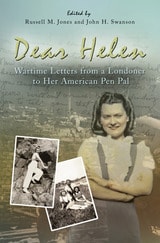
Dear Helen
Wartime Letters from a Londoner to Her American Pen PalEdited by Russell M. Jones & John H. Swanson
University of Missouri Press, 2009

Death and Life in the Big Red One
A Soldier’s World War II Journey from North Africa to GermanyJoseph P. Olexa
University of North Texas Press, 2023

Death at Cross Plains
An Alabama Reconstruction TragedyGene L. Howard with a foreword by Gary B. Mills
University of Alabama Press, 1984
Reconstruction in the South is a much studied and yet little understood period in the region’s history. In many areas it was marked by such violence as to have been guerrilla warfare in all but name. Death at Cross Plains is the gripping story of one local incident that illuminates the aftermath of the Civil War throughout the region.

Death in a Prairie House
Frank Lloyd Wright and the Taliesin MurdersDrennan
University of Wisconsin Press, 2008
In response to the scandal generated by his open affair with the proto-feminist and free love advocate Mamah Borthwick Cheney, Wright had begun to build Taliesin as a refuge and "love cottage" for himself and his mistress (both married at the time to others).
Conceived as the apotheosis of Wright’s prairie house style, the original Taliesin would stand in all its isolated glory for only a few months before the bloody slayings that rocked the nation and reduced the structure itself to a smoking hull.
Supplying both a gripping mystery story and an authoritative portrait of the artist as a young man, Drennan wades through the myths surrounding Wright and the massacre, casting fresh light on the formulation of Wright’s architectural ideology and the cataclysmic effects that the Taliesin murders exerted on the fabled architect and on his subsequent designs.
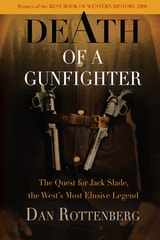
Death of a Gunfighter
The Quest for Jack Slade, the West's Most Elusive LegendDan Rottenberg
Westholme Publishing, 2008
The True Story of One of America’s Most Enigmatic and Tragic Heroes
Awarded Best Western History Book of 2008 by the Wild West History Association
"A superb biography"—Foreword Reviews
"An ambitious, well-written effort to restore a Wild West desperado to history.... Readers will surely remember Jack Slade from henceforth. A treat for Western history buffs and fans of true crime."—Kirkus Reviews
"An enjoyable read, and it is also a heroic effort."—Wall Street Journal
"Every bit the page-turner as Roughing It, with one added advantage—Rottenberg's book approaches the truth."—Wild West magazine
"Now and then a book of Western history comes along that captures an era and clears up many a mystery; Death of a Gunfighter is such a book."—Colorado Central magazine
In 1859, as the United States careened toward civil war, Washington's only northern link with America's richest state, California, was a stagecoach line operating between Missouri and the Pacific. Yet the stage line was plagued by graft, outlaws, and hostile Indians. At this critical moment, the company enlisted a former wagon train captain and Mexican War veteran to clean up its most dangerous division. Over the next three years, Joseph Alfred "Jack" Slade exceeded his employers' wildest dreams, capturing bandits and horse thieves and driving away gangs; he even shot to death a disruptive employee. He kept the stagecoaches and the U.S. Mail running, and helped launch the Pony Express, all of which kept California in the Union—and without California's gold, the Union would have failed to finance its cause. Across the Great Plains he became known as "The Law West of Kearny."
Slade's legend grew when he was shot multiple times and left for dead, only to survive and exact revenge on his would-be killer. But once Slade had restored the peace, leaving him without challenges, his life descended into an alcoholic Dr. Jekyll and Mr. Hyde nightmare, transforming him from a courageous leader, charming gentleman, and devoted husband into a vicious, quick-triggered ruffian—a purported outlaw —who finally lost his life at the hands of vigilantes.
Since Slade's death in 1864, persistent myths and stories have defied the efforts of writers and historians, including Mark Twain, to capture the real Jack Slade. Despite his notoriety, the pieces of Slade's fascinating life—including his marriage to the beautiful Maria Virginia—have remained scattered and hidden. He was never photographed and left almost no personal writings, not even a letter. In Death of a Gunfighter: The Quest for Jack Slade, the West's Most Elusive Legend, journalist Dan Rottenberg assembles years of research to reveal the true story of Jack Slade, one of America's greatest tragic heroes.
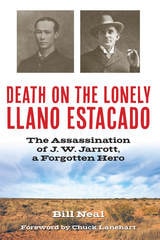
Death on the Lonely Llano Estacado
The Assassination of J. W. Jarrott, a Forgotten HeroBill Neal
University of North Texas Press, 2017

Death to Fascism
Louis Adamic's Fight for DemocracyJohn P. Enyeart
University of Illinois Press, 2019

Deathwork
Defending The CondemnedMichael Mello
University of Minnesota Press, 2002
A gripping exposé of what lawyers face when they defend prisoners in capital cases.
Legal cases are stories, and some of the most compelling-and the most disturbing-are those that take place on death row: the innocent man executed, juveniles and the mentally ill condemned to die, a smoking electric chair, a napping defense attorney, a senile hit man. These are the stories in which Michael Mello, as a capital public defender, played a crucial role, and they are the cases that make up Deathwork, a moment-by-moment, behind-the-scenes look at the life and work of a death row lawyer and his clients.
Part memoir, part legal casebook, Deathwork offers a gritty, often anguishing picture of what Supreme Court Justice Harry Blackmun called the American legal "machinery of death." The stories Mello tells raise questions about legal issues-from prosecutorial misconduct to the racial inequities of sentencing, from the rules of evidence to the rights of the mentally ill-that here take on a life-and-death urgency. They describe in detail how constitutional issues are raised postconviction, and how those issues are adjudicated by the courts and in accordance with bizarre claims of objectivity. And they show, with a painful immediacy and authenticity, what it is like to live and work under an impending death sentence, the adrenaline rush of the stay or unexpected success, the inconsolable sadness upon the execution of the sick, the afflicted, the innocent.As DNA reversals, last-minute confessions, and revelations of corruption are bringing capital punishment to the forefront of public debate nationwide, this firsthand account of the legalities and realities of the death penalty is as relevant as it is enthralling, as edifying as it is impossible to ignore.
Deckhand
Life on Freighters of the Great LakesNelson "Mickey" Haydamacker with Alan D. Millar
University of Michigan Press, 2009
Long before popular television shows such as Dirty Jobs and The Deadliest Catch, everyday men and women---the unsung heroes of the job world---toiled in important but mostly anonymous jobs. One of those jobs was deckhand on the ore boats.
With numerous photographs and engaging stories, Deckhand offers an insider's view of both the mundane and the intriguing duties performed by deckhands on these gritty cargo vessels. Boisterous port saloons, monster ice jams, near drownings, and the daily drudgery of soogeying---cleaning dirt and grime off the ships---are just a few of the experiences Mickey Haydamacker had as a young deckhand working on freighters of the Great Lakes in the early 1960s. Haydamacker sailed five Interlake Steamship Company boats, from the modern Elton Hoyt 2nd to the ancient coal-powered Colonel James Pickands with its backbreaking tarp-covered hatches.
Deckhand will appeal to shipping buffs and to anyone interested in Great Lakes shipping and maritime history as it chronicles the adventures of living on the lakes from the seldom-seen view of a deckhand.
Deep River
A Memoir of a Missouri FarmDavid Hamilton
University of Missouri Press, 2014
Deep River uncovers the layers of history—both personal and regional—that have accumulated on a river-bottom farm in west-central Missouri. This land was part of a late frontier, passed over, then developed through the middle of the last century as the author's father and uncle cleared a portion of it and established their farm.
Hamilton traces the generations of Native Americans, frontiersmen, settlers, and farmers who lived on and alongside the bottomland over the past two centuries. It was a region fought over by Union militia and Confederate bushwhackers, as well as by their respective armies; an area that invited speculation and the establishment of several small towns, both before and after the Civil War; land on which the Missouri Indians made their long last stand, less as a military force than as a settlement and civilization; land that attracted French explorers, the first Europeans to encounter the Missouris and their relatives, the Ioways, Otoes, and Osage, a century before Lewis and Clark. It is land with a long history of occupation and use, extending millennia before the Missouris. Most recently it was briefly and intensively receptive to farming before being restored in large part as state-managed wetlands.
Deep River is composed of four sections, each exploring aspects of the farm and its neighborhood. While the family story remains central to each, slavery and the Civil War in the nineteenth century and Native American history in the centuries before that become major themes as well. The resulting portrait is both personal memoir and informal history, brought up from layers of time, the compound of which forms an emblematic American story.
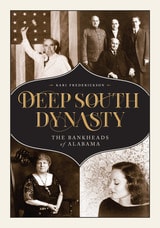
Deep South Dynasty
The Bankheads of AlabamaKari Frederickson
University of Alabama Press, 2022
WINNER OF THE GULF SOUTH HISTORICAL ASSOCIATION'S MICHAEL V. R. THOMASON BOOK AWARD
Family, influence, and the making of Southern power.
From Reconstruction through the end of World War II, the Bankheads served as the principal architects of the political, economic, and cultural framework of Alabama and the greater South. As a family, they were instrumental in fashioning the New South and the twentieth century American political economy, but now the Bankhead name is largely associated only with place names.
Deep South Dynasty: The Bankheads of Alabama is a deeply researched epic family biography that reflects the complicated and evolving world inhabited by three generations of the extremely accomplished—if problematic—Bankhead family of northwest Alabama. Kari Frederickson’s expertly crafted account traces the careers of five members of the family—John Hollis Bankhead; his sons, John Hollis Bankhead Jr. and William Brockman Bankhead; his daughter, Marie Bankhead Owen; and his granddaughter, Tallulah Brockman Bankhead.
A Confederate veteran and son of a slaveholder, John Hollis Bankhead held political office almost continuously from 1865 until his death in 1920, first in state-level positions and ultimately in Congress–in the House then in the Senate–for thirty-three years. Two of his three sons, John Jr. and William, followed in their father’s political footsteps. John Jr., a successful corporate attorney, was elected to the state legislature and then to the US Senate in 1930; William was elected to the House of Representatives in 1916 and chosen Speaker of the House in 1936. Together, father and sons played key roles in crafting and maintaining a conservative political culture, legal code, and economic system that facilitated economic opportunities for cotton farmers, coal barons, and emerging industries in Alabama and across the South while perpetuating White supremacy.
Daughter Marie Bankhead Owen extended the family’s cultural power during her thirty-five-year tenure as director of the Alabama Department of Archives and History. From this position and through her work with groups like the United Daughters of the Confederacy, she embraced and disseminated a historical narrative steeped in Lost Cause mythology that validated the power and privilege of White elites and naturalized the second-class status of African Americans. William’s daughter, actress Tallulah Bankhead, benefited from her family’s rich political bloodlines and in turn lent them a touch of glamour and made the Bankheads modern. Frederickson’s meticulously researched examination of this once-powerful but now largely forgotten southern family is a sweeping and complex story of the region and its relationship with the wider world over the course of eight decades, from the wreckage of the Civil War to the dawn of the nuclear age.

Deep Woods, Wild Waters
A MemoirDouglas Wood
University of Minnesota Press, 2025
A journey through the wilds of nature and the twists and turns of daily life with an icon of the North Woods—now in paperback
Wait, young Douglas’s grandfather says as the bobber twitches on the surface of Little Lake. Be patient. And so begins an encounter with the wonder and promise of nature that will last a lifetime. Deep Woods, Wild Waters traces the winding path that carried Douglas Wood from one marvel to the next, through a landscape of rocks, woods, and waters, with stops along the way for questions and reflections that link human nature to the larger mysteries of the natural world.
Like life itself, the author’s way is not linear. One landmark leads back to a favorite campsite, another prompts him to consider the “gospel of rocks,” another launches him into the wilderness beyond the stars—a contemplation of time and space and humanity’s place in all of it. The creator of thirty-four books, including the classic Old Turtle, and an expert woodsman and wilderness canoe guide, Wood brings all his storytelling and bushwhacking skills to bear as he takes us hurtling down wild rapids, crossing stormy lakes, or simply navigating the treacherous currents and twisty trails of everyday life.
A warm, generous, and knowing guide, Wood maps a journey that, as he says, “anyone can take, through a landscape anyone can know.” Turning the pages, hiking the portages, running the rapids, or scanning the wild country from a high promontory, he invites us to say, in a soul-satisfying moment of recognition, “I know that place.”
Deep
Real Life with Spinal Cord InjuryMarcy Epstein and Travar Pettway, Editors
University of Michigan Press, 2010
"This project fits into the larger picture of excellence that we wish to accomplish in all dimensions of our health system: groundbreaking and dedicated research, compassionate clinical care, progressive education, and a welcoming environment that includes community with people with disabilities. In Deep, the writers and editors of this book realize this mission with accuracy and clarity."
---Denise G. Tate, Director of Research at the University of Michigan Model Spinal Cord Injury Care System
People with spinal cord injuries experience life beyond their medical and rehabilitative journeys, but these stories are rarely told. Deep: Real Life with Spinal Cord Injury includes the stories of ten men and women whose lives have been transformed by spinal cord injury. Each essay challenges the stereotypes and misconceptions about SCI---with topics ranging from faith to humility to sex and manhood---offering a multitude of voices that weave together to create a better understanding of the diversity of disability and the uniqueness of those individuals whose lives are changed but not defined by their injuries. Life with SCI can be traumatic and ecstatic, uncharted and thrilling, but it always entails a journey beyond previous expectations. This volume captures this sea change, exploring the profound depths of SCI experience.

Deeper Blues
The Life, Songs, and Salvation of Cornbread HarrisAndrea Swensson
University of Minnesota Press, 2024
The emotional, epic story of James “Cornbread” Harris—a self-proclaimed “blessed dude” and one of Minneapolis’s most influential musicians
From the heart of the Minnesota blues comes the story of James “Cornbread” Harris Jr., the songwriter, pianist, and consummate bluesman whose seventy years making music helped to shape the Minneapolis Sound. “I am a blessed dude,” Cornbread tells Andrea Swensson, taking us along on his musical journey from a first “gig” entertaining his fellow soldiers during World War II to his subsequent years playing music for audiences across Minnesota. Following Cornbread’s extraordinary life story, Deeper Blues is a unique history of Minnesota music that evolves into a heartfelt tale of reconciliation and forgiveness, all to the tune of the legendary musician’s signature sound.
Cornbread’s career started in the 1950s, when he played with the Augie Garcia Quintet and cowrote their hit “Hi Ho Silver.” A tireless entertainer, he has been performing live ever since, influencing an entire generation of musicians credited with putting Minneapolis on the map in the 1980s—including his long-estranged son, Grammy-winning Rock and Roll Hall of Famer James “Jimmy Jam” Harris III. Going beyond the music, Deeper Blues turns toward family, atonement, and peace when Cornbread reunites with Jimmy Jam after a five-decade separation and they perform together on stage.
Through conversations with Cornbread, Jimmy Jam, and many others, Swensson reveals a story of perseverance and unfailing grace, a firsthand account of making music in the face of racism and segregation, and a hard-won acceptance of the personal sacrifices that are often required when dedicating one’s life to making music. As the man himself says, “All of my hardships ended up to be blessings.”
A rich mix of present-day anecdotes and historical vignettes, animated by voices from Cornbread’s life and the Twin Cities music scene, underscored by the bluesman’s original lyrics of heartache and hope, and featuring never-before-seen photographs of Cornbread and Jimmy Jam, Deeper Blues tells a singular story—one imprinted on the history, heart, and soul of the Minneapolis Sound.
Deeper Ground, Darker Shadows
The Making of a Mindanao RebelEddie L. Quitoriano
University of Wisconsin Press, 2025
Quitoriano finds revolutionary life thrilling but dangerous, with secretly arranged meetings and drops, doctored passports, and hastily planned plastic surgery. He wrestles with the global implications of his work, experiences daily struggles to survive in always-changing political circumstances, and is profoundly human in his love and concern for the family he has left behind in the Philippines. What emerges is a view of international revolutionary movements that only an insider could write. Quitoriano provides an essential and unique missing piece of twentieth-century Philippine and leftist history.

Defender of the Faithful
The Life and Thought of Rabbi Levi Yitshak of BerdychivArthur Green
Brandeis University Press, 2022
Defender of the Faithful explores the life and thought of Levi Yitshak of Berdychiv (1740–1809), one of the most fascinating and colorful Hasidic leaders of his time. This is an intellectual and religious biography, a reading of the development of his thought and career. Featuring examples of Levi Yitshak’s extraordinary texts alongside insightful analysis by scholar and theologian Arthur Green, Defender of the Faithful is a compelling study of both Levi Yitshak’s theology and broader philosophy.
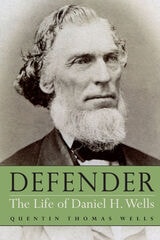
Defender
The Life of Daniel H. WellsQuentin Thomas Wells
Utah State University Press, 2022
Defender is the first and only scholarly biography of Daniel H. Wells, one of the important yet historically neglected leaders among the nineteenth-century Mormons—leaders like Heber C. Kimball, George Q. Cannon, and Jedediah M. Grant. An adult convert to the Mormon faith during the Mormons’ Nauvoo period, Wells developed relationships with men at the highest levels of the church hierarchy, emigrated to Utah with the Mormon pioneers, and served in a series of influential posts in both church and state.
Wells was known especially as a military leader in both Nauvoo and Utah—he led the territorial militia in four Indian conflicts and a confrontation with the US Army (the Utah War). But he was also the territorial attorney general and obtained title to all the land in Salt Lake City from the federal government during his tenure as the mayor of Salt Lake City. He was Second Counselor to Brigham Young in the LDS Church's First Presidency and twice served as president of the Mormon European mission. Among these and other accomplishments, he ran businesses in lumbering, coal mining, manufacturing, and gas production; developed roads, ferries, railroads, and public buildings; and presided over a family of seven wives and thirty-seven children.
Wells witnessed and influenced a wide range of consequential events that shaped the culture, politics, and society of Utah in the latter half of the nineteenth century. Using research from relevant collections, sources in public records, references to Wells in the Joseph Smith papers, other contemporaneous journals and letters, and the writings of Brigham Young, Quentin Thomas Wells has created a serious and significant contribution to Mormon history scholarship.

Defending Nazis in Postwar Czechoslovakia
Life of K. Resler, Defense Councel Ex Officio of K. H. FrankJakub Drápal
Karolinum Press, 2018

Defending the Masses
A Progressive Lawyer's Battles for Free SpeechEric B. Easton
University of Wisconsin Press, 2018
Roe was the principal trial lawyer of the Free Speech League—a precursor of the American Civil Liberties Union. His cases involved such activists as Emma Goldman, Lincoln Steffens, Margaret Sanger, Max Eastman, Upton Sinclair, John Reed, and Eugene Debs, as well as the socialist magazine The Masses and the New York City Teachers Union. A friend of Wisconsin's progressive senator Robert La Follette since their law partnership as young men, Roe defended "Fighting Bob" when the Senate tried to expel him for opposing America's entry into World War I.
In articulating and upholding Americans' fundamental right to free expression against charges of obscenity, libel, espionage, sedition, or conspiracy during turbulent times, Roe was rarely successful in the courts. But his battles illuminate the evolution of free speech doctrine and practice in an era when it was under heavy assault. His greatest victory, including the 1917 decision by Judge Learned Hand in The Masses Publishing Co. v. Patten, is still influential today.

Defending the Master Race
Conservation, Eugenics, and the Legacy of Madison GrantJonathan Spiro
University Press of New England, 2008

Degas at the Gas Station
EssaysThomas Beller
Duke University Press, 2025

Delightfulee
The Life and Music of Lee MorganJeffery S. McMillan
University of Michigan Press, 2008
One of the most individual stylists of his time, trumpeter Lee Morgan began his professional career in Philadelphia at age fifteen. At eighteen, after a short stint with Art Blakey's Jazz Messengers, Morgan joined Dizzy Gillespie's orchestra, where he stayed until the group disbanded in 1958. A return to Blakey brought Morgan new opportunities, including his first successful attempts at composition. But however much his time with Blakey helped to advance his playing and writing, his boss's and his bandmates' destructive drug habits exerted just as strong an influence. Within three years, Morgan would be back home in Philadelphia, strung out on heroin and penniless.
Morgan's return to music in the early to mid-sixties witnessed a tremendous evolution in his playing. Formerly a virtuoso in the model of his idol, Clifford Brown, Morgan brought to his critically acclaimed Blue Note records of the era an emotionally charged, muscular tone, full of poise and control. But it was with the record Sidewinder, recorded in 1963, that Morgan found his greatest fame and commercial success, due to the infectious groove of the title tune. By the time of his death, at thirty-three---murdered in a New York City club by his girlfriend during a gig---Morgan had begun a new phase of his career, experimenting with freer-forms of musical expression.
Jeff McMillan's Delightfulee is the first biography to seriously examine Morgan's vast contributions to jazz, both as a performer and as a composer. Thanks to exclusive access to Lee Morgan's now-deceased brother, McMillan is also able to provide unparalleled insight into Morgan's personal and family life
Jeff McMillan received his master's degree from the Jazz History and Research program at Rutgers-Newark in 2000 and currently works as an archivist for the Metropolitan Opera in New York City.

Dementia Caregivers Share Their Stories
A Support Group in a BookLynda A. Markut
Vanderbilt University Press, 2005
Highlighting the ingenuity and resourcefulness of caregivers, the book brims with inspirational stories, practical advice, and creative approaches to problem-solving. Among the issues addressed are:
Becoming a caregiver, whether for a spouse or parent
Dealing with the personality changes caused by dementia, from anxiety and paranoia to hallucinations and impulsive behavior
Keeping dementia sufferers meaningfully involved in life
Handling the emotions and stresses of caregiving
Seeking help through support groups and other sources, including medical professionals, clergy, and other family members The authors, who have both been caregivers themselves, augment their interviewees' stories with connective commentary and their own personal stories. A useful resource section is included to refer readers to associations and help-lines.
Denial and Repression of Anti-Semitism
Post-Communist Rehabilitation of the Serbian Bishop Nikolaj VelimirovicJovan Byford
Central European University Press, 2008
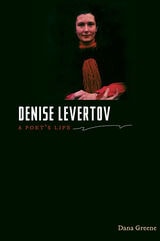
Denise Levertov
A Poet's LifeDana Greene
University of Illinois Press, 2014
Kenneth Rexroth called Denise Levertov (1923–1997) "the most subtly skillful poet of her generation, the most profound, . . . and the most moving." Author of twenty-four volumes of poetry, four books of essays, and several translations, Levertov became a lauded and honored poet. Born in England, she published her first book of poems at age twenty-three, but it was not until she married and came to the United States in 1948 that she found her poetic voice, helped by the likes of William Carlos Williams, Robert Duncan, and Robert Creeley. Shortly before her death in 1997, the woman who claimed no country as home was nominated to be America's poet laureate.
Levertov was the quintessential romantic. She wanted to live vividly, intensely, passionately, and on a grand scale. She wanted the persistence of Cézanne and the depth and generosity of Rilke. Once she acclimated herself to America, the dreamy lyric poetry of her early years gave way to the joy and wonder of ordinary life. By the late 1960s and early 1970s, however, her poems began to engage the issues of her times. Vehement and strident, her poetry of protest was both acclaimed and criticized. The end of both the Vietnam War and her marriage left her mentally fatigued and emotionally fragile, but gradually, over the span of a decade, she emerged with new energy. The crystalline and luminous poetry of her last years stands as final witness to a lifetime of searching for the mystery embedded in life itself. Through all the vagaries of life and art, her response was that of a "primary wonder."
In this illuminating biography, Dana Greene examines Levertov's interviews, essays, and self-revelatory poetry to discern the conflict and torment she both endured and created in her attempts to deal with her own psyche, her relationships with family, friends, lovers, colleagues, and the times in which she lived. Denise Levertov: A Poet's Life is the first complete biography of Levertov, a woman who claimed she did not want a biography, insisting that it was her work that she hoped would endure. And yet she confessed that her poetry in its various forms--lyric, political, natural, and religious--derived from her life experience. Although a substantial body of criticism has established Levertov as a major poet of the later twentieth century, this volume represents the first attempt to set her poetry within the framework of her often tumultuous life.

Dennis Brain
A Life in MusicStephen Gamble
University of North Texas Press, 2011

Depositions
Roberto Burle Marx and Public Landscapes under DictatorshipBy Catherine Seavitt Nordenson
University of Texas Press, 2018
Recipient of 2019 John Brinckerhoff Jackson Book Prize, Foundation for Landscape Studies
2021 On the Brinck Book Award Winner
“Burle Marx created a new and modern grammar for international landscape design.”
—Lauro Cavalcanti, quoted in the New York Times
“The real creator of the modern garden.”
—American Institute of Architects
Presenting the first English translation of Burle Marx’s “depositions,” this volume highlights the environmental advocacy of a preeminent Brazilian landscape architect who advised and challenged the country’s military dictatorship.
Roberto Burle Marx (1909–1994) is internationally known as one of the preeminent modernist landscape architects. He designed renowned public landscapes in Brazil, beginning with small plazas in Recife in the 1930s and culminating with large public parks in the early 1960s, most significantly the Parque do Flamengo in Rio de Janeiro. Depositions explores a pivotal moment in Burle Marx’s career—the years in which he served as a member of the Federal Cultural Council created by the military dictatorship in the mid-1960s. Despite the inherent conflict and risk in working with the military regime, Burle Marx boldly used his position to advocate for the protection of the unique Brazilian landscape, becoming a prophetic voice of caution against the regime’s policies of rapid development and resource exploitation.
Depositions presents the first English translation of eighteen environmental position pieces that Burle Marx wrote for the journal Cultura , a publication of the Brazilian Ministry of Education and Culture, from 1967 through 1973. Catherine Seavitt Nordenson introduces and contextualizes the depositions by analyzing their historical and political contexts, as well as by presenting pertinent examples of Burle Marx’s earlier public projects, which enables a comprehensive reading of the texts. Addressing deforestation, the establishment of national parks, the place of commemorative sculpture, and the unique history of the Brazilian cultural landscape, Depositions offers new insight into Burle Marx’s outstanding landscape oeuvre and elucidates his transition from prolific designer to prescient counselor.

Derzhavin
A BiographyVladislav Khodasevich, Translated and with an introduction by Angela Brintlinger
University of Wisconsin Press, 2007
“Khodasevich’s light narrative touch (as translated by Brintlinger) lends a novelistic quality to the biography, making it a genuine tour de force. All students and scholars – of history, literature, poetry, biography – will find something of interest here.”—Choice

Desert Birthright
A Midwife's MemoirLori Wrankle
University of Utah Press, 2025
Lori Wrankle was sixteen when she helped deliver her first baby. “I witnessed the entire universe unfold at my feet,” she writes in Desert Birthright. Later, working as a hospital doula, Wrankle observed firsthand the suffering inflicted upon birthing women by male-dominated Western childbirth practices, from casual racism to unnecessary and nonconsensual procedures, including the dreaded “husband stitch.” After a traumatic labor and delivery of her own, she decided to take back woman-centered childbirth and start a homebirth midwifery practice.
Desert Birthright traverses twenty-five years of midwifery, often in fundamentalist polygamist circles, weaving together birth stories with childhood memories as Wrankle grapples with her shifting Mormon faith. Her poetic voice shines—a placenta becomes the tree of life, the folds in a baby’s arm layers of sand in the desert. Desert Birthright is a deeply personal story of life, death, and modern womanhood in the rural Southwest, and of one midwife’s journey of faith, self-discovery, and liberation in the face of adversity.
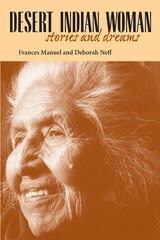
Desert Indian Woman
Stories and DreamsFrances Manuel and Deborah Neff
University of Arizona Press, 2001
Basket weaver, storyteller, and tribal elder, Frances Manuel is a living preserver of Tohono O’odham culture. Speaking in her own words from the heart of the Arizona desert, she now shares the story of her life. She tells of O’odham culture and society, and of the fortunes and misfortunes of Native Americans in the southwestern borderlands over the past century.
In Desert Indian Woman, Frances relates her life and her stories with the wit, humor, and insight that have endeared her to family and friends. She tells of her early childhood growing up in a mesquite brush house, her training in tribal traditions, her acquaintance with Mexican ways, and her education in an American boarding school. Through her recollections of births and deaths, heartache and happiness, we learn of her family’s migration from the reservation to the barrios and back again. In the details of her everyday life, we see how Frances has navigated between O’odham and American societies, always keeping her grandparents’ traditional teachings as her compass.
It is extraordinary to hear from a Native American woman like Frances, in her own words and her own point of view, to enter the complex and sensitive aspects of her life experience, her sorrows, and her dreams. We also become privy to her continuing search for her identity across the border, and the ways in which Frances and Deborah have attempted to make sense of their friendship over twenty-odd years. Throughout the book, Deborah captures the rhythms of Frances’s narrative style, conveying the connectedness of her dreams, songs, and legends with everyday life, bringing images and people from faraway times and places into the present.
Deborah Neff brings a breadth of experience in anthropology and Southwest Native American cultures to the task of placing Frances Manuel’s life in its broader historical context, illuminating how history works itself out in people’s everyday lives. Desert Indian Woman is the story of an individual life lived well and a major contribution to the understanding of history from a Native American point of view.

Desert Mementos
Stories of Iraq and NevadaCaleb S. Cage
University of Nevada Press, 2017
Cage captures similarities in the respective desert landscapes of both Iraq and Nevada, but it is not just a study in contrasting landscapes. The inter-connected stories explore similarities and differences in human needs from the perspectives of vastly different cultures. Specifically, the stories deftly capture the overlap in the respective desert landscapes of each region, the contrasting cultures and worldviews, and the common need for hope. Taken together, the stories represent the arc of a year-long deployment by young soldiers. Cage’s stories are bound together by the soldier’s searing experiences in the desert, bookended by leaving and returning home to Nevada, which in many ways can be just as disorienting as patrolling the Iraq desert.

Desert Rose
The Life and Legacy of Coretta Scott KingEdythe Scott Bagley with Joe Hilley
University of Alabama Press, 2012
An intimate biography illuminating the life, leadership, and legacy of Coretta Scott King within the American Civil Rights Movement.
Coretta Scott King—noted author, human rights activist, and wife and partner of famed Civil Rights Movement leader Martin Luther King Jr.—grew up in the rural Alabama Black Belt with her older sister, Edythe Scott Bagley. Bagley chronicles the sisters’ early education together at the Crossroads School and later at the progressive Lincoln School in Marion. She describes Coretta’s burgeoning talent for singing and her devotion to musical studies, and the sisters’ experiences matriculating at Antioch College, an all-white college far from the rural South. Bagley provides vivid insights into Coretta’s early passion for racial and economic justice, which lead to her involvement in the Peace Movement and the National Association for the Advancement of Colored People.
As Coretta’s older sister, Edythe shared in almost all of Coretta’s many trials and tribulations. Desert Rose charts Coretta’s hesitance about her romance with Martin Luther King and the prospect of having to sacrifice her dream of a career in music to become a minister’s wife. Ultimately, Coretta chose to utilize her artistic gifts and singing voice for the Movement through the development and performance of Freedom Concerts. This book also charts Coretta’s own commitment and dedication, in the years that followed King’s death, to the causes of international civil rights, the antiapartheid movement, and the establishment of the King Center in Atlanta and the national King Holiday. Coretta’s devotion to activism, motherhood, and the movement led by her husband, and her courageous assumption of the legacy left in the wake of King’s untimely assassination, are wonderfully detailed in this intimate biography.
Desire to Serve
The Autobiography of Congresswoman Eddie Bernice JohnsonCheryl Wattley
University of North Texas Press, 2024

Detroit Is No Dry Bones
The Eternal City of the Industrial AgeCamilo José Vergara
University of Michigan Press, 2016
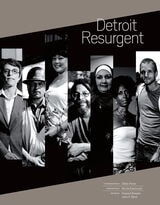
Detroit Resurgent
Howard Bossen
Michigan State University Press, 2014

Devil in Deerskins
My Life with Grey OwlUniversity of Manitoba Press, 2014
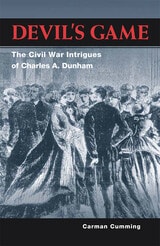
Devil's Game
The Civil War Intrigues of Charles A. DunhamCarman Cumming
University of Illinois Press, 2003
The first book-length study of one of the Civil War's most outlandish and mysterious characters
Devil's Game traces the amazing career of Charles A. Dunham, Civil War spy, forger, journalist, and master of dirty tricks. Writing for a variety of New York papers under alternate names, Dunham routinely faked stories, created new identities, and later boldly cast himself to play those roles. He achieved his greatest infamy when he was called to testify in Washington concerning Abraham Lincoln's assassination. Many parts of Dunham's career remain shadowy, but Cumming offers the first detailed tour of Dunham's convoluted, high-stakes, international deceits, including his effort to sell Lincoln on plans for a raid to capture Jefferson Davis.
Exhaustively researched and unprecedented in depth, this carefully crafted assessment of Dunham's motives, personality, and the complex effects of his schemes changes assumptions about covert operations during the Civil War.
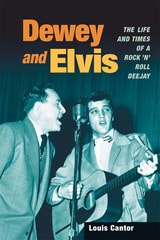
Dewey and Elvis
The Life and Times of a Rock 'n' Roll DeejayLouis Cantor
University of Illinois Press, 2010
Louis Cantor illuminates Phillips's role in turning a huge white audience on to previously forbidden race music. Phillips's zeal for rhythm and blues legitimized the sound and set the stage for both Elvis's subsequent success and the rock 'n' roll revolution of the 1950s. Using personal interviews, documentary sources, and oral history collections, Cantor presents a personal view of the disc jockey while restoring Phillips's place as an essential figure in rock 'n' roll history.
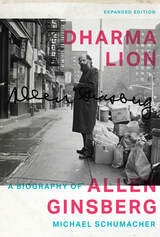
Dharma Lion
A Biography of Allen GinsbergMichael Schumacher
University of Minnesota Press, 2016
With the sweep of an epic novel, Michael Schumacher tells the story of Allen Ginsberg and his times, with fascinating portraits of Jack Kerouac, Neal Cassady, and William Burroughs, among others, along with many rarely seen photographs.
Dialogue with Death
The Journal of a Prisoner of the Fascists in the Spanish Civil WarArthur Koestler
University of Chicago Press, 2011
In 1937 during the Spanish Civil War, Arthur Koestler, a German exile writing for a British newspaper, was arrested by Nationalist forces in Málaga. He was then sentenced to execution and spent every day awaiting death—only to be released three months later under pressure from the British government. Out of this experience, Koestler wrote Darkness at Noon, his most acclaimed work in the United States, about a man arrested and executed in a Communist prison.
Dialogue with Death is Koestler’s riveting account of the fall of Málaga to rebel forces, his surreal arrest, and his three months facing death from a prison cell. Despite the harrowing circumstances, Koestler manages to convey the stress of uncertainty, fear, and deprivation of human contact with the keen eye of a reporter.
Dialogues
Saint Gregory the Great
Catholic University of America Press, 1959
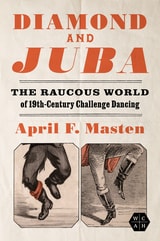
Diamond and Juba
The Raucous World of 19th-Century Challenge DancingApril F. Masten
University of Illinois Press, 2025
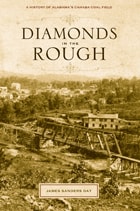
Diamonds in the Rough
A History of Alabama's Cahaba Coal FieldJames Sanders Day
University of Alabama Press, 2013
Winner of the 2014 Clinton Jackson Coley Award for Best Work on Alabama Local History from the Alabama Historical Association