Results by title
1066 books match the query 'Political' and 37 start with e
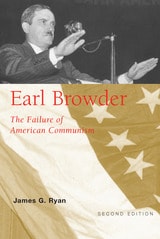
Earl Browder
The Failure of American CommunismJames G. Ryan
University of Alabama Press, 2005
Earl Browder, the preeminent 20th-century Communist party leader in the United States, steered the CPUSA through the critical years of the Great Depression and World War II. A Kansas native and veteran of numerous radical movements, he was peculiarly fitted by circumstance and temperament to head the cause during its heyday.
Serving as a bridge between American Communism’s secret and public worlds, Browder did more than anyone to attempt to explain the Soviet Union’s shifting policies to the American people in a way that would serve the interests of the CPUSA. A proud and loyal follower of Joseph Stalin, Browder nevertheless sought to move the party into the U.S. political mainstream. He used his knowledge of domestic politics to persuade the Communist International to modify Popular Front (1935-1939) tactics for the United States.
Despite his rise in the hierarchy, he possessed an independent streak that ultimately proved his undoing. Imprisonment as he neared age 50 left permanent psychological damage. After being released with the approval of President Franklin D. Roosevelt, Browder lost his perspective and began entertaining delusions of grandeur about his status in American politics and in the world Communist movement. Still, he could never quite bring legitimacy to the CPUSA because he lacked the vision and moral courage to separate himself totally from the Soviet Union. Ryan concludes that Browder was not so much insincere as deluded. His failure contributed to the demise of the popularity of the Communist party in the United States.
In preparation for this book, the author consulted the Browder Papers at Syracuse University and U.S. Government documents, particularly the F.B.I. files. In addition, he traveled to Russia for research in the Soviet Archives when recently opened to Western scholars, including the records of the former Communist International and a collection of American Communist party files, 1919-1944, shipped secretly to Moscow long ago. Indeed, until 1992, the existence of the CPUSA collection was only rumored.
Earthly Plenitudes
A Study on Sovereignty and LaborBruno Gullì
Temple University Press, 2016
Gullì first reviews approaches to sovereignty by philosophers as varied as Gottfried Leibniz and Georges Bataille, and then looks at concrete examples where the alliance of sovereignty and capital cracks under the potency of living labor. He examines contingent academic labor as an example of the super-exploitation of labor, which has become a global phenomenon, and as such, a clear threat to the sovereign logic of capital. Gullì also looks at disability to assert that a new measure of humanity can only be found outside the schemes of sovereignty, productivity, efficiency, and independence, through care and caring for others, in solidarity and interdependence.
Eccentric Culture
A Theory of Western CivilizationRémi Brague
St. Augustine's Press, 2009
Echoes of the Marseillaise
Two Centuries Look Back on the French RevolutionHobsbawm, Eric
Rutgers University Press, 2019
E.J. Hobsbawm’s classic historiographic study—written at the very moment when a new set of revolutions swept through the Eastern Bloc and brought down the Iron Curtain—explores how the French Revolution was perceived over the following two centuries. He traces how the French Revolution became integral to nineteenth-century political discourse, when everyone from bourgeois liberals to radical socialists cited these historical events, even as they disagreed on what their meaning. And he considers why references to the French Revolution continued to inflame passions into the twentieth century, as a rhetorical touchstone for communist revolutionaries and as a boogeyman for social conservatives.
Echoes of the Marseillaise is a stimulating examination of how the same events have been reimagined by different generations and factions to serve various political agendas. It will give readers a new appreciation for how the French Revolution not only made history, but also shaped our fundamental notions about history itself.
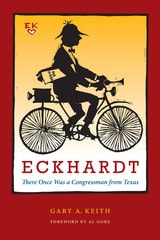
Eckhardt
There Once Was a Congressman from TexasBy Gary A. Keith
University of Texas Press, 2007
Runner-up, Violet Crown Award, Writer's League of Texas, 2008
Renowned for his "brilliant legislative mind" and political oratory—as well as for bicycling to Congress in a rumpled white linen suit and bow tie—U.S. Congressman Bob Eckhardt was a force to reckon with in Texas and national politics from the 1940s until 1980. A liberal Democrat who successfully championed progressive causes, from workers' rights to consumer protection to environmental preservation and energy conservation, Eckhardt won the respect of opponents as well as allies. Columnist Jack Anderson praised him as one of the most effective members of Congress, where Eckhardt was a national leader and mentor to younger congressmen such as Al Gore.
In this biography of Robert Christian Eckhardt (1913-2001), Gary A. Keith tells the story of Eckhardt's colorful life and career within the context of the changing political landscape of Texas and the rise of the New Right and the two-party state. He begins with Eckhardt's German-American family heritage and then traces his progression from labor lawyer, political organizer, and cofounder of the progressive Texas Observer magazine to Texas state legislator and U.S. congressman. Keith describes many of Eckhardt's legislative battles and victories, including the passage of the Open Beaches Act and the creation of the Big Thicket National Preserve, the struggle to limit presidential war-making ability through the War Powers Act, and the hard fight to shape President Carter's energy policy, as well as Eckhardt's work in Texas to tax the oil and gas industry.
The only thorough recounting of the life of a memorable, important, and flamboyant man, Eckhardt also recalls the last great era of progressive politics in the twentieth century and the key players who strove to make Texas and the United States a more just, inclusive society.
Economy and the Future
A Crisis of FaithJean-Pierre Dupuy
Michigan State University Press, 2014
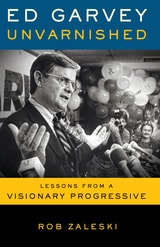
Ed Garvey Unvarnished
Lessons from a Visionary ProgressiveRob Zaleski
University of Wisconsin Press, 2019
Shortly before he died, Garvey expressed his views on everything in a series of detailed, no-holds-barred interviews with journalist Rob Zaleski. In his trademark witty, blunt, and often abrasive style, he offered his impressions of the political climate, worries about the environment, and Act 10 protests on Capitol Square. Garvey's candor during these conversations provides deeper insight into the personal highs and lows he experienced over his rich life. Diehard followers will fondly remember his energetic campaigns, but they may be surprised to learn of his long-simmering disappointment after those losses. Ever timely and meaningful, Garvey's words offer a path for how the Democratic Party, both within Wisconsin and nationally, can regain its soul.
Edges of the State
John Protevi
University of Minnesota Press, 2019
Using philosophical and scientific work to engage the perennial question of human nature
This book takes a look at the formation, and edges, of states: their breakdowns and attempts to repair them, and their encounters with non-state peoples. It draws upon anthropology, political philosophy, neuroscience, evolutionary biology, child developmental psychology, and other fields to look at states as projects of constructing “bodies politic,” where the civic and the somatic intersect. John Protevi asserts that humans are predisposed to “prosociality,” or being emotionally invested in social partners and patterns. With readings from Jean-Jacques Rousseau and James C. Scott; a critique of the assumption of widespread pre-state warfare as a selection pressure for the evolution of human prosociality and altruism; and an examination of the different “economies of violence” of state and non-state societies, Edges of the State sketches a notion of prosocial human nature and its attendant normative maxims.
Forerunners: Ideas First
Short books of thought-in-process scholarship, where intense analysis, questioning, and speculation take the lead
Edward Stanly
Whiggerys Tarheel ConquerNorman Brown
University of Alabama Press, 1974
A Southern Whig, a Unionist firebrand—Edward Stanly’s fight for principle in a fractured nation.
This biography of Edward Stanly relates the major political events of his life: his emergence, while still in his twenties, as a fiery and controversial leader of the Whig Party in North Carolina, his role as one of the ablest champions of Whiggery in the United States House of Representatives, 1837–1843; his candidacy for governor of California on the Republican ticket in 1857; his appointment by President Abraham Lincoln as military governor of North Carolina in 1862; and his support in California of President Andrew Johnson’s Reconstruction policy.
Raised under the “Ancient Standard of Federalism,” Edward Stanly was a southern nationalist in the tradition of the two great Virginia Federalists, George Washington and John Marshall. An outspoken opponent of the nullification and secession doctrines of party of section in national politics.
Effective Social Science
Eight Cases in Economics, Political Science, and SociologyBernard Barber
Russell Sage Foundation, 1987
Elected American
From Red China to Blue MarylandLily Qi
Temple University Press, 2026
“Only in America can you run for office and get elected by people who can’t even pronounce your name.”—Lily Qi
Thirty years after her solo journey to America, Chinese-born Lily Qi became a Maryland state delegate. It was a gratifying moment she did not take for granted. Qi had overcome a viral WeChat disinformation campaign from her Chinese community and was met with skepticism from the Democratic establishment before being elected.
Elected American tells the inspirational story of Qi’s dreams, setbacks, and achievements with candor and humility. Growing up in Mao’s Shanghai, when “politics meant danger,” she never imagined running for public office. However, living in America, Qi came to see political participation as a missed opportunity for immigrants. As she campaigned to energize her cultural base, Qi realized she had to teach first-time voters how to make their votes count in a system not designed for them.
As the only U.S. state legislator who lived through China’s Cultural Revolution, Qi brings a rare cross-system perspective to American politics and modern-day Asian American identity. Elected American is a political memoir and an immigrant story that emphasizes that democracy doesn’t wait on the sidelines—it favors those who participate.
Elemental Powers
Ernst Jünger, Critical Theory, and the Idea of Natural HistoryAndrew McCann
Northwestern University Press, 2027
Examining the conflicted legacy of Ernst Jünger’s thought and its relationship to critical theory
In the 1920s, Ernst Jünger’s journalistic advocacy of a militaristic, antidemocratic nationalism played a central role in the rise of German fascism. At the same time, Jünger developed an increasingly acute account of how the mobilizing force of industrial technology embodied a will to power that, on the one hand, anticipated an authoritarian state but, on the other, assumed a planetary perspective that made national identifications redundant. What he called the Gestalt of the worker expresses the “elemental powers” that, he believed, mark the limits of Enlightenment conceptions of historical progress.
Today, Jünger appears in intellectual history primarily as a representative of protofascist decisionism, reactionary modernism, or the so-called conservative revolution. Andrew McCann puts these aspects of Jünger’s early work into dialogue with the posthistorical orientation that he developed after the Second World War, in order to offer a fresh reading that demonstrates how Jünger’s obsession with the transience of cultural and historical forms displays deep structural affinities with the idea of natural history developed by Walter Benjamin and Theodor Adorno. By tracing this thread in intellectual history, McCann charts the currents of influence and confluence between what are usually understood as sharply polarized political positions and the conceptual postures that accompany them: immanence and transcendence, reason and myth, class and nation, relations of production and the forces of nature.
Elementary Aspects of the Political
Histories from the Global SouthPrathama Banerjee
Duke University Press, 2020

Ellen Wilkinson
From Red Suffragist to Government MinisterPaula Bartley
Pluto Press, 2014
Ellen Wilkinson was a key radical figure in the 20th century British socialist and feminist movement, a woman of passionate energy who was involved in most of the major struggles of her time.
Born in October 1891 into a working-class textile family, Wilkinson was involved in women’s suffrage, helped found the British Communist Party, led the Labour Party’s anti-fascist campaign, headed the iconic Jarrow Crusade and was the first female Minister of Education.
In this lively and engaging biography, Paula Bartley charts the political life of this extraordinary campaigner who went from street agitator to government minister whilst keeping her principles intact.
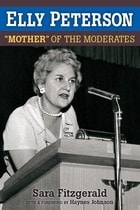
Elly Peterson
"Mother" of the ModeratesSara Fitzgerald
University of Michigan Press, 2012
"A magisterially written, well-researched, informative, and entertaining biography of a woman who helped throw open the doors to broader participation and power for women in the Republican Party and American politics."
---Dave Dempsey, author of William G. Milliken: Michigan's Passionate Moderate
"Elly Peterson will be a text to which historians and researchers turn for insight into the yin and yang of mainstream politics in the mid-century."
---Patricia Sullivan, past president, Journalism and Women Symposium
"This lively portrait of a leading woman in the Republican Party between 1952 and 1982 also charts the party's shift to the right after 1964, revealingly viewed through the eyes of liberal Republican women. Intensively researched with ethnographic attention to the subtleties of political culture, Fitzgerald's book is essential reading for anyone interested in how the Republican Party changed during the turbulent decades after 1960 and how women and women's issues shaped those changes."
---Kathryn Kish Sklar, Distinguished Professor of History, State University of New York, Binghamton
"Sara Fitzgerald tells Peterson's story in this superb and timely biography. It carries a message that deserves the widest audience as the nation struggles to find needed consensus on critical issues amid poisonous political partisanship that has made it increasingly difficult for public officials to bridge their differences. I hope that every American reads it."
---Pulitzer Prize winner Haynes Johnson, from the Foreword
"To understand the quest for equal rights in America you really need to meet those women who were active at the time of transition. In this gripping biography we meet one woman who entered a male dominated world and triumphed."
---Francis X. Blouin Jr., Director, Bentley Historical Library
"Sara Fitzgerald's writing is as intelligent as it is entertaining."
---Best-selling novelist Diane Chamberlain
Elly Peterson was one of the highest ranking women in the Republican Party. In 1964 she ran for a Michigan seat in the U.S. Senate and became the first woman to serve as chair of the Michigan Republican Party. During the 1960s she grew disenchanted with the increasing conservatism of her party, united with other feminists to push for the Equal Rights Amendment and reproductive choice, battled Phyllis Schlafly to prevent her from gaining control of the National Federation of Republican Women, and became an independent.
Elly Peterson's story is a missing chapter in the political history of Michigan, as well as the United States. This new biography, written by Sara Fitzgerald (a Michigan native and former Washington Post editor), finally gives full credit to one of the first female political leaders in this country.
When Peterson resigned in 1970 as assistant chairman of the Republican National Committee, David Broder of the Washington Post wrote that "her abilities would have earned her the national chairmanship, were it not for the unwritten sex barrier both parties have erected around that job."
Ends in Sight
Marx/Fukuyama/Hobsbawm/AndersonGregory Elliott
Pluto Press, 2008
Gregory Elliott argues that Marx is central to all three accounts and that, along with the Manifesto, they form a quartet of analyses of the results and prospects of capitalism and socialism, which are of enduring significance for the Left.
Senses of an Ending provides a readable survey of key historical and political thinkers that will appeal to anyone interested in modern political thought.
Enemies of All Humankind
Fictions of Legitimate ViolenceSonja Schillings
Dartmouth College Press, 2016
Enigmas of Sacrifice
A Critique of Joseph M. Plunkett and the Dublin Insurrection of 1916W. J. Mc Cormack
Michigan State University Press, 2016
Equaliberty
Political EssaysÉtienne Balibar
Duke University Press, 2014
Equality of Permission
The Politics of Feasible LiberalismDeirdre Nansen McCloskey
University of Chicago Press, 2026
From a revered public intellectual, an essential argument for the political preconditions of a liberal society.
Liberalism has always suffered from messaging challenges. It simultaneously implies a pursuit of individual liberty and social equality, two projects often regarded as at odds. Or: Liberal means the opposite of conservative. Except when it doesn’t. The list goes on.
Liberal bard Deirdre Nansen McCloskey understands these rhetorical troubles. Equality of Permission is her stirring and career-defining intervention on this essentially contested yet critical topic—a forceful case for liberalism as our best hope, and an essential vision of the political conditions necessary for its survival. McCloskey prescribes a liberalism built around liberty from the bottom up: “equality before the law and equality of political and economic permissions,” lightly administered.
The state, McCloskey argues, is increasingly the source of our discontents—an illiberal institution, hindered by a quixotic fixation on pursuing equality of wealth or opportunity. Equality of Permission evangelizes for a better, and earlier, version of liberalism—that of John Locke, Adam Smith, Mary Wollstonecraft, and Henry David Thoreau—as against a top-down quest for an unattainable utopia. McCloskey shows that statism in pursuit of a chimerical general will, even when well-intentioned, leads to tyranny.
Brimming with energy and erudition, drawing on wisdoms from Alexis de Tocqueville to Mae West, Equality of Permission is McCloskey at the peak of her powers—brilliant, lacerating, garrulous, funny, worldly, and warm. Amid intense debate over the use and abuse of government institutions, McCloskey shares her singular vision for a true democracy, one grounded in respect and conducive to universal human flourishing.
Equality of Permission
The Politics of Feasible LiberalismDeirdre Nansen McCloskey
University of Chicago Press, 2026
From a revered public intellectual, an essential argument for the political preconditions of a liberal society.
Liberalism has always suffered from messaging challenges. It simultaneously implies a pursuit of individual liberty and social equality, two projects often regarded as at odds. Or: Liberal means the opposite of conservative. Except when it doesn’t. The list goes on.
Liberal bard Deirdre Nansen McCloskey understands these rhetorical troubles. Equality of Permission is her stirring and career-defining intervention on this essentially contested yet critical topic—a forceful case for liberalism as our best hope, and an essential vision of the political conditions necessary for its survival. McCloskey prescribes a liberalism built around liberty from the bottom up: “equality before the law and equality of political and economic permissions,” lightly administered.
The state, McCloskey argues, is increasingly the source of our discontents—an illiberal institution, hindered by a quixotic fixation on pursuing equality of wealth or opportunity. Equality of Permission evangelizes for a better, and earlier, version of liberalism—that of John Locke, Adam Smith, Mary Wollstonecraft, and Henry David Thoreau—as against a top-down quest for an unattainable utopia. McCloskey shows that statism in pursuit of a chimerical general will, even when well-intentioned, leads to tyranny.
Brimming with energy and erudition, drawing on wisdoms from Alexis de Tocqueville to Mae West, Equality of Permission is McCloskey at the peak of her powers—brilliant, lacerating, garrulous, funny, worldly, and warm. Amid intense debate over the use and abuse of government institutions, McCloskey shares her singular vision for a true democracy, one grounded in respect and conducive to universal human flourishing.
Eric Voegelin and the Continental Tradition
Explorations in Modern Political ThoughtEdited by Lee Trepanier & Steven F. McGuire
University of Missouri Press, 2011
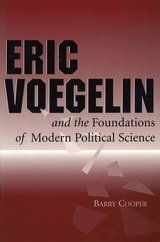
Eric Voegelin and the Foundations of Modern Political Science
Barry Cooper
University of Missouri Press, 1999
This important new work is a major analysis of the foundation of Eric Voegelin's political science. Barry Cooper maintains that the writings Voegelin undertook in the 1940s provide the groundwork for the brilliant book that is one of his best known, The New Science of Politics. At the time of that book's publication, however, few were aware of the enormous knowledge and accomplished scholarship that lay behind its illuminating, although sometimes baffling, formulations.
By focusing on several of the key chapters in Voegelin's eight- volume History of Political Ideas, especially the studies of Bodin, Vico, and Schelling, Cooper shows how those studies provide the basis for Voegelin's thought. Investigating Voegelin's study of Oriental influences on Western political "ideas," especially Mongol constitutional law, and his study of Toynbee, Cooper seeks to demonstrate the vast range of materials Voegelin used.
Cooper contends that, as with other great thinkers, political crisis, specifically the world war of 1939-1945, stimulated Voegelin's intellectual and spiritual achievement. He provides an analysis of Voegelin's immediate concern with the course of World War II, his ability to understand those dramatic events in a large context, and his ability to provide an insightful account of the causes, the significance, and the consequences of the spiritual and political disorder that was evident all around him.
In Eric Voegelin and the Foundations of Modern Political Science, Cooper makes the connection between Voegelin's political writings of the 1940s and the meditative interpretations that began to appear with the publication of Anamnesis and with the later volumes of Order and History much more intelligible than does any existing discussion of Voegelin. Scholars in intellectual history and political science will benefit enormously from this valuable new addition to Voegelin studies.
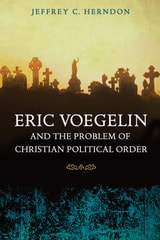
Eric Voegelin and the Problem of Christian Political Order
Jeffrey C. Herndon
University of Missouri Press, 2007
Although some critics of Eric Voegelin’s later work have faulted his failure to deal with the historical Jesus and to address the implications of Christianity for social and political life, the recent publication of Voegelin’s History of Political Ideas has allowed a more complete assessment of his position regarding the Christian political order. This book addresses that criticism through an analysis of Voegelin’s early work.
In Eric Voegelin and the Problem of Christian Political Order, Jeffrey C. Herndon analyzes the development of Voegelin’s thought regarding the origins of Christianity in the person of Jesus, the development of the church in the works of Paul, and the relationship between an immanent institutional order symbolizing the divine presence and the struggle for social and political order. Focusing on the tension between a spiritual phenomenon based on Pauline faith and the institutionalization of that experience in the church, Herndon offers one of the first examinations of the relationship of the History of Political Ideas to Voegelin’s larger body of work.
In his wide-ranging study, Herndon explores Voegelin’s examination of the problem of Christian political order from the inception of Christianity through the Great Reformation. He also presents a clarification of Voegelin’s theory of civilizational foundation and of Voegelin’s philosophy of history with regard to Christianity and Western political order.
Herndon addresses not only the nagging problem in Voegelin scholarship regarding his relationship with the historical Jesus but also the “Pauline compromises with the world” that enabled Christianity to become the instrument by which the West was civilized. He also shows that Voegelin’s interpretation of the historical pressures released by the Great Reformation is important to an understanding of his later work regarding the negative effect of Christian symbols in the creation of ideological disorder.
Eric Voegelin and the Problem of Christian Political Order clarifies issues in Voegelin studies regarding the intersection between political theory and Christian concerns, addressing the relation of religious experience to the public sphere of political life in the West and helping to explain Voegelin’s contention that the death of the spirit is the price of progress. It offers scholars a perspective heretofore lacking in Voegelin scholarship and a clearer view of Voegelin’s understanding of the Christian dispensation and its influence on the course of Western development, history, and philosophy.
Eric Voegelin's Dialogue with the Postmoderns
Searching for FoundationsEdited & Intro by Peter A. Petrakis & Cecil L. Eubanks
University of Missouri Press, 2004
This collection of essays endeavors to generate a dialogue between Eric Voegelin and other prominent twentieth-century thinkers and explore some of the more perplexing issues in contemporary political theory. Each essay rests on the underlying question: is it possible or desirable to construct or discover political foundations without resorting to metaphysical or essentialist constructs? The introduction focuses on the two nineteenth-century thinkers, Nietzsche and Husserl, who have framed the debate about modernity and postmodernity; thereafter, the book examines Voegelin's ideas as compared to those of other twentieth-century thinkers.
Discussed within the volume are Levinas and the precedence of ethics, Ricoeur's theory of narrative representation, Deleuze and the philosophy of immanence, Voegelin's relationship to a speech- dimension theory of human behavior, and Patocka's theory of pre- metaphysical transcendence in Socrates. What will impress scholars most about this collection is the provocative dialogue created between Voegelin and other major thinkers of postmodernism that addresses the issue of establishing foundations without foundationalism.
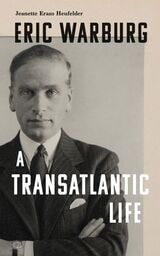
Eric Warburg
A Transatlantic LifeJeanette Erazo Heufelder
Haus Publishing, 2025
In Eric Warburg, Jeanette Erazo Heufelder tells the story of the nephew of the art historian Aby Warburg, whose world-famous library Eric saved from the Nazis. He was a Jew, a banker, a helper of escapees, an intelligence officer in the US Army, a transatlantic bridge builder, and a Cold Warrior. With the help of the cooperation channels he set up, West German and US social groups were aligned with the West amidst the turmoil of postwar Europe.
The history of the transatlantic partnership has become highly topical; since the Russian invasion of Ukraine on February 24, 2022, it has been invoked in Europe as a key reassurance. Eric Warburg’s life, and that of Aby Warburg’s library, tells the story of Europe's twentieth century, the legacy of which continues to inform and inspire the transatlantic partnership today.
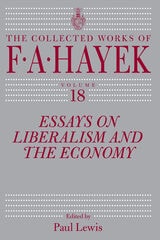
Essays on Liberalism and the Economy, Volume 18
F. A. Hayek
University of Chicago Press, 2022
Across seventeen volumes to date, the University of Chicago Press’s Collected Works of F. A. Hayek series has anthologized the diverse and prolific writings of the Austrian economist synonymous with classical liberalism. Essays on Liberalism and the Economy traces the author’s long and evolving writings on the cluster of beliefs he championed most: liberalism, its core tenets, and how its tradition represents the best hope for Western civilization.
This volume contains material from almost the entire span of Hayek’s career, the earliest from 1931 and the last from 1984. The works were written for a variety of purposes and audiences, and they include—along with conventional academic papers—encyclopedia entries, after-dinner addresses, a lecture for graduate students, a book review, newspaper articles, and letters to the editors of national newspapers. While many are available elsewhere, two have never appeared in print, and two others have not been published in English.
The varied formats collected here are enriched by Hayek’s changing voice at different stages of his life. Some of the pieces resonate as high-minded and noble; some are meant as cuts to “intellectuals” (a pejorative term when used by Hayek) like Keynes and Galbraith. All serve to distill important threads of his worldview.
Ethical Issues for a New Millennium
Edited by John Howie
Southern Illinois University Press, 2002
Modern advances in science and medicine bring with them an array of complex ethical dilemmas. In Ethical Issues for a New Millennium editor John Howie addresses contemporary ethical problems with eight essays from top thinkers in the field. This collection offers new and comprehensive overviews of some very tough ethical issues that will remain foremost in our minds in the years ahead. Each essay is written by a recognized authority within his or her specific field, and brings to light ethical questions rooted in ongoing philosophical debates in arenas such as human rights, the welfare state, women’s rights, genetic and gender equality, genetic equity, cloning, organ transplants, environmental ethics, insurrectionist ethics, and the erosion of moral sensibility.
These lectures where originally presented at Southern Illinois University as part of the Wayne Leys Memorial Lectures series. This collection represents the fourth volume in the series.
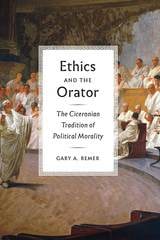
Ethics and the Orator
The Ciceronian Tradition of Political MoralityGary A. Remer
University of Chicago Press, 2017
Remer’s study is distinct from other works on political morality in that it turns to Cicero, not Aristotle, as the progenitor of an ethical rhetorical perspective. Contrary to many, if not most, studies of Cicero since the mid-nineteenth century, which have either attacked him as morally indifferent or have only taken his persuasive ends seriously (setting his moral concerns to the side), Ethics and the Orator demonstrates how Cicero presents his ideal orator as exemplary not only in his ability to persuade, but in his capacity as an ethical person. Remer makes a compelling case that Ciceronian values—balancing the moral and the useful, prudential reasoning, and decorum—are not particular only to the philosopher himself, but are distinctive of a broader Ciceronian rhetorical tradition that runs through the history of Western political thought post-Cicero, including the writings of Quintilian, John of Salisbury, Justus Lipsius, Edmund Burke, the authors of The Federalist, and John Stuart Mill.
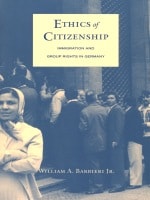
Ethics of Citizenship
Immigration and Group Rights in GermanyWilliam A. Barbieri Jr.
Duke University Press, 1998
Although some of Germany’s foreign workers have gradually attained a degree of social and economic legitimacy, Barbieri explains how they remain effectively excluded from true German citizenship. Describing how this exclusion has occurred and assessing current attitudes toward political membership in Germany, he argues for a just and democratic policy toward the tax-paying, migrant worker minority, one that would combine the extension of the individual rights of citizenship with the establishment of certain group rights. Through a dissection of ongoing public “membership debates” over issues such as suffrage, dual citizenship, and immigration and refugee policy, Barbieri identifies a range of competing responses to the question of who “belongs” in Germany. After critiquing these views, he proposes an alternative ethic of membership rooted in an account of domination and human rights that seeks to balance individual and group rights within the context of a commitment to democracy and equal citizenship.
Indispensable for scholars of German studies, Ethics of Citizenship also raises questions that will attract moral philosophers, constitutional scholars, and those interested in the continuing, global problems associated with migration.
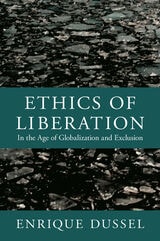
Ethics of Liberation
In the Age of Globalization and ExclusionEnrique Dussel
Duke University Press, 2012
Throughout his career, Dussel has sought to open a space for articulating new possibilities for humanity out of, and in light of, the suffering, dignity, and creative drive of those who have been excluded from Western Modernity and neoliberal rationalism. Grounded in engagement with the oppressed, his thinking has figured prominently in philosophy, political theory, and liberation movements around the world.
In Ethics of Liberation, Dussel provides a comprehensive world history of ethics, demonstrating that our most fundamental moral and ethical traditions did not emerge in ancient Greece and develop through modern European and North American thought. The obscured and ignored origins of Modernity lie outside the Western tradition. Ethics of Liberation is a monumental rethinking of the history, origins, and aims of ethics. It is a critical reorientation of ethical theory.
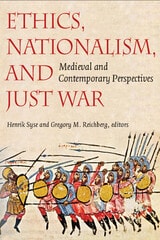
Ethics, Nationalism, and Just War
Medieval and Contemporary PerspectivesHenrik Syse
Catholic University of America Press, 2007
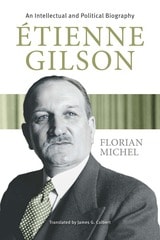
Etienne Gilson
An Intellectual and Political BiographyFlorian Michel
Catholic University of America Press, 2023

Everything is Police
Tia Trafford
University of Minnesota Press, 2024
How institutional and interpersonal policing have been central to worldmaking
Policing is constitutive of colonial modernity: normalizing, internalizing, and legalizing anti-Black violence as the ongoing condition for white life and freedom. The result, Tia Trafford argues here, is a situation where we cannot practically experience or even imagine worlds free from policing. From the plantation to the prison, global apartheid, and pandemic control, this book examines why and how policing has become the most ingrained, commonsense—and insidious—way of managing our world.
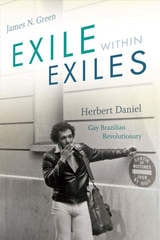
Exile within Exiles
Herbert Daniel, Gay Brazilian RevolutionaryJames N. Green
Duke University Press, 2018
Exploring the World of Human Practice
Readings in and about the Philosophy of Aurel KolnaiZoltán Balázs
Central European University Press, 2005
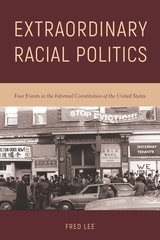
Extraordinary Racial Politics
Four Events in the Informal Constitution of the United StatesFred Lee
Temple University Press, 2018
Extraordinary racial politics rupture out of and reset everyday racial politics. In his cogent book, Fred Lee examines four unusual, episodic, and transformative moments in U.S. history: the 1830s–1840s southeastern Indian removals, the Japanese internment during World War II, the post-war civil rights movement, and the 1960s–1970s racial empowerment movements. Lee helps us connect these extraordinary events to both prior and subsequent everyday conflicts.
Extraordinary Racial Politics brings about an intellectual exchange between ethnic studies, which focuses on quotidian experiences and negotiations, and political theory, which emphasizes historical crises and breaks. In ethnic studies, Lee draws out the extraordinary moments in Michael Omi and Howard Winant’s as well as Charles Mills’s accounts of racial formation. In political theory, Lee considers the strengths and weaknesses of using Carl Schmitt’s and Hannah Arendt’s accounts of public constitution to study racial power.
Lee concludes that extraordinary racial politics represent both the promises of social emancipation and the perils of state power. This promise and peril characterizes our contentious racial present.