Results by title
4030 books match the query 'Language Arts & Disciplines' and 134 start with e
Enduring Legacy
Rhetoric and Ritual of the Lost CauseW. Stuart. Towns
University of Alabama Press, 2013
Explores the crucial role of rhetoric and oratory in creating and propagating a “Lost Cause” public memory of the American South
Enduring Legacy explores the vital place of ceremonial oratory in the oral tradition in the South and analyses how rituals such as Confederate Memorial Day, Confederate veteran reunions, and dedication of Confederate monuments have contributed to creating and sustaining a Lost Cause paradigm for Southern identity. Towns studies in detail secessionist and Civil War speeches and how they laid the groundwork for future generations, including Southern responses to the civil rights movement, and beyond.
The Lost Cause orators that came after the Civil War, Towns argues, helped to shape a lasting mythology of the brave Confederate martyr, and the Southern positions for why the Confederacy lost and who was to blame. Innumerable words were spent—in commemorative speeches, newspaper editorials, and statehouse oratory—condemning the evils of Reconstruction, redemption, reconciliation, and the new and future South. Towns concludes with an analysis of how Lost Cause myths still influence Southern and national perceptions of the region today, as evidenced in debates over the continued deployment of the Confederate flag and the popularity of Civil War reenactments.
Enemies of Promise
Cyril Connolly
University of Chicago Press, 2008
“Whom the gods wish to destroy,” writes Cyril Connolly, “they first call promising.” First published in 1938 and long out of print, Enemies of Promise, an “inquiry into the problem of how to write a book that lasts ten years,” tests the boundaries of criticism, journalism, and autobiography with the blistering prose that became Connolly’s trademark. Connolly here confronts the evils of domesticity, politics, drink, and advertising as well as novelists such as Joyce, Proust, Hemingway, and Faulkner in essays that remain fresh and penetrating to this day.
“A fine critic, compulsive traveler, and candid autobiographer. . . . [Connolly] lays down the law for all writers who wanted to count. . . . He had imagination and decisive images flashed with the speed of wit in his mind.”—V. S. Pritchett, New York Review of Books
“Anyone who writes, or wants to write, will find something on just about every single page that either endorses a long-held prejudice or outrages, and that makes it a pretty compelling read. . . . You end up muttering back at just about every ornately constructed pensée that Connolly utters, but that’s one of the joys of this book.”—Nick Hornby, The Believer
“A remarkable book.”—Anthony Powell
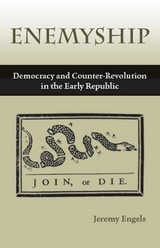
Enemyship
Democracy and Counter-Revolution in the Early RepublicJeremy Engels
Michigan State University Press, 2010
The Declaration of Independence is usually celebrated as a radical document that inspired revolution in the English colonies, in France, and elsewhere. In Enemyship, however, Jeremy Engels views the Declaration as a rhetorical strategy that outlined wildly effective arguments justifying revolution against a colonial authority—and then threatened political stability once independence was finally achieved.
Enemyship examines what happened during the latter years of the Revolutionary War and in the immediate post-Revolutionary period, when the rhetorics and energies of revolution began to seem problematic to many wealthy and powerful Americans.
To mitigate this threat, says Engles, the founders of the United States deployed the rhetorics of what he calls "enemyship," calling upon Americans to unite in opposition to their shared national enemies.
Engaged Library
High-Impact Educational Practices in Academic LibrariesJoan Ruelle
Assoc of College & Research Libraries, 2020
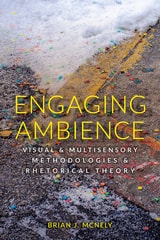
Engaging Ambience
Visual and Multisensory Methodologies and Rhetorical TheoryBrian McNely
Utah State University Press, 2024
By articulating theoretically sound methodologies and methods for the empirical study of rhetoric conceived as originary, immanent, and enveloping, Brian McNely contributes a methodological perspective that furthers new materialist theories of rhetoric. McNely demonstrates how scholars’ emergent theories of rhetoric call for new methodologies that can extend their reach, and in the process, he proposes a new conception of visual rhetoric. Engaging Ambience delineates methodologies and methods that help researchers in rhetoric and writing studies discover the ambient environments that condition and support everyday communication in all its forms.
Engaging Ambiencedetails and demonstrates visual and multisensory methodologies and methods for exploring the wondrous complexity of everyday communication. It will appeal to scholars and students of rhetorical theory, visual and multisensory rhetorics, and composition and writing studies.

Engaging Babies in the Library
Putting Theory into PracticeDebra J. Knoll
American Library Association, 2016
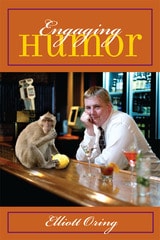
Engaging Humor
Elliott Oring
University of Illinois Press, 2002
Exploring the structure, motives, and meanings of humor in everyday life
In Engaging Humor, Elliott Oring asks essential questions concerning humorous expression in contemporary society, examining how humor works, why it is employed, and what its messages might be. This provocative book is filled with examples of jokes and riddles that reveal humor to be a meaningful--even significant--form of expression.Oring scrutinizes classic Jewish jokes, frontier humor, racist cartoons, blonde jokes, and Internet humor. He provides alternate ways of thinking about humorous expressions by examining their contexts--not just their contents. He also shows how the incongruity and absurdity essential to the production of laughter can serve serious communicative ends.
Engaging Humor examines the thoughts that underlie jokes, the question of racist motivation in ethnic humor, and the use of humor as a commentary on social interaction. The book also explores the relationship between humor and sentimentality and the role of humor in forging national identity. Engaging Humor demonstrates that when analyzed contextually and comparatively, humorous expressions emerge as communications that are startling, intriguing, and profound.
Engaging Museums
Rhetorical Education and Social JusticeLauren E. Obermark
Southern Illinois University Press, 2022
Museums offer an opportunity to reenvision rhetorical education through their address of hard, discomforting histories that challenge visitors to confront traumatic events and work toward a better future. While both museum studies and rhetoric center the audience in their scholarship and practices, this volume engages across and between these disciplines, allowing for a fuller theorization and enactment of rhetorical education’s connections to social justice. Engaging Museums works to fill gaps between the fields of rhetoric and social justice by going beyond classrooms to sites of public memory represented in museums.
This volume presents three distinct, diverse case studies of recently established historical museums taking on the rhetorically complex tasks of representing traumatic events: the National Underground Railroad Freedom Center, the National World War I Museum, and the Oklahoma City National Memorial Museum. Through rhetorical and comparative analysis of data collected from the museums and intersectional transdisciplinary frameworks, each chapter theorizes aspects of rhetoric—namely identification, collectivity, and memory—bringing rhetorical theory more firmly into current conversations surrounding civic engagement and social justice.
Obermark’s weave of voices and perspectives concludes with a critical focus on how memory may serve as a generative pedagogical topos for both public rhetoric and university-based rhetoric and writing classrooms. This book helps scholars, students, and teachers bring what museums do—difficult, complicated pedagogical work representing hard history—back inside the classroom and further into our civic discourse.

Engaging Social Media in China
Platforms, Publics, and ProductionGuobin Yang
Michigan State University Press, 2021
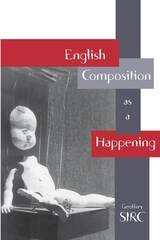
English Composition As A Happening
Geoffrey Sirc
Utah State University Press, 2002
"Contemporary Composition is still inflected by the epistemic turn taken in the 1980s, convincing me that we need to remember what we've forgotten—namely, how impassioned resolves and thrilling discoveries were abandoned and why. I'd like to retrace the road not taken in Composition Studies, to salvage what can still be recovered... I want to inspect the wreckage, in order to show what was the promise of the Happenings for Composition, as well as the huge gray longueur of its pale replacement, Eighties Composition. In so doing, I hope to begin a reconfiguration of our field's pre- and after history."
What happened to the bold, kicky promise of writing instruction in the 1960s? The current conservative trend in composition is analyzed allegorically by Geoffrey Sirc in this book-length homage to Charles Deemer's 1967 article, in which the theories and practices of Happenings artists (multi-disciplinary performance pioneers) were used to invigorate college writing. Sirc takes up Deemer's inquiry, moving through the material and theoretical concerns of such pre- and post-Happenings influences as Duchamp and Pollock, situationists and punks, as well as many of the Happenings artists proper.

English Pronunciation
Excercises in Sound Segments, Intonation, and RhythmRobert Lado and Charles C. Fries
University of Michigan Press, 1954
English Syntax
An IntroductionJon-Bok Kim and Peter Sells
CSLI, 2008
English Verb Classes and Alternations
A Preliminary InvestigationBeth Levin
University of Chicago Press, 1993
The first part of the book sets out alternate ways in which verbs can express their arguments. The second presents classes of verbs that share a kernel of meaning and explores in detail the behavior of each class, drawing on the alternations in the first part. Levin's discussion of each class and alternation includes lists of relevant verbs, illustrative examples, comments on noteworthy properties, and bibliographic references. The result is an original, systematic picture of the organization of the verb inventory.
Easy to use, English Verb Classes and Alternations sets the stage for further explorations of the interface between lexical semantics and syntax. It will prove indispensable for theoretical and computational linguists, psycholinguists, cognitive scientists, lexicographers, and teachers of English as a second language.
English Words Instructor's Manual
R. L. Cherry
University of Arizona Press, 1986
English Words from Latin and Greek Elements
Donald M. Ayers; Revised by Thomas D. Worthen
University of Arizona Press, 1986
Since its first publication in 1965, English Words from Latin and Greek Elements by Donald M. Ayers has empowered thousands of students to expand their vocabulary by uncovering the classical roots embedded in modern English. Now in its enduring second edition, this trusted resource proves that vocabulary is most effectively learned through understanding—not memorization.
Why dedicate an entire book to this approach? Because Ayers goes beyond the basics. Students are introduced to a broad spectrum of Latin and Greek roots, encounter new vocabulary in meaningful context, and reinforce their learning through targeted exercises. This method equips learners with lifelong tools to decode unfamiliar words and deepen their command of English.
Written for English learners—not classical language scholars—this book requires no prior knowledge of Latin or Greek. It’s proven effective across high school and college classrooms, and adaptable for both remedial and accelerated programs.
English across the Curriculum
Voices from around the WorldBruce Morrison
University Press of Colorado, 2021
English in Print from Caxton to Shakespeare to Milton
Valerie Hotchkiss and Fred C. Robinson
University of Illinois Press, 2007
English in Today's Research World
A Writing GuideJohn M. Swales and Christine B. Feak
University of Michigan Press, 2000
In addition to instruction on writing for publication, English in Today's Research World provides needed advice on applications, recommendations, and requests--types of communications that are particularly vulnerable to influences from national cultural expectations and conventions and that, therefore, place the NNS writer at increased disadvantage.
The text is both a reference manual and a course book, so that researchers can continue to use the book after they have completed their formal education. New ESL/EFL teachers can use English in Today's Research World as a reference book for themselves or as a teaching aid in the classroom.

English on the Bonin (Ogasawara) Islands, Volume 81
Daniel Long
Duke University Press, 0
Enhancing Teaching and Learning
A Leadership Guide for School LibrariansJean Donham
American Library Association, 2013
Enhancing Teaching and Learning
A Leadership Guide for School LibrariansJean Donham
American Library Association, 2020
Rapid change calls for informed leadership. The goal of Donham’s text has always been to help school library professionals make a difference in the educational experience and academic attainment of students in their schools. With the addition of new co-author Sims, a junior high school librarian, this newly revised fourth edition rises to the challenge with updates and enhancements that confirm its value as an important resource for both LIS students and current school librarians. Covering all aspects of the school system, including students, curriculum and instruction, principals, district administration, and the community, it demonstrates how to interact and collaborate in order to integrate the school library program throughout these environments. Inside, readers will find
- myriad real-world examples of issues in school librarianship and evidence-based practice;
- discussion of such urgent topics as the educational needs of the iGen (those born between 1995 and 2012), changing reading habits, the influence of the media, and news literacy and other issues related to the proliferation of fake news;
- updates which touch upon the new AASL Standards, inquiry-based learning, assessment, and library program evaluation;
- specific tactics for establishing the library program as an active player in teaching and learning;
- an overview of education-related technology such as course management systems, the virtual library, makerspaces, information presentation and data representation tools like ScreenCast and Google Maps, online home-school communication, and online student safety and privacy; and
- end-of-chapter discussion scenarios that explore opportunities for the practical application of concepts.
Reflecting changes—professional, theoretical, legal, and political—in both the library field and education, this new edition of a groundbreaking school library text will equip readers to be leaders at their schools and in their communities.
Entitled Opinions
Doxa after DigitalityCaddie Alford
University of Alabama Press, 2024
A rigorous redefinition of opinion—doxa—as an emergent, relational force shaped by digital infrastructures and rhetorical entanglements.
Many urgent contemporary issues—from demagoguery to white ethno-nationalism—compel us to consider opinions seriously. Yet while clichés like “he tells it like it is” and newer imperatives such as #BlackLivesMatter seem straightforward, haptics, emoji, and “like” buttons belie unexamined collective assumptions about how opinions in the digital realm function.
Caddie Alford illuminates this function by deploying the ancient Greek term for opinions: doxa. Doxa translates to “opinion,” but the term can also signal seemingness and expectations. Doxa’s capacious meanings reveal opinions to be more than static or monolithic: With doxa, opinions become emergent, dynamic, relational, and pluralistic.
Masterfully combining rhetorical frameworks as well as scholarship on opinions and digital media entanglements, Alford puts opinions into conversation with such case studies as algorithms, infrastructure, digital illiteracy, virality, and activism. She shows how “doxa” reveals gradations of opinions, from more reputable to less reputable. She demonstrates that these gradations are multifaceted and susceptible to interventions.
Entitled Opinions sheds much of the baggage associated with opinions while opening up more fertile pathways of inquiry. In a world that says, “don’t read the comments,” this book reads the comments, taking seriously content that could be easily dismissed otherwise and alchemizing judgments into implications.
Enumerations
Data and Literary StudyAndrew Piper
University of Chicago Press, 2018
In Enumerations, Andrew Piper answers that question across a variety of domains fundamental to the study of literature. He focuses on the elementary particles of literature, from the role of punctuation in poetry, the matter of plot in novels, the study of topoi, and the behavior of characters, to the nature of fictional language and the shape of a poet’s career. How does quantity affect our understanding of these categories? What happens when we look at 3,388,230 punctuation marks, 1.4 billion words, or 650,000 fictional characters? Does this change how we think about poetry, the novel, fictionality, character, the commonplace, or the writer’s career? In the course of answering such questions, Piper introduces readers to the analytical building blocks of computational text analysis and brings them to bear on fundamental concerns of literary scholarship. This book will be essential reading for anyone interested in Digital Humanities and the future of literary study.
Environmental Preservation and the Grey Cliffs Conflict
Negotiating Common Narratives, Values, and EthosKristin D. Pickering
Utah State University Press, 2024
Though environmental degradation and unauthorized use threatened the Grey Cliffs recreational lake area to the point that the Corps considered closure, community members valued it highly and wanted to keep it open. The community near this damaged and crime-ridden area needed help rejuvenating its landscape and image, but the Corps and community were sharply divided on how to maintain this beloved geographic space because of the stakeholders’ different cultural backgrounds and values, as well as the narratives used to discuss them. By co-constructing and aligning narratives, values, and ethos over time—a difficult and lengthy process—the Corps and community succeeded, and Grey Cliffs remains open to all. Focusing on field notes, participant interviews, and analysis of various texts created throughout the conflict, Pickering applies rhetorical analysis and a grounded theory approach to regulation, identity, sustainability, and community values to analyze this communication process.
Illustrating the positive change that can occur when governmental organizations and rural communities work together to construct shared values and engage in a rhetoric of relationship that preserves the environment, Environmental Preservation and the Grey Cliffs Conflict provides key recommendations for resolving environmental conflicts within local communities, especially for those working in technical and professional communication, organizational communication, environmental science, and public policy.

Environments For Student Growth And Development
LibraryLisa Hinchliffe
Assoc of College & Research Libraries, 2012
Envisioning the Framework
Jannette Finch
Assoc of College & Research Libraries, 2021
Envisioning the Framework offers a visual opportunity for thought, discovery, and sense-making of the Framework and its concepts. Seventeen chapters packed with full-color illustrations and tables explore topics including:
- LibGuides creation through conceptual integration with the Framework
- fostering interdisciplinary transference
- the convergence of metaliteracy with the Framework
- teaching multimodalities and data visualization
- mapping a culturally responsive information literacy journal for international students
Twenty-first-century information literacy involves the metaliterate learner, reflects seismic changes in the duties and roles of teaching librarians, requires new partnerships with faculty and instructional designers, and emphasizes continuous assessment practices. Envisioning the Framework can help you use symbols and visuals for deeper understanding of the Framework, to map the Framework with teaching and learning objectives, and to tell a coherent story to students featuring the frames and the Framework.
Epistemic Modality in Standard Spoken Tibetan
Epistemic Verbal Endings and CopulasZuzana Vokurková
Karolinum Press, 2017
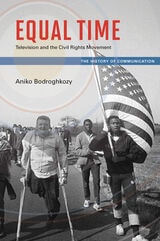
Equal Time
Television and the Civil Rights MovementAniko Bodroghkozy
University of Illinois Press, 2013
Equipping Technical Communicators for Social Justice Work
Theories, Methodologies, and PedagogiesRebecca Walton
Utah State University Press, 2021
For the field of technical and professional communication to maintain its commitment to this work, how social justice intersects with inclusivity through UX, technological, civic, and legal literacies, as well as through community engagement, must be acknowledged. Equipping Technical Communicators for Social Justice Work will be of significance to established scholar-teachers and graduate students, as well as to newcomers to the field.
Contributors: Kehinde Alonge, Alison Cardinal, Erin Brock Carlson, Oriana Gilson, Laura Gonzales, Keith Grant-Davie, Angela Haas, Mark Hannah, Kimberly Harper, Sarah Beth Hopton, Natasha Jones, Isidore Kafui Dorpenyo, Liz Lane, Emily Legg, Nicole Lowman, Kristen Moore, Emma Rose, Fernando Sanchez, Jennifer Sano-Franchini, Adam Strantz, Cana Uluak Itchuaqiyaq, Josephine Walwema, Miriam Williams, Han Yu
Ergativity
Argument Structure and Grammatical RelationsChristopher D. Manning
CSLI, 1996
Errors, Lies, and Libel
Peter E. Kane. Foreword by Elmer Gertz
Southern Illinois University Press, 1992
Peter E. Kane takes a critical look at the development of the present law through a discussion of seventeen landmark libel cases.
One of the many points Kane clarifies is the important distinction between an error and a lie when judging whether someone is guilty of libel. For example, in the series of events that led to Goldwater vs. Ginzburg, Ralph Ginzburg, publisher of fact magazine, compiled and printed in fact a montage of quotes he had collected from psychiatrists about Barry Goldwater. It took five years of legal sparring for the courts to conclude that Ginzburg had deliberately published a malicious and irresponsible document and to rule in favor of Goldwater. Kane closes with a discussion of current thinking on possible libel reform.
Escape Rooms and Other Immersive Experiences in the Library
Ellyssa Kroski
American Library Association, 2018

Escaping Into Words
A Creative Writing WorkbookVicente Concilio and Caroline Vetori, translated by Ashley Lucas
Michigan Publishing Services, 2025
Since 2016, the prison theatre program at UDESC has been a part of an international exchange program with the University of Michigan’s Prison Creative Arts Project (PCAP). Faculty and students visit classes at each other’s universities and visit theatre workshops in prisons in both nations. Ashley Lucas’s translation of Escaping Into Words extends this exchange and makes this text available to writers in Michigan prisons through PCAP.
The open access version of this book makes it possible for anyone with an interest in creative writing to explore the world and their own thoughts using this innovative and beautiful text. Those with incarcerated loved ones using the book can access the online edition or purchase a paperback edition to share this experience.
Essays in Linguistics
Dialectology, Grammar, and Lexicography in Honor of James B. McmillanJames C. Raymond
University of Alabama Press, 2004
"Raymond and Russell have fashioned a lively, useful volume. . . . The ability and integrity of the contributors make much of the difference, but the editors have given the book direction by soliciting state of the art essays in three fields . . . dialectology (the articles represent area linguistics at its best), grammar and usage (Algeo on usage shibboleths is particularly fine), and lexicography (a delight)."
—Choice
"These essays are quietly unassuming in tone but highly useful."
—Language in Society
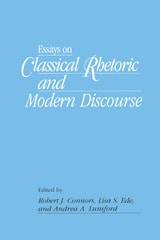
Essays on Classical Rhetoric and Modern Discourse
Edited by Robert J. Connors, Lisa S. Ede, and Andrea A. Lunsford
Southern Illinois University Press, 1984
Eighteen essays by leading scholars in English, speech communication, education, and philosophy explore the vitality of the classical rhetorical tradition and its influence on both contemporary discourse studies and the teaching of writing.
Some of the essays investigate theoretical and historical issues. Others show the bearing of classical rhetoric on contemporary problems in composition, thus blending theory and practice. Common to the varied approaches and viewpoints expressed in this volume is one central theme: the 20th-century revival of rhetoric entails a recovery of the classical tradition, with its marriage of a rich and fully articulated theory with an equally efficacious practice. A preface demonstrates the contribution of Edward P. J.Corbett to the 20th-century revival, and a last chapter includes a bibliography of his works.
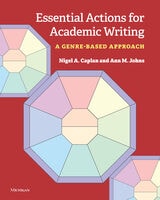
Essential Actions for Academic Writing
A Genre-Based ApproachNigel A. Caplan and Ann M. Johns
University of Michigan Press, 2022
Part I:
- Introduces students to rhetorical situation, genre, register, source use, and a framework for understanding how to approach any new writing task.
- Demonstrates that all writing responds to a context that includes the writer’s identity, the reader’s expectations, the purpose of the text, and the conventions that shape it.
- Explores the essential actions of academic writing (explain, summarize, synthesize, report and interpret data, argue, respond, and analyze).
- Provides examples of the genres and language that support each action.
- Offers four extended projects that combine the essential actions in different genres and contexts.
Essentials of English Grammar
Otto Jespersen
University of Alabama Press, 1964
A classic of English grammar, Essentials of English Grammar provides a common ground for the traditionalist and the structural or descriptive linguist. Jespersen’s work provides insight into the fundamental concepts that underlie the linguistic approach, but at the same time the foundation of the traditional approach is retained.
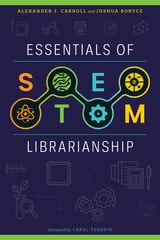
Essentials of STEM Librarianship
Alexander J. Carroll and Joshua Borycz; Foreword by Carol Tenopir
American Library Association, 2025
Amid overall falling enrollment figures for higher education, the growing success of STEM programs bucks the trend. Ensuring that these programs flourish has become a priority for administrators at the provost level and above. But this emphasis on STEM poses challenges for academic libraries, many of which have instead historically focused on the humanities and social sciences. This primer helps to fill that knowledge gap, demystifying the scientific teaching and research processes for LIS students and current academic librarians alike. Regardless of their background or level of experience, readers of this guide will
- gain an overview of the contemporary STEM teaching and research enterprise by learning about the roles and needs of STEM community members such as program administrators, tenure track principal investigators (PIs), non-tenure track teaching faculty, research staff, graduate students, and undergraduate students;
- become familiarized with the “research group,” the organizational structure through which these different personas come together to advance the university research enterprise;
- get pointers on building teaching and learning programs that enhance student success and designing research support services that integrate into STEM researchers' actual workflows;
- receive proven outreach strategies for engaging STEM communities;
- learn approaches for incorporating AI (artificial intelligence) and LLMs (large language models) into information literacy programs for scientists and engineers; and
- discover how library leaders can support both nascent and established STEM librarians to advance STEM education and research at their local institutions.
Esther's Town
Deemer Lee
University of Iowa Press, 2012
Ethical Communication
Moral Stances in Human DialogueClifford G. Christians and John C. Merrill
University of Missouri Press, 2009
Ethics and Practice in Science Communication
Edited by Susanna Priest, Jean Goodwin, and Michael F. Dahlstrom
University of Chicago Press, 2018
In three sections—how ethics matters, professional practice, and case studies—contributors to this volume explore the many complex questions surrounding the communication of scientific results to nonscientists. Has the science been shared clearly and accurately? Have questions of risk, uncertainty, and appropriate representation been adequately addressed? And, most fundamentally, what is the purpose of communicating science to the public: Is it to inform and empower? Or to persuade—to influence behavior and policy? By inspiring scientists and science communicators alike to think more deeply about their work, this book reaffirms that the integrity of the communication of science is vital to a healthy relationship between science and society today.
Ethics for Records and Information Management
Norman A. Mooradian
American Library Association, 2018
The scope and reach of information, driven by the explosive growth of information technologies and content types, has expanded dramatically over the past 30 years. The consequences of these changes to records and information management (RIM) professionals are profound, necessitating not only specialized knowledge but added responsibilities. RIM professionals require a professional ethics to guide them in their daily practice and to form a basis for developing and implementing organizational policies, and Mooradian’s new book provides a rigorous outline of such an ethics. Taking an authoritative principles/rules based approach to the subject, this book comprehensively addresses
- the structure of ethics, outlining principles, moral rules, judgements, and exceptions;
- ethical reasoning, from meaning and logic to dilemmas and decision methods;
- the ethical core of RIM, discussing key topics such as organizational context, the positive value of accountability, conflicts of interest, and confidentiality;
- important ethical concerns like copyright and intellectual property, whistleblowing, information leaks, disclosure, and privacy; and
- the relationship between RIM ethics and information governance.
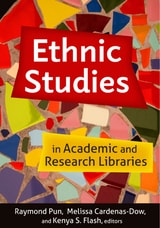
Ethnic Studies in Academic and Research Libraries
Raymond Pun
Assoc of College & Research Libraries, 2021
Ethnic Studies in Academic and Research Libraries serves as a snapshot of critical work that library workers are doing to support ethnic studies, including areas focusing on ethnic and racial experiences across the disciplines. Other curriculums or programs may emphasize race, migration, and diasporic studies, and these intersecting areas are highlighted to ensure work supporting ethnic studies is not solely defined by a discipline, but by commitment to programs that uplift underserved and underrepresented ethnic communities and communities of color. Twenty chapters are broken into three thorough sections:
- Instruction, Liaison Engagement, and Outreach
- Collections Projects and Programs
- Collaborations, Special Projects, and Community Partnerships
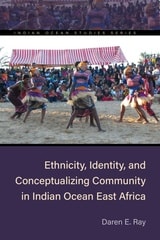
Ethnicity, Identity, and Conceptualizing Community in Indian Ocean East Africa
Daren E. Ray
Ohio University Press, 2023
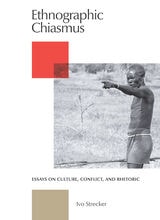
Ethnographic Chiasmus
Essays on Culture, Conflict and RhetoricIvo Strecker
Michigan State University Press, 2011
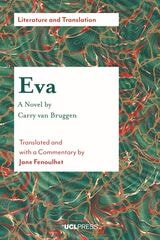
Eva
A NovelJane Fenoulhet
University College London, 2019
For the first time, Jane Fenoulhet has made this important, modernist novel accessible to English-language readers, her deft translation capturing the rich expressiveness of van Bruggen’s original Dutch. In insightful accompanying commentary, Fenoulhet describes how, just as the novel depicts the becoming of both Eva and her creator, so too can the translation be seen as the translator’s own becoming. Fenoulhet also describes the challenges of translating van Bruggen’s dynamic, intense narrative, which necessitated deep personal engagement with the novel.
Evaluating Teen Services and Programs
Sarah Flowers
American Library Association, 2012
Even More Great Ideas for Libraries and Friends
Sally Gardner Reed
American Library Association, 2008
Every Child Ready for School
Helping Adults Inspire Young Children to LearnDorothy Stoltz
American Library Association, 2013
Every Day I Write the Book
Notes on StyleAmitava Kumar
Duke University Press, 2020