Results by title
4917 books match the query 'Philosophy' and 231 start with e
Emblems of Mind
The Inner Life of Music and MathematicsEdward Rothstein
University of Chicago Press, 2006
Jacques Barzun called this book “splendid.” Martin Gardner said it was “beautifully written, marvelous and entertaining.” It will provoke all serious readers to think in new ways about the grand patterns in art and life.
“Lovely, wistful. . . . Rothstein is a wonderful guide to the architecture of musical space, its tensions and relations, its resonances and proportions. . . . His account of what is going on in the music is unfailingly felicitous.”—New Yorker
“Provocative and exciting. . . . Rothstein writes this book as a foreign correspondent, sending dispatches from a remote and mysterious locale as a guide for the intellectually adventurous. The remarkable fact about his work is not that it is profound, as much of the writing is, but that it is so accessible.”—Christian Science Monitor
Embodied Care
Jane Addams, Maurice Merleau-Ponty, and Feminist EthicsMaurice Hamington
University of Illinois Press, 2004
Hamington's argues that human bodies are "built to care"; as a result, embodiment must be recognized as a central factor in moral consideration. He takes the reader on an exciting journey from modern care ethics to Merleau-Ponty's philosophy of the body and then to Jane Addams's social activism and philosophy. The ideas in Embodied Care do not lead to yet another competing theory of morality; rather, they progress through theory and case studies to suggest that no theory of morality can be complete without a full consideration of the body.
Embodied Mind, Meaning, and Reason
How Our Bodies Give Rise to UnderstandingMark Johnson
University of Chicago Press, 2017
A brief account of Johnson’s own intellectual journey, through which we track some of the most important discoveries in the field over the past forty years, sets the stage. Subsequent chapters set out Johnson’s important role in embodied cognition theory, including his cofounding (with George Lakoff) of conceptual metaphor theory and, later, their theory of bodily structures and processes that underlie all meaning, conceptualization, and reasoning. A detailed account of how meaning arises from our physical engagement with our environments provides the basis for a nondualistic, nonreductive view of mind that he sees as most congruous with the latest cognitive science. A concluding section explores the implications of our embodiment for our understanding of knowledge, reason, and truth. The resulting book will be essential for all philosophers dealing with mind, thought, and language.
Embodiments
From the Body to the Body PoliticJames R. Mensch
Northwestern University Press, 2009
Mensch begins his inquiry by developing a philosophical anthropology based on this concept. He then applies the results of his investigation to the relations of power, authority, freedom, and sovereignty in public life. This involves confronting a line of interpretation, stretching from Hobbes to Agamben, which sees violence as both initiating and preserving the social contract. To contest this interpretation, Mensch argues against its presupposition, which is to equate freedom with sovereignty over others. He does so by understanding political freedom in terms of embodiment—in particular, in terms of the finitude and interdependence that our embodiment entails. Freedom, conceived in these terms, is understood as the gift of others. As a function of our dependence on others, it cannot exist apart from them. To show how public space and civil society presuppose this interdependence is the singular accomplishment of Embodiments. It accomplishes a phenomenological grounding for a new type of political philosophy.
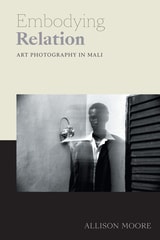
Embodying Relation
Art Photography in MaliAllison Moore
Duke University Press, 2020
Embodying Technesis
Technology beyond WritingMark Hansen
University of Michigan Press, 2000
Embodying Technesis examines how technological changes have rendered obsolete notions of technology as machine and as text. Voicing a sustained plea for rethinking the technological, Hansen argues that radical technological changes--from the steam engine to the internet and virtual reality--have fundamentally altered conditions of perception and, in so doing, changed the prevailing structures of modern experience. By emphasizing the dynamic interaction between technologies and bodies, between the diffuse effects of technological shifts and the collective embodied experiences of contemporary agents, Hansen opens the path for a radical revision of our understanding of the technological.
Mark Hansen is Assistant Professor of English, Princeton University.
Embracing the Void
Rethinking the Origin of the SacredRichard Boothby
Northwestern University Press, 2023
A radical reinterpretation of the origin of religion through a psychoanalytic theorization of the unknown
Renowned psychoanalytic philosopher Richard Boothby puts forward a novel theory of religion inspired by Jacques Lacan’s theory of das Ding, the disquieting, inaccessible dimension of fellow human beings. This notion of an unfathomable excess, originally encountered in the figure of the mother, led Lacan to break with Freud’s formulation of the Oedipus complex and underlies Lacan’s distinctive conception of unconscious dynamics. Leaning on this account, Boothby shows how our sense of the sacred arises from our relation to what we do not know.
Embracing the Void lays out the range of Freud’s attempts at a psychoanalytic theory of religion and then sketches the rough contours of Lacan’s contrasting approach. From there, Boothby offers the theoretical tools for interpreting the religious impulse and analyzes key religious traditions, from ancient Greek polytheism to Judaism and Christianity, and from Hinduism and Buddhism to Islam, finally turning to modern capitalist culture and the seductive deity that dominates it—money. Lucid, accessible, and compelling, the book provides a cogent intervention in one of the psychoanalytic tradition’s most contentious topics and offers a new approach to our understanding of religion.
Emergency
Reading the Popol Vuh in a Time of CrisisEdgar Garcia
University of Chicago Press, 2022
Written during the lockdown in Chicago in the depths of the COVID-19 pandemic, these essays consider the Popol Vuh as a work that was also written during a time of feverish social, political, and epidemiological crisis as Spanish missionaries and colonial military deepened their conquest of indigenous peoples and cultures in Mesoamerica. What separates the Popol Vuh from many other creation texts is the disposition of the gods engaged in creation. Whereas the book of Genesis is declarative in telling the story of the world’s creation, the Popol Vuh is interrogative and analytical: the gods, for example, question whether people actually need to be created, given the many perfect animals they have already placed on earth.
Emergency uses the historical emergency of the Popol Vuh to frame the ongoing emergencies of colonialism that have surfaced all too clearly in the global health crisis of COVID-19. In doing so, these essays reveal how the authors of the Popol Vuh—while implicated in deep social crisis—nonetheless insisted on transforming emergency into scenes of social, political, and intellectual emergence, translating crisis into creativity and world creation.

Emergent Forms of Life and the Anthropological Voice
Michael M. J. Fischer
Duke University Press, 2003
A vigorous advocate of the anthropological voice and method, Fischer emphasizes the ethical dimension of cultural anthropology. Ethnography, he suggests, is uniquely situated to gather and convey observations fundamental to the creation of new social institutions for an evolving civil society. In Emergent Forms of Life and the Anthropological Voice Fischer considers a dazzling array of subjects—among them Iranian and Polish cinema, cyberspace, autobiographical and fictional narrative, and genomic biotechnologies—and, in the process, demonstrates a cultural anthropology for a highly networked world. He lays the groundwork for a renewed and powerful twenty-first-century anthropology characterized by a continued insistence on empirical fieldwork, engagements with other disciplines, and dialogue with interlocutors around the globe.

Emerging Trends in Continental Philosophy
Edited by Todd May
University of Chicago Press, 2010
From Kant to Kierkegaard, from Hegel to Heidegger, continental philosophers have indelibly shaped the trajectory of Western thought since the eighteenth century. Although much has been written about these monumental thinkers, students and scholars lack a definitive guide to the entire scope of the continental tradition. The most comprehensive reference work to date, this eight-volume History of Continental Philosophy will both encapsulate the subject and reorient our understanding of it. Beginning with an overview of Kant’s philosophy and its initial reception, the History traces the evolution of continental philosophy through major figures as well as movements such as existentialism, phenomenology, hermeneutics, and poststructuralism. The final volume outlines the current state of the field, bringing the work of both historical and modern thinkers to bear on such contemporary topics as feminism, globalization, and the environment. Throughout, the volumes examine important philosophical figures and developments in their historical, political, and cultural contexts.
The first reference of its kind, A History of Continental Philosophy has been written and edited by internationally recognized experts with a commitment to explaining complex thinkers, texts, and movements in rigorous yet jargon-free essays suitable for both undergraduates and seasoned specialists. These volumes also elucidate ongoing debates about the nature of continental and analytic philosophy, surveying the distinctive, sometimes overlapping characteristics and approaches of each tradition. Featuring helpful overviews of major topics and plotting road maps to their underlying contexts, A History of Continental Philosophy is destined to be the resource of first and last resort for students and scholars alike.
Emerson and the Defense of Equality
Greg Garvey
University of Massachusetts Press, 2025
Arguing for equality as the necessary foundation of liberty
During Ralph Waldo Emerson’s lifetime, the idea of universal human equality was under intensive assault. Repeatedly—in contexts ranging from slavery, to marriage, to politics and workers’ rights—Americans of the time were being told that equality was an obsolete ideal and that the future would belong to those who accepted the hard truth that liberty lies not in egalitarian values but in hierarchies of domination and submission. Greg Garvey’s Emerson and the Defense of Equality focuses on Emerson as a real-time defender of equality during the antebellum culture wars.
In contrast to studies that treat individual liberty as Emerson’s primary concern, Garvey argues that Emerson’s works define a broad and sustained defense of equality as the necessary foundation of liberty. When read as part of a debate about equality, Emerson’s Nature is a treatise on individuality and the common weal; his anti-slavery speeches and English Traits advance evolutionary theories to rebut polygenesist arguments for white supremacy; the essays “Love” and “Domestic Life” challenge gender spheres and explore equality in marriage, friendship, and citizenship. As Emerson speculates on the future, “Politics” and “The Young American” anticipate a “beneficent socialism” in which human rights will always have priority over property rights. In his career-long effort to defend a threatened ideal, Emerson develops an aspirational vision of society that understands equality to be a fundamental aspect of liberty.
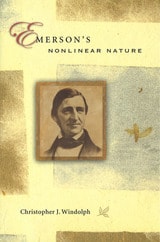
Emerson's Nonlinear Nature
Christopher J. Windolph
University of Missouri Press, 2007
In this provocative study, Christopher Windolph analyzes Emersonian naturalism from the standpoint of nonlinearity, offering new ways of reading and thinking about Emerson’s stance toward naturalism and the influence of science on his thought. Drawing on ideas in perspective theory, architecture, and nonlinear dynamics to argue that Emerson’s natural philosophy follows from his analysis of the development of organic forms, Windolph breaks new ground in Emerson studies by exploring how considerations of shape and the act of seeing underpin all of Emerson’s theories about nature.
Bringing to his study a focused attention to the history of Western science and philosophy, Windolph reexamines Emerson’s understanding of how the act of seeing occurs and of the eye’s ability to see through appearances to organizing principles, showing how Emerson’s naturalism extends beyond the narrow confines of traditional linear science. Through extensive readings of Emerson’s journals, essays, and lectures, Windolph shows that Emerson was an empirical idealist who integrated a scientific approach to nature with an exploration of nonlinear principles, revealing him to be more prescient in his writings about certain recent developments in scientific thought than has been realized.
This work makes a major contribution to the ongoing study of Emerson and science, expanding Emerson’s role as a major American philosopher while rebutting those who see him primarily as a rhetorician or poetic propagandist. Emerson’s Nonlinear Nature opens new ways of thinking about Emerson’s work in its nineteenth-century contexts, reassesses his reception in twentieth-century criticism, and makes a strong case for his continuing relevance in the century ahead.
Emily Dickinson's Approving God
Divine Design and the Problem of SufferingPatrick J. Keane
University of Missouri Press, 2008
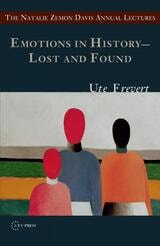
Emotions in History – Lost and Found
Ute Frevert
Central European University Press, 2011
Coming to terms with emotions and how they influence human behaviour, seems to be of the utmost importance to societies that are obsessed with everything "neuro." On the other hand, emotions have become an object of constant individual and social manipulation since "emotional intelligence" emerged as a buzzword of our times. Reflecting on this burgeoning interest in human emotions makes one think of how this interest developed and what fuelled it. From a historian's point of view, it can be traced back to classical antiquity. But it has undergone shifts and changes which can in turn shed light on social concepts of the self and its relation to other human beings (and nature). The volume focuses on the historicity of emotions and explores the processes that brought them to the fore of public interest and debate.
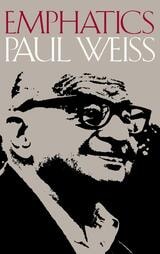
Emphatics
Paul Weiss
Vanderbilt University Press, 2000
Brilliant in every respect, Emphatics rewrites Weiss's systematic ontology in new terms. Not only are the lineaments of the system reexamined, but this book floods the reader with new perspectives and insights on relationship, signs, truth, particularity, space-time causality, education, mind-body issues, Being and other ultimate philosophical categories, and good and evil.
Weiss engages the various objections to his position in a series of question-and-answer epilogues at the end of each chapter that allow the reader to follow step-by-step a great philosophical mind at work. He takes his critics seriously, grapples with their objections, and answers them honestly. His discourse creatively revisits age-old questions and in reimagining new answers establishes the continuing relevance of philosophy as an academic discipline.
Empire Of Meaning
The Humanization Of The Social SciencesFrancois Dosse
University of Minnesota Press, 1998
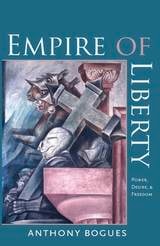
Empire of Liberty
Power, Desire, and FreedomAnthony Bogues
Dartmouth College Press, 2010
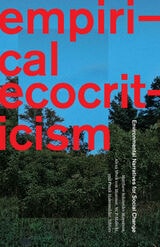
Empirical Ecocriticism
Environmental Narratives for Social ChangeMatthew Schneider-Mayerson
University of Minnesota Press, 2023
Finalist for the 2025 ASLE Ecocritical Book Award
A groundbreaking book that combines the environmental humanities and social sciences to study the impact of environmental stories
There is a growing consensus that environmental narratives can help catalyze the social change necessary to address today’s environmental crises; however, surprisingly little is known about their impact and effectiveness. In Empirical Ecocriticism, Matthew Schneider-Mayerson, Alexa Weik von Mossner, W. P. Malecki, and Frank Hakemulder combine an environmental humanities perspective with empirical methods derived from the social sciences to study the influence of environmental stories on our affects, attitudes, and actions.
Empirical Ecocriticism provides an approachable introduction to this growing field’s main methods and demonstrates their potential through case studies on topics ranging from the impact of climate fiction on readers’ willingness to engage in activism to the political empowerment that results from participating in environmental theater. Part manifesto, part toolkit, part proof of concept, and part dialogue, this introductory volume is divided into three sections: methods, case studies, and reflections. International in scope, it points toward a novel and fruitful synthesis of the environmental humanities and social sciences.
Contributors: Matthew Ballew, Yale U; Helena Bilandzic, U of Augsburg; Rebecca Dirksen, Indiana U; Greg Garrard, UBC Okanagan; Matthew H. Goldberg, Yale U; Abel Gustafson, U of Cincinnati; David I. Hanauer, Indiana U of Pennsylvania; Ursula K. Heise, UCLA; Jeremy Jimenez, SUNY Cortland; Anthony Leiserowitz, Yale U; David M. Markowitz, U of Oregon; Marcus Mayorga; Jessica Gall Myrick, Penn State U; Mary Beth Oliver, Penn State U; Yan Pang, Point Park U; Mark Pedelty, U of Minnesota; Seth A. Rosenthal, Yale U; Elja Roy, U of Memphis; Nicolai Skiveren, Aarhus U; Paul Slovic, U of Oregon; Scott Slovic, U of Idaho; Nicolette Sopcak, U of Alberta; Paul Sopcak, MacEwan U; Sara Warner, Cornell U.
Empty Moments
Cinema, Modernity, and DriftLeo Charney
Duke University Press, 1998
Empty Moments creates a catalytic dialogue among those who, at the time of the invention of film, attempted to define the experience of the fleeting present. Interspersing philosophical discussions with stylistically innovative prose, Charney mingles Proust’s conception of time/memory with Cubism’s attempt to interpret time through perspective and Surrealism’s exploration of subliminal representations of the present. Other topics include Husserl’s insistence that the present can only be fantasy or fabrication and the focus on impossibility, imperfection, and loss in Kelvin’s laws of thermodynamics. Ultimately, Charney’s work hints at parallels among such examples, the advent and popularity of cinema, and early film theory.
A book with a structural modernity of its own, Empty Moments will appeal to those interested in cinema and its history, as well as to other historians, philosophers, literary, and cultural scholars of modernity.
Empty Names, Fiction and the Puzzles of Non-Existence
Edited by Anthony Everett and Thomas Hofweber
CSLI, 2000

Enacting Decolonization
Political Subjectivity in Contemporary Arab ThoughtYasmeen Daifallah
Duke University Press, 2027
Encounters and Dialogues with Martin Heidegger, 1929-1976
Heinrich Wiegand Petzet
University of Chicago Press, 1993
A well-known art historian and an intimate friend of Heidegger's, Heinrich Wiegand Petzet provides a rich portrait of Heidegger that is part memoir, part biography, and part cultural history. By recounting chronologically a series of encounters between the two friends from their meeting in 1929 until the philosopher's death in 1976, as well as between Heidegger and other contemporaries, Petzet reveals not only new aspects of Heidegger's thought and attitudes toward the historical and intellectual events of his time but also the greater cultural and social context in which he articulated his thought.
End of the World as We Know It
Social Science for the Twenty-First CenturyImmanuel Wallerstein
University of Minnesota Press, 2001
Endings
Questions of Memory in Hegel and HeideggerEdited by Rebecca Comay and John McCumber
Northwestern University Press, 1999
Beginning at the point where Heidegger encountered Hegel, this volume of provocative essays addresses the respective philosophies of the two men. Leading scholars provide a variety of models from which to view the unique relationship between the bodies of thought of Heidegger and Hegel: bodies of thought that cannot be taken as two objects to be compared, contrasted, and finally evaluated but that must be viewed in dynamic terms, as a relationship in which self-transformations lead to mutual transformations and vice versa.
Endless Intervals
Cinema, Psychology, and Semiotechnics around 1900Jeffrey West Kirkwood
University of Minnesota Press, 2022
Revealing cinema’s place in the coevolution of media technology and the human
Cinema did not die with the digital, it gave rise to it. According to Jeffrey West Kirkwood, the notion that digital technologies replaced analog obscures how the earliest cinema laid the technological and philosophical groundwork for the digital world. In Endless Intervals, he introduces a theory of semiotechnics that explains how discrete intervals of machines came to represent something like a mind—and why they were feared for their challenge to the uniqueness of human intelligence.
Examining histories of early cinematic machines, Kirkwood locates the foundations for a scientific vision of the psyche as well as the information age. He theorizes an epochal shift in the understanding of mechanical stops, breaks, and pauses that demonstrates how cinema engineered an entirely new model of the psyche—a model that was at once mechanical and semiotic, discrete and continuous, physiological and psychological, analog and digital.
Recovering largely forgotten and untranslated texts, Endless Intervals makes the case that cinema, rather than being a technology assaulting the psyche, is in fact the technology that produced the modern psyche. Kirkwood considers the ways machines can create meaning, offering a fascinating theory of how the discontinuous intervals of soulless mechanisms ultimately produced a rich continuous experience of inner life.
Ends Of Globalization
Mohammed A. Bamyeh
University of Minnesota Press, 2000
A uniquely broad perspective that challenges current ideas about worldwide cultural and political change.
Political and Social Theory/Cultural Studies
A uniquely broad perspective that challenges current ideas about worldwide cultural and political change. An intervention into current debates about globalization, nationalism, imperialism, and culture, this book offers a cogent critique of much of what is being said about globalization, by both the Right and the Left. In doing so, it charts the complex processes of globalization, drawing out their historical and philosophical roots and outlining the connections between cultural, political, and economic life that globalization has made, historically and in our day.The author’s orientation toward political theory and comparative civilizations-a rarity in globalization studies-allows him to detect in specific terms what is most dangerous and opportune in what is happening in the world today. Mohammed A. Bamyeh makes a compelling argument that we are witnessing a process typified by massive disjunctions between political, cultural, and economic logics on a world scale. Bamyeh demonstrates how the disruptions caused by globalization, while they blur our vision and block our rational approaches, also possess the potential to liberate the autonomous and convivial human possibilities and capabilities long shackled by such modernist institutions of governance as the nation-state.Translation Inquiries: University of Minnesota Press
Ends in Sight
Marx/Fukuyama/Hobsbawm/AndersonGregory Elliott
Pluto Press, 2008
Gregory Elliott argues that Marx is central to all three accounts and that, along with the Manifesto, they form a quartet of analyses of the results and prospects of capitalism and socialism, which are of enduring significance for the Left.
Senses of an Ending provides a readable survey of key historical and political thinkers that will appeal to anyone interested in modern political thought.
Enemies from the East?
V. S. Soloviev on Paganism, Asian Civilizations, and IslamEdited by Vladimir Wozniuk
Northwestern University Press, 2007
The six essays comprising this book span Soloviev’s publishing career, beginning with “The Mythological Process in Ancient Paganism,” written at the age of twenty, and ending with “Muhammad, His Life and Religious Teaching,” which appeared four years before Soloviev’s death at forty-seven. Throughout, Soloviev grapples with commonalities and differences apparent in the moral frameworks of civilizations since antiquity; and in religious and cultural practices, from Europe through the Middle East to Asia. His probing of the sources of religious morality and political authority in human history reinvigorated Russian intellectual interest in the East/West question in his time and still resonates powerfully in our own.

Enemies of All Humankind
Fictions of Legitimate ViolenceSonja Schillings
Dartmouth College Press, 2016

Energy Culture
Art and Theory on Oil and BeyondImre Szeman
West Virginia University Press, 2019
Energy Culture is a provocative book about oil’s firm grip on our politics and everyday lives. It brings together essays and artwork produced in a collaborative environment to stimulate new ways of thinking and to achieve a more just and sustainable world.
The original work collected in Energy Culture creatively engages energy as a social form through lively arguments and artistic research organized around three vectors of inquiry. The first maps how fossil fuels became, and continue to be, embedded in North American society, from the ideology of tar sands reclamation projects to dreams of fiber optic cables running through the Northwest Passage. The second comprises creative and artistic responses to the dominance of fossil fuels in everyday life and to the challenge of realizing new energy cultures. The final section addresses the conceptual and political challenges posed by energy transition and calls into question established views on energy. Its contributions caution against solar capitalism, explore the politics of sabotage, and imagine an energy efficient transportation system called “the switch.” Imbued with a sense of urgency and hope, Energy Culture exposes the deep imbrications of energy and culture while pointing provocatively to ways of thinking and living otherwise.
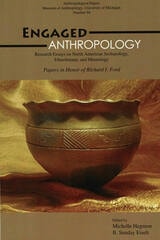
Engaged Anthropology
Research Essays on North American Archaeology, Ethnobotany, and MuseologyEdited by Michelle Hegmon and B. Sunday Eiselt
University of Michigan Press, 2005
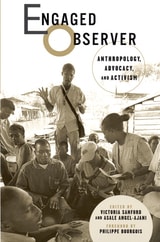
Engaged Observer
Anthropology, Advocacy, and ActivismSanford, Victoria
Rutgers University Press, 2006
Anthropology has long been associated with an ethos of “engagement.” The field’s core methods and practices involve long-term interpersonal contact between researchers and their study participants, giving major research topics in the field a distinctively human face. Can research findings be authentic and objective? Are anthropologists able to use their data to aid the participants of their study, and is that aid always welcome?
In Engaged Observer, Victoria Sanford and Asale Angel-Ajani bring together an international array of scholars who have been embedded in some of the most conflict-ridden and dangerous zones in the world to reflect on the role and responsibility of anthropological inquiry. They explore issues of truth and objectivity, the role of the academic, the politics of memory, and the impact of race, gender, and social position on the research process. Through ethnographic case studies, they offer models for conducting engaged research and illustrate the contradictions and challenges of doing so.
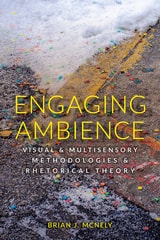
Engaging Ambience
Visual and Multisensory Methodologies and Rhetorical TheoryBrian McNely
Utah State University Press, 2024
By articulating theoretically sound methodologies and methods for the empirical study of rhetoric conceived as originary, immanent, and enveloping, Brian McNely contributes a methodological perspective that furthers new materialist theories of rhetoric. McNely demonstrates how scholars’ emergent theories of rhetoric call for new methodologies that can extend their reach, and in the process, he proposes a new conception of visual rhetoric. Engaging Ambience delineates methodologies and methods that help researchers in rhetoric and writing studies discover the ambient environments that condition and support everyday communication in all its forms.
Engaging Ambiencedetails and demonstrates visual and multisensory methodologies and methods for exploring the wondrous complexity of everyday communication. It will appeal to scholars and students of rhetorical theory, visual and multisensory rhetorics, and composition and writing studies.
Engaging Mbembe
Sindre Bandstad and Bjørn Enge Bertelsen, editors. Foreword by Arjun Appadurai.
Duke University Press, 2027
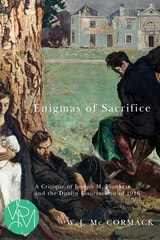
Enigmas of Sacrifice
A Critique of Joseph M. Plunkett and the Dublin Insurrection of 1916W. J. Mc Cormack
Michigan State University Press, 2016
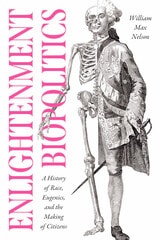
Enlightenment Biopolitics
A History of Race, Eugenics, and the Making of CitizensWilliam Max Nelson
University of Chicago Press, 2024
In Enlightenment Biopolitics, historian William Max Nelson pursues the ambitious task of tracing the context in which biopolitical thought emerged and circulated. He locates that context in the Enlightenment when emancipatory ideals sat alongside the horrors of colonialism, slavery, and race-based discrimination. In fact, these did not just coexist, Nelson argues; they were actually mutually constitutive of Enlightenment ideals.
In this book, Nelson focuses on Enlightenment-era visions of eugenics (including proposals to establish programs of selective breeding), forms of penal slavery, and spurious biological arguments about the supposed inferiority of particular groups. The Enlightenment, he shows, was rife with efforts to shape, harness, and “organize” the minds and especially the bodies of subjects and citizens. In his reading of the birth of biopolitics and its transformations, Nelson examines the shocking conceptual and practical connections between inclusion and exclusion, equality and inequality, rights and race, and the supposed “improvement of the human species” and practices of dehumanization.
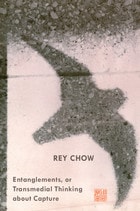
Entanglements, or Transmedial Thinking about Capture
Rey Chow
Duke University Press, 2012
These questions are dispersively heterologous yet mutually implicated. This paradoxical character of their discursive relations is what Rey Chow intends with the word "entanglements," by which she means, first, an enmeshment of topics: the mediatized image in modernist reflexivity; captivation and identification; victimhood; the place of East Asia in globalized Western academic study. Beyond enmeshment, she asks, can entanglements be phenomena that are not defined by affinity or proximity? Might entanglements be about partition and disparity rather than about conjunction and similarity?
Across medial forms (including theater, film, narrative, digitization, and photographic art), and against more popular trends of declaring things and people to be in flux, Chow proposes conceptual frames that foreground instead aesthetic, ontological, and sentient experiences of force, dominance, submission, fidelity, antagonism, masochism, letting-go, and the attraction to self-annihilation. Boundary, trap, capture, captivation, sacrifice, and mimesis: these riveting terms serve as analytic pressure points in her readings, articulating perversity, madness, and terror to pursuits of freedom.
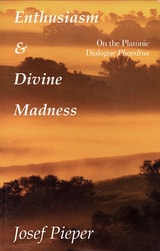
Enthusiasm And Divine Madness
Josef Pieper
St. Augustine's Press, 1999
Pieper gives interpretation of the dialogue. Leaving the more recondite scholarly preoccupations aside, he concentrates on the content, bringing the actual situation in the dialogue – Athens and its intellectuals engaged in spirited debate – alive. Equally alive is the discussion of ideas, which are brought to bear on contemporary experience and made to prove the perennial validity of Socratic wisdom, and its power to excite the mind. The main thesis – that in poetry and in love man is "beside himself," that is, divinely inspired - is discussed with reference to modern poets, novelists, and modern psychology.
Entre Nous
Between the World Cup and MeGrant Farred
Duke University Press, 2019
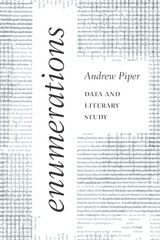
Enumerations
Data and Literary StudyAndrew Piper
University of Chicago Press, 2018
In Enumerations, Andrew Piper answers that question across a variety of domains fundamental to the study of literature. He focuses on the elementary particles of literature, from the role of punctuation in poetry, the matter of plot in novels, the study of topoi, and the behavior of characters, to the nature of fictional language and the shape of a poet’s career. How does quantity affect our understanding of these categories? What happens when we look at 3,388,230 punctuation marks, 1.4 billion words, or 650,000 fictional characters? Does this change how we think about poetry, the novel, fictionality, character, the commonplace, or the writer’s career? In the course of answering such questions, Piper introduces readers to the analytical building blocks of computational text analysis and brings them to bear on fundamental concerns of literary scholarship. This book will be essential reading for anyone interested in Digital Humanities and the future of literary study.

Environmental Ethics in the Midwest
Interdisciplinary ApproachesIan Smith
Michigan State University Press, 2022

Epicurus and His Philosophy
Norman Wentworth DeWitt
University of Minnesota Press, 1954
Epicurus and His Philosophy was first published in 1954. Minnesota Archive Editions uses digital technology to make long-unavailable books once again accessible, and are published unaltered from the original University of Minnesota Press editions.
In this volume, the first comprehensive book in English about Epicurus, existing data on the life of the ancient philosopher is related to the development of his doctrine. The result is a fascinating account that challenges traditional theories and interpretations of Epicurean philosophy. Professor DeWitt demonstrates the fallacy of centuries of abuse of Epicurus and the resulting distortion of most discussions of Epicureanism that appear in standard philosophical works. Of major significance to students of philosophy and theology are the findings that show the importance of Epicureanism as a source of numerous Christian beliefs.
Epicurus in Lycia
The Second-Century World of Diogenes of OenoandaPamela Gordon
University of Michigan Press, 1996
Epidemic Subjects - Radical Ontology
Edited by Elisabeth von Samsonow
Diaphanes, 2016
Epidemic Subjects—Radical Ontology brings together a renowned team of contributors, including Levi Bryant, Angela Melitopoulos, and Susan Stryker, who together forge a radically inclusive definition of subjectivity. Drawing on Gilles Deleuze and Félix Guattari’s concept of the “girl” as a heuristic device for examining modern society and its foundations, they tie together recent trends in philosophy and offer a concrete way forward from the conception of the “thing” or “object” privileged by new materialism, speculative realism, and other theories of subjectivity.

Epigenetic Landscapes
Drawings as MetaphorSusan Merrill Squier
Duke University Press, 2017
Epistemologies of Aesthetics
Dieter Mersch
Diaphanes, 2015
In Epistemologies of Aesthetics, Dieter Mersch deconstructs and displaces the terminology that typically accompanies the question of the relationship between art and scientific truth. Identifying artistic practices as modes of thought that do not make use of language in a way that can easily be translated into scientific discourse, Mersch advocate for an aesthetic mode of thought beyond the “linguistic turn,” a way of thinking that cannot be substituted by any other disciplinary system. A sophisticated reflection on the epistemological status of the aesthetic by one of Germany’s leading philosophers, Epistemologies of Aesthetics will be of great interest within this growing field of study.
Epistemology and Inference
Henry E. Kyburg, Jr.
University of Minnesota Press, 1983
Epistemology and Inference was first published in 1983. Minnesota Archive Editions uses digital technology to make long-unavailable books once again accessible, and are published unaltered from the original University of Minnesota Press editions.
Henry Kyburg has developed an original and important perspective on probabilistic and statistical inference. Unlike much contemporary writing by philosophers on these topics, Kyburg's work is informed by issues that have arisen in statistical theory and practice as well as issues familiar to professional philosophers. In two major books and many articles, Kyberg has elaborated his technical proposals and explained their ramifications for epistemology, decision-making, and scientific inquiry. In this collection of published and unpublished essays, Kyburg presents his novel ideas and their applications in a manner that makes them accessible to philosophers and provides specialists in probability and induction with a concise exposition of his system.

Epoché as a Guideline to (Inter)Subjectivity
On the Extent of Husserl’s Methodological Influence on Levinas and SartreJosef Matoušek
Karolinum Press, 2026
Offers a comparative study of Emmanuel Levinas and Jean-Paul Sartre through the lens of their engagement with Edmund Husserl’s phenomenology.
Focusing on the notions of epoché, phenomenological reduction, intentionality, and the cogito, Josef Matoušek traces how both Emmanuel Levinas and Jean-Paul Sartre appropriate and transform Husserl’s methodological framework in developing their respective accounts of subjectivity, transcendence, and the encounter with the Other. Building on and critically extending Kris Sealey’s influential comparison of both thinkers, Epoché as a Guideline to (Inter)Subjectivity argues that despite their significant philosophical differences, both remain deeply indebted to Husserl’s project and that their mature accounts of le visage and le regard can be better understood through this shared phenomenological background.
Equal Freedom
Stephen Darwall, Editor
University of Michigan Press, 1995
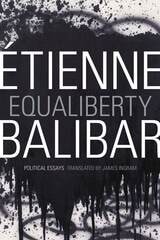
Equaliberty
Political EssaysÉtienne Balibar
Duke University Press, 2014