Results by title
22279 books match the query 'Social Science' and 684 start with e

Empire State-Building
War and Welfare in Kenya, 1925–1952Joanna Lewis
Ohio University Press, 2001
This history of administrative thought and practice in colonial Kenya looks at the ways in which white people tried to engineer social change.
It asks four questions:
- Why was Kenya’s welfare operation so idiosyncratic and spartan compared with that of other British colonies?
- Why did a transformation from social welfare to community development produce further neglect of the very poor?
- Why was there no equivalent to the French tradition of community medicine?
- If there was a transformatory element of colonial rule that sought to address poverty, where and why did it fall down?
The answers offer revealing insight into the dynamics of rule in the late colonial period in Kenya.
Empire and Environment
Ecological Ruin in the TranspacificJeffrey Santa Ana, Heidi Amin-Hong, Rina Garcia Chua, Zhou Xiaojing, Editors
University of Michigan Press, 2022
Empire in Africa
Angola and Its NeighborsDavid Birmingham
Ohio University Press, 2006
Empire in Question
Reading, Writing, and Teaching British ImperialismAntoinette Burton
Duke University Press, 2011
Empire of Defense
Race and the Cultural Politics of Permanent WarJoseph Darda
University of Chicago Press, 2019
From the formation of the DOD to the long wars of the twenty-first century, the United States rebranded war as the defense of Western liberalism from first communism, then crime, authoritarianism, and terrorism. Officials learned to frame state violence against Asians, Black and brown people, Arabs, and Muslims as the safeguarding of human rights from illiberal beliefs and behaviors. Through government documents, news media, and the writing and art of Joseph Heller, June Jordan, Trinh T. Minh-ha, I. F. Stone, and others, Darda shows how defense remade and sustained a weakened color line with new racial categories (the communist, the criminal, the authoritarian, the terrorist) that cast the state’s ideological enemies outside the human of human rights. Amid the rise of anticolonial and antiracist movements the world over, defense secured the future of war and white dominance.
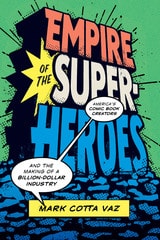
Empire of the Superheroes
America’s Comic Book Creators and the Making of a Billion-Dollar IndustryBy Mark Cotta Vaz
University of Texas Press, 2021
Superman may be faster than a speeding bullet, but even he can't outrun copyright law. Since the dawn of the pulp hero in the 1930s, publishers and authors have fought over the privilege of making money off of comics, and the authors and artists usually have lost. Jerry Siegel and Joe Shuster, the creators of Superman, got all of $130 for the rights to the hero.
In Empire of the Superheroes, Mark Cotta Vaz argues that licensing and litigation do as much as any ink-stained creator to shape the mythology of comic characters. Vaz reveals just how precarious life was for the legends of the industry. Siegel and Shuster—and their heirs—spent seventy years battling lawyers to regain rights to Superman. Jack Kirby and Joe Simon were cheated out of their interest in Captain America, and Kirby's children brought a case against Marvel to the doorstep of the Supreme Court. To make matters worse, the infant comics medium was nearly strangled in its crib by censorship and moral condemnation. For the writers and illustrators now celebrated as visionaries, the "golden age" of comics felt more like hard times.
The fantastical characters that now earn Hollywood billions have all-too-human roots. Empire of the Superheroes digs them up, detailing the creative martyrdom at the heart of a pop-culture powerhouse.
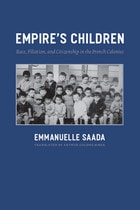
Empire's Children
Race, Filiation, and Citizenship in the French ColoniesEmmanuelle Saada
University of Chicago Press, 2012
Europe’s imperial projects were often predicated on a series of legal and scientific distinctions that were frequently challenged by the reality of social and sexual interactions between the colonized and the colonizers.When Emmanuelle Saada discovered a 1928 decree defining the status of persons of mixed parentage born in French Indochina—the métis—she found not only a remarkable artifact of colonial rule, but a legal bombshell that introduced race into French law for the first time. The decree was the culmination of a decades-long effort to resolve the “métis question”: the educational, social, and civil issues surrounding the mixed population. Operating at the intersection of history, anthropology, and law, Empire’s Children reveals the unacknowledged but central role of race in the definition of French nationality.
Through extensive archival work in both France and Vietnam, and a close reading of primary and secondary material from the Pacific islands and sub-Saharan and North Africa, Saada has created in Empire’s Children an original and compelling perspective on colonialism, law, race, and culture from the end of the nineteenth century until decolonization.
Empire's Endgame
Racism and the British StateGargi Bhattacharyya
Pluto Press, 2021
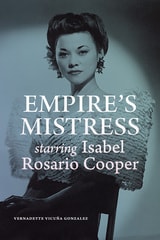
Empire's Mistress, Starring Isabel Rosario Cooper
Vernadette Vicuna Gonzalez
Duke University Press, 2021
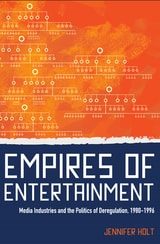
Empires of Entertainment
Media Industries and the Politics of Deregulation, 1980-1996Holt, Jennifer
Rutgers University Press, 2011
Empires of Entertainment integrates legal, regulatory, industrial, and political histories to chronicle the dramatic transformation within the media between 1980 and 1996. As film, broadcast, and cable grew from fundamentally separate industries to interconnected, synergistic components of global media conglomerates, the concepts of vertical and horizontal integration were redesigned. The parameters and boundaries of market concentration, consolidation, and government scrutiny began to shift as America's politics changed under the Reagan administration. Through the use of case studies that highlight key moments in this transformation, Jennifer Holt explores the politics of deregulation, the reinterpretation of antitrust law, and lasting modifications in the media landscape.
Holt skillfully expands the conventional models and boundaries of media history. A fundamental part of her argument is that these media industries have been intertwined for decades and, as such, cannot be considered separately. Instead, film, cable and broadcast must be understood in relation to one another, as critical components of a common history. Empires of Entertainment is a unique account of deregulation and its impact on political economy, industrial strategies, and media culture at the end of the twentieth century.
Empires of Time
Calendars, Clocks, and Cultures, Revised EditionAnthony Aveni
University Press of Colorado, 2002
—The Sciences
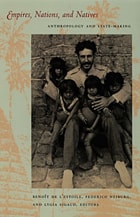
Empires, Nations, and Natives
Anthropology and State-MakingBenoît de L Estoile, Federico Neiburg and Lygia Sigaud, eds.
Duke University Press, 2005
The contributors—social and cultural anthropologists from the Americas and Europe—report on both historical and contemporary processes. Moving beyond controversies that cast the relationship between scholarship and politics in binary terms of complicity or autonomy, they bring into focus a dynamic process in which states, anthropological knowledge, and population groups themselves are mutually constructed. Such a reflexive endeavor is an essential contribution to a critical anthropological understanding of a changing world.
Contributors: Alban Bensa, Marcio Goldman, Adam Kuper, Benoît de L’Estoile, Claudio Lomnitz, David Mills, Federico Neiburg, João Pacheco de Oliveira, Jorge Pantaleón, Omar Ribeiro Thomaz, Lygia Sigaud, Antonio Carlos de Souza Lima, Florence Weber
Empowered by Design
Decentralization and the Gender Policy TrifectaMeg Rincker
Temple University Press, 2017
In her probing book, Empowered by Design, Meg Rincker asks, Under what conditions will decentralization lead to women’s empowerment in countries around the globe? Using three case studies—the United Kingdom, Poland, and Pakistan—she shows how decentralization reforms create new institutional offices as power shifts from the national level to a meso-tier level, which is located between the national government and local municipalities. These shifts impact a country’s political, administrative, and fiscal reforms as well as women’s representation.
Rincker argues that this shift should be inclusive of women—or at least lead more women to participate in institutions—but this is not always the case. She indicates that three conditions, “the gender policy trifecta,” need to be met to achieve this: legislative gender quotas, women’s policy agencies, and gender-responsive budgeting at the level of governance in question. Rincker's innovative research uses original comparative data about what women want, quantitative cross-national analyses, and interviews with women’s organization leaders and politicians to show how cross-institutional policymaking can empower women.
Rincker’s fine-grained analysis makes a significant contribution to the study of representation and gendered implications of decentralization, as well as how representatives go about understanding and aggregating our diverse policy preferences.
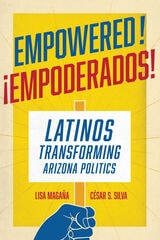
Empowered!
Latinos Transforming Arizona PoliticsLisa Magaña
University of Arizona Press, 2021
Empowered!examines Arizona’s recent political history and how it has been shaped and propelled by Latinos. It also provides a distilled reflection of U.S. politics more broadly, where the politics of exclusion and the desire for inclusion are forces of change.
Lisa Magaña and César S. Silva argue that the state of Arizona is more inclusive and progressive then it has ever been. Following in the footsteps of grassroots organizers in California and the southeastern states, Latinos in Arizona have struggled and succeeded to alter the anti-immigrant and racist policies that have been affecting Latinos in the state for many years. Draconian immigration policies have plagued Arizona’s political history. Empowered! shows innovative ways that Latinos have fought these policies.
Empowered! focuses on the legacy of Latino activism within politics. It raises important arguments about those who stand to profit financially and politically by stoking fear of immigrants and how resilient politicians and grassroots organizers have worked to counteract that fear mongering. Recognizing the long history of disenfranchisement and injustice surrounding minority communities in the United States, this book outlines the struggle to make Arizona a more just and equal place for Latinos to live.

Empowered
Popular Feminism and Popular MisogynySarah Banet-Weiser
Duke University Press, 2018
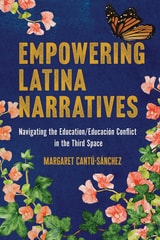
Empowering Latina Narratives
Navigating the Education/Educación Conflict in the Third SpaceMargaret Cantú-Sánchez
University of Arizona Press, 2025
In this groundbreaking book, author Margaret Cantú-Sánchez takes on the U.S. educational system. Cantú-Sánchez introduces the concept of the education/educación conflict, where Latinas navigate the clash between home and school epistemologies under Anglocentric, assimilationist pedagogies.
By analyzing literature, such as Barbara Renaud González’s Golondrina, Why Did You Leave Me?, and education testimonios from seminal works like This Bridge Called My Back and Telling to Live, Cantú-Sánchez reveals how Latina/Chicana protagonists and students negotiate this conflict through a mestizaje of epistemologies—blending elements of both home and school cultures within the third space of education.
Cantú-Sánchez utilizes an interdisciplinary approach, deploying critical race theory, Chicana third-space feminism, and other pedagogical theories like sentipensante (a sensing/thinking) pedagogy employed by education scholar Laura Rendon, among others. By providing pivotal insights and strategies, she demonstrates how educators can implement culturally relevant pedagogies in their classrooms from K–12 through higher education, fostering environments where Latina/Chicana students can thrive without forsaking their cultural identities.
Empowering Latina Narratives not only identifies the challenges Latina/Chicana students face but also offers a roadmap for overcoming them, making this book an essential resource for scholars, educators, and students committed to culturally inclusive education.
Empowering Men of Color on Campus
Building Student Community in Higher EducationBrooms, Derrick R.
Rutgers University Press, 2018
Empowerment and Black Deaf Persons
Lindsay Moeletsi Dunn
Gallaudet University Press, 2024
This is the inaugural volume in the Early Papers in Deaf Studies series, which will consist of reissued works originally published by the Gallaudet University College for Continuing Education but long out of print. The aim of this series is to restore these foundational papers to the scholarly community. Empowerment and Black Deaf Persons is available in both print and open digital formats, ensuring broad access to this important contribution to the literature.

Empty Moments
Cinema, Modernity, and DriftLeo Charney
Duke University Press, 1998
Empty Moments creates a catalytic dialogue among those who, at the time of the invention of film, attempted to define the experience of the fleeting present. Interspersing philosophical discussions with stylistically innovative prose, Charney mingles Proust’s conception of time/memory with Cubism’s attempt to interpret time through perspective and Surrealism’s exploration of subliminal representations of the present. Other topics include Husserl’s insistence that the present can only be fantasy or fabrication and the focus on impossibility, imperfection, and loss in Kelvin’s laws of thermodynamics. Ultimately, Charney’s work hints at parallels among such examples, the advent and popularity of cinema, and early film theory.
A book with a structural modernity of its own, Empty Moments will appeal to those interested in cinema and its history, as well as to other historians, philosophers, literary, and cultural scholars of modernity.
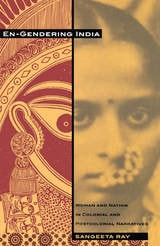
En-Gendering India
Woman and Nation in Colonial and Postcolonial NarrativesSangeeta Ray
Duke University Press, 2000
Through her readings of works by writers including Bankimchandra Chatterjee, Rabindranath Tagore, Harriet Martineau, Flora Annie Steel, Anita Desai, and Bapsi Sidhaa, Ray demonstrates that Indian women were presented as upper class and Hindu, an idealization that paradoxically served the needs of both colonial and nationalist discourses. The Indian nation’s goal of self-rule was expected to enable women’s full participation in private and public life. On the other hand, British colonial officials rendered themselves the protectors of passive Indian women against their “savage” male countrymen. Ray shows how the native woman thus became a symbol for both an incipient Indian nation and a fading British Empire. In addition, she reveals how the figure of the upper-class Hindu woman created divisions with the nationalist movement itself by underscoring caste, communal, and religious differences within the newly emerging state. As such, Ray’s study has important implications for discussions about nationalism, particularly those that address the concepts of identity and nationalism.
Building on recent scholarship in feminism and postcolonial studies, En-Gendering India will be of interest to scholars in those fields as well as to specialists in nationalism and nation-building and in Victorian, colonial, and postcolonial literature and culture.
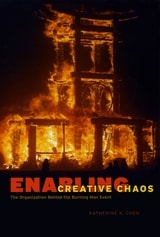
Enabling Creative Chaos
The Organization Behind the Burning Man EventKatherine K. Chen
University of Chicago Press, 2009
In the summer of 2008, nearly fifty thousand people traveled to Nevada’s Black Rock Desert to participate in the countercultural arts event Burning Man. Founded on a commitment to expression and community, the annual weeklong festival presents unique challenges to its organizers. Over four years Katherine K. Chen regularly participated in organizing efforts to safely and successfully create a temporary community in the middle of the desert under the hot August sun.
Enabling Creative Chaos tracks how a small, underfunded group of organizers transformed into an unconventional corporation with a ten-million-dollar budget and two thousand volunteers. Over the years, Burning Man’s organizers have experimented with different management models; learned how to recruit, motivate, and retain volunteers; and developed strategies to handle regulatory agencies and respond to media coverage. This remarkable evolution, Chen reveals, offers important lessons for managers in any organization, particularly in uncertain times.

Enacting Decolonization
Political Subjectivity in Contemporary Arab ThoughtYasmeen Daifallah
Duke University Press, 2027
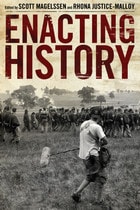
Enacting History
Edited by Scott Magelssen and Rhona Justice-Malloy
University of Alabama Press, 2011
Where performance meets the past: exploring how we stage, shape, and experience history.
Enacting History is a collection of new essays exploring the world of historical performances. The volume focuses on performances outside the traditional sphere of theatre, among them living history museums, battle reenactments, pageants, renaissance festivals, and adventure-tourism destinations. This volume argues that the recent surge in such performances have raised significant questions about the need for, interest in, and value of such nontraditional theater. Many of these performances claim a greater or lesser degree of historical "accuracy" or "authenticity," and the authors tease out the representational and historiographic issues related to these arguments. How, for instance, are issues of race, ethnicity, and gender dealt with at museums that purport to be accurate windows into the past? How are politics and labor issues handled in local- or state-funded institutions that rely on volunteer performers? How do tourists' expectations shape the choices made by would-be purveyors of the past? Where do matters of taste or censorship enter in when reconciling the archival evidence with a family-friendly mission?
Essays in the collection address, among other subjects, reenactments of period cookery and cuisine at a Maryland renaissance festival; the roles of women as represented at Minnesota's premiere living history museum, Historic Fort Snelling; and the Lewis and Clark bicentennial play as cultural commemoration. The editors argue that historical performances like these-regardless of their truth-telling claims-are an important means to communicate, document, and even shape history, and allow for a level of participation and accessibility that is unique to performance. Enacting History is an entertaining and informative account of the public's fascination with acting out and watching history and of the diverse methods of fulfilling this need.
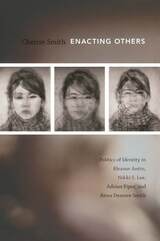
Enacting Others
Politics of Identity in Eleanor Antin, Nikki S. Lee, Adrian Piper, and Anna Deavere SmithCherise Smith
Duke University Press, 2011
Enchanted America
How Intuition and Reason Divide Our PoliticsJ. Eric Oliver and Thomas J. Wood
University of Chicago Press, 2018
The answer, according to J. Eric Oliver and Thomas J. Wood, can be found in the most important force shaping American politics today: human intuition. Much of what seems to be irrational in American politics arises from the growing divide in how its citizens make sense of the world. On one side are rationalists. They use science and reason to understand reality. On the other side are intuitionists. They rely on gut feelings and instincts as their guide to the world. Intuitionists believe in ghosts and End Times prophecies. They embrace conspiracy theories, disbelieve experts, and distrust the media. They are stridently nationalistic and deeply authoritarian in their outlook. And they are the most enthusiastic supporters of Donald Trump. The primary reason why Trump captured the presidency was that he spoke about politics in a way that resonated with how Intuitionists perceive the world. The Intuitionist divide has also become a threat to the American way of life. A generation ago, intuitionists were dispersed across the political spectrum, when most Americans believed in both God and science. Today, intuitionism is ideologically tilted toward the political right. Modern conservatism has become an Intuitionist movement, defined by conspiracy theories, strident nationalism, and hostility to basic civic norms.
Enchanted America is a clarion call to rationalists of all political persuasions to reach beyond the minority and speak to intuitionists in a way they understand. The values and principles that define American democracy are at stake.

Enchanted Modernities
Ancestral Vitalizations in the Upper MekongMicah F. Morton
University of Wisconsin Press, 2025
Although modernity and its colonial legacies are often portrayed as severing or at least attenuating people’s ancestral ties, Enchanted Modernities shows that those ties persist and, in fact, are on the rise. Akha and other Indigenous ancestral and animist resurgences are blossoming despite the paradigmatic Western framing of modernity as fundamentally at odds with Ancestors and, for that matter, kinship and even religion. Morton demonstrates that modernity and modernization proceed alongside the reproduction of new and old forms of enchantment.
Encoding Race, Encoding Class
Indian IT Workers in BerlinSareeta Amrute
Duke University Press, 2016
Encompassing Others
The Magic of Modernity in MelanesiaEdward LiPuma
University of Michigan Press, 2001
Focusing on the Maring people of Highland New Guinea and on the Westerners who interacted with them, Edward LiPuma presents issues from the perspectives of both sides. We hear the voice of the Anglican priest from San Francisco as well as the most powerful Maring shamans. Further, the book seeks to develop a theory of generations that helps explain how change accelerates and societies take on new directions across generations.
Theoretical, descriptive, but almost entirely free of jargon, this book is intended for all those who are interested in how the West's encompassment of other peoples influences how these others conceive of their past, imagine their future, and experience the present. It will have wide appeal for anthropologists and others concerned with colonialism, globalization, and the formation of the nation-state.
Edward LiPuma is Professor and Chair, Department of Anthropology, University of Miami.
Encounter with the Plumed Serpent
Drama and Power in the Heart of MesoamericaMaarten Jansen
University Press of Colorado, 2007
By analyzing and cross-referencing the codices, which have been fragmented and dispersed in far-flung archives, the authors attempt to reconstruct Mixtec history. Their synthesis here builds on long examination of the ancient manuscripts. Adding useful interpretation and commentary, Jansen and Pérez Jiménez synthesize the large body of surviving documents into the first unified narrative of Mixtec sacred history.
Archaeologists and other scholars as well as readers with an interest in Mesoamerican cultures will find this lavishly illustrated volume a compelling and fascinating history and a major step forward in knowledge of the Mixtec.
Encountering American Faultlines
Race, Class, and the Dominican Experience in ProvidenceJose Itzigsohn
Russell Sage Foundation, 2009
Encountering Pain
Hearing, Seeing, SpeakingEdited by Deborah Padfield and Joanna M. Zakrzewska
University College London, 2020
What is pain—and how do we communicate it? Persistent pain changes the brain and nervous system so that it can no longer warn of danger. However, despite being a major cause of disability globally, pain remains difficult to communicate. As language struggles to bridge the gap between those who suffer from pain and those who are trying to help, this book shares leading research into the potential value of visual images and non-verbal forms of communication as means of improving interactions between clinicians and their patients. Accompanied by vivid photographs co-created with those who live with pain, the volume integrates the voices of leading scientists, academics, and contemporary artists to provide a manual for understanding the meanings of pain for healthcare professionals, pain patients, students, academics, and artists.

Encounters in Modern Hebrew
Level 3Edna Amir Coffin
University of Michigan Press, 1997
This volume shows students a wider range of Hebrew-speaking cultural activities in a larger human context, from materials about holidays, including a Jewish holiday celebrated only in North Africa, to discussions of the roles of women that raise the issue of gender equality. Other chapters examine ethnic jokes and their problematic qualities, geography, and the differences between popular and literary language registers. Encounters in Modern Hebrew, Level 3 ushers the Hebrew student through a wide domain of the human community.
Encounters with American Ethnic Cultures
Edited by Philip L. Kilbride, Jane C. Goodale, and Elizabeth R. Ameisen
University of Alabama Press, 1990
Encounters with American Ethnic Cultures represents a cultural approach to understanding ethnic diversity in the Philadelphia metropolitan area.
Thirteen chapters, each using an ethnographic field methodology, explore such ethnic experience as the "invisible" (WASPS and African-Americans); "self-chosen" (Welsh-American, Irish-American, and Ukrainian-American); "gender-related" (the Lubovitcher); "religious" (Jewish, Native American, Greek-American, and Puerto Rican); and "dislocated" (Cambodians and the homeless). Ethnographic fieldwork focuses an insider's view on the meaning of ethnic experience in the lives of participants in the research. This volume examines the role and function of various ethnic endeavors in the preservation and maintenance of ethnic identity by contemporary Americans.
This five part volume includes:
Introduction: Ethnic Culture Analysis—A Course of Study, Jane C. Goodale and Philip L. Kilbride
Methodology, Elizabeth R. Ameisen and Carolyn G. Friedman
Part I. Black and WASP in American Cultural Experience: The Invisible Ones
Exclusivity in an Ethnic Elite: Racial Prejudice as Boundary Maintenance, Elizabeth R. Ameisen
Africans and African-Americans: An Ethnohistorical View and Symbolic Analysis of Food Habits, Carolyn G. Friedman
Part II. Self-Chosen Ethnicity
Unique Americans: The Welsh-American Ethnic Group in the Philadelphia Area, Lorraine Murray
Irish-Americans and Irish Dance: Self-Chosen Ethnicity, Erin McGauley Hebard
Art and Identity: Ukrainian-American Ethnicity, Jennifer Krier
Part III. Interpretations of Gender and Ethnicity: The Lubavitcher Experience
Equality Does Not Mean Sameness: The Role of Women within the Lubavitcher Marriage, Philip Baldinger
Strategies for Strength: Women and Personal Empowerment in Lubavitcher Hasidism, Gita Srinivasan
Part IV. Ethnicity and Religion: The Persistence of Collective Representations
Our Lives Revolve around the Holidays: Holidays in the Transmission of Jewish Ethnicity, Anna Dahlem
Fayetteville or Raleigh? An Analysis of an American Indian Baptist Church, Beth Batten
Issues in Greek Orthodoxy That Define and Maintain Greek-American Ethnicity, Karen L. Belsley
Es como si fuera la casa de uno: The Role of the Community Church in Maintaining Puerto Rican Ethnicity, Monica Schoch-Spana
Part V. Dislocation and Ethnicity
Cambodian Marriage: Marriage and How it is Changing among Cambodian Refugees in Philadelphia, Rebecca C. Popenoe
Ethnic Expression in a Jewish Street Person, Andrew Millstein
Conclusion, Philip L. Kilbride and Jane C. Goodale

Encounters with Korean Folk Religion
The Goddesses of Eight Peaks MountainClark W. Sorensen
Rutgers University Press, 2027
Encounters with Korean Folk Religion is an account of forty-five years of engagement with the cult of goddesses on Eight Peaks Mountain in Korea’s western Kangwŏn Province, the shaman who tended to the goddesses there from 1977 to 2015, and the folk religion of the surrounding village of Eight Peaks. Since the 1980s, South Korea has urbanized and the village of Eight Peaks has been transformed from a remote agricultural village into a rafting and ski resort. While communal worship ceremonies have been dying out in most of Korea, they have only grown on Eight Peaks Mountain, which has been a site of worship since at least the 15th century. What was a small-scale local ceremony in 1977 has grown into a large-scale regional celebration attracting shamans and tourists from far and wide. The manuscript delves in a historically and anthropologically innovative way into the social, religious, and historical reasons for this efflorescence.
Encrypted Propaganda
The Democratic Promise and Despotic Peril of Chat AppsInga Kristina Trauthig and Samuel Woolley
University of Chicago Press, 0
Essential reading on a hard-to-study but dominant communication tool, encrypted messaging apps—WhatsApp, Signal, and their kin—showing their promise and dangers.
Pundits have long pointed to social media’s power to catalyze or end political movements—and to strengthen or weaken democracies. But this power is shifting from social media platforms (such as Facebook and YouTube) to lesser-studied encrypted messaging apps (such as WhatsApp and Signal). This urgent book explains how these technologies work and how they differ from their predecessors, outlining their strengths and vulnerabilities at a crucial stage in their evolution.
While many Facebook users have at least heard of propaganda and the algorithms used to filter and highlight content on that platform, they are more likely to trust messaging apps as sources of authentic and secure information. Paired with a growing distrust of traditional media, more people are joining large groups on these apps and using them as news sources, even when those groups include relative strangers. This makes these apps particularly vulnerable to political propaganda—and even government espionage.
Security studies scholar Inga Kristina Trauthig and propaganda scholar Samuel Woolley consider both the role of these apps in spreading disinformation and as tools for maintaining free speech and civic discourse in the face of censorship. The same closed nature that makes these apps seem trustworthy has made them particularly difficult to research. And so this qualitative study draws on some 180 interviews with propagandists, activists, influence campaigners, and other users in fourteen countries. The book’s findings and the authors’ recommendations are crucial for understanding the future of online communication and safeguarding democratic speech.
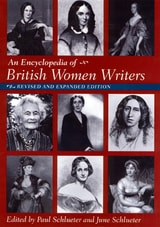
Encyclopedia of British Women Writers
Schlueter, Paul
Rutgers University Press, 1999
Paul Schlueter and June Schlueter have individually and jointly written and edited a number of critical and reference works, including The English Novel: Twentieth Century Criticism (Vol. 2: Twentieth Century Novelists) and Modern American Literature (Supplement 2). Paul Schlueter's books include The Novels of Doris Lessing and Shirley Ann Grau. June Schlueter, Provost, and Dana Professor of English at Lafayette College, has edited Feminist Readings of Modern American Drama and Modern American Drama: The Female Canon.
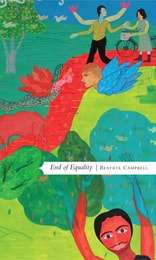
End of Equality
Beatrix Campbell
Seagull Books, 2013
In TheEnd of Equality, renowned feminist Beatrix Campbell argues that even as the patriarchy has lost some of its legitimacy, new inequalities are emerging in our culture. We are living, Campbell writes, in an era of neo-patriarchy in which violence has proliferated; body anxiety and self-hatred have flourished; rape is committed with impunity; sex trafficking thrives, and the struggle for equal pay is at an end. After four decades observing society, Campbell still speaks of the long-sought goal of gender equality. But now she calls for a new revolution.

End of the World as We Know It
Social Science for the Twenty-First CenturyImmanuel Wallerstein
University of Minnesota Press, 2001

Endangered City
The Politics of Security and Risk in BogotáAustin Zeiderman
Duke University Press, 2016
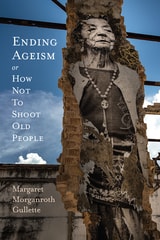
Ending Ageism, or How Not to Shoot Old People
Gullette, Margaret Morganroth
Rutgers University Press, 2017
When the term “ageism” was coined in 1969, many problems of exclusion seemed resolved by government programs like Social Security and Medicare. As people live longer lives, today’s great demotions of older people cut deeper into their self-worth and human relations, beyond the reach of law or public policy. In Ending Ageism, or How Not to Shoot Old People, award-winning writer and cultural critic Margaret Morganroth Gullette confronts the offenders: the ways people aging past midlife are portrayed in the media, by adult offspring; the esthetics and politics of representation in photography, film, and theater; and the incitement to commit suicide for those with early signs of “dementia.”
In this original and important book, Gullette presents evidence of pervasive age-related assaults in contemporary societies and their chronic affects. The sudden onset of age-related shaming can occur anywhere—the shove in the street, the cold shoulder at the party, the deaf ear at the meeting, the shut-out by the personnel office or the obtuseness of a government. Turning intimate suffering into public grievances, Ending Ageism, Or How Not to Shoot Old People effectively and beautifully argues that overcoming ageism is the next imperative social movement of our time.
About the cover image:
This elegant, dignified figure--Leda Machado, a Cuban old enough to have seen the Revolution--once the center of a vast photo mural, is now a fragment on a ruined wall. Ageism tears down the structures that all humans need to age well; to end it, a symbol of resilience offers us all brisk blue-sky energy.
“Leda Antonia Machado” from “Wrinkles of the City, 2012.”
Piotr Trybalski / Trybalski.com. Courtesy of the artist.
A Declaration of Grievances
"A Declaration of Grievances" was written by Margaret Morganroth Gullette and is excerpted from her book Ending Ageism, or How Not to Shoot Old People (2017, Rutgers University Press). The poster was designed by Carolyn Kerchof.
- A Declaration of Grievances (in English): https://d3tto5i5w9ogdd.cloudfront.net/wp-content/uploads/2023/01/15175130/A-Declaration-of-Grievances_Eng.pdf
- A Declaration of Grievances (in Spanish): https://d3tto5i5w9ogdd.cloudfront.net/wp-content/uploads/2023/01/15175131/A-Declaration-of-Grievances_Spanish.pdf
- A Declaration of Grievances (in French): https://d3tto5i5w9ogdd.cloudfront.net/wp-content/uploads/2023/01/15175130/A-Declaration-of-Grievances_French.pdf
- A Declaration of Grievances (in German): https://d3tto5i5w9ogdd.cloudfront.net/wp-content/uploads/2023/01/15175131/A-Declaration-of-Grievances_German.pdf
Print the PDF (make sure to click "fit to page") and hang the Declaration up in your home or place of work. Please share this link with other people you know who care about the rights of older persons. Share on social media with the hashtags #ADeclarationOfGrievances and #EndingAgeismGullette.
For more information, an excerpt, links to reviews, and special offers on this book, go to: https://www.rutgersuniversitypress.org/ending-ageism
Related website: (https://www.brandeis.edu/wsrc/scholars/profiles/gullette.html)

Ending Gender-Based Violence
Justice and Community in South AfricaHannah E. Britton
University of Illinois Press, 2020
Hannah E. Britton examines the reasons gendered violence persists in relationship to social inequalities even after women assume political power. Venturing into South African communities, Britton invites service providers, religious and traditional leaders, police officers, and medical professionals to address gender-based violence in their own words. Britton finds the recent turn toward carceral solutions—with a focus on arrests and prosecutions—fails to address the complexities of the problem and looks at how changing specific community dynamics can defuse interpersonal violence. She also examines how place and space affect the implementation of policy and suggests practical ways policymakers can support street level workers.
Clear-eyed and revealing, Ending Gender-Based Violence offers needed tools for breaking cycles of brutality and inequality around the world.
Ending Poverty As We Know It
Guaranteeing A Right To A JobWilliam P. Quigley
Temple University Press, 2003
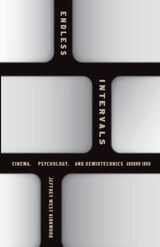
Endless Intervals
Cinema, Psychology, and Semiotechnics around 1900Jeffrey West Kirkwood
University of Minnesota Press, 2022
Revealing cinema’s place in the coevolution of media technology and the human
Cinema did not die with the digital, it gave rise to it. According to Jeffrey West Kirkwood, the notion that digital technologies replaced analog obscures how the earliest cinema laid the technological and philosophical groundwork for the digital world. In Endless Intervals, he introduces a theory of semiotechnics that explains how discrete intervals of machines came to represent something like a mind—and why they were feared for their challenge to the uniqueness of human intelligence.
Examining histories of early cinematic machines, Kirkwood locates the foundations for a scientific vision of the psyche as well as the information age. He theorizes an epochal shift in the understanding of mechanical stops, breaks, and pauses that demonstrates how cinema engineered an entirely new model of the psyche—a model that was at once mechanical and semiotic, discrete and continuous, physiological and psychological, analog and digital.
Recovering largely forgotten and untranslated texts, Endless Intervals makes the case that cinema, rather than being a technology assaulting the psyche, is in fact the technology that produced the modern psyche. Kirkwood considers the ways machines can create meaning, offering a fascinating theory of how the discontinuous intervals of soulless mechanisms ultimately produced a rich continuous experience of inner life.

Ends of Empire
Asian American Critique and the Cold WarJodi Kim
University of Minnesota Press, 2010

Endurance Media
Neta Alexander
University of Minnesota Press, 2027
How digital platforms profit from our inability to log off
Endurance Media explores how contemporary digital technologies extract value from our bodies by demanding sustained engagement that pushes us beyond, and even reconfigures, our limits. It introduces the concept of “endurance media”—systems, platforms, and practices that require users to align their bodily rhythms with relentless media temporalities, transforming exhaustion itself into a profitable resource and a cultural fantasy.
In Endurance Media leading media scholars explore the dark intersection of metabolic capitalism and algorithmic control. From exercise bikes that monetize heart rates and caloric expenditure, to gaming suits that deliver electric shocks for “haptic realism,” to energy drinks marketed as performance enhancers for marathon gaming sessions, Endurance Media reveals how digital platforms colonize rest time under the guise of pleasure, interactivity, and autonomy. This analysis extends from individual bodies to planetary infrastructure, connecting personal media habits to the environmental costs of server farms and AI resource extraction.
At stake is the possibility of recuperating endurance as a space for alternative modes of duration, relationality, and collective survival. To that end, this book offers a critical alternative through “anti-endurance media”—a disability-informed framework that values rest, refusal, and collective care over relentless individual optimization.
Retail e-book files for this title are screen-reader friendly with images accompanied by short alt text and/or extended descriptions.
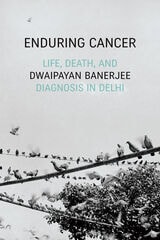
Enduring Cancer
Life, Death, and Diagnosis in DelhiDwaipayan Banerjee
Duke University Press, 2020
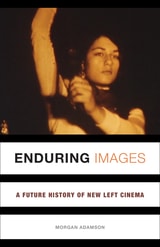
Enduring Images
A Future History of New Left CinemaMorgan Adamson
University of Minnesota Press, 2018
An integrated look at the political films of the 1960s and ’70s and how the New Left transformed cinema
A timely reassessment of political film culture in the 1960s and ’70s, Enduring Images examines international cinematic movements of the New Left in light of sweeping cultural and economic changes of that era. Looking at new forms of cinematic resistance—including detailed readings of particular films, collectives, and movements—Morgan Adamson makes a case for cinema’s centrality to the global New Left.
Enduring Images details how student, labor, anti-imperialist, Black Power, and second-wave feminist movements broke with auteur cinema and sought to forge local and international solidarities by producing political essay films, generating new ways of being and thinking in common. Adamson produces a comparative and theoretical account of New Left cinema that engages with discussions of work, debt, information, and resistance. Enduring Images argues that the cinemas of the New Left are sites to examine, through the lens of struggle, the reshaping of global capitalism during the pivotal moment in which they were made, while at the same time exploring how these movements endure in contemporary culture and politics.
Including in-depth discussions of Third Cinema in Argentina, feminist cinema in Italy, Newsreel movements in the United States, and cybernetics in early video, Enduring Images is an essential examination of the political films of the 1960s and ’70s.
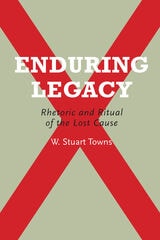
Enduring Legacy
Rhetoric and Ritual of the Lost CauseW. Stuart. Towns
University of Alabama Press, 2013
Explores the crucial role of rhetoric and oratory in creating and propagating a “Lost Cause” public memory of the American South
Enduring Legacy explores the vital place of ceremonial oratory in the oral tradition in the South and analyses how rituals such as Confederate Memorial Day, Confederate veteran reunions, and dedication of Confederate monuments have contributed to creating and sustaining a Lost Cause paradigm for Southern identity. Towns studies in detail secessionist and Civil War speeches and how they laid the groundwork for future generations, including Southern responses to the civil rights movement, and beyond.
The Lost Cause orators that came after the Civil War, Towns argues, helped to shape a lasting mythology of the brave Confederate martyr, and the Southern positions for why the Confederacy lost and who was to blame. Innumerable words were spent—in commemorative speeches, newspaper editorials, and statehouse oratory—condemning the evils of Reconstruction, redemption, reconciliation, and the new and future South. Towns concludes with an analysis of how Lost Cause myths still influence Southern and national perceptions of the region today, as evidenced in debates over the continued deployment of the Confederate flag and the popularity of Civil War reenactments.
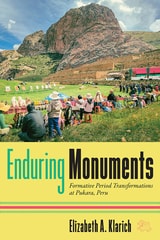
Enduring Monuments
Formative Period Transformations at Pukara, PeruElizabeth A. Klarich
University Press of Colorado, 2025
In the early twentieth century, Peruvian scholars Luis E. Valcárcel and Julio C. Tello visited Pukara and shared images of its multicolored pottery and unique stone sculptures with colleagues across the world. A number of both small-scale and multiyear field projects have followed, with goals of refining Lake Titicaca Basin cultural chronologies, tracking Pukara-style material culture in the south-central Andes, restoring the structural integrity of the Qalasaya, and documenting the reoccupations of Pukara by Colla, Inca, and early Spanish colonial populations. Enduring Monuments synthesizes the findings of these diverse projects and shares the results of fieldwork and artifact analysis by the Pukara Archaeological Project since 2000.
Using a “building biography” approach that tracks initial construction, major remodeling, and subsequent expansion efforts during the Middle and Late Formative periods (400 BC–AD 200), Klarich highlights transformations in material culture, settlement patterns, social hierarchy, and daily practices at Pukara and contemporaneous sites across the Titicaca Basin and situates Formative period Pukara within the vast anthropological and archaeological literature addressing monumentality, ritual practice, and incipient urbanism in complex societies in South America and beyond.
Enduring Motives
The Archaeology of Tradition and Religion in Native AmericaLinea Sundstrom
University of Alabama Press, 2012
Wesley Bernardini / James S. Brown Jr. / Cheryl Claassen / John E. Clark / ArleneColman / Warren DeBoer /