Results by title
18293 books match the query 'United States' and 472 start with e
Errors, Lies, and Libel
Peter E. Kane. Foreword by Elmer Gertz
Southern Illinois University Press, 1992
Peter E. Kane takes a critical look at the development of the present law through a discussion of seventeen landmark libel cases.
One of the many points Kane clarifies is the important distinction between an error and a lie when judging whether someone is guilty of libel. For example, in the series of events that led to Goldwater vs. Ginzburg, Ralph Ginzburg, publisher of fact magazine, compiled and printed in fact a montage of quotes he had collected from psychiatrists about Barry Goldwater. It took five years of legal sparring for the courts to conclude that Ginzburg had deliberately published a malicious and irresponsible document and to rule in favor of Goldwater. Kane closes with a discussion of current thinking on possible libel reform.
Esalen
America and the Religion of No ReligionJeffrey J. Kripal
University of Chicago Press, 2007
“An impressive new book. . . . [Kripal] has written the definitive intellectual history of the ideas behind the institute.”—San Francisco Chronicle
“Kripal examines Esalen’s extraordinary history and evocatively describes the breech birth of Murphy and Price’s brainchild. His real achievement, though, is effortlessly synthesizing a dizzying array of dissonant phenomena (Cold War espionage, ecstatic religiosity), incongruous pairings (Darwinism, Tantric sex), and otherwise schizy ephemera (psychedelic drugs, spaceflight) into a cogent, satisfyingly complete narrative.”—Atlantic Monthly
Escape Artist
The Life and Films of John SturgesGlenn Lovell
University of Wisconsin Press, 2008
Best Books for Special Interests, selected by the American Association of School Librarians, and Best Books for General Audiences, selected by the Public Library Association
"Pick up a copy of film critic and scholar Glenn Lovell's terrific new Sturges biography, Escape Artist. . . . I can't urge you enough to check out this interview-rich, aesthetically and culturally perceptive look at the filmmaker and his work."—Bob Strauss, Los Angeles Daily News
“Lovell’s list of interviewees reads like a who’s who of Hollywood and they obviously provided rich source material for this full-scale biography and career survey.”— Leonard Maltin
“This long overdue study of a major Hollywood director will find a welcome home in the libraries of film scholars, action movie buffs, and anyone interested in the popular culture of the twentieth century.”—Turner Classic Movies (TCM.com)
Escape Betwixt Two Suns
A True Tale of the Underground Railroad in IllinoisCarol Pirtle. Foreword by Rodney O. Davis
Southern Illinois University Press, 2000
Although the northern Illinois chapters of the story of Susan “Sukey” Richardson’s escape from slavery on the Underground Railroad are documented, the part played by southern Illinois in that historic episode has remained obscure. Carol Pirtle changes that with her investigation into the 1843 suit Andrew Borders lodged against William Hayes, charging his neighbor with helping slaves from the Borders estate escape to Galesburg. In conjunction with her probe into the past, Pirtle also discovered the Hayes correspondence.
Pirtle documents Hayes’s involvement in the Illinois Underground Railroad through approximately two hundred letters received by Hayes from the early 1820s until his death in 1849. Many of these letters specifically corroborate his participation in the escape of slaves from the Borders estate. One such letter came from T. A. Jones in 1843: “You Dear Sir are to me an unknown friend, yet I believe you are a friend to the poor down trodden Slave. This is as good an introduction as I want from any man. My brother, our cause is a holy one.” Letters written by Galesburg residents show that several prominent citizens of that community also assisted in the affair, proving that Knox College administrators and trustees were active in the Underground Railroad.
Pirtle also includes excerpts from the trial transcript from the 1844 civil case against Hayes, which was tried in Pinckneyville, Illinois. She researched newspaper accounts of the event, most notably those in the Western Citizen and the Sparta Herald. Records of the Covenanter Presbyterian church of which Hayes was a member provide partial explanations of Hayes’s motives.
Telling the story of Hayes and his involvement with Susan Richardson and the Underground Railroad, Pirtle provides insight into the work of abolitionists in Illinois. Escape Betwixt Two Suns, in fact, is one of the few books to substantiate the legends of the Underground Railroad. She tells the story of a quiet man who made a difference, of a man deserving the accolades of a hero.
Escape from New York
The New Negro Renaissance beyond HarlemDavarian L. Baldwin
University of Minnesota Press, 2013
In the midst of vast cultural and political shifts in the early twentieth century, politicians and cultural observers variously hailed and decried the rise of the “New Negro.” This phenomenon was most clearly manifest in the United States through the outpouring of Black arts and letters and social commentary known as the Harlem Renaissance. What is less known is how far afield of Harlem that renaissance flourished—how much the New Negro movement was actually just one part of a collective explosion of political protest, cultural expression, and intellectual debate all over the world.
In this volume, the Harlem Renaissance “escapes from New York” into its proper global context. These essays recover the broader New Negro experience as social movements, popular cultures, and public behavior spanned the globe from New York to New Orleans, from Paris to the Philippines and beyond. Escape from New York does not so much map the many sites of this early twentieth-century Black internationalism as it draws attention to how New Negroes and their global allies already lived. Resituating the Harlem Renaissance, the book stresses the need for scholarship to catch up with the historical reality of the New Negro experience. This more comprehensive vision serves as a lens through which to better understand capitalist developments, imperial expansions, and the formation of brave new worlds in the early twentieth century.
Contributors: Anastasia Curwood, Vanderbilt U; Frank A. Guridy, U of Texas at Austin; Claudrena Harold, U of Virginia; Jeannette Eileen Jones, U of Nebraska–Lincoln; Andrew W. Kahrl, Marquette U; Shannon King, College of Wooster; Charlie Lester; Thabiti Lewis, Washington State U, Vancouver; Treva Lindsey, U of Missouri–Columbia; David Luis-Brown, Claremont Graduate U; Emily Lutenski, Saint Louis U; Mark Anthony Neal, Duke U; Yuichiro Onishi, U of Minnesota, Twin Cities; Theresa Runstedtler, U at Buffalo (SUNY); T. Denean Sharpley-Whiting, Vanderbilt U; Michelle Stephens, Rutgers U, New Brunswick; Jennifer M. Wilks, U of Texas at Austin; Chad Williams, Brandeis U.
Escaping into Nature
The Making of a Sportsman-Conservationist and Environmental HistorianJohn F. Reiger
Oregon State University Press, 2013
In Escaping into Nature, prominent wildlife conservationist and environmental historian John Reiger shares his story of an angler and hunter who found a cause and a calling and combined them for his life’s work.
John Reiger’s outdoor adventures as a young man primed him for the teachings of the great sportsmen-conservationists of the past, particularly George Bird Grinnell, Theodore Roosevelt, and Aldo Leopold. Inspired by these conservation giants, Reiger left the security of a tenured professorship to serve as executive director of the Connecticut Audubon Society where he, sometimes controversially, put his ideals into practice. Later, he resumed his academic career to illuminate the lives of early wildlife conservationists, visionaries who continue to inspire us to care deeply about the future of the natural world.
Abused psychologically within his family in his early years, Reiger found solace in nature. Though he first entered the outdoors as an escape from his unpleasant circumstances, he soon found the study and pursuit of insects, fishes, and birds to be exciting ends in themselves. He came to believe that it was only by participating in the life and death of other creatures that one could learn to truly value the natural world, be a part of it, and be inspired to work for its conservation.
John Reiger’s autobiography is also the story of his own developing fascination with America’s past, especially as it relates to human interaction with the natural world; his desire to share that passion with others; and his experiences on the road to becoming a nationally recognized scholar. The twists and turns of that journey, and his accounts of the people—and of the wild creatures—who helped him along the way, will appeal to history enthusiasts and nature lovers alike.
Espíritu Santo de Zúñiga
A Frontier Mission in South TexasBy Tamra Lynn Walter
University of Texas Press, 2007
San Antonio Conservation Society Citation, 2009
In the early part of the eighteenth century, the Spanish colonial mission Espíritu Santo de Zúñiga was relocated from far south Texas to a site along the Guadalupe River in Mission Valley, Victoria County. This mission, along with a handful of others in south Texas, was established by the Spaniards in an effort to Christianize and civilize the local Native American tribes in the hopes that they would become loyal Spanish citizens who would protect this new frontier from foreign incursions.
With written historical records scarce for Espíritu Santo, Tamra Walter relies heavily on material culture recovered at this site through a series of recent archaeological investigations to present a compelling portrait of the Franciscan mission system. By examining findings from the entire mission site, including the compound, irrigation system, quarry, and kiln, she focuses on questions that are rarely, if ever, answered through historical records alone: What was daily life at the mission like? What effect did the mission routine have on the traditional lifeways of the mission Indians? How were both the Indians and the colonizers changed by their frontier experiences, and what does this say about the missionization process?
Walter goes beyond simple descriptions of artifacts and mission architecture to address the role these elements played in the lives of the mission residents, demonstrating how archaeology is able to address issues that are not typically addressed by historians. In doing so, she presents an accurate portrait of life in South Texas at this time. This study of Mission Espíritu Santo will serve as a model for research at similar early colonial sites in Texas and elsewhere.
Essayons
Autobiography of John W. SweetlandJohn W. Sweetland
Michigan Publishing Services, 2019
Essays in Linguistics
Dialectology, Grammar, and Lexicography in Honor of James B. McmillanJames C. Raymond
University of Alabama Press, 2004
"Raymond and Russell have fashioned a lively, useful volume. . . . The ability and integrity of the contributors make much of the difference, but the editors have given the book direction by soliciting state of the art essays in three fields . . . dialectology (the articles represent area linguistics at its best), grammar and usage (Algeo on usage shibboleths is particularly fine), and lexicography (a delight)."
—Choice
"These essays are quietly unassuming in tone but highly useful."
—Language in Society
Essays on the History of Transportation and Technology
EMORY L. KEMP
West Virginia University Press, 2014
Emory Kemp is the founder and director of the Institute for the History of Technology and Industrial Archaeology at West Virginia University, where he also served as a chair and professor of civil engineering and a professor of history. This collection of essays encompasses over fifty years of his research in the field of the history of technology.
Within these twelve essays, Kemp describes and analyzes nineteenth century improvements in building materials such as iron, steel, and cement; roads and bridges, especially the evolution of the suspension bridge; canals and navigable rivers, including the Ohio River and its tributaries; and water supply systems. As one of the few practicing American engineers who also researches and writes as an academic, Kemp adds an important historical context to his work by focusing not only on the construction of a structure but also on the analytical science that heralds a structure’s design and development.
Essentials of STEM Librarianship
Alexander J. Carroll and Joshua Borycz; Foreword by Carol Tenopir
American Library Association, 2025
Amid overall falling enrollment figures for higher education, the growing success of STEM programs bucks the trend. Ensuring that these programs flourish has become a priority for administrators at the provost level and above. But this emphasis on STEM poses challenges for academic libraries, many of which have instead historically focused on the humanities and social sciences. This primer helps to fill that knowledge gap, demystifying the scientific teaching and research processes for LIS students and current academic librarians alike. Regardless of their background or level of experience, readers of this guide will
- gain an overview of the contemporary STEM teaching and research enterprise by learning about the roles and needs of STEM community members such as program administrators, tenure track principal investigators (PIs), non-tenure track teaching faculty, research staff, graduate students, and undergraduate students;
- become familiarized with the “research group,” the organizational structure through which these different personas come together to advance the university research enterprise;
- get pointers on building teaching and learning programs that enhance student success and designing research support services that integrate into STEM researchers' actual workflows;
- receive proven outreach strategies for engaging STEM communities;
- learn approaches for incorporating AI (artificial intelligence) and LLMs (large language models) into information literacy programs for scientists and engineers; and
- discover how library leaders can support both nascent and established STEM librarians to advance STEM education and research at their local institutions.
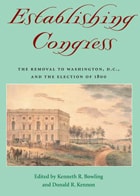
Establishing Congress
The Removal to Washington, D.C., and the Election of 1800Kenneth R. Bowling
Ohio University Press, 2005
Establishing Congress: The Removal to Washington, D.C., and the Election of 1800 focuses on the end of the 1790s, when, in rapid succession, George Washington died, the federal government moved to Washington, D.C., and the election of 1800 put Thomas Jefferson and the Democratic-Republican Party in charge of the federal government.
Establishing Congress dispels the myths and misinformation that surround the federal government’s move to Washington and demonstrates that the election of 1800 changed American party politics forever, establishing the success of the American experiment in government and completing the founding of the Republic. It also contends that the lame-duck session of Congress had far-reaching implications for the governance of the District of Columbia. Later chapters examine aspects of the political iconography of the Capitol—one illuminating Jefferson’s role in turning the building into a temple for the legislature and an instrument for nation-building, another analyzing the fascinating decades-long debate over whether to bury George Washington in the Capitol.
The book considers as well the political implications of social life in early Washington, examining the political lobbying by Washington women within a social context and detailing the social and political life in the city’s homes, hotels, boardinghouses, and eating messes. Establishing Congress is an invaluable reference work for anyone interested in these pivotal moments in American history.
Esther's Town
Deemer Lee
University of Iowa Press, 2012
Eternally Vigilant
Free Speech in the Modern EraEdited by Lee C. Bollinger and Geoffrey R. Stone
University of Chicago Press, 2001
"With group efforts, such as this collection of essays, it is almost inevitable that there will be a couple—and often several—duds among the bunch, or at least a dismaying repetition of ideas. Such is not the case here. . . . Whether one agrees with a given author or not (and it is possible to do both with any of the essays), each has something to add. Overall, Eternally Vigilant is a thoughtful and thought-provoking book, consistently intelligent and, at times, brilliant."—Richard J. Mollot, New York Law Journal
Contributors:
Lillian R. BeVier
Vincent Blasi
Lee C. Bollinger
Stanley Fish
Owen M. Fiss
R. Kent Greenawalt
Richard A. Posner
Robert C. Post
Frederick Schauer
Geoffrey R. Stone
David A. Strauss
Cass R. Sunstein
Ethel Rosenberg
Beyond the MythsPhilipson, Ilene
Rutgers University Press, 1992
Ilene Philipson's biography of Ethel Rosenberg, only the second woman in U.S. history to be executed for treason, is now available in paperback for the first time.
"Contributes to women's history and biography and to radical history, particularly to our understanding of family, gender relations, and feminine identity of women radicals. . . . Ilene Philipson has produced a fascinating book"--Nancy Chodorow
"Tells the story of Ethel . . . from a woman's point of view. . . . Philipson, whose literary style has the clean exactitude of a tracer bullet, has produced a heart-rending masterpiece. If you read only one book a year, make it this one."
--Florence King, Newsday
"[Ethel Rosenberg's] stoicism on the witness stand, her unflinching response to the guilty verdict and death sentence, and her seeming indifference to the ordeal of her two children shocked the nation. . . . Concerned with rehabilitating not only Ethel Rosenberg's name, but also her image, the author creates a moving portrait of a human and ordinary woman."--John Patrick Diggins, New York Times Book Review
Ethereal Queer
Television, Historicity, DesireAmy Villarejo
Duke University Press, 2013

Ethical Borders
NAFTA, Globalization, and Mexican MigrationAuthored by Bill Ong Hing
Temple University Press, 2010
In his topical new book, Ethical Borders, Bill Ong Hing asks, why do undocumented immigrants from Mexico continue to enter the United States and, what would discourage this surreptitious traffic? An expert on immigration law and policy, Hing examines the relationship between NAFTA, globalization, and undocumented migration, and he considers the policy options for controlling immigration. He develops an ethical rationale for opening up the U.S./Mexican border, as well as improving conditions in Mexico so that its citizens would have little incentive to migrate.
In Ethical Borders Hing insists that reforming NAFTA is vital to ameliorating much of the poverty that drives undocumented immigration and he points to the European Union's immigration and economic development policies as a model for North America. Hing considers the world-wide economic crisis and the social problems that attend labor migration into homogenous countries, arguing for a spectrum of changes, including stricter border enforcement and more effective barriers; a path to citizenship for undocumented migrants; or a guest worker program.
Hing also situates NAFTA and its effects in the larger, and rapidly shifting, context of globalization—particularly the recent rise of China as the world's economic giant. Showing how NAFTA’s unforeseen consequences have been detrimental to Mexico, Hing passionately argues that the United States is ethically bound to address the problems in a way that puts prosperity within the grasp of all North Americans.

Ethical Principles for Social Policy
John Howie
Southern Illinois University Press, 1983
Abortion, euthanasia, racism, sexism, paternalism, the rights of children, the population explosion, and the dynamics of economic growth are examined in the light of ethical principles by leading philosophers in order to suggest reasonable judgments.
Originally prepared for the distinguished Wayne Leys Memorial Lecture Series at Southern Illinois University, Carbondale, the essayists have addressed themselves to the most pressing ethical questions being asked today. William K. Frankena, Professor Emeritus, University of Michigan, in “The Ethics of Respect for Life” argues for a qualified view of moral respect for human personality. From his viewpoint it is always prima facie wrong to shorten or prevent human life, but not always actually wrong as other moral conditions may counter the presumed wrong. The late William T. Blackstone in “Zero Population Growth and Zero Economic Growth” contends that justice will require the production of the maximal level of goods to fulfill basic human needs compatible with the avoidance of ecological catastrophe.
Richard Wasserstrom, Professor of Philosophy at the University of California, Santa Cruz, proposes an assimilationist ideal in “Racism, Sexism, and Preferential Treatment.” Gerald Dworkin, Professor of Philosophy at the University of Illinois, Chicago Circle, dares to ask “Is More Choice Better than Less?” Joel Feinberg, Professor of Philosophy at the University of Arizona, in “The Child’s Right to an Open Future,” offers a defense of “rights-in-trust” of children. Tom L. Beauchamp, Professor of Philosophy and Senior Research Scholar at the Kennedy Institute-Center for Bioethics of Georgetown University, considers the paternalism used to justify social policies in the practice of medicine and insists that it invariably involves a conflict between the ethical principles of beneficence and autonomy.
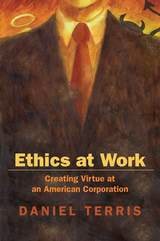
Ethics at Work
Creating Virtue at an American CorporationDaniel Terris
Brandeis University Press, 2013
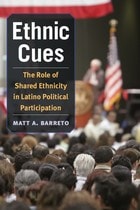
Ethnic Cues
The Role of Shared Ethnicity in Latino Political ParticipationMatt A. Barreto
University of Michigan Press, 2010
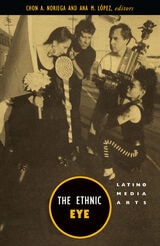
Ethnic Eye
Latino Media ArtsChon Noriega
University of Minnesota Press, 1996
The first in-depth treatment of Latino film and video.
This groundbreaking volume is the first to examine the range of Latino media arts, from independent feature production to documentary to experimental video. The essays explore the work of Chicano, Puerto Rican, Cuban American, and Latino film and video artists and address avant-garde practices, queer media, and performance art as well as more conventional film and video representations.
Contributors to The Ethnic Eye provide close readings of a wide variety of films and videos, including Stand and Deliver, American Me, Bedhead, El Mariachi, Carmelita Tropicana, Improper Conduct, Welcome to America’s Finest Tourist Plantation, Border Brujo, Mérida Proscrita, and Spitfire. The essays are unified by a concern with the creation of a common ground for Latino media arts, one that is pan-ethnic rather than narrowly transcribed by race, ethnicity, or national heritage. The volume also provides the first in-depth treatment of such artists as Robert Rodriquez, Ela Troyano, Raphael Montañez Ortiz, and Frances Salomé España. Eclectic in the range of media artists and works considered, The Ethnic Eye is unique in its inclusion of site-specific public art, as well as performance-based works. Contributors: Marcos Becquer; Charles Ramírez Berg, U of Texas; C. Ondine Chavoya; Marvin D’Lugo, Clark U; Claire F. Fox, Stanford U; Ilene S. Goldman; Carmen Huaco-Nuzum, U of California, Davis; Lillian Jiménez; Alisa Lebow; Scott MacDonald, Utica College; José Esteban Muñoz, New York U; Frances Negrón-Muntaner; Kathleen Newman, U of Iowa; Christopher Ortiz.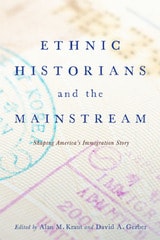
Ethnic Historians and the Mainstream
Shaping America's Immigration StoryAlan M. Kraut and David A. Gerber
Rutgers University Press, 2013
Do historians “write their biographies” with the subjects they choose to address in their research? In this collection, editors Alan M. Kraut and David A. Gerber compiled eleven original essays by historians whose own ethnic backgrounds shaped the choices they have made about their own research and writing as scholars. These authors, historians of American immigration and ethnicity, revisited family and personal experiences and reflect on how their lives helped shape their later scholarly pursuits, at times inspiring specific questions they asked of the nation’s immigrant past. They address issues of diversity, multiculturalism, and assimilation in academia, in the discipline of history, and in society at large. Most have been pioneers not only in their respective fields, but also in representing their ethnic group within American academia. Some of the women in the group were in the vanguard of gender diversity in the discipline of history as well as on the faculties of the institutions where they have taught.
The authors in this collection represent a wide array of backgrounds, spanning Europe, Africa, Asia, the Middle East, and Latin America. What they have in common is their passionate engagement with the making of social and personal identities and with finding a voice to explain their personal stories in public terms.
Contributors: Theresa Alfaro-Velcamp, John Bodnar, María C. García, David A. Gerber, Violet M. Showers Johnson, Alan M. Kraut, Timothy J. Meagher, Deborah Dash Moore, Dominic A. Pacyga, Barbara M. Posadas, Eileen H. Tamura, Virginia Yans, Judy Yung
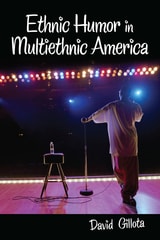
Ethnic Humor in Multiethnic America
Gillota, David
Rutgers University Press, 2013
Gillota investigates the manner in which various humorists respond to multiculturalism and the increasing diversity of the American population. Rather than looking at one or two ethnic groups at a time—as is common scholarly practice—the book focuses on the interplay between humorists from different ethnic communities. While some comic texts project a fantasy world in which diverse ethnic characters coexist in a rarely disputed harmony, others genuinely engage with the complexities and contradictions of multiethnic America.
The first chapter focuses on African American comedy with a discussion of such humorists as Paul Mooney and Chris Rock, who tend to reinforce a black/white vision of American race relations. This approach is contrasted to the comedy of Dave Chappelle, who looks beyond black and white and uses his humor to place blackness within a much wider multiethnic context.
Chapter 2 concentrates primarily on the Jewish humorists Sarah Silverman, Larry David, and Sacha Baron Cohen—three artists who use their personas to explore the peculiar position of contemporary Jews who exist in a middle space between white and other.
In chapter 3, Gillota discusses different humorous constructions of whiteness, from a detailed analysis of South Park to “Blue Collar Comedy” and the blog Stuff White People Like.
Chapter 4 is focused on the manner in which animated children’s film and the network situation comedy often project simplified and harmonious visions of diversity. In contrast, chapter 5 considers how many recent works, such as Harold and Kumar Go to White Castle and the Showtime series Weeds, engage with diversity in more complex and productive ways.
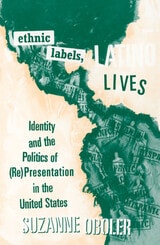
Ethnic Labels, Latino Lives
Identity and the Politics of (Re) Presentation in the United StatesSuzanne Oboler
University of Minnesota Press, 1995
Hispanic or Latino? Mexican American or Chicano? Social labels often take on a life of their own beyond the control of those who coin them or to whom they are applied. In Ethnic Labels, Latino Lives, Suzanne Oboler explores the history and current use of the label “Hispanic” as she illustrates the complex meanings that ethnicity has acquired in shaping our lives and identities.
Exploding the myth of cultural and national homogeneity among people of Latin American descent, Oboler interviews members of diverse groups who have traditionally been labeled “Hispanic” and records the many different meanings and social values they attribute to this label. For example, a person of Mexican descent has a different historical relationship with the United States and a different cultural background than an individual of Puerto Rican or Brazilian descent. The different meanings and social values those interviewed attribute to the label "Hispanic" also correspond to their gender and social class position, including racial prejudices and values stemming from their countries of origin. Though we have witnessed in recent years the fading of the idealized image of U.S. society as a melting pot, we have also realized that the possibility of recasting it in multicultural terms is problematic. Oboler discusses the historical process of labeling groups of individuals, illustrating how labels affect the meaning of citizenship and the struggle for full social participation in the United States. Ethnic Labels, Latino Lives aims to understand the role ethnic labels play in our society and brings us closer toward actualizing a society that values cultural diversity.
Ethnic Music on Records
A Discography of Ethnic Recordings Produced in the United States, 1893-1942. Vol. 1: Western EuropeRichard K. Spottswood
University of Illinois Press, 1990
Ethnic Music on Records
A Discography of Ethnic Recordings Produced in the United States, 1893-1942. Vol. 2: SlavicRichard K. Spottswood
University of Illinois Press, 1990
Ethnic Music on Records
A Discography of Ethnic Recordings Produced in the United States, 1893-1942. Vol. 3: Eastern EuropeRichard K. Spottswood
University of Illinois Press, 1990
Winner of the ARSC Award for Excellence in the Field of Recorded Country, Folk, or Ethnic Music, 1991.
Ethnic Music on Records
A Discography of Ethnic Recordings Produced in the United States, 1893-1942. Vol. 4: Spanish, Portuguese, Philippines, BasqueRichard K. Spottswood
University of Illinois Press, 1990
Ethnic Music on Records
A Discography of Ethnic Recordings Produced in the United States, 1893-1942. Vol. 5: Middle East, Far East, Scandinavian, English Language, American Indian, InternationalRichard K. Spottswood
University of Illinois Press, 1990
Ethnic Music on Records
A Discography of Ethnic Recordings Produced in the United States, 1893-1942. Vol. 6: Artist Index, Title IndexRichard K. Spottswood
University of Illinois Press, 1990
Ethnic Music on Records
A Discography of Ethnic Recordings Produced in the United States, 1893-1942. Vol. 7: Record Number Index, Matrix Number IndexRichard K. Spottswood
University of Illinois Press, 1990
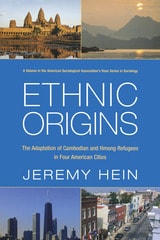
Ethnic Origins
The Adaptation of Cambodian and Hmong Refugees in Four American CitiesJeremy Hein
Russell Sage Foundation, 2006
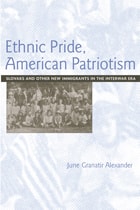
Ethnic Pride, American Patriotism
Slovaks And Other New ImiigrantsJune Granatir Alexander
Temple University Press, 2004
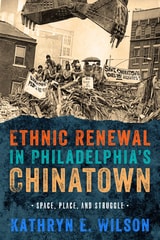
Ethnic Renewal in Philadelphia's Chinatown
Space, Place, and StruggleKathryn Wilson
Temple University Press, 2015
In Ethnic Renewal in Philadelphia’s Chinatown. Kathryn Wilson charts the unique history of this neighborhood. After 1945, a new generation of families began to shape Chinatown’s future. As plans for urban renewal—ranging from a cross-town expressway and commuter rail in the 1960s to a downtown baseball stadium in 2000—were proposed and developed, “Save Chinatown” activists rose up and fought for social justice.
Wilson chronicles the community’s efforts to save and renew itself through urban planning, territorial claims, and culturally specific rebuilding. She shows how these efforts led to Chinatown’s growth and its continued ability to serve as a living community for subsequent waves of new immigration.
Ethnic Routes to Becoming American
Indian Immigrants and the Cultures of CitizenshipRudrappa, Sharmila
Rutgers University Press, 2004
How does an immigrant become an ethnic American? And does American society fundamentally alter because of these newcomers?
In Ethnic Routes to Becoming American, Sharmila Rudrappa examines the paths South Asian immigrants in Chicago take toward assimilation in the late twentieth-century United States, where deliberations on citizenship rights are replete with the politics of recognition. She takes us inside two ethnic institutions, a battered women’s shelter, Apna Ghar, and a cultural organization, the Indo American Center, to show how immigrant activism, which brings cultural difference into public sphere debates, ironically abets these immigrants’ assimilation. She interlaces ethnographic details with political-philosophical debates on the politics of recognition and redistribution. In this study on the under-researched topic of the incorporation of South Asian immigrants into the American polity, Sharmila Rudrappa compels us to rethink ethnic activism, participatory democracy, and nation-building processes.

Ethnicity and the American Cemetery
Richard Meyer
University of Wisconsin Press, 1993
Contributors examine the material objects found within the cemeteries, as well as the customary practices bound to them. Contributors are from the fields of folklore, cultural history, historical archaeology, landscape architecture, and philosophy. Heavily illustrated, the volume also features an extensive annotated bibliography.
Ethnicity in Michigan
Issues and PeopleJack Glazier
Michigan State University Press, 2001
As the introductory volume in the series Discovering the Peoples of Michigan, Ethnicity in Michigan outlines the processes of migration, as well as the rich relationship between ethnic groups and the trajectories of historical and social change in Michigan. On both state and local levels, issues of identity, race, politics, and shared history inform community development. Jack Glazier and Arthur Helweg provide a substantive general and theoretical overview of the various ethnic groups in Michigan, and of the ways in which immigrants both respond to and shape Michigan's particular regional character.
Ethnicity on Parade
Inventing the Norwegian American through CelebrationApril R. Schultz
University of Massachusetts Press, 2009
These are some of the questions April R. Schultz addresses in this interdisciplinary study of the way in which ethnic identity has been shaped and expressed in American culture. Drawing on the work of historians, anthropologists, literary critics, and cultural theorists, Schultz analyzes one national celebration—the 1925 Norwegian-American Immigration Centennial—as a strategic site for the invention of ethnicity. She shows how Norwegian Americans used this ceremony to create a distinctive vision of their past and present—a social and cultural construction that both accommodated and resisted dominant Anglo-American conceptions of assimilation.
By taking a close look at the experiences of a white, middle-class, Protestant ethnic community, this book challenges many assumptions about the "Americanization" of immigrant groups and offers new insight into the uses of historical memory.
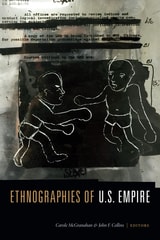
Ethnographies of U.S. Empire
Carole McGranahan and John F. Collins, editors
Duke University Press, 2018
Contributors: Kevin K. Birth, Joe Bryan, John F. Collins, Jean Dennison, Erin Fitz-Henry, Adriana María Garriga-López, Olívia Maria Gomes da Cunha, Matthew Gutmann, Ju Hui Judy Han, J. Kēhaulani Kauanui, Eleana Kim, Heonik Kwon, Soo Ah Kwon, Darryl Li, Catherine Lutz, Sunaina Maira, Carole McGranahan, Sean T. Mitchell, Jan M. Padios, Melissa Rosario, Audra Simpson, Ann Laura Stoler, Lisa Uperesa, David Vine
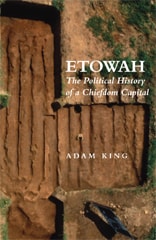
Etowah
The Political History of a Chiefdom CapitalAdam King
University of Alabama Press, 2002
A Dan Josselyn Memorial Publication
Detailed reconstruction of the waxing and waning of political fortunes among the chiefly elites at an important center of the prehistoric world
At the time the first Europeans arrived in the New World, thousands of earthen platform mounds dotted the landscape of eastern North America. Only a few of the mound sites have survived the ravages of time and the devastation of pilferers; one of these valuable monuments is Etowah, located near Cartersville in northern Georgia. Over a period of more than 100 years, excavations of the site’s six mounds, and in particular Mound C, have yielded a wealth of artifacts, including marble statues, copper embossed plates, ceremonial items, and personal adornments. These objects indicate an extensive trading network between Mississippian centers and confirm contact with Spanish conquistadores near Etowah in the mid-1500s.
Adam King has analyzed the architecture and artifacts of Etowah and deduced its vital role in the prehistory of the area. He advances a plausible historical sequence and a model for the ancient town's complex political structure. The chiefdom society relied upon institutional social ranking, permanent political offices, religious ideology, a redistribution of goods and services, and the willing support of the constituent population. King reveals strategies used by the paramount chiefs to maintain their sources of power and to control changes in the social organization. Elite alliances did not necessarily involve the extreme asymmetry of political domination and tribute extraction. King's use of ceramic assemblages recovered from Etowah to determine the occupation history and the construction sequence of public facilities (mounds and plazas) at the center is significant.
This fresh interpretation of the Etowah site places it in a contemporary social and political context with other Mississippian cultures. It is a one-volume sourcebook for the Etowah polity and its neighbors and will, therefore, command an eager audience of scholars and generalists.
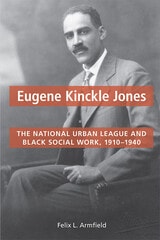
Eugene Kinckle Jones
The National Urban League and Black Social Work, 1910-1940Felix L. Armfield
University of Illinois Press, 2014
Drawing on interviews with Jones's colleagues and associates, as well as recently opened family and Urban League archives, Felix L. Armfield blends biography with an in-depth discussion of the roles of black institutions and organizations. The result is a work that offers new details on the growth of African American communities, the evolution of African American life, and the role of black social workers in the years before the civil rights era.
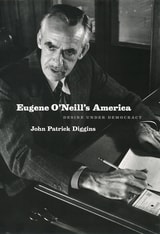
Eugene O'Neill's America
Desire Under DemocracyJohn Patrick Diggins
University of Chicago Press, 2007
In the face of seemingly relentless American optimism, Eugene O’Neill's plays reveal an America many would like to ignore, a place of seething resentments, aching desires, and family tragedy, where failure and disappointment are the norm and the American dream a chimera. Though derided by critics during his lifetime, his works resonated with audiences, won him the Nobel Prize and four Pulitzer, and continue to grip theatergoers today. Now noted historian John Patrick Diggins offers a masterly biography that both traces O’Neill’s tumultuous life and explains the forceful ideas that form the heart of his unflinching works.
Diggins paints a richly detailed portrait of the playwright’s life, from his Irish roots and his early years at sea to his relationships with his troubled mother and brother. Here we see O’Neill as a young Greenwich Village radical, a ravenous autodidact who attempted to understand the disjunction between the sunny public face of American life and the rage that he knew was simmering beneath. According to Diggins, O’Neill mined this disjunction like no other American writer. His characters burn with longing for an idealized future composed of equal parts material success and individual freedom, but repeatedly they fall back to earth, pulled by the tendrils of family and the insatiability of desire. Drawing on thinkers from Emerson to Nietzsche, O’Neill viewed this endlessly frustrated desire as the problematic core of American democracy, simultaneously driving and undermining American ideals of progress, success, and individual freedom.
Melding a penetrating assessment of O’Neill’s works and thought with a sensitive re-creation of his life, Eugene O’Neill’s America offers a striking new view of America’s greatest playwright—and a new picture of American democracy itself.
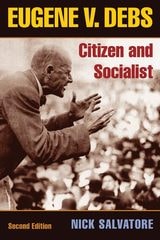
Eugene V. Debs
Citizen and SocialistNick Salvatore
University of Illinois Press, 2007
Eugene Debs (1855-1926) is regarded by many as American history's premier labor advocate. He was the leader of the Socialist party, five-time Socialist candidate for president, outspoken on the rights of all workers, and a persistent defender of America's democratic traditions.
Nick Salvatore's acclaimed biography offers a major reevaluation of Debs, the movements he launched, and his belief in American Socialism as an extension of the nation's democratic traditions. He also shows the relationship between Debs's public image and his private life as child, sibling, husband, and lover. Salvatore's Debs--weaknesses intact--emerges as a complex man, frustrated and angered by the glaring inequities of a new economic order, and willing to risk his freedom to preserve the essence of democratic society.
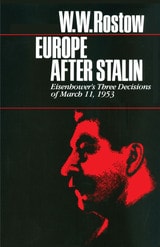
Europe after Stalin
Eisenhower's Three Decisions of March 11, 1953By W.W. Rostow
University of Texas Press, 1982
Stalin's death on March 6, 1953, reopened the debate within the Eisenhower administration over whether or not the United States should propose and actively promote the reunification of Germany at a summit conference. Written by an insider, this is the only published firsthand account of this foreign policy decision—a decision that illuminated the dilemmas of the Cold War at an important moment.
W. W. Rostow examines the origins of Eisenhower's "peace speech" of April 16, 1953, and of the National Security Council's debate on the German question between John Foster Dulles and presidential adviser C. D. Jackson. Jackson proposed immediate high-level diplomatic contact with the Soviet Union and the countries of Western Europe to discuss German reunification, as well as proposals for the general control of armaments and special security arrangements for Europe. Dulles, however, argued for a more reserved posture, which ruled out summitry and immediate negotiation with the Soviets. Dulles prevailed, but Eisenhower made his famous "peace speech."
In his concluding chapter, Rostow explores the question of whether or not anything was lost by this outcome. Was an opportunity for a united Germany forfeited when Eisenhower rejected Churchill's suggestion for a prompt summit meeting and backed Dulles against Jackson in the National Security Council meeting of March 11?
This is the third in a series of volumes by the author that probe the relationship between ideas and action in the making of major policy decisions. In this series, Rostow examines historic decision making from an insider's point of view while exploiting fully the rich documentary evidence.
Eutaw
A Sequel to The Forayers, or The Raid of the Dog DaysWilliam Gilmore Simms
University of Arkansas Press, 2006
Eutaw was a sequel to his very successful 1855 novel, The Forayers, and thus completed the most comprehensive saga of the war in our literary history. It focuses on the battle of Eutaw Springs in 1781, which ended British domination of South Carolina. Prominent in this significant battle were Nathanael Greene, Light-Horse Harry Lee, and Francis Marion, about whom Simms would later write a biography. As with other volumes in the Arkansas Edition of Simms’s work, this volume includes a critical introduction by the editor and a Simms chronology, as well as appendices dealing with textual matters.

Evaluating Teen Services and Programs
Sarah Flowers
American Library Association, 2012
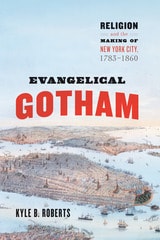
Evangelical Gotham
Religion and the Making of New York City, 1783–1860Kyle B. Roberts
University of Chicago Press, 2016

Evangelical Identity and Gendered Family Life
Gallagher, Sally K
Rutgers University Press, 2003
Evangelical Identity and Gendered Family Life provides a sociological and historical analysis of gender, family, and work among evangelical Protestants. In this innovative study, Sally Gallagher traces two lines of gender ideals—one of husbands’ authority and leadership, the other of mutuality and partnership in marriage—from the Puritans to the Promise Keepers into the lives of ordinary evangelicals today. Rather than simply reacting against or accommodating themselves to “secular society,” Gallagher argues that both traditional and egalitarian evangelicals draw on longstanding beliefs about gender, human nature, and the person of God.
The author bases her arguments on an analysis of evangelical family advice literature, data from a large national survey and personal interviews with over 300 evangelicals nationwide. No other work in this area draws on such a range of data and methodological resources. Evangelical Identity and Gendered Family Life establishes a standard for future research by locating the sources, strategies, and meaning of gender within evangelical Protestantism.
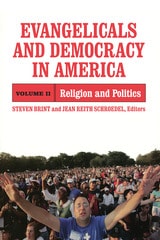
Evangelicals and Democracy in America
Religion and PoliticsSteven G. Brint
Russell Sage Foundation, 2009