Results by title
944 books match the query 'Indians of North America' and 38 start with f
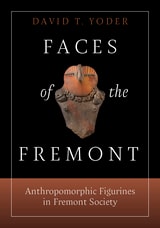
Faces of the Fremont
Anthropomorphic Figurines in Fremont SocietyDavid T. Yoder
University of Utah Press, 2025
The Fremont culture is famous for its anthropomorphic figurines—small clay figures occasionally dressed in clothing and decorated with jewelry—but surprisingly, archaeologists know very little about these important artifacts and their place in Fremont society. In Faces of the Fremont, the largest study of the subject ever undertaken, David T. Yoder takes a straightforward approach to cultural commentary through artifactual analysis as he interprets over 800 figurines and anthropomorphic objects.
Unlike previous research on the subject, this volume explores neglected topics within Fremont studies, including sex and gender, clothing and body decoration, hairstyles, and childhood. Complete with in-depth analysis and interpretation of the significance of the figurines to the Fremont people, as well as hundreds of beautiful color photographs, Faces of the Fremont provides a nuanced understanding of figurine manufacture, formalizes a classification system for figurine traits, and documents new and interesting geographic and temporal patterns.
Faith in Paper
The Ethnohistory and Litigation of Upper Great Lakes Indian TreatiesCharles E. Cleland
University of Michigan Press, 2011

Fantastic Antone Succeeds
Experiences in Educating Children with Fetal Alcohol SyndromeJudith Kleinfeld
University of Alaska Press, 1993
The book consists of separate chapters written in a popular and accessible style by psychologists, teachers, and birth and adoptive parents of alcohol-affected children. Many chapters are personal stories with emotional power. A birth mother, for example, tells of her anguish when she realizes that she has recovered from her own alcoholism but her daughter cannot. This mother describes how she dealt with her grief, how she told her daughter the truth, her daughter's relief at finally understanding what was wrong, and how they both developed ways of overcoming her daughter's learning problems.
Other chapters describe how experienced teachers have learned to organize classrooms where alcohol-affected children can thrive and how therapists have learned to work with parents. One chapter summarizes medical knowledge of FAS/FAE and offers information useful for understanding a child's learning and behavioral problems and devising educational approaches. The book includes lists of important resources, organizations to contact, and descriptions of effective classroom practices for teachers.
Without minimizing the seriousness of FAS/FAE and the first priority prevention, Fantastic Antone Succeeds provides practical tools and strategies that can help alcohol-affected individuals and their families lead happier, more productive lives.
Feminist Readings of Native American Literature
Coming to VoiceKathleen M. Donovan
University of Arizona Press, 1998
The author demonstrates how Canadian women of mixed-blood ancestry achieve a voice through autobiographies and autobiographical novels. Using a framework of feminist reader response theory, she considers an underlying misogyny in the writings of N. Scott Momaday. And in examining commonalities between specific cultures, she discusses how two women of color, Paula Gunn Allen and Toni Morrison, explore representations of femaleness in their respective cultures. By synthesizing a broad spectrum of critical writing that overlaps women's voices and Native American literature, Donovan expands on the frame of dialogue within feminist literary and cultural theory. Drawing on the related fields of ethnography, ethnopoetics, ecofeminism, and post-colonialism, Feminist Readings of Native American Literature offers the first systematic study of the intersection between two dynamic arenas in literary studies today.
Fictions of Land and Flesh
Blackness, Indigeneity, SpeculationMark Rifkin
Duke University Press, 2019

Field Man
Life as a Desert ArchaeologistJulian D. Hayden; Edited by Bill Broyles and Diane E. Boyer
University of Arizona Press, 2012
Fields of Vision
Essays on the Travels of William BartramEdited by Kathryn E. Holland Braund and Charlotte M. Porter
University of Alabama Press, 2010
A classic work of history, ethnography, and botany, and an examination of the life and environs of the 18th-century south
William Bartram was a naturalist, artist, and author of Travels through North and South Carolina, Georgia, East and West Florida, the Cherokee Country, the ExtensiveTerritories of the Muscogulees, or Creek Confederacy, and the Country of the Choctaws. The book, based on his journey across the South, reflects a remarkable coming of age. In 1773, Bartram departed his family home near Philadelphia, Pennsylvania, as a British colonist; in 1777, he returned as a citizen of an emerging nation of the United States. The account of his journey, published in 1791, established a national benchmark for nature writing and remains a classic of American literature, scientific writing, and history. Brought up as a Quaker, Bartram portrayed nature through a poetic lens of experience as well as scientific observation, and his work provides a window on 18th-century southern landscapes. Particularly enlightening and appealing are Bartram’s detailed accounts of Seminole, Creek, and Cherokee peoples.The Bartram Trail Conference fosters Bartram scholarship through biennial conferences held along the route of his travels. This richly illustrated volume of essays, a selection from recent conferences, brings together scholarly contributions from history, archaeology, and botany. The authors discuss the political and personal context of his travels; species of interest to Bartram; Creek architecture; foodways in the 18th-century south, particularly those of Indian groups that Bartram encountered; rediscovery of a lost Bartram manuscript; new techniques for charting Bartram’s trail and imaging his collections; and a fine analysis of Bartram’s place in contemporary environmental issues.
Fierce and Indomitable
The Protohistoric Non-Pueblo World in the American SouthwestEdited by Deni J. Seymour
University of Utah Press, 2016
Trending upward as an archaeological field of study, protohistoric mobile groups provide fascinating new directions for cutting-edge research in the American Southwest and beyond. These mobile residents represent the ancient and ancestral roots of many modern indigenous peoples, including the Apaches, Jumano, Yavapai, and Ute. These important protohistoric and historic mobile people have tended to be ignored because their archaeological sites were deemed too difficult to identify, too scant to be worthy of study, and too different to incorporate. This book brings together information from a diverse collection of authors working throughout the American Southwest and its fringes to make the bold statement that these groups can be identified in the archaeological record and their sites have much to contribute to the study of cultural process, method and theory, and past lifeways. Mobile groups are integral for assessing the grand reorganizational events of the Late Prehistoric period and are key to understanding colonial contact and transformations. Now, the only analyses, overviews, and class lectures that will be considered comprehensive will be those that address the presence of these many widespread mobile peoples.

Fighter in Velvet Gloves
Alaska Civil Rights Hero Elizabeth PeratrovichAnnie Boochever with Roy Peratrovich Jr.
University of Alaska Press, 2019
In 1945, Peratrovich stood before the Alaska Territorial Legislative Session and gave a powerful speech about her childhood and her experiences being treated as a second-class citizen. Her heartfelt testimony led to the passing of the landmark Alaska Anti-Discrimination Act, America’s first civil rights legislation. Today, Alaska celebrates Elizabeth Peratrovich Day every February 16, and she was honored on the gold one-dollar coin in 2020.
Annie Boochever worked with Elizabeth’s eldest son, Roy Peratrovich Jr., to bring Elizabeth’s story to life in the first book written for young teens on this remarkable Alaska Native woman.

Fighter in Velvet Gloves
Study GuideAnnie Boochever
University of Alaska Press, 2021
Annie Boochever worked with Elizabeth’s eldest son, Roy Peratrovich Jr., to bring Elizabeth’s story to life in the first book written for young teens on this remarkable Alaska Native woman. Written about an Alaska Native civil rights leader, Fighter in Velvet Gloves has been incorporated in school curricula around the country, and won the 2019 Lumen Award for Literary Excellence, in addition to receiving many other national recognitions. This study guide is a custom work designed to help instructors teach the story of Elizabeth Peratrovich to students in grades 6 through 12.
Fighting for Paradise
A Military History of the Pacific NorthwestKurt R. Nelson
Westholme Publishing, 2007
One of the Most Important Battlegrounds in the History of America
While it is in the eastern United States where most Americans identify our military history, the vast, resource-rich Pacific Northwest, stretching from Northern California through British Columbia, endured a series of battles and wars over the course of the nineteenth century that were of regional and national importance. It was here where Great Britain and the United States had their final confrontation in the Americas, where Chief Joseph attempted to secure independence for the Nez Perce, and where the Oregon Trail marked the first great migration to the West of settlers bent on carving out new lives in the wilderness. The Pacific Northwest also saw some of the only attacks on the mainland by Japan during World War II.
Beginning with the earliest known accounts of wars among the American Indians of the region, Fighting for Paradise: A Military History of the Pacific Northwest describes early European contact, including British trappers of the Hudson's Bay Company, the Lewis and Clark Expedition, Jedediah Smith, and John Jacob Astor's trading post. The competition over the lucrative fur trade led to the "Pig War," which almost resulted in another armed conflict between Great Britain and the United States, but it was the influx of settlers from the Oregon Trail that touched off the long bitter battles between whites and American Indians. Starting with the 1847 Whitman Massacre and the ensuing war it touched off, the book covers the next three decades of violence, ending with the Sheepeater's War in 1879. Kurt R. Nelson then relates the Pacific Northwest's contributions to the Spanish-American and Philippine-American Wars, the Mexican Punitive Expedition, World War I, and finally World War II, where the region fought Japanese submarine attacks and was harassed by balloon bombs. Throughout, the author provides current information about the state of preservation of various battle sites and other points of historical interest. Accompanied by maps and photographs, Fighting for Paradise provides insight into an area of American military history, rich in drama, that is not generally known.
Finding Right Relations
Quakers, Native Americans, and Settler ColonialismMarianne O. Nielsen and Barbara M. Heather
University of Arizona Press, 2022
Centering on the relationship between Quaker colonists and the Lenape people, Finding Right Relations explores the contradictory position of the Quakers as both egalitarian, pacifist people, and as settler colonists. This book explores major challenges to Quaker beliefs and resulting relations with American Indians from the mid-seventeenth century to the late nineteenth century. It shows how the Quakers not only failed to prevent settler colonial violence against American Indians but also perpetuated it. It provides historical examples such as the French and Indian War, the massacre of the Conestoga Indians, and the American Indian boarding schools to explore the power of colonialism to corrupt even those colonists with a belief system rooted in social justice.
While this truth rubs against Quaker identity as pacifists and socially conscious, justice-minded people, the authors address how facing these truths provide ways forward for achieving restitution for the harms of the past. This book offers a path to truth telling that is essential to the healing process.

Finding a Way to the Heart
Feminist Writings on Aboriginal and Women’s History in CanadaRobin Jarvis Brownlie
University of Manitoba Press, 2012
Finding the People who Flaked the Stone at English Camp
Close, Angela E
University of Utah Press, 2006

First Nations Gaming in Canada
Yale D. Belanger
University of Manitoba Press, 2011
First Peoples of Great Salt Lake
A Cultural Landscape from Nevada to WyomingSteven R. Simms
University of Utah Press, 2023
Great Salt Lake is a celebrated, world-recognized natural landmark. It, and the broader region bound to it, is also a thoroughly cultural landscape; generations of peoples made their lives there. In an eminently readable narrative, Steven Simms, one of the foremost archaeologists of the region, traces the scope of human history dating from the Pleistocene, when First Peoples interacted with the lapping waters of Lake Bonneville, to nearly the present day. Through vivid descriptions of how people lived, migrated, and mingled, with persistence and resilience, Simms honors the long human presence on the landscape.
First Peoples of Great Salt Lake takes a different approach to understanding the ancients than is typical of archaeology. De-emphasizing categories and labels, it traces changing environments, climates, and peoples through the notion of place. It challenges the "Pristine Myth," the cultural bias that Indigenous peoples were timeless, changeless, primitive, and the landscapes they lived in sparsely populated and perpetually pristine. First Peoples and their descendants modified the forests and understory vegetation, shaped wildlife populations, and adapted to long-term climate change. Native Americans of Great Salt Lake were very much part of their world, and the story here is one of long continuity through dramatic cultural change.
Firsting and Lasting
Writing Indians out of Existence in New EnglandJean M. O’Brien
University of Minnesota Press, 2010
Fish in the Lakes, Wild Rice, and Game in Abundance
Testimony on Behalf of Mille Lacs Ojibwe Hunting and Fishing RightsEdited by James M. McClurken
Michigan State University Press, 2000
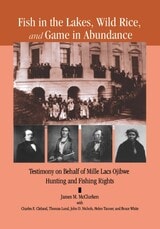
On 13 August 1990 members of the Mille Lacs Band of Ojibwe filed a lawsuit against the State of Minnesota for interfering with the hunting, fishing, and gathering rights that had been guaranteed to them in an 1837 treaty with the United States. In order to interpret the treaty the courts had to consider historical circumstances, the intentions of the parties, and the treaty's implementation. The Mille Lacs Band faced a mammoth challenge. How does one argue the Native side of the case when all historical documentation was written by non- Natives? The Mille Lacs selected six scholars to testify for them. Published here for the first time, Charles Cleland, James McClurken, Helen Tanner, John Nichols, Thomas Lund, and Bruce White discuss the circumstances under which the treaty was written, the personalities involved in the negotiations and the legal rhetoric of the times, as well as analyze related legal conflicts between Natives and non- Natives. Justice Sandra Day O'Connor delivered the 1999 Opinion of the [United States Supreme] Court.

Food Plants of the Sonoran Desert
Wendy C. Hodgson
University of Arizona Press, 2001
The seemingly inhospitable Sonoran Desert has provided sustenance to indigenous peoples for centuries. Although it is to all appearances a land bereft of useful plants, fully one-fifth of the desert's flora are edible.
This volume presents information on nearly 540 edible plants used by people of more than fifty traditional cultures of the Sonoran Desert and peripheral areas. Drawing on thirty years of research, Wendy Hodgson has synthesized the widely scattered literature and added her own experiences to create an exhaustive catalog of desert plants and their many and varied uses.
Food Plants of the Sonoran Desert includes not only plants such as gourds and legumes but also unexpected food sources such as palms, lilies, and cattails, all of which provided nutrition to desert peoples. Each species entry lists recorded names and describes indigenous uses, which often include nonfood therapeutic and commodity applications. The agave, for example, is cited for its use as food and for alcoholic and nonalcoholic beverages, syrup, fiber, cordage, clothing, sandals, nets, blankets, lances, fire hearths, musical instruments, hedgerows, soap, and medicine, and for ceremonial purposes. The agave entry includes information on harvesting, roasting, and consumption—and on distinguishing between edible and inedible varieties.
No other source provides such a vast amount of information on traditional plant uses for this region. Written to be easily accessible to general readers, the book is an invaluable compendium for anyone interested in the desert's hidden bounty.
Food Production in Native North America
An Archaeological PerspectiveKristen J. Gremillion
University Press of Colorado, 2018

Food Storage in Michigan's Late Woodland
The Work of Indigenous WomenKathryn M. Frederick
University of Alabama Press, 2026
Incorporates experimental archaeology to understand the food-caching strategies led by Indigenous women in Late Woodland Michigan.
This experimental archaeology book centers on the decision of Indigenous women in Michigan’s Late Woodland to store food in cache pits for later use, to ensure a stable food supply. These food storage techniques were efforts to increase communal chances of survival in direct responses to sociopolitical changes. Kathryn M. Frederick highlights the importance of food storage in these communities and the decision-making and behaviors behind it.
To discover why food storage became a popular practice at that period, Frederick considered the efficacy of subterranean food storage and constructed experiments to understand the timing and use of cache pits and to test their reliability and efficiency. She also compiled ethnographic data on location, environmental conditions, movement strategies, and types of foodstuffs stored for dozens of hunter-gatherer groups. Two distinct patterns of food storage emerged: “reliant” and “redundant.” Frederick argues that the Indigenous women utilized a system of reliant storage during times of abundance but could switch to a redundant system as the socioeconomic climate shifted. This book will interest a wide swath of archaeologists and others interested in Indigenous foodways and women’s key roles.
Footpaths and Bridges
Voices from the Native American Women Playwrights ArchiveEdited by Shirley A. Huston-Findley and Rebecca Howard
University of Michigan Press, 2011
Footpaths and Bridges celebrates the vitality and diversity of Native American women, collecting plays ranging from ETHNOSTRESS—a humorous take on art and identity politics—to the biographical musical Te Ata to a retelling of the Thanksgiving story from the Wampanoag perspective. The dramatic works are accompanied by critical commentary that illuminates Native American women’s theater practices and perspectives, highlighting the issues of heritage, identity, and changing lifestyles that the plays imaginatively tackle.
Featuring work from a wide array of tribes and geographic regions, the collection affords the artist, scholar, and general reader access to previously unheard voices that communicate the complexity and the diversity of the Native American experience. The far-ranging genres and content of the plays suggest the many possibilities for communicating the past and the present, the personal and the political, and the stunning kaleidoscope of Native American life and art.
“Often thoughtful provocateurs, Native American playwrights are frequently overlooked . . . eminently readable, and possibly performable, the plays [in this collection] examine colonization, generational differences, ‘ethnostress,’ and cultural identity.”
—Choice
Foraging in the Tennessee River Valley
12,500 to 8,000 Years AgoKandace D. Hollenbach
University of Alabama Press, 2009

Foreign Objects
Rethinking Indigenous Consumption in American ArchaeologyEdited by Craig N. Cipolla
University of Arizona Press, 2017
Brass tinklers and pendants. Owl effigies, copper kettles, crucifixes with blue glass stones. What do they have in common? The answer spans thousands of years and a multitude of peoples and places, and reveals how people made sense of their world as they collected and used the objects they encountered.
Foreign Objects demonstrates the breadth and vibrancy of contemporary archaeology. Taking a broad set of archaeological cases from across the Americas, editor Craig N. Cipolla and the volume contributors explore how indigenous communities have socialized foreign objects over time. The book critiques the artificial divide between prehistory and history, studying instead the long-term indigenous histories of consumption, a term typically associated with capitalism and modern-world colonialism.
The case studies range from “exotic” stone tools used millennia ago to nineteenth-century patent medicines made and marketed by an Indian doctress. Foreign Objects focuses on how indigenous groups and foreign objects became entangled with one another in myriad ways. The book explores how the framework of consumption can shed new light on trade, exchange, materiality, and cultural production.
Contributors place foreign objects in the spotlight and offer a comparison of how this general class of material played a part in indigenous and colonial worlds. Each chapter illustrates how notions of consumption fit into their place in time and also delves into how foreign objects related to ideas of the body and personhood, how people used them to participate in political and spiritual worlds, and how they presented new ways of enduring or resisting European colonialism and capitalism. Foreign Objects is a critical look at consumption through the lens of indigenous knowledge and archaeological theory.
Contributors:
Matthew A. Beaudoin
Lewis Borck
Kathleen J. Bragdon
Craig N. Cipolla
Charles R. Cobb
John L. Creese
Diana DiPaolo Loren
Martin Gallivan
Meghan C. L. Howey
Barbara J. Mills
Maxine Oland
Lee M. Panich
Patricia E. Rubertone
Christopher Shephard
Keith D. Stephenson
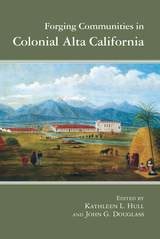
Forging Communities in Colonial Alta California
Edited by Kathleen L. Hull and John G. Douglass
University of Arizona Press, 2018
Forging Communities in Colonial Alta California reorients understandings of this dynamic period, which challenged both Native and non-Native people to reimagine communities not only in different places and spaces but also in novel forms and practices. The contributors draw on archaeological and historical archival sources to analyze the generative processes and nature of communities of belonging in the face of rapid demographic change and perceived or enforced difference.
Contributors provide important historical background on the effects that colonialism, missions, and lives lived beyond mission walls had on Indigenous settlement, marriage patterns, trade, and interactions. They also show the agency with which Indigenous peoples make their own decisions as they construct and reconstruct their communities. With nine different case studies and an insightful epilogue, this book offers analyses that can be applied broadly across the Americas, deepening our understanding of colonialism and community.
Contributors:
Julienne Bernard
James F. Brooks
John Dietler
Stella D’Oro
John G. Douglass
John Ellison
Glenn Farris
Heather Gibson
Kathleen L. Hull
Linda Hylkema
John R. Johnson
Kent G. Lightfoot
Lee M. Panich
Sarah Peelo
Seetha N. Reddy
David W. Robinson
Tsim D. Schneider
Christina Spellman
Benjamin Vargas
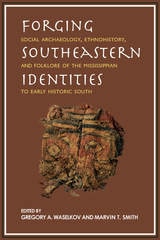
Forging Southeastern Identities
Social Archaeology, Ethnohistory, and Folklore of the Mississippian to Early Historic SouthGregory A. Waselkov
University of Alabama Press, 2017
Forging Southeastern Identities explores the many ways archaeologists and ethnohistorians define and trace the origins of Native Americans’ collective social identity.
Forging Southeastern Identities: Social Archaeology and Ethnohistory of the Mississippian to Early Historic South, a groundbreaking collection of ten essays, covers a broad expanse of time—from the ninth to the nineteenth centuries—and focuses on a common theme of identity. These essays represent the various methods used by esteemed scholars today to study how Native Americans in the distant past created new social identities when old ideas of the self were challenged by changes in circumstance or by historical contingencies.
Archaeologists, anthropologists, and folklorists working in the Southeast have always recognized the region’s social diversity; indeed, the central purpose of these disciplines is to study peoples overlooked by the mainstream. Yet the ability to define and trace the origins of a collective social identity—the means by which individuals or groups align themselves, always in contrast to others—has proven to be an elusive goal. Here, editors Gregory A. Waselkov and Marvin T. Smith champion the relational identification and categorical identification processes, taken from sociological theory, as effective analytical tools.
Taking up the challenge, the contributors have deployed an eclectic range of approaches to establish and inform an overarching theme of identity. Some investigate shell gorgets, textiles, shell trade, infrastructure, specific sites, or plant usage. Others focus on the edges of the Mississippian world or examine colonial encounters between Europeans and native peoples. A final chapter considers the adaptive malleability of historical legend in the telling and hearing of slave narratives.
French and Indians in the Heart of North America, 1630-1815
Robert Englebert
Michigan State University Press, 2013
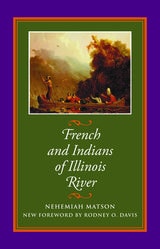
French and Indians of Illinois River
Nehemiah Matson. Foreword by Rodney O. Davis
Southern Illinois University Press, 2001
Complex and paradoxical, Nehemiah Matson (1816–1873) celebrated the occupation of the Middle West by European pioneers even as he labored to preserve the memory of the natives these pioneers replaced. He perpetuated the memory of the Indians who were driven out of the territory, but he nevertheless accumulated wealth selling their land to the pioneers. Rodney O. Davis notes in his new foreword to this book that Matson combined the attributes of a scholar with those of a salesman and promoter.
Matson settled in Princeton, Illinois, in 1836. He left behind a library partially endowed by him, named for him, and finally completed in 1913. According to Davis, however, Matson’s other legacy, “of equal significance in his own eyes, consisted of the five books he authored on northern Illinois and Illinois River history and cartography, volumes based not only on conscientious scholarship but also on both Indian and white reminiscence and on local folklore.”
Matson’s historical writings are valuable even when he deals with well-known events because his personal perspective makes his observations unique. Without the stories and reminiscences he collected, much valuable information would have been lost, especially since many of his informants, both Indian and European, were illiterate. Because his informants often told conflicting stories, Matson admitted that “harmonizing all conflicting accounts . . . has not been a success.”
Although Matson’s sources may not always have agreed, and sometimes his heart may have overruled his head and colored his accounts, he was a conscientious and committed author. “Obviously,” Davis explains, “this book must be evaluated as what it is, a piece of colorful local history, romantically anchored in legend yet rooted also in invaluable research and produced by a dedicated amateur whose standards were high. . . . French and Indians of Illinois River is a model of its type, indeed a minor classic.”

Friar Bringas Reports to the King
Methods of Indoctrination on the Frontier of New Spain, 1796–97Translated and Edited by Daniel S. Matson and Bernard L. Fontana
University of Arizona Press, 1977

Frigid Embrace
Politics, Economics, and Environment in AlaskaStephen Haycox
Oregon State University Press, 2002
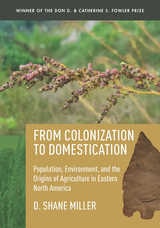
From Colonization to Domestication
Population, Environment, and the Origins of Agriculture in Eastern North AmericaD. Shane Miller
University of Utah Press, 2018
Eastern North America is one of only a handful of places in the world where people first discovered how to domesticate plants. In this book, anthropologist Shane Miller uses two common, although unconventional, sources of archaeological data—stone tools and the distribution of archaeological sites—to trace subsistence decisions from the initial colonization of the American Southeast at the end of the last Ice Age to the appearance of indigenous domesticated plants roughly 5,000 years ago.
Miller argues that the origins of plant domestication lie within the context of a boom/bust cycle that culminated in the mid-Holocene, when hunter-gatherers were able to intensively exploit shellfish, deer, oak, and hickory. After this resource “boom” ended, some groups shifted to other plants in place of oak and hickory, which included the suite of plants that were later domesticated. Accompanying these subsistence trends is evidence for increasing population pressure and declining returns from hunting. Miller contends, however, that the appearance of domesticated plants in eastern North America, rather than simply being an example of necessity as the mother of invention, is the result of individuals adjusting to periods of both abundance and shortfall driven by climate change.
From Household to Empire
Society and Economy in Early Colonial New MexicoHeather B. Trigg
University of Arizona Press, 2005
William P. Clements Center for Southwest Studies, Southern Methodist University
Settlers at Santa Fe and outlying homesteads during the seventeenth century established a thriving economy that saw the exchange of commodities produced by indigenous peoples, settlers, and Franciscan friars for goods manufactured as far away as China, France, and Turkey. This early Spanish colonial period in New Mexico provides an opportunity to explore both economic activity within a colony and the relations between colony and homeland. By examining the material remains of this era from 1598 to 1680, Heather Trigg reveals a more complete picture of colonial life. Drawing on both archaeological and historical sources, Trigg analyzes the various levels of economic activity that developed: production of items in colonial households, exchanges between households, and trade between the colony and Mexico. Rather than focusing only on the flow of products and services, she also explores the social mechanisms that likely had a significant impact on the economic life of the colony. Because economic activity was important to so many aspects of daily life, she is able to show how and why colonial society worked the way it did. While focusing on the colonists, she also explores their relations with Pueblo peoples. Through her analysis of these two pools of data, Trigg generates insights not usually gleaned from the limited texts of the period, providing information about average colonists in addition to the governors and clergy usually covered in historical accounts. By using specific examples from historical documents and archaeological materials, she shows that colonists from all levels of society modified both formal and informal rules of economic behavior to better fit the reality of the colonial frontier. With its valuable comparative data on colonization, From Household to Empire provides a novel way of examining colonial economies by focusing on the maintenance and modification of social values. For all readers fascinated by the history of the Southwest, this book provides a fuller picture of life in early New Mexico than has previously been seen.
From Mountain Top to Valley Bottom
Understanding Past Land Use in the Northern Rio Grande Valley, New MexicoBradley J. Vierra
University of Utah Press, 2013
The essays in this collection are unified by three specific themes: landscape, movement, and technology. Landscape involves the ecological backdrop of the northern Rio Grande valley, including past and present environments. Movement refers to the positioning of people across the landscape along with the dynamic and fluid nature with which people—past and present—view their relationship with the “above” and “below.” Technology not only refers to the tools and facilities that past people may have used but to the organization of labor needed to cooperatively exploit a variety of subsistence resources and the exchange of products across the region. This volume provides both a cross section of current research from expert scholars and a broad perspective that seeks to integrate new data from lowland and upland contexts. From Mountain Top to Valley Bottom will appeal to those interested in obsidian source studies, geoarchaeology, past climatic regimes, foraging societies, early agriculture, ceramic technology, subsistence, early village formation, ethnogenesis, and historic multiethnic economies.

From Quarry to Cornfield
The Political Economy of Mississippian Hoe ProductionCharles Richard Cobb
University of Alabama Press, 2001
An innovative model for examining the technology of hoe production and its contribution to the agriculture of Mississippian communities.
Lithic specialist Charles Cobb examines the political economy in Mississippian communities through a case study of raw material procurement and hoe production and usage at the Mill Creek site on Dillow Ridge in southwest Illinois. Cobb outlines the day-to-day activities in a Mississippian chiefdom village that flourished from about A.D. 1250 to 1500. In so doing, he provides a fascinating window into the specialized tasks of a variety of "day laborers" whose contribution to the community rested on their production of stone hoes necessary in the task of feeding the village. Overlooked in most previous studies, the skills and creativity of the makers of the hoes used in village farming provide a basis for broader analysis of the technology of hoe use in Mississippian times.
Although Cobb's work focuses on Mill Creek, his findings at this site are representative of the agricultural practices of Mississippian communities throughout the eastern United States. The theoretical underpinnings of Cobb's study make a clear case for a reexamination of the accepted definition of chiefdom, the mobilization of surplus labor, and issues of power, history, and agency in Mississippian times. In a well-crafted piece of writing, Cobb distinguishes himself as one of the leaders in the study of lithic technology. From Quarry to Cornfield will find a well-deserved place in the ongoing discussions of power and production in the Mississippian political economy.
From Time Immemorial
Indigenous Peoples and State SystemsBy Richard J. Perry
University of Texas Press, 1996
Around the globe, people who have lived in a place "from time immemorial" have found themselves confronted by and ultimately incorporated within larger state systems. During more than three decades of anthropological study of groups ranging from the Apache to the indigenous peoples of Kenya, Richard J. Perry has sought to understand this incorporation process and, more importantly, to identify the factors that drive it. This broadly synthetic and highly readable book chronicles his findings.
Perry delves into the relations between state systems and indigenous peoples in Canada, the United States, Mexico, and Australia. His explorations show how, despite differing historical circumstances, encounters between these state systems and native peoples generally followed a similar pattern: invasion, genocide, displacement, assimilation, and finally some measure of apparent self-determination for the indigenous people—which may, however, have its own pitfalls.
After establishing this common pattern, Perry tackles the harder question—why does it happen this way? Defining the state as a nexus of competing interest groups, Perry offers persuasive evidence that competition for resources is the crucial factor in conflicts between indigenous peoples and the powerful constituencies that drive state policies.
These findings shed new light on a historical phenomenon that is too often studied in isolated instances. This book will thus be important reading for everyone seeking to understand the new contours of our postcolonial world.

From the Other Side of Night/Del otro lado de la noche
New and Selected PoemsFrancisco X. Alarcón
University of Arizona Press, 2002
One of Chicano literature's premier poets, Alarcón has brought his luminous images to the page in such acclaimed volumes as Sonnets to Madness and Other Misfortunes and Snake Poems. Now he has assembled the best of his work from fifteen years, along with fourteen new poems, in a book that distills his magical sense of reality into a cup brimming with passion.
Raised in Guadalajara and now living in the San Francisco Bay area, Alarcón sees that " 'Mexican' / is not / a noun / or an / adjective / 'Mexican' / is a life / long / low-paying / job." Participating in a poetic tradition that goes back to the mystic Spanish poets of the sixteenth century, he brings us sonnets infused with romance and tenderness—and shorter poems that are direct and hard-hitting commentaries on American society, as he cries out for "a more godlike god," one "who spends nights / in houses / of ill repute / and gets up late / on Saturdays."
Alarcón invokes both the mysteries of Mesoamerica and the "otherness" of his gay identity. "My skin is dark / as the night / in this country / of noontime," he writes, "but my soul / is even darker / from all the light / I carry inside." In lyrical poems open to wide interpretation, he transcends ethnic concerns to address social, sexual, and historical issues of concern to all Americans. The fourteen new poems in From the Other Side of Night offer startling new commentaries on life and love, sex and AIDS.
Shifting effortlessly between English and Spanish—and even Nahuatl—Alarcón demonstrates the gift of language that has earned him both a wide readership and the admiration of fellow poets. With this book, he invites new readers to meet him where the darkness is palpable and the soul burns bright.

From the Skin
Defending Indigenous Nations Using Theory and PraxisEdited by J. Jeffery Clark and Elise Boxer; Foreword by Nick Estes
University of Arizona Press, 2023
In this volume, contributors demonstrate the real-world application of Indigenous theory to the work they do in their own communities and how this work is driven by urgency, responsibility, and justice—work that is from the skin.
In From the Skin, contributors reflect on and describe how they apply the theories and concepts of Indigenous studies to their communities, programs, and organizations, and the ways the discipline has informed and influenced the same. They show the ways these efforts advance disciplinary theories, methodologies, and praxes. Chapters cover topics including librarianship, health programs, community organizing, knowledge recovery, youth programming, and gendered violence. Through their examples, the contributors show how they negotiate their peoples’ knowledge systems with knowledge produced in Indigenous studies programs, demonstrating how they understand the relationship between their people, their nations, and academia.
Editors J. Jeffery Clark and Elise Boxer propose and develop the term practitioner-theorist to describe how the contributors theorize and practice knowledge within and between their nations and academia. Because they live and exist in their community, these practitioner-theorists always consider how their thinking and actions benefit their people and nations. The practitioner-theorists of this volume envision and labor toward decolonial futures where Indigenous peoples and nations exist on their own terms.
Contributors
Randi Lynn Boucher-Giago
Elise Boxer
Shawn Brigman
J. Jeffery Clark
Nick Estes
Eric Hardy
Shalene Joseph
Jennifer Marley
Brittani R. Orona
Alexander Soto
Frontier Forts of Iowa
Indians, Traders, and Soldiers, 1682-1862William E. Whittaker
University of Iowa Press, 2009
At least fifty-six frontier forts once stood in, or within view of, what is now the state of Iowa. The earliest date to the 1680s, while the latest date to the Dakota uprising of 1862. Some were vast compounds housing hundreds of soldiers; others consisted of a few sheds built by a trader along a riverbank. Regardless of their size and function—William Whittaker and his contributors include any compound that was historically called a fort, whether stockaded or not, as well as all military installations—all sought to control and manipulate Indians to the advantage of European and American traders, governments, and settlers. Frontier Forts of Iowa draws extensively upon the archaeological and historical records to document this era of transformation from the seventeenth-century fur trade until almost all Indians had been removed from the region.
The earliest European-constructed forts along the Mississippi, Des Moines, and Missouri rivers fostered a complex relationship between Indians and early traders. After the Louisiana Purchase of 1804, American military forts emerged in the Upper Midwest, defending the newly claimed territories from foreign armies, foreign traders, and foreign-supported Indians. After the War of 1812, new forts were built to control Indians until they could be moved out of the way of American settlers; forts of this period, which made extensive use of roads and trails, teamed a military presence with an Indian agent who negotiated treaties and regulated trade. The final phase of fort construction in Iowa occurred in response to the Spirit Lake massacre and the Dakota uprising; the complete removal of the Dakota in 1863 marked the end of frontier forts in a state now almost completely settled by Euro-Americans.
By focusing on the archaeological evidence produced by many years of excavations and by supporting their words with a wealth of maps and illustrations, the authors uncover the past and connect it with the real history of real places. In so doing they illuminate the complicated and dramatic history of the Upper Midwest in a time of enormous change. Past is linked to present in the form of a section on visiting original and reconstructed forts today.
Gayle F. Carlson
Jeffrey T. Carr
Lance M. Foster
Kathryn E. M. Gourley
Marshall B. McKusick
Cindy L. Nagel
David J. Nolan
Cynthia L. Peterson
Leah D. Rogers
Regena Jo Schantz
Christopher M. Schoen
Vicki L. Twinde-Javner
William E. Whittaker