Results by title
2335 books match the query 'Modern' and 97 start with f
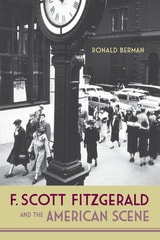
F. Scott Fitzgerald and the American Scene
Ronald Berman
University of Alabama Press, 2017
A study of the philosophical, intellectual, and political influences on the artistic creations of Fitzgerald and key early American modernist writers
F. Scott Fitzgerald and the American Scene continues Ronald Berman’s lifelong study of the philosophical, intellectual, and political influences on the artistic creations of key early American modernist writers. Each chapter in this volume elaborates on a crucial aspect of F. Scott Fitzgerald’s depiction of American society, specifically through the lens of the social sciences that most influenced his writing and thinking.
Berman addresses, among other subjects, Fitzgerald’s use of philosophy, cultural analyses, and sociology—all enriched by the insights of his own experience living an American life. He was especially interested in how life had changed from 1910 to 1920. Many Americans were unable to navigate between the 1920s and their own memories of a very different world before the Great War; especially Daisy Buchanan who evolves from girlhood (as typified in sentimental novels of the time) to wifehood (as actually experienced in the new decade). There is a profound similarity between what happens to Fitzgerald’s characters and what happened to the nation.
Berman revisits classics like The Great Gatsby but also looks carefully at Fitzgerald’s shorter fictions, analyzing a stimulating spectrum of scholars from more contemporary critics like Thomas Piketty to George Santayana, John Maynard Keynes, John Dewey, and Walter Lippmann. This fascinating addition to F. Scott Fitzgerald scholarship, although broad in its content, is accessible to a wide audience. Scholars and students of Fitzgerald and twentieth-century American literature, as well as dedicated Fitzgerald readers, will enjoy Berman’s take on a long-debated and celebrated author.
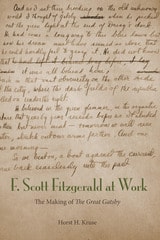
F. Scott Fitzgerald at Work
The Making of "The Great Gatsby"Horst H. Kruse
University of Alabama Press, 2014
The essays in F. Scott Fitzgerald at Work examine fresh facts that illuminate the experiences and source materials upon which Fitzgerald based this quintessentially American masterpiece. They confirm author Horst Kruse’s view that Fitzgerald’s flights of fancy, even at their most spectacular, are firmly grounded in biographical experience as well as in the social, literary, and philosophical circumstances of his era.
In the first essay, Kruse reconstructs the life story of the individual who allegedly inspired the character of Jay Gatsby: Max von Gerlach. Kruse recounts his journeys to various archives and libraries in the United States as well as in Germany to unearth new facts about the genesis of the Gatsby characters. In another journey, readers travel with Kruse to Long Island to explore its physical and moral geography in relation to Fitzgerald, specifically the role of certain elite Long Island families in the advancement of the “science of eugenics” movement. The final two essays take Kruse across the globe to various destinations to consider the broader place of The Great Gatsby in American and international intellectual history.
Replete with fascinating discoveries and insights, F. Scott Fitzgerald at Work both corrects previous assumptions about The Great Gatsby and deepens our appreciation and understanding of Fitzgerald‘s imagination.
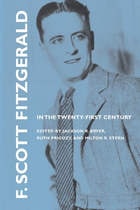
F. Scott Fitzgerald in the Twenty-First Century
Jackson R. Bryer
University of Alabama Press, 2003
This thought-provoking collection explores significant new facets of an American author of lasting international stature.
“Edited by three eminent Fitzgerald scholars, this fine book comprises nineteen incisive and provocative essays (most written for this collection) by . . . well-known Fitzgerald critics. The content is as varied as the international origins of its authors.” —Choice
As the author of some of the most compelling short stories ever written, two of the central novels in American literature, and some of the most beautiful prose ever penned, F. Scott Fitzgerald is read and studied all over the world. Sixty-two years after his death, his works—protean, provocative, multilayered, and rich—continue to elicit spirited responses. This collection grew out of the F. Scott Fitzgerald Conference that convened in Princeton at the centennial of this author's birth. Bringing together dozens of the world's leading scholars and commentators, the conference and the book celebrate the ever-growing legacy of Fitzgerald's art.
The subjects of these 19 essays reflect the contributors' wish to shine new light on less-frequently discussed aspects of Fitzgerald's work. Topics include Fitzgerald's Princeton influences and his expression of Catholic romanticism; his treatments of youth culture, the devil, and waste; parallels in the work of Mencken, Cather, and Murakami; and the ways gender, pastoral mode, humor, and the Civil War are variously presented in his work. One illustrated summary examines Fitzgerald's effect on popular culture through his appearance in the comics. Two broad overviews—one on Fitzgerald's career and another on the final developments in the author's style—round out the collection.
The international scope of the contributors to this volume reflects Fitzgerald's worldwide reputation and appeal. With extensive treatments of This Side of Paradise, The Beautiful and Damned, The Last Tycoon, and the Pat Hobby stories, this collection makes an unusual and significant contribution to the field of Fitzgerald studies.
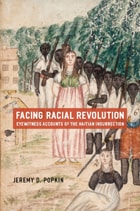
Facing Racial Revolution
Eyewitness Accounts of the Haitian InsurrectionJeremy D. Popkin
University of Chicago Press, 2008
Numerous firsthand narratives of these events survived, but their invaluable insights into the period have long languished in obscurity—until now. In Facing Racial Revolution, Jeremy D. Popkin unearths these documents and presents excerpts from more than a dozen accounts written by white colonists trying to come to grips with a world that had suddenly disintegrated. These dramatic writings give us our most direct portrayal of the actions of the revolutionaries, vividly depicting encounters with the uprising’s leaders—Toussaint Louverture, Boukman, and Jean-Jacques Dessalines—as well as putting faces on many of the anonymous participants in this epochal moment. Popkin’s expert commentary on each selection provides the necessary background about the authors and the incidents they describe, while also addressing the complex question of the witnesses’ reliability and urging the reader to consider the implications of the narrators’ perspectives.
Along with the American and French revolutions, the birth of Haiti helped shape the modern world. The powerful, moving, and sometimes troubling testimonies collected in Facing Racial Revolution significantly expand our understanding of this momentous event.
Failed States and Fragile Societies
A New World Disorder?Ingo Trauschweizer
Ohio University Press, 2014
Since the end of the Cold War, a new dynamic has arisen within the international system, one that does not conform to established notions of the state’s monopoly on war. In this changing environment, the global community must decide how to respond to the challenges posed to the state by military threats, political and economic decline, and social fragmentation. This insightful work considers the phenomenon of state failure and asks how the international community might better detect signs of state decay at an early stage and devise legally and politically legitimate responses.
This collection of essays brings military and social historians into conversation with political and social scientists and former military officers. In case studies from the former Yugoslavia, Somalia, Iraq, and Colombia, the distinguished contributors argue that early intervention to stabilize social, economic, and political systems offers the greatest promise, whereas military intervention at a later stage is both costlier and less likely to succeed.
Contributors: David Carment, Yiagadeesen Samy, David Curp, Jonathan House, James Carter, Vanda Felbab-Brown, Robert Rotberg, and Ken Menkhaus.
Faith and Feminism in Nineteenth-Century Religious Communities
Michaela Sohn-Kronthaler
SBL Press, 2019
Explore a diversity of feminist readings of the Bible
This latest volume in the Bible and Women series is concerned with documenting, through word and image, both well-known and largely unknown women and their relationship to the Bible from the period of the late eighteenth century up to the beginning of the twentieth century. The essays in this collection illustrate the broad range of treatment of the Holy Scripture. Paul Chilcote, Marion Ann Taylor, Christiana de Groot, Elizabeth M. Davis, and Pamela S. Nadell offer perspectives on the Anglo-American sphere during this period. Marina Cacchi, Adriano Valerio, Inmaculada Blasco Herranz, and Alexei Klutschewski and Eva Maria Synek illuminate the areas of southern and eastern Europe. Angela Berlis, Ruth Albrecht, Doris Brodbeck, Ute Gause, and Michaela Sohn-Kronthaler examine women from the German-speaking world and their texts. Bernhard Schneider, Magda Motté, Katharina Büttner-Kirschner, and Elfriede Wiltschnigg treat the subject area of religious literature and art.
Features
- Insight into how women participated in academic exegesis and applied biblical figures as models for structuring their own lives
- Exploration of genres used by women, including letters, diaries, autobiographical records, stories, novels, songs, poems, and specialized exegetical treatises and commentaries on individual books of the Bible
- Detailed analyses of women’s interpretations ranging from those that sought to confirm traditions to those that challenged them
False Documents
Inter-American Cultural History, Literature, and the Lost Decade (1975–1992)Frans Weiser
The Ohio State University Press, 2020
After deconstructing economic accounts of the “two Americas" model of the hemisphere, including the lost decade (1981–1992) and the “end of history” (1975–1992), Weiser considers six case studies during the same period that reach very different conclusions by drawing on cultural history, including works by Tomás Eloy Martínez, Laura Antillano, Ana Maria Machado, Silviano Santiago, John Updike, and Jay Cantor. In order to expose how governments controlled and misrepresented recent events, these writers created false documents, or fake historical texts, that presented themselves as legitimate eyewitness accounts or archival documents. Weiser establishes how this alternative to postmodern irony more effectively galvanized citizen responses. As the first book to contextualize the parallel, hemispheric evolutions of postwar literary criticism and cultural historiography, False Documents responds to the methodological impasse between Latin American and American studies as well as the antagonism between history and literature, arguing that collaboration and synthesis are particularly vital at a moment when the humanities is increasingly under attack.
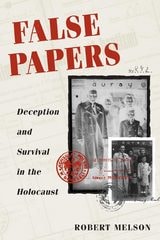
False Papers
DECEPTION AND SURVIVAL IN THE HOLOCAUSTRobert Melson
University of Illinois Press, 2000
Armed with their new lives and their new pasts, the Count and Countess Zamojski and their son, Count Bobi, took shelter in the very shadow of the Nazi machine, hiding day after day in plain sight behind a façade of elegant good manners and cultivated self-assurance, even arrogance: "you had to shout [the Gestapo] down or they would kill you." Melson's father took advantage of his flawless German to build a lucrative business career while working for a German businessman of the Schindler type. The Zamojskis acquired beautiful homes in the German quarter of Krakow and in Prague, where they had maids and entertained Nazi officials. Their masquerade enabled them to save not only themselves and their son but also an uncle and three Jewish women, one of whom became part of the family.
False Papers is a candid, sometimes funny account of a stylish couple who dazzled the Nazis with flamboyant theatrics then gradually, tragically fell apart after the war. Particularly arresting is Melson himself, who was just a child when his family embarked on their grand charade. A resilient boy who had to negotiate bewildering shifts of identify–-now Catholic, now Jewish; now European aristocrat, now penniless refugee who becomes an American college student--Melson closes each chapter of his parents' recollections with his childhood perceptions of the same events.
Against the totalizing, flattening, unrelenting Nazi behemoth, Melson says, "I wished to pit our very bodies, our quirky, sexy, funny, wicked, frail, ordinary selves." By balancing the adults' maneuvering with the perspective of a child, Melson crafts an account of the Holocaust that is at once poignant, entertaining, and troubling.
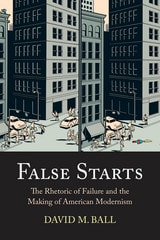
False Starts
The Rhetoric of Failure and the Making of American ModernismDavid M. Ball
Northwestern University Press, 2014
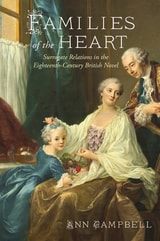
Families of the Heart
Surrogate Relations in the Eighteenth-Century British NovelAnn Campbell
Bucknell University Press, 2023
In this innovative analysis of canonical British novels, Campbell identifies a new literary device—the surrogate family—as a signal of cultural anxieties about young women’s changing relationship to matrimony across the long eighteenth century. By assembling chosen families rather than families of origin, Campbell convincingly argues, female protagonists in these works compensate for weak family ties, explore the world and themselves, prepare for idealized marriages, or sidestep marriage altogether. Tracing the evolution of this rich convention from the female characters in Defoe’s and Richardson’s fiction who are allowed some autonomy in choosing spouses, to the more explicitly feminist work of Haywood and Burney, in which connections between protagonists and their surrogate sisters and mothers can substitute for marriage itself, this book makes an ambitious intervention by upending a traditional trope—the model of the hierarchal family—ultimately offering a new lens through which to regard these familiar works.
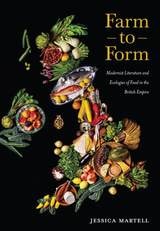
Farm to Form
Modernist Literature and Ecologies of Food in the British EmpireJessica Martell
University of Nevada Press, 2020
Deeply informed by Martell’s extensive knowledge of modern British, Irish, American, and World Literatures, this progressive work positions modernism as central to the study of narratives of resistance against social and environmental degradation. Analyzed works include those of Thomas Hardy, E. M. Forster, Virginia Woolf, Joseph Conrad, George Russell, and James Joyce.
In light of climate change, fossil fuel supremacy, nutritional dearth, and other pressing food issues, modernist texts bring to life an era of crisis and anxiety similar to our own. In doing so, Martell summons the past as a way to employ the modernist term of “defamiliarizing” the present so that entrenched perceptions can be challenged. Our current food regime is both new and constantly evolving with the first industrial food trades. Studying earlier cultural responses to them invites us to return to persistent problems with new insights and renewed passion.
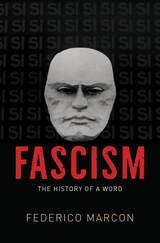
Fascism
The History of a WordFederico Marcon
University of Chicago Press, 2025
The rise and popular support for authoritarianism around the world and within traditional democracies have spurred debates over the meaning of the term “fascist” and when and whether it is appropriate to use it. The landmark study Fascism: The History of a Word takes this debate further by tackling its most fundamental questions: How did the terms “fascism” and “fascist” come to be in the first place? How and in what circumstances have they been used? How can they be understood today? And what are the advantages (or disadvantages) of using “fascism” to make sense of interwar authoritarianism as well as contemporary politics?
Exploring the writings and deeds of political leaders, activists, artists, authors, and philosophers, Federico Marcon traces the history of the term’s use (and usefulness) in relation to Mussolini’s political regime, antifascist resistance, and the quest of postwar historians to develop a definition of a “fascist minimum.” This investigation of the semiotics of “fascism” also aims to inquire about people’s voluntary renunciation of the modern emancipatory ideals of freedom, equality, and solidarity.

Fashionable Food
Seven Decades of Food FadsSylvia Lovegren
University of Chicago Press, 2005
Well researched and delightfully illustrated, this collection of faddish recipes from the 1920s to the 1990s is a decade-by-decade tour of a hungry American century. From the Three P's Salad—that's peas, pickles, and peanuts—of the post-World War I era to the Fruit Cocktail and Spam Buffet Party loaf—all the rage in the ultra-modern 1950s, when cooking from a can epitomized culinary sophistication—Fashionable Food details the origins of these curious delicacies. In two chapters devoted to "exotic foods of the East," for example, Lovegren explores the long American love affair with Chinese food and the social status conferred upon anyone chic enough to eat pu-pu platters from Polynesia. Throughout, Lovegren supplements recipes—some mouth-watering, some appalling—from classic cookbooks and family magazines, with humorous anecdotes that chronicle how society and kitchen technology influenced the way we lived and how we ate.
Equal parts American and culinary history, Fashionable Food examines our collective past from the kitchen counter. Even if it's been a while since you last had Tang Pie and your fondue set is collecting dust in the back of the cupboard, Fashionable Food will inspire, entertain, and inform.

Fast Combat Support Ship HNLMS Zuiderkruis
Jantinus Mulder
Amsterdam University Press, 2023

Fasti Ecclesiae Anglicanae 1541–1857
The Welsh Dioceses XIVCompiled by William H. Campbell
University of London Press, 2026
A detailed history of the Church of England’s Welsh dioceses, including the building of cathedrals and churches.
The volumes in this series trace the process of reorganization and reform that took place in the Church of England after the Norman conquest, with the building of new cathedrals, the establishment of new constitutions for their chapters, and the appointment of foreign clergy. In this period, when many documents are undated, the chronological framework is provided by the careers of bishops, dignitaries, canons, and cathedral priors.
This volume covers the years 1541 to 1857, with a focus on the Welsh dioceses. During this period, six new dioceses were created out of larger dioceses, with former abbey churches named as their cathedrals. These fourteen cathedrals were known as the New Foundation, as compared with the thirteen medieval secular cathedrals of the Old Foundation. Further substantial reorganization took place in the 1830s, and additional dioceses were created to meet the needs of the period. This volume offers a detailed and comprehensive account of the period, making it an essential research tool for historians.
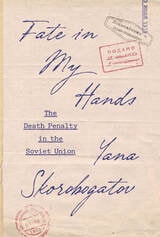
Fate in My Hands
The Death Penalty in the Soviet UnionYana Skorobogatov
University of Chicago Press, 2026
A striking examination of the death penalty in the Soviet Union that documents in heart-rending detail how its citizens, hopeful for a new life post-Stalin, lost faith that their transgressions could be forgiven.
From 1954 to 1991 in the Soviet Union, nearly forty thousand citizens were executed after the death penalty was reinstated as a punishment for homicide. Fate in My Hands introduces readers to the many citizens in this period—women and men of all ages and backgrounds—who found themselves on death row and tried to escape it in the only way available to them: asking for forgiveness.
Examining the letters and objects the dead left behind, Skorobogatov recovers their voices and allows them to speak anew. She offers a striking portrait of life in the Soviet Union and the citizens who dreamed of new possibilities even as they faced their tragic end. Using a corpus of never-before-accessed criminal court records, Fate in My Hands brings readers not just into the police interrogation rooms, courthouses, and cells where the condemned awaited their fates, but into the homes, workplaces, and psychiatric hospitals where families and friends alike came together to pursue an elusive, bitter justice in the wake of violent tragedy.
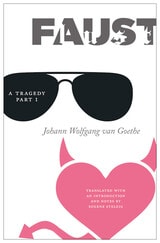
Faust
A Tragedy, Part IEugene Stelzig
Bucknell University Press, 2019
Published by Bucknell University Press. Distributed worldwide by Rutgers University Press.

Feeding the Future
School Lunch Programs as Global Social PolicyRutledge, Jennifer Geist
Rutgers University Press, 2016
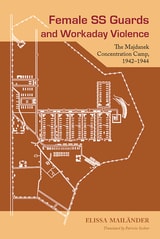
Female SS Guards and Workaday Violence
The Majdanek Concentration Camp, 1942-1944Elissa Mailänder
Michigan State University Press, 2015
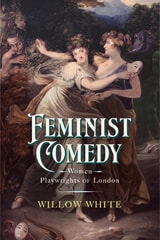
Feminist Comedy
Women Playwrights of LondonWillow White
University of Delaware Press, 2024
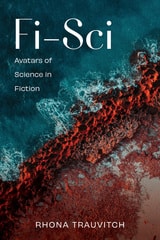
Fi-Sci
Avatars of Science in FictionRhona Trauvitch
The Ohio State University Press, 2026
In Fi-Sci, Rhona Trauvitch melds literary and scientific thought to advance a theory of how narrative, and specifically fictionality, is one of the most powerful tools we have for understanding science, particularly those concepts that defy imagination. Centering her argument on a rhetorical approach to fictionality, she proposes that fiction uniquely offers a means of conceptualizing and understanding perplexing and counterintuitive scientific phenomena, such as recombinant DNA or quantum superposition: Through finding analogous patterns in fiction, we can open up new pathways to understanding. Put another way, our abilities to perceive strange and confounding science phenomena are bolstered and even enabled by our experiences with fiction.
Drawing on a range of theorists such as James Phelan, Gérard Genette, Erwin Schrödinger, and others in her analysis of texts by Jorge Luis Borges, Julio Cortázar, Ursula K. Le Guin, Richard Powers, and many more, Trauvitch shows how literary forms—such as metafiction, metalepsis, and recursion—mirror and clarify complex scientific concepts including genetics, spacetime curvature, and quantum mechanics. In this way, she shows us how fiction is key to unlocking conceptual access to the indiscernible and inconceivable.

Fiat G.91
Arno Landewers
Amsterdam University Press, 2023
It was in production for nineteen years. 756 aircraft were completed, including the prototypes and pre-production models. The assembly lines were finally closed in 1977. The Fiat G.91 enjoyed a long service life that extended over 35 years. It was widely used by Portugal in the Portuguese Colonial War in Africa.
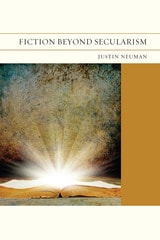
Fiction Beyond Secularism
Justin Neuman
Northwestern University Press, 2014
Modernist thinkers once presumed a progressive secularity, with the novel replacing religious texts as society’s moral epics. Yet religion—beginning with the Iranian revolution of 1979, through the collapse of communism, and culminating in the singular rupture of September 11, 2001—has not retreated quietly out of sight.
In Fiction Beyond Secularism, Justin Neuman argues that contemporary novelists who are most commonly identified as antireligious—among them Orhan Pamuk, Salman Rushdie, Ian McEwan, Margaret Atwood, Nadine Gordimer, Haruki Murakami, and J. M. Coetzee—have defied assumptions and have instead written some of the most trenchant critiques of secular ideologies, as well as the most exciting and rigorous inquiries into the legacies of the religious imagination. As a result, many readers (or nonreaders) on either side of the religious divide neglect the insights of works like The Satanic Verses, Disgrace, and Snow. Fiction Beyond Secularism serves as a timely corrective.
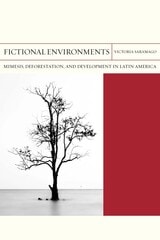
Fictional Environments
Mimesis, Deforestation, and Development in Latin AmericaVictoria Saramago
Northwestern University Press, 2021
Winner of the Brazilian Studies Association’s Roberto Reis Book Award for First Monograph • Honorable Mention for the Latin American Studies Association’s Antonio Candido Book Award • Shortlisted for the Association for the Study of Literature and Environment Book Award
Fictional Environments: Mimesis, Deforestation, and Development in Latin America investigates how fictional works have become sites for the production of knowledge, imagination, and intervention in Latin American environments. It investigates the dynamic relationship between fictional images and real places, as the lasting representations of forests, rural areas, and deserts in novels clash with collective perceptions of changes like deforestation and urbanization.
From the backlands of Brazil to a developing Rio de Janeiro, and from the rainforests of Venezuela and Peru to the Mexican countryside, rapid deforestation took place in Latin America in the second half of the twentieth century. How do fictional works and other cultural objects dramatize, resist, and intervene in these ecological transformations? Through analyses of work by João Guimarães Rosa, Alejo Carpentier, Juan Rulfo, Clarice Lispector, and Mario Vargas Llosa, Victoria Saramago shows how novels have inspired conservationist initiatives and offered counterpoints to developmentalist policies, and how environmental concerns have informed the agendas of novelists as essayists, politicians, and public intellectuals. This book seeks to understand the role of literary representation, or mimesis, in shaping, sustaining, and negotiating environmental imaginaries during the deep, ongoing transformations that have taken place from the 1950s to the present.
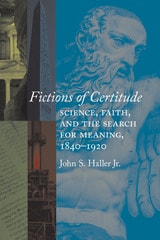
Fictions of Certitude
Science, Faith, and the Search for Meaning, 1840–1920John S. Haller Jr.
University of Alabama Press, 2020
The search for belief and meaning among nineteenth-century intellectuals
The nineteenth century’s explosion of scientific theories and new technologies undermined many deep-seated beliefs that had long formed the basis of Western society, making it impossible for many to retain the unconditional faith of their forebears. A myriad of discoveries—including Faraday’s electromagnetic induction, Joule’s law of conservation of energy, Pasteur’s germ theory, Darwin’s and Wallace’s theories of evolution by natural selection, and Planck’s work on quantum theory—shattered conventional understandings of the world that had been dictated by traditional religious teachings and philosophical systems for centuries.
Fictions of Certitude: Science, Faith, and the Search for Meaning, 1840–1920 investigates the fin de siècle search for truth and meaning in a world that had been radically transformed. John S. Haller Jr. examines the moral and philosophical journeys of nine European and American intellectuals who sought deeper understanding amid such paradigmatic upheaval. Auguste Comte, John Henry Newman, Herbert Spencer, Alfred Russel Wallace, Thomas Henry Huxley, John Fiske, William James, Lester Frank Ward, and Paul Carus all belonged to an age in which one world was passing while another world that was both astounding and threatening was rising to take its place.
For Haller, what makes the work of these nine thinkers worthy of examination is how they strove in different ways to find certitude and belief in the face of an epochal sea change. Some found ways to reconceptualize a world in which God and nature coexist. For others, the challenge was to discern meaning in a world in which no higher power or purpose can be found. As explained by D. H. Meyer, “The later Victorians were perhaps the last generation among English-speaking intellectuals able to believe that man was capable of understanding his universe, just as they were the first generation collectively to suspect that he never would.”
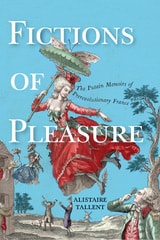
Fictions of Pleasure
The Putain Memoirs of Prerevolutionary FranceAlistaire Tallent
University of Delaware Press, 2024
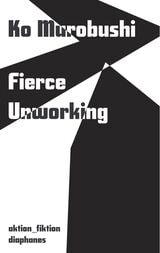
Fierce Unworking
Ko Murobushi
Diaphanes, 2025
Ko Murobushi was one of the most important performers and choreographers in the Japanese performance scene of the twenty-first century and a key figure in the mediation between the experimental Butoh tradition of Hijikata Tatsumi and anti-logocentric French avant-gardes such as Antonin Artaud and Gilles Deleuze. Radically positioned at the intersection of the two movements, Murobushi reveals himself as an extraordinary and poetic author in his “thinking of the body.”
Fierce Unworking highlights his role as an unparalleled pioneer of contemporary paradigms such as body language, the third space, and embodied knowledge. Published ten years after his death, this volume brings together writings, poems, and diary fragments—many of which are available in English for the first time—in collaboration with the Ko Murobushi Archive in Tokyo.
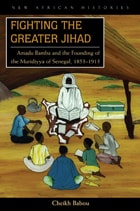
Fighting the Greater Jihad
Amadu Bamba and the Founding of the Muridiyya of Senegal, 1853–1913Cheikh Anta Babou
Ohio University Press, 2007
In Senegal, the Muridiyya, a large Islamic Sufi order, is the single most influential religious organization, including among its numbers the nation’s president. Yet little is known of this sect in the West. Drawn from a wide variety of archival, oral, and iconographic sources in Arabic, French, and Wolof, Fighting the Greater Jihad offers an astute analysis of the founding and development of the order and a biographical study of its founder, Cheikh Ahmadu Bamba Mbakke.
Cheikh Anta Babou explores the forging of Murid identity and pedagogy around the person and initiative of Amadu Bamba as well as the continuing reconstruction of this identity by more recent followers. He makes a compelling case for reexamining the history of Muslim institutions in Africa and elsewhere in order to appreciate believers’ motivation and initiatives, especially religious culture and education, beyond the narrow confines of political collaboration and resistance. Fighting the Greater Jihad also reveals how religious power is built at the intersection of genealogy, knowledge, and spiritual force, and how this power in turn affected colonial policy.
Fighting the Greater Jihad will dramatically alter the perspective from which anthropologists, historians, and political scientists study Muslim mystical orders.
Figurations of France
Literary Nation-Building in Times of Crisis (1550-1650)Marcus Keller
University of Delaware Press, 2011
In Figurations of France: Literary Nation-Building in Times of Crisis (1550-1650), Marcus Keller explores the often indirect and subtle ways in which key texts of early modern French literature, from Joachim Du Bellay’s Défense et illustration de la langue française to Corneille’s Le Cid, contribute to the fiction of France as a nation. Through his fresh take on these and other classics, he shows that they not only create the French as an imaginary community but also provide venues for an incisive critique of the political and cultural construct that underpins the modern nation-state.
Current theories of nationhood, in particular the concepts of the nation form and fictive ethnicity (Étienne Balibar), inform the close readings of Du Bellay’s Défense, Ronsard’s Discours, d’Aubigné’s Tragiques, Montaigne’s Essays, Malherbe’s odes, and Corneille’s Le Cid and Horace. They reveal the imaginary power and unifying force of early modern figurations of France that come to bear in this heteregoneous corpus of French literature, with texts ranging from manifesto and epic poem to essay and tragedy. Situating each author and text in their particular historical context, the study suggests that the literary invention of France in the sixteenth and seventeenth centuries is as abundant as it is conceptually innovative: Du Bellay, for example, develops an idea of France by portraying the French language as a pruned and grafted tree while d’Aubigné proposes to think of the French as a nuclear but fatherless family. Blood functions as a highly charged metaphor of nationhood in all texts.
Opening up new perspectives on these canonical works, the focus on literary nation-building also puts them into unexpected and thought-provoking relationships to each other. Figurations of France deliberately crosses the fictive boundary between the sixteenth and the seventeenth centuries and argues that, in terms of imaginary nation-building, the contours that delineate the early modern period and separate it from what we call the modern era quickly begin to dissolve. Ultimately, the book makes the case for early modern literature as a creative and critical discourse, able to nourish and nuance our thinking about the nation as the postmodern nation-state is increasingly called into question by the economical, political, and cultural effects of globalization.
Published by University of Delaware Press. Distributed worldwide by Rutgers University Press.
Figures of the World
The Naturalist Novel and Transnational FormChristopher Laing Hill
Northwestern University Press, 2020
The book begins by tracing the history of naturalist fiction from the 1860s into the twentieth century and the reasons it spread around the world. Hill explores the development of three naturalist figures—the degenerate body, the self-liberated woman, and the social milieu—through close readings of fiction from France, Japan, and the United States. Rather than genealogies of European influence or the domination of cultural “peripheries” by the center, novels by Émile Zola, Tayama Katai, Frank Norris, and other writers reveal conspicuous departures from metropolitan models as writers revised naturalist methods to address new social conditions. Hill offers a new approach to studying culture on a large scale for readers interested in literature, the arts, and the history of ideas.

Film and Genocide
Kristi M. Wilson
University of Wisconsin Press, 2011
Film and Genocide brings together scholars of film and of genocide to discuss film representations, both fictional and documentary, of the Holocaust, the Armenian genocide, and genocides in Chile, Australia, Rwanda, and the United States. Since 1955, when Alain Resnais created his experimental documentary Night and Fog about the Nazis’ mass killings of Jews and other ostracized groups, filmmakers have struggled with using this medium to tell such difficult stories, to re-create the sociopolitical contexts of genocide, and to urge awareness and action among viewers. This volume looks at such issues as realism versus fiction, the challenge of depicting atrocities in a manner palatable to spectators and film distributors, the Holocaust film as a model for films about other genocides, and the role of new technologies in disseminating films about genocide.
Film and Genocide also includes interviews with three film directors, who discuss their experiences in working with deeply disturbing images and bringing hidden stories to life: Irek Dobrowolski, director of The Portraitist (2005) a documentary about Wilhelm Brasse, an Auschwitz-Birkenau prisoner ordered to take more than 40,000 photos at the camp; Nick Hughes, director of 100 Days (2005) a dramatic film about the Rwandan mass killings; and Greg Barker, director of Ghosts of Rwanda (2004), a television documentary for Frontline.
Final Causality in Nature and Human Affairs
Richard F. Hassing
Catholic University of America Press, 2018

Final Solutions
Human Nature, Capitalism and GenocideSabby Sagall
Pluto Press, 2013
Final Solutions offers a ground-breaking and genuinely unique analysis of modern genocide. Sabby Sagall draws on the insights of the Frankfurt school and Wilhelm Reich to create an innovative combination of Marxism and psychoanalysis. He argues that genocide is a product of an ‘irrational’ destructiveness by social classes or communities that have suffered major historical defeats or similar forms of extreme stress.
Sagall shows how the denial of human needs and the ensuing feelings of isolation and powerlessness propel groups to project their impotent rage, hatred and destructiveness engendered by these defeats on to the 'outsider' and the 'other'.
The book applies this theoretical framework to four modern genocides – that of the Native Americans, the Armenians, the Jews and the Rwandan Tutsis. This is a truly pioneering contribution which adds to our understanding of some of the darkest hours of humanity – and how we can stop them from happening again.
Finding Duende
Duende: Play and Theory | Imagination, Inspiration, EvasionFederico García Lorca
Swan Isle Press, 2023
For years, Federico García Lorca’s lecture on duende has been a source of insight for writers and performers, including Ted Hughes, Nick Cave, Patti Smith, and Amanda Gorman.
Duende: Play and Theory not only provides a path into Lorca’s poetics and the arts of Spain; it is one of the strangest, most compelling accounts of inspiration ever offered by a poet. Contrasting the demon called duende with the Angel and the Muse, Lorca describes a mysterious telluric, diabolical current, an irreducible “it,” that can draw the best from both performer and audience.
This new translation by Christopher Maurer, based on a thoroughly revised edition of the Spanish original of 1933, also included in this volume, offers a more accurate and fully annotated version of the lecture, with an introduction by eminent philologist José Javier León. Drawing on a deep knowledge of flamenco, and correcting decades of discussion about duende and its supposed origins in Spanish folklore and popular speech, León shows to what extent the concept of duende—understood as the imp of artistic inspiration—was the playful, yet deadly serious, invention of Lorca himself.
Lorca’s bravura performance of duende is foreshadowed here with a bilingual version—the most complete ever—of his other major text on inspiration, “Imagination, Inspiration, Evasion,” in which he calls for greater freedom in poetry as if searching for duende and its “constant baptism of newly created things.”
Finding True North
First-Hand Stories of the Booms that Built Modern AlaskaMolly Rettig
University of Alaska Press, 2021
Melting sea ice and rumbling volcanoes. Sled dogs racing through unnamed valleys.
These were the images that came to mind when Molly Rettig moved to Fairbanks, Alaska to work as a reporter at the local newspaper. An avid environmentalist, she couldn’t wait to explore the vast, untamed spaces that had largely been paved over on the east coast. But when her 72-year-old neighbor, Clutch, invites her on a tour of his gold mine—an 800-foot tunnel blasted into the side of his house–she begins to question many of her ideas about Alaska, and about herself.
In Finding True North, Rettig takes us on a gripping journey through Alaska's past that brings alive the state's magnificent country and its quirky, larger-than-life characters. She meets a trapper who harvests all she needs from the land, a bush pilot who taught himself how to fly, and an archaeologist who helped build an oil pipeline through pristine wilderness. While she learns how airplanes, mines, and oil fields have paved the way for newcomers like herself, she also stumbles upon a bigger question: what has this quest for Alaska’s natural resources actually cost, and how much more is at stake?
This is a book about all the ways wild places teach us about ourselves. Rettig writes both playfully and honestly about how one place can be many things to many people—and how all of it can be true.

Finding the Weight of Things
Larry Eigner's EcrippoeticsGeorge Hart
University of Alabama Press, 2022
Where language, body, and form converge in the poetry of Larry Eigner.
Larry Eigner (1927–1996) wrote thousands of poems in his lifetime, despite profound physical limitations caused by cerebral palsy. Using only the thumb and index finger of his right hand, Eigner generated a torrent of urgent and rich language, participating in vital correspondences as well as publishing widely in literary magazines and poetry journals.
While Eigner wrote before the emergence of ecopoetics, his poetry reflected a serious engagement with scientific writing and media, including Rachel Carson’s seminal Silent Spring. Eigner was writing about environmental disasters and climate change long before such concerns took on a moral incumbency. Similarly, Eigner was ahead of his time in his exploration of disability. The field of disability studies has expanded rapidly in the new millennium. Eigner was not an overtly biographical poet, at least as far as his physical limitations were concerned, but his poetry spoke volumes on the idea of embodiment in all its forms.
Finding the Weight of Things: Larry Eigner’s Ecrippoetics is the first full-length study of Eigner’s poetry, covering his entire career from the beginning of his mature work in the 1950s to his last poems of the 1990s. George Hart charts where Eigner’s two central interests intersect, and how their interaction fueled his work as a poet-critic—one whose work has much to tell us about the ecology and embodiment of our futures. Hart sees Eigner’s overlapping concerns for disability, ecology, and poetic form as inextricable, and coins the phrase ecrippoetics here to describe Eigner’s prescient vision.
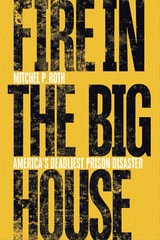
Fire in the Big House
America’s Deadliest Prison DisasterMitchel P. Roth
Ohio University Press, 2019
On April 21, 1930—Easter Monday—some rags caught fire under the Ohio Penitentiary’s dry and aging wooden roof, shortly after inmates had returned to their locked cells after supper. In less than an hour, 320 men who came from all corners of Prohibition-era America and from as far away as Russia had succumbed to fire and smoke in what remains the deadliest prison disaster in United States history.
Within 24 hours, moviegoers were watching Pathé’s newsreel of the fire, and in less than a week, the first iteration of the weepy ballad “Ohio Prison Fire” was released. The deaths brought urgent national and international focus to the horrifying conditions of America’s prisons (at the time of the fire, the Ohio Penitentiary was at almost three times its capacity). Yet, amid darkening world politics and the first years of the Great Depression, the fire receded from public concern.
In Fire in the Big House, Mitchel P. Roth does justice to the lives of convicts and guards and puts the conflagration in the context of the rise of the Big House prison model, local and state political machinations, and American penal history and reform efforts. The result is the first comprehensive account of a tragedy whose circumstances—violent unrest, overcrowding, poorly trained and underpaid guards, unsanitary conditions, inadequate food—will be familiar to prison watchdogs today.
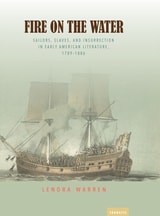
Fire on the Water
Sailors, Slaves, and Insurrection in Early American Literature, 1789-1886Warren, Lenora
Bucknell University Press, 2019
Published by Bucknell University Press. Distributed worldwide by Rutgers University Press.
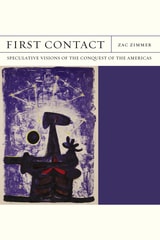
First Contact
Speculative Visions of the Conquest of the AmericasZac Zimmer
Northwestern University Press, 2025
Examining the power of speculative fiction to reimagine historical accounts of the conquest of the Americas
The historical conquest of the Americas resides at the core of all first-contact narratives, which stage colonization and resistance in the generic guise of speculative fiction. Starting from this axiom, First Contact: Speculative Visions of the Conquest of the Americas moves through a corpus of Mexican novels, Andean visual arts practices, and other cultural artifacts that have dramatized counterfactual narratives. Reimagining the early colonial period’s historiography from a south-to-north directionality while inventing parallel realities, these texts, which are concerned with limit cases, alterities, and alternative temporalities, refuse any reliance on the imperial ontologies of European expansion. Zac Zimmer examines these works to explore the slippage that exists between science fiction as the exemplary genre of the modern, colonial reality and literary speculation as an aesthetic tool that can be used to imagine other possible worlds. First Contact thus poses a foundational question: Can we understand the conquest as an originary world-historical event without eclipsing the other cosmologies that existed, and continue to exist, within the contact zone? Can we decolonize the speculative imagination itself?
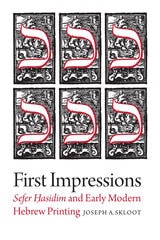
First Impressions
Sefer Hasidim and Early Modern Hebrew PrintingJoseph A. Skloot
Brandeis University Press, 2023
In 1538, a partnership of Jewish silk makers in the city of Bologna published a book entitled Sefer Hasidim, a compendium of rituals, stories, and religious instruction that primarily originated in medieval Franco-Germany. How these men, of Italian and Spanish descent, came to produce a book that would come to shape Ashkenazic culture, and Jewish culture more broadly, over the next four centuries is the basis of this kaleidoscopic study of the history of Hebrew printing in the sixteenth century.
During these early years of printing, the classic works of ancient and medieval Hebrew and Jewish literature became widely available to Jewish (and non-Jewish) readers for the first time. Printing, though, was not merely the duplication and distribution of pre-existing manuscripts, it was the creative adaptation and transformation of those manuscripts by printers. Ranging from Catholic Bologna to Protestant Basel to the Jewish heartland of the Polish-Lithuanian Commonwealth, Joseph A. Skloot uncovers the history of that creativity by examining the first two print editions of Sefer Hasidim. Along the way, he demonstrates how volumes that were long thought to be eternal and unchanging were in fact artifacts of historical agency and contingency, created by and for human beings.
Fishing by Obstinate Isles
Modern and Postmodern British Poetry and American ReadersKeith Tuma
Northwestern University Press, 1998
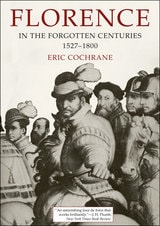
Florence in the Forgotten Centuries, 1527-1800
A History of Florence and the Florentines in the Age of the Grand DukesEric Cochrane
University of Chicago Press, 1976
Eric Cochrane shows that the Florentines maintained their creativity long after they had lost their position as the cultural leaders of Europe. When their political philosophy and historiography ran dry, they turned to the practical problems of civil administration. When their artists finally yielded to outside influence, they turned to music and the natural sciences. Even during the darkest days of the great economic depression of the late seventeenth and early eighteenth centuries, they succeeded in preserving—almost alone in Europe—the blessings of external peace and domestic tranquility.

Fokker C.X
Edwin Hoogschagen
Amsterdam University Press, 2023
The C.X is a little-known member of the Dutch Fokker stable. Just like the D.XXI this biplane served in the air forces of two little neutral countries on the eve of World War II. Both fought gallantly in a war of David versus Goliath proportions, and the complete operational history of the type spans a total of 25 years. In retrospect, the C.X was the last fighting biplane type built by Fokker and the company's last pre-war military type to survive.
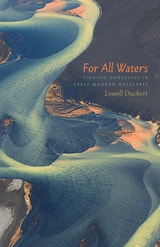
For All Waters
Finding Ourselves in Early Modern WetscapesLowell Duckert
University of Minnesota Press, 2017
Recent years have witnessed a surge in early modern ecostudies, many devoted to Shakespearean drama. Yet in this burgeoning discipline, travel writing appears moored in historicization, inorganic subjects are far less prevalent than organic ones, and freshwater sites are hardly visited. For All Waters explores these uncharted wetscapes.
Lowell Duckert shows that when playwrights and travel writers such as Sir Walter Raleigh physically interacted with rivers, glaciers, monsoons, and swamps, they composed “hydrographies,” or bodily and textual assemblages of human and nonhuman things that dissolved notions of human autonomy and its singular narrativity. With a playful, punning touch woven deftly into its theoretical rigor, For All Waters disputes fantasies of ecological solitude that would keep our selves high and dry and that would try to sustain a political ecology excluding water and the poor. The lives of both humans and waterscapes can be improved simultaneously through direct engagement with wetness.
For All Waters concludes by investigating waterscapes in peril today—West Virginia’s chemical rivers and Iceland’s vanishing glaciers—and outlining what we can learn from early moderns’ eco-ontological lessons. By taking their soggy and storied matters to heart, and arriving at a greater realization of our shared wetness, we can conceive new directions to take within the hydropolitical crises afflicting us today.
For Decades I Was Silent
A Holocaust Survivor's Journey Back to FaithBaruch G. Goldstein
University of Alabama Press, 2008
A survivor's powerful testament to faith, memory, and the triumph of the human spirit.
A fascinating memoir about a Holocaust survivor's loss of and journey back to faith. In 1939, Baruch Goldstein was a religiously observant adolescent resident of the Jewish community in Mlawa, a town that was then in East Prussia. After war broke out, the Jewish community there was relatively sheltered, as that region was incorporated into the German Reich rather than into the General Government (the German run-fragment of pre-war Poland, where conditions were harsh for everyone). However in 1942, Goldstein was sent to Auschwitz, where he stayed two-and-a-half years. His family was scattered all to their deaths, but he survived the war--barely. For Decades I Was Silent is an account of life in a small Polish-German town and provides information on the religious life of the Jewish citizens. This book creates a direct sense of the random, mystifying personal violence individuals felt at the hands of Germans--not the anonymous industrial death machine, but immediate, face-to-face violence.
After the war, Goldstein drifted as a refugee to UNRR camps in Italy. Over time, young Goldstein had to face the fact that all of his extended family was lost and he had only the possibilities of Palestine or help from distant relatives in the United States as a future. His American relatives urged him to enter the United States as a yeshiva student, and eventually he became a rabbi and started a family. As a young rabbinical student, and then as a rabbi, Goldstein was forced to confront the events of the Holocaust and the damage done to his faith.
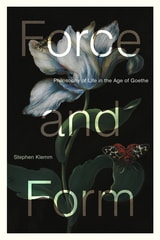
Force and Form
Philosophy of Life in the Age of GoetheStephen Klemm
Bucknell University Press, 2027
This book offers a bold rethinking of how modern ideas of life, nature, and subjectivity took shape in late-eighteenth- and early-nineteenth-century German thought. Moving beyond familiar narratives based on Kantian autonomy or Romantic irrationalism, it uncovers a vitalist tradition stretching from Herder to Schiller and Goethe, one that understood nature as dynamic, self-forming, and internally animated by life-force. Drawing on philosophy, the life sciences, and aesthetics, this innovative study reveals how these thinkers challenged mechanistic models of matter and resisted strict divisions between mind and nature. In doing so, they developed a historically contingent and embodied concept of subjectivity in which reason emerges from natural, cultural, and physiological processes rather than standing outside them. By situating this tradition within debates about epigenesis, form, and development, the book not only reshapes our understanding of German intellectual history but also sheds new light on contemporary debates about naturalism, posthumanism, and theories of life.
Published by Bucknell University Press. Distributed worldwide by Rutgers University Press.
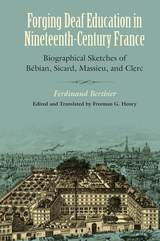
Forging Deaf Education in Nineteenth-Century France
Biographical Sketches of Bébian, Sicard, Massieu, and ClercFerdinand Berthier
Gallaudet University Press, 2009
In 1811, deaf student Ferdinand Berthier commenced his education at the National Institute for the Deaf in Paris under its director Abbé Sicard and his teachers Auguste Bébian, Jean Massieu, and Laurent Clerc. Their tutelage eventually led Berthier to join the faculty at the Institute and become a life-long proponent of sign language and Deaf culture. Berthier earned fame for instituting the famous silent banquets in Paris in 1834. He also learned to advance his agenda by writing biographies of important figures who advocated sign over oralism to educate deaf French students. Forging Deaf Education in Nineteenth-Century France offers the first translation of Berthier’s biographical sketches of the four men above who influenced him most.
Berthier wrote first about Bébian in 1839, timed to advocate sign language for teaching deaf students after the death of the pro-oralism Institute Director Désiré Ordinaire. Berthier extolled Bébian’s linguistic acumen and his educational philosophy. In later sketches, however, he described Sicard and Massieu in positive terms, but also criticized them for supporting “methodical” signing that conformed to spoken language conventions. In contrast, he lauded Clerc in his portrayal for using “natural” signing to teach deaf students. The clarity of these translations will introduce a brand new audience to Berthier’s biographies shaped by his unswerving beliefs about Deaf French education.
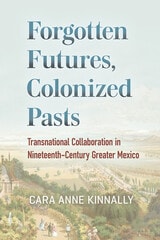
Forgotten Futures, Colonized Pasts
Transnational Collaboration in Nineteenth-Century Greater MexicoCara Anne Kinnally
Bucknell University Press, 2019
Published by Bucknell University Press. Distributed worldwide by Rutgers University Press.
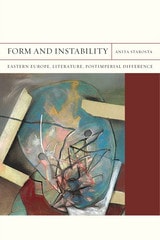
Form and Instability
Eastern Europe, Literature, Postimperial DifferenceAnita Starosta
Northwestern University Press, 2015
Located at the intersection of comparative literature, area studies, and literary theory, this interdisciplinary study has a twofold commitment: to Eastern Europe on the one hand and to literature on the other. It aims to intervene in the way we conceive of Eastern Europe by seeking to develop a more equitable way of thinking, one that avoids subordinating it to Eurocentric narratives of progress. At the same time, it marshals literature as both object and method of this rethinking, in order to extend existing conceptions of the usefulness and of the proper organization of literary studies. The three terms in the title of this book mark a passage—via literature—from “Eastern Europe” as an inadequate and obsolescent category to “post-imperial difference” as a more accurate, if provisional, account of the region. By way of original readings of particular texts, and by attending to literature as a critical
Forms of Discovery
Critical and Historical Essays on the Forms of the Short Poem in EnglishYvor Winters
Ohio University Press, 1967