Results by title
1668 books match the query 'Popular culture' and 86 start with f

For a Short Time Only
Itinerants and the Resurgence of Popular Culture in Early AmericaPeter Benes
University of Massachusetts Press, 2016
By the 1740s, colonists living in North America began to encounter scores of itinerant performers from England and Europe. These show people—acrobats, wire dancers, tumblers, trick riders, painters, dancing-masters, waxworks proprietors, healers, and singing and language teachers—brought novelty and culture to remote areas. Advertising in newspapers, they attracted audiences with the hook of appearing "for a short time only."
In this richly illustrated and deeply researched book, Peter Benes examines the rise of early American popular culture through the lives and work of itinerants who circulated in British North America and the United States from the late seventeenth through the early nineteenth century. Although they were frequently reviled as quacks and absconders by many provincials, these transients enjoyed a unique camaraderie and found audiences among high- and lowbrow alike. Drawing on contemporary diaries, letters, reminiscences, and hitherto inaccessible newspaper ads, broadsides, and images, Benes suggests why some elements of Europe's carnival and folklore traditions failed to gain acceptance in American society while others flourished brilliantly.
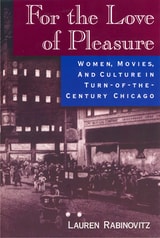
For the Love of Pleasure
Women, Movies, and Culture in Turn-of-the-Century ChicagoRabinovitz, Lauren
Rutgers University Press, 1998
--Gaylyn Studlar, atuhor of This Mad Masquerade: Stardom and Masculinity in the Jazz Age
The period from the 1880s until the 1920s saw the making of a consumer society, the inception of the technological, economic, and social landscape in which we currently live. Cinema played a key role in the changing urban landscape. For working-class women, it became a refuge from the factory. For middle-class women, it presented a new language of sexual danger and pleasure. Women found greater freedom in big cities, entering the workforce in record numbers and moving about unchaperoned in public spaces. Turn-of-the-century Chicago surpassed even New York as a proving ground for pleasure and education, attracting women workers at three times the national rate. Using Chicago as a model, Lauren Rabinovitz analyzes the rich interplay among demographic, visual, historical, and theoretical materials of the period. She skillfully links cinema theory and women's studies for a fuller understanding of cultural history. She also demonstrates how cinema dramatically affected social conventions, ultimately shaping modern codes of masculinity and feminity.
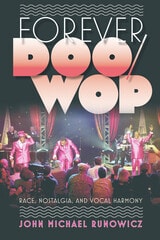
Forever Doo-Wop
Race, Nostalgia, and Vocal HarmonyJohn Michael Runowicz
University of Massachusetts Press, 2010
Music can be a storehouse for emotional, social, and cultural experiences that deepen and acquire greater value over time. This is a book about a particular genre of vocal harmony music called doo-wop that has accrued deep meaning and affective power among Americans since its inception in the aftermath of World War II. Although the first doo-wop singers were primarily young black males in major American cities, it wasn't long before white working-class teenagers began emulating their rhythm-and-blues harmonies. The racial exchange of this distinctive genre and the social bonding it engendered have had a significant and lasting impact on American musical culture.
In Forever Doo-Wop, John Runowicz traces the history of this music from its origins in nineteenth-century barbershop quartets through its emergence in the postwar era to its nostalgic adulthood from the mid-1960s to today. The book is based on interviews he has conducted and observations he has made over the last twenty-two years working as guitarist, musical director, and second tenor with one of the legendary doo-wop groups, the Cadillacs, on what is popularly known as the “oldies circuit.” As a graduate student, he broadened his research to include the wider doo-wop community.
Forever Doo-Wop invites readers to gaze through a window on our society and culture where certain truths are revealed about how white and black Americans coexist and interact, about how popular music functions as a vehicle for nostalgia, and about the role of music making over a long lifetime.

Forged under the Sun/Forjada bajo el sol
The Life of Maria Elena LucasEdited and with an Introduction by Fran Leeper Buss
University of Michigan Press, 1993

Form and the Art of Theatre
Paul Newell Campbell
University of Wisconsin Press, 1984
Forty Years of Texas Storytelling
Historical and Contemporary Tales from Diverse Writers and PoetsTed Parkhurst
Parkhurst Brothers, Inc., 2024

Four Jazz Lives
A. B. Spellman
University of Michigan Press, 2004
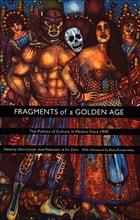
Fragments of a Golden Age
The Politics of Culture in Mexico Since 1940Gilbert M. Joseph, Anne Rubenstein, and Eric Zolov, eds.
Duke University Press, 2001
Each essay in its own way addresses the fragmentation of a cultural consensus that prevailed during the “golden age” of post–revolutionary prosperity, a time when the state was still successfully bolstering its power with narratives of modernization and shared community. Combining detailed case studies—both urban and rural—with larger discussions of political, economic, and cultural phenomena, the contributors take on such topics as the golden age of Mexican cinema, the death of Pedro Infante as a political spectacle, the 1951 “caravan of hunger,” professional wrestling, rock music, and soap operas.
Fragments of a Golden Age will fill a particular gap for students of modern Mexico, Latin American studies, cultural studies, political economy, and twentieth century history, as well as to others concerned with rethinking the cultural dimensions of nationalism, imperialism, and modernization.
Contributors. Steven J. Bachelor, Quetzil E. Castañeda, Seth Fein, Alison Greene, Omar Hernández, Jis & Trino, Gilbert M. Joseph, Heather Levi, Rubén Martínez, Emile McAnany, John Mraz, Jeffrey M. Pilcher, Elena Poniatowska, Anne Rubenstein, Alex Saragoza, Arthur Schmidt, Mary Kay Vaughan, Eric Zolov
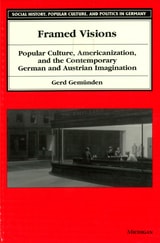
Framed Visions
Popular Culture, Americanization, and the Contemporary German and Austrian ImaginationGerd Gemunden
University of Michigan Press, 1998
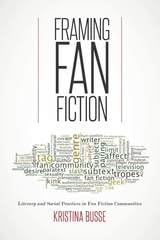
Framing Fan Fiction
Literary and Social Practices in Fan Fiction CommunitiesKristina Busse
University of Iowa Press, 2017
Framing Fan Fiction deploys personal history and the interpretations of specific stories to contextualize fan fiction culture and its particular forms of intertextuality and performativity. In doing so, it highlights the way fans use fan fiction’s reimagining of the source material to explore issues of identities and peformativities, gender and sexualities, within a community of like-minded people. In contrast to the celebration of originality in many other areas of artistic endeavor, fan fiction celebrates repetition, especially the collective creation and circulation of tropes.
An essential resource for scholars, Framing Fan Fiction is also an ideal starting point for those new to the study of fan fiction and its communities of writers.
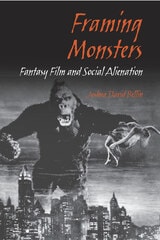
Framing Monsters
Fantasy Film and Social AlienationJoshua David Bellin
Southern Illinois University Press, 2005
The canon of popular cinema has long been rife with fantastic tales, yet critical studies have too often expediently mixed the fantasy genre with its kindred science fiction and horror films or dismissed it altogether as escapist fare. Framing Monsters: Fantasy Film and Social Alienation reconsiders the cultural significance of this storytelling mode by investigating how films seemingly divorced from reality and presented in a context of timelessness are, in fact, encoded with the social practices and beliefs of their era of production.
Situating representative fantasy films within their cultural moments, Joshua David Bellin illustrates how fantastic visions of monstrous others seek to propagate negative stereotypes of despised groups and support invidious hierarchies of social control. In constructing such an argument, Framing Monsters not only contests dismissive attitudes toward fantasy but also challenges the psychoanalytic criticism that has thus far dominated its limited critical study.
Beginning with celebrated classics, Bellin locates King Kong (1933) within the era of lynching to evince how the film protects whiteness against supposed aggressions of a black predator and reviews The Wizard of Oz (1939) as a product of the Depression’s economic anxieties. From there, the study moves to the cult classic animated Sinbad Trilogy (1958–1977) of Ray Harryhausen, films rampant with xenophobic fears of the Middle East as relevant today as when the series was originally produced.
Advancing to more recent subjects, Bellin focuses on the image of the monstrous woman and the threat of reproductive freedom found in Aliens (1986), Jurassic Park (1993), and Species (1995) and on depictions of the mentally ill as dangerous deviants in 12 Monkeys (1996) and The Cell (2000). An investigation into physical freakishness guides his approach to Edward Scissorhands (1990) and Beauty and the Beast (1991). He concludes with a discussion of X-Men (2000) and Lord of the Rings (2001–2003), commercial giants that extend a recent trend toward critical self-reflection within the genre while still participating in the continuity of social alienation.
Written to enhance rather than undermine our understanding of fantastic cinema, Framing Monsters invites filmmakers, critics, and fans alike to reassess this tremendously popular and influential film type and the monsters that populate it.
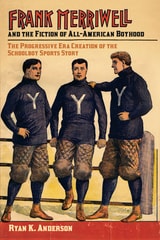
Frank Merriwell and the Fiction of All-American Boyhood
The Progressive Era Creation of the Schoolboy Sports StoryRyan K. Anderson
University of Arkansas Press, 2015
Merriwell came to symbolize the Progressive Era debate about how sport and school made boys into men. The saga featured the attractive Merriwell distinguishing between “good” and “bad” girls and focused on his squeaky-clean adventures in physical development and mentorship. By the serial’s conclusion, Merriwell had opened a school for “weak and wayward boys” that made him into a figure who taught readers how to approximate his example.
In Frank Merriwell and the Fiction of All-American Boyhood, Anderson treats Tip Top Weekly as a historical artifact, supplementing his reading of its text, illustrations, reader letters, and advertisements with his use of editorial correspondence, memoirs, trade journals, and legal documents. Anderson blends social and cultural history, with the history of business, gender, and sport, along with a general examination of childhood and youth in this fascinating study of how a fictional character was used to promote a homogeneous “normal” American boyhood rooted in an assumed pecking order of class, race, and gender.
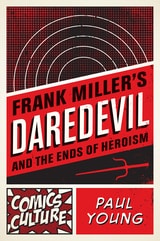
Frank Miller's Daredevil and the Ends of Heroism
Young, Paul
Rutgers University Press, 2016
In the late 1970s and early 1980s, writer-artist Frank Miller turned Daredevil from a tepid-selling comic into an industry-wide success story, doubling its sales within three years. Lawyer by day and costumed vigilante by night, the character of Daredevil was the perfect vehicle for the explorations of heroic ideals and violence that would come to define Miller’s work.
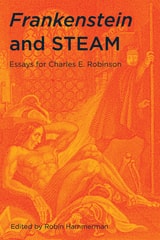
Frankenstein and STEAM
Essays for Charles E. RobinsonRobin Hammerman
University of Delaware Press, 2022
Charles E. Robinson, Professor Emeritus of English at The University of Delaware, definitively transformed study of the novel Frankenstein with his foundational volume The Frankenstein Notebooks and, in nineteenth century studies more broadly, brought heightened attention to the nuances of writing and editing. Frankenstein and STEAM consolidates the generative legacy of his later work on the novel's broad relation to topics in science, technology, engineering, arts, and mathematics (STEAM). Seven chapters written by leading and emerging scholars pay homage to Robinson's later perspectives of the novel and a concluding postscript contains remembrances by his colleagues and students. This volume not only makes explicit the question of what it means to be human, a question Robinson invited students and colleagues to examine throughout his career, but it also illustrates the depth of the field and diversity of those who have been inspired by Robinson's work. Frankenstein and STEAM offers direction for continuing scholarship on the intersections of literature, science, and technology.
Published by the University of Delaware Press. Distributed worldwide by Rutgers University Press.
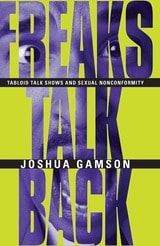
Freaks Talk Back
Tabloid Talk Shows and Sexual NonconformityJoshua Gamson
University of Chicago Press, 1998
"This entertaining, accessible, sobering discussion should make every viewer sit up and ponder the effects and possibilities of America's daily talk-fest with newly sharpened eyes."—Publishers Weekly
"Bold, witty. . . . There's a lot of empirical work behind this deceptively easy read, then, and it allows for the most sophisticated and complex analysis of talk shows yet."—Elayne Rapping, Women's Review of Books
"Funny, well-researched, fully theorized. . . . Engaged and humane scholarship. . . . A pretty inspiring example of what talking back to the mass media can be."—Jesse Berrett, Village Voice
"An extraordinarily well-researched volume, one of the most comprehensive studies of popular media to appear in this decade."—James Ledbetter, Newsday

Free Trade In The Bermuda Triangle
And Other Tales Of CounterglobalizationBrett Neilson
University of Minnesota Press, 2003
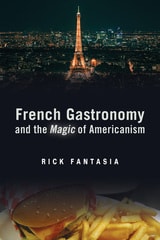
French Gastronomy and the Magic of Americanism
Rick Fantasia
Temple University Press, 2019
A tectonic shift has occurred in the gastronomic field in France, upsetting the cultural imagination. In a European country captivated by a high-stakes power struggle between chefs and restaurants in the culinary field, the mass marketing of factory-processed industrial cuisine and fast foods has created shock waves in French society, culture, and the economy.
In this insightful book, French Gastronomy and the Magic of Americanism, Rick Fantasia examines how national identity and the dynamics of cultural meaning-making within gastronomy have changed during a crucial period of transformation, from the 1970s through the 1990s. He illuminates the tensions and surprising points of cooperation between the skill, expertise, tradition, artistry, and authenticity of grand chefs and the industrial practices of food production, preparation, and distribution.
Fantasia examines the institutions and beliefs that have reinforced notions of French cultural supremacy—such as the rise and reverence of local cuisine—as well as the factors that subvert those notions, such as when famous French chefs lend their names to processed, frozen, and pre-packaged foods available at the supermarket. Ultimately, French Gastronomy and the Magic of Americanism shows what happens to a cultural field, like French gastronomy, when the logic and power of the economic field imposes itself upon it.
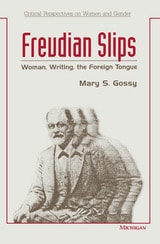
Freudian Slips
Woman, Writing, the Foreign TongueMary S. Gossy
University of Michigan Press, 1995
Gossy believes that Freud's most popular statement of a theory of the unconscious is written over foreign and feminized texts, bodies, and places, by way of anecdotes that range from the Dora case to menstruation to travel phobias. Freudian Slips: Woman, Writing, the Foreign Tongue does a feminist psychoanalytic reading of Freud's book and shows how slippery- textually, erotically, and historically- the writing of theory can be, and also how much we can learn from our slips when we are willing to admit that we have made them.
Bringing together autobiography, psychoanalysis, close readings, pedagogy, and politics in provocative and innovative ways, Gossy discusses Freud's work from both textual and theoretical perspectives and asks what his writing can teach us about authority, theory, home, and the foreign. Arguing that the dominant metaphor in the Psychopathology is that of the female body as foreign text, and that this body, writing, and the foreign tongue are identified with a feminized unconscious that threatens authoritative discourse, Freudian Slips moves toward fashioning a feminist theory that is both "slippery and (para)practical" and constantly searches for ways of writing theory that free, rather than sacrifice, the bodies of women.
"The readings of individual slips are often highly productive; the argument is both hardworking and playful. Freudian Slips is a book that people will enjoy reading and from which they will learn a great deal."-- Helena Michie, Rice University
Mary S. Gossy is Associate Professor of Spanish and Comparative Literature, Rutgers University. She is the author of The Untold Story: Women and Theory in Golden Age Texts.

Freudian Slips
Woman, Writing, the Foreign TongueMary S. Gossy
University of Michigan Press, 1995

From Azaleas to Zydeco
My 4,600-Mile Journey through the SouthMark W. Nichols
Butler Center for Arkansas Studies, 2013
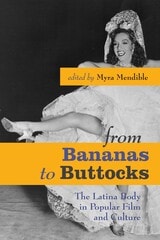
From Bananas to Buttocks
The Latina Body in Popular Film and CultureEdited by Myra Mendible
University of Texas Press, 2007
From the exuberant excesses of Carmen Miranda in the "tutti frutti hat" to the curvaceous posterior of Jennifer Lopez, the Latina body has long been a signifier of Latina/o identity in U.S. popular culture. But how does this stereotype of the exotic, erotic Latina "bombshell" relate, if at all, to real Latina women who represent a wide spectrum of ethnicities, national origins, cultures, and physical appearances? How are ideas about "Latinidad" imagined, challenged, and inscribed on Latina bodies? What racial, class, and other markers of identity do representations of the Latina body signal or reject?
In this broadly interdisciplinary book, experts from the fields of Latina/o studies, media studies, communication, comparative literature, women's studies, and sociology come together to offer the first wide-ranging look at the construction and representation of Latina identity in U.S. popular culture. The authors consider such popular figures as actresses Lupe Vélez, Salma Hayek, and Jennifer Lopez; singers Shakira and Celia Cruz; and even the Hispanic Barbie doll in her many guises. They investigate the media discourses surrounding controversial Latinas such as Lorena Bobbitt and Marisleysis González. And they discuss Latina representations in Lupe Solano's series of mystery books and in the popular TV shows El Show de Cristina and Laura en América. This extensive treatment of Latina representation in popular culture not only sheds new light on how meaning is produced through images of the Latina body, but also on how these representations of Latinas are received, revised, and challenged.
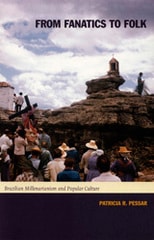
From Fanatics to Folk
Brazilian Millenarianism and Popular CulturePatricia R. Pessar
Duke University Press, 2004
Pessar combines cultural history spanning the colonial period to the present; comparative case studies of the Canudos, Contestado, Juazeiro, and Santa Brígida movements; and three decades of ethnographic research in the Brazilian Northeast. Highlighting the involvement of a broad range of individuals and institutions, the cross-fertilization between movements, contestation and accommodation vis-à-vis the church and state, and matters of spirituality and faith, From Fanatics to Folk reveals Brazilian millenarianism as long-enduring and constantly in flux.

From Good King Wenceslas to the Good Soldier Švejk
A Dictionary of Czech Popular CultureAndrew Roberts
Central European University Press, 2005
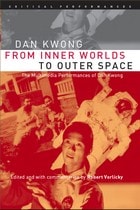
From Inner Worlds to Outer Space
The Multimedia Performances of Dan KwongDan Kwong
University of Michigan Press, 2004
"Somehow, Kwong has held onto his sense of childlike wonder about the cosmos, and that awe informs his free-wheeling and uproarious performance."
-Asian Week
"He weaves striking, multi-focus stage pictures around simple monologues about his Chinese and Japanese grandfathers, ironic accounts of his own childhood, and litanies of the trials facing Asian American males."
-L.A. Times
"Saturated with high-spirited enthusiasm . . . a refreshingly forthright approach to his often dark material."
-Chicago Tribune
"Kwong's humor is warm and loving . . . it stems from a delightfully twisted taste for the absurdity of human behavior. . . . Be prepared to laugh, to be moved, and to fall in love with a performer."
-L.A. Reader
Dan Kwong's performances delve into the complexities of growing up as a working-class Chinese-Japanese-American male in L.A., land of Hollywood and Disney. Kwong's remarkable performances, a potent array of multimedia effects and athletic physicalization, investigate questions of identity and the intersecting effects of race, culture, class, gender, and sexuality. From Inner Worlds to Outer Space brings together Kwong's scripts with illuminating commentary by critic Robert Vorlicky. The book includes interviews that reveal Kwong's personal and artistic influences, his evolution as an artist, and his philosophical and technical approach to art-making.
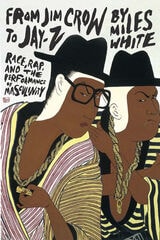
From Jim Crow to Jay-Z
Race, Rap, and the Performance of MasculinityMiles White
University of Illinois Press, 2011
From Jim Crow to Jay-Z traces black male representations to chattel slavery and American minstrelsy as early examples of fetishization and commodification of black male subjectivity. Continuing with diverse discussions including black action films, heavyweight prizefighting, Elvis Presley's performance of blackness, and white rappers such as Vanilla Ice and Eminem, White establishes a sophisticated framework for interpreting and critiquing black masculinity in hip-hop music and culture. Arguing that black music has undeniably shaped American popular culture and that hip-hop tropes have exerted a defining influence on young male aspirations and behavior, White draws a critical link between the body, musical sound, and the construction of identity.
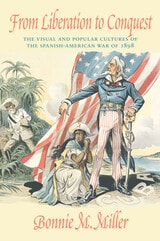
From Liberation to Conquest
The Visual and Popular Cultures of the Spanish-American War of 1898Bonnie M. Miller
University of Massachusetts Press, 2011
Although media campaigns initially advocated for the United States to step in to rescue Cuba from the horrors of colonial oppression, the war ended just months later with the U.S. acquisition of Spain's remaining empire, including Cuba, Puerto Rico, Guam, and the Philippines. President William McKinley heeded the call for war, with the American people behind him, and then proceeded to use the conflict to further his foreign policy agenda of expanding U.S. interests in the Caribbean and Far East.
Miller examines the shifting media portrayals of U.S. actions for the duration of the conflict, from liberation to conquest. She shows how the media capitalized on the public's thirst for drama, action, and spectacle and adapted to emerging imperial possibilities. Growing resistance to American imperialism by the war's end unraveled the consensus in support of U.S policy abroad and produced a rich debate that found expression in American visual and popular culture.
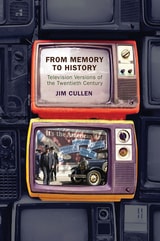
From Memory to History
Television Versions of the Twentieth CenturyJim Cullen
Rutgers University Press, 2021
From Memory to History takes readers on a journey through over fifty years of historical dramas and sitcoms that were set in earlier decades of the twentieth century. Along the way, it explores how comedies like M*A*S*H and Hogan’s Heroes offered veiled commentary on the Vietnam War, how dramas ranging like Mad Men echoed current economic concerns, and how The Americans and Halt and Catch Fire used the Cold War and the rise of the internet to reflect upon the present day. Cultural critic Jim Cullen is lively, informative, and incisive, and this book will help readers look at past times, present times, and prime time in a new light.

From Submarines to Suburbs
Selling a Better America, 1939–1959Cynthia Lee Henthorn
Ohio University Press, 2006
From Submarines to Suburbs surveys the development, strategy, and effect of these campaigns over a span of twenty pivotal years. Cynthia Lee Henthorn takes a close look at how pre-fabricated suburban houses, high-tech kitchens, and miracle products developed from war-related industries were promoted as the hygienic solutions for establishing this better America, one led by the captains of free enterprise.
As Henthorn demonstrates, wartime advertising and marketing strategies tying consumer prosperity to war were easily adapted in the Cold War era, when a symbiotic relationship between military standing and standards of living intensified in a culture dependent on defense spending. Were the efforts to engineer a better America successful? Using documentary evidence in the form of numerous advertisements, From Submarines to Suburbs stands as a significant contribution to understanding how today’s “better” America evolved.

From Tian'anmen to Times Square
Transnational China and the Chinese Diaspora on Global Screens, 1989-1997Gina Marchetti
Temple University Press, 2006
In From Tian'anmen to Times Square, leading film scholar Gina Marchetti considers the complex changes in the ways that China and the Chinese have been portrayed in cinema and media arts since the Tian'anmen revolt. Drawing on her interviews with leading contemporary Chinese filmmakers, Marchetti looks at a wide range of work by Chinese and non-Chinese media artists working in China, Hong Kong, Taiwan, and Singapore and on transnational co-productions involving those places. Focusing on the intersections of race, ethnicity, gender, and sexuality on global screens, Marchetti traces the momentous political, cultural, social, and economic forces confronting contemporary media artists and filmmakers working within "Greater China."

Front Yard America
The Evolution and Meanings of a Vernacular Domestic LandscapeFred E.H. Schroeder
University of Wisconsin Press, 1993
Throughout Front Yard America, Schroeder inquires into the functions, values, and meanings that Americans have found in the domestic landscapes of back yards and front yards, walls and fences, porches and patios.
Front-Page Detective
William J. Burns and the Detective Profession, 1880–1930William R. Hunt
University of Wisconsin Press, 1990
Fundamental Development of the Social Sciences
Rockefeller Philanthropy and the United States Social Science Research CouncilDonald Fisher
University of Michigan Press, 1993
The United States Social Science Research Council (SSRC), founded in 1923, was the first national social science institution in the world and might be said to represent the creation of a "science of society." In Fundamental Development of the Social Sciences , Donald Fisher shows how this institution, under the considerable influence of Rockefeller philanthropy, shaped an entire discipline.
Fisher demonstrates that the creation and growth of the SSRC during the 1920s and 1930s is essential to our understanding of the major developments in the social sciences since World War II. He shows that during this period, the place of social science and social scientists in American society was fixed in a way that has had substantial, lasting impact.
The author weaves a number of larger, related issues into his account of the wide-ranging influence of the SSRC: the role of social scientists in the political life of the societies in which they live; the way in which knowledge systems develop and change; the role of philanthropy in industrialized societies; and the formation and preservation of the modern capitalist state.
Donald Fisher's discussion of how an American institution sculpted an entire discipline will be of interest to all social scientists and historians of social science.
Funk the Erotic
Transaesthetics and Black Sexual CulturesL.H. Stallings
University of Illinois Press, 2015
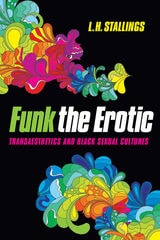
Stallings uses funk to highlight the importance of the erotic and eroticism in Black cultural and political movements, debunking "the truth of sex" and its histories. Brandishing funk as a theoretical tool, Stallings argues that Western theories of the erotic fail as universally applicable terms or philosophies, and thus lack utility in discussions of black bodies, subjects, and culture. In considering the Victorian concept of freak in black funk, Stallings proposes that black artists across all media have fashioned a tradition that embraces the superfreak, sexual guerrilla, sexual magic, mama's porn, black trans narratives, and sex work in a post-human subject position. Their goal: to ensure survival and evolution in a world that exploits black bodies in capitalist endeavors, imperialism, and colonization.
Revitalizing and wide-ranging, Funk the Erotic offers a needed examination of black sexual cultures, a discursive evolution of black ideas about eroticism, a critique of work society, a reexamination of love, and an articulation of the body in black movements.
Funny Stuff
How Comedy Shaped American HistoryLaura LaPlaca
Rutgers University Press, 2026
A Junior Library Guild Gold Standard Selection
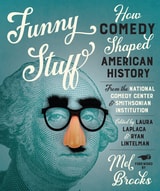
The National Comedy Center and Smithsonian Institution hold unparalleled collections of artifacts that illustrate the vitality and importance of comedy in American life, from vaudeville, silent films, and TV sitcoms to stand-up, sketch, and cartoons. Now, for the first time, these collections are brought together in vibrant photographs and illuminating essays that tell the story of how comedy shaped American history.
Written by historians responsible for safeguarding these cultural treasures, the book takes readers behind the scenes to uncover the stories behind American heirlooms like Groucho Marx’s tailcoat, George Carlin’s joke files, Carol Burnett’s “Went with the Wind” dress, Johnny Carson’s monologues, and the very first Saturday Night Live script, alongside materials from cultural touchstones like The Simpsons, The Muppet Show, In Living Color, All In the Family, and I Love Lucy.
With a foreword by comedy legend Mel Brooks, this dynamic work offers pop culture aficionados, history lovers, and comedy nerds alike a new perspective on America’s past and who we are as a nation through our comedy.

Furious Feminisms
Alternate Routes on Mad Max: Fury RoadAlexis L. Boylan
University of Minnesota Press, 2019
A provocative peek into this complicated film as a space for subversion, activism, and imaginative power
While both fans and foes point to Mad Max: Fury Road’s feminist credentials, Furious Feminisms asks: is there really anything feminist or radical happening on the screen? The four authors—from backgrounds in art history, American literature, disability studies, and sociology—ask what is possible, desirable, or damaging in theorizing feminism in the contested landscape of the twenty-first century. Can we find beauty in the Anthropocene? Can power be wrested from a violent system without employing and perpetuating violence?
This experiment in collaborative criticism weaves multiple threads of dialogue together to offer a fresh perspective on our current cultural moment.
Forerunners: Ideas First
Short books of thought-in-process scholarship, where intense analysis, questioning, and speculation take the lead
Futures At Stake
Youth, Gambling, And SocietyHoward J. Shaffer
University of Nevada Press, 2003
The widespread legalization of gambling across the U.S. has produced concerns for serious social, economic, and health problems. For the first time in this country, an entire generation of young people has reached adulthood within a context of approval and endorsement of gambling as a source of entertainment and recreation. Compared with their adult counterparts, these young people have evidenced a higher level of gambling related problems. In Futures at Stake, specialists in psychology, medicine, law, public health, economics, casino management, psychiatry, and criminal justice examine this problem from the perspective of their various disciplines, producing an intelligent, thought-provoking, and valuable survey of what is fast becoming a leading social-health problem across the nation. Foreword by Thomas N. Cummings.