Results by title
8128 books match the query 'Literary Criticism' and 298 start with f
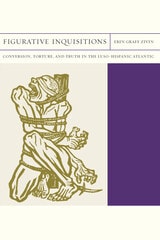
Figurative Inquisitions
Conversion, Torture, and Truth in the Luso-Hispanic AtlanticErin Graff Zivin
Northwestern University Press, 2014
Winner, 2015 LAJSA Best Book in Latin American Jewish Studies
The practices of interrogation, torture, and confession have resurfaced in public debates since the early 2000s following human rights abuses around the globe. Yet discussion of torture has remained restricted to three principal fields: the legal, the pragmatic, and the moral, eclipsing the less immediate but vital question of what torture does.Figurative Inquisitions seeks to correct this lacuna by approaching the question of torture from a literary vantage point.
This book investigates the uncanny presence of the Inquisition and marranismo (crypto-Judaism) in modern literature, theater, and film from Mexico, Brazil, and Portugal. Through a critique of fictional scenes of interrogation, it underscores the vital role of the literary in deconstructing the relation between torture and truth. Figurative Inquisitions traces the contours of a relationship among aesthetics, ethics, and politics in an account of the "Inquisitional logic" that continues to haunt contemporary political forms. In so doing, the book offers a unique humanistic perspective on current torture debates.
Figures of Conversion
“The Jewish Question” and English National IdentityMichael Ragussis
Duke University Press, 1995
—Daniel Defoe, The Farther Adventures of Robinson Crusoe (1719)
When the hero of Defoe’s novel listens skeptically to this anecdote related by a French Roman Catholic priest, he little suspects that in less than a century the conversion of the Jews would become nothing short of a national project—not in France but in England. In this book, Michael Ragussis explores the phenomenon of Jewish conversion—the subject of popular enthusiasm, public scandal, national debate, and dubbed "the English madness" by its critics—in Protestant England from the 1790s through the 1870s.
Moving beyond the familiar catalog of anti-Semitic stereotypes, Ragussis analyzes the rhetoric of conversion as it was reinvented by the English in sermons, stories for the young, histories of the Jews, memoirs by Jewish converts, and popular novels. Alongside these texts and the countertexts produced by English Jews, he situates such writers as Edgeworth, Scott, Disraeli, Arnold, Trollope, and Eliot within the debate over conversion and related issues of race, gender, and nation-formation. His work reveals how a powerful group of emergent cultural projects—including a revisionist tradition of the novel, the new science of ethnology, and the rewriting of European history—redefined English national identity in response to the ideology of conversion, the history of the Jews, and "the Jewish question."
Figures of Conversion offers an entirely new way of regarding Jewish identity in nineteenth-century British culture and will be of importance not only to literary scholars but also to scholars of Judaic and religious studies, history, and cultural studies.

Figures of Ill Repute
Representing Prostitution in Nineteenth-Century FranceCharles Bernheimer
Duke University Press, 0
Figures of Resistance
Language, Poetry, and Narrating in The Tale of the Genji and Other Mid-Heian TextsH. Richard Okada
Duke University Press, 1991
Okada develops a highly original and sophisticated reading strategy that demonstrates how readers might understand texts belonging to a different time and place without being complicit in their assimilation to categories derived from Western literary traditions. The author’s reading stratgey is based on the texts’ own resistance to modes of analysis that employ such Western canonical terms as novel, lyric, and third-person narrative. Emphasis is also given to the distinctive cultural circles, as well as socio-political and genealogical circumstances that surrounded the emergence of the texts.
Indispensable readings for specialists in literature, cultural studies, and Japanese literature and history, Figures of Resistance will also appeal to general readers interested in the problems and complexities of studying another culture.
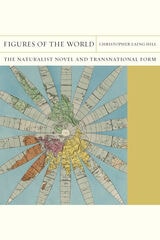
Figures of the World
The Naturalist Novel and Transnational FormChristopher Laing Hill
Northwestern University Press, 2020
The book begins by tracing the history of naturalist fiction from the 1860s into the twentieth century and the reasons it spread around the world. Hill explores the development of three naturalist figures—the degenerate body, the self-liberated woman, and the social milieu—through close readings of fiction from France, Japan, and the United States. Rather than genealogies of European influence or the domination of cultural “peripheries” by the center, novels by Émile Zola, Tayama Katai, Frank Norris, and other writers reveal conspicuous departures from metropolitan models as writers revised naturalist methods to address new social conditions. Hill offers a new approach to studying culture on a large scale for readers interested in literature, the arts, and the history of ideas.
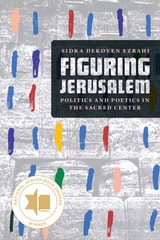
Figuring Jerusalem
Politics and Poetics in the Sacred CenterSidra DeKoven Ezrahi
University of Chicago Press, 2022
For two thousand years, Hebrew writers used their exile from the Holy Land as a license for invention. The question at the heart of Figuring Jerusalem is this: how did these writers bring their imagination “home” in the Zionist century? Sidra DeKoven Ezrahi finds that the same diasporic conventions that Hebrew writers practiced in exile were maintained throughout the first half of the twentieth century. And even after 1948, when the state of Israel was founded but East Jerusalem and its holy sites remained under Arab control, Jerusalem continued to figure in the Hebrew imagination as mediated space. It was only in the aftermath of the Six Day War that the temptations and dilemmas of proximity to the sacred would become acute in every area of Hebrew politics and culture.
Figuring Jerusalem ranges from classical texts, biblical and medieval, to the post-1967 writings of S. Y. Agnon and Yehuda Amichai. Ultimately, DeKoven Ezrahi shows that the wisdom Jews acquired through two thousand years of exile, as inscribed in their literary imagination, must be rediscovered if the diverse inhabitants of Jerusalem are to coexist.

Filth
Dirt, Digust, and Modern LifeWilliam A. Cohen
University of Minnesota Press, 2004
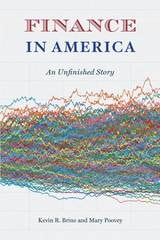
Finance in America
An Unfinished StoryKevin R. Brine and Mary Poovey
University of Chicago Press, 2017
To understand finance, however, we have to learn its history, and this book fills that need. Kevin R. Brine, an industry veteran, and Mary Poovey, an acclaimed historian, show that finance as we know it today emerged gradually in the late nineteenth century and only coalesced after World War II, becoming ever more complicated—and ever more central to the American economy. The authors explain the models, regulations, and institutions at the heart of modern finance and uncover the complex and sometimes surprising origins of its critical features, such as corporate accounting standards, the Federal Reserve System, risk management practices, and American Keynesian and New Classic monetary economics. This book sees finance through its highs and lows, from pre-Depression to post-Recession, exploring the myriad ways in which the practices of finance and the realities of the economy influenced one another through the years.
A masterwork of collaboration, Finance in America lays bare the theories and practices that constitute finance, opening up the discussion of its role and risks to a broad range of scholars and citizens.
Financial Speculation in Victorian Fiction
Plotting Money and the Novel Genre, 1815–1901Tamara S. Wagner
The Ohio State University Press, 2010
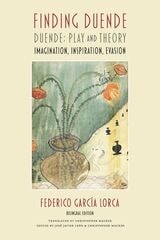
Finding Duende
Duende: Play and Theory | Imagination, Inspiration, EvasionFederico García Lorca
Swan Isle Press, 2023
For years, Federico García Lorca’s lecture on duende has been a source of insight for writers and performers, including Ted Hughes, Nick Cave, Patti Smith, and Amanda Gorman.
Duende: Play and Theory not only provides a path into Lorca’s poetics and the arts of Spain; it is one of the strangest, most compelling accounts of inspiration ever offered by a poet. Contrasting the demon called duende with the Angel and the Muse, Lorca describes a mysterious telluric, diabolical current, an irreducible “it,” that can draw the best from both performer and audience.
This new translation by Christopher Maurer, based on a thoroughly revised edition of the Spanish original of 1933, also included in this volume, offers a more accurate and fully annotated version of the lecture, with an introduction by eminent philologist José Javier León. Drawing on a deep knowledge of flamenco, and correcting decades of discussion about duende and its supposed origins in Spanish folklore and popular speech, León shows to what extent the concept of duende—understood as the imp of artistic inspiration—was the playful, yet deadly serious, invention of Lorca himself.
Lorca’s bravura performance of duende is foreshadowed here with a bilingual version—the most complete ever—of his other major text on inspiration, “Imagination, Inspiration, Evasion,” in which he calls for greater freedom in poetry as if searching for duende and its “constant baptism of newly created things.”
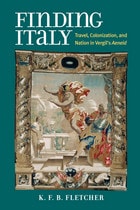
Finding Italy
Travel, Nation, and Colonization in Vergil's AeneidK. F. B. Fletcher
University of Michigan Press, 2014
Finding Italy explores the journey of the Romans’ ancestor Aeneas and his fellow Trojans from their old home, Troy, to their new country, Italy, narrated in Vergil’s epic poem Aeneid. K. F. B. Fletcher argues that a main narrative theme is patriotism, specifically the problem of how one comes to love one’s new country. The various directions Aeneas receives throughout the first half of the poem are meant to create this love, explaining both to Aeneas and to Vergil’s readers how they should respond to the new, unified Italy synonymous with Rome. These directions come from the gods, or from people close to Aeneas who have divine connections, and they all serve to instill an emotional connection to the land, creating a mental image of Italy that tells him far more about his destination than merely its location, and ultimately making him fall in love with Italy enough to fight for it soon after his arrival. The poem thus dramatizes the birth of nationalism, as Italy is only a concept to Aeneas throughout his trip; these directions do not describe Italy as it is at the time of Aeneas’ journey, but as an ideal to be realized by Aeneas and his descendants, reaching its final, perfect form under Augustus Caesar.
Finding Italy provides a very detailed reading of the directions Aeneas receives by situating them within their relevant contexts: ancient geography, Greek colonization narratives, prophecy, and ancient views of wandering. Vergil draws on all of these concepts to craft instructions that create in Aeneas an attachment to Italy before he ever arrives, a process that dramatizes a key emotional problem in the late first century BCE in the wake of the Social and Civil Wars: how to balance the love of one's modest birthplace with the love of Rome, the larger city that now encompasses it.
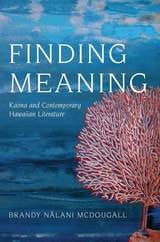
Finding Meaning
Kaona and Contemporary Hawaiian LiteratureBrandy Nalani McDougall
University of Arizona Press, 2016
In this first extensive study of contemporary Hawaiian literature, Brandy Nalani McDougall examines a vibrant selection of fiction, poetry, and drama by emerging and established Hawaiian authors, including Haunani-Kay Trask, John Dominis Holt, Imaikalani Kalahele, and Victoria Nalani Kneubuhl. At the center of the analysis is a hallmark of Hawaiian aesthetics—kaona, the intellectual practice of hiding and finding meaning that encompasses the allegorical, the symbolic, the allusive, and the figurative.
With a poet’s attention to detail, McDougall interprets examples of kaona, guiding readers through olelo no'eau (proverbs), mo‘olelo (literature and histories), and mooku'auhau (genealogies) alongside their contemporary literary descendants, unveiling complex layers of Hawaiian identity, culture, history, politics, and ecology.
Throughout, McDougall asserts that “kaona connectivity” not only carries bright possibilities for connecting the present to the past, but it may also ignite a decolonial future. Ultimately, Finding Meaning affirms the tremendous power of Indigenous stories and genealogies to give activism and decolonization movements lasting meaning.
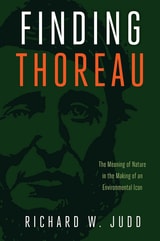
Finding Thoreau
The Meaning of Nature in the Making of an Environmental IconRichard W. Judd
University of Massachusetts Press, 2018
In his 1862 eulogy for Henry David Thoreau, Ralph Waldo Emerson reflected that his friend “dedicated his genius with such entire love to the fields, hills, and waters of his native town, that he made them known and interesting to all reading Americans, and to people over the sea.” Finding Thoreau traces the reception of Thoreau's work from the time of his death to his ascendancy as an environmental icon in the 1970s, revealing insights into American culture's conception of the environment.
Moving decade by decade through this period, Richard W. Judd unveils a cache of commentary from intellectuals, critics, and journalists to demonstrate the dynamism in the idea of nature, as Americans defined and redefined the organic world around them amidst shifting intellectual, creative, and political forces. This book tells the captivating story of one writer's rise from obscurity to fame through a cultural reappraisal of the work he left behind.

Finding a Common Thread
Reading Great Texts from Homer to O'ConnorRobert C. Roberts
St. Augustine's Press, 2013
In this book, a group of prominent scholar-teachers meditate on how to read, in the context of a specifically Christian university or college education, some of the greatest texts of the Western tradition. Each author devotes himself or herself to a single text. In many cases, the authors have been reading, rereading, marking, ruminating, inwardly digesting, teaching, and discussing their text for several decades, so that they offer here a distillation of years of familiarity and reflection.
The texts span nearly 3,000 years. They are pre-Christian, Christian, and post-Christian. Each kind of text – indeed, each individual text – offers its own special opportunities and challenges for Christian interpretation. From these diverse readings emerges a sense that these texts all belong to a single great tradition, one to which Christianity made and continues to make enormous contributions. Medieval Christian writers exploit and transform pagan texts, and post-Christian writers like Nietzsche and Joyce are often preoccupied with Christian themes. In one way or another all the texts are about what it is to be a human being and what a good human life might look like. Thus “common threads” bind one text to the next, creating countless resonances among them.
The authors of the essays in this book all address the question, “How shall we read these texts from the vantage point of faith in God and Jesus Christ? Moreover, how shall we read them as members of a community with a common vision of the human good, aiming to nurture our students in that vision by reading with them some of the profoundest and most delightful things the human hand has penned?” As the Introduction suggests, the volume hopes to contribute to a renewal of the original intention of university education: to cultivate minds and hearts formed and informed by wisdom, the highest of intellectual goods.
Finding the Middle Ground
Krestovskii, Tur, and the Power of Ambivalence in Nineteenth-Century Russian Women's ProseJehanne Gheith
Northwestern University Press, 2004

Finding the Right Place on the Map
Central and Eastern European Media Change in a Global PerspectiveEdited by Karol Jakubowicz and Miklós Sükösd
Intellect Books, 2008

Finding the Weight of Things
Larry Eigner's EcrippoeticsGeorge Hart
University of Alabama Press, 2022
Where language, body, and form converge in the poetry of Larry Eigner.
Larry Eigner (1927–1996) wrote thousands of poems in his lifetime, despite profound physical limitations caused by cerebral palsy. Using only the thumb and index finger of his right hand, Eigner generated a torrent of urgent and rich language, participating in vital correspondences as well as publishing widely in literary magazines and poetry journals.
While Eigner wrote before the emergence of ecopoetics, his poetry reflected a serious engagement with scientific writing and media, including Rachel Carson’s seminal Silent Spring. Eigner was writing about environmental disasters and climate change long before such concerns took on a moral incumbency. Similarly, Eigner was ahead of his time in his exploration of disability. The field of disability studies has expanded rapidly in the new millennium. Eigner was not an overtly biographical poet, at least as far as his physical limitations were concerned, but his poetry spoke volumes on the idea of embodiment in all its forms.
Finding the Weight of Things: Larry Eigner’s Ecrippoetics is the first full-length study of Eigner’s poetry, covering his entire career from the beginning of his mature work in the 1950s to his last poems of the 1990s. George Hart charts where Eigner’s two central interests intersect, and how their interaction fueled his work as a poet-critic—one whose work has much to tell us about the ecology and embodiment of our futures. Hart sees Eigner’s overlapping concerns for disability, ecology, and poetic form as inextricable, and coins the phrase ecrippoetics here to describe Eigner’s prescient vision.
Finite Perfection
Reflections on VirtueMichael A. Weinstein
University of Massachusetts Press, 1985
A contemporary account of how virtue can have significance in a world that has lost the certainty of common and collective meanings.
Finite Perfection: Reflections on Virtue is a work of political philosophy and ethical theory in which Michael A. Weinstein develops a rigorous and original account of virtue grounded in the existentialist tradition rather than in classical metaphysics or theology. The book's title captures its central philosophical tension: where classical and religious traditions have often located virtue in relation to an infinite, divine, or transcendent standard of perfection, Weinstein insists on taking seriously the finitude of the human condition—the irreducible limits of time, mortality, and embodied existence—and asking what excellence and virtue can mean for beings who are, by nature, incomplete and bounded.
Weinstein's approach is rooted in the concept of the self-possessed individual—a person who has achieved a kind of integrity and mastery over themselves not through escape from finitude, but through honest acknowledgment and creative embrace of it. Virtue, on this view, is not a transcendence of human limitation but a perfecting of what is possible within it: the best a finite being can be. This framework draws productively on the existentialist tradition (particularly its emphasis on authenticity, self-creation, and the confrontation with mortality), while also engaging with the Aristotelian tradition of virtue ethics and the Nietzschean understanding of self-overcoming.
Throughout its pages, Weinstein brings his characteristic intellectual breadth to bear, moving across political philosophy, ethics, and social theory to construct an account of virtue that is both philosophically rigorous and deeply humane.
Fire and Desire
Mixed-Race Movies in the Silent EraJane M. Gaines
University of Chicago Press, 2001
Fire and Desire offers a penetrating look at the black independent film movement during the silent period. Gaines traces the profound influence that D. W. Griffith's racist epic The Birth of a Nation exerted on black filmmakers such as Oscar Micheaux, the director of the newly recovered Within Our Gates. Beginning with What Happened in the Tunnel, a movie that played with race and sex taboos by featuring the first interracial kiss in film, Gaines also explores the cinematic constitution of self and other through surprise encounters: James Baldwin sees himself in the face of Bette Davis, family resemblance is read in Richard S. Robert's portrait of an interracial family, and black film pioneer George P. Johnson looks back on Micheaux.
Given the impossibility of purity and the co-implication of white and black, Fire and Desire ultimately questions the category of "race movies" itself.
Fire on the Water
Sailors, Slaves, and Insurrection in Early American Literature, 1789-1886Warren, Lenora
Bucknell University Press, 2019
Published by Bucknell University Press. Distributed worldwide by Rutgers University Press.
First Books
The Printed Word and Cultural Formation in Early AlabamaPhilip D. Beidler
University of Alabama Press, 1999
Early 19th-century Alabama was a society still in the making. Now Philip Beidler tells how the first books written and published in the state influenced the formation of Alabama's literary and political culture. As Beidler shows, virtually overnight early Alabama found itself in possession of the social, political, and economic conditions required to jump start a traditional literary culture in the old Anglo-European model: property-based class relationships, large concentrations of personal wealth, and professional and merchant classes of similar social, political, educational, and literary views.
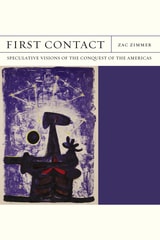
First Contact
Speculative Visions of the Conquest of the AmericasZac Zimmer
Northwestern University Press, 2025
Examining the power of speculative fiction to reimagine historical accounts of the conquest of the Americas
The historical conquest of the Americas resides at the core of all first-contact narratives, which stage colonization and resistance in the generic guise of speculative fiction. Starting from this axiom, First Contact: Speculative Visions of the Conquest of the Americas moves through a corpus of Mexican novels, Andean visual arts practices, and other cultural artifacts that have dramatized counterfactual narratives. Reimagining the early colonial period’s historiography from a south-to-north directionality while inventing parallel realities, these texts, which are concerned with limit cases, alterities, and alternative temporalities, refuse any reliance on the imperial ontologies of European expansion. Zac Zimmer examines these works to explore the slippage that exists between science fiction as the exemplary genre of the modern, colonial reality and literary speculation as an aesthetic tool that can be used to imagine other possible worlds. First Contact thus poses a foundational question: Can we understand the conquest as an originary world-historical event without eclipsing the other cosmologies that existed, and continue to exist, within the contact zone? Can we decolonize the speculative imagination itself?
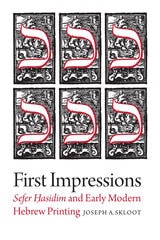
First Impressions
Sefer Hasidim and Early Modern Hebrew PrintingJoseph A. Skloot
Brandeis University Press, 2023
In 1538, a partnership of Jewish silk makers in the city of Bologna published a book entitled Sefer Hasidim, a compendium of rituals, stories, and religious instruction that primarily originated in medieval Franco-Germany. How these men, of Italian and Spanish descent, came to produce a book that would come to shape Ashkenazic culture, and Jewish culture more broadly, over the next four centuries is the basis of this kaleidoscopic study of the history of Hebrew printing in the sixteenth century.
During these early years of printing, the classic works of ancient and medieval Hebrew and Jewish literature became widely available to Jewish (and non-Jewish) readers for the first time. Printing, though, was not merely the duplication and distribution of pre-existing manuscripts, it was the creative adaptation and transformation of those manuscripts by printers. Ranging from Catholic Bologna to Protestant Basel to the Jewish heartland of the Polish-Lithuanian Commonwealth, Joseph A. Skloot uncovers the history of that creativity by examining the first two print editions of Sefer Hasidim. Along the way, he demonstrates how volumes that were long thought to be eternal and unchanging were in fact artifacts of historical agency and contingency, created by and for human beings.

First Love
The Affections of Modern FictionMaria DiBattista
University of Chicago Press, 1991
DiBattista argues that modernity reinvented First Love as a myth of creative initiative, as its characteristic response to a pervasive sense of historical belatedness. Anxious that its own creations can never be more than diminished forms of mightier originals, modernity idolizes First Love as the beginning that can never be repeated. First Love hence epitomizes the dream of a new self-incarnation. From Turgenev's First Love to the formative works of Virginia Woolf, Gertrude Stein, E. M. Forster, and Vladimir Nabokov, First Love confirms the birth of an artistic vocation. For modern men and women intent on becoming the original authors of their own lives, First Love becomes paradigmatic of those life-altering moments that transform the undifferentiated sequence of days into a fateful narrative.
DiBattista focuses on the enunciation of First Love in the fiction of Thomas Hardy, D. H. Lawrence, James Joyce, and Samuel Beckett. In reading their works, DiBattista dramatically revises the accepted view of irony as the dominant tone of modernism. First Love constitutes, she shows, a new apprehension of the world characterized not by the frigid distances of irony but by a belief in the creative individual who may begin the world anew, as if for the first time.
First Loves and Other Adventures
Grace Schulman
University of Michigan Press, 2009
Grace Schulman's acclaimed poetry is often about joy, the celebration of the miraculous, and the birth of beauty from adversity. In her new prose collection, she explores the passion for reading and other disciplines that led her to exult in her craft.
In First Loves and Other Adventures Schulman explores how she became a writer; her wide-ranging influences; and some of the many writers and works that have enchanted her over the years, ranging from Genesis and Song of Songs in the King James Bible to T. S. Eliot to Walt Whitman. These reflections on her art and career touch on a variety of other disciplines, including science, the novel, music, and art, and their relation to poetry as a field. Her belief that art transcends formal boundaries is a recurring theme throughout her discussion of these influences, as well as in her own work.
Grace Schulman is the author of six books of poems. Among her honors are the Aiken Taylor Award for poetry, the Delmore Schwartz Memorial Award, a Guggenheim Fellowship, and New York University's Distinguished Alumni Award. Her poems have won three Pushcart Prizes, and her collection Days of Wonder was selected by Library Journal as one of the best poetry books of 2002. Schulman is the former director of the Poetry Center and former poetry editor of the Nation and currently is Distinguished Professor of English at Baruch College, City University of New York.
A volume in the POETS ON POETRY series, which collects critical works by contemporary poets, gathering together the articles, interviews, and book reviews by which they have articulated the poetics of a new generation.
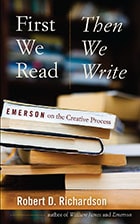
First We Read, Then We Write
Emerson on the Creative ProcessRobert D. Richardson
University of Iowa Press, 2009
Writing was the central passion of Emerson’s life. While his thoughts on the craft are well developed in “The Poet,” “The American Scholar,” Nature, “Goethe,” and “Persian Poetry,” less well known are the many pages in his private journals devoted to the relationship between writing and reading. Here, for the first time, is the Concord Sage’s energetic, exuberant, and unconventional advice on the idea of writing, focused and distilled by the preeminent Emerson biographer at work today.
Emerson advised that “the way to write is to throw your body at the mark when your arrows are spent.” First We Read, Then We Write contains numerous such surprises—from “every word we speak is million-faced” to “talent alone cannot make a writer”—but it is no mere collection of aphorisms and exhortations. Instead, in Robert Richardson’s hands, the biographical and historical context in which Emerson worked becomes clear.
Emerson’s advice grew from his personal experience; in practically every moment of his adult life he was either preparing to write, trying to write, or writing. Richardson shows us an Emerson who is no granite bust but instead is a fully fleshed, creative person disarmingly willing to confront his own failures. Emerson urges his readers to try anything—strategies, tricks, makeshifts—speaking not only of the nuts and bolts of writing but also of the grain and sinew of his determination. Whether a writer by trade or a novice, every reader will find something to treasure in this volume. Fearlessly wrestling with “the birthing stage of art,” Emerson’s counsel on being a reader and writer will be read and reread for years to come.
Fishing by Obstinate Isles
Modern and Postmodern British Poetry and American ReadersKeith Tuma
Northwestern University Press, 1998
Fitness in American Culture
Images of Health, Sport, and the Body, 1830-1940Kathryn Grover
University of Massachusetts Press, 1989

Fitzgerald's Mentors
Edmund Wilson, H. L. Mencken, and Gerald MurphyRonald Berman
University of Alabama Press, 2012
Fitzgerald, Hemingway, and the Twenties
Ronald Berman
University of Alabama Press, 2002
A noted scholar offers fresh ways of looking at two legendary American authors.
Both F. Scott Fitzgerald and Ernest Hemingway came into their own in the 1920s and did some of their best writing during that decade. In a series of interrelated essays, Ronald Berman considers an array of novels and short stories by both authors within the context of the decade's popular culture, philosophy, and intellectual history. As Berman shows, the thought of Fitzgerald and Hemingway went considerably past the limits of such labels as the Jazz Age or the Lost Generation.
Both Fitzgerald and Hemingway were avid readers, alive to the intellectual currents of their day, especially the contradictions and clashes of ideas and ideologies. Both writers, for example, were very much concerned with the problem of untenable belief—and also with the need to believe. In this light, Berman offers fresh readings of such works as Fitzgerald's The Great Gatsby, "Bernice Bobs Her Hair," and "The Diamond as Big as the Ritz" and Hemingway's "The Killers," A Farewell to Arms, and The Sun Also Rises. Berman invokes the thinking of a wide range of writers in his considerations of these texts, including William James, Alfred North Whitehead, Walter Lippman, and Edmund Wilson.
Berman's essays are driven and connected by a focused line of inquiry into Fitzgerald's and Hemingway's concerns with dogma both religious and secular, with new and old ideas of selfhood,and, particularly in the case of Hemingway, with the way we understand, explain, and transmit experience.
Fitzgerald-Wilson-Hemingway
Language and ExperienceRonald Berman
University of Alabama Press, 2003
In this study, Ronald Berman examines the work of the critic/novelist Edmund Wilson and the art of F. Scott Fitzgerald and Ernest Hemingway as they wrestled with the problems of language, experience, perception and reality in the "age of jazz." By focusing specifically on aesthetics—the ways these writers translated everyday reality into language—Berman challenges and redefines many routinely accepted ideas concerning the legacy of these authors.
Fitzgerald is generally thought of as a romantic, but Berman shows that we need to expand the idea of Romanticism to include its philosophy. Hemingway, widely viewed as a stylist who captured experience by simplifying language, is revealed as consciously demonstrating reality's resistance to language. Between these two renowned writers stands Wilson, who is critically influenced by Alfred North Whitehead, as well as Dewey, James, Santayana, and Freud.
By patiently mapping the correctness of these philosophers, historians, literary critics and writers, Berman aims to open a gateway into the era. This work should be of interest to scholars of American literature, philosophy and aesthetics; to academic libraries; to students of intellectual history; and to general readers interested in Fitzgerald, Hemingway and Wilson.
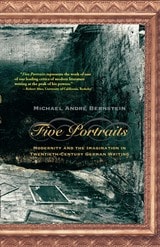
Five Portraits
Modernity and the Imagination in Twentieth-Century German WritingMichael Bernstein
Northwestern University Press, 2000
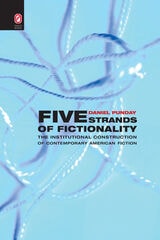
Five Strands of Fictionality
The Institutional Construction of Contemporary American FictionDaniel Punday
The Ohio State University Press, 2010
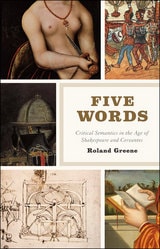
Five Words
Critical Semantics in the Age of Shakespeare and CervantesRoland Greene
University of Chicago Press, 2013
Rather than analyzing works, careers, or histories, Greene discusses a broad swath of Renaissance and transatlantic literature—including Shakespeare, Cervantes, Camões, and Milton—in terms of the development of these five words. Aiming to shift the conversation around Renaissance literature from current approaches to riskier enterprises, Greene also proposes new methods that take advantage of digital resources like full-text databases, but still depend on the interpreter to fashion ideas out of ordinary language. Five Words is an innovative and accessible book that points the field of literary studies in an exciting new direction.
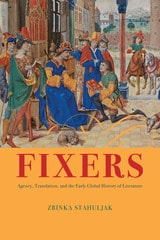
Fixers
Agency, Translation, and the Early Global History of LiteratureZrinka Stahuljak
University of Chicago Press, 2024
In this book, Zrinka Stahuljak challenges scholars in both medieval and translation studies to rethink how ideas and texts circulated in the medieval world. Whereas many view translators as mere conduits of authorial intention, Stahuljak proposes a new perspective rooted in a term from journalism: the fixer. With this language, Stahuljak captures the diverse, active roles medieval translators and interpreters played as mediators of entire cultures—insider informants, local guides, knowledge brokers, art distributors, and political players. Fixers offers nothing less than a new history of literature, art, translation, and social exchange from the perspective not of the author or state but of the fixer.
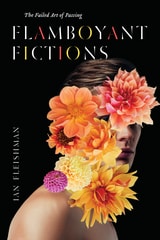
Flamboyant Fictions
The Failed Art of PassingIan Fleishman
Northwestern University Press, 2025
Exposes a stylistic tradition of flamboyantly failed passing in queer literature and film
This book posits formal experimentation as an index for evolving expressions of male homosexuality from literary modernism to the German New Wave and the present day. Ian Fleishman exposes a tradition of flamingly failed passing that is itself a surreptitious mode of passing: the flaunting of queer style as an intentionally unconvincing cover for queer content. Exploring a corpus of films and novels by André Gide, Jean Genet, Rainer Werner Fassbinder, Werner Schroeter, François Ozon, and Xavier Dolan, among others, Flamboyant Fictions: The Failed Art of Passing intervenes in trenchant debates about queer agency, visibility, negativity, and disidentification. Mapping queer strategies of storytelling onto queer practices of self-invention, Flamboyant Fictions wagers that it is precisely in instances of conflict between these auteurs and their inventions that narrative becomes a laboratory for testing the sovereignty and self-determination of queer identity.
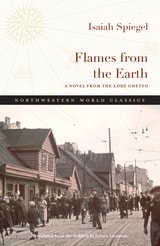
Flames from the Earth
A Novel from the Lódz GhettoIsaiah Spiegel, translated from the Yiddish by Julian Levinson
Northwestern University Press, 2023
Flames from the Earth: A Novel from the Łódź Ghetto is an autobiographical novel written by Isaiah Spiegel, one of the most revered Yiddish authors to survive the Holocaust. Originally published in Israel in 1966, the novel brings together material that Spiegel wrote while imprisoned in the Łódź Ghetto, which he recovered from a cellar when he returned from Auschwitz after the war. The only works by Spiegel previously available to English readers have been short stories.
In this, his first novel, Spiegel explores a complex web of characters in and around the Łódź Ghetto: Vigdor and Gitele, lovers who are involved in the ghetto resistance movement; Nicodem, a Polish priest, who hides a member of the Jewish underground; Stefan Kaczmarek, a Polish tavern keeper who betrays Nicodem to preserve his own smuggling business; Franz Jessike, a Nazi guard who blackmails local Poles for personal gain; and Chaim Vidaver, the heroic leader of the ghetto resistance. Based largely on historical events, the novel’s lyrical style echoes its emotional intensity.
Gripping and atmospheric, Flames from the Earth honors daring acts of heroism and human connections forged amid unthinkable conditions. Spiegel’s novel represents an important contribution to the archive of literary depictions of historical trauma.
Flannery O'Connor, Walker Percy, and the Aesthetic of Revelation
John D. Sykes, Jr.
University of Missouri Press, 2007
With his mastery of modernist technique and his depictions of characters obsessed with the past, Nobel laureate William Faulkner raised the bar for southern fiction writers. But the work of two later authors shows that the aesthetic of memory is not enough: Confederate thunder fades as they turn to an explicitly religious source of meaning.
According to John Sykes, the fiction of Flannery O’Connor and Walker Percy provides occasions for divine revelation. He traces their work from its common roots in midcentury southern and Catholic intellectual life to show how the two adopted different theological emphases and rhetorical strategies—O’Connor building to climactic images, Percy striving for dialogue with the reader—as a means of uncovering the sacramental foundation of the created order.
Sykes sets O’Connor and Percy against the background of the Southern Renaissance from which they emerged, showing not only how they shared a distinctly Christian notion of art that led them to see fiction as revelatory but also how their methods of revelation took them in different directions. Yet, despite their differences in strategy and emphasis, he argues that the two are united in their conception of the artist as “God’s sharp-eyed witness,” and he connects them with the philosophers and critics, both Christian and non-Christian, who had a meaningful influence on their work.
Through sustained readings of key texts—particularly such O’Connor stories as “The Artificial Nigger” and “The Geranium” and Percy’s novels Love in the Ruins and The Second Coming—Sykes focuses on the intertwined themes of revelation, sacrament, and community. He views their work in relation to the theological difficulties that they were not able to overcome concerning community. For both writers, the question of community is further complicated by the changing nature of the South as the Lost Cause and segregation lose their holds and a new form of prosperity arises.
By disclosing how O’Connor and Percy made aesthetic choices based on their Catholicism and their belief that fiction by its very nature is revelatory, Sykes demonstrates that their work cannot be seen as merely a continuation of the historical aesthetic that dominated southern literature for so long. Flannery O’Connor, Walker Percy, and the Aesthetic of Revelation is theoretically sophisticated without being esoteric and is accessible to any reader with a serious interest in these writers, brimming with fresh insights about both that clarify their approaches to art and enrich our understanding of their work.
Flawed Texts and Verbal Icons
Literary Authority and American FictionHershel Parker
Northwestern University Press, 1984
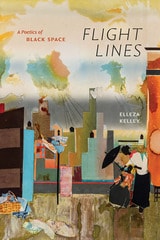
Flight Lines
A Poetics of Black SpaceElleza Kelley
Duke University Press, 2026
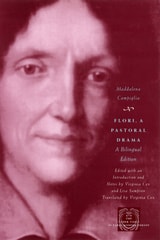
Flori, a Pastoral Drama
A Bilingual EditionMaddalena Campiglia
University of Chicago Press, 2004
Although acclaimed in her day, Campiglia (1553-95) has not benefited from the recent wave of scholarship that has done much to enhance the visibility and reputation of contemporaries such as Isabella Andreini, Moderata Fonte, and Veronica Franco. As this bilingual, first-ever critical edition of Flori illustrates, this neglect is decidedly unwarranted. Flori is a work of great literary and cultural interest, noteworthy in particular for the intensity of its focus on the experiences and perceptions of its female protagonists and their ideals of female autonomy. Flori will be read by those involved in the study of early modern literature and drama, women's studies, and the study of gender and sexuality in this period.
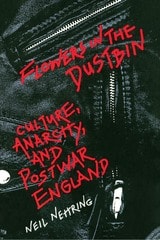
Flowers in the Dustbin
Culture, Anarchy, and Postwar EnglandNeil Nehring
University of Michigan Press, 1993

Folgore da San Gimignano and his Followers
The Complete PoemsFabian Alfie
Arizona Center for Medieval and Renaissance Studies, 2019
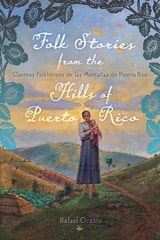
Folk Stories from the Hills of Puerto Rico / Cuentos folklóricos de las montañas de Puerto Rico
Rafael Ocasio
Rutgers University Press, 2021
Some stories provide a distinctive Caribbean twist on classic tales including “Snow White” and “Cinderella.” Others fictionalize the lives of local historical figures, such as infamous pirate Roberto Cofresí, rendered here as a Robin Hood figure who subverts the colonial social order. The collection also introduces such beloved local characters as Cucarachita Martina, the kind cockroach who falls in love with Ratoncito Pérez, her devoted mouse husband who brings her delicious food.
Including a fresh English translation of each folktale as well as the original Spanish version, the collection also contains an introduction from literary historian Rafael Ocasio that highlights the historical importance of these tales and the Jíbaro cultural values they impart. These vibrant, funny, and poignant stories will give readers unique insights into Puerto Rico’s rich cultural heritage.
Esta nueva y emocionante antología reúne cuentos populares puertorriqueños que fueron transmitidos oralmente durante generaciones antes de ser finalmente transcritos comenzando en 1914 por el equipo del famoso antropólogo Franz Boas. Estos encantadores cuentos ofrecen a los lectores un vistazo a la imaginación y las aspiraciones de los jíbaros, los campesinos de Puerto Rico.
Algunas historias brindan un distintivo toque caribeño a cuentos clásicos como "Blanca Nieves" y "Cenicienta". Otros ficcionalizan la vida de personajes históricos locales, como el famoso pirata Roberto Cofresí, representado como una figura al estilo de Robin Hood, quien subvierte el orden social colonial. La colección también presenta personajes locales tan queridos como Cucarachita Martina, la amable cucaracha que se enamora de Ratoncito Pérez, su devoto esposo ratón que le trae deliciosa comida.
Incluyendo una nueva traducción al inglés de estos cuentos populares, así como las versiones originales en español, la colección también contiene una introducción del historiador literario Rafael Ocasio, quien destaca la importancia histórica de estos cuentos y los valores culturales del jíbaro que éstos imparten en los relatos. Estas historias vibrantes, divertidas y conmovedoras brindarán a los lectores una visión única de la rica herencia cultural de Puerto Rico.
Introducción en español (https://d3tto5i5w9ogdd.cloudfront.net/wp-content/uploads/2021/02/03154419/Ocasio_Cuentos_Intro_Espan%CC%83ol.pdf)
Rafael Ocasio will discussing his book, 'Folk Stories from the Hills of Puerto Rico / Cuentos folklóricos de las montañas de Puerto Rico' at Biblioteca Juvenil de Mayagüez in Puerto Rico (https://youtu.be/o6Tub094EoI)
Folklore and Folklife
An IntroductionRichard M. Dorson
University of Chicago Press, 1982
Folklore in New World Black Fiction
Writing and the Oral Traditional AestheticsChiji Akoma
The Ohio State University Press, 2007
Folktales of Egypt
Hasan M. El-Shamy
University of Chicago Press, 1982

Following Michigan's Ink Trails
Writing Michigan, Reading MichiganDave Dempsey
Michigan State University Press, 2027
Michigan is renowned for its natural beauty and automotive history, yet its rich literary heritage often goes unrecognized. This engaging and extensively researched book aims to change that by providing vivid portraits of both well-known and overlooked authors. It also offers an enjoyable tour through the state’s libraries and bookstores. The book takes readers on a fascinating journey across the back roads and highways of Michigan writing, showcasing the remarkable diversity of authors who have called the state home as well as those who have found it inspirational. It is perfect for anyone interested in reading, Michigan’s literary heritage, and its culture.
Food Studies in Latin American Literature
Perspectives on the GastronarrativeRocío del Aguila
University of Arkansas Press, 2021
Food Studies in Latin American Literature presents a timely collection of essays analyzing a wide array of Latin American narratives through the lens of food studies. Topics explored include potato and maize in colonial and contemporary global narratives; the role of cooking in Sor Juana Inés de la Cruz’s poetics; the centrality of desire in twentieth-century cooking writing by women; the relationship among food, recipes, and national identity; the role of food in travel narratives; and the impact of advertisements on domestic roles.
The contributors included here—experts in Latin American history, literature, and cultural studies—bring a novel, interdisciplinary approach to these explorations, presenting new perspectives on Latin American literature and culture.
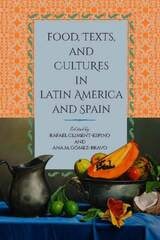
Food, Texts, and Cultures in Latin America and Spain
Rafael Climent-Espino
Vanderbilt University Press, 2020
The studies span from the Middle Ages to the twenty-first century, and the contributing scholars occupy diverse fields within Latin American and Hispanic Studies. As such, their essays showcase eclectic critical and theoretical approaches to the subject of Latin American and Iberian food.
Food, Texts, and Cultures in Latin America and Spain also introduces the first English-language publication of works from such award-winning scholars as Adolfo Castañón of the Mexican Academy of Language; Sergio Ramírez, winner of the 2017 Miguel de Cervantes Prize in Literature; and Carmen Simón Palmer, winner of the 2015 Julián Marías Prize for Research.