Results by title
5448 books match the query 'History and criticism' and 217 start with f
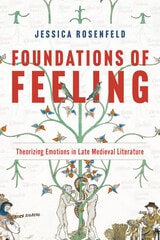
Foundations of Feeling
Theorizing Emotions in Late Medieval LiteratureJessica Rosenfeld
University of Chicago Press, 2026
A fresh reading of medieval literature as deeply concerned with thinking about feelings.
Are emotions primarily bodily or cognitive? Do “natural” emotions exist? What is the relationship between emotion and gender? In Foundations of Feeling, Jessica Rosenfeld shows how medieval literature informs contemporary ideas about how emotions operate. Ranging widely from love poetry to pastoral and theological writings, to political satire and more, Rosenfeld reveals a wealth of attention to emotions in both scientific and philosophical discourses of the time. By mining Latin, medieval French, and Middle English traditions, she relates medieval concerns to the most central, current debates (and impasses) in the fields of history of emotion and affect theory today, reframing how we think about and define feelings.
Fourteen Landing Zones
Approaches to Vietnam War LiteraturePhilip K. Jason
University of Iowa Press, 1991
It is in the spirit of the LZ that the essayists in Fourteen Landing Zones approach the writings of the Vietnam War. These fourteen diverse and powerful works by some of today's leading critics in Vietnam studies begin to answer the question of how we will filter the writings of the Vietnam War—including fiction, poetry, drama, and memoirs. What will survive the process of critical acclaim and societal affirmation—and why? Included is an incisive introduction by Jason that provides an overview of the burgeoning body of Vietnam War literature and its peculiar life in the literary and academic marketplace. This strong, often emotional volume will be of particular importance to all those interested in the literature of the Vietnam War, contemporary literature, and contemporary culture and history.

Fourth of July, Asbury Park
A History of the Promised LandDaniel Wolff
Rutgers University Press, 2022
Fourth of July, Asbury Park tells the tale of the city’s first 150 years, guiding us through the development of its lavish amusement parks and bandstands, as well as the decay of its working-class neighborhoods and spread of its racially-segregated ghettos. Featuring exclusive interviews with Springsteen and other prominent Asbury Park residents, Daniel Wolff uncovers the history of how this Jersey shore resort town came to epitomize both the promises of the American dream and the tragic consequences when those promises are broken.
Hailed by The New York Times as a “wonderfully evocative…grand, sad story” when first published in 2006, this revised and expanded edition considers how Asbury Park has changed in the twenty-first century, experiencing both gentrification and new forms of segregation.

Fractured Borders
Reading Women's Cancer LiteratureMary K. DeShazer
University of Michigan Press, 2010
Fractured Borders: Reading Women's Cancer Literature surveys a wide range of contemporary writing about breast, uterine, and ovarian cancer, including works by Marilyn Hacker, Margaret Edson, Carole Maso, Audre Lorde, Eve Sedgwick, Mahasweta Devi, Lucille Clifton, Alicia Ostriker, Jayne Anne Phillips, Terry Tempest Williams, and Jeanette Winterson, among many others. DeShazer's readings bring insights from body theory, performance theory, feminist literary criticism, French feminisms, and disability studies to bear on these works, shining new light on a literary subject that is engaging more and more writers.
"An important and useful book that will appeal to people in a variety of fields and walks of life, including scholars, teachers, and anyone interested in this subject."
--Suzanne Poirier, University of Illinois at Chicago
"A book on a timely and important topic, wisely written beyond scholarly boundaries and crossing many theoretical and disciplinary lines."
--Patricia Moran, University of California, Davis
Fragments and Assemblages
Forming Compilations of Medieval LondonArthur Bahr
University of Chicago Press, 2013
Fragments for a History of a Vanishing Humanism
Edited by Myra Seaman and Eileen A. Joy
The Ohio State University Press, 2016
This volume, edited by Myra Seaman and Eileen A. Joy, insists on the always provisional and contingent formations of the human, and of various humanisms, over time, while also aiming to demonstrate the different ways these formations emerge (and also disappear) in different times and places, from the most ancient past to the most contemporary present. The essays are offered as “fragments” because the authors do not believe there can ever be a “total history” of either the human or the post/human as they play themselves out in differing historical contexts. At the same time, the volume as a whole argues that defining what “the human” (or “post/human”) is has always been an ongoing, never finished cultural project.
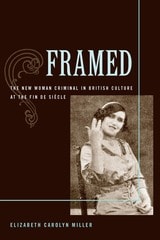
Framed
The New Woman Criminal in British Culture at the Fin de SiecleElizabeth Carolyn Miller
University of Michigan Press, 2008
Framed uses fin de siècle British crime narrative to pose a highly interesting question: why do female criminal characters tend to be alluring and appealing while fictional male criminals of the era are unsympathetic or even grotesque?
In this elegantly argued study, Elizabeth Carolyn Miller addresses this question, examining popular literary and cinematic culture from roughly 1880 to 1914 to shed light on an otherwise overlooked social and cultural type: the conspicuously glamorous New Woman criminal. In so doing, she breaks with the many Foucauldian studies of crime to emphasize the genuinely subversive aspects of these popular female figures. Drawing on a rich body of archival material, Miller argues that the New Woman Criminal exploited iconic elements of late nineteenth- and early twentieth-century commodity culture, including cosmetics and clothing, to fashion an illicit identity that enabled her to subvert legal authority in both the public and the private spheres.
"This is a truly extraordinary argument, one that will forever alter our view of turn-of-the-century literary culture, and Miller has demonstrated it with an enrapturing series of readings of fictional and filmic criminal figures. In the process, she has filled a gap between feminist studies of the New Woman of the 1890s and more gender-neutral studies of early twentieth-century literary and social change. Her book offers an extraordinarily important new way to think about the changing shape of political culture at the turn of the century."
---John Kucich, Professor of English, Rutgers University
"Given the intellectual adventurousness of these chapters, the rich material that the author has brought to bear, and its combination of archival depth and disciplinary range, any reader of this remarkable book will be amply rewarded."
---Jonathan Freedman, Professor of English and American Culture, University of Michigan
Elizabeth Carolyn Miller is Assistant Professor of English at the University of California, Davis.
digitalculturebooks is an imprint of the University of Michigan and the Scholarly Publishing Office of the University of Michigan Library dedicated to publishing innovative and accessible work exploring new media and their impact on society, culture, and scholarly communication. Visit the website at www.digitalculture.org.
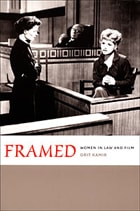
Framed
Women in Law and FilmOrit Kamir
Duke University Press, 2006
Through innovative readings of a dozen movies made between 1928 and 2001 in Europe, Japan, and the United States, Orit Kamir shows that in representing “gender crimes,” feature films have constructed a cinematic jurisprudence, training audiences worldwide in patterns of judgment of women (and men) in such situations. Offering a novel formulation of the emerging field of law and film, Kamir combines basic legal concepts—murder, rape, provocation, insanity, and self-defense—with narratology, social science methodologies, and film studies.
Framed not only offers a unique study of law and film but also points toward new directions in feminist thought. Shedding light on central feminist themes such as victimization and agency, multiculturalism, and postmodernism, Kamir outlines a feminist cinematic legal critique, a perspective from which to evaluate the “cinematic legalism” that indoctrinates and disciplines audiences around the world. Bringing an original perspective to feminist analysis, she demonstrates that the distinction between honor and dignity has crucial implications for how societies construct women, their social status, and their legal rights. In Framed, she outlines a dignity-oriented, honor-sensitive feminist approach to law and film.
Frames of Evil
The Holocaust as Horror in American FilmCaroline J. S. Picart, and David A. Frank. Foreword by Dominick LaCapra. Introduction by Edward J. Ingebretsen
Southern Illinois University Press, 2006
Challenging the classic horror frame in American film
American filmmakers appropriate the “look” of horror in Holocaust films and often use Nazis and Holocaust imagery to explain evil in the world, say authors Caroline Joan (Kay) S. Picart and David A. Frank. In Frames of Evil: The Holocaust as Horror in American Film, Picart and Frank challenge this classic horror frame—the narrative and visual borders used to demarcate monsters and the monstrous. After examining the way in which directors and producers of the most influential American Holocaust movies default to this Gothic frame, they propose that multiple frames are needed to account for evil and genocide.
Using Schindler’s List, The Silence of the Lambs, and Apt Pupil as case studies, the authors provide substantive and critical analyses of these films that transcend the classic horror interpretation. For example, Schindler’s List, say Picart and Frank, has the appearance of a historical docudrama but actually employs the visual rhetoric and narrative devices of the Hollywood horror film. The authors argue that evil has a face: Nazism, which is configured as quintessentially innate, and supernaturally crafty.
Frames of Evil, which is augmented by thirty-six film and publicity stills, also explores the commercial exploitation of suffering in film and offers constructive ways of critically evaluating this exploitation. The authors suggest that audiences will recognize their participation in much larger narrative formulas that place a premium on monstrosity and elide the role of modernity in depriving millions of their lives and dignity, often framing the suffering of others in a manner that allows for merely “documentary” enjoyment.
Frames of Friction
Black Genealogies, White Hegemony, and the Essay as Critical InterventionCarsten Junker
Campus Verlag, 2010
In Frames of Friction, Carsten Junker maps out a dazzling panorama of critical cultural debatesfrom the twentieth century to explore the ways in which African American speakers and writers established their authority and gained recognition. Taking into account the latest ideas from gender studies and African American studies, as well as current essay theory, Junker juxtaposes the ways in which African American authors and speakers from the 1920s to the 1970s debated critical topics with their white and Jewish contemporaries in order to emphasize the dialogic nature of the essay form. Ultimately, Junker hones in on the genre of essay itself, arguing that it is repeatedly questioned and reconstituted during times of social change.
Framing Fan Fiction
Literary and Social Practices in Fan Fiction CommunitiesKristina Busse
University of Iowa Press, 2017
Framing Fan Fiction deploys personal history and the interpretations of specific stories to contextualize fan fiction culture and its particular forms of intertextuality and performativity. In doing so, it highlights the way fans use fan fiction’s reimagining of the source material to explore issues of identities and peformativities, gender and sexualities, within a community of like-minded people. In contrast to the celebration of originality in many other areas of artistic endeavor, fan fiction celebrates repetition, especially the collective creation and circulation of tropes.
An essential resource for scholars, Framing Fan Fiction is also an ideal starting point for those new to the study of fan fiction and its communities of writers.
Framing Faust
Twentieth-Century Cultural StrugglesInez Hedges
Southern Illinois University Press, 2009
In this interdisciplinary cultural history that encompasses film, literature, music, and drama, Inez Hedges follows the thread of the Faustian rebel in the major intellectual currents of the last hundred years. She presents Faust and his counterpart Mephistopheles as antagonistic—yet complementary—figures whose productive conflict was integral to such phenomena as the birth of narrative cinema, the rise of modernist avant-gardes before World War II, and feminist critiques of Western cultural traditions.
Framing Faust: Twentieth-Century Cultural Struggles pursues a dialectical approach to cultural history. Using the probing lens of cultural studies, Hedges shows how claims to the Faustian legacy permeated the struggle against Nazism in the 1930s while infusing not only the search for socialist utopias in Russia, France, and Germany, but also the quest for legitimacy on both sides of the Cold War divide after 1945.
Hedges balances new perspectives on such well-known works as Thomas Mann’s Dr. Faustus and Jack Kerouac’s Dr. Sax with discussions of previously overlooked twentieth-century expressions of the Faust myth, including American film noir and the Faust films of Stan Brakhage. She evaluates musical compositions—Hanns Eisler’s Faust libretto, the opera Votre Faust by Henri Pousseur and Michel Butor, and Alfred Schnittke’s Faust Cantata—as well as works of fiction and drama in French and German, many of which have heretofore never been discussed outside narrow disciplinary confines.
Enhanced by twenty-four illustrations, Framing Faust provides a fascinating and focused narrative of some of the major cultural struggles of the past century as seen through the Faustian prism, and establishes Faust as an important present-day frame of reference.
Framing History
The Rosenberg Story and the Cold WarVirginia Carmichael
University of Minnesota Press, 1993
Framing Shakespeare on Film
How the Frame Reveals MeaningKathy M. Howlett
Ohio University Press, 2000
The aesthetics of frame theory form the basis of Framing Shakespeare on Film. This groundbreaking work expands on the discussion of film constructivists in its claim that the spectacle of Shakespeare on film is a problem-solving activity.
Kathy Howlett demonstrates convincingly how viewers’ expectations for understanding Shakespeare on film can be manipulated by the director’s cinematic technique. Emphasizing that the successful film can transform Shakespeare’s text while remaining rooted in Shakespearean conceptions, Howlett raises the question of how directors and audiences understand the genre of Shakespeare on film and reveals how the medium alters the patterns through which the audience views Shakespeare.
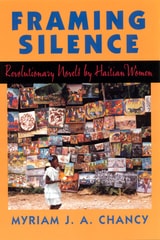
Framing Silence
Revolutionary Novels by Haitian WomenChancy, Myriam J
Rutgers University Press, 1992
Raped and colonized, coerced and silenced--this has been the position of Haitian women within their own society, as well as how they have been seen by foreign occupiers. Romanticized symbols of nationhood, they have served, however unwillingly, as a politicized site of contestation between opposing forces.
In this first book-length study in English devoted exclusively to Haitian women's literature, Myriam Chancy finds that Haitian women have their own history, traditions, and stories to tell, tales that they are unwilling to suppress or subordinate to narratives of national autonomy. Issues of race, class, color, caste, nationality, and sexuality are all central to their fiction--as is an urgent sense of the historical place of women between the two U.S. occupations of the country. Their novels interrogate women's social and political stance in Haiti from an explicitly female point of view, forcefully responding to overt sexual and political violence within the nation's ambivalent political climate. Through daring and sensitive readings, simultaneously historical, fictional and autobiographical, Chancy explores this literature, seeking to uncover answers to the current crisis facing these women today, both within their country and in exile.The writers surveyed include Anne-christine d'Adesky, Ghislaine Rey Charlier, Marie Chauvet, Jan J. Dominique, Nadine Magloire, and Edwidge Danticat, whose work has recently achieved such high acclaim.

Framing the Past
The Historiograpy of German Cinema and TelevisionEdited by Bruce A. Murray and Christopher J. Wickham
Southern Illinois University Press, 1992
This collection of essays was selected from those presented in October 1988 at a conference sponsored by the National Endowment for the Humanities, "Concepts of History in German Cinema." The contributors include notable historians, film scholars, and German studies specialists who explore the complex network of social, political, and religious institutions that have influenced the historiography of German cinema and television.
Before the turn of the century, Germans began to employ the medium of film to represent the past when they attempted to document their Prussian heritage. Since then, German cinema and television have promoted history as a component of personal, cultural, and national identity by consistently providing prominent treatment of historical subjects.
Although it is relatively easy to document changes in the selection and handling of these subjects, it is more difficult to determine precisely which factors have motivated those changes.
In attempting to define these factors, the link between German cinema, television, and history has developed around three interrelated issues: (1) the reception of Weimar cinema, which for most film scholars continues to be mediated to one extent or another by Siegfried Kracauer’s work; (2) the inscribing of fascism in cinema and television; and (3) the nature of, and potential for, alternatives to mainstream cinema and television.
Framing the Polish Home
Postwar Cultural Constructions of Hearth, Nation, and SelfBozena Shallcross
Ohio University Press, 2002
As the subject of ideological, aesthetic, and existential manipulations, the Polish home and its representation is an ever-changing phenomenon that absorbs new tendencies and, at the same time, retains its centrality to Polish literature, whether written in Poland or abroad. Framing the Polish Home is a pioneering work that explores the idea of home as fundamental to the question of cultural and national identity within Poland's recent history and its tradition.
In this inaugural volume of the Polish and Polish-American Studies Series, the Polish home emerges in its rich verbal and visual representations and multiple material embodiments, as the discussion moves from the loss of the home during wartime to the Sovietized politics of housing and from the exilic strategies of having a home to the the idyllic evocation of the abodes of the past.
Although, as Bożena Shallcross notes in her introduction, “few concepts seem to have such universal appeal as the notion of the home,” this area of study is still seriously underdeveloped. In essays from sixteen scholars, Framing the Polish Home takes a significant step to correct that oversight, covering a broad range of issues pertinent to the discourse on the home and demonstrating the complexity of the home in Polish literature and culture.
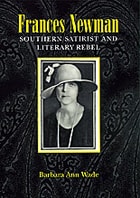
Frances Newman
Southern Satirist and Literary RebelBarbara Ann Wade
University of Alabama Press, 1998
This first biographical and literary assessment of Frances Newman highlights one of the most experimental writers of the Southern Renaissance
Frances Newman was born into a prominent Atlanta family and was educated at private schools in the South and the Northeast. Her first novel, The Hard-Boiled Virgin, was hailed by James Branch Cabell as “the most brilliant, the most candid, the most civilized, and the most profound yet written by any American woman.” Cabell and H. L. Mencken became Newman’s literary mentors and loyally supported her satire of southern culture, which revealed the racism, class prejudice, and religious intolerance that reinforced the idealized image of the white southern lady. Writing within a nearly forgotten feminist tradition of southern women’s fiction, Newman portrayed the widely acclaimed social change in the early part of the century in the South as superficial rather than substantial, with its continued restrictive roles for women in courtship and marriage and limited educational and career opportunities.
Barbara Wade explores Newman’s place in the feminist literary tradition by comparing her novels with those of her contemporaries Ellen Glasgow, Mary Johnston, and Isa Glenn. Wade draws from Newman’s personal correspondence and newspaper articles to reveal a vibrant, independent woman who simultaneously defied and was influenced by the traditional southern society she satirized in her writing.
Francesca Caccini at the Medici Court
Music and the Circulation of PowerSuzanne G. Cusick
University of Chicago Press, 2009
Suzanne G. Cusick argues that Caccini’s career depended on the usefulness of her talents to the political agenda of Grand Duchess Christine de Lorraine, Tuscany’s de facto regent from 1606 to 1636. Drawing on Classical and feminist theory, Cusick shows how the music Caccini made for the Medici court sustained the culture that enabled Christine’s power, thereby also supporting the sexual and political aims of its women.
In bringing Caccini’s surprising story so vividly to life, Cusick ultimately illuminates how music making functioned in early modern Italy as a significant medium for the circulation of power.
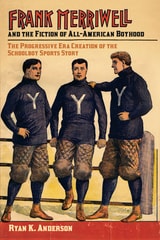
Frank Merriwell and the Fiction of All-American Boyhood
The Progressive Era Creation of the Schoolboy Sports StoryRyan K. Anderson
University of Arkansas Press, 2015
Merriwell came to symbolize the Progressive Era debate about how sport and school made boys into men. The saga featured the attractive Merriwell distinguishing between “good” and “bad” girls and focused on his squeaky-clean adventures in physical development and mentorship. By the serial’s conclusion, Merriwell had opened a school for “weak and wayward boys” that made him into a figure who taught readers how to approximate his example.
In Frank Merriwell and the Fiction of All-American Boyhood, Anderson treats Tip Top Weekly as a historical artifact, supplementing his reading of its text, illustrations, reader letters, and advertisements with his use of editorial correspondence, memoirs, trade journals, and legal documents. Anderson blends social and cultural history, with the history of business, gender, and sport, along with a general examination of childhood and youth in this fascinating study of how a fictional character was used to promote a homogeneous “normal” American boyhood rooted in an assumed pecking order of class, race, and gender.
Frank Miller's Daredevil and the Ends of Heroism
Young, Paul
Rutgers University Press, 2016
In the late 1970s and early 1980s, writer-artist Frank Miller turned Daredevil from a tepid-selling comic into an industry-wide success story, doubling its sales within three years. Lawyer by day and costumed vigilante by night, the character of Daredevil was the perfect vehicle for the explorations of heroic ideals and violence that would come to define Miller’s work.
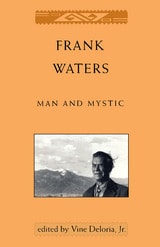
Frank Waters
Man and MysticVine Deloria Jr.
Ohio University Press, 1993
“In addition to his accomplishments as a talented novelist, a thorough historian, and an excellent essayist, Frank Waters is that rare breed of man who has merged heart and mind early in his life and moved forward to confront ultimate questions. This dilemma of faith and heritage, religion and identity, and commitment and comfort has never been resolved intellectually. Even with profound faith and rigorous discipline of self, mystics have found it difficult to resolve through action and prayer…I look at the life and writing of Frank Waters…and find…a remarkable journey of inquiry spanning nearly a century and illuminating questions which I did not think possible to formulate.”
—Vine Deloria, Jr., editor
Contributors to this volume are Alvin M. Josephy, Jr., Bobby Bridger, Steven Wall, Will Wright, William Eastlake, Larry Evers, David Jongeward, Max Evans, Win Blevins, Barbara Waters, Rudolfo Anaya, Thomas J. Lyon, Joe Gordon, Robert Kostka, Charles Adams, Father Peter J. Powell, Quay Grigg, Alexander Blackburn, and T. N. Luther.
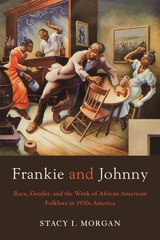
Frankie and Johnny
Race, Gender, and the Work of African American Folklore in 1930s AmericaBy Stacy I. Morgan
University of Texas Press, 2017
Winner, Wayland D. Hand Prize, American Folklore Society, 2018
Originating in a homicide in St. Louis in 1899, the ballad of “Frankie and Johnny” became one of America’s most familiar songs during the first half of the twentieth century. It crossed lines of race, class, and artistic genres, taking form in such varied expressions as a folk song performed by Huddie Ledbetter (Lead Belly); a ballet choreographed by Ruth Page and Bentley Stone under New Deal sponsorship; a mural in the Missouri State Capitol by Thomas Hart Benton; a play by John Huston; a motion picture, She Done Him Wrong, that made Mae West a national celebrity; and an anti-lynching poem by Sterling Brown.
In this innovative book, Stacy I. Morgan explores why African American folklore—and “Frankie and Johnny” in particular—became prized source material for artists of diverse political and aesthetic sensibilities. He looks at a confluence of factors, including the Harlem Renaissance, the Great Depression, and resurgent nationalism, that led those creators to engage with this ubiquitous song. Morgan’s research uncovers the wide range of work that artists called upon African American folklore to perform in the 1930s, as it alternately reinforced and challenged norms of race, gender, and appropriate subjects for artistic expression. He demonstrates that the folklorists and creative artists of that generation forged a new national culture in which African American folk songs featured centrally not only in folk and popular culture but in the fine arts as well.
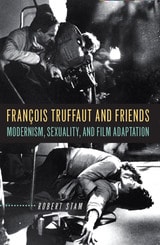
François Truffaut and Friends
Modernism, Sexuality, and Film AdaptationStam, Robert
Rutgers University Press, 2006
Drawing on this film and others by Truffaut, Robert Stam provides the first in-depth examination of the multifaceted relationship between Truffaut and Roch. In the process, he provides a unique lens through which to understand how adaptation works-from history to novel, and ultimately to film-and how each form of expression is inflected by the period in which it is created. Truffaut's adaptation of Roch's work, Stam suggests, demonstrates how reworkings can be much more than simply copies of their originals; rather, they can become an immensely creative enterprise-a form of writing in itself.
The book also moves beyond Truffaut's film and the mnage--trois involving Roch, Hessel, and Grund to explore the intertwined lives and work of other famous artists and intellectuals, including Marcel Duchamp, Walter Benjamin, and Charlotte Wolff. Tracing the tangled webs that linked these individuals' lives, Stam opens the door to an erotic/writerly territory where the complex interplay of various artistic sensibilities-all mulling over the same nucleus of feelings and events-vividly comes alive.
Frederik Pohl
Michael Page
University of Illinois Press, 2015
Free Verse
An Essay on ProsodyCharles O. Hartman
Northwestern University Press, 1996
Free Women
Ethics and Aesthetics in Twentieth-Century Women's FictionKate Fullbrook
Temple University Press, 1990
Freedom and Responsibility in Russian Literature
Essays in Honor of Robert Louis JacksonElizabeth Cheresh Allen and Gary Saul Morson
Northwestern University Press, 1994
Freedom with Violence
Race, Sexuality, and the US StateChandan Reddy
Duke University Press, 2011
Freedom's Empire
Race and the Rise of the Novel in Atlantic Modernity, 1640-1940Laura Doyle
Duke University Press, 2007
Doyle brings together authors often separated by nation, race, and period, including Aphra Behn, Eliza Haywood, Olaudah Equiano, Nathaniel Hawthorne, Harriet Wilson, Pauline Hopkins, George Eliot, and Nella Larsen. In so doing, she reassesses the strategies of early women novelists, reinterprets the significance of rape and incest in the novel, and measures the power of race in the modern English-language imagination.

French Colonial Documentary
Mythologies of HumanitarianismPeter J. Bloom
University of Minnesota Press, 2008
Despite altruistic goals, humanitarianism often propagates foreign, and sometimes unjust, power structures where it is employed. Tracing the visual rhetoric of French colonial humanitarianism, Peter J. Bloom’s unexpected analysis reveals how the project of remaking the colonies in the image of France was integral to its national identity.
French Colonial Documentary investigates how the promise of universal citizenship rights in France was projected onto the colonies as a form of evolutionary interventionism. Bloom focuses on the promotion of French education efforts, hygienic reform, and new agricultural techniques in the colonies as a means of renegotiating the social contract between citizens and the state on an international scale. Bloom’s insightful readings disclose the pervasiveness of colonial iconography, including the relationship between “natural man” and colonial subjectivity; representations of the Senegalese Sharpshooters as obedient, brave, and sexualized colonial subjects; and the appeal of exotic adventure narratives in the trans-Saharan film genre.
Examining the interconnection between French documentary realism and the colonial enterprise, Bloom demonstrates how the colonial archive is crucial to contemporary debates about multiculturalism in France.
Peter J. Bloom is associate professor of film and media studies at the University of California-Santa Barbara.y debates about multiculturalism in France.
Freud Upside Down
African American Literature and Psychoanalytic CultureBadia Sahar Ahad
University of Illinois Press, 2010
Freud in Oz
At the Intersections of Psychoanalysis and Children’s LiteratureKenneth B. Kidd
University of Minnesota Press, 2011
Children’s literature has spent decades on the psychiatrist’s couch, submitting to psychoanalysis by scores of scholars and popular writers alike. Freud in Oz turns the tables, suggesting that psychoanalysts owe a significant and largely unacknowledged debt to books ostensibly written for children. In fact, Kenneth B. Kidd argues, children’s literature and psychoanalysis have influenced and interacted with each other since Freud published his first case studies.
In Freud in Oz, Kidd shows how psychoanalysis developed in part through its engagement with children’s literature, which it used to articulate and dramatize its themes and methods, turning first to folklore and fairy tales, then to materials from psychoanalysis of children, and thence to children’s literary texts, especially such classic fantasies as Peter Pan and Alice’s Adventures in Wonderland. He traces how children’s literature, and critical response to it, aided the popularization of psychoanalytic theory. With increasing acceptance of psychoanalysis came two new genres of children’s literature—known today as picture books and young adult novels—that were frequently fashioned as psychological in their forms and functions.
Freud in Oz offers a history of reigning theories in the study of children’s literature and psychoanalysis, providing fresh insights on a diversity of topics, including the view that Maurice Sendak and Bruno Bettelheim can be thought of as rivals, that Sendak’s makeover of monstrosity helped lead to the likes of the Muppets, and that “Poohology” is its own kind of literary criticism—serving up Winnie the Pooh as the poster bear for theorists of widely varying stripes.
From Androboros to the First Amendment
A History of America's First PlayPeter A. Davis
University of Iowa Press, 2015
Androboros was not just the first of its kind, it was also ahead of its time in many ways, preceding the harsh political satires and farces of the later eighteenth century by some fifty years. Such plays served a small but essential role in promoting political thought among the colonists. Written by anonymous authors and passed from hand to hand, these short, crude, and often bawdy plays and dialogues were rarely acted due to their inflammatory lampoonery. Nevertheless, they provided an opportunity for disgruntled colonists to vent their grievances and promote their ideas to fellow citizens. The farces of the late eighteenth century drove home the meaning and message of the American Revolution.
Equally significant is that Androboros may have influenced a few of the key political discourses published in the 1730s, and these works in turn may well have shaped the future of the American political landscape for the next several decades and even into the modern era. But as a closet drama intended only to be read by close friends and political supporters, this play has languished as a minor footnote in American intellectual history. Scholarly research published to date has been, for the most part, inadequate and occasionally inaccurate. This study remedies that oversight, providing a full analysis as well as an annotated typescript and facsimiles of the original printing.

From Behind the Veil
A STUDY OF AFRO-AMERICAN NARRATIVERobert B. Stepto
University of Illinois Press, 1991
From Dickinson to Dylan
Visions of Transcendence in Modernist LiteratureGlenn Hughes
University of Missouri Press, 2020
This work is unique in its extended focus, in a comparative study spanning a century, on the persistence and centrality in modernist literature of the struggle to understand and articulate the dependence of human meaning on the mystery of transcendent meaning. Hughes shows us that each of these authors is a mystic in his or her way, and that none are tempted by the modern inclination to suppose that meaning originates with human beings. Together, they address one of the most difficult and important challenges of modern literature: how to be a mystic in modernity.
From Dixie to Rocky Top
Music and Meaning in Southeastern Conference FootballCarrie Tipton
Vanderbilt University Press, 2023
The first book to explore the history of college fight songs as a culturally important phenomenon, From Dixie to Rocky Top zeroes in on the US South, where college football has forged a powerful, quasi-religious sense of meaning and identity throughout the region.
Tracing the story of Southeastern Conference (SEC) fight songs from the late nineteenth to the early twenty-first century, author Carrie Tipton places this popular repertory within the broader commercial music industry and uses fight songs to explore themes of authorship and copyright; the commodification of school spirit; and the construction of race, gender, and regional identity in Southern football culture.
This book unearths the history embedded in SEC football’s music traditions, drawing from the archives of the seventeen universities currently or formerly in the conference. Alongside rich primary sources, Tipton incorporates approaches and literature from sports history, Southern and American history, Southern and American studies, and musicology.
Chronicling iconic Southern fight songs’ origins, dissemination, meanings, and cultural reception over a turbulent century, From Dixie to Rocky Top weaves a compelling narrative around a virtually unstudied body of popular music.

From Gift to Commodity
Capitalism and Sacrifice in Nineteenth-Century American FictionHildegard Hoeller
University of New Hampshire Press, 2012
From Hanoi to Hollywood
The Vietnam War in American FilmDittmar, Linda
Rutgers University Press, 1990
The title of this anthology calls attention to the process whereby aspects of the Vietnam War have been appropriated by the American cultural industry. Probing the large body of emotion-laden, controversial films, From Hanoi to Hollywood is concerned with the retelling of history and the retrospection that such a process involves. In this anthology, an awareness of film as a cultural artifact that molds beliefs and guides action is emphasized, an awareness that the contributors bring to a variety of films. Their essays span over one hundred documentary and fiction films, and include in-depth analyses of major commercial films, ranging from Apocalypse Now to Platoon, Rambo: First Blood Part II, and Full Metal Jacket, and documentaries from In the Year of the Pig to Dear America: Letters Home from Vietnam.
The essays in this volume deal with representations of the Vietnam war in documentary film and television reporting, examining the ways the power of film is used to deliver political messages. There are surprises here, new readings, and important insights on the ways we as a society have attempted to come to terms with the experiences of the Vietnam era. The book also contains two appendixes-a detailed chronology charting the relationship between major historical events and the release of American war films from 1954 through 1988, and a filmography listing information on over four hundred American and foreign films about the Vietnam War.

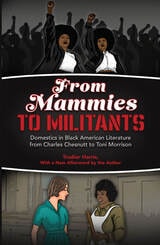
From Mammies to Militants
Domestics in Black American Literature from Charles Chesnutt to Toni MorrisonTrudier Harris
University of Alabama Press, 2023
From Charles Chesnutt’s The Marrow of Tradition to Toni Morrison’s The Bluest Eye, Black writers, some of whom worked as maids themselves, have manipulated the stereotype in a strategic way as a figure to comment on Black-white relations or to dramatize the conflicts of the Black protagonists. In fact, the characters themselves, like real-life maids, often use the stereotype to their advantage or to trick their oppressors.
Harris combines folkloristic, sociological, historical, and psychological analyses with literary ones, drawing on her own interviews with Black women who worked as domestics. She explores the differences between Northern and Southern maids and between “mammy” and “militant.” Her invaluable book provides a sweeping exploration of Black American writers of the twentieth century, with extended discussion of works by Charles Chesnutt, Kristin Hunter, Toni Morrison, Richard Wright, Ann Petry, William Melvin Kelley, Alice Childress, John A. Williams, Douglas Turner Ward, Barbara Woods, Ted Shine, and Ed Bullins. Often privileging political statements over realistic characterization in the design of their texts, the authors in Harris’s study urged Black Americans to take action to change their powerless conditions, politely if possible, violently if necessary. Through their commitment to improving the conditions of Black people in America, these writers demonstrate the connectedness of art and politics.
In her new afterword, “From Militants to Movie Stars,” Harris looks at domestic workers in African American literature after the original publication of her book in 1982. Exploring five subsequent literary treatments of Black domestic workers from Ernest J. Gaines’s A Lesson Before Dying to Lynn Nottage’s By the Way, Meet Vera Stark, Harris tracks how the landscape of representation of domestic workers has broken with tradition and continues to transform into something entirely new.
From Mammies to Militants
Domestics in Black American Literature from Charles Chesnutt to Toni MorrisonTrudier Harris
University of Alabama Press, 2023
Unmasking stereotypes and reclaiming identity of Black Womanhood in American Culture.
Welfare queen, hot momma, unwed mother: these stereotypes of Black women share their historical conception in the image of the Black woman as domestic. Focusing on the issue of stereotypes, the new edition of Trudier Harris’s classic 1982 study From Mammies to Militants examines the position of the domestic in Black American literature with a new afterword bringing her analysis into the present.
From Charles Chesnutt’s The Marrow of Tradition to Toni Morrison’s The Bluest Eye, Black writers, some of whom worked as maids themselves, have manipulated the stereotype in a strategic way as a figure to comment on Black-white relations or to dramatize the conflicts of the Black protagonists. In fact, the characters themselves, like real-life maids, often use the stereotype to their advantage or to trick their oppressors.
Harris combines folkloristic, sociological, historical, and psychological analyses with literary ones, drawing on her own interviews with Black women who worked as domestics. She explores the differences between Northern and Southern maids and between “mammy” and “militant.” Her invaluable book provides a sweeping exploration of Black American writers of the twentieth century, with extended discussion of works by Charles Chesnutt, Kristin Hunter, Toni Morrison, Richard Wright, Ann Petry, William Melvin Kelley, Alice Childress, John A. Williams, Douglas Turner Ward, Barbara Woods, Ted Shine, and Ed Bullins. Often privileging political statements over realistic characterization in the design of their texts, the authors in Harris’s study urged Black Americans to take action to change their powerless conditions, politely if possible, violently if necessary. Through their commitment to improving the conditions of Black people in America, these writers demonstrate the connectedness of art and politics.
In her new afterword, “From Militants to Movie Stars,” Harris looks at domestic workers in African American literature after the original publication of her book in 1982. Exploring five subsequent literary treatments of Black domestic workers from Ernest J. Gaines’s A Lesson Before Dying to Lynn Nottage’s By the Way, Meet Vera Stark, Harris tracks how the landscape of representation of domestic workers has broken with tradition and continues to transform into something entirely new.
From Many Gods to One
Divine Action in Renaissance EpicTobias Gregory
University of Chicago Press, 2006
Epic poets of the Renaissance looked to emulate the poems of Greco-Roman antiquity, but doing so presented a dilemma: what to do about the gods? Divine intervention plays a major part in the epics of Homer and Virgil—indeed, quarrels within the family of Olympian gods are essential to the narrative structure of those poems—yet poets of the Renaissance recognized that the cantankerous Olympians could not be imitated too closely. The divine action of their classical models had to be transformed to accord with contemporary tastes and Christian belief.
From Many Gods to One offers the first comparative study of poetic approaches to the problem of epic divine action. Through readings of Petrarch, Vida, Ariosto, Tasso, and Milton, Tobias Gregorydescribes the narrative and ideological consequences of the epic’s turn from pagan to Christian. Drawing on scholarship in several disciplines—religious studies, classics, history, and philosophy, as well as literature—From Many Gods to One sheds new light on two subjects of enduring importance in Renaissance studies: the precarious balance between classical literary models and Christian religious norms and the role of religion in drawing lines between allies and others.
From Metaphor to Direct Speech
Contemporary Russophone Drama and Performance TheoryE. Susanna Weygandt
University of Wisconsin Press, 2025
As a result, the Russophone New Dramatists speak dissent and dramatize resistance. Ultimately, they shift theatrical productions from something constrained and limited, in both place and time, to an ephemeral but unbounded gateway for social activism. The sonic stage thus effectively functions as a social forum, transposing action from the actors to the audience. From Metaphor to Direct Speech therefore contributes to cultural as well as performance studies, offering a compelling look not just at developments in theatrical modes but also at dissent and cultural aesthetics in Russia today.
From Outlaw to Classic
Canons in American PoetryAlan Golding
University of Wisconsin Press, 1995
From Outlaw to Classic presents a sweeping history of the forces that have shaped, and continue to shape, the American poetry canon. Students, scholars, critics, and poets will welcome this enlightening and impressively documented book.
Recent writings by critics and theorists on literary canons have dealt almost exclusively with prose; Alan Golding shows that, like all canons, those of American poetry are characterized by conflict. Choosing a series of varied but representative instances, he analyzes battles and contentions among poets, anthologists, poetry magazine editors, and schools of thought in university English departments. The chapters:
• present a history of American poetry anthologies
• compare competing models of canon-formation, the aesthetic (poet-centered) and the institutional (critic-centered)
• discuss the influence of the New Critics, emphasizing their status as practicing poets, their anti-nationalist reading of American poetry, and the landmark textbook, Understanding Poetry by Cleanth Brooks and Robert Penn Warren
• examine the canonizing effects of an experimental “little magazine,” Origin
• trace how the Language poets address, in both their theory and their method, the canonizing institutions and canonical assumptions of the age.
From Page to Performance
Essays in Early English DramaJohn A. Alford
Michigan State University Press, 1995
From Red-Baiting to Blacklisting
The Labor Plays of Manny FriedBarry B. Witham
Southern Illinois University Press, 2020
Author Barry B. Witham reclaims the work of Manny Fried, an essential American playwright so thoroughly blacklisted after he defied the House Committee on Un-American Activities in 1954, and again in 1964, that his work all but completely disappeared from the canon. Witham details Manny Fried’s work inside and outside the theatre and examines his three major labor plays and the political climate that both nurtured and disparaged their productions. Drawing on never-before-published interview materials, Witham reveals the details of how the United States government worked to ruin Fried’s career.
From Red-Baiting to Blacklisting includes the complete text of Fried’s major labor plays, all long out of print. In Elegy for Stanley Gorski, Fried depicts one of the many red-baiting campaigns that threatened countless unions in the wake of the Taft-Hartley Act and the collusion of the Catholic Church with these activities. In Drop Hammer, Fried tackles the issues of union dues, misappropriation, and potential criminal activities. In the third play, The Dodo Bird, perhaps his most popular, Fried achieves a remarkable character study of a man outsourced from his job by technology and plant closures.
Manny Fried’s plays portray the hard edges of capitalism and government power and illuminate present-day struggles with hostility to labor unions and the passage in several states of right-to-work laws. Fried had no illusions about the government’s determination to destroy communism and unionism—causes to which he was deeply committed.
From Renaissance to Baroque
Essays on Literature and ArtLouis L. Martz
University of Missouri Press, 1991
Distinguished critic and scholar Louis L. Martz refreshingly addresses some of the central concerns in current studies of English poetry from the sixteenth and seventeenth centuries, exploring the context of religious controversy within which this poetry developed and the relationship of poetry to the visual arts.
From Slave Cabins to the White House
Homemade Citizenship in African American CultureKoritha Mitchell
University of Illinois Press, 2021
Koritha Mitchell analyzes canonical texts by and about African American women to lay bare the hostility these women face as they invest in traditional domesticity. Instead of the respectability and safety granted white homemakers, black women endure pejorative labels, racist governmental policies, attacks on their citizenship, and aggression meant to keep them in "their place."
Tracing how African Americans define and redefine success in a nation determined to deprive them of it, Mitchell plumbs the works of Frances Harper, Zora Neale Hurston, Lorraine Hansberry, Toni Morrison, Michelle Obama, and others. These artists honor black homes from slavery and post-emancipation through the Civil Rights era to "post-racial" America. Mitchell follows black families asserting their citizenship in domestic settings while the larger society and culture marginalize and attack them, not because they are deviants or failures but because they meet American standards.
Powerful and provocative, From Slave Cabins to the White House illuminates the links between African American women's homemaking and citizenship in history and across literature.
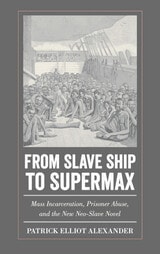
From Slave Ship to Supermax
Mass Incarceration, Prisoner Abuse, and the New Neo-Slave NovelPatrick Elliot Alexander
Temple University Press, 2017
In his cogent and groundbreaking book, From Slave Ship to Supermax, Patrick Elliot Alexander argues that the disciplinary logic and violence of slavery haunt depictions of the contemporary U.S. prison in late twentieth-century Black fiction. Alexander links representations of prison life in James Baldwin’s novel If Beale Street Could Talk to his engagements with imprisoned intellectuals like George Jackson, who exposed historical continuities between slavery and mass incarceration. Likewise, Alexander reveals how Toni Morrison’s Beloved was informed by Angela Y. Davis’s jail writings on slavery-reminiscent practices in contemporary women’s facilities. Alexander also examines recurring associations between slave ships and prisons in Charles Johnson’s Middle Passage, and connects slavery’s logic of racialized premature death to scenes of death row imprisonment in Ernest Gaines’ A Lesson Before Dying.
Alexander ultimately makes the case that contemporary Black novelists depict racial terror as a centuries-spanning social control practice that structured carceral life on slave ships and slave plantations—and that mass-produces prisoners and prisoner abuse in post–Civil Rights America. These authors expand free society’s view of torment confronted and combated in the prison industrial complex, where discriminatory laws and the institutionalization of secrecy have reinstated slavery’s system of dehumanization.
From Spirituals to Symphonies
African-American Women Composers and Their MusicHelen Walker-Hill
University of Illinois Press, 2006
Helen Walker-Hill's unique study provides a carefully researched examination of the history and scope of musical composition by African American women composers from the nineteenth and twentieth centuries. Focusing on the effect of race, gender, and class, From Spirituals to Symphonies notes the important role played by individual personalities and circumstances in shaping this underappreciated category of American art. The study also provides in-depth exploration of the backgrounds, experiences, and musical compositions of eight African American women including Margaret Bonds, Undine Smith Moore, and Julia Perry, who combined the techniques of Western art music with their own cultural traditions and individual gifts. Despite having gained national and international recognition during their lifetimes, the contributions of many of these women are today forgotten.